

Your exact documents and application process can vary based on the provider, your residential status, age, account type and other circumstances. Check the provider’s current requirements before applying.
Introduction
Shares and many other investments are no longer normally held as printed certificates. They are recorded electronically, making them easier to hold, transfer and track. A Demat account is the account used to keep these eligible securities in electronic form.
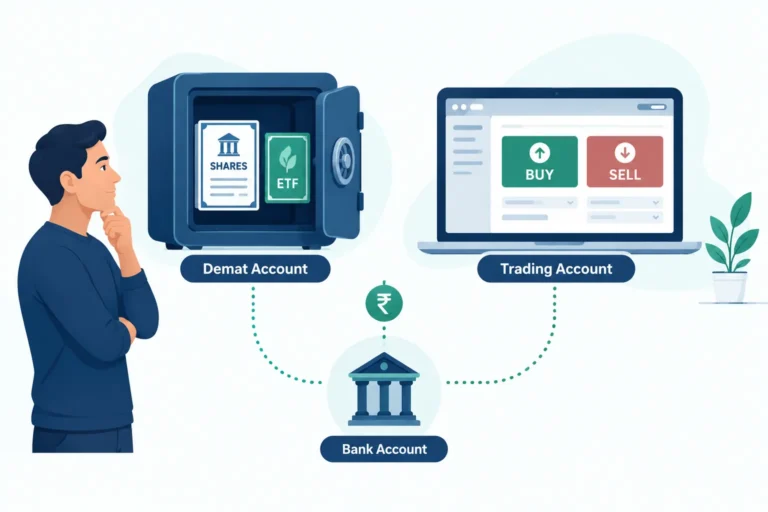
If you want to understand how to open a Demat account, it helps to first know what the account does and how it connects with your trading account and bank account. These accounts have different roles, even when one company offers all of them through a single app.
For example, suppose Priya buys shares of an Indian listed company. Money for the purchase is linked to the payment and settlement process, the order is placed through her broker, and the shares received after settlement are credited to her Demat account. When she sells eligible shares, they are debited from the Demat account through an authorised process.
Opening the account itself is generally straightforward, but beginners should not rush through the forms. Names, PAN details, bank information and contact details should be accurate and consistent. It is also important to understand which requirements arise from securities-market rules and which are simply the chosen provider’s operating procedures.
Demat Account Basics, Eligibility, and Documents
What Is a Demat Account?
“Demat” is short for dematerialised. A Demat account holds securities electronically instead of using physical certificates. Depending on the security and available facilities, it may hold shares, exchange-traded funds, bonds, government securities, mutual fund units and certain other investments.
The person in whose name the securities are held is commonly called the beneficial owner. The Demat account records the securities and quantities owned by that person. It is not the same as a bank account and does not function as a general cash wallet.
A Demat account may also show transactions such as credits, debits, corporate actions and transfers. Investors should review their statements and alerts regularly rather than relying only on the balance displayed in a broker’s app.
Depository, DP, Broker, Trading Account and Bank Account
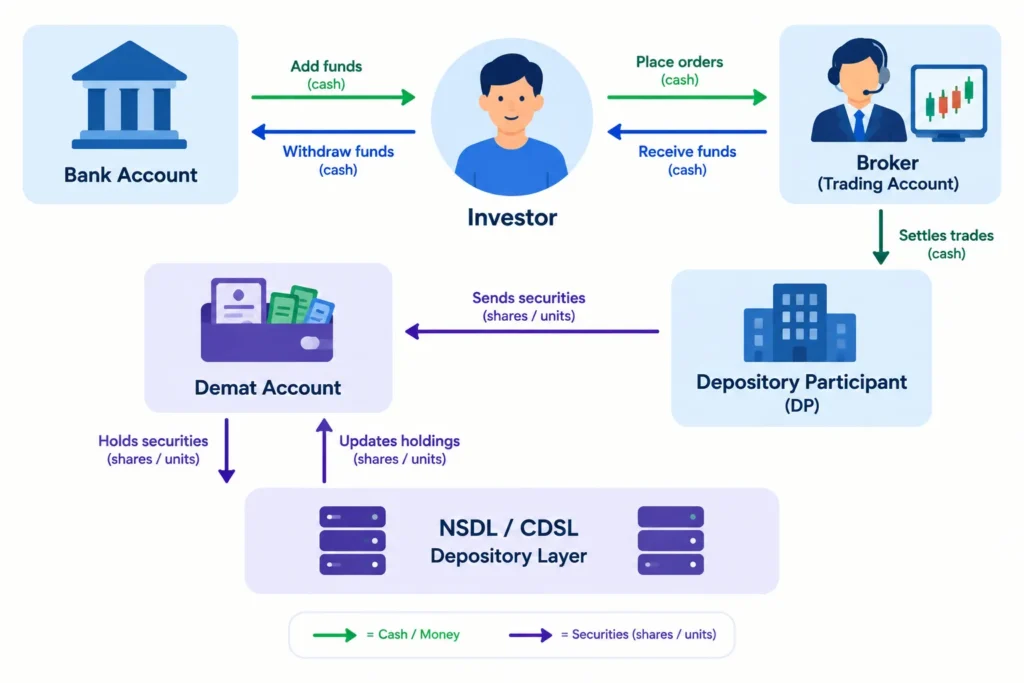
Several organisations and accounts are involved in investing. Their names can sound similar, but each has a separate job.
- Depository: A depository maintains securities in electronic form and supports their transfer and settlement. India has two securities depositories: NSDL and CDSL.
- Depository Participant: A Depository Participant, or DP, is an intermediary through which an investor accesses depository services. Banks, stockbrokers and other eligible financial organisations may operate as DPs. You open the Demat account through a DP, not by directly approaching the depository in the usual retail process.
- Broker: A stockbroker provides access to stock exchanges so that you can place buy and sell orders. A broker may also be a DP, but the two functions remain different.
- Trading account: This account is used to place and manage market orders through a broker. It does not replace the Demat account in which delivered securities are held.
- Bank account: Your bank account is used for money-related transactions, subject to the broker’s payment and settlement arrangements. It is also generally linked for purposes such as receiving eligible payouts.
Many providers offer a combined onboarding process for a trading account and a Demat account. This convenience does not make them one account. It also does not mean you must automatically accept every optional product or facility shown during registration.
Who Can Generally Apply?
Resident individuals who satisfy the applicable KYC and documentation requirements may generally apply for a Demat account. A person does not need to be an experienced investor or already own shares before opening one.
Minors may generally hold a Demat account operated through a guardian, subject to applicable rules and the DP’s process. Non-resident Indians may also have Demat account options, but the account setup, bank linkage, declarations and investment rules can differ from those for resident applicants.
Entities such as companies, partnership firms, trusts and Hindu Undivided Families may have relevant account arrangements, depending on their legal status and the provider’s services. They usually need additional entity, authority and beneficial ownership documents.
Eligibility and account choices depend on the applicant’s circumstances. Age, residential status, citizenship, legal capacity, tax status and intended market activity can affect the process. A provider may not support every applicant category or account type.
Basic Document and Information Checklist
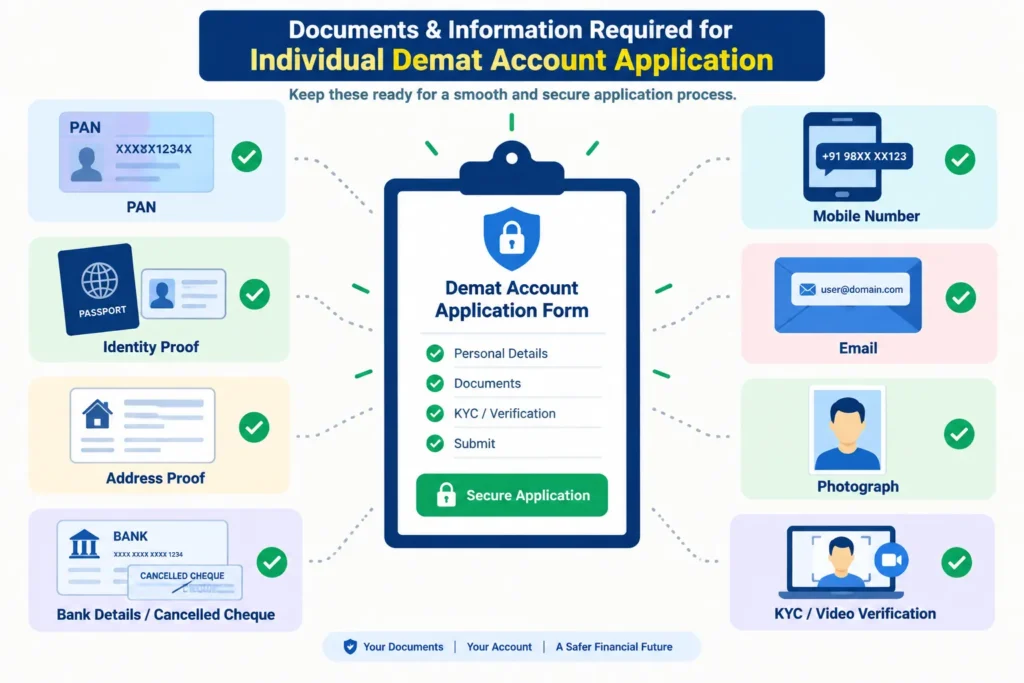
The following checklist covers the items commonly required from an individual applicant. It is a starting point, not a universal list for every case.
- PAN: A valid Permanent Account Number is generally required, subject to any legally recognised exception that may apply in a specific case. The PAN details should match the application and KYC records.
- Identity proof: The provider may accept Aadhaar or another officially accepted identity document, depending on the verification route and applicable requirements.
- Address proof: An accepted document showing the applicant’s current or permanent address may be needed. Examples can include Aadhaar, passport, driving licence, voter identity card or another document accepted under the applicable KYC framework.
- Bank details: You will normally provide the account number, account type and IFSC for the bank account being linked.
- Bank proof, where requested: A cancelled cheque, recent bank statement, passbook copy or another accepted document may be required. The provider may ask that the applicant’s name, account number and IFSC are clearly visible.
- Mobile number: An active number is needed for communication, verification and security alerts. Some online processes may require access to the mobile number linked with Aadhaar.
- Email address: An active personal email address is commonly required for statements, confirmations, notices and verification.
- Photograph: A recent photograph or live image may be collected, depending on whether the application is online or offline.
- Verification: This may involve Aadhaar-based e-KYC, video or in-person verification, digital signatures, one-time passwords, or another permitted method supported by the provider.
If you want to activate additional services, the provider may request more information. For example, access to certain trading segments may require income-related documents or declarations. Such requirements should not be confused with the basic purpose of holding securities in a Demat account.
Regulatory Requirements Versus Provider Procedures
Some requirements come from the broader securities-market and KYC framework. These can include identifying the applicant, verifying PAN where applicable, confirming contact details, recording bank information, completing verification and obtaining required declarations or agreements.
The exact way these requirements are completed can be provider-specific. One DP may request a scanned cancelled cheque, while another may verify the bank account electronically. One may support Aadhaar-based online onboarding, while another may offer video verification, physical forms or a branch-based process.
Providers may also set their own supported file formats, image sizes, signature methods and document-age limits within the applicable framework. A document that contains the necessary information may still be rejected if it is blurred, cropped, password-protected, outdated under the provider’s policy or inconsistent with the application.
Before submitting the form, check that your name, date of birth, PAN, address and bank details are entered correctly. If different documents show different names or addresses, ask the provider what supporting proof or correction is needed. Avoid changing information merely to make the application pass; the records should accurately reflect your circumstances.
How to Open a Demat Account Online: Step-by-Step Process
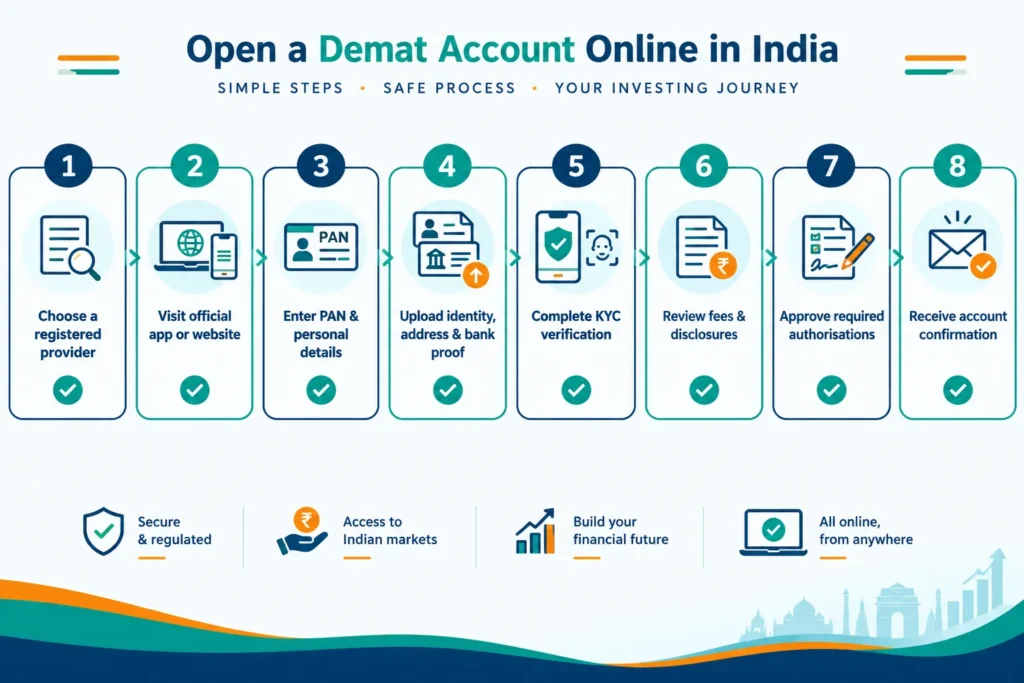
If you are wondering how to open a demat account, the online process is usually straightforward. You select a suitable Depository Participant, submit your details and documents, complete verification, review the terms, and wait for approval.
A Depository Participant, or DP, acts as an intermediary between you and a depository such as the National Securities Depository Limited (NSDL) or Central Depository Services (India) Limited (CDSL). Banks, stockbrokers and financial service companies may operate as DPs.
A demat account holds eligible securities in electronic form. If you also want to buy or sell shares on a stock exchange, you will generally need a trading account. Many providers offer both accounts through one application, but their functions are different.
1. Select a SEBI-Registered Intermediary
Start by comparing banks, brokers and other Depository Participants. Do not select a provider only because it advertises free account opening or low brokerage.
Check whether the intermediary has the relevant registration. You can verify registration information through official sources such as the Securities and Exchange Board of India, NSDL or CDSL. You may also check whether the provider’s name, registration number and contact details match across official records.
Consider the following points before choosing:
- Account opening and annual maintenance charges
- Brokerage and other transaction-related charges, if a trading account is included
- Depository Participant transaction charges
- Available investment products and stock exchanges
- Quality of the website and mobile application
- Customer support and complaint-handling process
- Availability of account statements and transaction alerts
Charges can differ by provider, account type, transaction and service plan. Read the current tariff sheet instead of relying only on advertisements.
2. Use Only the Provider’s Official Website or Application
Open the account through the provider’s official website or mobile application. Avoid links sent through unknown messages, social media accounts or unofficial groups.
Check the provider’s name carefully before installing an application or entering personal information. Fraudulent websites and applications may imitate genuine financial companies. If you are unsure, find the provider through its verified official communication channels rather than clicking a forwarded link.
You may be asked to provide your mobile number and email address and verify them using one-time passwords. Use contact details that you control because account updates, transaction alerts and security messages may be sent to them.
3. Enter Your Personal and PAN Details
Fill in your name, date of birth, Permanent Account Number and other requested information. Your name and other key details should be consistent across PAN, bank and identity records. Differences in spelling, initials or date of birth can lead to additional checks.
The application may also ask for your occupation, income range, tax residency, marital status and investment experience. These questions form part of the account opening and regulatory process. Answer them accurately.
Some providers may ask whether you want to open only a demat account or a combined demat and trading account. Read the selection carefully so that you understand which services you are applying for.
4. Verify Your Identity, Address and Bank Account
You will normally need to submit valid proof of identity and address according to the provider’s accepted-document rules. PAN is a key document for most applicants. Aadhaar may be used for permitted electronic verification, but the exact process depends on applicable rules and the verification route offered.
You must also link a bank account. The provider may ask for a cancelled cheque, bank statement, passbook copy or an electronic bank verification. The document should clearly show the required details, such as your name, account number and IFSC.
Check every uploaded image before submission. It should be clear, complete and readable. Blurred documents, cropped information or a name mismatch may delay processing or require resubmission.
- You May Also Like:How to Maximize Your Savings Account Benefits in India →
5. Complete KYC and Required Verification
Know Your Customer, or KYC, is used to verify your identity and other information. Depending on your existing KYC status, the provider’s process and applicable regulations, you may complete permitted e-KYC or another verification method.
You may also need to complete in-person verification or video verification. During video verification, you may be asked to show your face, display an original document, read a code or confirm certain details. Follow only the instructions shown through the provider’s official system.
Complete the verification yourself in a well-lit place with a stable internet connection. Do not allow an agent or another person to impersonate you or control the verification process.
6. Review Charges, Policies and Disclosures
Before accepting the application, read the account opening documents and disclosures. Pay attention to the tariff sheet, rights and obligations, risk disclosure documents, privacy terms and account closure process.
If a trading account is included, understand how brokerage is calculated and which additional charges may apply. These can include taxes, exchange charges, regulatory charges, depository charges and other fees permitted under the account terms.
Do not assume that “zero brokerage” means every service is free. A provider may charge for certain transactions, plans, calls and trades, payment facilities or value-added services.
7. Complete the Required Authorisations
The application may require an electronic signature, OTP confirmation or other valid acceptance method. Review each document before authorising it.
You may also see options connected with nomination and the handling of securities when you sell them. A provider may offer permitted mechanisms such as TPIN-based authorisation or a Demat Debit and Pledge Instruction, depending on its process and applicable rules.
Do not approve a Power of Attorney, DDPI or any similar instruction without understanding its purpose and scope. Check whether a facility is mandatory for the selected service or optional. Do not accept pre-selected add-on products merely to finish the application quickly.
Where nomination choices are presented, record your decision through the prescribed process. Ensure that nominee details are accurate if you choose to add one.
8. Submit the Application and Wait for Confirmation
Review the full form before submission. Correct any spelling errors, bank-detail mistakes or document mismatches. Save the application or reference number if one is provided.
Account opening time varies. It can depend on document accuracy, KYC status, verification results, the provider’s internal procedures and the applicant’s circumstances. An online application does not guarantee immediate approval.
The provider may contact you for clarification or an additional document. Respond only through verified channels. After approval, you should receive account information such as your Beneficial Owner identification details and instructions for accessing the account. Keep these records safely.
Security Warning During Account Opening
Never share your PAN, Aadhaar, OTPs, passwords, PINs or banking credentials with RegularStation or unknown parties. RegularStation does not need these details to explain how a demat account works.
Submit PAN, Aadhaar or bank documents only when required through the official and secure account-opening process of the selected registered provider. Never tell anyone your OTP, password, trading PIN, UPI PIN, card PIN or internet-banking password. A genuine support representative should not need these secret credentials.
After activation, set a strong password and enable available security controls. Verify account details through official statements and alerts from the provider, NSDL or CDSL. If you notice an unfamiliar request or transaction, contact the provider through its verified support channel promptly.
Official Sources You Can Use for Verification
For current registration details and regulatory requirements, refer to official information published by SEBI. Depository and DP-related information can also be checked through NSDL and CDSL. KYC, account-opening and authorisation requirements may change, so rely on the latest official instructions and the provider’s current documents before submitting your application.
Charges, Provider Checks, Common Mistakes, and FAQs
Opening a Demat account may be free with some providers, but operating the account can still involve charges. Before you apply, read the provider’s current fee schedule and account terms. Do not choose an account only because an advertisement says “zero account opening fee”.
Remember that a Demat account and a trading account perform different functions. The Demat account holds securities in electronic form, while the trading account is used to place buy and sell orders. Their charges may therefore be listed separately.
Charges You May Have to Pay
The exact fees depend on the Depository Participant, or DP, the type of account, the services selected, and the transactions carried out. A provider may waive a fee under one plan and charge it under another.
| Type of charge | What it generally covers |
|---|---|
| Account opening charge | A one-time fee for opening the Demat account. Some providers may waive it. |
| Annual maintenance charge | A recurring charge for maintaining the Demat account. It may be billed annually or at another stated frequency. |
| Debit or transaction charge | A fee that may apply when securities are debited from the Demat account, such as when shares are sold or transferred. |
| Dematerialisation or rematerialisation charge | A charge for converting eligible physical securities into electronic form, or electronic holdings back into physical form where permitted. |
| Pledge-related charge | A fee that may apply when securities are pledged, unpledged or invoked under the provider’s terms. |
| Statement or service charge | A fee for certain physical statements, failed instructions, special requests or other account services. |
| Brokerage | A trading account charge for executing eligible buy or sell orders. This is different from Demat account maintenance fees. |
| Other statutory or exchange-related charges | Applicable taxes, duties, exchange fees and regulatory charges may arise when trading or using related services. |
Compare the complete cost rather than focusing on a single fee. For example, a provider may offer free account opening but charge annual maintenance or securities debit fees. Another provider may offer different plans based on trading frequency or account features.
Check whether an advertised concession is permanent, available only for a limited period, or subject to conditions. Keep a copy of the fee schedule accepted at the time of opening, and review notifications about later revisions.
How to Check a Demat Account Provider
When learning how to open a Demat account, it is sensible to compare providers on more than price. A low-cost account is not necessarily suitable if the platform is difficult to use or customer support is hard to reach.
- Regulatory status: Confirm that the provider is appropriately registered and operates as a Depository Participant with an Indian depository. Verify details through official regulatory or depository sources rather than relying only on advertisements.
- Published fees: Read the account opening charges, maintenance charges, debit charges, pledge fees, brokerage plans and other disclosed costs.
- Service quality: Check how the provider handles account requests, complaints, statements, nominee-related services and profile updates.
- Platform usability: Review whether the website or app is easy to understand. Important details such as holdings, transactions, charges and support options should be accessible.
- Customer support: Check the available support channels and complaint process. This can be important if a transaction fails or your account access is blocked.
- Account features: Compare features you genuinely need, such as online statements, alerts, nomination facilities, pledge services or integration with a trading and bank account.
- Security practices: Look for secure login methods, transaction alerts and clear procedures for reporting suspicious activity. Use only the provider’s official app or website.
A provider that suits an active trader may not be the best choice for a person who plans to buy shares occasionally and hold them for years. Select the account based on your likely usage, not on promotional claims alone.
Common Mistakes to Avoid
- Ignoring the fee schedule: Read all relevant charges before accepting the terms. Pay attention to recurring and transaction-based fees, not just the opening charge.
- Using unofficial links: Fraudulent websites and messages can imitate financial companies. Start the application from the provider’s verified channel and check the name carefully before entering personal information.
- Sharing OTPs or passwords: Do not share login passwords, PINs, OTPs or other security credentials with an agent, friend or caller. Genuine support staff should not need your confidential login credentials.
- Approving requests without reading them: Understand each consent, electronic signature, power of attorney or electronic authorisation before accepting it. Ask the provider for clarification if the language is unclear.
- Confusing Demat and trading accounts: A Demat account stores securities, while a trading account helps place market orders. Charges and terms for each can differ even when both are opened together.
- Entering mismatched information: Differences in your name, PAN, bank details or contact information can delay verification. Use accurate details that match the supporting records.
- Overlooking account alerts: Review transaction messages and holding statements. Contact the provider promptly if you notice an instruction or debit you do not recognise.
Frequently Asked Questions
Can I open a Demat account completely online?
Many providers support an online application using digital identity checks, document submission, bank verification, electronic signatures and video or other remote verification methods. However, the process depends on the provider, your documents and applicable rules. In some cases, additional verification or an offline step may be required.
Is PAN required to open a Demat account?
PAN is normally required for opening a Demat account in India and completing the applicable KYC process. Any permitted exception would depend on current regulations and the applicant’s circumstances. Confirm the latest requirement with the chosen registered provider.
Can I open a Demat account without a trading account?
Yes, a Demat account can generally exist without a trading account. It can hold eligible securities electronically. However, if you want to buy or sell shares through a stock exchange, you will normally also need suitable trading services. Some providers offer both accounts together, while others may allow separate arrangements.
Do I need a bank account?
A bank account is generally required for verification and for receiving or making payments connected with investment activity. The bank account may also be linked for dividends, refunds or trading settlements, depending on the services used. The accepted bank proof and linking process can vary by provider.
Does every Demat account have an annual maintenance charge?
Not necessarily. Annual maintenance charges depend on the provider, account category, plan and any available concession. A provider may waive the charge for a period or under specified conditions. Read what happens after the promotional period and check whether other transaction or service charges still apply.
Can a complete beginner open a Demat account?
Yes. Prior stock market experience is not generally required merely to apply for a Demat account. The applicant must meet the relevant eligibility, KYC and provider conditions. Opening an account does not mean you must invest immediately. Beginners should first understand the product, risks, costs and order process before using trading services.
Is opening a Demat account the same as starting to invest?
No. A Demat account is an account infrastructure for holding eligible securities electronically. Opening it does not select investments for you, remove market risk or guarantee returns. Any investment decision should be made separately after considering the security, costs, risk level and your financial situation.
Summary
To complete the process safely, compare registered providers, read the full fee schedule and understand the difference between Demat and trading account charges. Check platform usability, service quality, support, account features and security practices before choosing a provider.
Use only official application channels, keep OTPs and passwords private, and do not accept an authorisation without understanding it. Requirements, fees and account conditions can change, so confirm the current details directly with your chosen registered provider before applying.
This article provides general financial information for beginners. It is not personalised investment, legal or tax advice, and it does not recommend any particular Demat account provider or investment.



Comments