

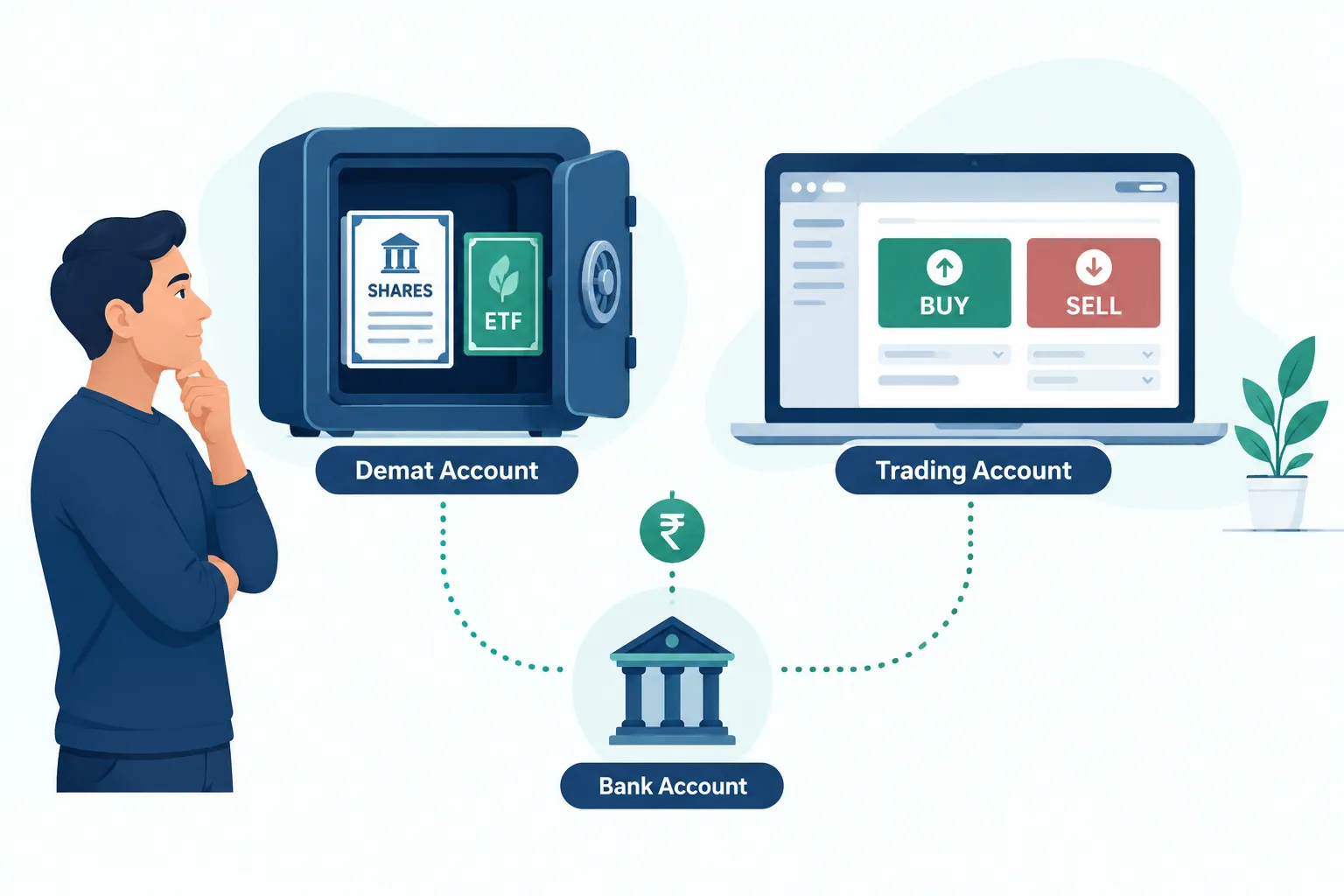
A demat account stores shares and other eligible securities in electronic form. A trading account is used to place buy and sell orders through a stockbroker.
When you buy shares for delivery, the trading account handles the order and the demat account receives the shares after settlement. When you sell those shares, they move out of your demat account, while the trading account sends the sell order to the stock exchange.
Many brokers open both accounts together, but their functions remain separate. Depending on the investment product and type of transaction, you may need both accounts, only a demat account, or neither.
Introduction
New investors often use the terms demat account and trading account as if they mean the same thing. This is understandable because stockbrokers commonly offer them as part of a single account-opening process.
However, the difference is important. One account holds your investments, while the other helps you transact in the market. Knowing how they work can help you understand account statements, charges and the steps involved in buying or selling shares.
This distinction is also a basic part of understanding stock market investing in India. It connects to wider topics such as stock exchanges, depositories, brokers, order placement and trade settlement, which are covered in RegularStation’s complete beginner’s guide to the stock market and investing in India.
Demat Account vs Trading Account: Meaning and Key Differences
What Is a Demat Account?
“Demat” is short for dematerialised. A demat account holds eligible financial securities in electronic form instead of paper certificates.
You can think of it as an electronic storage account for investments. If you buy shares for delivery, the shares are credited to your demat account after the trade is settled. If you sell them, the relevant quantity is debited from the account.
A demat account may hold securities such as:
- Equity shares
- Exchange-traded funds, or ETFs
- Listed bonds and debentures
- Sovereign Gold Bonds, where held in demat form
- Mutual fund units held in demat form
- Other securities that are eligible for dematerialised holding
A demat account does not, by itself, place an order on the National Stock Exchange or the BSE. Its main job is to hold securities and record credits, debits and balances.
What Is a Trading Account?
A trading account is used to place buy and sell orders through a stockbroker. It gives you access to the broker’s trading platform, which may be a mobile app, website or desktop application.
For example, suppose you want to buy five shares of an Indian listed company. You log in to your broker’s platform, search for the company and place a buy order. This instruction is placed through your trading account and sent to the selected stock exchange.
If the order is matched and the trade is successfully settled, the shares are credited to your linked demat account when the purchase is for delivery.
The trading account may also show information such as:
- Open and completed orders
- Trade history
- Available trading balance or margin
- Positions for the day
- Holdings fetched from the linked demat account
- Profit and loss information calculated by the broker’s platform
Some of these features are presented in one dashboard, which can make the demat and trading accounts appear to be a single account. Legally and operationally, however, they perform different functions.
Demat Account vs Trading Account: Main Comparison
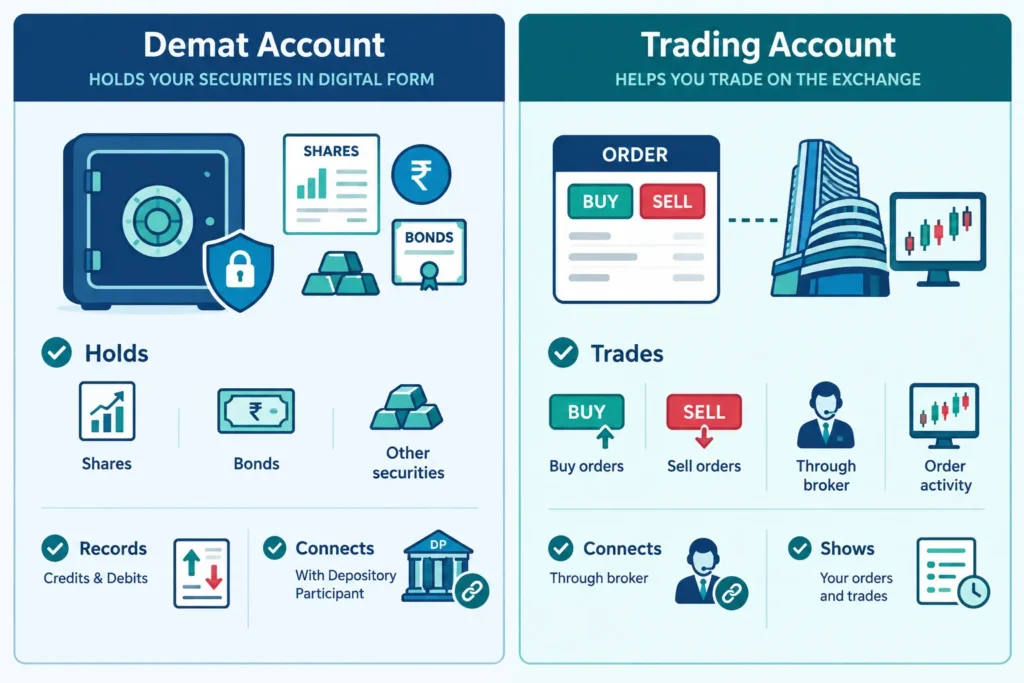
| Point | Demat Account | Trading Account |
|---|---|---|
| Main purpose | To hold eligible securities electronically | To place buy and sell orders in the market |
| Basic function | Records securities credited, debited and held | Connects your orders to the broker and stock exchange |
| Typical use | Holding shares, ETFs, listed bonds and other eligible securities | Buying and selling exchange-traded products |
| Who provides access? | A depository participant registered with NSDL or CDSL | A stockbroker authorised to provide trading services |
| Possible charges | Account maintenance and transaction-related charges may apply | Brokerage, exchange charges and other transaction-related charges may apply |
| Is it required for delivery-based share investing? | Yes, to receive and hold the shares electronically | Generally yes, when buying or selling shares through a stock exchange |
| Does it hold money? | No; it holds securities, not your regular cash balance | The broker may maintain a trading ledger, but the trading account is not a bank savings account |
| Can it place stock exchange orders? | No | Yes, through the stockbroker |
How the Two Accounts Work Together
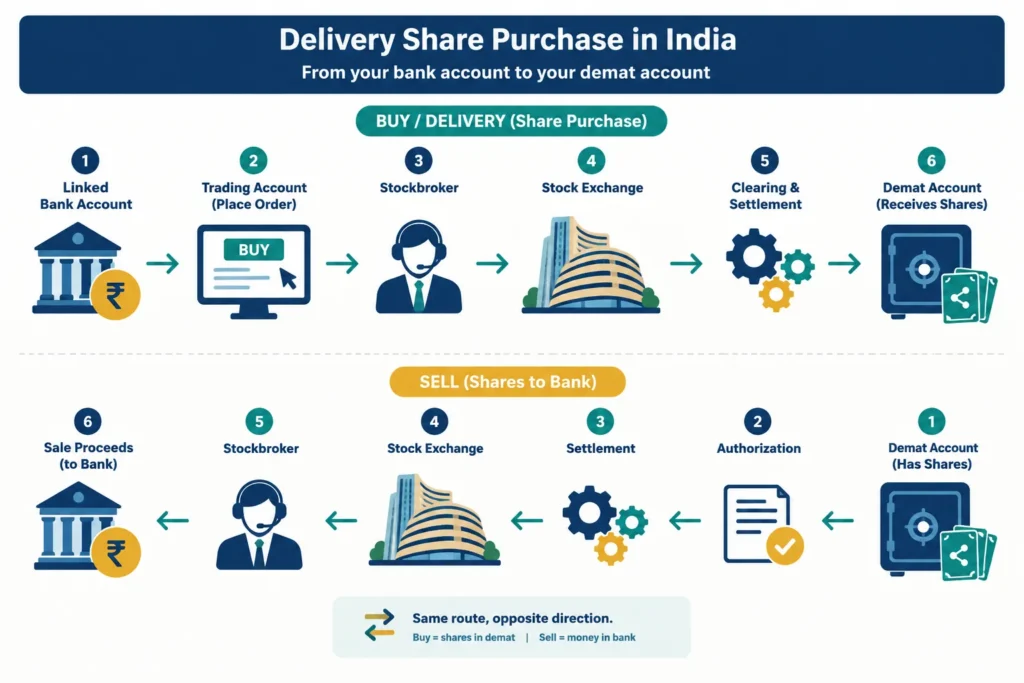
Assume Priya wants to buy ten shares of a company listed on the NSE. She transfers funds using the payment options supported by her broker and places the order through her trading account.
The broker sends the order to the exchange. If a matching seller is available at the required price and the order is executed, the trade enters the clearing and settlement process. After successful settlement, the purchased shares are credited to Priya’s demat account.
Later, Priya decides to sell four shares. She places the sell order through her trading account. The required shares are debited from her demat account as part of the authorised settlement process. The sale proceeds are reflected in her broker ledger and can be withdrawn according to the applicable settlement and broker rules.
This example shows the central difference: the trading account handles the transaction instruction, while the demat account handles the electronic securities.
Stockbroker, Depository Participant, NSDL and CDSL
A stockbroker provides access to trading facilities. The broker accepts your order and routes it to a stock exchange, subject to the relevant rules and checks.
A depository participant, commonly called a DP, provides demat account services. It acts as an intermediary between you and a depository. Banks, brokers and other eligible financial institutions can operate as depository participants after obtaining the required registrations.
India has two securities depositories:
- National Securities Depository Limited, or NSDL
- Central Depository Services (India) Limited, or CDSL
NSDL and CDSL maintain the depository infrastructure and electronic records of securities. Investors do not normally open an account directly with a depository. They open a demat account through a registered DP.
A company may act as both a stockbroker and a depository participant. This allows it to offer a trading account and demat account through one application. Even in this arrangement, the company is performing two separate roles.
What Do NSE and BSE Do?
The National Stock Exchange of India, or NSE, and BSE Limited, commonly called BSE, are stock exchanges. They provide regulated marketplaces where eligible securities can be bought and sold.
NSE and BSE do not perform the same function as your demat account. The exchange provides the trading venue, the broker gives you access to that venue, and the depository system records your electronic securities holdings.
A simplified flow is:
- You place an order using your trading account.
- Your stockbroker sends the order to the selected exchange.
- The exchange attempts to match the order with a corresponding order.
- Clearing and settlement processes are completed.
- For a delivery purchase, the securities are credited to your demat account.
Do You Always Need Both Accounts?
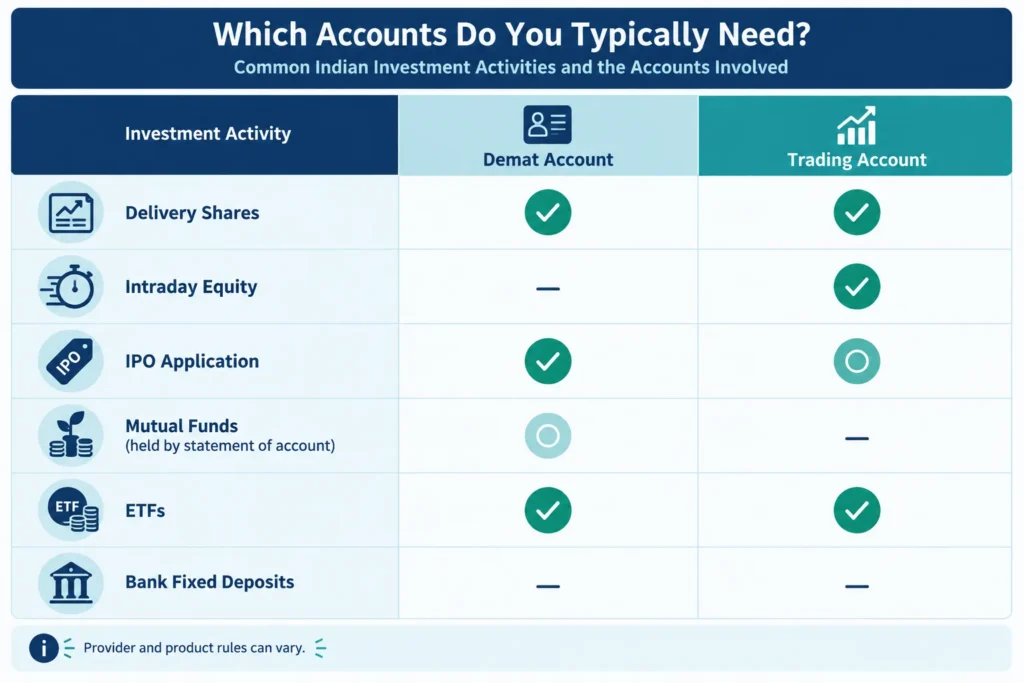
No. The requirement depends on the product and transaction.
For delivery-based investing in listed shares, you normally need a trading account to place exchange orders and a demat account to receive and hold the shares.
For intraday equity trading, positions are generally opened and closed on the same trading day, so shares are not intended to remain in the demat account as delivery holdings. Brokers may still require customers to open a demat account as part of their standard setup.
You can invest in many mutual fund schemes directly through an asset management company or another permitted channel without holding the units in a demat account. Mutual fund units can also be held in demat form if the chosen process supports it.
An IPO application requires valid demat account details because allotted shares must be credited electronically. However, an investor may apply through an eligible bank or another supported channel rather than placing a regular secondary-market order through a trading account.
Some government securities and bonds may also be available through channels that do not require the usual broker-linked demat and trading account combination. Always check the rules for the specific product, platform and transaction before opening or using an account.
How Demat and Trading Accounts Work Together
A demat account and a trading account perform different jobs, but they usually work together when you invest in listed shares. The trading account helps you place buy and sell orders. The demat account holds the shares you own in electronic form.
You can think of the trading account as the place where you give instructions and the demat account as the place where your investments are stored. Your linked bank account handles the movement of money.
Step 1: Choose a Broker
To begin, you need to choose a stockbroker registered with the Securities and Exchange Board of India. Brokers generally offer access to stock exchanges such as the NSE and BSE through a website, mobile app or desktop platform.
Do not select a broker only because it advertises low brokerage. Also consider the account charges, platform reliability, customer support, available order types and ease of use. If you may invest in mutual funds, exchange-traded funds or other products, check whether the platform supports them.
Before applying, read the broker’s current tariff sheet. This document explains the fees that may apply to your account and transactions.
Step 2: Complete KYC and Open the Accounts
You must complete the Know Your Customer process before opening an account. Depending on the broker and regulatory requirements, you may need to provide details or documents such as:
- PAN
- Proof of identity and address
- Bank account details
- Photograph and signature
- Mobile number and email address
- Income proof if you want access to certain segments, such as derivatives
The broker may also require identity verification, video verification, electronic signatures or other checks. The exact process can vary.
Many providers allow you to apply for a demat account and a trading account together. The demat account is maintained through a depository participant connected to either NSDL or CDSL. The trading account is provided by the broker for placing market orders.
Your bank account is linked so that money can be added for purchases and eligible sale proceeds can be withdrawn. The names and ownership details across the accounts should be consistent to avoid delays.
For a broader account-opening checklist, the article “How to Start Investing in Stocks in India” should receive a verified internal link during publication.
Step 3: Add Funds as Required
Before buying shares, you generally need sufficient money or available balance in the trading account. You can transfer funds from your linked bank account using one of the payment methods supported by the broker.
Adding money does not mean that you have invested it. It simply makes the amount available for placing orders. You should check the available balance, required margin and estimated charges before confirming a trade.
Some payment methods or brokers may have specific transfer conditions or charges. Always check the current rules displayed on the platform.
Step 4: Place a Buy Order
Suppose Neha, a beginner from Pune, wants to buy 10 shares of an Indian listed company. After researching the business and understanding the risks, she searches for the company on her broker’s trading platform.
She selects the delivery or investment option rather than an intraday product because she wants to hold the shares beyond the same trading day. She then enters the quantity and chooses an order type.
- Market order: The order seeks execution at the best available market price. The final price may differ from the price visible when the order was placed.
- Limit order: Neha sets the maximum price she is willing to pay. The order will execute only if a matching price is available, so execution is not certain.
When Neha submits the order, it goes through the trading account to the stock exchange. The exchange attempts to match it with a corresponding sell order.
Trade Execution, Settlement and Share Credit
If Neha’s order is matched, the trade is executed. Her trading platform displays the executed quantity and price. An order may be fully executed, partly executed or remain unexecuted, depending on market availability and the order conditions.
Execution is not the final administrative step. The trade must also go through clearing and settlement under the applicable market cycle. During settlement, the required amount, securities and charges are processed through the relevant market intermediaries.
After successful settlement, the purchased shares are credited to Neha’s demat account. Her trading platform may show the transaction earlier, but the demat account is where the settled shares are held electronically.
The division of work is therefore straightforward:
| Stage | Account or system involved | What happens |
|---|---|---|
| Adding money | Bank and trading accounts | Funds become available for eligible orders. |
| Placing the order | Trading account | The buy instruction is sent to the exchange. |
| Executing the trade | Exchange and clearing system | The buy order is matched with a sell order. |
| Holding the shares | Demat account | Settled shares are stored electronically. |
What Happens When You Sell Shares?
Assume Neha later decides to sell all 10 shares. Their market value may be higher or lower than her purchase price. A demat account does not protect her from losses, and a trading account does not guarantee that she will receive her preferred selling price.
Neha opens the broker’s platform, selects the shares from her holdings and enters a sell order. As with a purchase, she may use a market order or specify a limit price. The order is sent through her trading account to the exchange.
If the sell order is matched, the trade is executed. The shares must then be debited from her demat account for delivery under the applicable settlement process.
This debit requires valid authorization. Depending on the facility and arrangement offered, authorization may involve a depository mechanism such as TPIN-based confirmation or another permitted instruction. Some investors may have a standing authorization or other approved setup. The precise process can differ by broker, depository and current rules.
After settlement, the eligible sale proceeds are reflected according to the broker’s process. Neha may then be able to withdraw the available amount to her linked bank account. The amount she receives will account for the executed sale value and applicable charges.
In short, the trading account communicates the sell instruction, while the demat account supplies the shares that must be delivered.
Costs of Using Demat and Trading Accounts
Opening and using these accounts may involve several costs. A provider may waive one fee while charging another, so a “free account” does not necessarily mean that every service or transaction is free.
- Account-opening fee: Some providers charge a one-time fee for opening the accounts, while others may waive it.
- Annual maintenance charge: A demat account may have a yearly maintenance fee. The amount and eligibility for concessions can vary.
- Brokerage: The broker may charge for executing buy or sell transactions. The structure may differ across delivery, intraday and other segments.
- Depository participant charges: Charges may apply when securities are debited from the demat account, including in certain sale transactions.
- Exchange and transaction charges: Market infrastructure institutions may levy charges on trades.
- Statutory levies: Applicable taxes and regulatory charges may include securities transaction tax, GST, stamp duty and SEBI-related charges.
- Other service fees: Charges may apply for payment facilities, physical statements, failed instructions, pledge-related services or other optional services.
Costs vary by provider, account type, product, transaction value and pricing plan. Regulatory charges can also change. Before opening an account or placing a trade, check the broker’s latest tariff sheet, contract note format and the current statutory levies.
Finally, review the contract note issued after a trade. It records important details such as the executed price, quantity and charges. Comparing it with your order history helps you understand the complete cost of buying or selling shares through your demat and trading accounts.
Choosing, Managing and Protecting Your Accounts
When comparing a demat account vs trading account, do not choose a provider only because account opening is free or a popular advertisement promises low brokerage. Your provider will hold important financial records, process transactions and support you when something goes wrong.
How to Compare Account Providers
Start by checking whether the stockbroker is registered with SEBI and is a member of the relevant stock exchanges, such as NSE or BSE. For the demat account, confirm whether the provider is a Depository Participant associated with NSDL or CDSL.
Registration does not remove investment risk, but it helps you avoid dealing with an unregulated platform. Verify registration details through official regulatory, exchange and depository channels rather than relying only on an app, advertisement or social media profile.
Consider the following factors before opening an account:
- Platform usability: The website or app should make it easy to place orders, review holdings, download statements and understand charges.
- Service quality: Check how the provider handles account opening, nominee details, profile changes, pledges, transfers and account closure.
- Customer support: Look for clear complaint channels, service request tracking and support that is available when markets are open.
- Investment features: Confirm whether the platform offers the products and order types you actually need. A beginner may not need advanced derivatives tools.
- Research and education: Educational material can be useful, but research reports or app suggestions should not replace your own assessment.
- Statements and reports: You should be able to access contract notes, ledger statements, tax reports and demat holding statements.
- Security controls: Look for login alerts, two-factor authentication and clear procedures for freezing access or reporting suspicious transactions.
Read the Complete Tariff Sheet
A “zero brokerage” or “free account” offer may apply only to selected services. Read the complete tariff sheet and account opening documents before agreeing to the terms.
Depending on the provider and your activity, charges may include:
- Account opening and annual maintenance charges
- Brokerage for different market segments
- Depository Participant charges when securities are debited
- Exchange transaction charges and applicable taxes
- Pledge creation, invocation or closure charges
- Call-and-trade or dealer-assisted order charges
- Payment gateway or fund transfer charges
- Charges for physical statements, failed instructions or account modification
- Fees related to transferring securities or closing an account
Compare costs using your expected behaviour. For example, a person investing in one equity index ETF every month may care more about annual maintenance and demat debit charges than about intraday brokerage. A frequent trader may be more affected by order-level costs and other transaction charges.
Tariffs can change. Check the latest schedule on the provider’s official platform and review updated notices sent to you.
Can Demat and Trading Accounts Be with Different Providers?
Yes, it may be possible to maintain a demat account with one Depository Participant and a trading account with another broker. You can also have more than one demat or trading account, subject to applicable rules and the providers’ processes.
However, using different providers may create additional work. The broker needs suitable demat details for settlement, and you may need to complete linking or authorization steps. Selling securities held in a demat account that is not smoothly integrated with the trading platform can be less convenient.
For beginners, opening both accounts through one provider is often simpler. This is a matter of convenience, not a requirement to keep every financial account with one company. Confirm compatibility, settlement instructions and charges before choosing separate providers.
Is a Demat Account Required for Every Investment?
No. A demat account is mainly used to hold eligible securities in electronic form. The requirement depends on the product, how it is purchased and the applicable rules.
| Investment product | Typical demat requirement |
|---|---|
| Listed company shares | A demat account is generally needed to hold and sell them electronically. |
| Exchange-traded funds | A demat account is generally required because ETFs trade on a stock exchange. |
| Listed bonds and similar securities | Demat holding may be required or commonly used, depending on the issue and transaction route. |
| Mutual funds | A demat account is not always necessary. Units can often be held through the mutual fund’s statement-of-account route. |
| Bank fixed deposits | A demat account is generally not required. |
| PPF and similar small savings schemes | A demat account is not required. |
| Insurance policies | A regular securities demat account is generally not required. |
Product rules and platform arrangements can differ. Do not open a demat account merely because you want to start a bank deposit or a mutual fund systematic investment plan. First check how that specific product is held.
Changing a Broker or Transferring Securities
You do not necessarily need to sell all your investments when changing providers. Eligible securities may be transferable from one demat account to another. The process may be online or offline and can depend on whether the two accounts are with the same depository or different depositories.
Before starting a transfer, check that your name, PAN and account details match. Also review pending trades, pledged securities, frozen holdings and unsettled balances. These can delay or complicate the process.
A transfer may also require you to:
- Open and activate the new demat and trading accounts.
- Obtain the correct beneficiary account and depository details.
- Submit a transfer instruction through the approved process.
- Review possible transfer or closure charges.
- Confirm that the securities have reached the new account.
- Download old contract notes, ledgers and tax reports before closing access.
- Submit a separate closure request if you no longer need the old account.
Transferring securities without changing the beneficial owner is different from selling and buying them again. Even so, keep records of acquisition dates, quantities and costs because these may be needed for tax calculations later.
Procedures, authorization methods, charges and regulatory requirements can change. Before publication and before taking action, verify current details through official information from SEBI, NSE, BSE, NSDL, CDSL and the relevant provider.
Protect Your Accounts
A regulated provider cannot protect you if you voluntarily share confidential credentials with a fraudster. Treat your trading login and demat authorization details like bank account credentials.
- Create a strong, unique password and change it if you suspect exposure.
- Never share passwords, PINs, OTPs or authorization codes, including with someone claiming to be customer support.
- Use two-factor authentication and keep your registered mobile number and email address updated.
- Avoid logging in through unknown links, public computers or unsecured Wi-Fi networks.
- Install apps only from official sources and verify the publisher before signing in.
- Do not allow another person to remotely control your phone or computer.
- Review order confirmations, contract notes, ledger entries and depository statements regularly.
- Read SMS and email alerts for trades, fund movements, pledges and security debits.
If you notice an order, transfer or login that you do not recognize, act promptly. Change your credentials, contact the broker or Depository Participant through its official support channel, and ask about blocking or freezing the affected access where available. Preserve messages, screenshots and transaction details.
Use the provider’s formal grievance process and escalate through the applicable official exchange, depository or SEBI complaint mechanism when required. Do not call a telephone number received through an unsolicited message without independently verifying it.
Frequently Asked Questions
Can I invest in shares with only a demat account?
A demat account can hold shares, but a trading account is generally needed to place exchange buy and sell orders through a broker. A linked bank account is also used for funds.
Can I have more than one demat account?
Yes, subject to current rules and each provider’s requirements. Multiple accounts may mean additional maintenance charges, statements and security responsibilities.
Should I select the broker with the lowest brokerage?
Not automatically. Compare the complete tariff sheet, regulation status, platform reliability, support quality, reporting tools and security practices. The cheapest option for one investor may not be the cheapest for another.
Do I need to sell my shares when changing brokers?
Not always. Eligible holdings may generally be transferred to another demat account through the prescribed process. Check for pending settlements, pledges, charges and matching account details first.
Is a demat account required for mutual funds?
Not in every case. Mutual fund units can often be held outside demat form through a statement of account. The available holding method depends on the purchase channel and scheme arrangements.
What should I do if I receive an unauthorized transaction alert?
Contact the broker or Depository Participant immediately through verified official channels. Secure your login, preserve evidence, check recent transactions and use the formal grievance and escalation process if needed.
Summary
Choosing between providers is an important part of understanding a demat account vs trading account. Verify regulation, assess platform usability and support, and read the full tariff sheet instead of focusing only on advertised brokerage.
A demat account is not required for every investment product, and your demat and trading accounts may be with different providers if their processes are compatible. When changing brokers, check transfer procedures, records, charges and pending transactions before closing an old account.
Keep passwords, PINs and OTPs private, review alerts and statements, and report unauthorized activity quickly through official channels. A demat account only provides a way to hold eligible securities electronically; it does not guarantee returns. Market investments can lose value, and this article is for education only, not personalized investment, tax or legal advice.




Comments