

Crypto Trading for Beginners: How to Understand the Basics

A simple guide to how crypto trading works, the terms beginners should know, common approaches, major risks and responsible ways to learn before trading.

Crypto Trading for Beginners: How to Understand the Basics

Educational risk disclaimer: Crypto assets are highly volatile and can lead to substantial losses. This article explains basic concepts for educational purposes. It is not investment, trading, tax or legal advice. Never trade with borrowed money or funds needed for rent, bills, emergencies or other essential goals.

Quick Answer

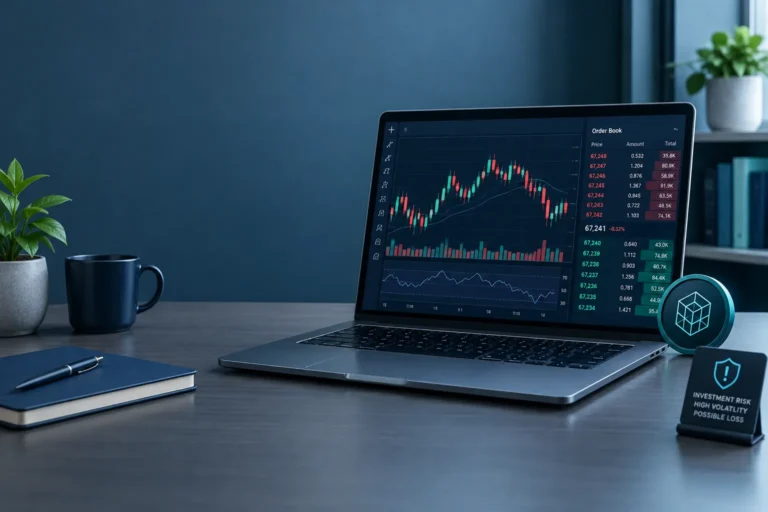
Crypto trading means buying and selling crypto assets, such as Bitcoin or Ether, to try to benefit from price movements. A trader may hold an asset for minutes, days or months, depending on the strategy. This differs from long-term investing, where a person generally buys an asset with the intention of holding it for several years.

No trader can know future prices with certainty. Crypto markets can move sharply in either direction, and a profitable-looking trade can quickly become a loss. Beginners should first understand trading pairs, orders, liquidity, fees and risk before considering any trade.

Introduction

Crypto markets can appear simple at first. You open an account on a trading platform, deposit money and choose a coin to buy. However, the process happening behind the screen is more complex.

Every transaction involves buyers, sellers, orders and changing prices. The price shown on one platform may differ slightly from the price shown elsewhere. Some crypto assets are traded actively, while others may have very few willing buyers or sellers.

Understanding these basics is an important first step in crypto trading for beginners. It helps you read a trading screen, recognise major risks and avoid making decisions based only on social media excitement or fear of missing out.

What Crypto Trading Is and How the Market Works

What Does Crypto Trading Mean?

Crypto trading is the activity of buying and selling crypto assets in an attempt to benefit from changes in their prices. For example, a trader might buy Bitcoin at a particular price and later sell it at a higher price. If the price falls instead, the trader may face a loss.

Some traders also use products that allow them to take a position on falling prices. These products can involve leverage, liquidation and additional complexity. They are generally much riskier than simply buying a crypto asset and are not an appropriate starting point for most beginners.

Trading is based on probabilities, not certainty. Charts, news and market data may help a trader form a view, but they cannot guarantee what will happen next. Unexpected regulation, security incidents, large transactions or changes in general market sentiment can quickly reverse a price trend.

Trading Versus Long-Term Holding

A long-term holder usually buys a crypto asset because they believe it may become more useful or valuable over several years. A trader focuses more closely on shorter-term price movements and may buy and sell more frequently.

Point Crypto trading Long-term investing
Main focus Shorter-term price movements Long-term adoption and value
Holding period Minutes, days, weeks or months Usually several years
Activity level Frequent monitoring and decisions Less frequent buying and reviewing
Typical concerns Entry price, exit price, liquidity and volatility Long-term usefulness, security and sustainability
Costs Frequent fees and possible slippage Usually fewer transaction costs

Neither approach removes risk. A long holding period does not guarantee that a crypto asset will recover from a fall. Similarly, frequent trading does not automatically produce better returns. Readers who want a deeper comparison can refer to the RegularStation article Crypto Trading vs Long-Term Investing: Key Differences and Risks.

Who Creates the Crypto Market?

A market exists because some participants want to buy while others want to sell. Individual traders, professional firms, long-term holders, miners, token projects and market makers may all participate.

Most beginners trade through a crypto trading platform. The platform provides an interface for placing orders and may match buyers with sellers. Depending on its structure, it may also hold customers’ rupees or crypto assets. This creates operational and counterparty risks that beginners should not ignore.

Crypto is normally quoted as a trading pair. A pair shows which asset is being priced and what is being used to pay for it. In a BTC/INR pair, Bitcoin is priced in Indian rupees. In an ETH/USDT pair, Ether is priced using USDT.

How an Order Book Works
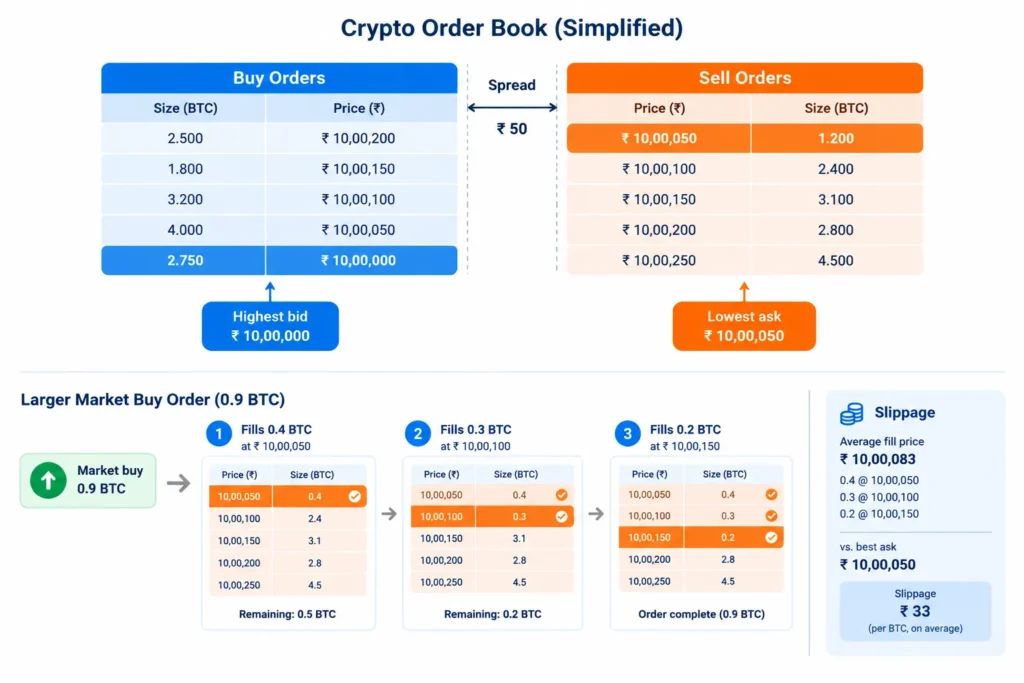
Diagram of bids, asks, the spread and a market order creating slippage across several price levels.

Many trading platforms use an order book. It is a list of open buy and sell orders submitted by market participants.

  • Bid: The highest price a buyer is currently willing to pay.
  • Ask: The lowest price a seller is currently willing to accept.
  • Spread: The difference between the best bid and the best ask.
You May Also Like:Crypto Spot Trading vs Futures Trading: Key Differences for Beginners

Suppose a hypothetical BTC/INR order book has a highest bid of ₹50,00,000 and a lowest ask of ₹50,05,000. The spread is ₹5,000. A person who wants to buy immediately may have to accept the ask price, while someone selling immediately may receive the bid price.

This is only a simplified example. A large order may be completed at several different prices if there are not enough orders available at the best quoted price. The difference between the expected price and the actual average execution price is commonly called slippage.

Market Orders and Price Discovery

A market order asks the platform to buy or sell immediately at the best available prices. It prioritises execution, not a specific price. In a fast or illiquid market, the final price can differ noticeably from the price displayed when the order was submitted.

Price discovery is the continuing process through which buyers and sellers arrive at a market price. When buyers are willing to pay more, prices may rise. When sellers accept lower prices, prices may fall. New trades and changes in open orders constantly update the quoted price.

The market price generally refers to the latest traded price or a platform’s current reference price. Different platforms can show slightly different market prices because each may have its own users, liquidity and order book.

Essential Market Terms for Beginners

  • Trading volume: The quantity or value of an asset traded during a stated period. Higher volume can indicate more active participation, but volume alone does not show whether the price will rise or fall.
  • Market capitalisation: The current price of a crypto asset multiplied by its circulating supply. It provides a rough measure of relative market size, but it does not represent cash held by the project or guarantee stability.
  • Volatility: The speed and size of price changes. A highly volatile asset can rise or fall sharply over a short period.
  • Liquidity: How easily an asset can be bought or sold without causing a large price change. Strong liquidity generally means there are many orders near the current market price.

Liquidity is particularly important for smaller crypto assets. A coin may show an attractive quoted price, but a trader could struggle to sell a meaningful quantity near that price if the order book is thin.

Why Crypto Prices Fluctuate

Crypto prices change because the balance between demand and supply keeps changing. Common influences include:

  • Changes in buyer and seller sentiment
  • Regulatory announcements in India or other major markets
  • Cyberattacks, platform failures or technical problems
  • Updates to a blockchain network or crypto project
  • Large purchases or sales by major holders
  • Global interest rates and appetite for risky assets
  • Rumours, social media activity and speculative enthusiasm

A price move can have several causes, and the explanation may only become clear later. Beginners should therefore be cautious about confident claims that a coin “must” rise or that a particular event is already guaranteed to affect its price.

Main Risks to Understand

Market risk is the possibility that prices move against your position. Liquidity risk means you may not be able to trade at the expected price, especially during sharp market moves.

Cybersecurity risk includes account theft, phishing, malware and attacks on platforms or wallets. Counterparty risk arises when a platform, custodian or other service provider fails, freezes withdrawals or does not return customer assets.

Regulatory risk refers to the possibility that laws, tax rules or restrictions change. Indian crypto users should check current official requirements and keep accurate transaction records. These risks can overlap, which is why understanding the market is necessary before placing even a small trade.

Trading Methods, Orders and Basic Market Reading

For anyone learning crypto trading for beginners, the first step is to understand what is being traded. Buying a crypto asset directly is different from trading a contract linked to its price. The risks, costs and responsibilities can also be very different.

What Is Spot Trading?

Spot trading means buying or selling the actual crypto asset at the current market or at a price you choose. For example, if you use Indian rupees to buy Bitcoin on the spot market, the purchased Bitcoin is credited to your exchange account after the order is completed.

You can hold the asset, sell it later or, where supported, transfer it to a personal wallet. Ownership and withdrawal rules depend on the exchange and the specific crypto asset.

Suppose Bitcoin is trading at ₹50 lakh and you buy Bitcoin worth ₹5,000. You receive a small fraction of one Bitcoin, minus any applicable fees. You do not need to purchase a whole coin.

Spot trading is generally easier to understand than derivatives. However, it is not risk-free. Crypto prices can fall sharply, an exchange can face operational problems, and transferring assets to the wrong wallet address may result in permanent loss.

You May Also Like:What Is Web3? How It Works and How It Differs from Web2

How Futures and Other Derivatives Differ

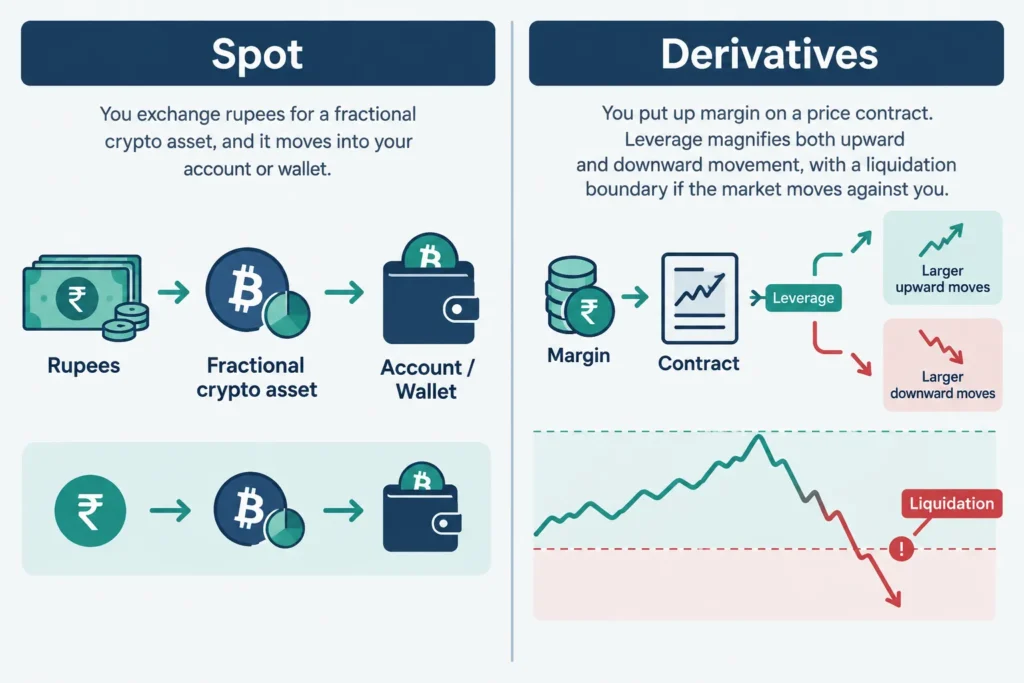
Comparison of spot trading ownership with leveraged derivatives, margin and liquidation risk.

A crypto derivative is a financial contract whose value is linked to an underlying crypto asset. Common examples include futures, perpetual futures and options. A trader may gain or lose money from price movements without directly owning the underlying coin.

Derivatives can allow traders to take a long position when they expect the price to rise or a short position when they expect it to fall. They may also involve leverage, margin requirements, funding payments and liquidation rules.

Feature Spot Trading Derivatives Trading
What you trade The actual crypto asset A contract linked to the asset’s price
Ownership You generally own the purchased asset You generally do not own the underlying asset
Leverage Usually not required Commonly available and sometimes built into the product
Maximum loss The asset can lose most or all of its value Losses can develop quickly and may exceed the margin committed, depending on the product and platform rules
Liquidation risk No leveraged-position liquidation in ordinary spot buying A position may be closed automatically if margin becomes insufficient
Complexity Relatively simple Higher due to contracts, margin, funding and settlement rules

Beginners should not assume that derivatives are simply faster versions of spot trading. They are different products with additional risks. Their availability and legal or regulatory treatment may also vary by platform and location.

Leverage, Margin and Liquidation

Leverage allows a trader to control a position larger than the money committed. For example, ₹10,000 used with five-times leverage could control a position worth ₹50,000. This magnifies exposure to both gains and losses.

Margin is the amount provided to open and maintain a leveraged position. If the market moves against the trader, the available margin falls. The platform may ask for more funds or close the position automatically when the required margin level is no longer maintained. This automatic closure is called liquidation.

Even a relatively small price movement can cause a large loss when leverage is high. Fees, funding charges and sudden price gaps can make the outcome worse. Beginners do not need leverage to learn how markets work, and should not use it without fully understanding the contract and its liquidation rules.

Market, Limit and Stop Orders

An order tells the exchange how you want to buy or sell. The exact order types and names differ across platforms, so check the exchange’s order screen and rules before confirming a trade.

  • Market order: An instruction to buy or sell immediately at the best available prices. It prioritises speed, not a specific execution price.
  • Limit order: An instruction to buy at a chosen price or lower, or sell at a chosen price or higher. It provides price control, but the order may remain unfilled.
  • Stop order: An order that is activated after the market reaches a specified trigger price. Depending on the platform, it may become a market order or a limit order after activation.

Consider a crypto asset displayed at ₹100. A market buy order may not be fully completed at exactly ₹100. Some units could be purchased at ₹100, others at ₹100.20 and the rest at ₹100.50. This can happen because the order uses the available sell orders in the exchange’s order book.

The difference between the expected price and the average execution price is called slippage. It is usually more noticeable in fast-moving markets, for large orders or when an asset has low trading activity.

A limit order can reduce uncertainty about the maximum buying price or minimum selling price. However, reaching the limit price does not always mean the whole order will be filled. Other orders may be ahead of it, or the market may move away before enough quantity is available.

Stop orders are often used to manage risk, but they do not guarantee a particular exit price. A stop-market order may execute far from its trigger during a sharp move. A stop-limit order may avoid an unwanted price but could remain unfilled if the market moves too quickly.

Trading Fees and the Final Cost

The trading result is not determined by price movement alone. Exchanges may charge a fee when an order is executed. Rates can differ based on trading volume, order type, account level and whether the order adds liquidity to or removes liquidity from the order book.

Other possible costs include deposit or withdrawal fees, network charges, spreads, funding payments on perpetual contracts and currency conversion costs. Indian users must also consider applicable tax and reporting requirements. These rules can change, so records of purchases, sales, transfers and fees should be maintained carefully.

Before placing an order, review the estimated quantity, fee and total amount. The final figure can still differ because of slippage, partial fills or changes in the available market price.

Day Trading, Swing Trading and Position Trading

Trading styles are often grouped by how long positions are normally held. None of these approaches is reliably profitable, and a longer or shorter holding period does not remove risk.

Trading style Typical holding period Time commitment Key risks
Day trading Minutes to hours, usually closed within the day High; frequent monitoring may be required Rapid losses, overtrading, fees, stress and slippage
Swing trading Several days to a few weeks Moderate; positions still need regular review Overnight moves, sudden news and trend reversals
Position trading Weeks, months or longer Lower trading frequency, but ongoing research is needed Large drawdowns, long market declines and changing fundamentals

Day trading can appear attractive because many decisions are made quickly, but frequent activity also creates more opportunities for mistakes and costs. Swing traders try to capture medium-term price moves, while position traders focus on broader market direction. The appropriate style depends on available time, risk capacity, knowledge and emotional discipline.

Reading a Basic Crypto Price Chart

A price chart displays how an asset’s traded price changed over time. You can select intervals such as one minute, one hour, one day or one week. The same market may look highly volatile on a five-minute chart but relatively calm on a weekly chart.

Candlestick charts are commonly used. Each candle represents a chosen period and shows four prices: open, high, low and close. The body shows the distance between the opening and closing prices, while the thin lines, often called wicks, show the highest and lowest prices reached.

A trend describes the broad direction of price movement. An uptrend generally forms higher highs and higher lows. A downtrend generally forms lower highs and lower lows. A sideways market moves within a range without a clear direction.

Support is an area where buying interest has previously appeared, while resistance is an area where selling interest has previously appeared. These are zones rather than exact barriers. Price can break through either level, and an old support area may later act as resistance, or vice versa.

Volume shows how much of an asset was traded during a period on a particular market or exchange. Higher volume can indicate stronger participation, but it does not prove that a price move will continue. Volume data may also differ between exchanges.

Charts, trends, support, resistance and volume are analytical tools, not predictions. They help organise information about past and current trading activity. They cannot account for every announcement, platform failure, regulatory development or sudden shift in market sentiment.

Detailed indicators, chart patterns and execution techniques require separate study. The broader concepts are covered within Crypto Trading & Technical Analysis: A Practical Guide, but beginners should first become comfortable with spot markets, basic orders and risk before moving to advanced tools.

You May Also Like:NFTs Explained: What They Are, How They Work and Their Risks

Section 3: Research, Risk Management, Mistakes and a Responsible Learning Roadmap

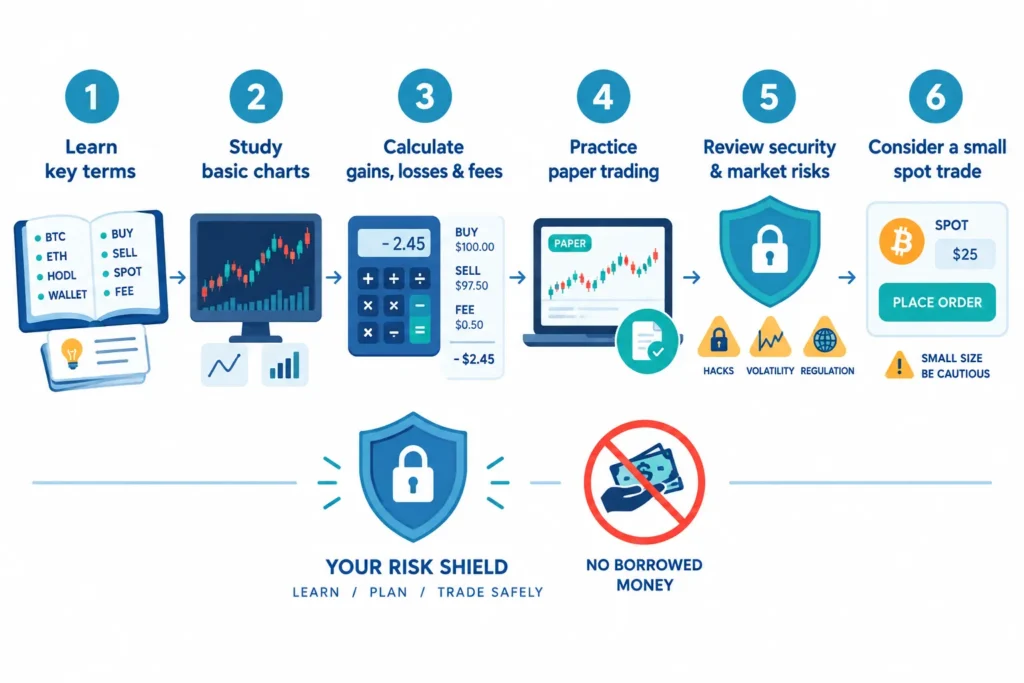
Six-step roadmap from learning crypto terms and paper trading to cautious risk-aware practice.

Crypto trading for beginners should start with research and risk control, not with finding a coin that may rise quickly. Crypto assets can move sharply, platforms can fail, and some tokens may have little practical value or liquidity. Losses can be substantial or total.

How to Research a Crypto Project

A token’s price, logo or social-media popularity does not tell you whether the underlying project is credible. Before considering a trade, examine what the project claims to do and whether reliable information supports those claims.

  • Purpose: Identify the problem the project is trying to solve. Be cautious if its purpose is vague, constantly changing or based mainly on attracting new buyers.
  • Token utility: Understand why the token exists. It may be used to pay network fees, access a service, participate in governance or support another function. A stated use does not automatically create lasting demand or value.
  • Token supply: Check the current supply, maximum supply, future issuance and token release schedule. Large future releases may increase the number of tokens available for sale.
  • Liquidity: Look at whether the token can normally be bought or sold without causing a major price change. Low-liquidity tokens may have wide price differences and unreliable order execution.
  • Documentation: Read the project’s official documentation, including its technical explanation and token distribution details. Treat polished marketing as different from evidence.
  • Security history: Check for reported hacks, smart-contract failures, network outages and unresolved security concerns. Also review how the project responded to earlier incidents.
  • Team or governance: Look for meaningful disclosures about the people, organisation or community controlling important decisions. Anonymous involvement is not proof of fraud, but it may make accountability harder.
  • Risk information: Seek independent reporting and clearly disclosed risks. Do not rely only on material published by the project, exchange or promoter.

Research should also include the trading platform. The RegularStation article Crypto Exchanges in India: How They Work and How to Choose One explains factors such as platform structure, order types, liquidity, fees, security and withdrawal rules. These details can affect a trade even when your view of the asset is correct.

Recognise Hype and Manipulated Promotions

Social-media attention can create a false sense of urgency. Posts may be paid promotions, coordinated campaigns or attempts to push up a token’s price before early holders sell. High follower counts and professional-looking videos do not prove expertise or honesty.

Watch for fake celebrity endorsements, edited screenshots, private messaging groups, promises of “secret signals” and claims of guaranteed returns. No person can guarantee profits from a volatile market. Requests to transfer crypto to unlock a reward, recover losses or receive a larger amount back are major warning signs.

Do not trade merely because a token is trending. Verify claims through credible sources and ask who benefits if you buy. The RegularStation article Cryptocurrency Risks: Common Dangers and How to Invest More Safely provides broader context on scams, custody, volatility and platform-related dangers.

Basic Risk Management Rules

Use only money you can afford to lose without affecting rent, loan payments, insurance, education, emergency savings or other essential goals. Avoid using credit cards, personal loans, margin loans or money borrowed from family and friends.

Limiting concentration is also important. Putting most available money into one token, one trading strategy or one platform can make a single failure especially damaging. Diversification may reduce some concentration risk, but it cannot remove the possibility of loss.

Before placing an order, check all applicable costs. These may include trading fees, taxes deducted or payable, deposit and withdrawal charges, network fees, spreads, currency conversion costs and funding charges on leveraged positions. Frequent trading can make small charges add up.

Secure each account with a unique password and strong multi-factor authentication. Protect recovery codes, verify withdrawal addresses and never share one-time passwords or private keys. Understand whether you or the platform controls the crypto assets and what may happen if access is lost or the platform restricts withdrawals.

Maintain a simple trading record. For every decision, note the asset, entry reason, intended holding period, amount at risk, relevant fees and conditions that would make you exit. This helps separate a planned decision from an emotional reaction.

Stop Orders Have Limitations

A stop order can help manage risk, but it is not a guaranteed exit price. When the stop price is reached, a stop-market order may become a market order and execute at the best available prices. In a fast fall, the actual price may be much worse than expected.

A stop-limit order gives more control over the acceptable price, but it may not fill if the market moves beyond the limit. Thinly traded tokens can make both problems more serious. Platform outages, unusual volatility and differences in order rules may also affect execution.

Common Beginner Mistakes

  • FOMO: Buying because prices are rising and other people appear to be making easy profits.
  • Panic selling: Exiting without reviewing the original plan simply because the market has fallen quickly.
  • Overtrading: Placing too many trades out of boredom, excitement or an urge to recover a loss.
  • Chasing a sudden rise: Buying after a sharp increase without checking liquidity, news quality or downside risk.
  • Copying influencers: Following an online personality without knowing whether the person was paid, owns the token or has already sold.
  • Ignoring fees: Looking only at the displayed gain while overlooking trading costs, spreads, taxes and withdrawal charges.
  • Using excessive leverage: Taking a position larger than the money deposited. Small adverse moves can cause rapid losses or forced liquidation.
  • Misunderstanding platform rules: Assuming every exchange handles order execution, liquidation, withdrawals, custody and disputes in the same way.
You May Also Like:Stablecoins Explained: Types, Uses and Risks for Indian Beginners

After a loss, avoid increasing position size merely to win the money back. A loss does not make the next trade more likely to succeed. Pause, review the record and decide whether the original method was reasonable.

A Responsible Learning Roadmap

  1. Learn essential terms: Understand wallets, private keys, exchanges, spot markets, market orders, limit orders, liquidity, volatility, leverage and liquidation.
  2. Study basic charts: Learn what price, volume, timeframes, trends and support or resistance represent. Indicators should support analysis, not replace judgement.
  3. Review hypothetical examples: Calculate possible gains, losses and fees before risking money. Include scenarios where the price moves sharply against the trade.
  4. Practise without real money: Where suitable tools are available, use paper trading or a personal spreadsheet to record imaginary transactions. Simulated results do not fully reproduce slippage, stress or live order execution.
  5. Understand the risks: Study fraud, custody failure, technical faults, illiquidity, leverage and regulatory uncertainty before considering a live transaction.
  6. Start cautiously if proceeding: Use a small amount, avoid complex products and review every decision. Experience does not eliminate market risk.

Beginner Checklist

  • I understand what the project claims to do and why its token exists.
  • I have checked token supply, liquidity, documentation and relevant security history.
  • I have looked beyond social-media promotions and influencer claims.
  • I understand the platform’s fees, order rules, custody model and withdrawal process.
  • I am not using borrowed money or money needed for essential expenses.
  • I have limited the amount exposed to one token, strategy and platform.
  • I know that stop orders may execute at a worse price or may not fill as expected.
  • I have recorded the reason, risk and intended exit conditions for the trade.
  • I understand that leverage can magnify losses and lead to liquidation.
  • I am prepared for a substantial or total loss.

Indian readers should not assume that an exchange listing makes a crypto asset legally approved or protected. Tax treatment, reporting obligations, platform requirements and regulatory positions can change. Rules may also differ across jurisdictions when a platform, token issuer or service provider is based outside India.

Current legal, regulatory and tax details must be checked against authoritative Indian sources before publication or before acting on the information. Where necessary, consult a qualified tax or legal professional about your circumstances. Do not rely on old articles, social-media posts or another trader’s tax treatment.

Frequently Asked Questions

How much money should a beginner use for crypto trading?

There is no amount suitable for everyone. Any amount considered should be money you can afford to lose completely without affecting essential expenses, debt payments, emergency savings or important financial goals. Borrowed money should be avoided.

Can research prevent losses?

No. Research can help identify weak claims, hidden risks and unsuitable trades, but it cannot predict prices or prevent every loss. Credible projects can still fall because of market conditions, technical problems, regulation or changing demand.

Is a stop-loss order guaranteed to protect my capital?

No. A stop-market order may execute below the expected price during a rapid move. A stop-limit order may remain unfilled if no buyer is available within the chosen limit. Liquidity and platform rules matter.

Should beginners use leverage?

Leverage adds complexity and can magnify losses very quickly. It can also trigger forced liquidation. A beginner should understand spot trading, fees, volatility and order execution before even considering leveraged products.

Is paper trading the same as live trading?

No. Paper trading can help you practise order planning and record-keeping, but it does not fully capture real fees, slippage, platform problems or the emotional pressure of losing money.

Summary

Crypto trading for beginners requires careful research, realistic expectations and strict risk control. Review a project’s purpose, token utility, supply, liquidity, documentation, security history and governance. Treat hype, fake endorsements and guaranteed-profit claims as warning signs.

Use only money you can afford to lose, avoid borrowing, check every fee, secure your accounts and record why each trade is being considered. Learn with hypothetical examples and practice tools before deciding whether live trading is appropriate. Even with preparation and risk controls, crypto losses can be substantial or total.

Share this article
KEEP READING

Related Articles

View all →

Comments

Leave a Comment

Crypto Trading for Beginners: How to Understand the Basics

Educational risk disclaimer: Crypto assets are highly volatile and can lead to substantial losses. This article explains basic concepts for educational purposes. It is not investment, trading, tax or legal advice. Never trade with borrowed money or funds needed for rent, bills, emergencies or other essential goals.

Quick Answer

Crypto trading means buying and selling crypto assets, such as Bitcoin or Ether, to try to benefit from price movements. A trader may hold an asset for minutes, days or months, depending on the strategy. This differs from long-term investing, where a person generally buys an asset with the intention of holding it for several years.

No trader can know future prices with certainty. Crypto markets can move sharply in either direction, and a profitable-looking trade can quickly become a loss. Beginners should first understand trading pairs, orders, liquidity, fees and risk before considering any trade.

Introduction

Crypto markets can appear simple at first. You open an account on a trading platform, deposit money and choose a coin to buy. However, the process happening behind the screen is more complex.

Every transaction involves buyers, sellers, orders and changing prices. The price shown on one platform may differ slightly from the price shown elsewhere. Some crypto assets are traded actively, while others may have very few willing buyers or sellers.

Understanding these basics is an important first step in crypto trading for beginners. It helps you read a trading screen, recognise major risks and avoid making decisions based only on social media excitement or fear of missing out.

What Crypto Trading Is and How the Market Works

What Does Crypto Trading Mean?

Crypto trading is the activity of buying and selling crypto assets in an attempt to benefit from changes in their prices. For example, a trader might buy Bitcoin at a particular price and later sell it at a higher price. If the price falls instead, the trader may face a loss.

Some traders also use products that allow them to take a position on falling prices. These products can involve leverage, liquidation and additional complexity. They are generally much riskier than simply buying a crypto asset and are not an appropriate starting point for most beginners.

Trading is based on probabilities, not certainty. Charts, news and market data may help a trader form a view, but they cannot guarantee what will happen next. Unexpected regulation, security incidents, large transactions or changes in general market sentiment can quickly reverse a price trend.

Trading Versus Long-Term Holding

A long-term holder usually buys a crypto asset because they believe it may become more useful or valuable over several years. A trader focuses more closely on shorter-term price movements and may buy and sell more frequently.

Point Crypto trading Long-term investing
Main focus Shorter-term price movements Long-term adoption and value
Holding period Minutes, days, weeks or months Usually several years
Activity level Frequent monitoring and decisions Less frequent buying and reviewing
Typical concerns Entry price, exit price, liquidity and volatility Long-term usefulness, security and sustainability
Costs Frequent fees and possible slippage Usually fewer transaction costs

Neither approach removes risk. A long holding period does not guarantee that a crypto asset will recover from a fall. Similarly, frequent trading does not automatically produce better returns. Readers who want a deeper comparison can refer to the RegularStation article Crypto Trading vs Long-Term Investing: Key Differences and Risks.

Who Creates the Crypto Market?

A market exists because some participants want to buy while others want to sell. Individual traders, professional firms, long-term holders, miners, token projects and market makers may all participate.

Most beginners trade through a crypto trading platform. The platform provides an interface for placing orders and may match buyers with sellers. Depending on its structure, it may also hold customers’ rupees or crypto assets. This creates operational and counterparty risks that beginners should not ignore.

Crypto is normally quoted as a trading pair. A pair shows which asset is being priced and what is being used to pay for it. In a BTC/INR pair, Bitcoin is priced in Indian rupees. In an ETH/USDT pair, Ether is priced using USDT.

How an Order Book Works

Diagram of bids, asks, the spread and a market order creating slippage across several price levels.

Many trading platforms use an order book. It is a list of open buy and sell orders submitted by market participants.

  • Bid: The highest price a buyer is currently willing to pay.
  • Ask: The lowest price a seller is currently willing to accept.
  • Spread: The difference between the best bid and the best ask.

Suppose a hypothetical BTC/INR order book has a highest bid of ₹50,00,000 and a lowest ask of ₹50,05,000. The spread is ₹5,000. A person who wants to buy immediately may have to accept the ask price, while someone selling immediately may receive the bid price.

This is only a simplified example. A large order may be completed at several different prices if there are not enough orders available at the best quoted price. The difference between the expected price and the actual average execution price is commonly called slippage.

Market Orders and Price Discovery

A market order asks the platform to buy or sell immediately at the best available prices. It prioritises execution, not a specific price. In a fast or illiquid market, the final price can differ noticeably from the price displayed when the order was submitted.

Price discovery is the continuing process through which buyers and sellers arrive at a market price. When buyers are willing to pay more, prices may rise. When sellers accept lower prices, prices may fall. New trades and changes in open orders constantly update the quoted price.

The market price generally refers to the latest traded price or a platform’s current reference price. Different platforms can show slightly different market prices because each may have its own users, liquidity and order book.

Essential Market Terms for Beginners

  • Trading volume: The quantity or value of an asset traded during a stated period. Higher volume can indicate more active participation, but volume alone does not show whether the price will rise or fall.
  • Market capitalisation: The current price of a crypto asset multiplied by its circulating supply. It provides a rough measure of relative market size, but it does not represent cash held by the project or guarantee stability.
  • Volatility: The speed and size of price changes. A highly volatile asset can rise or fall sharply over a short period.
  • Liquidity: How easily an asset can be bought or sold without causing a large price change. Strong liquidity generally means there are many orders near the current market price.

Liquidity is particularly important for smaller crypto assets. A coin may show an attractive quoted price, but a trader could struggle to sell a meaningful quantity near that price if the order book is thin.

Why Crypto Prices Fluctuate

Crypto prices change because the balance between demand and supply keeps changing. Common influences include:

  • Changes in buyer and seller sentiment
  • Regulatory announcements in India or other major markets
  • Cyberattacks, platform failures or technical problems
  • Updates to a blockchain network or crypto project
  • Large purchases or sales by major holders
  • Global interest rates and appetite for risky assets
  • Rumours, social media activity and speculative enthusiasm

A price move can have several causes, and the explanation may only become clear later. Beginners should therefore be cautious about confident claims that a coin “must” rise or that a particular event is already guaranteed to affect its price.

Main Risks to Understand

Market risk is the possibility that prices move against your position. Liquidity risk means you may not be able to trade at the expected price, especially during sharp market moves.

Cybersecurity risk includes account theft, phishing, malware and attacks on platforms or wallets. Counterparty risk arises when a platform, custodian or other service provider fails, freezes withdrawals or does not return customer assets.

Regulatory risk refers to the possibility that laws, tax rules or restrictions change. Indian crypto users should check current official requirements and keep accurate transaction records. These risks can overlap, which is why understanding the market is necessary before placing even a small trade.

Trading Methods, Orders and Basic Market Reading

For anyone learning crypto trading for beginners, the first step is to understand what is being traded. Buying a crypto asset directly is different from trading a contract linked to its price. The risks, costs and responsibilities can also be very different.

What Is Spot Trading?

Spot trading means buying or selling the actual crypto asset at the current market or at a price you choose. For example, if you use Indian rupees to buy Bitcoin on the spot market, the purchased Bitcoin is credited to your exchange account after the order is completed.

You can hold the asset, sell it later or, where supported, transfer it to a personal wallet. Ownership and withdrawal rules depend on the exchange and the specific crypto asset.

Suppose Bitcoin is trading at ₹50 lakh and you buy Bitcoin worth ₹5,000. You receive a small fraction of one Bitcoin, minus any applicable fees. You do not need to purchase a whole coin.

Spot trading is generally easier to understand than derivatives. However, it is not risk-free. Crypto prices can fall sharply, an exchange can face operational problems, and transferring assets to the wrong wallet address may result in permanent loss.

How Futures and Other Derivatives Differ
Comparison of spot trading ownership with leveraged derivatives, margin and liquidation risk.

A crypto derivative is a financial contract whose value is linked to an underlying crypto asset. Common examples include futures, perpetual futures and options. A trader may gain or lose money from price movements without directly owning the underlying coin.

Derivatives can allow traders to take a long position when they expect the price to rise or a short position when they expect it to fall. They may also involve leverage, margin requirements, funding payments and liquidation rules.

Feature Spot Trading Derivatives Trading
What you trade The actual crypto asset A contract linked to the asset’s price
Ownership You generally own the purchased asset You generally do not own the underlying asset
Leverage Usually not required Commonly available and sometimes built into the product
Maximum loss The asset can lose most or all of its value Losses can develop quickly and may exceed the margin committed, depending on the product and platform rules
Liquidation risk No leveraged-position liquidation in ordinary spot buying A position may be closed automatically if margin becomes insufficient
Complexity Relatively simple Higher due to contracts, margin, funding and settlement rules

Beginners should not assume that derivatives are simply faster versions of spot trading. They are different products with additional risks. Their availability and legal or regulatory treatment may also vary by platform and location.

Leverage, Margin and Liquidation

Leverage allows a trader to control a position larger than the money committed. For example, ₹10,000 used with five-times leverage could control a position worth ₹50,000. This magnifies exposure to both gains and losses.

Margin is the amount provided to open and maintain a leveraged position. If the market moves against the trader, the available margin falls. The platform may ask for more funds or close the position automatically when the required margin level is no longer maintained. This automatic closure is called liquidation.

Even a relatively small price movement can cause a large loss when leverage is high. Fees, funding charges and sudden price gaps can make the outcome worse. Beginners do not need leverage to learn how markets work, and should not use it without fully understanding the contract and its liquidation rules.

Market, Limit and Stop Orders

An order tells the exchange how you want to buy or sell. The exact order types and names differ across platforms, so check the exchange’s order screen and rules before confirming a trade.

  • Market order: An instruction to buy or sell immediately at the best available prices. It prioritises speed, not a specific execution price.
  • Limit order: An instruction to buy at a chosen price or lower, or sell at a chosen price or higher. It provides price control, but the order may remain unfilled.
  • Stop order: An order that is activated after the market reaches a specified trigger price. Depending on the platform, it may become a market order or a limit order after activation.

Consider a crypto asset displayed at ₹100. A market buy order may not be fully completed at exactly ₹100. Some units could be purchased at ₹100, others at ₹100.20 and the rest at ₹100.50. This can happen because the order uses the available sell orders in the exchange’s order book.

The difference between the expected price and the average execution price is called slippage. It is usually more noticeable in fast-moving markets, for large orders or when an asset has low trading activity.

A limit order can reduce uncertainty about the maximum buying price or minimum selling price. However, reaching the limit price does not always mean the whole order will be filled. Other orders may be ahead of it, or the market may move away before enough quantity is available.

Stop orders are often used to manage risk, but they do not guarantee a particular exit price. A stop-market order may execute far from its trigger during a sharp move. A stop-limit order may avoid an unwanted price but could remain unfilled if the market moves too quickly.

Trading Fees and the Final Cost

The trading result is not determined by price movement alone. Exchanges may charge a fee when an order is executed. Rates can differ based on trading volume, order type, account level and whether the order adds liquidity to or removes liquidity from the order book.

Other possible costs include deposit or withdrawal fees, network charges, spreads, funding payments on perpetual contracts and currency conversion costs. Indian users must also consider applicable tax and reporting requirements. These rules can change, so records of purchases, sales, transfers and fees should be maintained carefully.

Before placing an order, review the estimated quantity, fee and total amount. The final figure can still differ because of slippage, partial fills or changes in the available market price.

Day Trading, Swing Trading and Position Trading

Trading styles are often grouped by how long positions are normally held. None of these approaches is reliably profitable, and a longer or shorter holding period does not remove risk.

Trading style Typical holding period Time commitment Key risks
Day trading Minutes to hours, usually closed within the day High; frequent monitoring may be required Rapid losses, overtrading, fees, stress and slippage
Swing trading Several days to a few weeks Moderate; positions still need regular review Overnight moves, sudden news and trend reversals
Position trading Weeks, months or longer Lower trading frequency, but ongoing research is needed Large drawdowns, long market declines and changing fundamentals

Day trading can appear attractive because many decisions are made quickly, but frequent activity also creates more opportunities for mistakes and costs. Swing traders try to capture medium-term price moves, while position traders focus on broader market direction. The appropriate style depends on available time, risk capacity, knowledge and emotional discipline.

Reading a Basic Crypto Price Chart

A price chart displays how an asset’s traded price changed over time. You can select intervals such as one minute, one hour, one day or one week. The same market may look highly volatile on a five-minute chart but relatively calm on a weekly chart.

Candlestick charts are commonly used. Each candle represents a chosen period and shows four prices: open, high, low and close. The body shows the distance between the opening and closing prices, while the thin lines, often called wicks, show the highest and lowest prices reached.

A trend describes the broad direction of price movement. An uptrend generally forms higher highs and higher lows. A downtrend generally forms lower highs and lower lows. A sideways market moves within a range without a clear direction.

Support is an area where buying interest has previously appeared, while resistance is an area where selling interest has previously appeared. These are zones rather than exact barriers. Price can break through either level, and an old support area may later act as resistance, or vice versa.

Volume shows how much of an asset was traded during a period on a particular market or exchange. Higher volume can indicate stronger participation, but it does not prove that a price move will continue. Volume data may also differ between exchanges.

Charts, trends, support, resistance and volume are analytical tools, not predictions. They help organise information about past and current trading activity. They cannot account for every announcement, platform failure, regulatory development or sudden shift in market sentiment.

Detailed indicators, chart patterns and execution techniques require separate study. The broader concepts are covered within Crypto Trading & Technical Analysis: A Practical Guide, but beginners should first become comfortable with spot markets, basic orders and risk before moving to advanced tools.

Section 3: Research, Risk Management, Mistakes and a Responsible Learning Roadmap
Six-step roadmap from learning crypto terms and paper trading to cautious risk-aware practice.

Crypto trading for beginners should start with research and risk control, not with finding a coin that may rise quickly. Crypto assets can move sharply, platforms can fail, and some tokens may have little practical value or liquidity. Losses can be substantial or total.

How to Research a Crypto Project

A token’s price, logo or social-media popularity does not tell you whether the underlying project is credible. Before considering a trade, examine what the project claims to do and whether reliable information supports those claims.

  • Purpose: Identify the problem the project is trying to solve. Be cautious if its purpose is vague, constantly changing or based mainly on attracting new buyers.
  • Token utility: Understand why the token exists. It may be used to pay network fees, access a service, participate in governance or support another function. A stated use does not automatically create lasting demand or value.
  • Token supply: Check the current supply, maximum supply, future issuance and token release schedule. Large future releases may increase the number of tokens available for sale.
  • Liquidity: Look at whether the token can normally be bought or sold without causing a major price change. Low-liquidity tokens may have wide price differences and unreliable order execution.
  • Documentation: Read the project’s official documentation, including its technical explanation and token distribution details. Treat polished marketing as different from evidence.
  • Security history: Check for reported hacks, smart-contract failures, network outages and unresolved security concerns. Also review how the project responded to earlier incidents.
  • Team or governance: Look for meaningful disclosures about the people, organisation or community controlling important decisions. Anonymous involvement is not proof of fraud, but it may make accountability harder.
  • Risk information: Seek independent reporting and clearly disclosed risks. Do not rely only on material published by the project, exchange or promoter.

Research should also include the trading platform. The RegularStation article Crypto Exchanges in India: How They Work and How to Choose One explains factors such as platform structure, order types, liquidity, fees, security and withdrawal rules. These details can affect a trade even when your view of the asset is correct.

Recognise Hype and Manipulated Promotions

Social-media attention can create a false sense of urgency. Posts may be paid promotions, coordinated campaigns or attempts to push up a token’s price before early holders sell. High follower counts and professional-looking videos do not prove expertise or honesty.

Watch for fake celebrity endorsements, edited screenshots, private messaging groups, promises of “secret signals” and claims of guaranteed returns. No person can guarantee profits from a volatile market. Requests to transfer crypto to unlock a reward, recover losses or receive a larger amount back are major warning signs.

Do not trade merely because a token is trending. Verify claims through credible sources and ask who benefits if you buy. The RegularStation article Cryptocurrency Risks: Common Dangers and How to Invest More Safely provides broader context on scams, custody, volatility and platform-related dangers.

Basic Risk Management Rules

Use only money you can afford to lose without affecting rent, loan payments, insurance, education, emergency savings or other essential goals. Avoid using credit cards, personal loans, margin loans or money borrowed from family and friends.

Limiting concentration is also important. Putting most available money into one token, one trading strategy or one platform can make a single failure especially damaging. Diversification may reduce some concentration risk, but it cannot remove the possibility of loss.

Before placing an order, check all applicable costs. These may include trading fees, taxes deducted or payable, deposit and withdrawal charges, network fees, spreads, currency conversion costs and funding charges on leveraged positions. Frequent trading can make small charges add up.

Secure each account with a unique password and strong multi-factor authentication. Protect recovery codes, verify withdrawal addresses and never share one-time passwords or private keys. Understand whether you or the platform controls the crypto assets and what may happen if access is lost or the platform restricts withdrawals.

Maintain a simple trading record. For every decision, note the asset, entry reason, intended holding period, amount at risk, relevant fees and conditions that would make you exit. This helps separate a planned decision from an emotional reaction.

Stop Orders Have Limitations

A stop order can help manage risk, but it is not a guaranteed exit price. When the stop price is reached, a stop-market order may become a market order and execute at the best available prices. In a fast fall, the actual price may be much worse than expected.

A stop-limit order gives more control over the acceptable price, but it may not fill if the market moves beyond the limit. Thinly traded tokens can make both problems more serious. Platform outages, unusual volatility and differences in order rules may also affect execution.

Common Beginner Mistakes

  • FOMO: Buying because prices are rising and other people appear to be making easy profits.
  • Panic selling: Exiting without reviewing the original plan simply because the market has fallen quickly.
  • Overtrading: Placing too many trades out of boredom, excitement or an urge to recover a loss.
  • Chasing a sudden rise: Buying after a sharp increase without checking liquidity, news quality or downside risk.
  • Copying influencers: Following an online personality without knowing whether the person was paid, owns the token or has already sold.
  • Ignoring fees: Looking only at the displayed gain while overlooking trading costs, spreads, taxes and withdrawal charges.
  • Using excessive leverage: Taking a position larger than the money deposited. Small adverse moves can cause rapid losses or forced liquidation.
  • Misunderstanding platform rules: Assuming every exchange handles order execution, liquidation, withdrawals, custody and disputes in the same way.

After a loss, avoid increasing position size merely to win the money back. A loss does not make the next trade more likely to succeed. Pause, review the record and decide whether the original method was reasonable.

A Responsible Learning Roadmap

  1. Learn essential terms: Understand wallets, private keys, exchanges, spot markets, market orders, limit orders, liquidity, volatility, leverage and liquidation.
  2. Study basic charts: Learn what price, volume, timeframes, trends and support or resistance represent. Indicators should support analysis, not replace judgement.
  3. Review hypothetical examples: Calculate possible gains, losses and fees before risking money. Include scenarios where the price moves sharply against the trade.
  4. Practise without real money: Where suitable tools are available, use paper trading or a personal spreadsheet to record imaginary transactions. Simulated results do not fully reproduce slippage, stress or live order execution.
  5. Understand the risks: Study fraud, custody failure, technical faults, illiquidity, leverage and regulatory uncertainty before considering a live transaction.
  6. Start cautiously if proceeding: Use a small amount, avoid complex products and review every decision. Experience does not eliminate market risk.

Beginner Checklist

  • I understand what the project claims to do and why its token exists.
  • I have checked token supply, liquidity, documentation and relevant security history.
  • I have looked beyond social-media promotions and influencer claims.
  • I understand the platform’s fees, order rules, custody model and withdrawal process.
  • I am not using borrowed money or money needed for essential expenses.
  • I have limited the amount exposed to one token, strategy and platform.
  • I know that stop orders may execute at a worse price or may not fill as expected.
  • I have recorded the reason, risk and intended exit conditions for the trade.
  • I understand that leverage can magnify losses and lead to liquidation.
  • I am prepared for a substantial or total loss.

India-Specific Legal, Regulatory and Tax Note

Indian readers should not assume that an exchange listing makes a crypto asset legally approved or protected. Tax treatment, reporting obligations, platform requirements and regulatory positions can change. Rules may also differ across jurisdictions when a platform, token issuer or service provider is based outside India.

Current legal, regulatory and tax details must be checked against authoritative Indian sources before publication or before acting on the information. Where necessary, consult a qualified tax or legal professional about your circumstances. Do not rely on old articles, social-media posts or another trader’s tax treatment.

Frequently Asked Questions

How much money should a beginner use for crypto trading?

There is no amount suitable for everyone. Any amount considered should be money you can afford to lose completely without affecting essential expenses, debt payments, emergency savings or important financial goals. Borrowed money should be avoided.

Can research prevent losses?

No. Research can help identify weak claims, hidden risks and unsuitable trades, but it cannot predict prices or prevent every loss. Credible projects can still fall because of market conditions, technical problems, regulation or changing demand.

Is a stop-loss order guaranteed to protect my capital?

No. A stop-market order may execute below the expected price during a rapid move. A stop-limit order may remain unfilled if no buyer is available within the chosen limit. Liquidity and platform rules matter.

Should beginners use leverage?

Leverage adds complexity and can magnify losses very quickly. It can also trigger forced liquidation. A beginner should understand spot trading, fees, volatility and order execution before even considering leveraged products.

Is paper trading the same as live trading?

No. Paper trading can help you practise order planning and record-keeping, but it does not fully capture real fees, slippage, platform problems or the emotional pressure of losing money.

Summary

Crypto trading for beginners requires careful research, realistic expectations and strict risk control. Review a project’s purpose, token utility, supply, liquidity, documentation, security history and governance. Treat hype, fake endorsements and guaranteed-profit claims as warning signs.

Use only money you can afford to lose, avoid borrowing, check every fee, secure your accounts and record why each trade is being considered. Learn with hypothetical examples and practice tools before deciding whether live trading is appropriate. Even with preparation and risk controls, crypto losses can be substantial or total.

Leave a Comment