


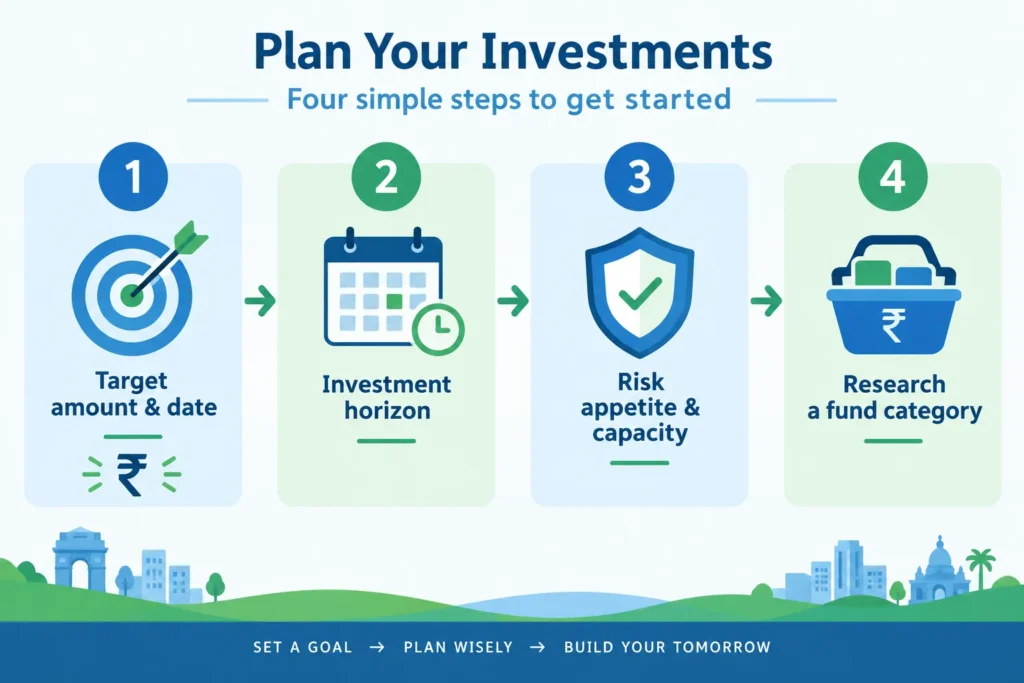
To understand how to choose mutual funds, begin with your financial goal rather than a fund’s recent returns. Define how much money you need, when you need it, how much you have already saved and how much you can invest regularly. Then consider your ability and willingness to accept losses.
As a broad principle, short-term goals usually require more focus on capital stability and easy access to money. Long-term goals may have greater capacity to handle equity market volatility. However, no mutual fund category guarantees returns, and the suitable choice depends on your personal circumstances.
Introduction
Many beginners start by searching for the “best mutual fund” or the fund with the highest recent return. This approach puts the product before the purpose. A fund that suits retirement planning may be unsuitable for school fees due next year. Similarly, a low-volatility fund may not offer enough growth potential for a goal that is 20 years away.
Choosing without a clear goal can create three common problems. You may take more risk than the goal can tolerate, choose a fund that does not provide suitable liquidity, or expect returns that the category cannot reliably deliver.
Your goal provides the basic filter. It helps you decide how long the money can remain invested, how much uncertainty you can accept and which broad mutual fund categories are worth researching. Scheme selection should come only after these points are clear.
Start With the Goal, Time Horizon and Risk Appetite
Write a Clear Financial Goal
“I want to build wealth” is an intention, but it is not yet a usable financial goal. A clear goal should answer four questions:
- Target amount: How much money will you need?
- Target date: By when will you need it?
- Current savings: How much have you already set aside for the goal?
- Likely contribution: How much can you invest regularly or as a lump sum?
For example, suppose a family wants to arrange Rs. 12 lakh for a house down payment in five years. It already has Rs. 3 lakh and expects to invest Rs. 12,000 per month. This is more useful than simply saying, “We want to buy a house.” The details help the family assess whether the contribution is realistic and how much investment risk the goal can tolerate.
The target amount should also reflect likely changes in cost. Higher education, housing and healthcare expenses may rise over time. You do not need a perfect estimate, but you should review the amount periodically rather than treating today’s cost as permanent.
If the required contribution appears unaffordable, do not try to solve the gap simply by assuming a higher return. Expected returns are uncertain. More practical options may include increasing the monthly investment gradually, extending the target date, reducing the target amount or combining these steps.
Match the Investment Horizon to the Goal
Your investment horizon is the time between investing the money and needing it for the goal. It is not automatically the same as the fund’s suggested holding period. Your actual withdrawal date matters most.
Consider these common Indian household goals:
- Emergency savings: The money may be needed without notice for a medical bill, job loss or urgent repair. Liquidity and capital stability are more important than chasing high returns.
- House down payment: If the purchase is planned within a few years, a sharp market fall near the purchase date could disrupt the plan.
- Children’s higher education: A goal that is 12 or 15 years away may have time to recover from periods of equity market weakness. As admission approaches, protecting the accumulated amount becomes increasingly important.
- Retirement: A person with 25 years until retirement may be able to accept more short-term volatility than someone retiring in three years. Retirement itself may also be a long period, so the planning does not end on the retirement date.
A longer horizon does not make equity safe or guarantee a profit. It simply gives an investor more time to remain invested through market cycles. Short-term goals have less recovery time if the market falls just before the money is required.
Understand Risk Appetite and Risk Capacity
Risk appetite is your emotional willingness to accept fluctuations. Risk capacity is your financial ability to absorb a loss or delay without damaging essential goals. These are related, but they are not the same.
An investor may say that a 20% fall would not cause worry. That suggests a high risk appetite. But if the money is required for a home payment in six months, the investor has low risk capacity for that goal. Confidence cannot replace the missing recovery time.
The reverse can also happen. A young investor with stable income, limited debt and a retirement goal 30 years away may have relatively high risk capacity. However, if market falls cause the investor to stop SIPs or sell in panic, the person’s actual risk appetite may be low.
Several personal factors influence risk capacity:
- Income stability: A salaried employee with a stable job may have more room for volatility than someone with irregular business income, provided other circumstances are similar.
- Dependants: Supporting children, parents or other family members can reduce the amount of financial risk you can comfortably take.
- Existing debt: Large EMIs, credit card balances or other expensive debt can weaken your ability to handle investment losses or income disruption.
- Emergency reserve: Without adequate emergency savings, you may be forced to redeem long-term investments at an unfavourable time.
- Goal flexibility: Retirement may sometimes be postponed by a year, but a college admission payment usually cannot. Less flexible goals generally have lower capacity for risk.
- Other assets: Bank deposits, provident fund balances, property and existing investments affect your overall financial position. A new mutual fund should not be assessed in isolation.
Risk should therefore be assessed separately for each goal. The same person may use a conservative approach for next year’s school fees and accept greater volatility for retirement two decades away.
Connect the Goal to Broad Fund Categories
Once the goal, horizon and risk capacity are clear, you can identify broad categories for further research. The table below is illustrative, not a recommendation or a promise of returns.
| Illustrative goal | Possible horizon | Main priority | Broad categories to research |
|---|---|---|---|
| Emergency reserve | Immediate or uncertain | Liquidity and capital stability | Overnight funds and liquid funds, alongside suitable bank-based options |
| Known expense in one to three years | Short term | Limit volatility and preserve access | Short-maturity debt fund categories appropriate to the time horizon |
| House down payment | About three to five years | Balance limited growth needs with protection of the target | Suitable debt categories or carefully assessed hybrid categories, depending on risk capacity |
| Children’s higher education | About ten years or more | Long-term growth, followed by gradual risk reduction | Diversified equity categories or equity-oriented hybrid categories |
| Retirement | Fifteen years or more | Long-term growth with an allocation suited to the investor | Diversified equity, index and hybrid categories, combined with other retirement assets as appropriate |
Short-term goals generally need greater emphasis on liquidity and capital stability. Even debt funds can face interest-rate risk, credit risk or temporary changes in value, so they should not be treated as guaranteed substitutes for bank deposits.
Long-term goals may support some equity exposure because there is more time to handle volatility. However, “long term” does not mean investing entirely in equity by default. Your income, dependants, debts, behaviour during market falls and the importance of the goal all matter.
As a goal approaches, its risk capacity usually falls. An investor may gradually shift money needed soon from volatile assets to more stable options instead of waiting until the final month. This reduces the chance that a sudden market decline will affect an essential payment.
No mutual fund category offers guaranteed returns unless a specific guarantee is explicitly structured and permitted, which ordinary mutual fund expectations should not assume. Market conditions and personal circumstances can also change. Review the goal periodically and after major events such as marriage, a new child, a job change, a large loan or a change in the target date.
Understand Fund Categories and Compare Investment Routes
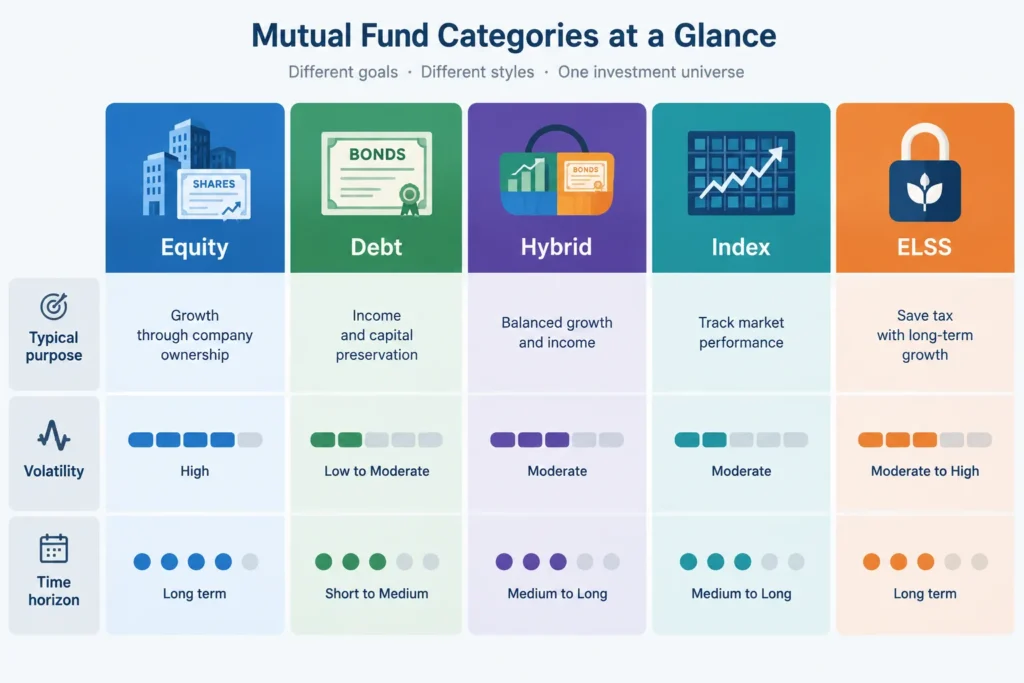
Once your financial goal, time horizon and ability to handle losses are clear, the next step is to understand the main types of mutual funds. Each category serves a different purpose. A fund suitable for retirement after 25 years may not be suitable for a school fee due in three years.
When learning how to choose mutual funds, do not select a category only because it recently delivered high returns. Start with the goal and then consider the fund category, risk level and investment route.
Equity Mutual Funds
Equity mutual funds invest mainly in shares of companies. Depending on the scheme, they may focus on large companies, smaller companies, particular sectors or a mix of businesses.
The main purpose of equity funds is long-term capital growth. However, share prices can move sharply in either direction. The value of an equity fund may fall during market corrections, economic uncertainty or company-specific problems.
Equity funds may be considered for long-term goals such as retirement or a child’s higher education when the goal is many years away. They are generally not suitable for money that will be required soon.
Beginners should remember that different equity categories can have very different risk levels. A diversified fund investing across many companies is not the same as a fund concentrated in one sector. Small-cap and sector-focused funds can experience particularly large fluctuations.
Debt Mutual Funds
Debt mutual funds invest in instruments such as government securities, treasury bills, corporate bonds and money-market instruments. They are commonly used for capital stability, income-oriented needs or shorter investment periods, depending on the specific debt category.
A debt fund is not the same as a bank fixed deposit. A fixed deposit generally offers a stated interest rate, subject to its terms. A debt fund’s value changes with the market value of the securities it holds, and its return is not fixed.
Debt funds carry several important risks:
- Interest-rate risk: Bond prices may fall when market interest rates rise. Funds holding longer-duration securities can be more sensitive to such changes.
- Credit risk: A company or other issuer may be unable to make interest or principal payments on time.
- Liquidity risk: A security may be difficult to sell at a reasonable price when the fund needs cash.
Debt funds range from overnight and liquid categories to funds holding longer-maturity or lower-rated securities. Therefore, “debt” does not automatically mean safe. Check the portfolio quality, maturity profile and category before investing.
Hybrid Mutual Funds
Hybrid funds invest in more than one asset class, usually a combination of equity and debt. Some maintain a relatively balanced allocation, while others hold much more equity or use dynamic allocation strategies.
These funds can be useful for investors who want equity and debt exposure within one scheme. The fund manager handles the allocation according to the scheme’s stated strategy.
However, hybrid funds are not automatically low risk. An equity-oriented hybrid fund may still fall substantially when share markets decline. A fund’s risk depends on its actual equity allocation, debt holdings and investment strategy.
Beginners should read the scheme’s asset-allocation range rather than relying only on the word “hybrid.” They should also check whether the allocation matches their goal and comfort with fluctuations.
Index Mutual Funds
An index fund aims to track a chosen market index, such as an index made up of large Indian companies. Instead of actively selecting shares with the aim of beating the market, it generally holds securities in line with the selected index.
Index funds are often easier to understand and may have lower costs than many actively managed funds. However, an index fund can still fall. If the index declines, a fund tracking it will usually decline as well, apart from costs and tracking differences.
When comparing index funds that follow the same index, beginners may examine the expense ratio, tracking error or tracking difference, and how consistently the fund follows its benchmark. They should also understand what the chosen index contains. An index focused on one sector is more concentrated than a broad-market index.
Equity Linked Savings Schemes
An Equity Linked Savings Scheme, or ELSS, is an equity mutual fund designed for tax-saving investment under the applicable income-tax rules. It invests mainly in equities, so its value can rise or fall with the market.
Each ELSS investment has a three-year lock-in. For example, every instalment made through a monthly SIP has its own separate three-year lock-in period. The first instalment does not unlock all later instalments at the same time.
Tax eligibility and usefulness depend on the tax regime selected and the rules applicable to the investor. Tax provisions can change. Current provisions should be verified through official sources before publication or before taking action.
The lock-in should not be mistaken for a recommended investment period. Because ELSS is equity-oriented, investors may need a longer horizon to manage market volatility. Tax saving alone is not a sufficient reason to choose an unsuitable fund.
Fund-Category Comparison
| Fund category | Main use | Broad risk profile | Beginner consideration |
|---|---|---|---|
| Equity funds | Long-term capital growth | High market volatility; risk varies by category | Preferably match with long-term goals and the ability to tolerate temporary losses |
| Debt funds | Shorter-term needs, stability or income-oriented allocation, depending on category | Interest-rate, credit and liquidity risks | Do not treat them as fixed deposits; examine portfolio quality and maturity |
| Hybrid funds | Combined equity and debt exposure | Varies from moderate to high based on allocation and strategy | Check the actual asset mix; the hybrid label does not guarantee low risk |
| Index funds | Passive exposure to a chosen index | Depends on the index and can include substantial market risk | Compare costs, tracking quality and index concentration |
| ELSS funds | Tax-saving equity investment under applicable rules | Equity-market risk | Each investment has a three-year lock-in; verify current tax provisions |
Direct Plans and Regular Plans
Most mutual fund schemes offer Direct and Regular plans. Both plans normally invest in the same underlying portfolio and are managed using the same investment strategy. The main difference is how the investor accesses the fund and pays for distribution support.
A Direct plan is purchased without a distributor. It generally has a lower expense ratio because it does not include distributor commission. The investor is responsible for choosing funds, completing transactions, reviewing performance and deciding when changes are necessary.
A Regular plan is purchased through a distributor or intermediary. Its expense ratio is generally higher because distribution commission is included. Depending on the service provider, the investor may receive help with paperwork, transactions and general fund selection.
The higher cost of a Regular plan does not automatically mean that it is unsuitable. A beginner who values ongoing support may consider the service worthwhile. On the other hand, an informed investor who can research and manage the portfolio independently may prefer the lower cost of a Direct plan.
Investors should understand the nature of the support being offered. Distribution is not always the same as independent, fee-based financial advice. Ask how the person is compensated and whether the recommendation considers the investor’s complete financial position.
SIP and Lump Sum Investing
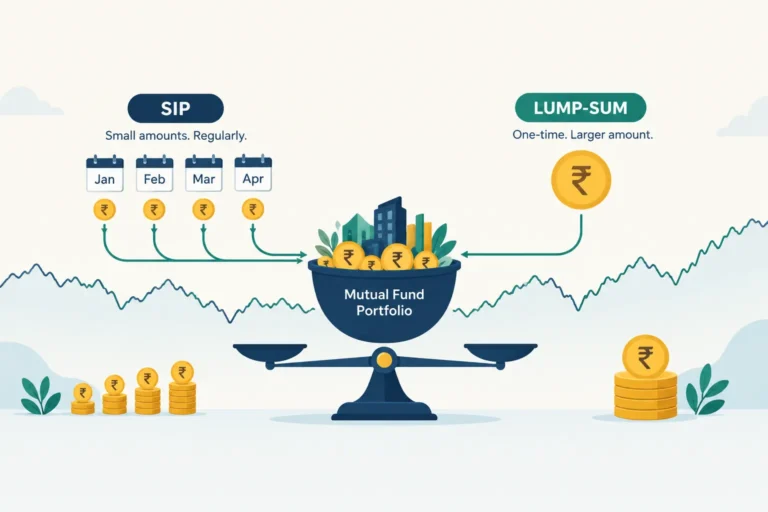
A systematic investment plan, or SIP, is a method of investing a fixed amount at regular intervals. For example, a salaried investor may invest ₹3,000 every month after receiving a salary.
A SIP can support investment discipline and spread purchases across different market levels. When prices are lower, the same amount buys more units; when prices are higher, it buys fewer units. However, a SIP does not remove market risk or guarantee positive returns. The final result depends on market performance, costs, the selected fund and the investment period.
A lump sum means investing a larger amount at one time. It may be considered when investible cash is already available, such as from a bonus, asset sale or accumulated savings. Before investing, the person should keep emergency money and funds needed for near-term expenses separate.
Lump sum investing exposes the full amount to market movements immediately. This can be uncomfortable for an investor entering a volatile equity market. Some people may choose to invest gradually, but spreading an investment does not guarantee a better result. The suitable route depends on cash flow, goal timing and risk tolerance.
How Different Investors Might Think About the Route
A salaried beginner saving for retirement: A 28-year-old with a stable monthly salary and several decades until retirement may consider a monthly SIP into a suitably diversified equity or broad index category. The long horizon may provide time to face market fluctuations, but the person must still review risk and maintain an emergency fund.
A family planning education expenses: Parents expecting a college expense in seven years may use a mix of equity and debt based on their risk capacity. As the payment date approaches, they may gradually reduce exposure to volatile assets. The category should be selected around the date when the money will be needed, not simply around recent returns.
A person with available investible cash: Someone receiving a bonus may have money available for a long-term goal. After setting aside taxes, emergency savings and near-term expenses, the person may compare investing the eligible amount as a lump sum with investing it in stages. The decision should reflect comfort with immediate market exposure rather than an attempt to predict the perfect entry date.
There is no single route that suits every investor. The useful sequence is to identify the goal, select an appropriate fund category, decide between Direct and Regular plans, and then choose SIP, lump sum or a combination based on available cash flow.
Section 3: Evaluate a Scheme, Apply the Checklist and Review FAQs
Once you have selected a suitable mutual fund category for your goal, the next step is to compare schemes within that category. Compare like with like. For example, compare a large-cap fund with other large-cap funds, not with a small-cap fund or a short-duration debt fund.
The aim is not to find the scheme with the highest recent return. It is to identify a fund whose portfolio, costs, risks and investment process are reasonably suited to your goal.
Step 1: Read the Current Scheme Information
Begin with the latest Scheme Information Document, Key Information Memorandum and monthly factsheet. These documents can help you understand:
- The scheme’s investment objective
- The types of securities it may hold
- Its stated benchmark
- The risk level shown on the Riskometer
- Asset allocation limits
- Fund manager details
- Expense ratio and exit load
- Major portfolio holdings
Use current information from the AMC and official materials published by SEBI, AMFI and the Income Tax Department. Scheme features, regulations and tax rules can change, so avoid relying only on old articles or screenshots.
Step 2: Compare Performance in the Right Context
Past performance does not predict future returns. However, it can show how a fund behaved under different market conditions.
For equity funds, examine performance over longer periods and, where data is available, across rising, falling and sideways markets. For a short-term debt goal, long-term equity performance is not relevant because equity may not suit the required time horizon in the first place.
Compare the scheme with:
- Its stated benchmark
- Other funds in the same category
- Its own investment objective and risk level
A single one-year return tells you very little. Check whether performance has been reasonably consistent rather than driven by one exceptional period. Rolling-return data, where available from a reliable source, can provide more context than point-to-point returns because it measures many overlapping investment periods.
Do not expect a fund to beat its benchmark every year. Look at how it performed over relevant periods, how much risk it took and whether its results fit its stated process. Recent category toppers may fall behind later, especially if their returns came from concentrated positions or a temporary market trend.
Step 3: Check Costs, Management and Investment Process
The expense ratio is charged to the scheme and reduces the investor’s return. Compare expense ratios only among similar plans and categories. Also confirm whether you are viewing a Direct plan or a Regular plan, as their costs differ.
Check the fund manager’s tenure. If the current manager joined recently, the scheme’s older track record may reflect a different manager or process. A change is not automatically negative, but it deserves attention.
Try to understand the investment process. Does the fund follow a clear style? Does the portfolio broadly match the scheme’s stated category? Frequent and unexplained changes in style can make the fund harder to use for goal planning.
Ratings can be a starting point, but they should not make the decision for you. Ratings may use past data, may differ across agencies and can change. They cannot assess your goal, income stability, time horizon or ability to tolerate losses.
Step 4: Examine the Portfolio and Its Risks
For an equity fund, review its major holdings, sector allocation and concentration. A portfolio heavily dependent on a few companies or sectors may experience sharper movements. Check whether you already hold similar funds with many of the same stocks. Several schemes do not provide useful diversification if their portfolios substantially overlap.
For a debt fund, examine credit quality, maturity profile and interest-rate sensitivity. Debt mutual funds are not fixed deposits. Their values can change because of interest-rate movements, credit downgrades, defaults or difficulty selling securities.
Also consider liquidity. Some underlying securities may be harder to sell during stressed markets. Read the standard risk disclosures, Riskometer and portfolio notes instead of assuming that a low-volatility history means no risk.
Goal-Based Walkthroughs: Illustrations Only
The following examples show how to choose mutual funds by starting with the goal. They are illustrations, not personal investment advice.
Illustration 1: Emergency Savings
Suppose a salaried person wants money for job loss, urgent repairs or medical needs. Safety and quick access matter more than high returns. The person may first keep part of the emergency fund in a bank account or deposit. If researching a mutual fund for a portion of this money, the focus may be on categories designed for very short holding periods, along with liquidity, credit quality, exit load and taxation.
An equity fund would generally be unsuitable for an emergency reserve because its value may be down exactly when the money is needed.
Illustration 2: House Purchase
Assume a couple plans to make a house down payment in three years. A sharp market fall near the purchase date could delay the goal. They may therefore prioritise capital stability and avoid treating an aggressive equity fund as the default choice.
If the goal were much further away, they might research a suitable mix of equity and debt based on their risk capacity. As the purchase date approaches, reducing exposure to volatile assets may help protect the amount already accumulated.
Illustration 3: Children’s Education
Consider parents investing for college expenses that may arise after 12 years. The long time horizon may allow them to research diversified equity categories for growth, while understanding that returns will fluctuate.
They should estimate the future education cost, invest regularly and review progress. Several years before the payment is due, they may gradually move the required amount towards less volatile options instead of waiting until the final year.
Illustration 4: Retirement
A 30-year-old investing for retirement has a long accumulation period. The investor may research diversified equity funds for long-term growth and suitable debt exposure for stability, depending on personal risk capacity.
Retirement planning does not end at selecting a high-return fund. Contribution size, annual increases in investment, asset allocation, inflation and the gradual reduction of risk closer to retirement can be more important than finding a recent top performer.
Actionable Mutual Fund Selection Checklist
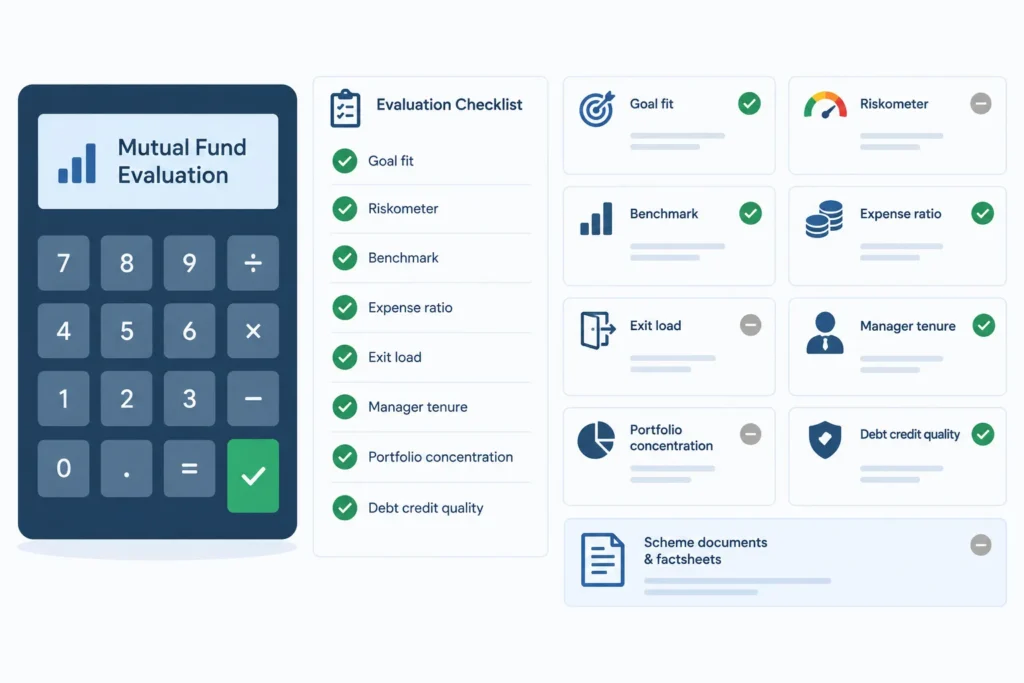
- Define the goal amount, target date and priority.
- Assess your ability and willingness to accept losses.
- Select the category before selecting the scheme.
- Compare only funds with similar mandates.
- Read the latest scheme documents and factsheet.
- Check the benchmark, Riskometer, exit load and expense ratio.
- Review performance over relevant periods and market conditions.
- Use rolling-return context where reliable data is available.
- Check fund manager tenure and the investment process.
- Review holdings, sector exposure and portfolio concentration.
- For debt funds, examine credit quality, maturity and liquidity risk.
- Avoid unnecessary overlap with funds you already own.
- Do not select solely on ratings or recent top performance.
- Check the current tax treatment before investing or redeeming.
- Record why you selected the fund and what would justify replacing it.
Review Without Reacting to Every Market Move
Review your goals and portfolio periodically, such as once or twice a year, and after major life changes. Check whether the goal amount, deadline, monthly contribution or risk capacity has changed. Also examine whether the scheme still follows its mandate and whether there have been important changes in management, costs or portfolio risk.
Short-term underperformance alone is not necessarily a reason to switch. Frequent changes can create taxes, exit loads and behavioural mistakes. Consider action when the goal changes, the chosen category is no longer suitable, the fund repeatedly departs from its mandate, or its process and risk profile have materially changed.
Frequently Asked Questions
1. Can one mutual fund serve every goal?
Usually not. Goals have different deadlines, priorities and risk limits. An equity fund considered for retirement may be unsuitable for an emergency fund or a house payment due soon. Separate goal-wise planning makes selection and review clearer.
2. Which fund category can a beginner research first?
It depends on the goal. For a long-term growth goal, a beginner may start by researching broadly diversified equity categories. For near-term needs, appropriate short-duration debt or cash-like options may deserve attention. Category selection must follow the time horizon and risk capacity.
3. Are debt mutual funds risk-free?
No. Debt funds may face interest-rate, credit, liquidity and reinvestment risks. Their returns are not guaranteed, and their net asset values can fall.
4. Is a Direct plan always better than a Regular plan?
A Direct plan generally has a lower expense ratio because it does not include distributor commission. However, investors who need ongoing help may value a suitable advisory or distribution service. Compare costs, service and possible conflicts before choosing.
5. Is SIP safer than lump sum?
A SIP spreads investments across dates and can reduce the pressure of choosing one entry point. It does not remove market risk or guarantee profit. A lump sum may be suitable in some circumstances, but its value can fluctuate immediately after investment.
6. How many mutual funds are enough for diversification?
There is no universal number. A small set of well-chosen funds across the required asset categories may be enough for many investors. Adding schemes with similar holdings can create complexity without meaningful diversification.
7. How often should a mutual fund portfolio be reviewed?
A review once or twice a year may be sufficient for many long-term investors, unless there is a major change in the goal, personal finances or scheme. Monitoring need not mean frequent buying and selling.
Summary
To understand how to choose mutual funds, begin with the goal and category, then compare suitable schemes using their benchmark, consistency, costs, manager tenure, process, holdings and risks. Avoid choosing solely from ratings or recent returns. Review periodically, but do not react to every short-term market movement.
Educational disclaimer: Mutual funds are subject to market risks, and suitability depends on personal circumstances. All examples are illustrative. Read scheme documents carefully, and verify current tax rules and regulations before investing.

Comments