


How to Calculate Gratuity in India: Formula, Eligibility and Examples

A beginner-friendly guide to gratuity calculation in India, including eligibility, formulas, salary rules, examples, taxation and payment situations.

How to Calculate Gratuity in India: Formula, Eligibility and Examples

Quick answer: For an employee covered by the Payment of Gratuity Act, gratuity is generally calculated as last drawn Basic Salary plus Dearness Allowance × 15 ÷ 26 × completed years of service. You normally become eligible after completing five years of continuous service with the same employer. The five-year condition does not apply when employment ends because of death or disablement. Service beyond six months is usually counted as a full year, while service of six months or less is ignored.

Gratuity is an important employment benefit in India, especially for people who stay with one organisation for several years. However, many employees are unsure about the salary figure to use, how partial years are counted, and whether resignation qualifies.

This guide begins with the basic eligibility rules and the standard gratuity calculation formula. The exact amount can depend on whether your employer is covered by the applicable gratuity law and whether the employer offers more favourable terms under its own policy.

What Is Gratuity?

Gratuity is a lump-sum amount paid by an employer to an eligible employee as a reward for long and continuous service. It is normally paid when employment comes to an end because of resignation, retirement, superannuation, death, disablement or another qualifying event.

Unlike your monthly salary, gratuity is not usually paid regularly. It becomes payable when you leave employment after meeting the relevant conditions.

Gratuity is also different from the Employees’ Provident Fund, or EPF. EPF is built through regular contributions during employment. Gratuity is generally an employer-funded benefit calculated using your eligible salary and length of service.

The Payment of Gratuity Act, 1972 has traditionally provided the main legal framework for gratuity in India. Labour law implementation can change, so employees should also check the law currently in force, their appointment terms and their employer’s gratuity policy.

Who Is Eligible for Gratuity?

You are generally eligible for gratuity if you are an employee covered by the applicable gratuity law and your employment ends after the required period of continuous service.

General five-year service requirement

In most ordinary cases, an employee must complete at least five years of continuous service with the same employer. Gratuity may become payable when the employee:

  • Resigns after completing the qualifying service period.
  • Retires from employment.
  • Reaches the employer’s age of superannuation.
  • Leaves employment following another event recognised under the applicable law or employment terms.

Changing jobs normally resets the service period because gratuity is linked to service with a particular employer. However, a transfer within the same organisation or a qualifying transfer of employment may be treated differently depending on the facts and official records.

Exceptions for death or disablement

The usual five-year condition does not apply when employment ends because of the employee’s death or disablement due to an accident or disease. In such cases, gratuity may be payable even if the employee served for less than five years.

If an employee dies, the amount is generally paid to the nominee. Where no valid nomination exists, it may be paid to the legal heir, subject to the required procedure and documents.

Which establishments are generally covered?

The gratuity law generally applies to factories, mines, oilfields, plantations, ports and railway companies. It also applies to shops and establishments meeting the prescribed employee threshold, commonly ten or more employees, subject to the relevant legal provisions.

Once an establishment becomes covered, it generally continues to remain covered even if its employee count later falls below the threshold.

Not every person working for an organisation will necessarily be treated in the same way. For example, apprentices may be excluded from the statutory definition of employee, while contract staffing arrangements can require closer examination of the actual employer and applicable records.

Does resignation qualify for gratuity?

Yes. Gratuity is not limited to retirement. An employee who voluntarily resigns can generally claim gratuity after completing the required continuous service. Being asked to serve a notice period does not by itself remove the right to gratuity.

Gratuity can be forfeited fully or partly only in certain legally specified situations involving termination for particular misconduct, damage or loss. An employer cannot ordinarily deny it merely because an eligible employee resigned.

How Is Gratuity Calculated?

Gratuity calculation mainly depends on three factors:

  • Your last drawn eligible salary.
  • Your completed years of continuous service.
  • Whether the statutory formula or a different employer policy applies.

For employees covered under the gratuity law, the calculation generally provides 15 days’ wages for every completed year of service. A month is treated as 26 working days for this purpose. Therefore, 15 days’ wages are represented by multiplying eligible monthly salary by 15 and dividing it by 26.

How are completed years of service counted?
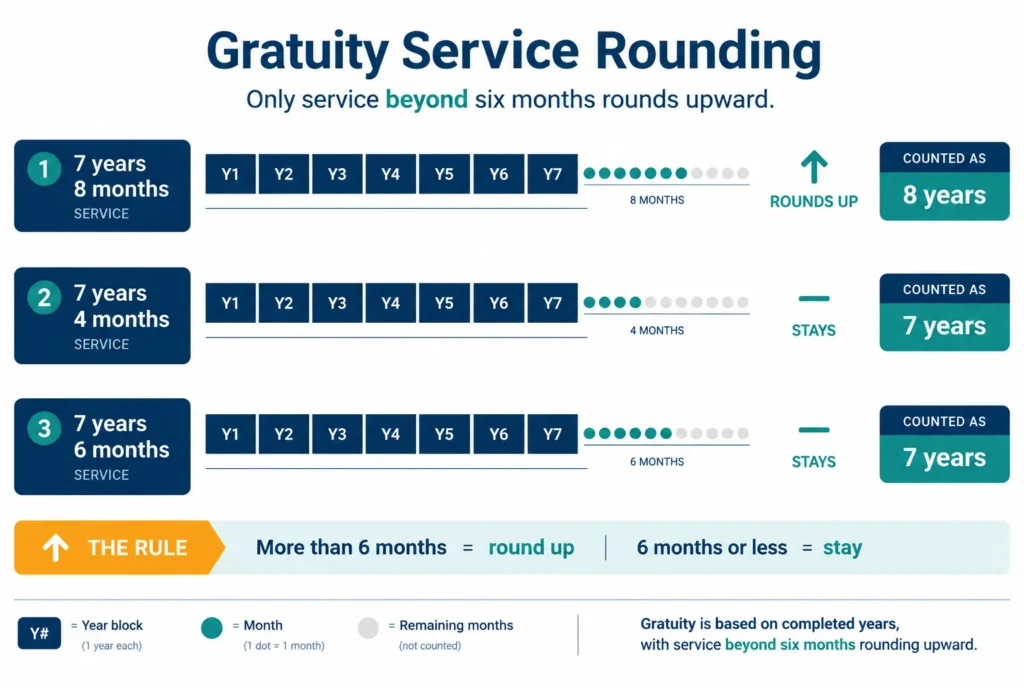
Timeline showing how additional months affect completed years used in an Indian gratuity calculation

For the statutory calculation, service beyond six months is generally rounded up to the next full year. A fraction of six months or less is normally ignored.

  • 7 years and 8 months: counted as 8 years.
  • 7 years and 4 months: counted as 7 years.
  • 7 years and exactly 6 months: generally counted as 7 years because the statutory wording refers to service exceeding six months.
You May Also Like:PPF Calculator: Calculate Your PPF Maturity Amount, Interest and Returns

This rounding rule is used to determine the years included in the formula. It does not mean that an employee who has served less than the normal qualifying period automatically becomes eligible merely because part of a year can be rounded. Eligibility and calculation should be examined separately.

Gratuity Calculation Formula
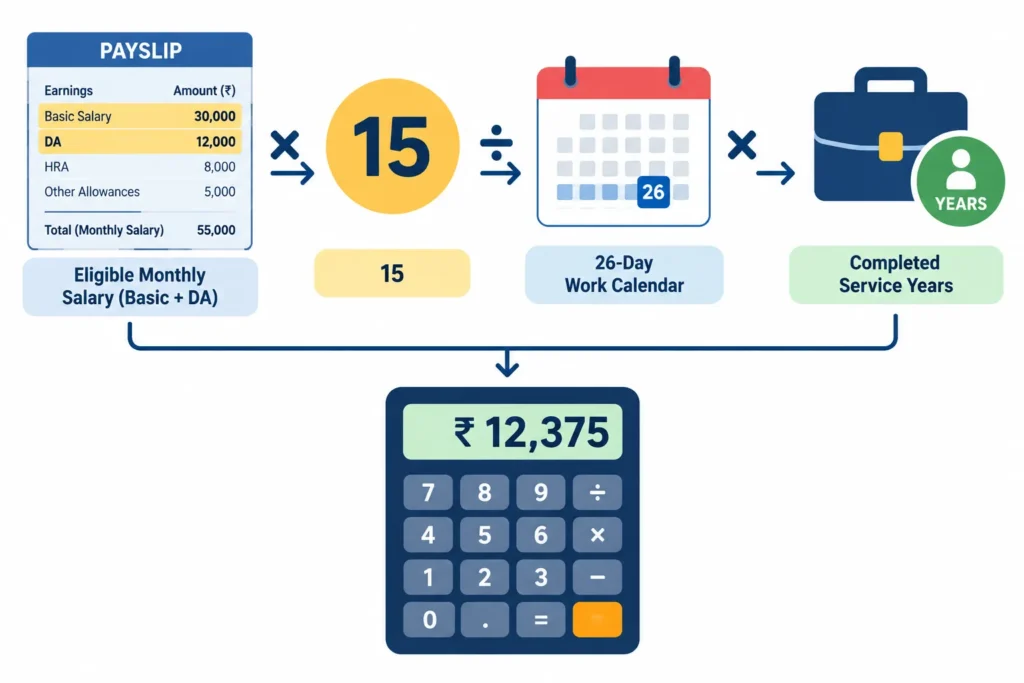
Visual breakdown of gratuity as eligible salary multiplied by 15, divided by 26, and multiplied by completed service years

For an employee covered under the applicable gratuity law, the standard formula is:

Gratuity = Last drawn eligible monthly salary × 15 ÷ 26 × completed years of service

Each part of the formula means:

  • Last drawn eligible monthly salary: Basic Salary plus Dearness Allowance, where applicable, in the final salary period.
  • 15: the prescribed 15 days’ wages for each completed year of service.
  • 26: the number of working days used to convert monthly salary into daily wages for this calculation.
  • Completed years of service: total qualifying years after applying the rule for service exceeding six months.

Simple gratuity calculation example

Suppose Meera’s last drawn Basic Salary plus Dearness Allowance is Rs.40,000 per month. She leaves after 8 years and 7 months of continuous service.

Because the extra service exceeds six months, her service is counted as 9 years.

Gratuity = Rs.40,000 × 15 ÷ 26 × 9

Gratuity = approximately Rs.2,07,692

This is the formula-based amount before considering matters such as the prevailing statutory ceiling, tax treatment, recoveries permitted by law or any more favourable benefit offered by the employer.

Employees not covered by the statutory formula

An employer not covered by the applicable gratuity law may still provide gratuity through an employment contract, company policy or voluntary scheme. Such an employer may use a different basis, often involving 30 calendar days instead of 26 working days.

A commonly seen non-statutory formula is:

Gratuity = Eligible salary × 15 ÷ 30 × completed years of service

This should not be assumed in every case. The company policy may define eligible salary differently, ignore partial years, provide a better benefit or impose other lawful terms. Employees should read the gratuity clause in their appointment letter, employee handbook or separation statement.

If an employer’s policy provides a benefit better than the statutory minimum, the more favourable terms may continue to apply. A policy cannot ordinarily be used to reduce the minimum benefit available to an employee covered by the law.

What Salary Is Considered for Gratuity Calculation?
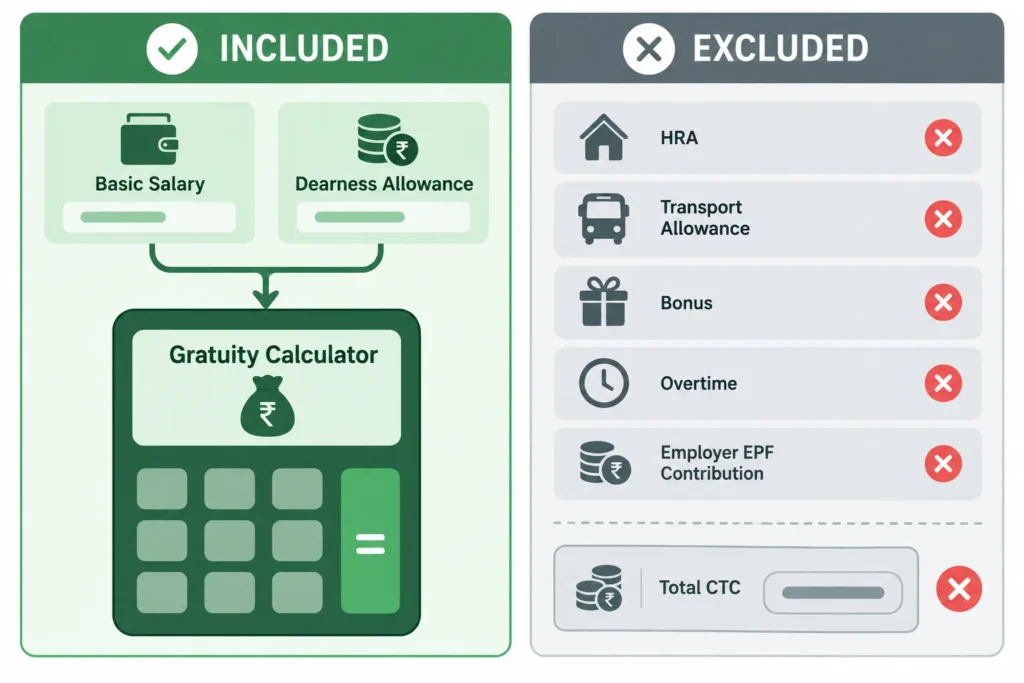
Comparison of salary components generally included and excluded when calculating statutory gratuity in India

For the standard statutory gratuity calculation, the relevant salary is generally the employee’s last drawn Basic Salary plus Dearness Allowance.

If your final monthly salary structure shows Basic Salary of Rs.35,000 and Dearness Allowance of Rs.5,000, the eligible salary for the formula would generally be Rs.40,000.

Other parts of the cost-to-company package are usually not included in the statutory salary figure. These commonly include:

  • House Rent Allowance or HRA.
  • Conveyance or transport allowance.
  • Special allowance.
  • Overtime payments.
  • Performance bonus and incentives.
  • Commission that does not form part of eligible wages under the applicable rules.
  • Employer contributions to EPF or other retirement benefits.

Your total CTC is therefore not the correct figure to insert into the standard formula. The monthly in-hand salary is also not suitable because it reflects deductions such as EPF, professional tax and income tax.

Employees should check the final payslip and identify Basic Salary and Dearness Allowance separately. If the salary structure does not have a Dearness Allowance component, the calculation will commonly use the last drawn Basic Salary alone, subject to the applicable employment terms and law.

For employees outside statutory coverage, the salary definition can be different. The employer’s policy might use Basic Salary alone, Basic Salary plus Dearness Allowance, or another clearly defined amount. Confirming both the formula and the salary components is essential before estimating gratuity.

Gratuity Calculation Examples

A gratuity calculation becomes easier when you separate it into three parts: eligible wages, completed years of service and the applicable formula.

For an employee covered by the Payment of Gratuity Act, 1972, the commonly used formula is:

Gratuity = Last drawn wages × 15 ÷ 26 × completed years of service

For this purpose, last drawn wages generally include basic salary and dearness allowance. Components such as house rent allowance, bonus, overtime and most other allowances are generally not included.

Example 1: Service of exactly 7 years

Suppose Meera works for a covered private company. Her last drawn basic salary is ₹32,000 per month, and she does not receive dearness allowance. She leaves after completing exactly seven years.

  1. Last drawn eligible wages: ₹32,000
  2. Daily wage for the formula: ₹32,000 ÷ 26 = ₹1,230.77
  3. Fifteen days’ wages: ₹1,230.77 × 15 = ₹18,461.54
  4. Gratuity for seven years: ₹18,461.54 × 7 = ₹1,29,230.78

Meera’s gratuity would therefore be approximately ₹1,29,231, subject to the employer’s final calculation and applicable rules.

Example 2: Service includes more than six additional months

Suppose Arjun’s last drawn basic salary plus dearness allowance is ₹45,000. He has worked for 10 years and eight months in an establishment covered by the Act.

A service period above six months is generally counted as one additional year for calculating the amount. Therefore, 10 years and eight months is treated as 11 years.

Gratuity = ₹45,000 × 15 ÷ 26 × 11 = approximately ₹2,85,577

You May Also Like:How to Choose the Best Term Insurance Plan in India: Complete 2026 Guide

Example 3: Additional service is six months or less

Assume Kavita’s eligible last drawn wages are ₹28,000, and her service period is eight years and five months.

The additional five months are generally ignored for the calculation. Her gratuity is calculated using eight completed years.

Gratuity = ₹28,000 × 15 ÷ 26 × 8 = approximately ₹1,29,231

This rounding rule helps determine the number of years used in the formula. It should not automatically be used to decide whether an employee has completed the minimum qualifying service.

How Is Gratuity Calculated for Different Employees?

Employees covered by the Payment of Gratuity Act

The Act generally applies to factories, mines, oilfields, plantations, ports, railway companies, shops and establishments that meet the legal employee threshold. Once the Act becomes applicable to an establishment, later changes in employee strength do not ordinarily remove that coverage.

For a covered employee, gratuity is normally based on 15 days’ wages for every completed year of service or part exceeding six months. The monthly wage is divided by 26 because the statutory formula treats a working month as 26 days.

Employees paid on a piece-rate basis or those working in seasonal establishments can have different calculation rules. Such cases should be checked against the Act, employment records and the employer’s calculation.

Employees not covered by the Act

An employee outside the Act may still receive gratuity under an employment contract, company policy, award or service rules. However, the eligibility conditions and calculation method can depend on those terms.

A commonly used approach for certain non-covered employees is half a month’s salary for each completed year of service, based on average salary. A typical expression is:

Gratuity = Average monthly salary × 15 ÷ 30 × completed years of service

For example, if the applicable average monthly salary is ₹40,000 and the recognised service period is nine completed years:

Gratuity = ₹40,000 × 15 ÷ 30 × 9 = ₹1,80,000

This method should not be assumed for every non-covered employee. The employment contract or applicable service rules may define salary, service rounding and other conditions differently.

Gratuity After 5 Years of Service

Gratuity generally becomes payable under the Act when an employee has completed at least five years of continuous service and employment ends due to resignation, retirement or superannuation. The five-year condition does not apply when employment ends because of death or disablement.

Continuous service does not always mean that the employee must have attended work every single day. Certain authorised absences and interruptions may still count under the law. Payroll and attendance records are important when there is a dispute about the service period.

Example after exactly five years

Suppose Rohit resigns after completing exactly five years. His last drawn basic salary is ₹36,000, and his dearness allowance is ₹4,000. His eligible wages are therefore ₹40,000.

Gratuity = ₹40,000 × 15 ÷ 26 × 5 = approximately ₹1,15,385

Do not add HRA or other allowances merely because they appear in the monthly payslip. The wage components used should follow the applicable gratuity rules.

Employees sometimes assume that four years and more than six months automatically becomes five years for eligibility. This is not a safe general rule. The provision that counts a part-year exceeding six months mainly applies when calculating the gratuity amount after eligibility is established. Questions involving service below five calendar years may depend on continuous-service provisions, working days, establishment type and judicial interpretation.

What Happens to Gratuity When You Resign?

Resignation does not by itself cancel gratuity. If an employee is covered by the Act and has completed the required continuous service, gratuity generally becomes payable when the employment ends.

The basic process is usually as follows:

  1. Confirm the date of joining and last working date.
  2. Check whether the establishment and employee are covered by the Act.
  3. Identify the last drawn basic salary and dearness allowance.
  4. Determine the completed service period and apply the part-year rule correctly.
  5. Compare the employer’s calculation with the statutory formula or applicable service terms.

For example, if Sana resigns after 12 years and four months with eligible last drawn wages of ₹52,000, the calculation normally uses 12 years because the extra period does not exceed six months.

Gratuity = ₹52,000 × 15 ÷ 26 × 12 = ₹3,60,000

An employer may offer more favourable gratuity terms than the statutory minimum. In that case, the employee should check the appointment letter, employee handbook, settlement documents and company gratuity policy.

Gratuity can be wholly or partly forfeited only in specified circumstances under the law, such as certain cases involving damage, loss, violence or an offence involving moral turpitude committed during employment. Resignation alone is not a reason for forfeiture.

You May Also Like:How to Track Promoter Buying and Selling in Indian Stocks

Gratuity in Case of Death or Disablement

The minimum five-year service condition is waived when employment ends because of the employee’s death or disablement due to an accident or disease. The gratuity calculation is then based on the eligible wages and recognised service period up to that event.

Example involving death before five years

Suppose an employee dies after three years and nine months of service. The last drawn basic salary plus dearness allowance is ₹30,000.

Because the additional service exceeds six months, four years may be used for calculating the amount.

Gratuity = ₹30,000 × 15 ÷ 26 × 4 = approximately ₹69,231

The amount is generally payable to the employee’s nominee. If no valid nomination exists, payment may have to be made to the legal heirs, subject to the required documents and legal procedure. Keeping the gratuity nomination updated can reduce confusion for the family, especially after marriage or other major family changes.

Disablement and reduced wages

If an employee becomes disabled and continues in employment on reduced wages, special protection may apply to the calculation. The period before disablement may be valued using the wages received before disablement, while the later period may be valued using the reduced wages.

Because such cases can involve medical records, wage changes and separate service periods, employees or families should ask for a written calculation. They should verify the joining date, event date, eligible wage components, service rounding, nomination details and any documents requested for payment.

Is Gratuity Taxable?

The tax treatment of gratuity depends on where you work and whether your employer is covered by the Payment of Gratuity Act, 1972. An exemption means that the eligible amount is not added to your taxable income.

Central, state and local government employees

Gratuity received by an eligible central government, state government or local authority employee is generally fully exempt from income tax. This exemption does not automatically apply to employees of public sector undertakings, statutory corporations or government-owned companies.

Employees covered by the Payment of Gratuity Act

For an employee covered by the Act, the tax-exempt amount is the lowest of the following:

  • The gratuity actually received.
  • The gratuity calculated under the prescribed formula.
  • The applicable lifetime tax-exemption ceiling of Rs. 20 lakh.

The prescribed gratuity calculation generally uses this formula:

Last drawn Basic Salary plus Dearness Allowance × 15 ÷ 26 × completed years of service

For this calculation, service exceeding six months is normally treated as a full year. A shorter extra period is ignored.

Suppose an employee receives Rs. 9 lakh as gratuity, while the formula-based amount is Rs. 8.50 lakh. If the employee has not used the exemption earlier, Rs. 8.50 lakh may be exempt and the remaining Rs. 50,000 may be taxable.

Employees not covered by the Payment of Gratuity Act

For an employee not covered by the Act, the exempt amount is generally the lowest of:

  • The gratuity actually received.
  • Half a month’s average salary for each completed year of service.
  • The applicable lifetime tax-exemption ceiling of Rs. 20 lakh.

Average salary is generally based on the 10 months immediately before the month of retirement or termination. For this purpose, salary can include basic salary, dearness allowance forming part of retirement benefits, and commission calculated as a fixed percentage of turnover.

Only completed years are normally counted for employees outside the Act. A fraction of a year is ignored.

The Rs. 20 lakh tax exemption is an overall lifetime ceiling for gratuity received from one or more employers. Any exemption claimed in the past reduces the available ceiling for a later receipt.

Gratuity Limit and Maximum Amount

The statutory gratuity ceiling under the Payment of Gratuity Act is Rs. 20 lakh. This is the maximum amount an employer is ordinarily required to pay under the Act, subject to the employee’s eligibility and formula-based entitlement.

However, an employment contract, company gratuity scheme, award or settlement may offer a better benefit. An employer can therefore pay more than the statutory amount.

Do not confuse these three figures:

  • Formula amount: The benefit calculated from salary and service.
  • Statutory ceiling: The maximum compulsory payment under the Act.
  • Tax-exempt amount: The portion exempt under income-tax rules.

If an employer voluntarily pays more than Rs. 20 lakh, the employee may receive the higher amount. However, the excess does not automatically become tax-free. The final exemption depends on the employee category, earlier gratuity exemptions and applicable tax provisions.

When Is Gratuity Paid?

Gratuity generally becomes payable when employment ends due to retirement, resignation, superannuation, death or disablement, provided the eligibility conditions are met. The normal five-year service condition does not apply in cases of death or disablement.

The usual claim and payment process is as follows:

  1. The employee, nominee or legal heir submits the prescribed application and supporting documents.
  2. The employer determines whether gratuity is payable and calculates the amount.
  3. The employer issues a written notice showing the amount and payment details.
  4. The amount is paid to the eligible person, usually through a traceable banking method.

An employee should ordinarily submit the application promptly. A delayed application does not by itself cancel a valid gratuity claim, but it can make verification and follow-up more difficult.

Under the Act, the employer must generally arrange payment within 30 days from the date gratuity becomes payable. Interest may apply when payment is delayed, except in limited situations where the delay is due to the employee and the required approval has been obtained.

If the amount is disputed or payment is not made, the employee can approach the controlling authority under the Payment of Gratuity Act. Keep the appointment letter, salary slips, resignation or retirement letter, service certificate and employer correspondence safely.

You May Also Like:How to Know Which Stocks FII Are Buying: A Simple Guide for Investors

Gratuity vs Provident Fund

Gratuity and provident fund are both employment-related benefits, but they work differently.

Point Gratuity Provident Fund
Nature End-of-service benefit paid by the employer Retirement savings built through regular contributions
Employee contribution Normally none Employee usually contributes from salary
Employer contribution Employer bears the gratuity cost Employer contributes under applicable EPF rules
Eligibility Usually linked to continuous service and the reason employment ends Linked to EPF membership and contributions
Amount Based mainly on eligible salary and service Based on contributions, interest and permitted withdrawals
Portability Calculated separately for each employer Can generally continue through the same UAN when jobs change

Changing employers normally closes the gratuity service period with the old employer and starts a fresh period with the new employer. Your provident fund balance, on the other hand, can usually be transferred and continued.

How to Calculate Your Gratuity Yourself

Use this practical checklist before accepting an estimate from an online calculator or salary portal:

  1. Check coverage: Confirm whether your employer and employment are covered by the Payment of Gratuity Act.
  2. Confirm eligibility: Check continuous service and whether the five-year condition applies.
  3. Find eligible salary: Use basic salary and eligible dearness allowance, not total cost to company or take-home pay.
  4. Use the correct salary figure: Employees covered by the Act generally use the last drawn eligible salary. Different rules apply to employees outside the Act.
  5. Count service correctly: Apply the relevant rule for the remaining months. Do not automatically round every fraction upward.
  6. Apply the right formula: For a covered employee, use eligible salary × 15 ÷ 26 × completed years.
  7. Check the ceiling: Compare the formula result with the statutory limit and any better benefit promised by the employer.
  8. Estimate tax separately: Consider your employee category, actual receipt and gratuity exemptions claimed earlier.
  9. Verify the final statement: Match the employer’s calculation with salary slips, joining date and last working date.

Common mistakes include using gross salary, counting service from an incorrect joining date, treating provident fund as part of gratuity, ignoring past exemptions and assuming the full employer payment is tax-free.

Frequently Asked Questions About Gratuity

Does four years and six months of service qualify?

It depends on the facts, establishment and applicable legal interpretation. The rule for rounding a service fraction is mainly used to calculate the amount after eligibility is established. Employees close to five years should obtain a written calculation from the employer or professional advice rather than assuming eligibility.

Can I receive gratuity after resignation?

Yes. Resignation is a recognised event for gratuity payment if the required continuous service condition is satisfied. Gratuity is not limited to retirement.

What happens if my salary changed during service?

For an employee covered by the Act, gratuity is generally based on the last drawn basic salary plus eligible dearness allowance. Earlier salary levels are not separately averaged merely because they were lower.

Can service with multiple employers be combined?

Normally, no. Each employer calculates gratuity for the service completed with that employer. A transfer within the same legal employer may be treated differently from joining a separate company.

Which tax documents should I keep?

Keep the gratuity calculation sheet, payment advice, employer letter, bank proof, Form 16 and details of any past gratuity exemption. These documents can support the exemption claimed in your income-tax return.

What can I do if payment is delayed?

Send a written request to the employer and retain proof. If the issue is not resolved, an eligible employee may approach the controlling authority under the Payment of Gratuity Act and seek the amount along with applicable interest.

What is the most common gratuity calculation mistake?

The most common mistake is using gross salary or cost to company instead of eligible basic salary and dearness allowance. Incorrect service rounding and failure to apply the ceiling are also frequent errors.

Summary

Gratuity is an employer-funded benefit based mainly on eligible salary and length of service. Its tax treatment depends on the employee category, formula-based entitlement, actual payment and the lifetime exemption ceiling. Check the correct salary components, service period, statutory limit and previous exemptions before finalising your gratuity calculation. Keep the employer’s calculation and payment records, especially if you claim a tax exemption or need to follow up on delayed payment.


Share this article
KEEP READING

Related Articles

View all →

Comments

Leave a Comment

How to Calculate Gratuity in India: Formula, Eligibility and Examples

Quick answer: For an employee covered by the Payment of Gratuity Act, gratuity is generally calculated as last drawn Basic Salary plus Dearness Allowance × 15 ÷ 26 × completed years of service. You normally become eligible after completing five years of continuous service with the same employer. The five-year condition does not apply when employment ends because of death or disablement. Service beyond six months is usually counted as a full year, while service of six months or less is ignored.

Gratuity is an important employment benefit in India, especially for people who stay with one organisation for several years. However, many employees are unsure about the salary figure to use, how partial years are counted, and whether resignation qualifies.

This guide begins with the basic eligibility rules and the standard gratuity calculation formula. The exact amount can depend on whether your employer is covered by the applicable gratuity law and whether the employer offers more favourable terms under its own policy.

What Is Gratuity?

Gratuity is a lump-sum amount paid by an employer to an eligible employee as a reward for long and continuous service. It is normally paid when employment comes to an end because of resignation, retirement, superannuation, death, disablement or another qualifying event.

Unlike your monthly salary, gratuity is not usually paid regularly. It becomes payable when you leave employment after meeting the relevant conditions.

Gratuity is also different from the Employees’ Provident Fund, or EPF. EPF is built through regular contributions during employment. Gratuity is generally an employer-funded benefit calculated using your eligible salary and length of service.

The Payment of Gratuity Act, 1972 has traditionally provided the main legal framework for gratuity in India. Labour law implementation can change, so employees should also check the law currently in force, their appointment terms and their employer’s gratuity policy.

Who Is Eligible for Gratuity?

You are generally eligible for gratuity if you are an employee covered by the applicable gratuity law and your employment ends after the required period of continuous service.

General five-year service requirement

In most ordinary cases, an employee must complete at least five years of continuous service with the same employer. Gratuity may become payable when the employee:

  • Resigns after completing the qualifying service period.
  • Retires from employment.
  • Reaches the employer’s age of superannuation.
  • Leaves employment following another event recognised under the applicable law or employment terms.

Changing jobs normally resets the service period because gratuity is linked to service with a particular employer. However, a transfer within the same organisation or a qualifying transfer of employment may be treated differently depending on the facts and official records.

Exceptions for death or disablement

The usual five-year condition does not apply when employment ends because of the employee’s death or disablement due to an accident or disease. In such cases, gratuity may be payable even if the employee served for less than five years.

If an employee dies, the amount is generally paid to the nominee. Where no valid nomination exists, it may be paid to the legal heir, subject to the required procedure and documents.

Which establishments are generally covered?

The gratuity law generally applies to factories, mines, oilfields, plantations, ports and railway companies. It also applies to shops and establishments meeting the prescribed employee threshold, commonly ten or more employees, subject to the relevant legal provisions.

Once an establishment becomes covered, it generally continues to remain covered even if its employee count later falls below the threshold.

Not every person working for an organisation will necessarily be treated in the same way. For example, apprentices may be excluded from the statutory definition of employee, while contract staffing arrangements can require closer examination of the actual employer and applicable records.

Does resignation qualify for gratuity?

Yes. Gratuity is not limited to retirement. An employee who voluntarily resigns can generally claim gratuity after completing the required continuous service. Being asked to serve a notice period does not by itself remove the right to gratuity.

Gratuity can be forfeited fully or partly only in certain legally specified situations involving termination for particular misconduct, damage or loss. An employer cannot ordinarily deny it merely because an eligible employee resigned.

How Is Gratuity Calculated?

Gratuity calculation mainly depends on three factors:

  • Your last drawn eligible salary.
  • Your completed years of continuous service.
  • Whether the statutory formula or a different employer policy applies.

For employees covered under the gratuity law, the calculation generally provides 15 days’ wages for every completed year of service. A month is treated as 26 working days for this purpose. Therefore, 15 days’ wages are represented by multiplying eligible monthly salary by 15 and dividing it by 26.

How are completed years of service counted?

Timeline showing how additional months affect completed years used in an Indian gratuity calculation

For the statutory calculation, service beyond six months is generally rounded up to the next full year. A fraction of six months or less is normally ignored.

  • 7 years and 8 months: counted as 8 years.
  • 7 years and 4 months: counted as 7 years.
  • 7 years and exactly 6 months: generally counted as 7 years because the statutory wording refers to service exceeding six months.

This rounding rule is used to determine the years included in the formula. It does not mean that an employee who has served less than the normal qualifying period automatically becomes eligible merely because part of a year can be rounded. Eligibility and calculation should be examined separately.

Gratuity Calculation Formula

Visual breakdown of gratuity as eligible salary multiplied by 15, divided by 26, and multiplied by completed service years

For an employee covered under the applicable gratuity law, the standard formula is:

Gratuity = Last drawn eligible monthly salary × 15 ÷ 26 × completed years of service

Each part of the formula means:

  • Last drawn eligible monthly salary: Basic Salary plus Dearness Allowance, where applicable, in the final salary period.
  • 15: the prescribed 15 days’ wages for each completed year of service.
  • 26: the number of working days used to convert monthly salary into daily wages for this calculation.
  • Completed years of service: total qualifying years after applying the rule for service exceeding six months.

Simple gratuity calculation example

Suppose Meera’s last drawn Basic Salary plus Dearness Allowance is Rs.40,000 per month. She leaves after 8 years and 7 months of continuous service.

Because the extra service exceeds six months, her service is counted as 9 years.

Gratuity = Rs.40,000 × 15 ÷ 26 × 9

Gratuity = approximately Rs.2,07,692

This is the formula-based amount before considering matters such as the prevailing statutory ceiling, tax treatment, recoveries permitted by law or any more favourable benefit offered by the employer.

Employees not covered by the statutory formula

An employer not covered by the applicable gratuity law may still provide gratuity through an employment contract, company policy or voluntary scheme. Such an employer may use a different basis, often involving 30 calendar days instead of 26 working days.

A commonly seen non-statutory formula is:

Gratuity = Eligible salary × 15 ÷ 30 × completed years of service

This should not be assumed in every case. The company policy may define eligible salary differently, ignore partial years, provide a better benefit or impose other lawful terms. Employees should read the gratuity clause in their appointment letter, employee handbook or separation statement.

If an employer’s policy provides a benefit better than the statutory minimum, the more favourable terms may continue to apply. A policy cannot ordinarily be used to reduce the minimum benefit available to an employee covered by the law.

What Salary Is Considered for Gratuity Calculation?

Comparison of salary components generally included and excluded when calculating statutory gratuity in India

For the standard statutory gratuity calculation, the relevant salary is generally the employee’s last drawn Basic Salary plus Dearness Allowance.

If your final monthly salary structure shows Basic Salary of Rs.35,000 and Dearness Allowance of Rs.5,000, the eligible salary for the formula would generally be Rs.40,000.

Other parts of the cost-to-company package are usually not included in the statutory salary figure. These commonly include:

  • House Rent Allowance or HRA.
  • Conveyance or transport allowance.
  • Special allowance.
  • Overtime payments.
  • Performance bonus and incentives.
  • Commission that does not form part of eligible wages under the applicable rules.
  • Employer contributions to EPF or other retirement benefits.

Your total CTC is therefore not the correct figure to insert into the standard formula. The monthly in-hand salary is also not suitable because it reflects deductions such as EPF, professional tax and income tax.

Employees should check the final payslip and identify Basic Salary and Dearness Allowance separately. If the salary structure does not have a Dearness Allowance component, the calculation will commonly use the last drawn Basic Salary alone, subject to the applicable employment terms and law.

For employees outside statutory coverage, the salary definition can be different. The employer’s policy might use Basic Salary alone, Basic Salary plus Dearness Allowance, or another clearly defined amount. Confirming both the formula and the salary components is essential before estimating gratuity.

Gratuity Calculation Examples

A gratuity calculation becomes easier when you separate it into three parts: eligible wages, completed years of service and the applicable formula.

For an employee covered by the Payment of Gratuity Act, 1972, the commonly used formula is:

Gratuity = Last drawn wages × 15 ÷ 26 × completed years of service

For this purpose, last drawn wages generally include basic salary and dearness allowance. Components such as house rent allowance, bonus, overtime and most other allowances are generally not included.

Example 1: Service of exactly 7 years

Suppose Meera works for a covered private company. Her last drawn basic salary is ₹32,000 per month, and she does not receive dearness allowance. She leaves after completing exactly seven years.

  1. Last drawn eligible wages: ₹32,000
  2. Daily wage for the formula: ₹32,000 ÷ 26 = ₹1,230.77
  3. Fifteen days’ wages: ₹1,230.77 × 15 = ₹18,461.54
  4. Gratuity for seven years: ₹18,461.54 × 7 = ₹1,29,230.78

Meera’s gratuity would therefore be approximately ₹1,29,231, subject to the employer’s final calculation and applicable rules.

Example 2: Service includes more than six additional months

Suppose Arjun’s last drawn basic salary plus dearness allowance is ₹45,000. He has worked for 10 years and eight months in an establishment covered by the Act.

A service period above six months is generally counted as one additional year for calculating the amount. Therefore, 10 years and eight months is treated as 11 years.

Gratuity = ₹45,000 × 15 ÷ 26 × 11 = approximately ₹2,85,577

Example 3: Additional service is six months or less

Assume Kavita’s eligible last drawn wages are ₹28,000, and her service period is eight years and five months.

The additional five months are generally ignored for the calculation. Her gratuity is calculated using eight completed years.

Gratuity = ₹28,000 × 15 ÷ 26 × 8 = approximately ₹1,29,231

This rounding rule helps determine the number of years used in the formula. It should not automatically be used to decide whether an employee has completed the minimum qualifying service.

How Is Gratuity Calculated for Different Employees?

Employees covered by the Payment of Gratuity Act

The Act generally applies to factories, mines, oilfields, plantations, ports, railway companies, shops and establishments that meet the legal employee threshold. Once the Act becomes applicable to an establishment, later changes in employee strength do not ordinarily remove that coverage.

For a covered employee, gratuity is normally based on 15 days’ wages for every completed year of service or part exceeding six months. The monthly wage is divided by 26 because the statutory formula treats a working month as 26 days.

Employees paid on a piece-rate basis or those working in seasonal establishments can have different calculation rules. Such cases should be checked against the Act, employment records and the employer’s calculation.

Employees not covered by the Act

An employee outside the Act may still receive gratuity under an employment contract, company policy, award or service rules. However, the eligibility conditions and calculation method can depend on those terms.

A commonly used approach for certain non-covered employees is half a month’s salary for each completed year of service, based on average salary. A typical expression is:

Gratuity = Average monthly salary × 15 ÷ 30 × completed years of service

For example, if the applicable average monthly salary is ₹40,000 and the recognised service period is nine completed years:

Gratuity = ₹40,000 × 15 ÷ 30 × 9 = ₹1,80,000

This method should not be assumed for every non-covered employee. The employment contract or applicable service rules may define salary, service rounding and other conditions differently.

Gratuity After 5 Years of Service

Gratuity generally becomes payable under the Act when an employee has completed at least five years of continuous service and employment ends due to resignation, retirement or superannuation. The five-year condition does not apply when employment ends because of death or disablement.

Continuous service does not always mean that the employee must have attended work every single day. Certain authorised absences and interruptions may still count under the law. Payroll and attendance records are important when there is a dispute about the service period.

Example after exactly five years

Suppose Rohit resigns after completing exactly five years. His last drawn basic salary is ₹36,000, and his dearness allowance is ₹4,000. His eligible wages are therefore ₹40,000.

Gratuity = ₹40,000 × 15 ÷ 26 × 5 = approximately ₹1,15,385

Do not add HRA or other allowances merely because they appear in the monthly payslip. The wage components used should follow the applicable gratuity rules.

Employees sometimes assume that four years and more than six months automatically becomes five years for eligibility. This is not a safe general rule. The provision that counts a part-year exceeding six months mainly applies when calculating the gratuity amount after eligibility is established. Questions involving service below five calendar years may depend on continuous-service provisions, working days, establishment type and judicial interpretation.

What Happens to Gratuity When You Resign?

Resignation does not by itself cancel gratuity. If an employee is covered by the Act and has completed the required continuous service, gratuity generally becomes payable when the employment ends.

The basic process is usually as follows:

  1. Confirm the date of joining and last working date.
  2. Check whether the establishment and employee are covered by the Act.
  3. Identify the last drawn basic salary and dearness allowance.
  4. Determine the completed service period and apply the part-year rule correctly.
  5. Compare the employer’s calculation with the statutory formula or applicable service terms.

For example, if Sana resigns after 12 years and four months with eligible last drawn wages of ₹52,000, the calculation normally uses 12 years because the extra period does not exceed six months.

Gratuity = ₹52,000 × 15 ÷ 26 × 12 = ₹3,60,000

An employer may offer more favourable gratuity terms than the statutory minimum. In that case, the employee should check the appointment letter, employee handbook, settlement documents and company gratuity policy.

Gratuity can be wholly or partly forfeited only in specified circumstances under the law, such as certain cases involving damage, loss, violence or an offence involving moral turpitude committed during employment. Resignation alone is not a reason for forfeiture.

Gratuity in Case of Death or Disablement

The minimum five-year service condition is waived when employment ends because of the employee’s death or disablement due to an accident or disease. The gratuity calculation is then based on the eligible wages and recognised service period up to that event.

Example involving death before five years

Suppose an employee dies after three years and nine months of service. The last drawn basic salary plus dearness allowance is ₹30,000.

Because the additional service exceeds six months, four years may be used for calculating the amount.

Gratuity = ₹30,000 × 15 ÷ 26 × 4 = approximately ₹69,231

The amount is generally payable to the employee’s nominee. If no valid nomination exists, payment may have to be made to the legal heirs, subject to the required documents and legal procedure. Keeping the gratuity nomination updated can reduce confusion for the family, especially after marriage or other major family changes.

Disablement and reduced wages

If an employee becomes disabled and continues in employment on reduced wages, special protection may apply to the calculation. The period before disablement may be valued using the wages received before disablement, while the later period may be valued using the reduced wages.

Because such cases can involve medical records, wage changes and separate service periods, employees or families should ask for a written calculation. They should verify the joining date, event date, eligible wage components, service rounding, nomination details and any documents requested for payment.

Is Gratuity Taxable?

The tax treatment of gratuity depends on where you work and whether your employer is covered by the Payment of Gratuity Act, 1972. An exemption means that the eligible amount is not added to your taxable income.

Central, state and local government employees

Gratuity received by an eligible central government, state government or local authority employee is generally fully exempt from income tax. This exemption does not automatically apply to employees of public sector undertakings, statutory corporations or government-owned companies.

Employees covered by the Payment of Gratuity Act

For an employee covered by the Act, the tax-exempt amount is the lowest of the following:

  • The gratuity actually received.
  • The gratuity calculated under the prescribed formula.
  • The applicable lifetime tax-exemption ceiling of Rs. 20 lakh.

The prescribed gratuity calculation generally uses this formula:

Last drawn Basic Salary plus Dearness Allowance × 15 ÷ 26 × completed years of service

For this calculation, service exceeding six months is normally treated as a full year. A shorter extra period is ignored.

Suppose an employee receives Rs. 9 lakh as gratuity, while the formula-based amount is Rs. 8.50 lakh. If the employee has not used the exemption earlier, Rs. 8.50 lakh may be exempt and the remaining Rs. 50,000 may be taxable.

Employees not covered by the Payment of Gratuity Act

For an employee not covered by the Act, the exempt amount is generally the lowest of:

  • The gratuity actually received.
  • Half a month’s average salary for each completed year of service.
  • The applicable lifetime tax-exemption ceiling of Rs. 20 lakh.

Average salary is generally based on the 10 months immediately before the month of retirement or termination. For this purpose, salary can include basic salary, dearness allowance forming part of retirement benefits, and commission calculated as a fixed percentage of turnover.

Only completed years are normally counted for employees outside the Act. A fraction of a year is ignored.

The Rs. 20 lakh tax exemption is an overall lifetime ceiling for gratuity received from one or more employers. Any exemption claimed in the past reduces the available ceiling for a later receipt.

Gratuity Limit and Maximum Amount

The statutory gratuity ceiling under the Payment of Gratuity Act is Rs. 20 lakh. This is the maximum amount an employer is ordinarily required to pay under the Act, subject to the employee’s eligibility and formula-based entitlement.

However, an employment contract, company gratuity scheme, award or settlement may offer a better benefit. An employer can therefore pay more than the statutory amount.

Do not confuse these three figures:

  • Formula amount: The benefit calculated from salary and service.
  • Statutory ceiling: The maximum compulsory payment under the Act.
  • Tax-exempt amount: The portion exempt under income-tax rules.

If an employer voluntarily pays more than Rs. 20 lakh, the employee may receive the higher amount. However, the excess does not automatically become tax-free. The final exemption depends on the employee category, earlier gratuity exemptions and applicable tax provisions.

When Is Gratuity Paid?

Gratuity generally becomes payable when employment ends due to retirement, resignation, superannuation, death or disablement, provided the eligibility conditions are met. The normal five-year service condition does not apply in cases of death or disablement.

The usual claim and payment process is as follows:

  1. The employee, nominee or legal heir submits the prescribed application and supporting documents.
  2. The employer determines whether gratuity is payable and calculates the amount.
  3. The employer issues a written notice showing the amount and payment details.
  4. The amount is paid to the eligible person, usually through a traceable banking method.

An employee should ordinarily submit the application promptly. A delayed application does not by itself cancel a valid gratuity claim, but it can make verification and follow-up more difficult.

Under the Act, the employer must generally arrange payment within 30 days from the date gratuity becomes payable. Interest may apply when payment is delayed, except in limited situations where the delay is due to the employee and the required approval has been obtained.

If the amount is disputed or payment is not made, the employee can approach the controlling authority under the Payment of Gratuity Act. Keep the appointment letter, salary slips, resignation or retirement letter, service certificate and employer correspondence safely.

Gratuity vs Provident Fund

Gratuity and provident fund are both employment-related benefits, but they work differently.

Point Gratuity Provident Fund
Nature End-of-service benefit paid by the employer Retirement savings built through regular contributions
Employee contribution Normally none Employee usually contributes from salary
Employer contribution Employer bears the gratuity cost Employer contributes under applicable EPF rules
Eligibility Usually linked to continuous service and the reason employment ends Linked to EPF membership and contributions
Amount Based mainly on eligible salary and service Based on contributions, interest and permitted withdrawals
Portability Calculated separately for each employer Can generally continue through the same UAN when jobs change

Changing employers normally closes the gratuity service period with the old employer and starts a fresh period with the new employer. Your provident fund balance, on the other hand, can usually be transferred and continued.

How to Calculate Your Gratuity Yourself

Use this practical checklist before accepting an estimate from an online calculator or salary portal:

  1. Check coverage: Confirm whether your employer and employment are covered by the Payment of Gratuity Act.
  2. Confirm eligibility: Check continuous service and whether the five-year condition applies.
  3. Find eligible salary: Use basic salary and eligible dearness allowance, not total cost to company or take-home pay.
  4. Use the correct salary figure: Employees covered by the Act generally use the last drawn eligible salary. Different rules apply to employees outside the Act.
  5. Count service correctly: Apply the relevant rule for the remaining months. Do not automatically round every fraction upward.
  6. Apply the right formula: For a covered employee, use eligible salary × 15 ÷ 26 × completed years.
  7. Check the ceiling: Compare the formula result with the statutory limit and any better benefit promised by the employer.
  8. Estimate tax separately: Consider your employee category, actual receipt and gratuity exemptions claimed earlier.
  9. Verify the final statement: Match the employer’s calculation with salary slips, joining date and last working date.

Common mistakes include using gross salary, counting service from an incorrect joining date, treating provident fund as part of gratuity, ignoring past exemptions and assuming the full employer payment is tax-free.

Frequently Asked Questions About Gratuity

Does four years and six months of service qualify?

It depends on the facts, establishment and applicable legal interpretation. The rule for rounding a service fraction is mainly used to calculate the amount after eligibility is established. Employees close to five years should obtain a written calculation from the employer or professional advice rather than assuming eligibility.

Can I receive gratuity after resignation?

Yes. Resignation is a recognised event for gratuity payment if the required continuous service condition is satisfied. Gratuity is not limited to retirement.

What happens if my salary changed during service?

For an employee covered by the Act, gratuity is generally based on the last drawn basic salary plus eligible dearness allowance. Earlier salary levels are not separately averaged merely because they were lower.

Can service with multiple employers be combined?

Normally, no. Each employer calculates gratuity for the service completed with that employer. A transfer within the same legal employer may be treated differently from joining a separate company.

Which tax documents should I keep?

Keep the gratuity calculation sheet, payment advice, employer letter, bank proof, Form 16 and details of any past gratuity exemption. These documents can support the exemption claimed in your income-tax return.

What can I do if payment is delayed?

Send a written request to the employer and retain proof. If the issue is not resolved, an eligible employee may approach the controlling authority under the Payment of Gratuity Act and seek the amount along with applicable interest.

What is the most common gratuity calculation mistake?

The most common mistake is using gross salary or cost to company instead of eligible basic salary and dearness allowance. Incorrect service rounding and failure to apply the ceiling are also frequent errors.

Summary

Gratuity is an employer-funded benefit based mainly on eligible salary and length of service. Its tax treatment depends on the employee category, formula-based entitlement, actual payment and the lifetime exemption ceiling. Check the correct salary components, service period, statutory limit and previous exemptions before finalising your gratuity calculation. Keep the employer’s calculation and payment records, especially if you claim a tax exemption or need to follow up on delayed payment.

Leave a Comment