


Types of Insurance You May Need: Health, Term and Other Covers

A practical beginner’s guide to the main types of insurance in India, who may need each cover, how to estimate coverage and which common mistakes to avoid.

Types of Insurance You May Need: Health, Term and Other Covers

The main types of insurance protect your health, income, family and valuable assets from large financial shocks. For most people in India, health insurance is a priority. Term life insurance becomes important when others depend on your income or you have major liabilities. Other covers may be useful depending on the assets you own, your work and your lifestyle.

Insurance is not meant to make you rich. Its main purpose is to prevent an unexpected event from damaging years of savings or forcing your family into debt.

However, not everyone needs every policy. A young professional living with financially independent parents may have different requirements from a married person with children and a home loan. The right approach is to identify your risks first and then choose suitable protection.

Why Insurance Is an Important Part of Financial Planning

Financial planning is not only about saving and investing. It also involves protecting what you already have and making sure that your important goals can continue even when something goes wrong.

Insurance works through risk transfer. You pay a premium to an insurance company. In return, the insurer agrees to cover specified financial losses according to the policy terms.

For example, suppose a hospital treatment costs several lakh rupees. Without health insurance, you may have to use your emergency fund, withdraw investments or borrow money. With suitable health insurance, the insurer may pay eligible expenses, subject to the sum insured and policy conditions.

Insurance can be useful when a risk has two features:

  • The event may or may not happen.
  • If it happens, the financial impact could be difficult to manage from regular income or savings.

Common examples include a serious illness, the death of an earning family member, a major road accident, fire damage to a house or theft of an insured vehicle.

Insurance and Investing Serve Different Purposes
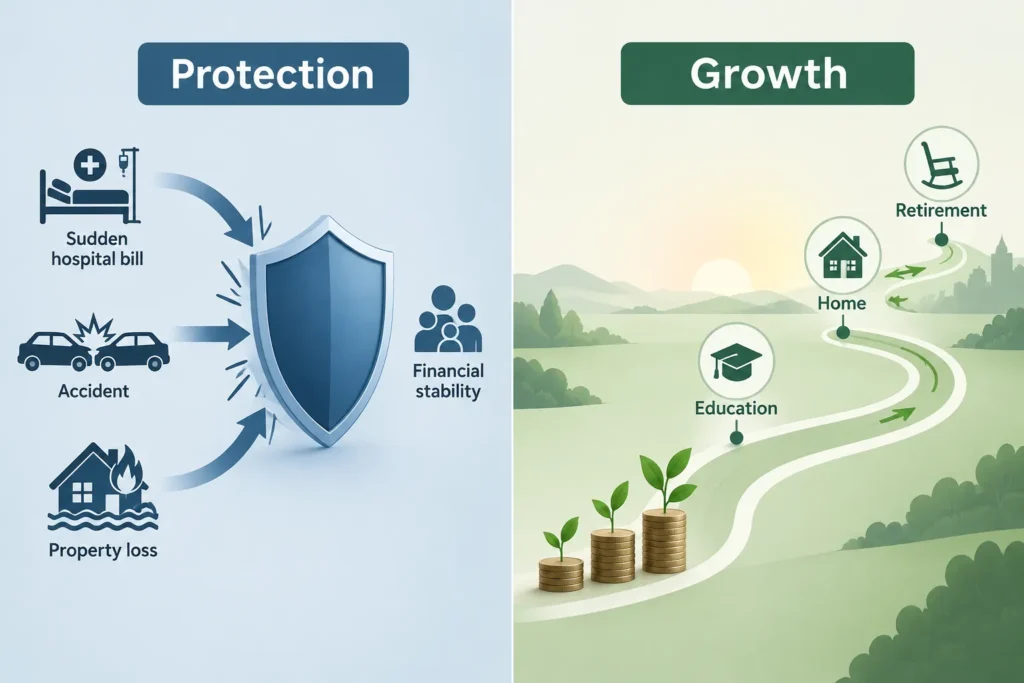
Visual comparison showing insurance for financial protection and investing for long-term wealth goals
Beginners sometimes treat insurance and investing as interchangeable. They are not.

Insurance protects against financial loss. You pay for a promise of financial support if a covered event occurs.

Investing builds wealth over time. You put money into assets such as equity mutual funds, debt instruments, fixed deposits or retirement products with the aim of funding future goals.

A health insurance premium does not need to generate a return to be useful. Its value lies in the protection offered during the policy period. Similarly, pure term insurance generally provides a death benefit if the insured person dies while the policy is active, but it usually does not pay a maturity amount if the person survives the term.

Some products combine insurance and investment. These can have more complex costs, benefits and conditions. Beginners should understand both components clearly before buying. A simple approach is often to assess protection needs separately from investment goals.

How an Uninsured Event Can Disrupt Your Finances

A large hospital bill can consume savings intended for a house deposit, education or retirement. It may also create debt at a time when the patient or caregiver cannot work normally.

The death of an earning family member can have an even wider impact. The household may lose income but still need to pay for rent, school fees, groceries, loan installments and long-term goals. Term life insurance is designed to address this income-protection risk, although its suitability and cover amount depend on the family’s circumstances.

Damage to an important asset can also affect daily life. A damaged car may disrupt commuting or work. Serious damage to a home can create repair and temporary accommodation costs. Insurance cannot remove the emotional or practical difficulty, but it can reduce the financial burden when the loss is covered.

This is why protection should be considered before taking excessive investment risk. A portfolio may be growing well, but one major uninsured event can force you to sell investments at an unsuitable time.

How to Decide Which Insurance You Need
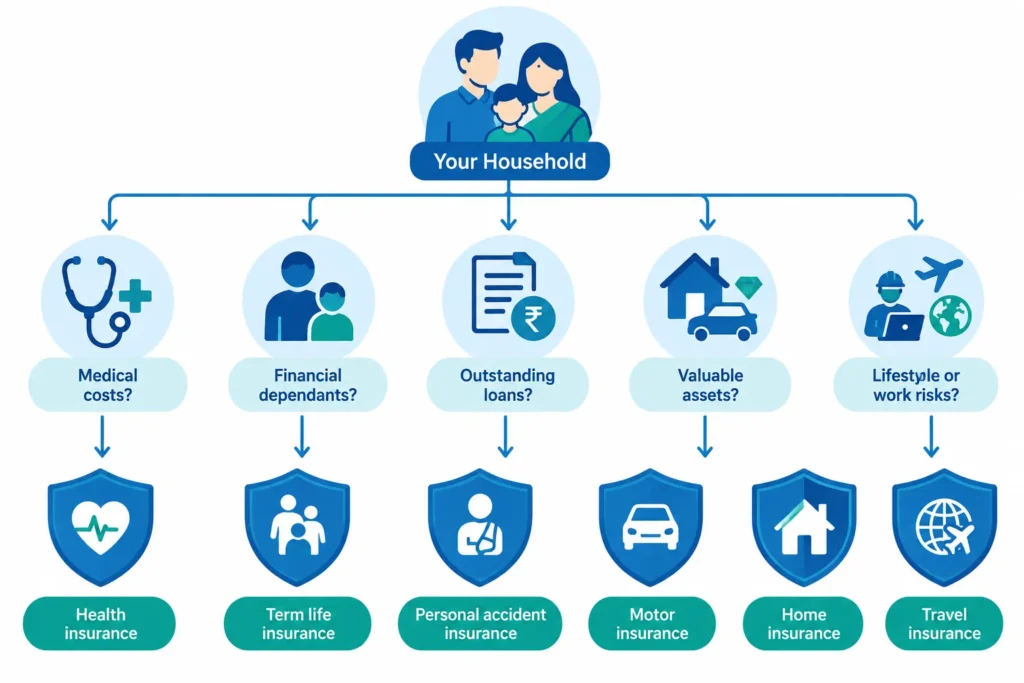
Flowchart matching health, dependants, loans, assets and lifestyle risks with suitable types of insurance
Do not begin by asking which policy an agent, colleague or relative bought. Start with your own financial responsibilities. The following checklist can help you identify important gaps.

1. Review Your Income

Ask who earns money in your household and how stable each income is. If your family relies heavily on one person’s salary or business income, the financial effect of that person’s death or disability could be significant.

Also consider whether a health problem could interrupt your income. A self-employed person may not receive paid medical leave, while a salaried employee may have limited leave and employer benefits.

2. Identify Your Dependents

Dependents may include children, a spouse without sufficient independent income, ageing parents or other relatives you support regularly.

The more people who rely on your income, the greater your potential need for life and health protection. Their future expenses, existing savings and ability to earn should also be considered.

3. List Your Liabilities

Write down outstanding loans, including a home loan, education loan, vehicle loan and large personal loan. Check whether your family could continue repayments if your income stopped.

A liability does not automatically determine how much insurance you need. However, it is an important part of the calculation because the debt may otherwise reduce the money available for your family’s living expenses and goals.

4. Check the Assets You Need to Protect

Consider your house, vehicle, business equipment and other valuable assets. Focus on assets whose loss or damage would create a serious financial problem, rather than trying to insure every possession.

5. Examine Employer Benefits

Your employer may provide group health insurance, group life cover or accident benefits. Find out the exact sum insured, who is covered, major restrictions and what happens when you resign, retire or lose the job.

Employer cover is useful, but it may not be fully under your control. Benefits can change, and the cover may end with employment. It should therefore be included in your review but not assumed to be permanent.

6. Consider Your Lifestyle and Responsibilities

Frequent driving, international travel, hazardous work or running a business may create additional risks. Your responsibilities can also change after marriage, childbirth, a home purchase, a career move or taking responsibility for parents.

Review your insurance after major life events and at regular intervals. The policy that was suitable when you were single may not be enough several years later.

You May Also Like:FD Calculator: Calculate Fixed Deposit Maturity and Interest

Health Insurance

Health insurance helps pay eligible medical expenses according to the policy terms. It is often one of the first types of insurance to consider because hospital treatment can be expensive and may be required unexpectedly.

Do not select a policy only by comparing premiums. A cheaper plan may have conditions that increase what you pay during a claim. Read the policy wording and benefit schedule carefully.

Individual and Family Floater Plans

An individual health policy gives each insured person a separate sum insured. This can be useful when family members have different health needs or when one person is more likely to require substantial treatment.

A family floater policy provides a shared sum insured for covered family members. For example, a couple and their children may use the same pool of cover. It can be convenient for a young family, but multiple claims in one policy year can reduce the amount available to other members.

Including older parents in the same floater may not always be suitable because age and health conditions can affect pricing and claim usage. Separate policies for parents may be worth evaluating.

Why Employer Health Cover May Not Be Enough

Employer health insurance can provide valuable support, especially if it includes dependents or parents. However, the sum insured may be lower than your family requires. There may also be sub-limits, co-payments or restrictions on certain treatments.

The cover normally depends on your employment. If you change jobs or face a gap between jobs, you may be without the same protection. Buying a personal policy while you are healthy may also help you complete applicable waiting periods earlier, subject to the insurer’s terms.

Important Policy Conditions to Check

  • Waiting periods: Certain illnesses, treatments or pre-existing diseases may be covered only after a specified period. Check the different waiting periods rather than assuming all conditions are covered immediately.
  • Exclusions: These are situations or expenses the policy does not cover. Permanent exclusions and treatment-specific restrictions deserve close attention.
  • Deductible: This is the amount you must pay before the insurer starts paying an eligible claim. Deductibles are common in top-up and super top-up plans, but the way they apply can differ.
  • Co-payment: Under a co-payment clause, you pay a stated portion of an admissible claim and the insurer pays the remaining eligible amount.
  • Room-rent conditions: A cap on room rent can affect your out-of-pocket cost. In some policies, choosing a room above the allowed category may also influence payment of associated hospital expenses.
  • Network hospitals: These hospitals may offer cashless claim facilities, subject to authorisation. Check whether suitable hospitals near your home and workplace are included.
  • Restoration benefit: This may restore some or all of the sum insured after it is used. Check when restoration applies, whether it can be used for the same illness and whether related conditions limit its use.

Cashless treatment does not mean every hospital expense will be paid. Non-medical items, excluded treatments, amounts above policy limits and other inadmissible costs may still have to be paid by the policyholder.

A Simple Indian Example

Consider Neha, a salaried employee in Pune. Her employer provides group health cover for her, her spouse and one child. Instead of assuming this is sufficient, she checks the sum insured, room eligibility, co-payment rules and nearby network hospitals.

Neha discovers that the policy will end if she leaves the company and that adding her retired parents provides only limited cover with a co-payment. She therefore compares a separate personal family floater for herself, her spouse and child, while reviewing individual policies for her parents.

She also checks waiting periods, exclusions and restoration rules before comparing premiums. This needs-based review helps her understand what the employer policy already covers, where the gaps are and which family members may need separate protection.

Term Life Insurance

Term life insurance is one of the most important types of insurance for people whose death could create financial difficulty for others. It pays the policy’s death benefit to the nominee if the insured person dies during the policy term, subject to the policy conditions.

Who may need term insurance?

You may need term insurance if your spouse, children, parents or other family members depend on your income. It can also be useful when you have major liabilities that your family may struggle to repay, such as a home loan.

A person with no financial dependants and no significant liabilities may have a lower immediate need for life cover. However, this position can change after marriage, parenthood or taking a large loan. Review your need when your responsibilities change.

How dependants and liabilities affect cover

The purpose of term insurance is to replace the financial support that would disappear after the policyholder’s death. When estimating the required cover, consider:

  • Regular household expenses that your income currently supports.
  • Outstanding loans and other major financial obligations.
  • Future goals such as a child’s education.
  • The number of years for which your family may need support.
  • Existing savings, investments and life insurance policies.
  • Any income your dependants earn independently.

A large cover amount is not automatically the right amount. It should reflect your family’s needs and remain affordable enough for you to continue paying the premiums.

Choosing the policy term

The policy term should generally cover the period during which your family depends heavily on your earnings or your major liabilities remain unpaid. For example, a parent with young children may want protection through their education years. A borrower may consider how long a home loan is expected to continue.

A very short term could end while financial responsibilities still exist. A much longer term may cost more and may not always be necessary. Compare the policy term with your expected working years, family goals and loan repayment schedule.

Nominees and disclosures

A nominee is the person named to receive the policy proceeds after the insured person’s death, subject to applicable rules and policy conditions. Provide accurate nominee details and update them after major life events such as marriage or the death of an existing nominee. Tell trusted family members that the policy exists and where its documents are kept.

Disclosures in the proposal form are equally important. Answer questions about health, occupation, income, smoking, alcohol use and existing policies truthfully. Do not ask an agent or another person to hide information or complete answers without checking them. Incorrect or incomplete information can create difficulties when a claim is assessed.

You May Also Like:Fixed vs Floating Interest Rate: What Borrowers Should Know

Term insurance is not a savings product

Pure term insurance is mainly designed to provide death protection. It generally does not build an investment value or pay a maturity benefit if the insured person survives the term, unless the chosen product specifically includes another feature.

Savings-linked life insurance combines insurance with a savings or investment element. Its premiums, benefits, charges and risks can be different. Compare protection and investment separately instead of assuming that every life insurance policy serves the same purpose.

Personal Accident Insurance

Personal accident insurance is designed for specified consequences of an accident. Depending on the policy, it may provide a benefit for accidental death, permanent total disability, permanent partial disability or certain temporary disabilities.

Disability protection is especially relevant because an accident can affect the ability to work while living costs continue. A self-employed electrician, delivery worker or shop owner, for example, may face a serious income problem if an injury prevents regular work.

How it differs from health and life insurance

  • Health insurance mainly covers eligible medical expenses according to its terms. It can cover illnesses as well as accidents, but it does not automatically replace income lost because of disability.
  • Life insurance pays the applicable death benefit when the insured person dies during the covered period, subject to policy conditions. It is not limited to accidental death unless the product says so.
  • Personal accident insurance focuses on covered accidental death or disability. It does not normally replace broad health or life cover.

Read the benefit schedule carefully. Some benefits are lump-sum payments, while others may depend on the type or severity of disability. Definitions, exclusions, waiting periods and documentation requirements vary across policies.

Motor Insurance

Motor insurance protects against certain financial risks connected with a car, two-wheeler or other insured vehicle. In India, third-party motor insurance is legally required for a vehicle used in a public place. This is different from protection for damage to your own vehicle.

Third-party cover

Third-party insurance addresses covered legal liability arising from injury, death or property damage involving another person. It does not pay for repairs to your own vehicle merely because you caused an accident or the vehicle was damaged.

Own-damage protection

Own-damage cover protects the insured vehicle against specified events, subject to policy conditions. These may include accidents, theft, fire or certain natural events. It can be purchased in a suitable policy structure along with the required third-party protection.

Before buying, check the insured declared value, deductibles, exclusions, claim process and available add-ons. Add-ons such as zero-depreciation or roadside assistance provide specific additional features, but they also increase the premium and have their own conditions.

Do not select a policy only because it is the cheapest option. Consider the cover provided, the vehicle’s age and value, how frequently it is used, and whether you could comfortably pay for major repairs yourself.

Home and Property Insurance

Home insurance can protect the building, household contents or both. These are separate risks, so it is important to know what the selected policy actually covers.

Building cover

Building insurance generally relates to the physical structure, such as walls, roof and permanent fixtures, against specified events. It may be relevant for homeowners, including people who have invested a large part of their savings in a house or flat.

The appropriate amount should be based on the basis stated in the policy, which may relate to reconstruction or reinstatement cost rather than the property’s market price. Land value is not the same as the cost of rebuilding the structure.

Contents cover

Contents insurance can cover eligible household possessions such as furniture, appliances and electronics against specified risks. It may be useful even when the building is covered separately by a housing society, landlord or lender.

Create a basic inventory of valuable items and keep bills, photographs or serial numbers where practical. Jewellery, artwork, cash and other high-value belongings may have special limits or may need separate declarations. Never assume that every possession is automatically covered.

Tenants may not need to insure a building they do not own, but they can consider protection for their own contents. Homeowners should check both structure and contents instead of treating “home insurance” as a single standard package.

Travel Insurance

Travel insurance covers selected risks during a domestic or international trip. It can be particularly useful when travelling to a country where medical treatment is expensive or where a sudden disruption could create a large unplanned cost.

Common areas of protection

  • Medical emergencies: Eligible treatment costs arising during the trip, subject to limits, exclusions and assistance procedures.
  • Trip disruption: Specified losses linked to cancellation, curtailment, delay or missed connections.
  • Baggage issues: Covered loss, theft or delay of checked baggage, usually with limits and documentation requirements.
  • Emergency assistance: Support services that may help coordinate treatment, evacuation or other covered emergencies.
You May Also Like:Home Loan EMI: How It Is Calculated and What Affects It

Travel policies vary widely. Pre-existing medical conditions, adventure sports, alcohol-related incidents, unattended baggage and travel against medical advice may be excluded or restricted. A claim may also require reports from the airline, police, hospital or another relevant authority.

Some destinations, visa categories, tour operators or educational institutions may require insurance meeting particular standards. Check the current requirement with the relevant official authority before travelling. Do not assume that any low-cost policy will satisfy it.

Match the policy to the destination, trip duration, traveller’s age, health needs and planned activities. Confirm the geographical area, medical limit, deductible and emergency contact process before departure. Keep the policy details accessible during the trip rather than only in luggage that could be lost.

Insurance You May Not Need

Insurance is useful when it protects you from a financial loss that would be difficult to handle on your own. However, buying more policies does not always mean better protection. Some covers may overlap, offer limited value or solve a risk that does not apply to you.

Overlapping or duplicate policies

Having multiple policies can be useful when each one serves a clear purpose. But duplicate coverage may add premiums without providing a meaningful benefit. For example, two personal accident policies may cover many of the same events, while certain claims may still be restricted by policy conditions.

Before buying another policy, compare it with your existing covers. Check the insured events, exclusions, claim limits and whether benefits can be claimed from more than one insurer.

Add-ons with limited value

Add-ons can expand a basic policy, but not every add-on is necessary. A motor insurance add-on that is useful for a new car may offer less value for an older vehicle. Similarly, a health insurance add-on may duplicate a benefit already included in your main policy.

Do not choose an add-on only because its premium looks small. Read what it covers, when it applies and how much it can actually pay.

Benefits already provided by your employer

Your employer may provide health, accident or life insurance. Buying an identical additional benefit without checking the employer policy can result in unnecessary overlap.

However, employer benefits should not automatically replace personal insurance. The cover may be limited, revised by the employer or end when you leave the job. Treat employer insurance as part of your existing coverage, not as permanent protection.

Insurance bought mainly as an investment

Some products combine life insurance with savings or investment features. They may suit certain needs, but they are not automatically suitable for everyone. Such products can have long commitments, limited flexibility and returns that depend on the product structure.

Beginners should first identify the main goal. If the goal is family protection, compare the product with pure term insurance. If the goal is wealth creation, compare it with suitable investment options. Understand costs, surrender rules, lock-ins and expected benefits before committing.

How Much Insurance Coverage Do You Need?
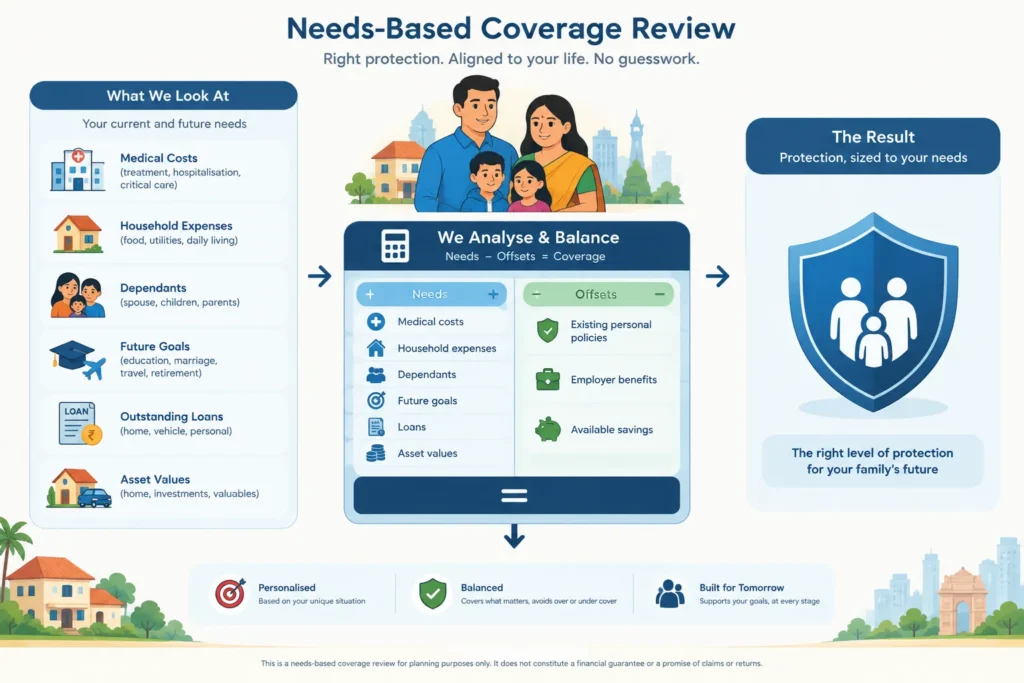
Calculator-style illustration of factors used to estimate insurance coverage needs
There is no single coverage amount that works for every person. Your needs depend on your family, income, location, loans, assets and existing policies. Use practical estimates rather than copying a round number from an advertisement or another person.

Estimating health insurance needs

Consider the possible cost of hospital treatment in your city and the type of hospital you are likely to use. Also account for the number and age of family members, existing illnesses, room-rent restrictions, co-payments and employer coverage.

A young couple in Pune may have different needs from a retired couple in Mumbai. Parents may also need a separate policy because including them in one family floater can affect the premium and the amount available to other members.

A base health policy combined with a super top-up may sometimes provide broader coverage at a manageable cost. However, understand the deductible and claim conditions before choosing this structure.

Estimating term insurance needs

Term insurance should focus on the money your dependants may require if your income stops permanently. Consider:

  • Regular household expenses that your income currently supports.
  • Future costs such as children’s education.
  • Outstanding home, personal or other major loans.
  • Financial support required by a spouse, parents or children.
  • Existing savings, investments and life insurance benefits.

Do not count every asset at its full value. Your family home, for example, may not be available for sale if dependants need to continue living there. Also consider inflation when estimating expenses that may arise many years later.

Covering vehicles, homes and other assets

Asset insurance should reflect the value that can be insured under the policy, not an emotional estimate. For motor insurance, understand the insured declared value and how depreciation affects it. For home insurance, separate the cost of rebuilding the structure from the market price of the land.

Make an inventory of important household contents if you are considering contents insurance. Keep bills, photographs and serial numbers where possible.

You May Also Like:The Complete Guide to Loans and EMIs in India

Subtract existing protection carefully

Include employer insurance and existing policies when reviewing your total cover, but recognise their limitations. A policy that may end with your job should not be treated as lifelong coverage. Similarly, savings meant for retirement should not be fully allocated to family protection if that would create another financial gap.

Common Insurance Mistakes to Avoid

  • Hiding medical or lifestyle details: Disclose illnesses, treatments, smoking habits and other information requested in the proposal form. Incorrect information can create problems during a claim.
  • Choosing only by premium: A low premium is not useful if the policy has restrictive limits, unsuitable exclusions or inadequate coverage.
  • Ignoring exclusions and waiting periods: Read when the policy will not pay. Health policies may have waiting periods, while accident policies may exclude certain activities or events.
  • Missing renewals: A lapsed policy can leave you uninsured. In health insurance, it may also affect continuity benefits. Set reminders and keep payment details current.
  • Depending entirely on employer cover: You may lose the benefit after resignation, retirement or a job loss. Personal coverage provides greater continuity.
  • Not updating nominees: Review nominees after marriage, divorce, a birth or a death in the family. Nomination helps with claim administration, though legal ownership may still depend on applicable succession rules.
  • Letting someone else complete the form without checking it: Review all answers and declarations before signing or submitting the proposal.
  • Not keeping family members informed: Your family should know which policies exist, where documents are stored and how to contact the insurer.

How Insurance Fits Into Your Overall Financial Plan

Insurance is the protection layer of a financial plan. It does not replace savings, investing or responsible borrowing. Instead, it helps prevent a major medical event, death, accident or asset loss from disrupting your other goals.

Build an emergency fund

Insurance claims may not cover every expense, and reimbursement can take time. An emergency fund can pay deductibles, excluded expenses and immediate household bills. Keep it accessible rather than investing the entire amount in volatile assets.

Include premiums in your budget

Choose policies whose premiums you can continue paying. A large policy that lapses because it is unaffordable may be less useful than sustainable coverage selected after careful comparison. Account for possible premium increases, especially for health insurance.

Balance insurance with debt repayment and investing

Protect major risks first, then continue repaying expensive debt and investing for future goals. Do not stop retirement investing merely to purchase every optional cover. At the same time, avoid building an investment portfolio while leaving dependants exposed to an obvious protection gap.

Review the plan periodically

Review your types of insurance at least periodically and after major life events. Marriage, a new child, a home loan, a job change, retirement or a major increase in income can alter your needs. Check coverage, nominees, contact details, exclusions and policy documents during each review.

Frequently Asked Questions About Insurance

Can I buy more than one insurance policy?

Yes. You can hold multiple policies, but claim rules vary by product. Health indemnity policies generally reimburse eligible expenses rather than create a profit, while some benefit-based policies pay a fixed amount. Disclose existing coverage when the proposal form asks for it.

Is employer health insurance enough?

It may be helpful, but it is not always sufficient. Check the sum insured, family coverage, room limits and exclusions. A personal policy can provide continuity when you change jobs or retire.

Is health insurance the same as personal accident insurance?

No. Health insurance generally covers eligible hospitalisation and medical expenses under its terms. Personal accident insurance focuses on accidental death or disability. One does not automatically replace the other.

Do people without dependants need term insurance?

Not always. If nobody depends on your income and you have no major obligations, term insurance may be a lower priority. It may become relevant if you expect future dependants, have a co-borrowed loan or financially support parents.

How often should I review my policies?

Review them periodically and whenever your family, income, debts, job or health situation changes. Also check renewal notices and revised policy terms each year.

How should I choose an insurer?

Look beyond promotions and premium discounts. Compare policy wording, suitability, exclusions, service channels, hospital or garage networks where relevant, and the claim process. Choose based on your needs and comfort with the contract.

Summary

A sensible insurance plan covers major financial risks without collecting unnecessary policies. Estimate coverage using medical costs, dependants’ needs, loans, income replacement, asset values and existing benefits. Disclose information honestly, read exclusions, renew on time and keep nominees updated. Finally, combine insurance with an emergency fund, a workable budget, debt repayment and long-term investing, and review the plan as your life changes.


Share this article
KEEP READING

Related Articles

View all →

Comments

Leave a Comment

Types of Insurance You May Need: Health, Term and Other Covers

The main types of insurance protect your health, income, family and valuable assets from large financial shocks. For most people in India, health insurance is a priority. Term life insurance becomes important when others depend on your income or you have major liabilities. Other covers may be useful depending on the assets you own, your work and your lifestyle.

Insurance is not meant to make you rich. Its main purpose is to prevent an unexpected event from damaging years of savings or forcing your family into debt.

However, not everyone needs every policy. A young professional living with financially independent parents may have different requirements from a married person with children and a home loan. The right approach is to identify your risks first and then choose suitable protection.

Why Insurance Is an Important Part of Financial Planning

Financial planning is not only about saving and investing. It also involves protecting what you already have and making sure that your important goals can continue even when something goes wrong.

Insurance works through risk transfer. You pay a premium to an insurance company. In return, the insurer agrees to cover specified financial losses according to the policy terms.

For example, suppose a hospital treatment costs several lakh rupees. Without health insurance, you may have to use your emergency fund, withdraw investments or borrow money. With suitable health insurance, the insurer may pay eligible expenses, subject to the sum insured and policy conditions.

Insurance can be useful when a risk has two features:

  • The event may or may not happen.
  • If it happens, the financial impact could be difficult to manage from regular income or savings.

Common examples include a serious illness, the death of an earning family member, a major road accident, fire damage to a house or theft of an insured vehicle.

Insurance and Investing Serve Different Purposes

Visual comparison showing insurance for financial protection and investing for long-term wealth goals
Beginners sometimes treat insurance and investing as interchangeable. They are not.

Insurance protects against financial loss. You pay for a promise of financial support if a covered event occurs.

Investing builds wealth over time. You put money into assets such as equity mutual funds, debt instruments, fixed deposits or retirement products with the aim of funding future goals.

A health insurance premium does not need to generate a return to be useful. Its value lies in the protection offered during the policy period. Similarly, pure term insurance generally provides a death benefit if the insured person dies while the policy is active, but it usually does not pay a maturity amount if the person survives the term.

Some products combine insurance and investment. These can have more complex costs, benefits and conditions. Beginners should understand both components clearly before buying. A simple approach is often to assess protection needs separately from investment goals.

How an Uninsured Event Can Disrupt Your Finances

A large hospital bill can consume savings intended for a house deposit, education or retirement. It may also create debt at a time when the patient or caregiver cannot work normally.

The death of an earning family member can have an even wider impact. The household may lose income but still need to pay for rent, school fees, groceries, loan installments and long-term goals. Term life insurance is designed to address this income-protection risk, although its suitability and cover amount depend on the family’s circumstances.

Damage to an important asset can also affect daily life. A damaged car may disrupt commuting or work. Serious damage to a home can create repair and temporary accommodation costs. Insurance cannot remove the emotional or practical difficulty, but it can reduce the financial burden when the loss is covered.

This is why protection should be considered before taking excessive investment risk. A portfolio may be growing well, but one major uninsured event can force you to sell investments at an unsuitable time.

How to Decide Which Insurance You Need

Flowchart matching health, dependants, loans, assets and lifestyle risks with suitable types of insurance
Do not begin by asking which policy an agent, colleague or relative bought. Start with your own financial responsibilities. The following checklist can help you identify important gaps.

1. Review Your Income

Ask who earns money in your household and how stable each income is. If your family relies heavily on one person’s salary or business income, the financial effect of that person’s death or disability could be significant.

Also consider whether a health problem could interrupt your income. A self-employed person may not receive paid medical leave, while a salaried employee may have limited leave and employer benefits.

2. Identify Your Dependents

Dependents may include children, a spouse without sufficient independent income, ageing parents or other relatives you support regularly.

The more people who rely on your income, the greater your potential need for life and health protection. Their future expenses, existing savings and ability to earn should also be considered.

3. List Your Liabilities

Write down outstanding loans, including a home loan, education loan, vehicle loan and large personal loan. Check whether your family could continue repayments if your income stopped.

A liability does not automatically determine how much insurance you need. However, it is an important part of the calculation because the debt may otherwise reduce the money available for your family’s living expenses and goals.

4. Check the Assets You Need to Protect

Consider your house, vehicle, business equipment and other valuable assets. Focus on assets whose loss or damage would create a serious financial problem, rather than trying to insure every possession.

5. Examine Employer Benefits

Your employer may provide group health insurance, group life cover or accident benefits. Find out the exact sum insured, who is covered, major restrictions and what happens when you resign, retire or lose the job.

Employer cover is useful, but it may not be fully under your control. Benefits can change, and the cover may end with employment. It should therefore be included in your review but not assumed to be permanent.

6. Consider Your Lifestyle and Responsibilities

Frequent driving, international travel, hazardous work or running a business may create additional risks. Your responsibilities can also change after marriage, childbirth, a home purchase, a career move or taking responsibility for parents.

Review your insurance after major life events and at regular intervals. The policy that was suitable when you were single may not be enough several years later.

Health Insurance

Health insurance helps pay eligible medical expenses according to the policy terms. It is often one of the first types of insurance to consider because hospital treatment can be expensive and may be required unexpectedly.

Do not select a policy only by comparing premiums. A cheaper plan may have conditions that increase what you pay during a claim. Read the policy wording and benefit schedule carefully.

Individual and Family Floater Plans

An individual health policy gives each insured person a separate sum insured. This can be useful when family members have different health needs or when one person is more likely to require substantial treatment.

A family floater policy provides a shared sum insured for covered family members. For example, a couple and their children may use the same pool of cover. It can be convenient for a young family, but multiple claims in one policy year can reduce the amount available to other members.

Including older parents in the same floater may not always be suitable because age and health conditions can affect pricing and claim usage. Separate policies for parents may be worth evaluating.

Why Employer Health Cover May Not Be Enough

Employer health insurance can provide valuable support, especially if it includes dependents or parents. However, the sum insured may be lower than your family requires. There may also be sub-limits, co-payments or restrictions on certain treatments.

The cover normally depends on your employment. If you change jobs or face a gap between jobs, you may be without the same protection. Buying a personal policy while you are healthy may also help you complete applicable waiting periods earlier, subject to the insurer’s terms.

Important Policy Conditions to Check

  • Waiting periods: Certain illnesses, treatments or pre-existing diseases may be covered only after a specified period. Check the different waiting periods rather than assuming all conditions are covered immediately.
  • Exclusions: These are situations or expenses the policy does not cover. Permanent exclusions and treatment-specific restrictions deserve close attention.
  • Deductible: This is the amount you must pay before the insurer starts paying an eligible claim. Deductibles are common in top-up and super top-up plans, but the way they apply can differ.
  • Co-payment: Under a co-payment clause, you pay a stated portion of an admissible claim and the insurer pays the remaining eligible amount.
  • Room-rent conditions: A cap on room rent can affect your out-of-pocket cost. In some policies, choosing a room above the allowed category may also influence payment of associated hospital expenses.
  • Network hospitals: These hospitals may offer cashless claim facilities, subject to authorisation. Check whether suitable hospitals near your home and workplace are included.
  • Restoration benefit: This may restore some or all of the sum insured after it is used. Check when restoration applies, whether it can be used for the same illness and whether related conditions limit its use.

Cashless treatment does not mean every hospital expense will be paid. Non-medical items, excluded treatments, amounts above policy limits and other inadmissible costs may still have to be paid by the policyholder.

A Simple Indian Example

Consider Neha, a salaried employee in Pune. Her employer provides group health cover for her, her spouse and one child. Instead of assuming this is sufficient, she checks the sum insured, room eligibility, co-payment rules and nearby network hospitals.

Neha discovers that the policy will end if she leaves the company and that adding her retired parents provides only limited cover with a co-payment. She therefore compares a separate personal family floater for herself, her spouse and child, while reviewing individual policies for her parents.

She also checks waiting periods, exclusions and restoration rules before comparing premiums. This needs-based review helps her understand what the employer policy already covers, where the gaps are and which family members may need separate protection.

Term Life Insurance

Term life insurance is one of the most important types of insurance for people whose death could create financial difficulty for others. It pays the policy’s death benefit to the nominee if the insured person dies during the policy term, subject to the policy conditions.

Who may need term insurance?

You may need term insurance if your spouse, children, parents or other family members depend on your income. It can also be useful when you have major liabilities that your family may struggle to repay, such as a home loan.

A person with no financial dependants and no significant liabilities may have a lower immediate need for life cover. However, this position can change after marriage, parenthood or taking a large loan. Review your need when your responsibilities change.

How dependants and liabilities affect cover

The purpose of term insurance is to replace the financial support that would disappear after the policyholder’s death. When estimating the required cover, consider:

  • Regular household expenses that your income currently supports.
  • Outstanding loans and other major financial obligations.
  • Future goals such as a child’s education.
  • The number of years for which your family may need support.
  • Existing savings, investments and life insurance policies.
  • Any income your dependants earn independently.

A large cover amount is not automatically the right amount. It should reflect your family’s needs and remain affordable enough for you to continue paying the premiums.

Choosing the policy term

The policy term should generally cover the period during which your family depends heavily on your earnings or your major liabilities remain unpaid. For example, a parent with young children may want protection through their education years. A borrower may consider how long a home loan is expected to continue.

A very short term could end while financial responsibilities still exist. A much longer term may cost more and may not always be necessary. Compare the policy term with your expected working years, family goals and loan repayment schedule.

Nominees and disclosures

A nominee is the person named to receive the policy proceeds after the insured person’s death, subject to applicable rules and policy conditions. Provide accurate nominee details and update them after major life events such as marriage or the death of an existing nominee. Tell trusted family members that the policy exists and where its documents are kept.

Disclosures in the proposal form are equally important. Answer questions about health, occupation, income, smoking, alcohol use and existing policies truthfully. Do not ask an agent or another person to hide information or complete answers without checking them. Incorrect or incomplete information can create difficulties when a claim is assessed.

Term insurance is not a savings product

Pure term insurance is mainly designed to provide death protection. It generally does not build an investment value or pay a maturity benefit if the insured person survives the term, unless the chosen product specifically includes another feature.

Savings-linked life insurance combines insurance with a savings or investment element. Its premiums, benefits, charges and risks can be different. Compare protection and investment separately instead of assuming that every life insurance policy serves the same purpose.

Personal Accident Insurance

Personal accident insurance is designed for specified consequences of an accident. Depending on the policy, it may provide a benefit for accidental death, permanent total disability, permanent partial disability or certain temporary disabilities.

Disability protection is especially relevant because an accident can affect the ability to work while living costs continue. A self-employed electrician, delivery worker or shop owner, for example, may face a serious income problem if an injury prevents regular work.

How it differs from health and life insurance

  • Health insurance mainly covers eligible medical expenses according to its terms. It can cover illnesses as well as accidents, but it does not automatically replace income lost because of disability.
  • Life insurance pays the applicable death benefit when the insured person dies during the covered period, subject to policy conditions. It is not limited to accidental death unless the product says so.
  • Personal accident insurance focuses on covered accidental death or disability. It does not normally replace broad health or life cover.

Read the benefit schedule carefully. Some benefits are lump-sum payments, while others may depend on the type or severity of disability. Definitions, exclusions, waiting periods and documentation requirements vary across policies.

Motor Insurance

Motor insurance protects against certain financial risks connected with a car, two-wheeler or other insured vehicle. In India, third-party motor insurance is legally required for a vehicle used in a public place. This is different from protection for damage to your own vehicle.

Third-party cover

Third-party insurance addresses covered legal liability arising from injury, death or property damage involving another person. It does not pay for repairs to your own vehicle merely because you caused an accident or the vehicle was damaged.

Own-damage protection

Own-damage cover protects the insured vehicle against specified events, subject to policy conditions. These may include accidents, theft, fire or certain natural events. It can be purchased in a suitable policy structure along with the required third-party protection.

Before buying, check the insured declared value, deductibles, exclusions, claim process and available add-ons. Add-ons such as zero-depreciation or roadside assistance provide specific additional features, but they also increase the premium and have their own conditions.

Do not select a policy only because it is the cheapest option. Consider the cover provided, the vehicle’s age and value, how frequently it is used, and whether you could comfortably pay for major repairs yourself.

Home and Property Insurance

Home insurance can protect the building, household contents or both. These are separate risks, so it is important to know what the selected policy actually covers.

Building cover

Building insurance generally relates to the physical structure, such as walls, roof and permanent fixtures, against specified events. It may be relevant for homeowners, including people who have invested a large part of their savings in a house or flat.

The appropriate amount should be based on the basis stated in the policy, which may relate to reconstruction or reinstatement cost rather than the property’s market price. Land value is not the same as the cost of rebuilding the structure.

Contents cover

Contents insurance can cover eligible household possessions such as furniture, appliances and electronics against specified risks. It may be useful even when the building is covered separately by a housing society, landlord or lender.

Create a basic inventory of valuable items and keep bills, photographs or serial numbers where practical. Jewellery, artwork, cash and other high-value belongings may have special limits or may need separate declarations. Never assume that every possession is automatically covered.

Tenants may not need to insure a building they do not own, but they can consider protection for their own contents. Homeowners should check both structure and contents instead of treating “home insurance” as a single standard package.

Travel Insurance

Travel insurance covers selected risks during a domestic or international trip. It can be particularly useful when travelling to a country where medical treatment is expensive or where a sudden disruption could create a large unplanned cost.

Common areas of protection

  • Medical emergencies: Eligible treatment costs arising during the trip, subject to limits, exclusions and assistance procedures.
  • Trip disruption: Specified losses linked to cancellation, curtailment, delay or missed connections.
  • Baggage issues: Covered loss, theft or delay of checked baggage, usually with limits and documentation requirements.
  • Emergency assistance: Support services that may help coordinate treatment, evacuation or other covered emergencies.

Travel policies vary widely. Pre-existing medical conditions, adventure sports, alcohol-related incidents, unattended baggage and travel against medical advice may be excluded or restricted. A claim may also require reports from the airline, police, hospital or another relevant authority.

Some destinations, visa categories, tour operators or educational institutions may require insurance meeting particular standards. Check the current requirement with the relevant official authority before travelling. Do not assume that any low-cost policy will satisfy it.

Match the policy to the destination, trip duration, traveller’s age, health needs and planned activities. Confirm the geographical area, medical limit, deductible and emergency contact process before departure. Keep the policy details accessible during the trip rather than only in luggage that could be lost.

Insurance You May Not Need

Insurance is useful when it protects you from a financial loss that would be difficult to handle on your own. However, buying more policies does not always mean better protection. Some covers may overlap, offer limited value or solve a risk that does not apply to you.

Overlapping or duplicate policies

Having multiple policies can be useful when each one serves a clear purpose. But duplicate coverage may add premiums without providing a meaningful benefit. For example, two personal accident policies may cover many of the same events, while certain claims may still be restricted by policy conditions.

Before buying another policy, compare it with your existing covers. Check the insured events, exclusions, claim limits and whether benefits can be claimed from more than one insurer.

Add-ons with limited value

Add-ons can expand a basic policy, but not every add-on is necessary. A motor insurance add-on that is useful for a new car may offer less value for an older vehicle. Similarly, a health insurance add-on may duplicate a benefit already included in your main policy.

Do not choose an add-on only because its premium looks small. Read what it covers, when it applies and how much it can actually pay.

Benefits already provided by your employer

Your employer may provide health, accident or life insurance. Buying an identical additional benefit without checking the employer policy can result in unnecessary overlap.

However, employer benefits should not automatically replace personal insurance. The cover may be limited, revised by the employer or end when you leave the job. Treat employer insurance as part of your existing coverage, not as permanent protection.

Insurance bought mainly as an investment

Some products combine life insurance with savings or investment features. They may suit certain needs, but they are not automatically suitable for everyone. Such products can have long commitments, limited flexibility and returns that depend on the product structure.

Beginners should first identify the main goal. If the goal is family protection, compare the product with pure term insurance. If the goal is wealth creation, compare it with suitable investment options. Understand costs, surrender rules, lock-ins and expected benefits before committing.

How Much Insurance Coverage Do You Need?

Calculator-style illustration of factors used to estimate insurance coverage needs
There is no single coverage amount that works for every person. Your needs depend on your family, income, location, loans, assets and existing policies. Use practical estimates rather than copying a round number from an advertisement or another person.

Estimating health insurance needs

Consider the possible cost of hospital treatment in your city and the type of hospital you are likely to use. Also account for the number and age of family members, existing illnesses, room-rent restrictions, co-payments and employer coverage.

A young couple in Pune may have different needs from a retired couple in Mumbai. Parents may also need a separate policy because including them in one family floater can affect the premium and the amount available to other members.

A base health policy combined with a super top-up may sometimes provide broader coverage at a manageable cost. However, understand the deductible and claim conditions before choosing this structure.

Estimating term insurance needs

Term insurance should focus on the money your dependants may require if your income stops permanently. Consider:

  • Regular household expenses that your income currently supports.
  • Future costs such as children’s education.
  • Outstanding home, personal or other major loans.
  • Financial support required by a spouse, parents or children.
  • Existing savings, investments and life insurance benefits.

Do not count every asset at its full value. Your family home, for example, may not be available for sale if dependants need to continue living there. Also consider inflation when estimating expenses that may arise many years later.

Covering vehicles, homes and other assets

Asset insurance should reflect the value that can be insured under the policy, not an emotional estimate. For motor insurance, understand the insured declared value and how depreciation affects it. For home insurance, separate the cost of rebuilding the structure from the market price of the land.

Make an inventory of important household contents if you are considering contents insurance. Keep bills, photographs and serial numbers where possible.

Subtract existing protection carefully

Include employer insurance and existing policies when reviewing your total cover, but recognise their limitations. A policy that may end with your job should not be treated as lifelong coverage. Similarly, savings meant for retirement should not be fully allocated to family protection if that would create another financial gap.

Common Insurance Mistakes to Avoid

  • Hiding medical or lifestyle details: Disclose illnesses, treatments, smoking habits and other information requested in the proposal form. Incorrect information can create problems during a claim.
  • Choosing only by premium: A low premium is not useful if the policy has restrictive limits, unsuitable exclusions or inadequate coverage.
  • Ignoring exclusions and waiting periods: Read when the policy will not pay. Health policies may have waiting periods, while accident policies may exclude certain activities or events.
  • Missing renewals: A lapsed policy can leave you uninsured. In health insurance, it may also affect continuity benefits. Set reminders and keep payment details current.
  • Depending entirely on employer cover: You may lose the benefit after resignation, retirement or a job loss. Personal coverage provides greater continuity.
  • Not updating nominees: Review nominees after marriage, divorce, a birth or a death in the family. Nomination helps with claim administration, though legal ownership may still depend on applicable succession rules.
  • Letting someone else complete the form without checking it: Review all answers and declarations before signing or submitting the proposal.
  • Not keeping family members informed: Your family should know which policies exist, where documents are stored and how to contact the insurer.

How Insurance Fits Into Your Overall Financial Plan

Insurance is the protection layer of a financial plan. It does not replace savings, investing or responsible borrowing. Instead, it helps prevent a major medical event, death, accident or asset loss from disrupting your other goals.

Build an emergency fund

Insurance claims may not cover every expense, and reimbursement can take time. An emergency fund can pay deductibles, excluded expenses and immediate household bills. Keep it accessible rather than investing the entire amount in volatile assets.

Include premiums in your budget

Choose policies whose premiums you can continue paying. A large policy that lapses because it is unaffordable may be less useful than sustainable coverage selected after careful comparison. Account for possible premium increases, especially for health insurance.

Balance insurance with debt repayment and investing

Protect major risks first, then continue repaying expensive debt and investing for future goals. Do not stop retirement investing merely to purchase every optional cover. At the same time, avoid building an investment portfolio while leaving dependants exposed to an obvious protection gap.

Review the plan periodically

Review your types of insurance at least periodically and after major life events. Marriage, a new child, a home loan, a job change, retirement or a major increase in income can alter your needs. Check coverage, nominees, contact details, exclusions and policy documents during each review.

Frequently Asked Questions About Insurance

Can I buy more than one insurance policy?

Yes. You can hold multiple policies, but claim rules vary by product. Health indemnity policies generally reimburse eligible expenses rather than create a profit, while some benefit-based policies pay a fixed amount. Disclose existing coverage when the proposal form asks for it.

Is employer health insurance enough?

It may be helpful, but it is not always sufficient. Check the sum insured, family coverage, room limits and exclusions. A personal policy can provide continuity when you change jobs or retire.

Is health insurance the same as personal accident insurance?

No. Health insurance generally covers eligible hospitalisation and medical expenses under its terms. Personal accident insurance focuses on accidental death or disability. One does not automatically replace the other.

Do people without dependants need term insurance?

Not always. If nobody depends on your income and you have no major obligations, term insurance may be a lower priority. It may become relevant if you expect future dependants, have a co-borrowed loan or financially support parents.

How often should I review my policies?

Review them periodically and whenever your family, income, debts, job or health situation changes. Also check renewal notices and revised policy terms each year.

How should I choose an insurer?

Look beyond promotions and premium discounts. Compare policy wording, suitability, exclusions, service channels, hospital or garage networks where relevant, and the claim process. Choose based on your needs and comfort with the contract.

Summary

A sensible insurance plan covers major financial risks without collecting unnecessary policies. Estimate coverage using medical costs, dependants’ needs, loans, income replacement, asset values and existing benefits. Disclose information honestly, read exclusions, renew on time and keep nominees updated. Finally, combine insurance with an emergency fund, a workable budget, debt repayment and long-term investing, and review the plan as your life changes.
Leave a Comment