


How to Start Investing in India: A Beginner’s Guide

A practical guide for Indian beginners covering financial preparation, investment risk, popular options, goal-based investing and regular portfolio reviews.

How to Start Investing in India: A Beginner’s Guide

To learn how to start investing in India, first organise your finances. Set clear goals, prepare a monthly budget, build an emergency fund and repay high-cost debt. Then assess how much risk you can realistically take and how long you can leave the money invested.

If you are planning a loan alongside your savings goals, you can use our EMI Calculator to estimate monthly repayments and total interest.

Do not choose an investment only because it recently gave high returns. The right choice depends on your income stability, family responsibilities, need for quick access to money and ability to handle losses. Investing should support your financial goals without putting essential expenses at risk.

Introduction

Starting your investment journey can feel confusing. You may hear about mutual funds, shares, fixed deposits, gold, property and many other options. Friends, relatives and social media may also offer conflicting suggestions.

The good news is that you do not need to understand every product before taking the first step. A beginner should first understand what investing means and prepare a stable financial base. Product selection comes later.

This preparation matters because investments can rise and fall in value. If you invest money that may be needed for next month’s rent, a medical emergency or an upcoming loan payment, you could be forced to withdraw at the wrong time.

Let us begin with the essential investing basics and the financial checks you should complete before putting your money into an investment.

Investing Basics and Financial Preparation

What Does Investing Mean?

Investing means putting money into an asset with the expectation that it may grow in value or generate income over time. Examples include bank fixed deposits, bonds, mutual funds, shares, gold and property.

However, expected growth is not guaranteed growth. Every investment has some form of uncertainty. The value may fluctuate, returns may be lower than expected, or you may have difficulty accessing the money when you need it.

Investing is generally more useful for medium-term and long-term goals than for immediate expenses. For example, someone may invest for a child’s higher education after 12 years or for retirement after 25 years. Money required for electricity bills next month should not normally depend on uncertain market returns.

Saving Versus Investing

Saving and investing are related, but they serve different purposes.

Point Saving Investing
Main purpose Safety and easy access Potential growth or income
Typical use Emergencies and near-term expenses Medium-term and long-term goals
Common examples Savings account and accessible bank deposit Mutual funds, shares, bonds, gold and property
Uncertainty Usually lower, depending on the product Varies from low to very high

Suppose Priya keeps ₹60,000 in a savings account for emergencies. That money is primarily a safety reserve. If she separately puts ₹5,000 each month into an investment for a goal ten years away, she is accepting some uncertainty in return for the possibility of long-term growth.

Saving is not inferior to investing. Both are necessary. Savings protect your short-term financial stability, while suitable investments may help you work towards future goals.

Why Inflation Matters

Inflation means that the general cost of goods and services rises over time. When prices increase, the same amount of money buys less.

For example, imagine that a course costs ₹1 lakh today. If education costs rise over the years, ₹1 lakh may not be enough to pay for a similar course in the future. Simply preserving the original amount may therefore be insufficient for a long-term goal.

This is one reason people invest. They seek returns that may help their money keep pace with rising costs. But no investment can promise that it will always beat inflation. Returns, taxes, charges and the type of asset all affect the final result.

Why Investing Involves Uncertainty

Investment returns depend on future events. Interest rates can change, businesses can perform poorly, markets can fall and property may take time to sell. Even an investment considered relatively stable may have limits, such as a lock-in period or a return that does not keep pace with inflation.

Risk is not limited to losing money in the share market. It can also include:

  • Receiving returns that are lower than inflation.
  • Being unable to withdraw money when it is needed.
  • Depending too heavily on one company, asset or property.
  • Taking a loan to invest and then struggling with repayments.
  • Selling during a temporary fall because the investment feels too stressful.

A sensible beginner accepts that uncertainty exists and plans for it. The aim is not to find a completely risk-free path. It is to take only the types and levels of risk that fit your situation.

Before You Start Investing
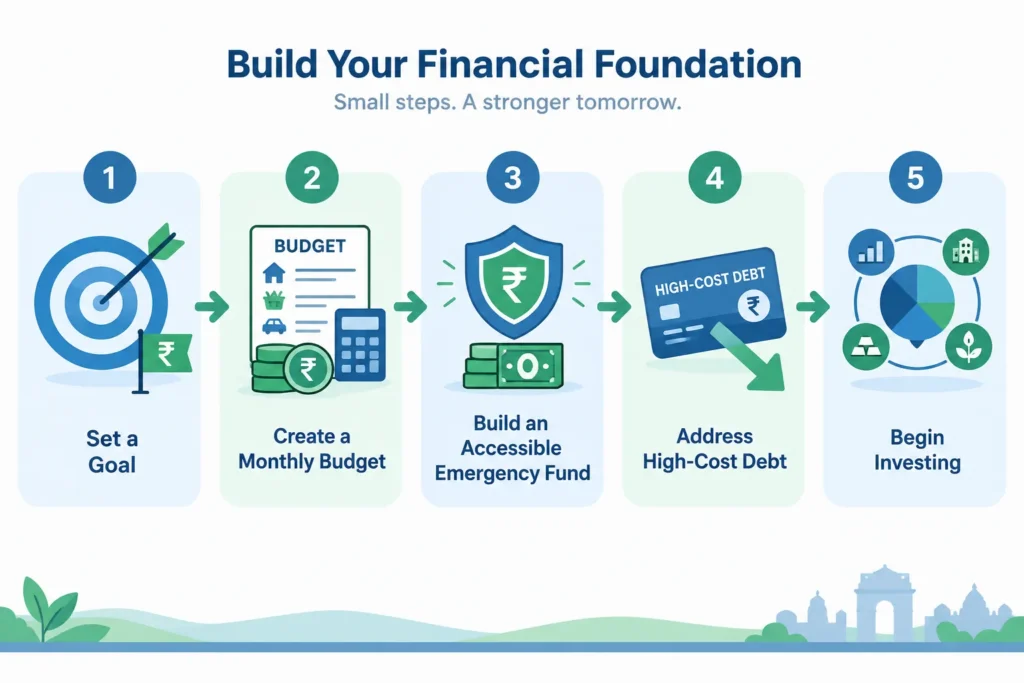
Flowchart showing goals, budgeting, emergency savings and debt management before investing.

Before investing, check whether your basic finances are ready. This does not mean that everything must be perfect. It means that investing should not weaken your ability to meet essential commitments.

1. Set Clear Financial Goals

A goal gives your investment a purpose. Write down what you need the money for, the estimated amount and when you may need it.

For example, “I want to invest more” is vague. “I want to prepare ₹4 lakh for a professional course in four years” is more useful. It gives you a target amount and an investment horizon.

Common goals may include:

  • Building a house down payment.
  • Paying for higher education.
  • Starting a business.
  • Preparing for retirement.
  • Buying a vehicle.

Keep near-term goals separate from long-term goals. Money needed next year generally requires more stability and accessibility than money meant for retirement several decades away.

2. Make a Practical Budget

A budget shows how much you can invest consistently without borrowing for regular expenses. Start with monthly take-home income, then list essential expenses, loan payments, insurance premiums and other commitments.

Use a realistic amount rather than an ambitious number that leaves no room for irregular costs. If ₹3,000 per month is comfortable, starting with ₹3,000 can be better than committing ₹10,000 and stopping after two months.

People with variable income, such as freelancers or small business owners, may need extra flexibility. They can estimate essential monthly costs, maintain a larger cash buffer and invest more during stronger income months instead of assuming a fixed salary.

You May Also Like:What Is a SIP? How Systematic Investment Plans Work in India

3. Build an Accessible Emergency Fund

An emergency fund is money reserved for unexpected but necessary expenses, such as urgent medical costs, temporary job loss or an essential home repair. It should be kept somewhere reasonably safe and easy to access.

The appropriate amount depends on your circumstances. Someone with a stable salary, no dependants and good insurance may need a different buffer from a self-employed parent supporting a family.

Do not place the entire emergency fund in assets that can fall sharply or take a long time to sell. If an emergency happens during a market decline, you should not have to sell a long-term investment at a loss merely to pay essential bills.

4. Address High-Cost Debt

High-interest debt can work against your investment progress. Credit card balances and some personal loans may charge substantial interest. If your investment earns less than the cost of the debt, your overall financial position may still worsen.

Consider prioritising expensive debt before making aggressive investments. Continue required repayments on all loans and understand any prepayment conditions before paying extra.

Not every loan must always be cleared before any investment. A home loan, for example, differs from revolving credit card debt. The decision depends on the interest cost, repayment security, tax considerations, available emergency savings and your wider financial situation.

Understand Your Investment Risk
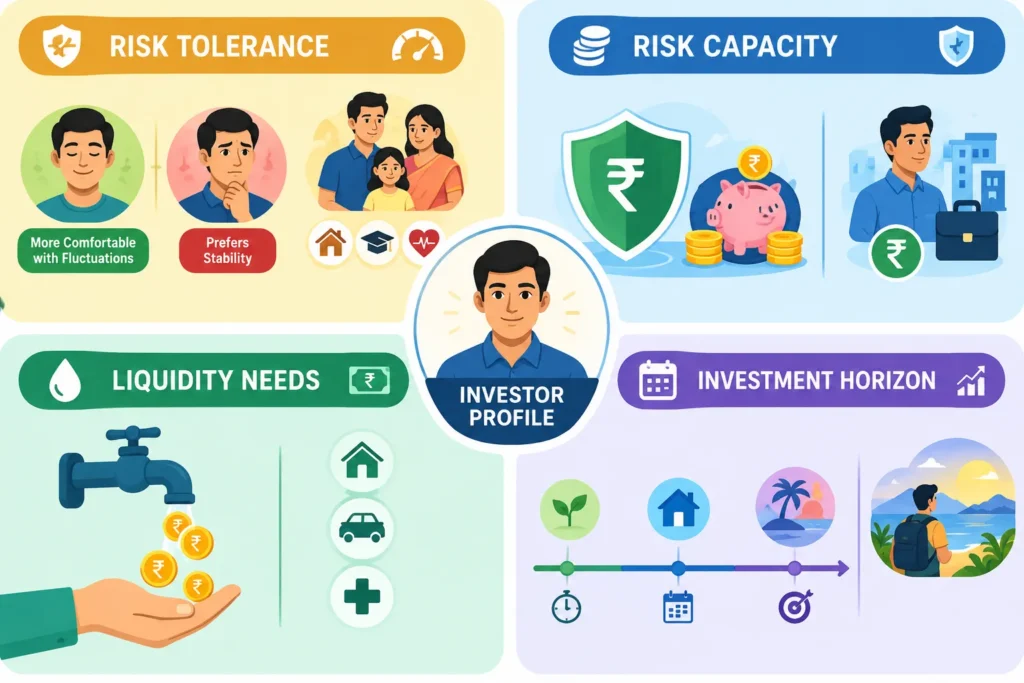
Diagram of risk tolerance, risk capacity, liquidity and investment horizon around an investor profile.

Investment risk is personal. Two people earning the same salary may need different portfolios because their responsibilities, job security and goals are different.

Risk Tolerance

Risk tolerance is your emotional ability to handle changes in investment value. If ₹1 lakh temporarily falls to ₹80,000, would you remain calm and follow your plan, or would you sell immediately?

It is easy to claim high risk tolerance when markets are rising. Your real response becomes clearer during a decline. A suitable investment should not cause constant anxiety or tempt you to make impulsive decisions.

Risk Capacity

Risk capacity is your financial ability to bear a loss. It is different from how brave you feel.

A 25-year-old with stable income, no dependants, an emergency fund and a retirement goal decades away may have greater capacity for market fluctuations. Another 25-year-old supporting parents, repaying costly debt and saving for a medical expense next year may have much lower capacity.

Risk capacity should usually carry more weight than enthusiasm. You may be comfortable with risk emotionally, but that does not make it suitable if the money is essential in the near future.

Liquidity

Liquidity refers to how easily and quickly an asset can be converted into usable money without a major reduction in value. A savings account is generally more liquid than a property, which may take months to sell and involve transaction costs.

Before investing, ask when you might need the money and how easily you can withdraw it. Also check for lock-in periods, exit charges, withdrawal rules and possible tax effects.

Investment Horizon

Your investment horizon is the time between investing and needing the money. A longer horizon may provide more time to recover from short-term market falls, but it does not remove risk or guarantee returns.

For example, ₹2 lakh needed for a wedding in 18 months should generally not face the same level of uncertainty as money intended for retirement after 30 years. As a goal gets closer, protecting the required amount and maintaining access to it usually become more important.

Before you start investing, consider all four factors together: risk tolerance, risk capacity, liquidity needs and investment horizon. The suitable choice is not determined by age or returns alone. It depends on your income stability, responsibilities, debt, emergency savings and the purpose of the money.

Investment Options and How to Begin

Once your basic budget and emergency savings are in place, the next step is to match your money with suitable investments. Learning how to start investing in India does not mean finding one “best” product. Different products serve different goals, time periods and risk levels.

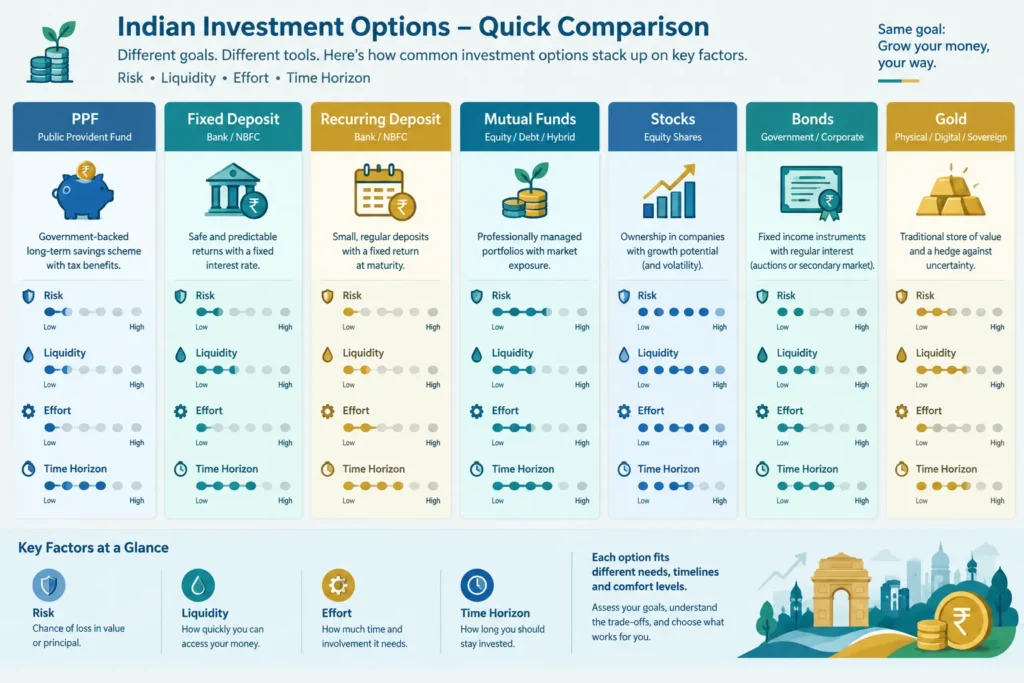
Before investing, understand four basic factors:

  • Risk: The possibility that returns may be lower than expected or that the investment value may fall.
  • Liquidity: How quickly and easily you can access your money.
  • Effort: The research, monitoring and decision-making required.
  • Time horizon: How long you can leave the money invested.

Visual comparison of PPF, deposits, mutual funds, stocks, bonds and gold by risk, liquidity, effort and horizon.

Beginners often come across PPF, fixed deposits, recurring deposits, mutual funds, shares, bonds and gold. Each works differently. A useful starting point is to understand their broad purpose rather than selecting one based only on its recent return.

Investment Broad risk level Liquidity Effort required Common use
PPF Relatively low Low due to long lock-in and withdrawal rules Low Long-term savings
FD Relatively low, subject to institution-related risk Moderate; early withdrawal may involve a penalty Low Short- to medium-term goals
RD Relatively low, subject to institution-related risk Moderate; premature closure conditions may apply Low Regular saving for a planned expense
Mutual funds Varies by fund type Usually moderate to high, but exit rules may apply Low to moderate Goals across different time horizons
Stocks High Generally high for actively traded listed shares High Long-term wealth creation for informed investors
Bonds Low to high, depending on issuer and structure Varies Moderate Income or portfolio diversification
Gold Moderate; prices can fluctuate Varies by form Low to moderate Diversification and selected long-term goals
You May Also Like:PPF vs ELSS: Understanding the Key Differences for Indian Investors

Public Provident Fund

The Public Provident Fund, or PPF, is a government-backed long-term savings scheme. It has a long maturity period and rules for deposits, partial withdrawals and loans. It may suit goals that are many years away, but it is not designed for money that you may need at short notice.

A PPF Calculator can help estimate how deposits may grow using an assumed interest rate. However, the government can revise PPF rates, while contribution limits, withdrawal conditions and tax rules may also change. Check the current rules before depositing.

Fixed Deposits and Recurring Deposits

A fixed deposit, or FD, allows you to place a lump sum with a bank or eligible financial institution for a chosen period. The applicable interest rate is usually known when you open the deposit. An FD can be useful when stability matters more than high growth, although inflation and tax can reduce the effective return.

An FD Calculator can estimate maturity value and interest based on the deposit amount, tenure and assumed rate. Actual results depend on the institution’s rate, compounding method, payout option, taxation and premature withdrawal conditions.

A recurring deposit, or RD, lets you deposit a fixed amount regularly for a selected tenure. It can suit someone saving monthly for a planned expense, such as a laptop, course fee or family event. Missing instalments or closing the RD early may have consequences under the provider’s terms.

Mutual Funds

A mutual fund pools money from multiple investors and invests it according to a stated objective. Equity funds mainly invest in shares and can fluctuate significantly. Debt funds invest in debt instruments but are not risk-free. Hybrid funds combine equity and debt in different proportions.

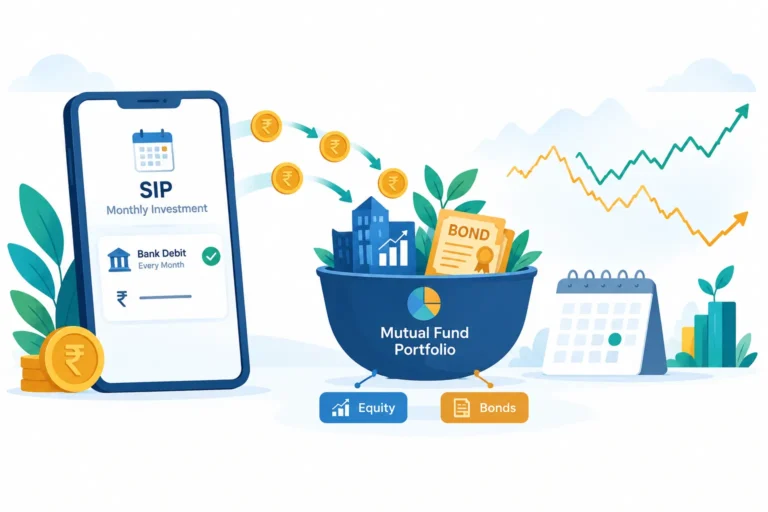
Many investors use a Systematic Investment Plan, or SIP, to invest a chosen amount at regular intervals. A SIP is a method of investing, not a separate investment product, and it does not guarantee returns.

A SIP Calculator shows an estimated future value using an assumed return. Market returns are not fixed, so the result should be treated as an illustration rather than a promise. Read the scheme’s objective, risk level, costs and exit conditions before investing.

Stocks, Bonds and Gold

Buying a stock means owning a small part of a listed company. Share prices can rise or fall sharply due to business performance, valuations, economic conditions and market sentiment. Direct stock investing requires research, diversification and ongoing monitoring. Beginners should avoid buying shares only because of tips, social media posts or recent price increases.

Bonds are instruments through which an investor lends money to a government, company or other issuer. In return, the issuer may pay interest and repay the principal according to stated terms. Bond risk depends on the issuer’s ability to repay, interest-rate movements, maturity and liquidity. A higher advertised return can indicate higher risk.

Gold can be held as jewellery, coins, exchange-traded products or other regulated forms. Jewellery includes making charges and may not be efficient as a pure investment. Gold prices also move up and down, so gold should not automatically be treated as a guaranteed safe return. Its role is usually diversification rather than funding every goal.

How to Start Investing Step by Step

  1. Define the goal. Write down what you are investing for and estimate the amount required. A goal such as “child’s college fees in 12 years” is clearer than simply saying “wealth creation.”
  2. Choose the time horizon. Separate goals into near-term, medium-term and long-term needs. Money required soon generally needs greater stability and accessibility.
  3. Assess your risk capacity and comfort. Consider income stability, dependants, existing debt and your reaction to temporary losses. Your ability to take risk may differ from your willingness to see market fluctuations.
  4. Understand the product. Review how it earns returns, where the money is invested, the main risks, costs, lock-ins, withdrawal rules and tax treatment.
  5. Complete account formalities. Depending on the product, you may need PAN, identity and address proof, a bank account, KYC verification, nominee details, and a demat or investment account. Use regulated institutions and keep your contact and nomination details updated.
  6. Start with an affordable amount. Choose an amount that does not disrupt rent, groceries, insurance premiums, loan payments or emergency savings.
  7. Automate where suitable. A standing instruction for an RD or a SIP can support consistency. Keep enough money in the linked bank account and review automated contributions when your income or goals change.

How Much Should a Beginner Invest?

There is no single amount or fixed percentage suitable for every beginner. Someone with irregular income, costly debt or no emergency reserve may need to begin cautiously. Another person with stable income and adequate savings may be able to invest more.

Start with an amount you can continue through ordinary monthly expenses. Even a small regular contribution can help build the habit of investing. Increase it after a salary rise or when a loan ends, but avoid committing money that may be required for an upcoming bill.

Do not invest your full monthly surplus without considering irregular costs such as annual insurance premiums, school fees, medical expenses, repairs and festivals. A simple cash buffer can prevent you from withdrawing long-term investments at an unsuitable time.

Investing Based on Your Goal

Emergency reserve: This money should be easy to access and should not depend heavily on market movements. A savings account, sweep facility or suitable short-duration deposit may be considered. Accessibility and safety are more important than chasing the highest return.

Near-term purchase: Suppose you plan to buy a two-wheeler in two years. An RD or appropriately timed FD may provide more predictability than equity investments. Check whether the maturity date matches the expected purchase date.

Education planning: A goal ten or more years away may allow some exposure to growth-oriented assets, depending on your risk capacity. As the admission date approaches, gradually moving the required amount towards more stable and liquid options can reduce dependence on market conditions at the last moment.

Retirement planning: Retirement is usually a long-term goal, so growth, inflation and diversification matter. A mix of suitable market-linked investments and more stable long-term products may be considered. The right combination depends on your age, income, existing retirement benefits and ability to handle fluctuations.

Review each goal at least periodically and after major changes such as marriage, a new job, childbirth or a home loan. Returns, interest rates, tax rules and product conditions can change. Your investment plan should therefore remain simple enough to understand and flexible enough to update.

Common Investing Mistakes Beginners Make

Learning how to start investing in India also means learning what to avoid. Most beginner mistakes come from rushing, copying others or investing without a clear purpose.

Investing Without an Emergency Fund

Do not invest money that you may need for an urgent expense. A medical bill, job loss or major home repair could force you to sell an investment at the wrong time.

Build an emergency fund before making large long-term investments. Keep it in an accessible place, such as a savings account, sweep deposit or suitable liquid option. The right amount depends on your job stability, dependants, insurance and monthly expenses.

You May Also Like:The Complete Guide to Loans and EMIs in India

Chasing Recent Returns

An investment that performed well last year may not perform well next year. Recent returns can attract investors after prices have already risen sharply.

Do not select a mutual fund, stock, gold product or other asset only because it recently topped a return chart. Check whether it suits your goal, time horizon and ability to handle losses. Past performance is not a guarantee of future returns.

Following Tips Blindly

Friends, relatives, social media creators and messaging groups may recommend “sure-shot” investments. Such tips may ignore your financial position and may not explain the risks.

Before investing, understand what you are buying, how it can generate returns, what it costs and when you can withdraw. Avoid acting on urgency, rumours or promises of quick wealth. If you cannot explain an investment in simple words, pause and research it.

Ignoring Fees, Taxes and Liquidity

Costs reduce the return that stays with you. Depending on the product, costs may include an expense ratio, brokerage, account charges, exit load, advisory fees or other transaction costs.

Liquidity matters too. Some investments can be sold quickly, while others have lock-ins, penalties, limited buyers or a longer withdrawal process. Read the product documents instead of assuming that all investments can be converted into cash immediately.

Tax treatment can also differ by product, holding period and current law. Consider post-tax returns, but do not buy an unsuitable product only to save tax.

Putting Everything in One Asset

Concentrating all your money in one share, sector, property, mutual fund category or asset type can expose you to avoidable risk. Even a familiar company or popular theme can disappoint.

Diversification spreads money across suitable assets and investments. It does not prevent all losses, but it can reduce the damage caused by one poor investment. Diversification should be meaningful; owning many similar funds may not provide much additional protection.

Taking More Risk Than You Can Handle

Your risk tolerance is not only about how you feel when markets rise. It is about whether you can stay invested when the value falls.

A person saving for a house deposit needed in two years should usually take less market risk than someone investing for retirement several decades away. Your income stability, existing debt, dependants and need for liquidity also affect how much risk is suitable.

Stopping During Normal Market Volatility

Market-linked investments move up and down. A temporary decline does not automatically mean that your plan has failed. Stopping a systematic investment plan during every correction may interrupt disciplined investing and turn a temporary concern into a permanent change of strategy.

However, staying invested should not be automatic in every situation. Review the investment if its objective has changed, its quality has deteriorated, its costs are unreasonable or it no longer suits your goal. The key is to make a reasoned decision rather than react to headlines.

Expecting Guaranteed High Returns

Higher potential returns usually come with higher uncertainty. Be cautious if someone promises high returns with little or no risk. Market-linked products cannot provide guaranteed market returns.

Some regulated products may offer stated or government-backed benefits under specific conditions, but you must still check rules, lock-ins, liquidity and tax treatment. Always distinguish between a contractual benefit and a sales claim.

How to Review Your Investments

Investing does not require daily monitoring. Frequent checking can encourage emotional decisions based on ordinary market movements. For many beginners, a structured review once or twice a year may be more useful. You should also review your plan after an important life event.

Examples include marriage, the birth of a child, a home purchase, a major salary change, job loss or a change in the target date of a goal.

Review Your Goals and Time Horizon

Start with the purpose of the investment. Ask whether the goal still exists, how much it may cost and when the money will be needed.

As a goal approaches, you may need to reduce exposure to volatile assets. This can lower the risk of a market fall just before you need the money. The shift should be planned gradually rather than made in panic.

Check Your Asset Allocation

Asset allocation is the division of your portfolio among assets such as equity, debt, gold and cash. Market movements can push this allocation away from your original plan.

For example, a strong rise in equity may make your portfolio riskier than intended. You may be able to restore the planned allocation by directing new contributions to underweighted assets. In some cases, buying or selling may be required, but consider taxes, exit loads and transaction costs before rebalancing.

You May Also Like:Fixed vs Floating Interest Rate: What Borrowers Should Know

Review Contributions and Costs

Check whether your regular investments are affordable and sufficient for the goal. If your income has increased, you may consider raising your contribution. Do not increase it so much that monthly cash flow or emergency savings suffer.

Review expense ratios, advisory charges, brokerage and other costs. A low-cost product is not automatically suitable, but unnecessary costs can reduce long-term outcomes.

Update Nominations and Records

Confirm that nominations are recorded correctly for relevant bank, demat, mutual fund, insurance and other financial accounts. Update details after major family changes.

Keep a simple list of investments, account details and key contacts in a secure place. Tell a trusted family member how to locate it. A nomination can help with transmission, but succession rights may depend on applicable law and estate documents.

Confirm That Each Product Is Still Suitable

Do not judge every product only by one-year returns. Compare it with its stated purpose, risk level, relevant benchmark and suitable alternatives over a meaningful period.

Ask whether the product remains aligned with your goal, horizon, liquidity needs and risk tolerance. A product may be good in general but unsuitable for your particular situation.

Frequently Asked Questions

Can I start investing with a small amount?

Yes. Several mutual fund SIPs and other products allow relatively small contributions, subject to their minimum investment rules. Start with an amount you can maintain without borrowing or disturbing essential expenses. Consistency matters more than choosing an impressive starting amount.

Do I always need a demat account?

No. A demat account is generally required for buying listed shares and exchange-traded funds. Many mutual funds can be held without a demat account. Bank deposits, government small savings products and some other investments also do not require one.

Is an SIP an investment product?

No. A systematic investment plan is a method of investing a fixed amount regularly in a mutual fund. The risk and return depend on the selected mutual fund scheme, not on the SIP method itself. An SIP does not guarantee profits or prevent losses.

Can I lose money while investing?

Yes. Market-linked investments can fall in value, and some may remain below the purchase price for a long time. Even non-market products can have inflation, liquidity, interest-rate, credit or reinvestment risks. Understand the main risks before investing.

How many investments do I need for diversification?

There is no ideal number for everyone. Diversification depends on what each holding contains. One broad-market fund may hold many companies, while several sector funds may still leave you concentrated. Focus on exposure across suitable assets and categories rather than collecting products.

Should I invest before building an emergency fund?

Usually, basic emergency savings should come first. You may continue essential long-term contributions while building the fund if your cash flow permits, but do not leave yourself unable to meet an urgent expense. High-interest debt and adequate insurance may also need attention before aggressive investing.

What taxes should a beginner consider?

Tax rules differ across equity, mutual funds, deposits, bonds, gold, property and retirement products. Tax may depend on the income type, holding period and your tax situation. Rules can change, so verify current provisions before acting. Also consider tax deducted at source, reporting requirements and whether an exemption or deduction has conditions.

When should I seek professional advice?

Professional advice may help if your finances are complex, you have several competing goals, receive a large lump sum, are close to retirement or are unsure how much risk to take. Check the adviser’s registration, fees, services and conflicts of interest. Understand whether the person is providing advice or selling a product.

Summary: A Calm Beginner Action Checklist

  • Build an emergency fund and review essential insurance before taking substantial investment risk.
  • Set a clear goal, target date and realistic contribution amount.
  • Choose investments that you understand and that match the goal.
  • Diversify instead of depending on one company, sector or asset.
  • Check fees, taxes, lock-ins, withdrawal rules and liquidity.
  • Ignore rumours, urgent tips and guaranteed-return claims.
  • Automate regular contributions where appropriate, but review affordability.
  • Review goals, asset allocation, costs, nominations and suitability once or twice a year and after major life changes.
  • Avoid changing a long-term plan because of every normal market movement.
  • Seek qualified professional advice when the decision is complex or the consequences are significant.

There is no single answer to how to start investing in India. Suitable choices depend on your goals, investment horizon, risk tolerance, liquidity needs and overall personal finances. Start carefully, keep the plan understandable and make changes for clear financial reasons rather than fear or excitement.

Share this article
KEEP READING

Related Articles

View all →

Comments

Leave a Comment

How to Start Investing in India: A Beginner’s Guide

To learn how to start investing in India, first organise your finances. Set clear goals, prepare a monthly budget, build an emergency fund and repay high-cost debt. Then assess how much risk you can realistically take and how long you can leave the money invested.

If you are planning a loan alongside your savings goals, you can use our EMI Calculator to estimate monthly repayments and total interest.

Do not choose an investment only because it recently gave high returns. The right choice depends on your income stability, family responsibilities, need for quick access to money and ability to handle losses. Investing should support your financial goals without putting essential expenses at risk.

Introduction

Starting your investment journey can feel confusing. You may hear about mutual funds, shares, fixed deposits, gold, property and many other options. Friends, relatives and social media may also offer conflicting suggestions.

The good news is that you do not need to understand every product before taking the first step. A beginner should first understand what investing means and prepare a stable financial base. Product selection comes later.

This preparation matters because investments can rise and fall in value. If you invest money that may be needed for next month’s rent, a medical emergency or an upcoming loan payment, you could be forced to withdraw at the wrong time.

Let us begin with the essential investing basics and the financial checks you should complete before putting your money into an investment.

Investing Basics and Financial Preparation

What Does Investing Mean?

Investing means putting money into an asset with the expectation that it may grow in value or generate income over time. Examples include bank fixed deposits, bonds, mutual funds, shares, gold and property.

However, expected growth is not guaranteed growth. Every investment has some form of uncertainty. The value may fluctuate, returns may be lower than expected, or you may have difficulty accessing the money when you need it.

Investing is generally more useful for medium-term and long-term goals than for immediate expenses. For example, someone may invest for a child’s higher education after 12 years or for retirement after 25 years. Money required for electricity bills next month should not normally depend on uncertain market returns.

Saving Versus Investing

Saving and investing are related, but they serve different purposes.

Point Saving Investing
Main purpose Safety and easy access Potential growth or income
Typical use Emergencies and near-term expenses Medium-term and long-term goals
Common examples Savings account and accessible bank deposit Mutual funds, shares, bonds, gold and property
Uncertainty Usually lower, depending on the product Varies from low to very high

Suppose Priya keeps ₹60,000 in a savings account for emergencies. That money is primarily a safety reserve. If she separately puts ₹5,000 each month into an investment for a goal ten years away, she is accepting some uncertainty in return for the possibility of long-term growth.

Saving is not inferior to investing. Both are necessary. Savings protect your short-term financial stability, while suitable investments may help you work towards future goals.

Why Inflation Matters

Inflation means that the general cost of goods and services rises over time. When prices increase, the same amount of money buys less.

For example, imagine that a course costs ₹1 lakh today. If education costs rise over the years, ₹1 lakh may not be enough to pay for a similar course in the future. Simply preserving the original amount may therefore be insufficient for a long-term goal.

This is one reason people invest. They seek returns that may help their money keep pace with rising costs. But no investment can promise that it will always beat inflation. Returns, taxes, charges and the type of asset all affect the final result.

Why Investing Involves Uncertainty

Investment returns depend on future events. Interest rates can change, businesses can perform poorly, markets can fall and property may take time to sell. Even an investment considered relatively stable may have limits, such as a lock-in period or a return that does not keep pace with inflation.

Risk is not limited to losing money in the share market. It can also include:

  • Receiving returns that are lower than inflation.
  • Being unable to withdraw money when it is needed.
  • Depending too heavily on one company, asset or property.
  • Taking a loan to invest and then struggling with repayments.
  • Selling during a temporary fall because the investment feels too stressful.

A sensible beginner accepts that uncertainty exists and plans for it. The aim is not to find a completely risk-free path. It is to take only the types and levels of risk that fit your situation.

Before You Start Investing

Flowchart showing goals, budgeting, emergency savings and debt management before investing.

Before investing, check whether your basic finances are ready. This does not mean that everything must be perfect. It means that investing should not weaken your ability to meet essential commitments.

1. Set Clear Financial Goals

A goal gives your investment a purpose. Write down what you need the money for, the estimated amount and when you may need it.

For example, “I want to invest more” is vague. “I want to prepare ₹4 lakh for a professional course in four years” is more useful. It gives you a target amount and an investment horizon.

Common goals may include:

  • Building a house down payment.
  • Paying for higher education.
  • Starting a business.
  • Preparing for retirement.
  • Buying a vehicle.

Keep near-term goals separate from long-term goals. Money needed next year generally requires more stability and accessibility than money meant for retirement several decades away.

2. Make a Practical Budget

A budget shows how much you can invest consistently without borrowing for regular expenses. Start with monthly take-home income, then list essential expenses, loan payments, insurance premiums and other commitments.

Use a realistic amount rather than an ambitious number that leaves no room for irregular costs. If ₹3,000 per month is comfortable, starting with ₹3,000 can be better than committing ₹10,000 and stopping after two months.

People with variable income, such as freelancers or small business owners, may need extra flexibility. They can estimate essential monthly costs, maintain a larger cash buffer and invest more during stronger income months instead of assuming a fixed salary.

3. Build an Accessible Emergency Fund

An emergency fund is money reserved for unexpected but necessary expenses, such as urgent medical costs, temporary job loss or an essential home repair. It should be kept somewhere reasonably safe and easy to access.

The appropriate amount depends on your circumstances. Someone with a stable salary, no dependants and good insurance may need a different buffer from a self-employed parent supporting a family.

Do not place the entire emergency fund in assets that can fall sharply or take a long time to sell. If an emergency happens during a market decline, you should not have to sell a long-term investment at a loss merely to pay essential bills.

4. Address High-Cost Debt

High-interest debt can work against your investment progress. Credit card balances and some personal loans may charge substantial interest. If your investment earns less than the cost of the debt, your overall financial position may still worsen.

Consider prioritising expensive debt before making aggressive investments. Continue required repayments on all loans and understand any prepayment conditions before paying extra.

Not every loan must always be cleared before any investment. A home loan, for example, differs from revolving credit card debt. The decision depends on the interest cost, repayment security, tax considerations, available emergency savings and your wider financial situation.

Understand Your Investment Risk

Diagram of risk tolerance, risk capacity, liquidity and investment horizon around an investor profile.

Investment risk is personal. Two people earning the same salary may need different portfolios because their responsibilities, job security and goals are different.

Risk Tolerance

Risk tolerance is your emotional ability to handle changes in investment value. If ₹1 lakh temporarily falls to ₹80,000, would you remain calm and follow your plan, or would you sell immediately?

It is easy to claim high risk tolerance when markets are rising. Your real response becomes clearer during a decline. A suitable investment should not cause constant anxiety or tempt you to make impulsive decisions.

Risk Capacity

Risk capacity is your financial ability to bear a loss. It is different from how brave you feel.

A 25-year-old with stable income, no dependants, an emergency fund and a retirement goal decades away may have greater capacity for market fluctuations. Another 25-year-old supporting parents, repaying costly debt and saving for a medical expense next year may have much lower capacity.

Risk capacity should usually carry more weight than enthusiasm. You may be comfortable with risk emotionally, but that does not make it suitable if the money is essential in the near future.

Liquidity

Liquidity refers to how easily and quickly an asset can be converted into usable money without a major reduction in value. A savings account is generally more liquid than a property, which may take months to sell and involve transaction costs.

Before investing, ask when you might need the money and how easily you can withdraw it. Also check for lock-in periods, exit charges, withdrawal rules and possible tax effects.

Investment Horizon

Your investment horizon is the time between investing and needing the money. A longer horizon may provide more time to recover from short-term market falls, but it does not remove risk or guarantee returns.

For example, ₹2 lakh needed for a wedding in 18 months should generally not face the same level of uncertainty as money intended for retirement after 30 years. As a goal gets closer, protecting the required amount and maintaining access to it usually become more important.

Before you start investing, consider all four factors together: risk tolerance, risk capacity, liquidity needs and investment horizon. The suitable choice is not determined by age or returns alone. It depends on your income stability, responsibilities, debt, emergency savings and the purpose of the money.

Investment Options and How to Begin

Once your basic budget and emergency savings are in place, the next step is to match your money with suitable investments. Learning how to start investing in India does not mean finding one “best” product. Different products serve different goals, time periods and risk levels.

Before investing, understand four basic factors:

  • Risk: The possibility that returns may be lower than expected or that the investment value may fall.
  • Liquidity: How quickly and easily you can access your money.
  • Effort: The research, monitoring and decision-making required.
  • Time horizon: How long you can leave the money invested.

Popular Investment Options in India
Visual comparison of PPF, deposits, mutual funds, stocks, bonds and gold by risk, liquidity, effort and horizon.

Beginners often come across PPF, fixed deposits, recurring deposits, mutual funds, shares, bonds and gold. Each works differently. A useful starting point is to understand their broad purpose rather than selecting one based only on its recent return.

Investment Broad risk level Liquidity Effort required Common use
PPF Relatively low Low due to long lock-in and withdrawal rules Low Long-term savings
FD Relatively low, subject to institution-related risk Moderate; early withdrawal may involve a penalty Low Short- to medium-term goals
RD Relatively low, subject to institution-related risk Moderate; premature closure conditions may apply Low Regular saving for a planned expense
Mutual funds Varies by fund type Usually moderate to high, but exit rules may apply Low to moderate Goals across different time horizons
Stocks High Generally high for actively traded listed shares High Long-term wealth creation for informed investors
Bonds Low to high, depending on issuer and structure Varies Moderate Income or portfolio diversification
Gold Moderate; prices can fluctuate Varies by form Low to moderate Diversification and selected long-term goals

Public Provident Fund

The Public Provident Fund, or PPF, is a government-backed long-term savings scheme. It has a long maturity period and rules for deposits, partial withdrawals and loans. It may suit goals that are many years away, but it is not designed for money that you may need at short notice.

A PPF Calculator can help estimate how deposits may grow using an assumed interest rate. However, the government can revise PPF rates, while contribution limits, withdrawal conditions and tax rules may also change. Check the current rules before depositing.

Fixed Deposits and Recurring Deposits

A fixed deposit, or FD, allows you to place a lump sum with a bank or eligible financial institution for a chosen period. The applicable interest rate is usually known when you open the deposit. An FD can be useful when stability matters more than high growth, although inflation and tax can reduce the effective return.

An FD Calculator can estimate maturity value and interest based on the deposit amount, tenure and assumed rate. Actual results depend on the institution’s rate, compounding method, payout option, taxation and premature withdrawal conditions.

A recurring deposit, or RD, lets you deposit a fixed amount regularly for a selected tenure. It can suit someone saving monthly for a planned expense, such as a laptop, course fee or family event. Missing instalments or closing the RD early may have consequences under the provider’s terms.

Mutual Funds

A mutual fund pools money from multiple investors and invests it according to a stated objective. Equity funds mainly invest in shares and can fluctuate significantly. Debt funds invest in debt instruments but are not risk-free. Hybrid funds combine equity and debt in different proportions.

Many investors use a Systematic Investment Plan, or SIP, to invest a chosen amount at regular intervals. A SIP is a method of investing, not a separate investment product, and it does not guarantee returns.

A SIP Calculator shows an estimated future value using an assumed return. Market returns are not fixed, so the result should be treated as an illustration rather than a promise. Read the scheme’s objective, risk level, costs and exit conditions before investing.

Stocks, Bonds and Gold

Buying a stock means owning a small part of a listed company. Share prices can rise or fall sharply due to business performance, valuations, economic conditions and market sentiment. Direct stock investing requires research, diversification and ongoing monitoring. Beginners should avoid buying shares only because of tips, social media posts or recent price increases.

Bonds are instruments through which an investor lends money to a government, company or other issuer. In return, the issuer may pay interest and repay the principal according to stated terms. Bond risk depends on the issuer’s ability to repay, interest-rate movements, maturity and liquidity. A higher advertised return can indicate higher risk.

Gold can be held as jewellery, coins, exchange-traded products or other regulated forms. Jewellery includes making charges and may not be efficient as a pure investment. Gold prices also move up and down, so gold should not automatically be treated as a guaranteed safe return. Its role is usually diversification rather than funding every goal.

How to Start Investing Step by Step

  1. Define the goal. Write down what you are investing for and estimate the amount required. A goal such as “child’s college fees in 12 years” is clearer than simply saying “wealth creation.”
  2. Choose the time horizon. Separate goals into near-term, medium-term and long-term needs. Money required soon generally needs greater stability and accessibility.
  3. Assess your risk capacity and comfort. Consider income stability, dependants, existing debt and your reaction to temporary losses. Your ability to take risk may differ from your willingness to see market fluctuations.
  4. Understand the product. Review how it earns returns, where the money is invested, the main risks, costs, lock-ins, withdrawal rules and tax treatment.
  5. Complete account formalities. Depending on the product, you may need PAN, identity and address proof, a bank account, KYC verification, nominee details, and a demat or investment account. Use regulated institutions and keep your contact and nomination details updated.
  6. Start with an affordable amount. Choose an amount that does not disrupt rent, groceries, insurance premiums, loan payments or emergency savings.
  7. Automate where suitable. A standing instruction for an RD or a SIP can support consistency. Keep enough money in the linked bank account and review automated contributions when your income or goals change.

How Much Should a Beginner Invest?

There is no single amount or fixed percentage suitable for every beginner. Someone with irregular income, costly debt or no emergency reserve may need to begin cautiously. Another person with stable income and adequate savings may be able to invest more.

Start with an amount you can continue through ordinary monthly expenses. Even a small regular contribution can help build the habit of investing. Increase it after a salary rise or when a loan ends, but avoid committing money that may be required for an upcoming bill.

Do not invest your full monthly surplus without considering irregular costs such as annual insurance premiums, school fees, medical expenses, repairs and festivals. A simple cash buffer can prevent you from withdrawing long-term investments at an unsuitable time.

Investing Based on Your Goal

Emergency reserve: This money should be easy to access and should not depend heavily on market movements. A savings account, sweep facility or suitable short-duration deposit may be considered. Accessibility and safety are more important than chasing the highest return.

Near-term purchase: Suppose you plan to buy a two-wheeler in two years. An RD or appropriately timed FD may provide more predictability than equity investments. Check whether the maturity date matches the expected purchase date.

Education planning: A goal ten or more years away may allow some exposure to growth-oriented assets, depending on your risk capacity. As the admission date approaches, gradually moving the required amount towards more stable and liquid options can reduce dependence on market conditions at the last moment.

Retirement planning: Retirement is usually a long-term goal, so growth, inflation and diversification matter. A mix of suitable market-linked investments and more stable long-term products may be considered. The right combination depends on your age, income, existing retirement benefits and ability to handle fluctuations.

Review each goal at least periodically and after major changes such as marriage, a new job, childbirth or a home loan. Returns, interest rates, tax rules and product conditions can change. Your investment plan should therefore remain simple enough to understand and flexible enough to update.

Common Investing Mistakes Beginners Make

Learning how to start investing in India also means learning what to avoid. Most beginner mistakes come from rushing, copying others or investing without a clear purpose.

Investing Without an Emergency Fund

Do not invest money that you may need for an urgent expense. A medical bill, job loss or major home repair could force you to sell an investment at the wrong time.

Build an emergency fund before making large long-term investments. Keep it in an accessible place, such as a savings account, sweep deposit or suitable liquid option. The right amount depends on your job stability, dependants, insurance and monthly expenses.

Chasing Recent Returns

An investment that performed well last year may not perform well next year. Recent returns can attract investors after prices have already risen sharply.

Do not select a mutual fund, stock, gold product or other asset only because it recently topped a return chart. Check whether it suits your goal, time horizon and ability to handle losses. Past performance is not a guarantee of future returns.

Following Tips Blindly

Friends, relatives, social media creators and messaging groups may recommend “sure-shot” investments. Such tips may ignore your financial position and may not explain the risks.

Before investing, understand what you are buying, how it can generate returns, what it costs and when you can withdraw. Avoid acting on urgency, rumours or promises of quick wealth. If you cannot explain an investment in simple words, pause and research it.

Ignoring Fees, Taxes and Liquidity

Costs reduce the return that stays with you. Depending on the product, costs may include an expense ratio, brokerage, account charges, exit load, advisory fees or other transaction costs.

Liquidity matters too. Some investments can be sold quickly, while others have lock-ins, penalties, limited buyers or a longer withdrawal process. Read the product documents instead of assuming that all investments can be converted into cash immediately.

Tax treatment can also differ by product, holding period and current law. Consider post-tax returns, but do not buy an unsuitable product only to save tax.

Putting Everything in One Asset

Concentrating all your money in one share, sector, property, mutual fund category or asset type can expose you to avoidable risk. Even a familiar company or popular theme can disappoint.

Diversification spreads money across suitable assets and investments. It does not prevent all losses, but it can reduce the damage caused by one poor investment. Diversification should be meaningful; owning many similar funds may not provide much additional protection.

Taking More Risk Than You Can Handle

Your risk tolerance is not only about how you feel when markets rise. It is about whether you can stay invested when the value falls.

A person saving for a house deposit needed in two years should usually take less market risk than someone investing for retirement several decades away. Your income stability, existing debt, dependants and need for liquidity also affect how much risk is suitable.

Stopping During Normal Market Volatility

Market-linked investments move up and down. A temporary decline does not automatically mean that your plan has failed. Stopping a systematic investment plan during every correction may interrupt disciplined investing and turn a temporary concern into a permanent change of strategy.

However, staying invested should not be automatic in every situation. Review the investment if its objective has changed, its quality has deteriorated, its costs are unreasonable or it no longer suits your goal. The key is to make a reasoned decision rather than react to headlines.

Expecting Guaranteed High Returns

Higher potential returns usually come with higher uncertainty. Be cautious if someone promises high returns with little or no risk. Market-linked products cannot provide guaranteed market returns.

Some regulated products may offer stated or government-backed benefits under specific conditions, but you must still check rules, lock-ins, liquidity and tax treatment. Always distinguish between a contractual benefit and a sales claim.

How to Review Your Investments

Investing does not require daily monitoring. Frequent checking can encourage emotional decisions based on ordinary market movements. For many beginners, a structured review once or twice a year may be more useful. You should also review your plan after an important life event.

Examples include marriage, the birth of a child, a home purchase, a major salary change, job loss or a change in the target date of a goal.

Review Your Goals and Time Horizon

Start with the purpose of the investment. Ask whether the goal still exists, how much it may cost and when the money will be needed.

As a goal approaches, you may need to reduce exposure to volatile assets. This can lower the risk of a market fall just before you need the money. The shift should be planned gradually rather than made in panic.

Check Your Asset Allocation

Asset allocation is the division of your portfolio among assets such as equity, debt, gold and cash. Market movements can push this allocation away from your original plan.

For example, a strong rise in equity may make your portfolio riskier than intended. You may be able to restore the planned allocation by directing new contributions to underweighted assets. In some cases, buying or selling may be required, but consider taxes, exit loads and transaction costs before rebalancing.

Review Contributions and Costs

Check whether your regular investments are affordable and sufficient for the goal. If your income has increased, you may consider raising your contribution. Do not increase it so much that monthly cash flow or emergency savings suffer.

Review expense ratios, advisory charges, brokerage and other costs. A low-cost product is not automatically suitable, but unnecessary costs can reduce long-term outcomes.

Update Nominations and Records

Confirm that nominations are recorded correctly for relevant bank, demat, mutual fund, insurance and other financial accounts. Update details after major family changes.

Keep a simple list of investments, account details and key contacts in a secure place. Tell a trusted family member how to locate it. A nomination can help with transmission, but succession rights may depend on applicable law and estate documents.

Confirm That Each Product Is Still Suitable

Do not judge every product only by one-year returns. Compare it with its stated purpose, risk level, relevant benchmark and suitable alternatives over a meaningful period.

Ask whether the product remains aligned with your goal, horizon, liquidity needs and risk tolerance. A product may be good in general but unsuitable for your particular situation.

Frequently Asked Questions

Can I start investing with a small amount?

Yes. Several mutual fund SIPs and other products allow relatively small contributions, subject to their minimum investment rules. Start with an amount you can maintain without borrowing or disturbing essential expenses. Consistency matters more than choosing an impressive starting amount.

Do I always need a demat account?

No. A demat account is generally required for buying listed shares and exchange-traded funds. Many mutual funds can be held without a demat account. Bank deposits, government small savings products and some other investments also do not require one.

Is an SIP an investment product?

No. A systematic investment plan is a method of investing a fixed amount regularly in a mutual fund. The risk and return depend on the selected mutual fund scheme, not on the SIP method itself. An SIP does not guarantee profits or prevent losses.

Can I lose money while investing?

Yes. Market-linked investments can fall in value, and some may remain below the purchase price for a long time. Even non-market products can have inflation, liquidity, interest-rate, credit or reinvestment risks. Understand the main risks before investing.

How many investments do I need for diversification?

There is no ideal number for everyone. Diversification depends on what each holding contains. One broad-market fund may hold many companies, while several sector funds may still leave you concentrated. Focus on exposure across suitable assets and categories rather than collecting products.

Should I invest before building an emergency fund?

Usually, basic emergency savings should come first. You may continue essential long-term contributions while building the fund if your cash flow permits, but do not leave yourself unable to meet an urgent expense. High-interest debt and adequate insurance may also need attention before aggressive investing.

What taxes should a beginner consider?

Tax rules differ across equity, mutual funds, deposits, bonds, gold, property and retirement products. Tax may depend on the income type, holding period and your tax situation. Rules can change, so verify current provisions before acting. Also consider tax deducted at source, reporting requirements and whether an exemption or deduction has conditions.

When should I seek professional advice?

Professional advice may help if your finances are complex, you have several competing goals, receive a large lump sum, are close to retirement or are unsure how much risk to take. Check the adviser’s registration, fees, services and conflicts of interest. Understand whether the person is providing advice or selling a product.

Summary: A Calm Beginner Action Checklist

  • Build an emergency fund and review essential insurance before taking substantial investment risk.
  • Set a clear goal, target date and realistic contribution amount.
  • Choose investments that you understand and that match the goal.
  • Diversify instead of depending on one company, sector or asset.
  • Check fees, taxes, lock-ins, withdrawal rules and liquidity.
  • Ignore rumours, urgent tips and guaranteed-return claims.
  • Automate regular contributions where appropriate, but review affordability.
  • Review goals, asset allocation, costs, nominations and suitability once or twice a year and after major life changes.
  • Avoid changing a long-term plan because of every normal market movement.
  • Seek qualified professional advice when the decision is complex or the consequences are significant.

There is no single answer to how to start investing in India. Suitable choices depend on your goals, investment horizon, risk tolerance, liquidity needs and overall personal finances. Start carefully, keep the plan understandable and make changes for clear financial reasons rather than fear or excitement.

Leave a Comment