

The loan to value ratio, or LTV, shows what percentage of a property’s value is being financed through a loan. It is calculated by dividing the loan amount by the property value and multiplying the result by 100. For example, if a home is valued at ₹50 lakh and the loan is ₹40 lakh, the LTV is 80%. The remaining ₹10 lakh must generally come from the borrower’s own funds.
When you apply for a home loan in India, the lender usually does not finance the entire cost of the property. You need to contribute a part of the purchase price yourself. This contribution is commonly called the down payment or margin money.
The loan to value ratio helps the lender decide how much of the property value it is willing to finance. It also helps you estimate the loan you may receive and the amount you may need to arrange from savings.
However, the calculation is not always based only on the price agreed between the buyer and seller. The lender may conduct an independent property valuation. If its acceptable value is lower than the purchase price, your eligible loan can fall and your required contribution can increase.
What Is Loan-to-Value Ratio?
The loan-to-value ratio is the loan amount expressed as a percentage of the property’s value. In simple terms, it answers this question: how much of the property value is being funded by the lender?
Suppose you want to buy a flat for ₹50 lakh. You apply for a home loan of ₹40 lakh and plan to pay the remaining ₹10 lakh yourself. In this case, the lender is financing 80% of the property value. Therefore, the LTV is 80%.
LTV has two main parts:
- Loan amount: The amount you want to borrow or the amount approved by the lender.
- Property value: The value accepted by the lender for calculating the loan.
A higher LTV means the loan covers a larger part of the property value. A lower LTV means the borrower contributes a larger amount from personal funds.
For example, on a property valued at ₹50 lakh, a ₹45 lakh loan would have a higher LTV than a ₹35 lakh loan. The ₹45 lakh loan requires less upfront contribution from the buyer, but it also means the lender is financing a greater share of the property.
The property value used for LTV may not always be the same as the amount written in the sale agreement. The lender may review documents, location, construction quality, property condition and comparable transactions before arriving at an acceptable value. Its lending decision is then based on its policy and valuation process.
How Does LTV Work?
When assessing a home loan application, the lender examines both the requested loan amount and the property’s acceptable value. It then checks whether the resulting loan to value ratio falls within its lending rules.
The process usually works in the following way:
- You select a property and agree on a purchase price with the seller.
- You apply for a home loan and state the amount you want to borrow.
- The lender arranges a legal and technical review of the property.
- A valuer estimates the property value acceptable to the lender.
- The lender calculates the LTV using the proposed loan and the accepted property value.
- The final loan amount is decided after considering LTV and other factors such as income, repayment capacity, credit history and property documents.
LTV is therefore only one part of home loan approval. An acceptable LTV does not automatically mean that the full requested loan will be approved. Your income must also support the expected EMI, and the property must meet the lender’s legal and technical requirements.
What a Higher or Lower LTV Means
A higher LTV reduces the amount you need to bring towards the basic property value. However, it also leaves the lender with a smaller value cushion if property prices fall or if the loan later becomes difficult to recover.
A lower LTV means you are borrowing a smaller share of the property value. You must contribute more upfront, but your loan principal and related interest cost may be lower, assuming the same tenure and interest rate.
| LTV level | What it means for the borrower |
|---|---|
| Higher LTV | A larger share of the property value is financed, so the initial contribution may be lower. |
| Lower LTV | A smaller share is financed, so the borrower must contribute more from personal funds. |
Your own contribution is not necessarily your only upfront expense. Costs such as stamp duty, registration charges, brokerage, documentation expenses and some other transaction charges may need to be paid separately. Whether a particular cost is included for loan calculation depends on the lender’s policy and the nature of the transaction.
LTV Formula
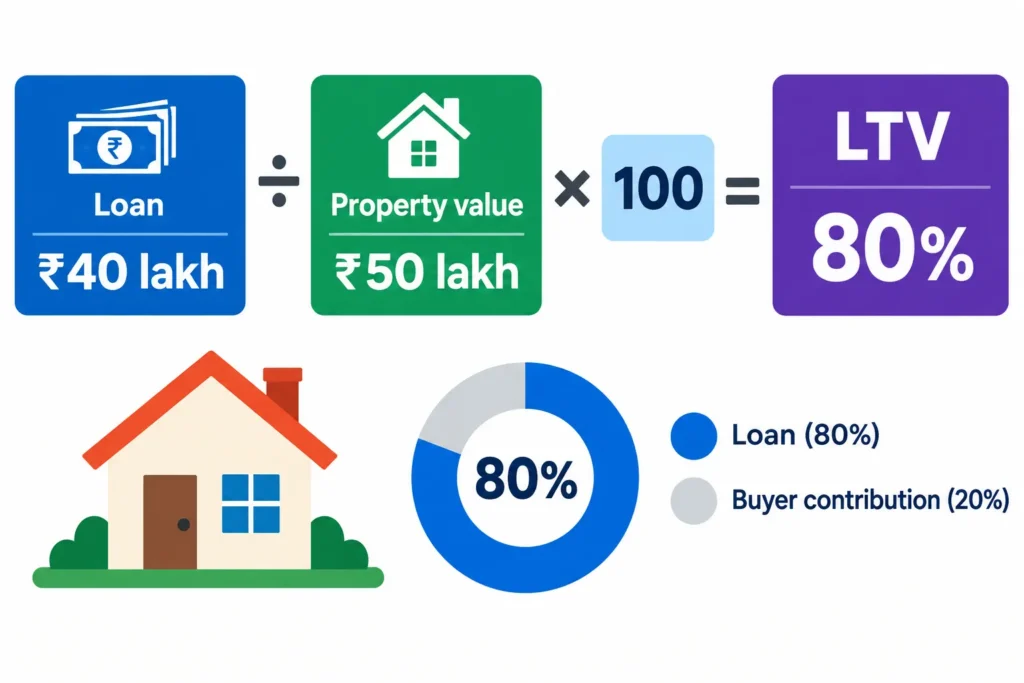
The standard loan to value ratio formula is:
LTV = (Loan amount ÷ Property value accepted by the lender) × 100
Both figures must relate to the same property and should be stated in the same unit. You can use rupees, lakh or crore, as long as the loan amount and property value use the same unit.
For instance, if the loan is written as ₹40 lakh, the property value should also be written in lakh. Dividing ₹40 lakh by ₹50 lakh gives 0.80. Multiplying by 100 converts it into 80%.
You can also rearrange the formula to estimate a possible loan amount when the property value and applicable LTV are known:
Possible loan amount = Property value × Applicable LTV
When using this version, write the percentage as a decimal. For example, 80% becomes 0.80. The resulting figure is only an LTV-based estimate. The lender may approve a lower amount after checking your income, existing EMIs, credit profile and property details.
Loan-to-Value Ratio Example
Assume that Neha plans to purchase a home in Pune for ₹50 lakh. She requests a home loan of ₹40 lakh.
| Property value | ₹50 lakh |
|---|---|
| Requested loan | ₹40 lakh |
| Borrower’s contribution towards property value | ₹10 lakh |
The LTV calculation is:
LTV = (₹40 lakh ÷ ₹50 lakh) × 100 = 80%
The loan to value ratio is therefore 80%. The lender would finance 80% of the property value, while Neha would contribute the remaining 20%, or ₹10 lakh, towards the purchase price. She may also need separate funds for transaction costs that are not financed.
What If the Lender Values the Property at a Lower Amount?
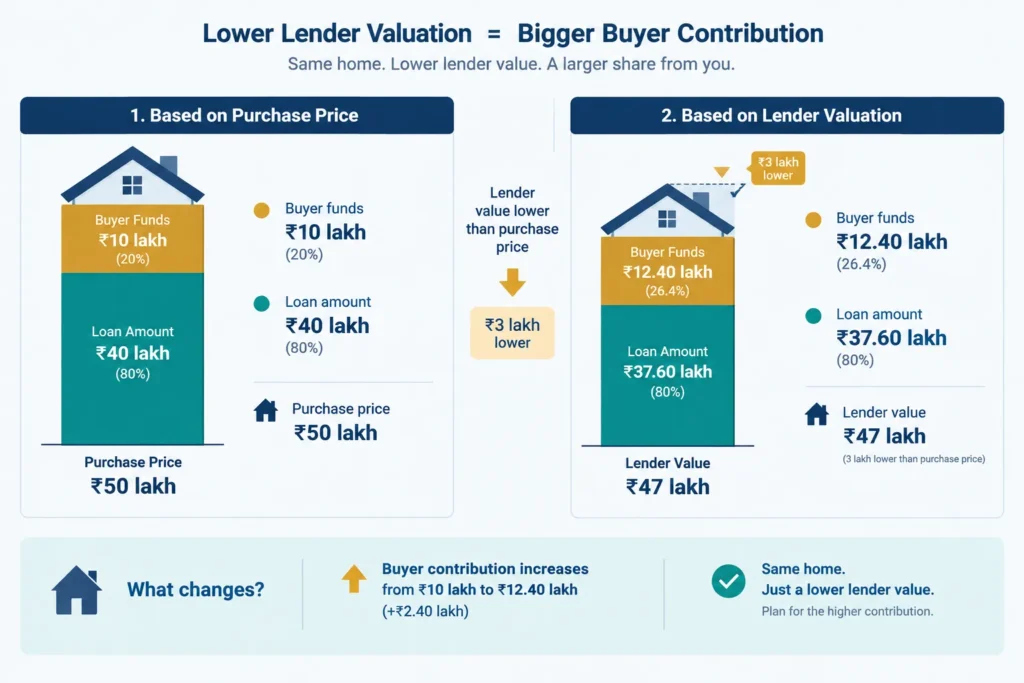
Now assume the agreed purchase price remains ₹50 lakh, but the lender’s valuer considers the property worth only ₹47 lakh. If the lender is willing to finance up to 80% of its accepted value for this case, the calculation changes.
Possible loan amount = ₹47 lakh × 80% = ₹37.60 lakh
Neha requested ₹40 lakh, but an 80% LTV on the lender’s valuation supports only ₹37.60 lakh. To complete the ₹50 lakh purchase, she would need to arrange ₹12.40 lakh from her own funds instead of ₹10 lakh, apart from any additional transaction costs.
If the lender calculated LTV using the full requested loan of ₹40 lakh against its valuation of ₹47 lakh, the ratio would be approximately 85.1%. That may be higher than the LTV the lender is prepared to accept in this example.
This illustrates why buyers should not assume that the loan will be calculated only on the negotiated purchase price. A lower lender valuation can reduce the eligible loan, increase the down payment, or require the borrower to reconsider the transaction before proceeding.
Why Do Lenders Use LTV?
The loan to value ratio helps a lender understand how much of a property’s value is being financed through a home loan. It compares the proposed loan amount with the value of the property accepted by the lender.
For example, suppose a bank values a flat at ₹50 lakh and offers a loan of ₹40 lakh. The LTV is 80%. The remaining ₹10 lakh must generally come from the buyer’s own funds.
Lenders use LTV mainly to measure collateral risk. A home is security for the loan, but its value may change. If the borrower stops repaying, the lender may have to sell the property to recover the outstanding amount. Sale delays, legal expenses and changes in market prices can reduce the amount recovered.
A lower LTV gives the lender a larger safety margin. If the property is valued at ₹50 lakh and the loan is ₹30 lakh, the lender has financed 60% of the value. If the loan is ₹45 lakh, it has financed 90%, leaving a much smaller margin.
However, LTV is only one part of a home loan assessment. Lenders also examine:
- Your income and its stability
- Your existing EMIs and other financial commitments
- Your credit history and credit score
- Your age and preferred loan tenure
- The property’s legal documents and approvals
- The lender’s technical valuation of the property
- Your ability to provide the required down payment
A loan within the permitted LTV ceiling is not automatically approved. The lender must still be satisfied that you can repay the proposed EMI and that the property is acceptable as security.
How LTV Affects Your Home Loan
The loan to value ratio can affect the maximum home loan available against a property. It may also influence the lender’s overall risk assessment.
Consider a home with an accepted value of ₹60 lakh. If the applicable maximum LTV is 80%, the loan based only on the property value cannot normally exceed ₹48 lakh.
But this does not mean the borrower will necessarily receive ₹48 lakh. Suppose the lender’s income assessment shows that the borrower can manage only a ₹40 lakh loan. In that case, the lower amount may be approved.
The final eligible loan is generally constrained by several checks, including:
- The LTV ceiling applicable to the loan
- The value accepted by the lender
- The borrower’s repayment capacity
- The lender’s internal eligibility rules
- The property’s legal and technical acceptability
Lender valuation is especially important. The price written in the sale agreement is not always the value used for the LTV calculation. A bank or housing finance company may conduct an independent valuation.
For instance, you may agree to buy a flat for ₹70 lakh, but the lender may value it at ₹65 lakh. If it applies an 80% LTV to the accepted value, the value-based loan limit would be ₹52 lakh, not ₹56 lakh.
This difference can create a funding gap. You would need to arrange the difference between the purchase price and the approved loan from your own eligible sources.
A high LTV application may receive closer scrutiny because the borrower is contributing a smaller share of the property value. Depending on the lender’s policy, LTV may also be considered while deciding interest rates, risk premiums or other loan conditions. These practices vary, so a lower LTV does not guarantee a lower interest rate.
LTV and Down Payment
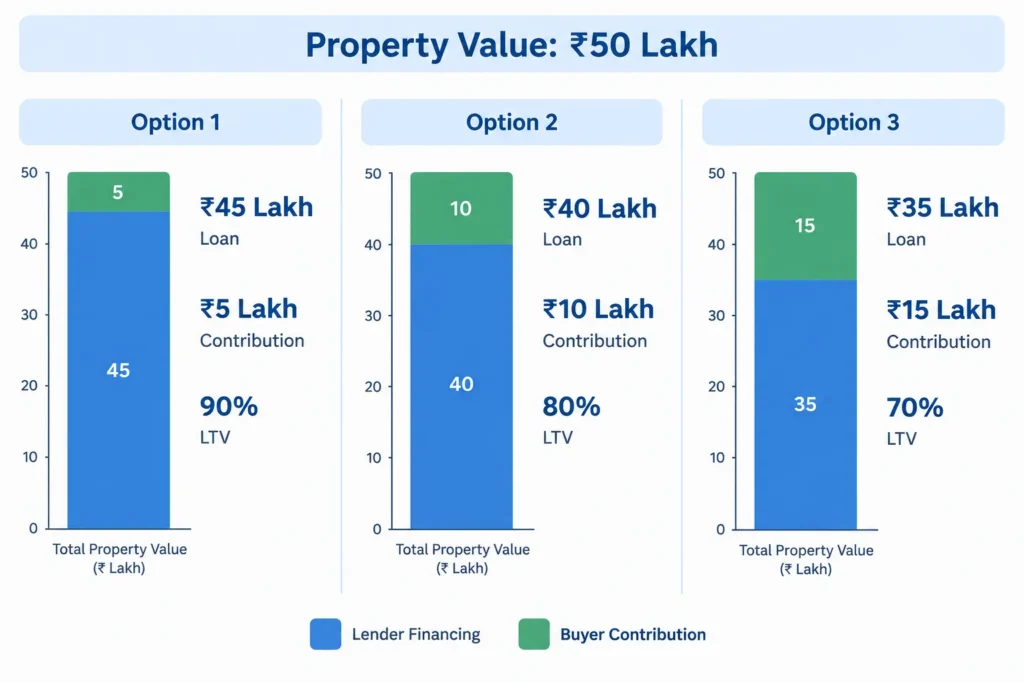
The down payment is the portion of the property purchase that you pay from your own funds rather than through the home loan. LTV and down payment are closely connected.
If the lender accepts a property value of ₹50 lakh and provides a ₹40 lakh loan, the LTV is 80%. The basic difference of ₹10 lakh represents 20% of the accepted property value.
Increasing the down payment reduces the required loan and therefore lowers the LTV. Using the same ₹50 lakh property:
| Loan amount | Buyer’s basic contribution | LTV |
|---|---|---|
| ₹45 lakh | ₹5 lakh | 90% |
| ₹40 lakh | ₹10 lakh | 80% |
| ₹35 lakh | ₹15 lakh | 70% |
This is a simplified illustration. Your total upfront requirement can be higher than the basic difference between the property value and the loan amount.
Stamp duty, registration charges, documentation costs, brokerage, moving expenses and certain other charges may need to be paid separately. Under RBI guidance for banks, stamp duty, registration and documentation charges are generally not included in the property cost used to calculate LTV. A limited regulatory exception may apply to small-cost houses within the threshold specified by the RBI.
You should therefore avoid treating “20% down payment” as the complete amount needed before possession. Prepare a separate estimate for transaction costs and retain an emergency buffer.
The down payment should normally come from disclosed and acceptable sources. A separate personal loan for the down payment can increase your EMI burden and may reduce home loan eligibility. Lenders can consider all existing and proposed debts while assessing repayment capacity.
LTV Limits for Home Loans in India
RBI regulatory ceilings restrict how much banks can lend relative to the value of a residential property. At publication time, the applicable RBI guidance should be checked from the latest official circulars or master directions, as regulations and classifications can change.
Based on the prevailing RBI framework for individual housing loans, the broad maximum LTV ceilings for banks are:
| Housing loan category | Maximum regulatory LTV |
|---|---|
| Loans up to ₹30 lakh | Up to 90% |
| Loans above ₹30 lakh and up to ₹75 lakh | Up to 80% |
| Loans above ₹75 lakh | Up to 75% |
These are regulatory ceilings, not promises of funding. A ceiling of 80% means a bank should not cross that limit for the relevant category. It does not mean every eligible borrower will receive exactly 80% of the property value.
A lender may apply a lower LTV because of its internal credit policy, the borrower’s financial profile, the property type, location, construction stage or valuation concerns. Housing finance companies and other regulated lenders must follow the framework applicable to them, which should also be confirmed from the latest official directions.
Borrowers should also distinguish between the loan category and the property price. The applicable band may depend on how the regulatory framework classifies the housing loan, not simply the amount quoted by the seller.
Before paying a large non-refundable booking amount, ask the lender how it will determine the property value and which LTV ceiling is likely to apply. A provisional eligibility letter based on income does not replace legal and technical approval of the property.
Can a Higher Down Payment Improve Your Loan Terms?
A higher down payment reduces the loan amount and lowers the LTV. This can strengthen the application by showing that the borrower is contributing more of their own money.
It may also produce practical benefits. A smaller loan usually means a lower EMI if the interest rate and tenure remain unchanged. Alternatively, you may choose a shorter tenure while keeping the EMI affordable, which can reduce total interest outgo.
Some lenders may view a lower LTV as lower risk and may offer more favourable pricing or terms under their internal policies. However, this is not guaranteed. Interest rates also depend on factors such as the credit profile, income, employment type, loan size, benchmark rate and lender policy.
A larger down payment also does not correct every weakness in an application. Approval may still be affected by irregular income, a high existing debt burden, poor credit history, incomplete property documents or an unacceptable valuation.
Do not use all your savings only to achieve the lowest possible LTV. After making the down payment, you may still need money for registration, basic furnishing, repairs and emergencies. A balanced contribution is usually safer than exhausting your cash reserves.
Compare scenarios before deciding. Check the resulting LTV, EMI, tenure, total interest cost and cash left after the purchase. The best down payment is one that keeps the loan manageable without leaving your household financially exposed.
Calculating and Using LTV Correctly
The loan to value ratio becomes easier to understand when you separate three things: the loan amount, the property value accepted by the lender, and the LTV percentage. These figures are connected, but they are not interchangeable.
LTV vs Loan Amount vs Property Value
Loan amount is the money you borrow from the bank or housing finance company. It is shown in rupees.
Property value is the value that the lender accepts for calculating the loan. Depending on the lender’s policy, this may be based on the purchase price, the registered agreement value, an independent valuation, or the lower of relevant values.
Loan to value ratio is the loan amount expressed as a percentage of the accepted property value.
| Term | What it means | How it is expressed |
|---|---|---|
| Loan amount | Money borrowed from the lender | Rupees |
| Property value | Value accepted by the lender for LTV calculation | Rupees |
| LTV | Loan amount as a share of property value | Percentage |
For example, suppose a lender accepts a flat’s value as Rs. 60 lakh and offers a loan of Rs. 45 lakh. The loan amount is Rs. 45 lakh, the property value is Rs. 60 lakh, and the LTV is 75%.
The balance of Rs. 15 lakh is the buyer’s contribution towards the property price. It is often called the down payment or upfront contribution. However, the buyer may also need separate funds for stamp duty, registration, brokerage, legal checks, repairs or other purchase-related expenses.
How to Calculate LTV Yourself
The basic formula is:
Loan to value ratio = Loan amount ÷ Property value accepted by the lender × 100
Step-by-step LTV calculation
- Find the loan amount that you plan to borrow.
- Find the property value that the lender is likely to accept.
- Divide the loan amount by that property value.
- Multiply the result by 100 to convert it into a percentage.
Assume you want a home loan of Rs. 56 lakh. The lender values the property at Rs. 70 lakh.
LTV = Rs. 56 lakh ÷ Rs. 70 lakh × 100 = 80%
This means the proposed loan covers 80% of the lender-accepted property value. The remaining 20% must generally come from your own funds.
How to estimate the minimum upfront contribution
If you know the property value and the LTV offered by the lender, you can estimate the loan amount and your contribution.
Estimated maximum loan = Accepted property value × LTV percentage
Estimated upfront contribution = Accepted property value − Estimated loan amount
Suppose the accepted property value is Rs. 50 lakh and the applicable LTV is 80%.
- Estimated loan: Rs. 50 lakh × 80% = Rs. 40 lakh
- Estimated contribution towards the property value: Rs. 50 lakh − Rs. 40 lakh = Rs. 10 lakh
The Rs. 10 lakh figure is only the contribution towards the accepted property value. It does not automatically include stamp duty, registration charges or other costs that the lender may not finance.
What if the lender values the property lower?
Consider a flat with an asking or agreed price of Rs. 80 lakh. After its checks, the lender accepts a value of only Rs. 72 lakh. If the applicable LTV is 75%, the estimated loan would be based on Rs. 72 lakh.
Estimated loan = Rs. 72 lakh × 75% = Rs. 54 lakh
The buyer would then need to arrange the difference between the purchase price of Rs. 80 lakh and the loan of Rs. 54 lakh. That is Rs. 26 lakh, apart from expenses not included in the financing.
This is why buyers should avoid finalising their budget only on the seller’s asking price. The lender’s valuation can materially change the amount available.
Common Mistakes Borrowers Should Avoid
Using the EMI in the LTV formula
EMI is the monthly repayment amount. It depends on the loan amount, interest rate and tenure. It is not used as the numerator or denominator in the LTV formula.
LTV measures how much is being borrowed against the property’s accepted value. EMI measures the monthly repayment burden. They answer different questions.
Using total interest as part of the loan amount
Do not add the total interest payable over the loan tenure when calculating LTV. Use the sanctioned or proposed principal loan amount.
For example, if the principal is Rs. 40 lakh, use Rs. 40 lakh in the formula. Do not use the total of all future EMIs, because that amount includes interest.
Using only the seller’s asking price
An asking price is what the seller hopes to receive. It does not necessarily become the value accepted by the lender.
The lender may conduct a technical valuation, examine comparable prices, check the property’s condition and review legal documents. A lower accepted value can increase the effective LTV or reduce the loan available.
Assuming every purchase-related cost will be financed
A high LTV does not mean that the lender will pay the same percentage of every expense connected with the purchase.
Stamp duty, registration charges, brokerage, maintenance deposits, parking charges, furnishing and legal expenses may need to be paid separately. Treatment can differ by lender, loan product and applicable rules, so ask for a written cost breakdown.
Treating the maximum LTV as guaranteed eligibility
The maximum permitted LTV is a ceiling, not a promise. A lender may approve a smaller loan after checking your income, existing EMIs, credit history, age, employment stability and repayment capacity.
The property must also satisfy legal and technical requirements. Even when the proposed LTV is within the lender’s limit, the application can be reduced or rejected for other reasons.
Ignoring the cash buffer needed after purchase
Using all savings for the down payment can leave little money for emergencies, moving costs or basic repairs. Estimate the full cash requirement before choosing a loan amount.
A larger upfront contribution can reduce the loan and EMI, but it should not come at the cost of exhausting your emergency savings.
Frequently Asked Questions About LTV
Does LTV change after I start repaying the loan?
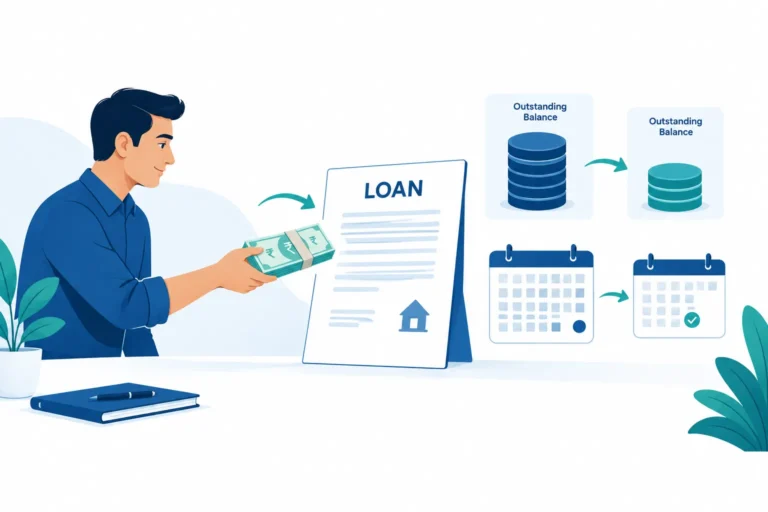
Yes, the effective LTV can change. As you repay principal, the outstanding loan balance falls. If the property value stays unchanged, the LTV becomes lower. A change in the property’s current value can also affect a fresh LTV calculation.
However, lenders do not necessarily revalue the property after every EMI. For practical purposes, the original LTV is mainly used during sanction and disbursement, while later calculations may be relevant for refinancing, a top-up loan or risk assessment.
How does lender valuation affect LTV?
LTV is calculated using the property value accepted under the lender’s policy. If the lender’s valuation is lower than the purchase price, the eligible loan may decrease and your required upfront contribution may increase.
Keep some flexibility in your budget until the legal and technical valuation process is complete.
Does a lower LTV guarantee loan approval?
No. A lower LTV can reduce the lender’s property-related risk, but approval also depends on repayment capacity, credit profile, documents and the legal and technical acceptability of the property.
Does LTV apply only to home loans?
No. LTV can also be used for loans against property, vehicle loans, gold loans and other secured borrowing. The asset used as security, valuation method and applicable LTV limits differ across products.
Are registration charges and stamp duty included in the property value?
Not necessarily. Lenders generally follow their own policy and applicable rules when deciding the value used for LTV. Stamp duty and registration charges may not be included in the financed property value, meaning the borrower must pay them from personal funds.
Ask the lender whether its calculation is based on the agreement value, assessed value or another permitted amount. Also confirm which charges are excluded before arranging the down payment.
Summary
The loan to value ratio compares the principal loan amount with the property value accepted by the lender. It does not use the EMI, future interest or total repayment amount.
Calculate LTV by dividing the proposed loan by the accepted property value and multiplying by 100. To estimate your upfront contribution, subtract the estimated loan from the property value, then add any stamp duty, registration and other expenses that are not financed.
Most importantly, do not treat the maximum LTV as guaranteed approval. The final loan depends on both your repayment profile and the lender’s legal and technical assessment of the property.


Comments