


Personal finance for women starts with knowing what you earn, spend, own and owe. Build a workable budget, keep emergency savings in an accessible place, and repay expensive debt carefully. You should also have independent access to your bank accounts, investments, insurance records and important financial documents.
Good money planning is not about following one fixed formula. A salaried professional, a business owner, a freelancer, a homemaker managing household money and a woman returning to work may all need different systems.
The aim is the same: to understand your financial position and make informed decisions. This foundation can help you handle emergencies, plan life changes and invest for long-term goals with greater confidence.
Why Personal Finance Matters for Women
Personal finance for women is not limited to earning or investing. It also includes day-to-day money management, access to financial accounts, protection from unexpected costs and preparation for future goals.
Your income may change over time. You might switch jobs, start a business, take a study break or reduce paid work to provide care. Unpaid caregiving can also affect savings and retirement planning even though the work has significant value.
Some financial goals can continue for decades. Retirement, healthcare, supporting family members or maintaining a home may require long-term planning. Starting early helps, but starting now is more useful than worrying about a late beginning.
Financial control does not mean that every household expense must be managed separately. Couples and families can combine money if that works for them. However, every adult should ideally know where the money is kept and how it can be accessed.
This includes knowing:
- Which bank accounts, deposits and investments exist
- Whose name appears as the holder, joint holder or nominee
- How regular household bills are paid
- What loans and insurance policies are active
- Where important documents are stored
- How to access money during an emergency
Do not share passwords, PINs or one-time passwords casually. At the same time, create a safe emergency-information system so that trusted family members can locate essential records when genuinely required.
Build a Strong Financial Foundation
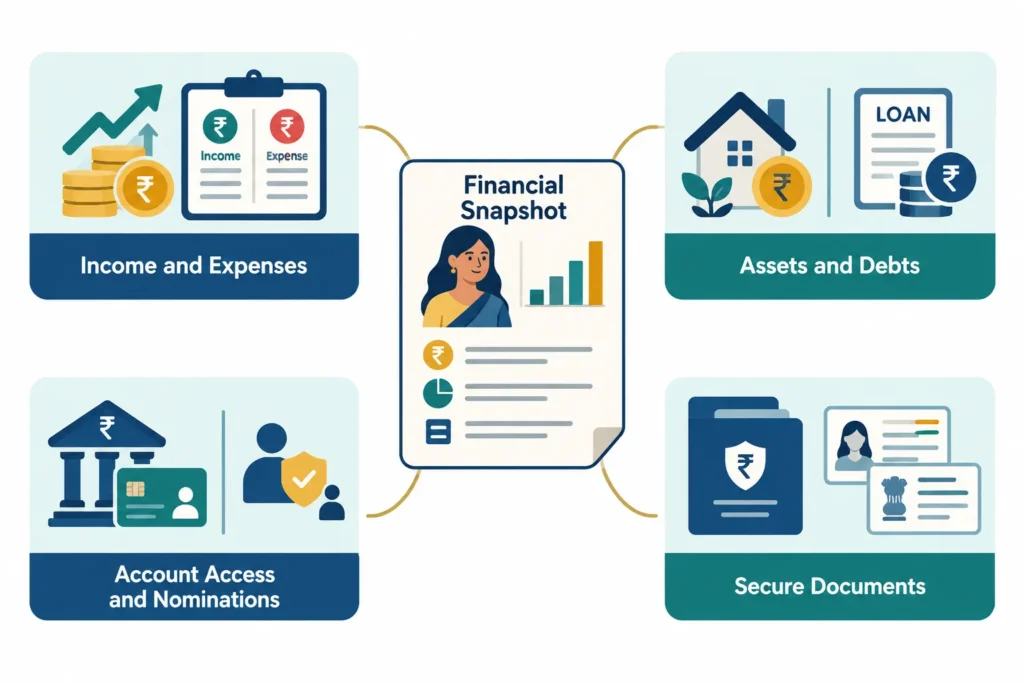
Before choosing investments, prepare a simple financial snapshot. You can use a notebook, spreadsheet or budgeting app. The best system is one you can understand and update regularly.
List your income and expenses
Record every reliable source of income, such as salary, business income, freelance payments, rent, pension or interest. If your income changes each month, calculate a cautious working estimate based on recent lower-income months rather than your best month.
Next, divide expenses into three broad groups:
- Essential expenses: Rent, groceries, electricity, transport, medicines, school fees and minimum loan payments
- Flexible expenses: Eating out, shopping, subscriptions, travel and entertainment
- Future-focused contributions: Emergency savings, insurance premiums, investments and additional loan repayments
Annual costs should not be ignored. School admissions, vehicle insurance, festivals, professional fees and home repairs may not occur every month, but they are still predictable. Divide an expected annual cost by 12 and set aside that amount monthly where practical.
List your assets and debts
Assets may include savings accounts, fixed deposits, provident fund balances, mutual funds, shares, gold and property. Record an approximate current value and note whether the asset is easy to sell or withdraw.
Then list all debts, including home loans, education loans, personal loans, vehicle loans, credit-card balances and informal family borrowing. For each debt, write down the outstanding amount, interest rate, monthly payment and repayment date.
This exercise shows your actual position. It may also reveal forgotten accounts, duplicated insurance policies, idle savings or expensive debt that needs attention.
Check access, nominations and documents
Knowing that an asset exists is not enough. Confirm that your mobile number, email address, address and identity details are current with financial institutions. Check nominations for bank accounts, deposits, investments, provident fund accounts and insurance policies.
A nominee usually helps the institution release or manage assets after the holder’s death, but nomination does not automatically settle every inheritance question. Succession can depend on the type of asset, account structure, will and applicable law. Consider appropriate legal guidance for complex family or estate situations.
Keep organised copies of documents such as PAN, Aadhaar, bank details, insurance policies, loan statements, investment records, property papers and a will, if one exists. Store physical and digital copies securely. Review this financial file at least once a year and after a major life event.
Create a Practical Budget
A budget is a plan for your money, not a punishment. It should cover essentials, allow reasonable personal spending and direct money towards your priorities.
You do not have to follow a rigid percentage rule. Housing costs differ across Indian cities, family responsibilities vary, and income may not be consistent. Start with actual rupee amounts and adjust them.
A simple monthly example
Suppose a woman receives an in-hand salary of Rs 60,000. Her plan could look like this:
| Category | Monthly amount |
|---|---|
| Essential household expenses | Rs 30,000 |
| Loan repayment | Rs 7,000 |
| Emergency fund and investments | Rs 12,000 |
| Personal and flexible spending | Rs 8,000 |
| Annual-cost provision | Rs 3,000 |
This is only an illustration, not an ideal allocation. Someone paying high rent may spend more on essentials. Someone repaying costly debt may temporarily invest less and direct extra money towards repayment.
Adapt the budget to your situation
If your income varies, create a basic budget using a conservative monthly income. During better months, put part of the surplus into a buffer for low-income periods, taxes, annual costs and long-term goals.
In a shared household, agree on which expenses are joint and which remain individual. Contributions do not have to be equal if incomes differ. A proportionate arrangement may be more practical. Each person should still understand the household finances and ideally retain some money in an account they can access independently.
Review the budget monthly at first. If you repeatedly exceed a category, the plan may be unrealistic. Adjust the amount instead of abandoning budgeting altogether.
Build an Emergency Fund
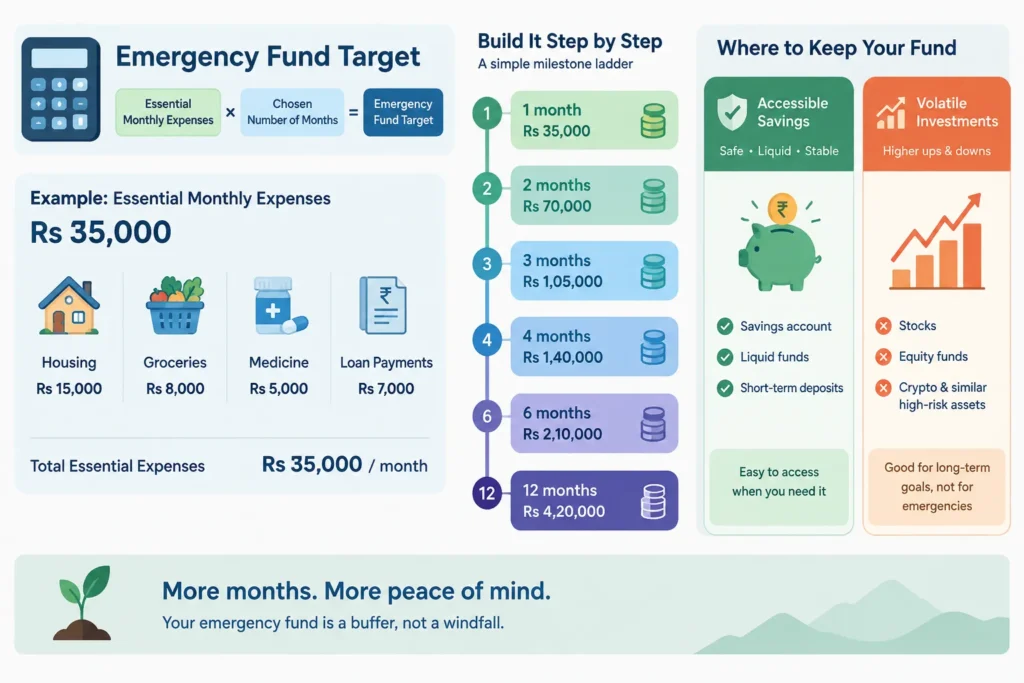
An emergency fund pays for necessary costs when income stops or an unexpected expense occurs. It can reduce the need to use credit cards, sell long-term investments or borrow urgently.
Choose the target based on your essential monthly expenses rather than your total income. Your target may need to be higher if your income is irregular, you support dependants, you have ongoing medical needs or you expect a career break. A household with two stable incomes may assess the risk differently from a household relying on one variable income.
For example, if essential expenses are Rs 35,000 a month, first aim for Rs 35,000 rather than waiting until you can save several months of expenses. After reaching that milestone, gradually build the next month’s amount.
Accessibility and capital safety matter more than chasing high returns for this money. Keep at least part of the fund where it can be withdrawn quickly, such as an appropriate bank savings account. A portion may be placed in a suitable short-term deposit if it remains easy to access and you understand any premature-withdrawal conditions.
Automate a manageable transfer after receiving income. Add bonuses, gifts or freelance surpluses when possible. If you use the fund, restart contributions without treating the withdrawal as a failure. That is what the fund was created for.
Manage Loans and Credit Carefully
Start with a complete debt list. Include the lender, outstanding balance, interest rate, monthly instalment, due date and any prepayment conditions. Continue making at least the required payment on every debt to avoid penalties and damage to your credit history.
Extra repayment can generally be directed towards the highest-cost debt first, particularly revolving credit-card balances and costly personal loans. Alternatively, clearing a small balance first may provide motivation. Compare interest costs, tax effects and prepayment charges before making large loan decisions.
Pay the full credit-card bill by the due date whenever possible. Paying only the minimum amount can leave most of the balance attracting interest. Avoid cash withdrawals on credit cards unless you fully understand the charges.
Review your credit report periodically for unknown accounts, incorrect late-payment records or errors in personal details. A healthy repayment history can support future applications, but borrowing only to build a credit score is unnecessary.
Be cautious when becoming a co-borrower or guarantor. If the main borrower fails to pay, you may be responsible for repayment, and missed payments may affect your credit record. Read the agreement and check whether you have ownership rights in any asset linked to the loan.
Finally, avoid taking new debt for non-essential spending when existing repayments already strain the budget. A purchase that looks affordable as a monthly instalment may still increase the total cost and reduce money available for emergencies and future goals.
Get the Right Insurance Protection
Insurance protects your finances when an unexpected event creates a large expense or stops your income. It is not mainly an investment. Its first job is to transfer financial risk that you may not be able to handle from your savings alone.
The right cover depends on your actual responsibilities, not on your gender or marital status. A salaried woman supporting her parents, a homemaker whose unpaid work would be costly to replace, and a business owner with irregular income may each need different protection.
Health insurance
Medical treatment can quickly use up savings. Health insurance can cover eligible hospital expenses, but every policy has conditions. Check the sum insured, waiting periods, room-rent restrictions, co-payments, hospital network and exclusions before buying.
Do not rely only on insurance provided by your employer. That cover may be insufficient, may not include all family members and usually ends when you leave the job. A career break, job change or business venture could therefore leave you without protection. An individual or family policy can provide continuity, subject to its terms.
When choosing family coverage, consider the age and health of each person. Adding older parents to the same family floater may not always be suitable because one large claim can reduce the cover available to everyone else. Compare the structure and conditions carefully rather than looking only at the premium.
Life and disability protection
Life insurance is important when someone depends on your income or unpaid contribution. This may include children, parents, a spouse, loan co-borrowers or other family members. The required cover should reflect outstanding debts, essential household costs and important future goals.
Even a homemaker may need life cover if the family would have to pay for childcare, household management or elder care in her absence. However, a person with no dependants and no major financial obligations may have a lower need for life insurance.
Disability can also affect earning capacity. Disability or personal accident protection may provide financial support after a covered injury or disability. Read how the policy defines temporary, permanent, partial and total disability. A policy may not pay merely because you cannot perform your current job.
Read the policy, disclose details and keep records
Low premiums should not be the only basis for selection. Understand what is covered, what is excluded, when benefits begin and how a claim must be filed. Maternity expenses, pre-existing illnesses, certain treatments, risky activities and specific medical conditions may have limits or waiting periods.
Provide complete and accurate information about health, occupation, habits and existing policies. Hiding information can create problems during a claim. Fill in the proposal form carefully instead of signing a blank form or allowing someone else to guess the answers.
Keep policy documents, premium receipts, nominee details, medical records and insurer contact information in an organised physical or digital folder. Tell a trusted family member where these records are stored. Review protection after marriage, divorce, childbirth, a home loan, a change in dependants or a major income change.
Start Investing for Long-Term Goals
Saving and investing serve different purposes. Saving generally focuses on safety and easy access. It is useful for emergencies and near-term expenses. Investing accepts some uncertainty in value to seek growth over a longer period.
| Factor | Saving | Investing |
|---|---|---|
| Main purpose | Protect money needed soon | Build wealth for longer-term goals |
| Access | Usually quick and simple | Depends on the investment |
| Value changes | Generally limited in suitable deposit products | Can rise or fall |
| Typical use | Emergency fund or next year’s fees | Retirement or a goal many years away |
Begin with the goal. Write down what the money is for, the likely amount needed and the target date. A holiday next year, a home down payment in six years and retirement after several decades should not use the same investment approach.
Match investments to time, risk and access needs
Your time horizon is the period before you need the money. For a short-term goal, protecting the amount is usually more important than seeking high growth. For a long-term goal, you may be able to accept more short-term movement because there is more time to recover from market declines.
Risk capacity means how much financial loss or delay you can actually handle. It is different from risk tolerance, which is how comfortable you feel when values fall. A person may feel adventurous but still have low risk capacity if her income is uncertain or the money is needed soon.
Liquidity means how easily an investment can be converted into usable money. Keep emergency money and near-term commitments in accessible options. Do not lock all your funds into products that are difficult, costly or slow to exit.
Inflation also matters. Over time, rising prices reduce what a fixed amount can buy. Money for distant goals may therefore need some exposure to growth-oriented assets. This does not mean taking unnecessary risk. It means choosing a mix that considers both inflation and possible losses.
Diversify and invest regularly
Diversification means spreading money across suitable types of assets rather than depending on one company, property, sector or idea. It cannot remove all risk, but it can reduce the damage caused by one investment performing badly.
Regular monthly investing can make the process easier for salaried earners and others with predictable cash flow. If income is irregular, such as for a freelancer or entrepreneur, invest a manageable base amount and add more in stronger months. Consistency matters more than trying to predict the perfect day to invest.
Avoid chasing recent returns, social-media tips or promises of quick wealth. High past returns do not guarantee future performance. If you cannot explain how a product works, what it costs, when you can withdraw and how much you could lose, pause before investing. Complex products are not automatically better than simple ones.
Plan for Retirement
Retirement planning is a key part of personal finance for women because retirement may last for many years and career paths are not always continuous. Time away from paid work for childcare, elder care, health needs or relocation can reduce income, employer benefits and years of investing.
Start with a rough estimate rather than waiting for a perfect number. Consider the age at which you may stop full-time work, basic living costs, housing, healthcare, support for dependants and the lifestyle you want. Then account for inflation because today’s monthly expenses are unlikely to remain unchanged.
Begin with an affordable contribution. A small amount invested consistently is more useful than an ambitious plan that stops after a few months. Increase the contribution whenever your salary rises, debts reduce or irregular income improves. Automating contributions soon after income arrives can help prevent other spending from taking priority.
Keep retirement assets separate from money for weddings, travel, home upgrades or adult children’s expenses. Supporting family can be important, but using retirement funds may create future dependence. Give retirement its own account, investment plan and progress review.
If you take a career break, avoid abandoning the plan. Continue a smaller contribution if possible, review household arrangements and restart or increase investments when income resumes. Where partners manage money together, both should understand the retirement assets, nominees, account access and expected income sources. Each woman should also retain access to money in her own name.
Plan for Major Financial Goals
Major goals may include higher education, buying a home, starting a business, travelling, supporting parents or building an independent security fund. Writing them down makes trade-offs clearer and turns a broad wish into a practical plan.
For each goal, estimate the current cost, target date, amount already saved and monthly contribution required. Review the estimate periodically because education fees, property prices, business costs and family needs can change.
For example, money needed for a professional course in two years should focus on access and stability. A home down payment expected in seven years may allow a different mix, with risk reduced as the purchase approaches. Money for a future business should also include a buffer because initial revenue may be uncertain.
Prioritise when goals compete
You may not be able to fund every goal at the same speed. Use the following order to make decisions:
- Protect essential living needs, insurance and emergency savings.
- Address high-cost debt and goals with fixed deadlines or serious consequences.
- Continue retirement contributions because lost time is difficult to replace.
- Fund flexible goals such as premium travel, a larger home or non-essential upgrades after core goals are on track.
Separate your own goals from social expectations. A large wedding, costly gifts or pressure to fund relatives should not automatically take priority over financial security. Set a clear amount you can afford when supporting family and avoid committing money required for emergencies or retirement.
An independent security fund can be useful even in a supportive household. It may cover a temporary move, legal or medical needs, a career transition or essential expenses during a difficult period. Keep it accessible and under your control, with documents and account details updated.
When the numbers do not fit, adjust one or more parts of the plan: extend the timeline, reduce the target cost, increase contributions or change the goal’s priority. Review major goals at least periodically and after major life changes. A realistic plan that adapts is more valuable than an impressive plan that cannot be followed.
Financial Planning During Career Breaks
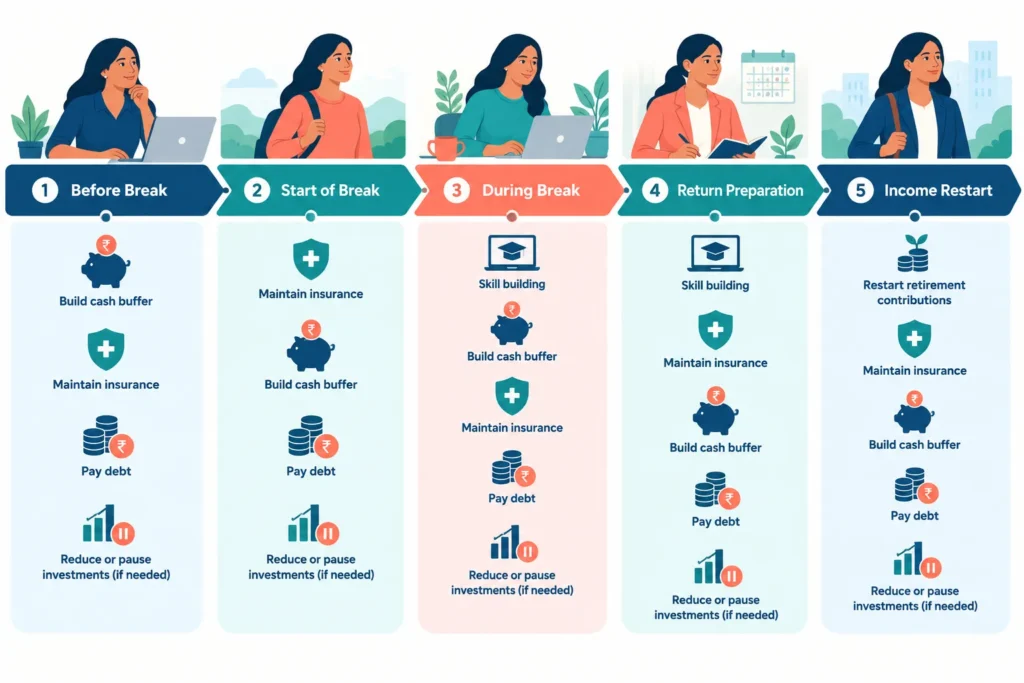
Career breaks can happen for many reasons, including caregiving, health needs, higher studies, entrepreneurship, relocation or irregular work. Some breaks are planned, while others arrive unexpectedly. A financial plan can reduce stress and help you retain control over your money during this period.
Build a Larger Cash Buffer
Before a planned break, estimate essential monthly expenses such as housing, groceries, medicines, insurance premiums, school fees and loan repayments. Try to build a cash buffer that can cover several months of these costs. The right amount depends on the length of the break, household income stability and your responsibilities.
Keep this money in a safe and accessible place, such as a separate savings account or suitable short-term deposit. Avoid putting emergency money entirely into volatile investments because you may need it at short notice.
If the break is unplanned, immediately review your spending. Separate essential expenses from costs that can be paused, reduced or cancelled. This can help your available cash last longer.
Maintain Insurance Continuity
Check whether your health insurance is linked to your employer. Employer coverage may end when you leave the job. A personal health insurance policy can provide continuity during a break and between jobs.
If other people depend on your income or unpaid care work, review whether term life insurance is appropriate. Keep premiums within your budget and make sure policy nominations and contact details are current.
Prepare for Debt Repayments
List all EMIs, interest rates and repayment dates before taking a break. Expensive debt, such as unpaid credit card balances, can become difficult to manage when income falls.
Where possible, reduce high-interest debt before the break. Do not assume that a spouse, parent or future business income will automatically cover every repayment. Discuss responsibilities clearly and keep enough money available for unavoidable EMIs.
Continue Investing at a Sustainable Level
You may need to reduce investments when income stops, but you do not always have to stop completely. A small, affordable contribution can preserve the saving habit. Never continue investing by using credit cards or borrowing money.
Prioritise essentials, insurance and debt payments first. If cash flow is too tight, pausing an investment may be more sensible than missing an EMI or insurance premium. Restart or increase contributions when regular income returns.
Plan for Skills and Returning to Work
Include skill-building costs in the break budget. These may include a recognised course, professional membership, examination fee, software, childcare or travel for interviews. Choose training based on a realistic return-to-work or business plan rather than collecting courses without a clear purpose.
Keep your professional profile updated and stay connected with former colleagues where practical. For entrepreneurship or freelance work, separate business and household money. Irregular income should be budgeted conservatively instead of treating a strong month as the new normal.
Understand the Retirement Impact
A career break can reduce contributions to EPF, NPS, mutual funds or other retirement investments. It can also reduce the time available for compounding. Estimate the gap and decide how you may address it later through higher contributions, a longer investment period or adjusted retirement goals.
Do not treat retirement as only the responsibility of a spouse. Even during a break, know where retirement assets are held, who owns them and how they fit into the household plan.
Create a Return-to-Work Plan
Set a tentative timeline, even if it may change. Note the skills required, expected starting income, childcare or eldercare arrangements and costs involved. Review the plan every few months. A flexible roadmap is more useful than waiting for the perfect time to restart.
Common Money Mistakes to Avoid
Good personal finance for women is not only about selecting investments. It also involves avoiding habits that reduce financial control or create unnecessary risk.
- Having no personal account access: Maintain access to money in your own name. Know the login process, account details and whom to contact if access is blocked.
- Relying entirely on another person: Shared decisions are healthy, but complete dependence can create problems during illness, separation, death or family disputes.
- Delaying investing for too long: You do not need a large salary to begin. A small, regular amount can help build knowledge and discipline.
- Ignoring retirement: Women may experience career breaks and may need retirement money for many years. Retirement planning should not be postponed until the final years of employment.
- Carrying expensive debt: Paying only the minimum due on a credit card can keep the balance outstanding and increase interest costs.
- Mixing insurance and investing without understanding the product: Check the purpose, charges, lock-in, benefits and exit conditions before committing money.
- Signing without reviewing documents: Never sign blank forms or become a borrower, co-borrower or guarantor without understanding your legal and repayment responsibilities.
- Following unverified advice: Tips from social media, relatives or informal groups may not suit your goals or risk level. Understand the product before investing.
How to Build Financial Independence Step by Step
Financial independence does not necessarily mean managing every household expense alone. It means having knowledge, access, decision-making ability and resources to handle your financial needs.
- Assess your current position. List income, regular expenses, debts, insurance policies, bank accounts and investments. Include assets held jointly and individually.
- Set clear goals. Divide goals into short-, medium- and long-term needs. Examples include an emergency fund, education, a home deposit, starting a business and retirement.
- Create a workable budget. Decide how much is needed for essentials, flexible spending, debt repayment and savings. Use realistic numbers based on actual bank statements.
- Automate savings. Schedule a transfer soon after income is credited. Start with an amount you can sustain and increase it when income rises.
- Build an emergency fund. Keep it separate from money meant for holidays, shopping or investments. Increase the buffer if income is irregular or you support dependants.
- Manage expensive debt. Pay EMIs on time and prioritise high-interest balances. Avoid taking new debt merely to maintain a lifestyle.
- Protect major risks. Review health insurance and, where relevant, term life, disability or accident cover. Insurance should support the financial plan, not replace it.
- Invest according to each goal. Consider the time available, need for liquidity and ability to handle market fluctuations. Avoid choosing investments only because they recently performed well.
- Maintain organised records. Keep account details, nominations, insurance documents, loan papers and investment statements secure. A trusted family member should know how to locate essential information.
- Review the plan regularly. Conduct a review at least annually and after major changes such as marriage, divorce, childbirth, a career break, inheritance, relocation or retirement.
Frequently Asked Questions About Personal Finance for Women
Can I start financial planning with a small income?
Yes. Begin by tracking expenses, avoiding costly debt and saving a manageable amount regularly. The initial amount matters less than building a consistent habit and increasing it as your income improves.
How large should my emergency fund be?
It should reflect your essential expenses, job stability, dependants, health needs and insurance coverage. Someone with irregular work, a single income or caregiving duties may need a larger buffer than someone in a dual-income household with stable jobs.
Should I invest while repaying debt?
It depends on the cost of the debt and your cash flow. Continue essential insurance and maintain a basic emergency reserve. High-interest debt usually deserves priority, while affordable long-term loans may allow some investing alongside repayment.
What should I do with investments during a career break?
Review cash flow before deciding. You may reduce, pause or continue contributions depending on your buffer and expenses. Avoid withdrawing long-term investments automatically; first check taxes, exit conditions and whether other funds are available.
Are shared finances enough after marriage?
Shared finances can work well, but both partners should understand household income, debts, insurance and investments. Each person should also have account access, personal identification documents and some money they can use independently.
When should I begin retirement planning?
Start as early as practical, even with a small contribution. Review retirement planning after salary changes and career breaks. Do not rely only on a spouse’s retirement assets or an expected inheritance.
Why are nominations important?
A nomination helps the financial institution identify whom to deal with after an account holder’s death. Keep nominations updated across bank accounts, deposits, insurance and investments. A nomination may not replace succession law or a valid will, so estate documents should also be reviewed where appropriate.
When may professional financial advice be useful?
Consider professional advice when finances are complex, goals conflict or important legal and tax consequences are involved. Examples include divorce, inheritance, business ownership, large debt, cross-border assets or retirement planning. Check the adviser’s qualifications, fees, regulatory status and possible conflicts of interest.
Summary
Financial independence is built through practical actions: know your accounts, maintain an emergency buffer, manage debt, continue suitable insurance and invest for your own goals. Prepare carefully for career breaks and understand their effect on cash flow and retirement.
Start with one step today. List your accounts and debts, set a savings transfer, update a nomination or review your emergency fund. Small, informed actions repeated over time can create greater financial control through changing stages of life.


Comments