
Crypto Spot Trading vs Futures Trading: Key Differences for Beginners

A beginner-friendly comparison of crypto spot and futures trading, explaining how they work, their costs and risks, and why leveraged derivatives require extra caution.

Crypto Spot Trading vs Futures Trading: Key Differences for Beginners

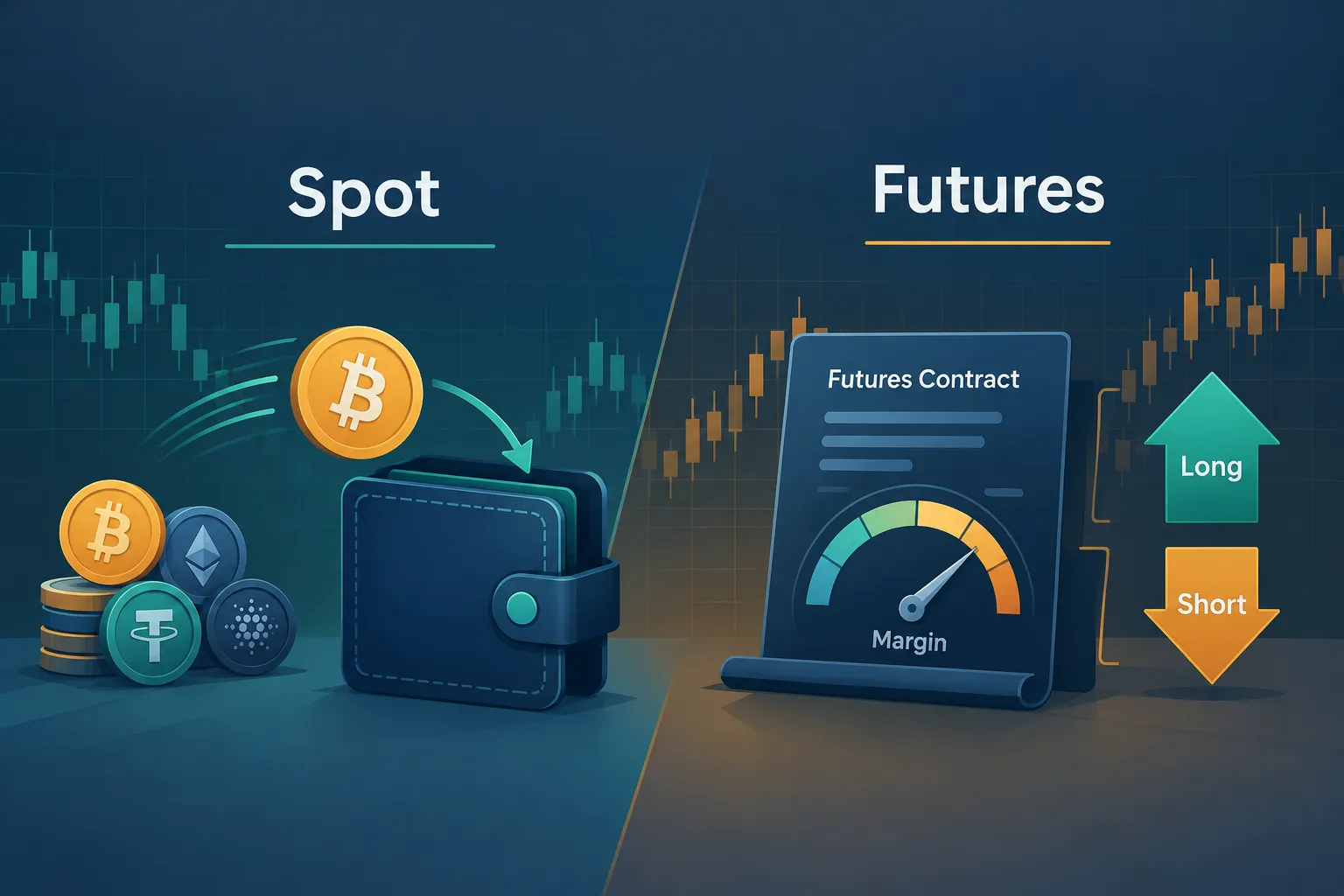
In crypto spot trading, you generally buy or sell the actual cryptocurrency at the current market price. If you buy Bitcoin in the spot market, for example, the Bitcoin is usually credited to your exchange account and may be transferred to a personal wallet where the platform supports withdrawals.

Crypto futures trading is different. You trade a derivative contract whose value is linked to a cryptocurrency rather than directly buying that cryptocurrency. Futures allow both long and short positions and often involve margin. They can magnify profits as well as losses, and a leveraged position may be liquidated if the market moves against you.

Introduction

Important risk warning: Crypto assets are highly volatile, and crypto derivatives can be even riskier. Trading may lead to a substantial or total loss of your capital. Leverage can make losses build quickly, and you may lose the entire margin committed to a position. This article is for education only. It is not investment, trading, tax or legal advice.

The difference between spot trading and futures trading in crypto begins with one basic question: what exactly are you trading?

In the spot market, you generally exchange money or one crypto asset for another crypto asset. In the futures market, you trade a contract linked to the price of an underlying asset. This distinction affects ownership, margin requirements, settlement and the risks involved.

For a beginner, the trading screen can make both markets look similar. Each may display a price chart, an order book and buttons marked “Buy” and “Sell.” However, placing a spot order is not the same as opening a futures position.

Before comparing strategies or choosing a market, it is important to understand the basic structure of each one. Readers who are completely new to exchanges may also benefit from the RegularStation guides Crypto Trading & Technical Analysis: A Practical Guide and Crypto Trading for Beginners: How to Understand the Basics. Verified internal URLs should be added to these titles during publication.

What Are Crypto Spot Trading and Futures Trading?
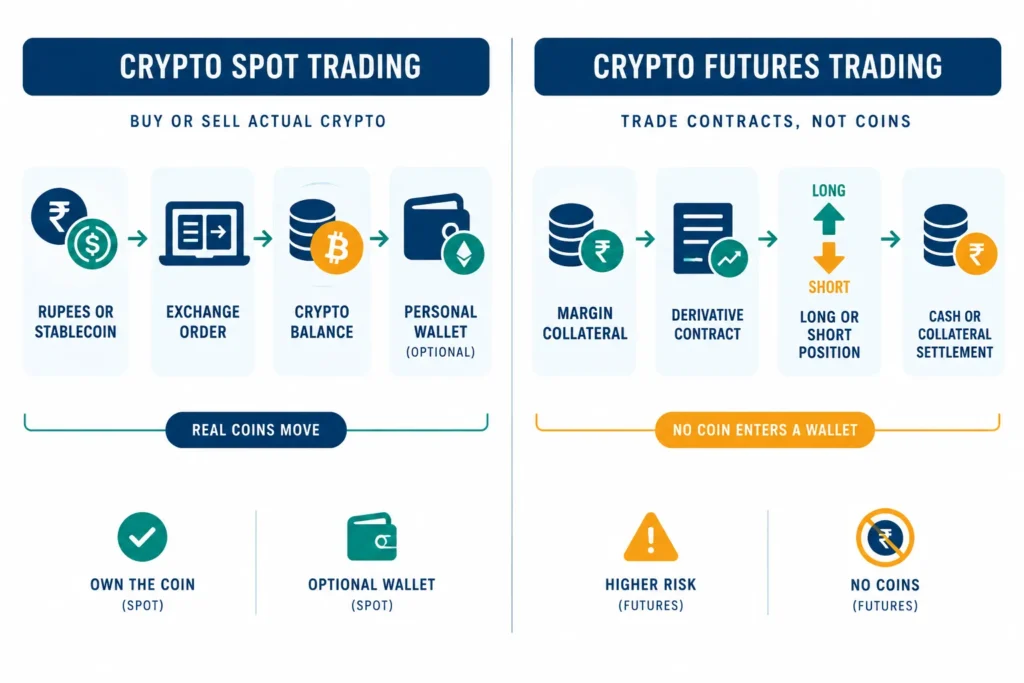
Flowchart showing that spot trading results in a crypto balance while futures trading creates a contract position backed by margin.

What Is Crypto Spot Trading?

Crypto spot trading generally means buying or selling the underlying cryptocurrency for settlement at or near the current market price. In simple terms, you exchange one asset for another.

Suppose Bitcoin is trading against Indian rupees on an exchange that offers a BTC/INR market. If you place a spot buy order and it is executed, you pay in rupees and receive the corresponding amount of Bitcoin in your exchange account. If you sell, you give up Bitcoin and receive rupees, subject to the platform’s rules, fees and settlement process.

Spot markets are organised around trading pairs. A pair shows which two assets can be exchanged. Common examples include:

  • BTC/INR: Bitcoin is traded against Indian rupees.
  • ETH/USDT: Ether is traded against USDT.
  • ETH/BTC: Ether is traded against Bitcoin.

In a pair such as ETH/INR, ETH is the base asset and INR is the quote asset. If the displayed price is ₹X, it means one unit of ETH is being valued at ₹X in that market. The actual price available to you can change before or while your order is filled.

An order must be matched or otherwise executed through the platform’s trading system. A market order usually seeks immediate execution at the best available prices, but the final average price may differ from the last traded price. This is especially possible in a fast-moving or low-liquidity market. A limit order lets you specify a price, but it may remain unfilled or be only partly filled.

After a spot purchase, you generally have an economic claim to the cryptocurrency credited to your account. Whether you directly control it depends on how it is held.

If the crypto remains on a centralised exchange, the platform normally controls the private keys and holds the asset in custody under its terms. Your account balance records your entitlement. This introduces platform and custody risk, including the possibility of withdrawal restrictions, operational failure, cyber incidents or insolvency.

Where withdrawals are supported, you may be able to transfer the purchased cryptocurrency to a personal wallet. A personal wallet can provide direct control through private keys or a recovery phrase, but it also creates personal responsibility. Sending an asset to the wrong address, selecting an incompatible network or losing the recovery phrase may cause a permanent loss.

Not every platform permits withdrawals for every listed token or network. Some products that look like spot exposure may also operate differently from a straightforward purchase of an on-chain asset. Traders should check the platform’s custody, withdrawal and settlement terms before placing an order.

You May Also Like:Crypto Trading vs Long-Term Investing: Key Differences and Risks

What Is Crypto Futures Trading?

A crypto futures contract is a derivative. Its price is linked to an underlying cryptocurrency or crypto index, but trading the contract does not normally mean that you have bought the underlying coins.

For example, opening a Bitcoin futures position gives you exposure to movements in the contract price. It does not necessarily place Bitcoin in your spot wallet, and you may not be able to withdraw Bitcoin from that futures position.

Futures contracts allow traders to take two basic directions:

  • Long position: The trader generally benefits if the contract price rises and loses if it falls.
  • Short position: The trader generally benefits if the contract price falls and loses if it rises.

Short positions are one reason traders use futures. In a standard spot transaction, selling usually requires you to own or obtain the asset first. A futures platform may allow you to open a short position through a derivative contract, subject to its margin and eligibility rules.

Every futures product has contract specifications. These rules may state the contract size, quoted currency, minimum order size, accepted collateral, settlement method, price reference and trading limits. They may also explain how profit and loss are calculated.

The settlement asset is important. Some contracts are margined and settled in a stablecoin. Others may use the underlying cryptocurrency as collateral or settlement. A contract can also be cash-settled against a reference price without delivering the underlying crypto. Exact arrangements depend on the product.

Margin and Leverage in Futures

Futures positions usually require margin. Margin is collateral deposited to open and maintain a position. It is not the same as paying the full value of an ordinary spot purchase.

Leverage allows a trader to control a position larger than the margin committed. For instance, a platform may permit a position whose notional value is several times the trader’s margin. This does not make the trade safer or create free capital. It makes the position more sensitive to price movements.

If the market moves against the position, losses reduce the available margin. The trader may need to add collateral or reduce the position. If the margin falls below the platform’s required level, the position may be automatically closed through liquidation. Fees, price gaps and rapid volatility can affect the final loss.

Platforms may offer isolated margin, where collateral is assigned to a particular position, or cross margin, where a broader balance supports multiple positions. The consequences differ, so traders should not assume the margin mode shown by default is suitable for them.

Expiry Futures and Perpetual Futures

Some crypto futures have a fixed expiry or settlement date. These contracts may settle weekly, monthly, quarterly or according to another schedule stated in the specifications. A trader can close the position before expiry, but an open contract at expiry is settled under the platform’s rules.

Perpetual futures, often called perpetuals or perpetual swaps, do not have a conventional expiry date. A position can generally remain open while the trader meets margin requirements and the platform continues to support the contract.

Because perpetual contracts do not expire, many use periodic funding payments to help keep the contract price aligned with the underlying spot or index price. Depending on the funding rate and position direction, long traders may pay short traders, or short traders may pay long traders. Funding is not guaranteed income, and rates can change.

Contract names can look similar across exchanges while their actual rules differ. Margin requirements, liquidation methods, funding calculations, settlement assets, expiry terms and regional availability all depend on the platform and the specific contract. Indian users should also check whether a product is available to them and understand the applicable platform terms and legal or tax obligations before trading.

Spot Trading vs Futures Trading: Differences, Costs and Example

The main difference between spot trading and futures trading is what you trade. In spot trading, you buy or sell the crypto asset itself. In futures trading, you trade a contract whose value is linked to the asset’s price.

This distinction changes how ownership, leverage, costs and risk work. The following table summarises the key differences in spot trading vs futures trading crypto markets.

Feature Spot Trading Futures Trading
Ownership You generally buy and own the crypto asset credited to your exchange or wallet balance. You hold a contract linked to the crypto price, not the underlying asset itself.
Custody The asset may remain with the exchange or be transferred to a compatible personal wallet. There is normally no crypto asset to withdraw. The platform records your contract position.
Contract structure A direct purchase or sale at the current market price. A standardised contract settled according to the platform’s rules.
Leverage A normal cash purchase has no leverage. You pay the full purchase amount. Leverage may allow a larger position using a smaller amount of margin.
Margin Not required for a fully paid purchase. Initial and maintenance margin requirements usually apply.
Short exposure Usually requires you to already hold the asset before selling it. A trader can generally open a short position to seek gains from a price fall.
Liquidation risk A fully paid spot holding is not normally liquidated merely because its market price falls. A leveraged position may be closed automatically if available margin becomes insufficient.
Expiry No contract expiry. You can hold the asset while the exchange or wallet continues to support it. Traditional futures may expire. Perpetual futures do not have a fixed expiry but may involve funding payments.
Funding payments Not applicable to an ordinary spot purchase. Perpetual futures may require payments between long and short traders at specified intervals.
Main trading costs Trading fees, bid-ask spread, slippage, withdrawal charges and other platform charges may apply. Trading fees, spread, slippage, funding, liquidation-related charges and other contract fees may apply.
Complexity Generally simpler for beginners. More complex because leverage, margin, liquidation and contract terms must be monitored.
You May Also Like:Stablecoins Explained: Types, Uses and Risks for Indian Beginners

Initial Margin, Maintenance Margin and Liquidation
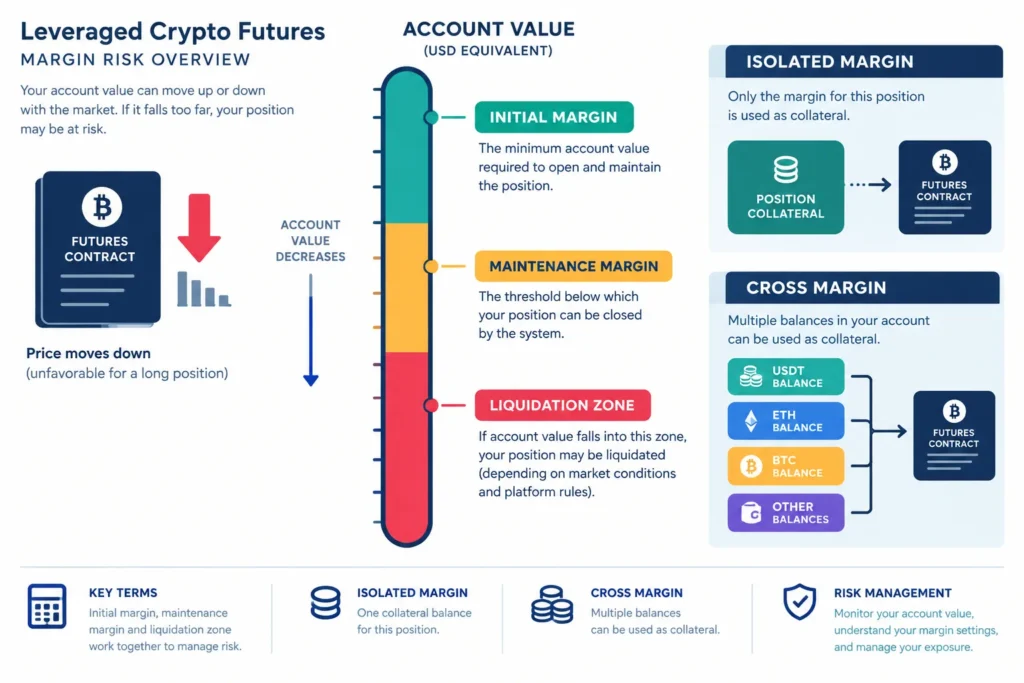
Diagram of initial margin falling toward the maintenance threshold and liquidation zone in crypto futures trading.

Margin is the capital set aside to support a futures position. It is not the same as paying the full value of the position.

Initial margin is the amount required to open a position. For example, if a trader opens a futures position worth ₹10,000 using ₹2,000 of margin, the position has five times the exposure of the posted capital.

Maintenance margin is the minimum account value that must remain available to keep the position open. The platform calculates this under its own contract and risk rules. Maintenance requirements may change with position size, market conditions or the asset being traded.

Liquidation can happen when losses reduce the trader’s available margin below the required level. The platform may then close all or part of the position automatically. This is designed to stop the account from falling further below its margin requirement.

A liquidation price is not necessarily the price at which the entire initial margin would mathematically be lost. Maintenance margin, fees, the platform’s price calculation and any extra margin in the account can affect when liquidation happens.

Some platforms use isolated margin, where a specified amount supports one position. Others offer cross margin, where a wider account balance may support multiple positions. With cross margin, losses from one trade can place more of the account balance at risk.

Traders should not assume that losses are always limited to the initial margin. The result depends on the contract rules, market movement, liquidation process and any negative-balance protection offered by the platform. Fast price gaps or poor liquidity can also affect execution.

Trading Costs Beyond the Visible Price

Profit and loss calculations should include more than the change in the displayed market price.

  • Trading fees: The platform may charge a fee when an order is executed. The amount can depend on whether the order adds liquidity or takes available liquidity.
  • Bid-ask spread: The highest available buying price and lowest available selling price are usually different. Crossing this spread creates an immediate trading cost.
  • Slippage: A market order may execute at a worse average price than expected, especially during volatility or in a thinly traded contract.
  • Funding payments: Perpetual futures commonly use periodic payments to help keep the contract price near the spot price. Depending on the funding rate and position direction, a trader may pay or receive funding.
  • Additional charges: Platforms may apply withdrawal charges, settlement fees, liquidation charges, conversion costs or other account-level fees.

Funding is not automatically a cost for every futures trader because it can sometimes be received. However, it can become a repeated expense when a position is held for longer periods. Traders should check the funding schedule and current rate before opening a perpetual futures position.

Hypothetical Rupee Example
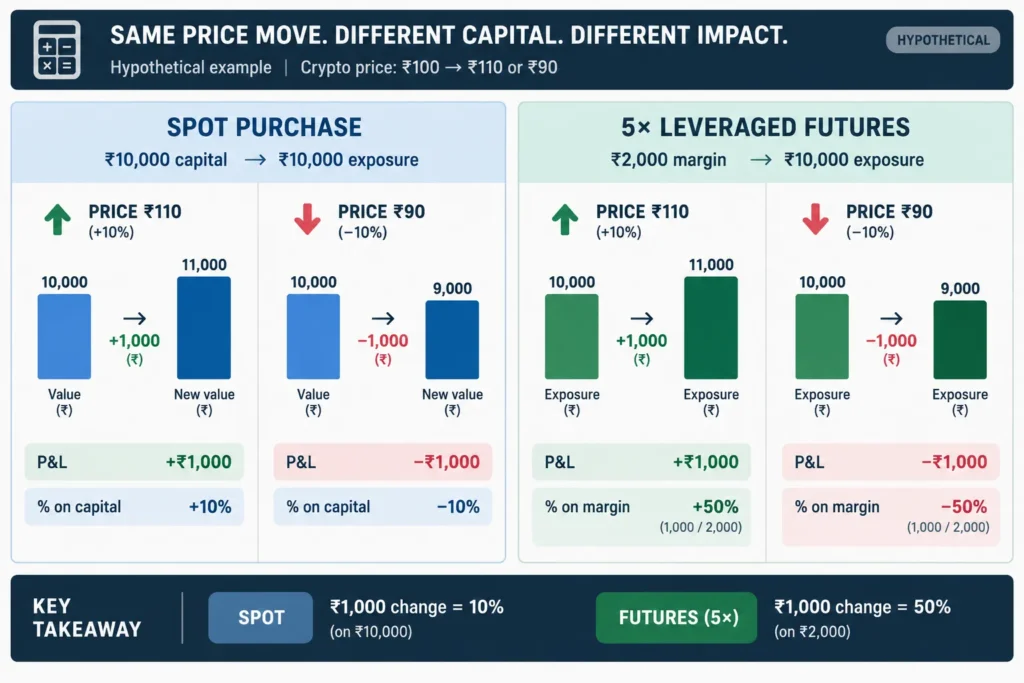
Hypothetical rupee comparison showing how the same price move has a larger percentage impact on leveraged futures margin than on spot capital.

This is a simplified hypothetical example, not a forecast or trading recommendation. Assume a crypto asset trades at ₹100 per unit. Ignore taxes, fees, spreads, slippage and funding initially so that the effect of leverage is easy to see.

Trader A makes a spot purchase of 100 units for ₹10,000. Trader B opens a long futures position covering 100 units, so the futures position also has a notional value of ₹10,000. Trader B uses five-times leverage and posts ₹2,000 as initial margin.

Scenario Spot Position Five-Times Leveraged Futures Position
Capital paid or posted ₹10,000 purchase amount ₹2,000 initial margin
Notional exposure ₹10,000 ₹10,000
Price rises from ₹100 to ₹110 Gain of ₹1,000 Gain of ₹1,000
Return relative to paid or posted capital 10% before costs 50% before costs
Price falls from ₹100 to ₹90 Loss of ₹1,000 Loss of ₹1,000
Loss relative to paid or posted capital 10% before costs 50% before costs

Both positions have the same ₹10,000 market exposure, so the rupee gain or loss from a 10% price move is ₹1,000. The difference is the capital committed. For the spot buyer, ₹1,000 is 10% of ₹10,000. For the futures trader, it is 50% of the ₹2,000 margin.

This is how leverage magnifies results relative to posted capital. It does not make the underlying price move larger. It allows the trader to take larger exposure with less upfront capital, making both gains and losses more significant as a percentage of that capital.

If the price keeps falling, the futures position may be liquidated before the full ₹2,000 margin is lost on paper. The exact liquidation point cannot be calculated from this simplified example because it depends on maintenance margin, fees, the platform’s reference price and whether extra account funds support the position.

The spot holder can also suffer a substantial loss if the asset price collapses. However, a fully paid spot holding does not normally face forced liquidation solely due to a price decline. The holder retains the units unless they sell them or another event affects custody.

Correct Direction Does Not Always Mean a Profit

A trader may correctly predict that a crypto price will rise and still fail to make a net profit. A small favourable move could be less than the combined trading fees, spread, slippage and funding payments.

Direction can also be correct over a longer period but wrong in the short term. For example, a trader may expect the price to rise by the end of the week, but a sharp fall today could liquidate a leveraged long position first. The later recovery would not restore a position that has already been closed.

Spot trading is generally easier to understand because there is no contract margin or routine liquidation mechanism for a fully paid purchase. Futures offer short exposure and greater capital efficiency, but they add leverage, funding and forced-exit risk. Beginners should compare the complete cost structure and contract rules, not only the possible return.

You May Also Like:Cryptocurrency vs Digital Currency: Key Differences Explained

Risks, Indian Context and Beginner Checklist

When comparing spot trading vs futures trading crypto, it is important to look beyond possible returns. Both methods can cause substantial losses, and neither guarantees a profit.

Spot trading is generally easier to understand because you buy or sell the crypto asset at the current market price. Futures trading is more complex because it involves contracts, margin, leverage, funding charges and possible liquidation.

Risks Common to Spot and Futures Trading

Crypto prices can change sharply within minutes. A coin bought for ₹10,000 may quickly fall in value because of market sentiment, regulatory news, security incidents or low trading activity. Price volatility affects both spot and futures traders.

Other important risks include:

  • Liquidity risk: A market may not have enough buyers and sellers at the expected price. Your order may be delayed or executed at a worse price, especially in smaller crypto assets.
  • Platform risk: An exchange may face technical problems, withdrawal delays, insolvency, operational failures or legal restrictions.
  • Counterparty risk: A platform or another party involved in a transaction may fail to meet its obligations.
  • Cybersecurity risk: Accounts can be targeted through phishing, malware, stolen passwords, fake applications and SIM-swap attacks.
  • Market manipulation risk: Crypto markets may experience artificial price movements, misleading promotions or coordinated buying and selling.
  • Cost risk: Trading fees, spreads, taxes, withdrawal charges, network fees and futures-related costs can reduce returns.

Liquidity can also vary across platforms. A large order that is easily completed on one exchange may cause significant price slippage on another. The displayed market price is not always the final price you receive.

Spot Ownership Still Carries Risk

Buying crypto in the spot market may give you ownership or a claim to the asset, depending on the platform and custody arrangement. This does not make the investment safe.

If the price falls by 60%, the value of your holding also falls by about 60%, excluding costs. There may be no automatic liquidation if the purchase was made entirely with your own money, but a large or total economic loss is still possible.

Custody is another major issue. If assets remain on an exchange, you depend on that exchange to protect them and process withdrawals. If you use a private wallet, you become responsible for safeguarding the private keys or recovery phrase. Losing this information may permanently prevent access to the assets.

Before choosing where to trade or hold crypto, readers can consult Crypto Exchanges in India: How They Work and How to Choose One for a broader explanation of exchange selection, custody and platform checks.

Why Futures Can Create Faster Losses

Futures contracts can magnify both gains and losses through leverage. Suppose a trader deposits ₹5,000 as margin and takes a position worth ₹50,000. A relatively small adverse price movement may consume a large part of the margin.

If the account no longer meets the platform’s margin requirement, the position may be liquidated. Liquidation means the platform closes the position, often automatically, to prevent further losses to the trading system. The trader may lose most or all of the margin committed to that position.

Depending on the product, platform rules and market conditions, losses and charges may be more complicated than the initial amount shown on the order screen. Traders must understand whether additional margin can be requested and how the platform handles extreme price movements.

Futures users also need to understand:

  • Initial and maintenance margin requirements
  • Leverage limits and how they affect liquidation prices
  • Contract size, settlement method and expiry, if applicable
  • Funding payments for perpetual futures
  • Mark price and index price rules
  • Trading, liquidation and settlement fees
  • What happens during system downtime or unusually volatile markets

Futures trading is not a necessary next step after spot trading. A person can decide never to trade futures. Beginners who do not fully understand margin and liquidation should not treat leverage as a shortcut to higher returns.

Indian crypto rules can change, and different activities may be treated differently. Legal status, tax treatment, reporting duties, platform requirements and product availability should be checked against current authoritative Indian sources before publication and before any transaction.

Domestic and offshore platforms may not receive identical legal, regulatory or tax treatment. Spot purchases, futures contracts, transfers, conversions and other transactions may also have different consequences. The fact that an overseas platform allows an Indian user to open an account does not by itself confirm that every product is permitted, protected or suitable under Indian rules.

Do not rely only on social media posts, influencer videos or an exchange’s promotional material. Check current government notifications, regulator communications, tax guidance and the platform’s applicable terms. Consider advice from a qualified Indian tax or legal professional when the amount or transaction structure is significant.

Tax may apply even when profits are left on a platform or used for another transaction, depending on the current rules and facts. Maintain clear records of deposits, purchases, sales, transfers, fees and withdrawals. Futures activity can produce additional records such as funding payments and realised profit or loss statements.

You May Also Like:Crypto Mining Explained: How It Works, Costs and Risks

Beginner Checklist Before Trading

  1. Identify the product. Confirm whether you are buying spot crypto, a dated futures contract, a perpetual futures contract or another product.
  2. Understand how losses occur. Know what happens if the market moves against you. For futures, estimate the liquidation price rather than focusing only on the possible profit.
  3. Read the terms. Review the platform’s rules for custody, withdrawals, margin, funding, settlement, liquidation and account closure.
  4. Confirm availability and applicable rules. Check whether the product is offered to Indian residents and verify current legal, regulatory and tax requirements through authoritative sources.
  5. Calculate all costs. Include trading fees, spreads, network fees, withdrawal charges, funding payments, taxes and possible currency-conversion costs.
  6. Assess custody. Understand whether the platform controls the assets or whether you will use a private wallet. Plan how recovery information will be secured.
  7. Protect the account. Use a unique password, enable strong two-factor authentication and verify the application or website before entering login details.
  8. Avoid borrowed money. Do not fund crypto trades with personal loans, credit-card debt or money needed for rent, bills, emergencies or near-term goals.
  9. Avoid excessive leverage. Higher leverage reduces the room available for normal price movements and can bring the liquidation price closer.
  10. Practise first. Write down hypothetical entry prices, fees, funding costs, exit prices and losses. This can reveal misunderstandings without putting money at risk.

For a wider safety review, see Cryptocurrency Risks: Common Dangers and How to Invest More Safely. It can help readers assess fraud, custody, platform and cybersecurity concerns before opening a position.

Frequently Asked Questions

Is spot trading safer than futures trading?

Spot trading without borrowed money is generally simpler and does not usually carry the same liquidation risk as leveraged futures. However, the crypto asset can still lose most or all of its value. Exchange failure, fraud, poor custody and cybersecurity incidents can also cause losses.

Can I lose more money in crypto futures?

Leverage can cause rapid losses and liquidation. The exact loss process depends on the contract and platform terms, including margin requirements, fees and treatment during extreme market conditions. Read these rules before trading.

Do I own crypto when trading futures?

Usually, a futures trader holds a contract linked to the asset’s price rather than owning the underlying coins. Settlement rules vary, so the contract specification must be checked.

This cannot be assumed merely because a platform accepts registrations from India. Product access, legal treatment, regulatory protection and tax obligations may differ. Verify the current position using authoritative Indian sources and obtain professional advice where necessary.

Should a beginner move from spot to futures?

No progression is required. Futures are not an essential stage of crypto trading. A beginner should consider them only after understanding margin, leverage, funding, liquidation and contract terms, and may reasonably choose to avoid them entirely.

Summary

The key difference in spot trading vs futures trading crypto is that spot trading generally involves buying or selling the asset at the current price, while futures trading involves a contract linked to future or ongoing price movements.

Spot trading is easier to understand, but ownership does not remove volatility, custody, platform or cybersecurity risk. Futures add leverage, margin, funding and liquidation risk, making losses faster and more complex.

Indian users should verify current legal, regulatory and taxation details before acting because domestic and offshore platforms, products and transactions may not receive identical treatment. Understand the product, include every cost, protect custody and account access, avoid borrowed money and excessive leverage, and practise with hypothetical examples before risking funds.
Share this article
KEEP READING

Related Articles

View all →

Comments

Leave a Comment

Crypto Spot Trading vs Futures Trading: Key Differences for Beginners

In crypto spot trading, you generally buy or sell the actual cryptocurrency at the current market price. If you buy Bitcoin in the spot market, for example, the Bitcoin is usually credited to your exchange account and may be transferred to a personal wallet where the platform supports withdrawals.

Crypto futures trading is different. You trade a derivative contract whose value is linked to a cryptocurrency rather than directly buying that cryptocurrency. Futures allow both long and short positions and often involve margin. They can magnify profits as well as losses, and a leveraged position may be liquidated if the market moves against you.

Introduction

Important risk warning: Crypto assets are highly volatile, and crypto derivatives can be even riskier. Trading may lead to a substantial or total loss of your capital. Leverage can make losses build quickly, and you may lose the entire margin committed to a position. This article is for education only. It is not investment, trading, tax or legal advice.

The difference between spot trading and futures trading in crypto begins with one basic question: what exactly are you trading?

In the spot market, you generally exchange money or one crypto asset for another crypto asset. In the futures market, you trade a contract linked to the price of an underlying asset. This distinction affects ownership, margin requirements, settlement and the risks involved.

For a beginner, the trading screen can make both markets look similar. Each may display a price chart, an order book and buttons marked “Buy” and “Sell.” However, placing a spot order is not the same as opening a futures position.

Before comparing strategies or choosing a market, it is important to understand the basic structure of each one. Readers who are completely new to exchanges may also benefit from the RegularStation guides Crypto Trading & Technical Analysis: A Practical Guide and Crypto Trading for Beginners: How to Understand the Basics. Verified internal URLs should be added to these titles during publication.

What Are Crypto Spot Trading and Futures Trading?

Flowchart showing that spot trading results in a crypto balance while futures trading creates a contract position backed by margin.

What Is Crypto Spot Trading?

Crypto spot trading generally means buying or selling the underlying cryptocurrency for settlement at or near the current market price. In simple terms, you exchange one asset for another.

Suppose Bitcoin is trading against Indian rupees on an exchange that offers a BTC/INR market. If you place a spot buy order and it is executed, you pay in rupees and receive the corresponding amount of Bitcoin in your exchange account. If you sell, you give up Bitcoin and receive rupees, subject to the platform’s rules, fees and settlement process.

Spot markets are organised around trading pairs. A pair shows which two assets can be exchanged. Common examples include:

  • BTC/INR: Bitcoin is traded against Indian rupees.
  • ETH/USDT: Ether is traded against USDT.
  • ETH/BTC: Ether is traded against Bitcoin.

In a pair such as ETH/INR, ETH is the base asset and INR is the quote asset. If the displayed price is ₹X, it means one unit of ETH is being valued at ₹X in that market. The actual price available to you can change before or while your order is filled.

An order must be matched or otherwise executed through the platform’s trading system. A market order usually seeks immediate execution at the best available prices, but the final average price may differ from the last traded price. This is especially possible in a fast-moving or low-liquidity market. A limit order lets you specify a price, but it may remain unfilled or be only partly filled.

After a spot purchase, you generally have an economic claim to the cryptocurrency credited to your account. Whether you directly control it depends on how it is held.

If the crypto remains on a centralised exchange, the platform normally controls the private keys and holds the asset in custody under its terms. Your account balance records your entitlement. This introduces platform and custody risk, including the possibility of withdrawal restrictions, operational failure, cyber incidents or insolvency.

Where withdrawals are supported, you may be able to transfer the purchased cryptocurrency to a personal wallet. A personal wallet can provide direct control through private keys or a recovery phrase, but it also creates personal responsibility. Sending an asset to the wrong address, selecting an incompatible network or losing the recovery phrase may cause a permanent loss.

Not every platform permits withdrawals for every listed token or network. Some products that look like spot exposure may also operate differently from a straightforward purchase of an on-chain asset. Traders should check the platform’s custody, withdrawal and settlement terms before placing an order.

What Is Crypto Futures Trading?

A crypto futures contract is a derivative. Its price is linked to an underlying cryptocurrency or crypto index, but trading the contract does not normally mean that you have bought the underlying coins.

For example, opening a Bitcoin futures position gives you exposure to movements in the contract price. It does not necessarily place Bitcoin in your spot wallet, and you may not be able to withdraw Bitcoin from that futures position.

Futures contracts allow traders to take two basic directions:

  • Long position: The trader generally benefits if the contract price rises and loses if it falls.
  • Short position: The trader generally benefits if the contract price falls and loses if it rises.

Short positions are one reason traders use futures. In a standard spot transaction, selling usually requires you to own or obtain the asset first. A futures platform may allow you to open a short position through a derivative contract, subject to its margin and eligibility rules.

Every futures product has contract specifications. These rules may state the contract size, quoted currency, minimum order size, accepted collateral, settlement method, price reference and trading limits. They may also explain how profit and loss are calculated.

The settlement asset is important. Some contracts are margined and settled in a stablecoin. Others may use the underlying cryptocurrency as collateral or settlement. A contract can also be cash-settled against a reference price without delivering the underlying crypto. Exact arrangements depend on the product.

Margin and Leverage in Futures

Futures positions usually require margin. Margin is collateral deposited to open and maintain a position. It is not the same as paying the full value of an ordinary spot purchase.

Leverage allows a trader to control a position larger than the margin committed. For instance, a platform may permit a position whose notional value is several times the trader’s margin. This does not make the trade safer or create free capital. It makes the position more sensitive to price movements.

If the market moves against the position, losses reduce the available margin. The trader may need to add collateral or reduce the position. If the margin falls below the platform’s required level, the position may be automatically closed through liquidation. Fees, price gaps and rapid volatility can affect the final loss.

Platforms may offer isolated margin, where collateral is assigned to a particular position, or cross margin, where a broader balance supports multiple positions. The consequences differ, so traders should not assume the margin mode shown by default is suitable for them.

Expiry Futures and Perpetual Futures

Some crypto futures have a fixed expiry or settlement date. These contracts may settle weekly, monthly, quarterly or according to another schedule stated in the specifications. A trader can close the position before expiry, but an open contract at expiry is settled under the platform’s rules.

Perpetual futures, often called perpetuals or perpetual swaps, do not have a conventional expiry date. A position can generally remain open while the trader meets margin requirements and the platform continues to support the contract.

Because perpetual contracts do not expire, many use periodic funding payments to help keep the contract price aligned with the underlying spot or index price. Depending on the funding rate and position direction, long traders may pay short traders, or short traders may pay long traders. Funding is not guaranteed income, and rates can change.

Contract names can look similar across exchanges while their actual rules differ. Margin requirements, liquidation methods, funding calculations, settlement assets, expiry terms and regional availability all depend on the platform and the specific contract. Indian users should also check whether a product is available to them and understand the applicable platform terms and legal or tax obligations before trading.

Spot Trading vs Futures Trading: Differences, Costs and Example

The main difference between spot trading and futures trading is what you trade. In spot trading, you buy or sell the crypto asset itself. In futures trading, you trade a contract whose value is linked to the asset’s price.

This distinction changes how ownership, leverage, costs and risk work. The following table summarises the key differences in spot trading vs futures trading crypto markets.

Feature Spot Trading Futures Trading
Ownership You generally buy and own the crypto asset credited to your exchange or wallet balance. You hold a contract linked to the crypto price, not the underlying asset itself.
Custody The asset may remain with the exchange or be transferred to a compatible personal wallet. There is normally no crypto asset to withdraw. The platform records your contract position.
Contract structure A direct purchase or sale at the current market price. A standardised contract settled according to the platform’s rules.
Leverage A normal cash purchase has no leverage. You pay the full purchase amount. Leverage may allow a larger position using a smaller amount of margin.
Margin Not required for a fully paid purchase. Initial and maintenance margin requirements usually apply.
Short exposure Usually requires you to already hold the asset before selling it. A trader can generally open a short position to seek gains from a price fall.
Liquidation risk A fully paid spot holding is not normally liquidated merely because its market price falls. A leveraged position may be closed automatically if available margin becomes insufficient.
Expiry No contract expiry. You can hold the asset while the exchange or wallet continues to support it. Traditional futures may expire. Perpetual futures do not have a fixed expiry but may involve funding payments.
Funding payments Not applicable to an ordinary spot purchase. Perpetual futures may require payments between long and short traders at specified intervals.
Main trading costs Trading fees, bid-ask spread, slippage, withdrawal charges and other platform charges may apply. Trading fees, spread, slippage, funding, liquidation-related charges and other contract fees may apply.
Complexity Generally simpler for beginners. More complex because leverage, margin, liquidation and contract terms must be monitored.

Initial Margin, Maintenance Margin and Liquidation

Diagram of initial margin falling toward the maintenance threshold and liquidation zone in crypto futures trading.

Margin is the capital set aside to support a futures position. It is not the same as paying the full value of the position.

Initial margin is the amount required to open a position. For example, if a trader opens a futures position worth ₹10,000 using ₹2,000 of margin, the position has five times the exposure of the posted capital.

Maintenance margin is the minimum account value that must remain available to keep the position open. The platform calculates this under its own contract and risk rules. Maintenance requirements may change with position size, market conditions or the asset being traded.

Liquidation can happen when losses reduce the trader’s available margin below the required level. The platform may then close all or part of the position automatically. This is designed to stop the account from falling further below its margin requirement.

A liquidation price is not necessarily the price at which the entire initial margin would mathematically be lost. Maintenance margin, fees, the platform’s price calculation and any extra margin in the account can affect when liquidation happens.

Some platforms use isolated margin, where a specified amount supports one position. Others offer cross margin, where a wider account balance may support multiple positions. With cross margin, losses from one trade can place more of the account balance at risk.

Traders should not assume that losses are always limited to the initial margin. The result depends on the contract rules, market movement, liquidation process and any negative-balance protection offered by the platform. Fast price gaps or poor liquidity can also affect execution.

Trading Costs Beyond the Visible Price

Profit and loss calculations should include more than the change in the displayed market price.

  • Trading fees: The platform may charge a fee when an order is executed. The amount can depend on whether the order adds liquidity or takes available liquidity.
  • Bid-ask spread: The highest available buying price and lowest available selling price are usually different. Crossing this spread creates an immediate trading cost.
  • Slippage: A market order may execute at a worse average price than expected, especially during volatility or in a thinly traded contract.
  • Funding payments: Perpetual futures commonly use periodic payments to help keep the contract price near the spot price. Depending on the funding rate and position direction, a trader may pay or receive funding.
  • Additional charges: Platforms may apply withdrawal charges, settlement fees, liquidation charges, conversion costs or other account-level fees.

Funding is not automatically a cost for every futures trader because it can sometimes be received. However, it can become a repeated expense when a position is held for longer periods. Traders should check the funding schedule and current rate before opening a perpetual futures position.

Hypothetical Rupee Example

Hypothetical rupee comparison showing how the same price move has a larger percentage impact on leveraged futures margin than on spot capital.

This is a simplified hypothetical example, not a forecast or trading recommendation. Assume a crypto asset trades at ₹100 per unit. Ignore taxes, fees, spreads, slippage and funding initially so that the effect of leverage is easy to see.

Trader A makes a spot purchase of 100 units for ₹10,000. Trader B opens a long futures position covering 100 units, so the futures position also has a notional value of ₹10,000. Trader B uses five-times leverage and posts ₹2,000 as initial margin.

Scenario Spot Position Five-Times Leveraged Futures Position
Capital paid or posted ₹10,000 purchase amount ₹2,000 initial margin
Notional exposure ₹10,000 ₹10,000
Price rises from ₹100 to ₹110 Gain of ₹1,000 Gain of ₹1,000
Return relative to paid or posted capital 10% before costs 50% before costs
Price falls from ₹100 to ₹90 Loss of ₹1,000 Loss of ₹1,000
Loss relative to paid or posted capital 10% before costs 50% before costs

Both positions have the same ₹10,000 market exposure, so the rupee gain or loss from a 10% price move is ₹1,000. The difference is the capital committed. For the spot buyer, ₹1,000 is 10% of ₹10,000. For the futures trader, it is 50% of the ₹2,000 margin.

This is how leverage magnifies results relative to posted capital. It does not make the underlying price move larger. It allows the trader to take larger exposure with less upfront capital, making both gains and losses more significant as a percentage of that capital.

If the price keeps falling, the futures position may be liquidated before the full ₹2,000 margin is lost on paper. The exact liquidation point cannot be calculated from this simplified example because it depends on maintenance margin, fees, the platform’s reference price and whether extra account funds support the position.

The spot holder can also suffer a substantial loss if the asset price collapses. However, a fully paid spot holding does not normally face forced liquidation solely due to a price decline. The holder retains the units unless they sell them or another event affects custody.

Correct Direction Does Not Always Mean a Profit

A trader may correctly predict that a crypto price will rise and still fail to make a net profit. A small favourable move could be less than the combined trading fees, spread, slippage and funding payments.

Direction can also be correct over a longer period but wrong in the short term. For example, a trader may expect the price to rise by the end of the week, but a sharp fall today could liquidate a leveraged long position first. The later recovery would not restore a position that has already been closed.

Spot trading is generally easier to understand because there is no contract margin or routine liquidation mechanism for a fully paid purchase. Futures offer short exposure and greater capital efficiency, but they add leverage, funding and forced-exit risk. Beginners should compare the complete cost structure and contract rules, not only the possible return.

Risks, Indian Context and Beginner Checklist

When comparing spot trading vs futures trading crypto, it is important to look beyond possible returns. Both methods can cause substantial losses, and neither guarantees a profit.

Spot trading is generally easier to understand because you buy or sell the crypto asset at the current market price. Futures trading is more complex because it involves contracts, margin, leverage, funding charges and possible liquidation.

Risks Common to Spot and Futures Trading

Crypto prices can change sharply within minutes. A coin bought for ₹10,000 may quickly fall in value because of market sentiment, regulatory news, security incidents or low trading activity. Price volatility affects both spot and futures traders.

Other important risks include:

  • Liquidity risk: A market may not have enough buyers and sellers at the expected price. Your order may be delayed or executed at a worse price, especially in smaller crypto assets.
  • Platform risk: An exchange may face technical problems, withdrawal delays, insolvency, operational failures or legal restrictions.
  • Counterparty risk: A platform or another party involved in a transaction may fail to meet its obligations.
  • Cybersecurity risk: Accounts can be targeted through phishing, malware, stolen passwords, fake applications and SIM-swap attacks.
  • Market manipulation risk: Crypto markets may experience artificial price movements, misleading promotions or coordinated buying and selling.
  • Cost risk: Trading fees, spreads, taxes, withdrawal charges, network fees and futures-related costs can reduce returns.

Liquidity can also vary across platforms. A large order that is easily completed on one exchange may cause significant price slippage on another. The displayed market price is not always the final price you receive.

Spot Ownership Still Carries Risk

Buying crypto in the spot market may give you ownership or a claim to the asset, depending on the platform and custody arrangement. This does not make the investment safe.

If the price falls by 60%, the value of your holding also falls by about 60%, excluding costs. There may be no automatic liquidation if the purchase was made entirely with your own money, but a large or total economic loss is still possible.

Custody is another major issue. If assets remain on an exchange, you depend on that exchange to protect them and process withdrawals. If you use a private wallet, you become responsible for safeguarding the private keys or recovery phrase. Losing this information may permanently prevent access to the assets.

Before choosing where to trade or hold crypto, readers can consult Crypto Exchanges in India: How They Work and How to Choose One for a broader explanation of exchange selection, custody and platform checks.

Why Futures Can Create Faster Losses

Futures contracts can magnify both gains and losses through leverage. Suppose a trader deposits ₹5,000 as margin and takes a position worth ₹50,000. A relatively small adverse price movement may consume a large part of the margin.

If the account no longer meets the platform’s margin requirement, the position may be liquidated. Liquidation means the platform closes the position, often automatically, to prevent further losses to the trading system. The trader may lose most or all of the margin committed to that position.

Depending on the product, platform rules and market conditions, losses and charges may be more complicated than the initial amount shown on the order screen. Traders must understand whether additional margin can be requested and how the platform handles extreme price movements.

Futures users also need to understand:

  • Initial and maintenance margin requirements
  • Leverage limits and how they affect liquidation prices
  • Contract size, settlement method and expiry, if applicable
  • Funding payments for perpetual futures
  • Mark price and index price rules
  • Trading, liquidation and settlement fees
  • What happens during system downtime or unusually volatile markets

Futures trading is not a necessary next step after spot trading. A person can decide never to trade futures. Beginners who do not fully understand margin and liquidation should not treat leverage as a shortcut to higher returns.

Indian Legal, Regulatory and Tax Context

Indian crypto rules can change, and different activities may be treated differently. Legal status, tax treatment, reporting duties, platform requirements and product availability should be checked against current authoritative Indian sources before publication and before any transaction.

Domestic and offshore platforms may not receive identical legal, regulatory or tax treatment. Spot purchases, futures contracts, transfers, conversions and other transactions may also have different consequences. The fact that an overseas platform allows an Indian user to open an account does not by itself confirm that every product is permitted, protected or suitable under Indian rules.

Do not rely only on social media posts, influencer videos or an exchange’s promotional material. Check current government notifications, regulator communications, tax guidance and the platform’s applicable terms. Consider advice from a qualified Indian tax or legal professional when the amount or transaction structure is significant.

Tax may apply even when profits are left on a platform or used for another transaction, depending on the current rules and facts. Maintain clear records of deposits, purchases, sales, transfers, fees and withdrawals. Futures activity can produce additional records such as funding payments and realised profit or loss statements.

Beginner Checklist Before Trading

  1. Identify the product. Confirm whether you are buying spot crypto, a dated futures contract, a perpetual futures contract or another product.
  2. Understand how losses occur. Know what happens if the market moves against you. For futures, estimate the liquidation price rather than focusing only on the possible profit.
  3. Read the terms. Review the platform’s rules for custody, withdrawals, margin, funding, settlement, liquidation and account closure.
  4. Confirm availability and applicable rules. Check whether the product is offered to Indian residents and verify current legal, regulatory and tax requirements through authoritative sources.
  5. Calculate all costs. Include trading fees, spreads, network fees, withdrawal charges, funding payments, taxes and possible currency-conversion costs.
  6. Assess custody. Understand whether the platform controls the assets or whether you will use a private wallet. Plan how recovery information will be secured.
  7. Protect the account. Use a unique password, enable strong two-factor authentication and verify the application or website before entering login details.
  8. Avoid borrowed money. Do not fund crypto trades with personal loans, credit-card debt or money needed for rent, bills, emergencies or near-term goals.
  9. Avoid excessive leverage. Higher leverage reduces the room available for normal price movements and can bring the liquidation price closer.
  10. Practise first. Write down hypothetical entry prices, fees, funding costs, exit prices and losses. This can reveal misunderstandings without putting money at risk.

For a wider safety review, see Cryptocurrency Risks: Common Dangers and How to Invest More Safely. It can help readers assess fraud, custody, platform and cybersecurity concerns before opening a position.

Frequently Asked Questions

Is spot trading safer than futures trading?

Spot trading without borrowed money is generally simpler and does not usually carry the same liquidation risk as leveraged futures. However, the crypto asset can still lose most or all of its value. Exchange failure, fraud, poor custody and cybersecurity incidents can also cause losses.

Can I lose more money in crypto futures?

Leverage can cause rapid losses and liquidation. The exact loss process depends on the contract and platform terms, including margin requirements, fees and treatment during extreme market conditions. Read these rules before trading.

Do I own crypto when trading futures?

Usually, a futures trader holds a contract linked to the asset’s price rather than owning the underlying coins. Settlement rules vary, so the contract specification must be checked.

Are offshore crypto futures platforms legal for Indian users?

This cannot be assumed merely because a platform accepts registrations from India. Product access, legal treatment, regulatory protection and tax obligations may differ. Verify the current position using authoritative Indian sources and obtain professional advice where necessary.

Should a beginner move from spot to futures?

No progression is required. Futures are not an essential stage of crypto trading. A beginner should consider them only after understanding margin, leverage, funding, liquidation and contract terms, and may reasonably choose to avoid them entirely.

Summary

The key difference in spot trading vs futures trading crypto is that spot trading generally involves buying or selling the asset at the current price, while futures trading involves a contract linked to future or ongoing price movements.

Spot trading is easier to understand, but ownership does not remove volatility, custody, platform or cybersecurity risk. Futures add leverage, margin, funding and liquidation risk, making losses faster and more complex.

Indian users should verify current legal, regulatory and taxation details before acting because domestic and offshore platforms, products and transactions may not receive identical treatment. Understand the product, include every cost, protect custody and account access, avoid borrowed money and excessive leverage, and practise with hypothetical examples before risking funds.

Leave a Comment