


Direct vs regular mutual funds are usually two plan options of the same mutual fund scheme. They generally invest in the same underlying portfolio and follow the same investment objective. The main difference is how you invest and what the plan charges.
A direct plan does not include distributor commission in its expenses. It therefore usually has a lower expense ratio. A regular plan is purchased through a mutual fund distributor or another intermediary, and the plan’s expenses include distribution commission as permitted under applicable rules.
Because of the lower expense ratio, a direct plan will generally have a higher net asset value, or NAV, and may deliver a slightly higher return than the regular plan of the same scheme over the same period. However, a regular plan may provide assistance with transactions, paperwork and basic fund selection. The better option depends on whether you can confidently manage your investments yourself or value help from an intermediary.
Introduction
When beginners compare mutual funds, they often focus on categories such as equity funds, debt funds and hybrid funds. But after choosing a scheme, they may see two more labels: “Direct Plan” and “Regular Plan”. This can create confusion.
Direct and regular plans are not separate mutual fund categories. For example, an equity fund may offer both a direct plan and a regular plan. Both plans normally invest in the same shares, hold the same securities and are managed according to the same scheme objective.
The difference mainly relates to distribution and costs. In a direct plan, you invest without a distributor commission being included in the plan’s expenses. In a regular plan, you invest through an intermediary whose commission forms part of the scheme expenses, subject to mutual fund rules.
This cost difference affects the NAV and the return received by investors. It may look small in the short term, but recurring expenses can have a meaningful effect over a long investment period. Before comparing returns, therefore, it is important to understand how the two plans work.
If mutual fund terms such as scheme, portfolio, NAV and expense ratio are new to you, first build a foundation through the Mutual Funds and SIP Investing guide and the mutual fund basics guide. The types of mutual funds guide can then help you understand how plan choice differs from fund category choice.
Understanding Direct and Regular Mutual Fund Plans
Every mutual fund scheme has an investment objective. It may aim to invest mainly in large Indian companies, government securities, corporate bonds or a mix of assets. The scheme may then offer direct and regular plans as two ways for investors to participate in that same portfolio.
Suppose an asset management company offers an equity scheme called ABC Equity Fund. It may have an “ABC Equity Fund Direct Plan” and an “ABC Equity Fund Regular Plan”. These are two plans within ABC Equity Fund, not two independently managed equity funds.
The fund manager generally makes the same portfolio decisions for both plans. If the scheme buys shares of an Indian bank or an information technology company, both plans normally receive exposure to that investment. Their net returns can still differ because each plan deducts a different level of expenses.
What Is a Direct Mutual Fund Plan?
A direct plan is a plan in which distributor commission is not included in the plan’s expenses. Investors may purchase it directly from the asset management company or through an eligible platform or channel that offers direct plans.
The word “direct” describes the plan’s cost and distribution arrangement. It does not necessarily mean that every transaction must be completed only on the mutual fund company’s website. Some online services allow investors to buy direct plans, although the service itself may charge a separate fee. Investors should check both the mutual fund expense ratio and any platform, subscription or advisory charges.
Direct plans are generally suitable for people who can handle tasks such as:
- Selecting a suitable mutual fund category and scheme.
- Checking whether the fund matches their goal, time horizon and risk capacity.
- Completing the required KYC and transaction process.
- Setting up and monitoring SIPs or lump-sum investments.
- Reviewing the investment without reacting unnecessarily to short-term market movements.
A direct plan is not automatically a better investment simply because it costs less. A low-cost plan can still be unsuitable if the investor chooses the wrong fund category, takes excessive risk or invests for an unrealistic period.
What Is a Regular Mutual Fund Plan?
A regular plan is distributed through an intermediary, such as a mutual fund distributor. The intermediary may help the investor understand available schemes, complete transactions, maintain records or deal with service requests.
The distributor may receive commission from the mutual fund company. This commission is reflected in the scheme’s expenses in accordance with applicable rules. As a result, the expense ratio of a regular plan is generally higher than that of the direct plan of the same scheme.
Investors do not usually receive a separate bill for this commission. Instead, the applicable expenses are deducted from the scheme’s assets before the NAV is declared. This makes the cost less visible than a fee paid directly from a bank account, but it still reduces the return available to investors.
Regular plans may be useful for beginners who want transaction assistance or ongoing service. However, the quality and scope of support can vary significantly between intermediaries. Investors should ask what service will actually be provided instead of assuming that every regular-plan relationship includes detailed financial planning.
Direct vs Regular Mutual Funds: Key Differences
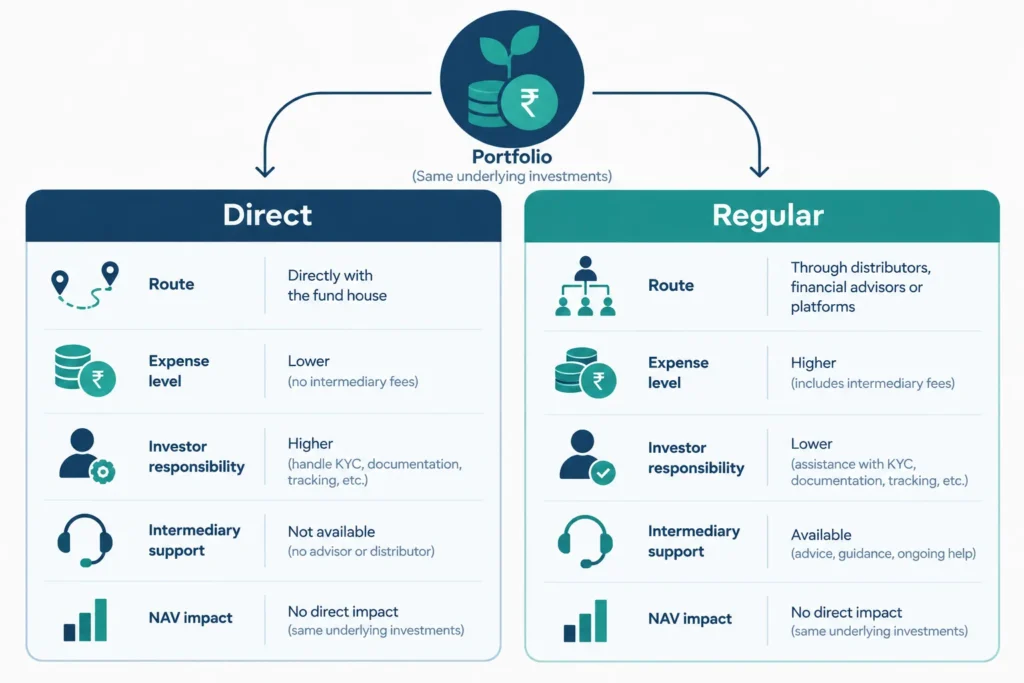
| Point of comparison | Direct plan | Regular plan |
|---|---|---|
| Expense ratio | Usually lower because distributor commission is not included in plan expenses. | Usually higher because distribution commission forms part of scheme expenses, subject to applicable rules. |
| Distribution support | No traditional distributor is attached to the plan. Support may come from the AMC or chosen direct-plan platform. | Purchased through an intermediary who may provide transaction and service support. |
| Investor assistance | The investor generally takes more responsibility for research, transactions and reviews. | The intermediary may assist with paperwork, transactions and general fund information. |
| Plan selection | The investor selects the plan independently or pays separately for suitable advice. | A distributor may suggest schemes, but the nature and depth of the recommendation can vary. |
| NAV | Usually higher than the regular plan’s NAV because lower ongoing expenses leave more value in the plan. | Usually lower than the direct plan’s NAV because of higher ongoing expenses. |
| Underlying portfolio | Generally the same portfolio as the regular plan of the same scheme. | Generally the same portfolio as the direct plan of the same scheme. |
| Long-term cost effect | Lower recurring expenses may allow a larger portion of returns to remain invested and compound. | Higher recurring expenses can reduce the amount that compounds over time. |
The different NAVs do not mean that one plan owns better securities. Each plan calculates its NAV after accounting for the expenses applicable to that plan. Since the direct plan generally deducts lower expenses, its NAV gradually differs from that of the regular plan.
This also explains why direct and regular plans of the same scheme can report different returns. The underlying portfolio performance may be the same, but the return left for investors after expenses is different. A lower NAV in the regular plan does not make it cheaper or offer more units of economic value in the way a lower share price might appear to do.
Distribution Is Not the Same as Investment Advice
Mutual fund distribution and regulated investment advice are not automatically the same service. A distributor facilitates or recommends mutual fund products and may earn commission from the product provider. A regulated investment adviser operates under a different framework and may charge the client separately for advice.
This distinction matters because an investor may need more than help choosing a scheme. Proper investment advice can involve understanding income, expenses, existing investments, debt, emergency savings, goals, time horizon and risk capacity. Not every distributor offers this level of analysis, and not every direct-plan platform provides personal advice.
Before choosing a channel, ask how the person or platform is compensated, whether the recommendation covers only mutual funds, what ongoing support is included and whether separate charges apply. This makes the direct vs regular mutual funds decision clearer and helps you compare the total service received with the total cost paid.
How Costs Can Affect NAV and Returns
Direct and regular plans of the same mutual fund scheme usually invest in the same portfolio. They generally hold the same shares, bonds and other securities in the same proportions. The fund manager and investment strategy are also usually the same.
The main difference is how you invest and what the plan charges. A direct plan does not include distributor commission in its expenses. A regular plan includes the cost of distribution and related services. As a result, the direct plan generally has a lower expense ratio than the regular plan of the same scheme.
This cost difference affects the amount that remains invested for you. It can therefore lead to different NAVs and returns over time.
Why the NAVs of Direct and Regular Plans Are Different
NAV, or net asset value, is the per-unit value of a mutual fund plan after accounting for its assets, liabilities and expenses. Mutual fund expenses are deducted from the plan’s assets before the NAV is declared.
Suppose the direct and regular plans begin with the same portfolio value. If the regular plan has higher expenses, a slightly larger amount is deducted from its assets. The direct plan retains more of the portfolio’s gains because its expenses are lower.
This process happens continuously. The difference may look small over a few days or months, but it can accumulate over several years. Therefore, the direct plan’s NAV will usually become higher than the regular plan’s NAV if both started on the same date and have otherwise followed the same portfolio.
However, a higher NAV does not mean that a mutual fund is expensive or less attractive. Similarly, a lower NAV does not mean that it is cheaper or offers better value. NAV is simply the per-unit value of the plan. When comparing direct vs regular mutual funds, compare their plan-specific returns and costs rather than judging them by the absolute NAV.
How the Expense Ratio Affects Your Return
The expense ratio represents the annual operating expenses charged to a mutual fund plan as a percentage of its average assets. It covers items such as investment management, administration and other permitted expenses. In a regular plan, it also reflects distribution-related costs.
Expenses are not normally collected from you as a separate bill. They are adjusted within the scheme’s NAV. This means the returns displayed by the mutual fund are generally after the plan’s expenses have been deducted.
For example, imagine that the underlying portfolio produces a return before plan expenses. The direct and regular plans may receive the same portfolio performance, but their returns after expenses can differ because their expense ratios are different.
- A lower expense ratio leaves more of the portfolio return with investors.
- A higher expense ratio reduces the return retained by investors.
- The impact can compound because the amount deducted as expenses is no longer available to earn future returns.
For a fuller explanation of how this charge is calculated and disclosed, readers can refer to RegularStation’s expense ratio explainer, where available. When comparing plan-level costs, the fund comparison guide can also help you check equivalent plans on a like-for-like basis.
Hypothetical Cost-and-Compounding Example
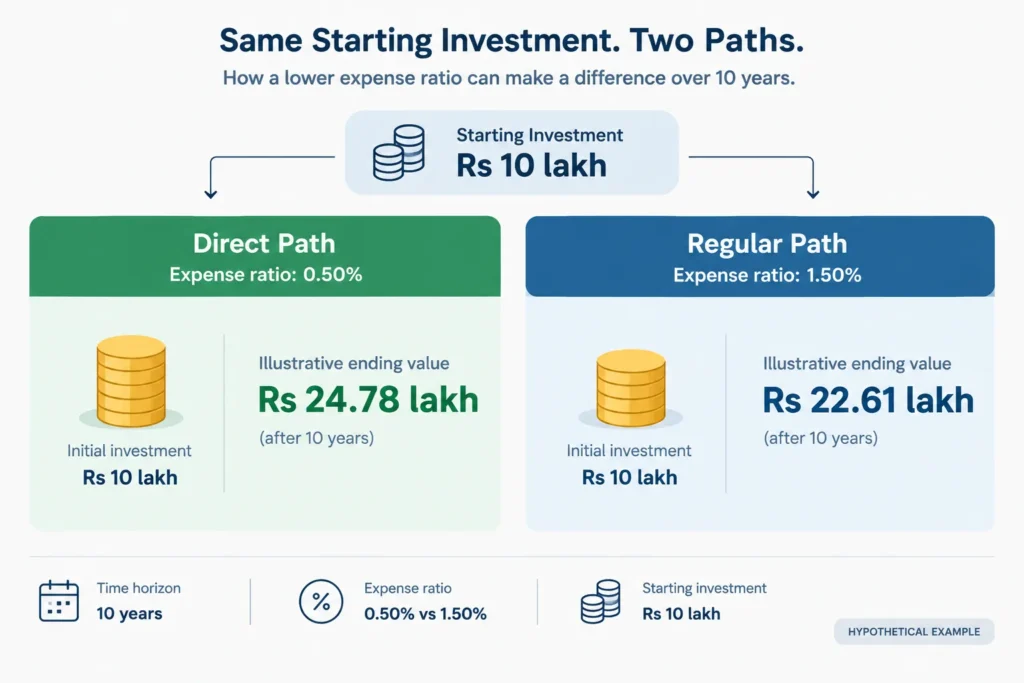
This is a simplified hypothetical example, not a return forecast.
Assume an investor puts Rs 10 lakh into each plan for 10 years. For illustration, assume the portfolio earns 10% a year before expenses every year. Also assume the direct plan has an annual expense ratio of 0.50%, while the regular plan has an annual expense ratio of 1.50%.
To keep the calculation simple, we will subtract the expense ratio from the assumed gross return once a year. This gives an illustrative net return of 9.50% for the direct plan and 8.50% for the regular plan.
| Assumption | Direct plan | Regular plan |
|---|---|---|
| Initial investment | Rs 10 lakh | Rs 10 lakh |
| Assumed annual return before expenses | 10.00% | 10.00% |
| Assumed annual expense ratio | 0.50% | 1.50% |
| Simplified annual return after expenses | 9.50% | 8.50% |
| Approximate value after 10 years | Rs 24.78 lakh | Rs 22.61 lakh |
| Approximate difference | Rs 2.17 lakh | |
The calculation uses annual compounding and rounded figures. The direct plan value is approximately Rs 10 lakh multiplied by 1.095 for 10 years. The regular plan value is approximately Rs 10 lakh multiplied by 1.085 for 10 years.
In this example, the one-percentage-point annual cost difference results in an approximate gap of Rs 2.17 lakh after 10 years. The gap is larger than simply applying 1% to the original investment for 10 years because compounding affects both the retained return and the future growth earned on it.
Real mutual funds do not produce a fixed return every year. Expenses are also accrued within the NAV rather than deducted through this simplified annual calculation. The expense ratio may change, and the investment value will move with the market. Taxes, exit loads and investor cash flows are not included in this example.
Lower Costs Do Not Remove Investment Risk
When all other factors are equal, a lower expense ratio can improve the return received by an investor. This is why the direct plan of the same scheme will generally show a better return than its regular plan over the same period.
However, lower costs do not guarantee positive returns. They also do not protect your money from market declines. If the scheme’s portfolio falls sharply, both plans can lose value. The direct plan may lose slightly less after accounting for the cost difference, but it still carries the same underlying market and portfolio risks.
There can also be short periods in which displayed figures do not fit a simple expectation. Differences in plan launch dates, return measurement periods, rounding and data presentation can affect comparisons. Always compare the direct and regular options of the same scheme using the same start date, end date and return method.
How to Check Whether You Hold a Direct or Regular Plan
Do not assume that an investment is direct merely because it was made online. A bank, broker, distributor or investment platform may offer regular plans digitally. Similarly, investing through an online channel does not automatically remove distributor commission.
You can verify the selected plan in the following places:
- Scheme name: Look for the word “Direct” or “Regular” in the full plan name. It may also mention the growth or income-distribution option separately.
- Account statement: Check the mutual fund statement or consolidated account statement for the complete scheme and plan name.
- Fund factsheet: Find the expense ratio and NAV listed separately for the direct and regular plans.
- Investment platform: Open the scheme details and check the plan type before confirming the transaction.
- AMC records: Review the folio details provided by the asset management company to confirm the registered plan.
Pay attention to the complete label. “Direct-Growth” and “Regular-Growth” are different plans, even though both use the growth option. The words “Direct” and “Regular” identify the plan route, while “Growth” or an income-distribution label identifies how gains or distributions are handled.
Also check the expense ratio shown for the exact plan. A scheme-level page may display more than one expense ratio, and selecting the wrong row can lead to an incorrect comparison.
Before investing, verify the full plan name on the final order screen. After the transaction, check the account statement to ensure that the units were allotted under the intended plan. This simple review can prevent an accidental selection from continuing across future SIP instalments.
Choosing a Plan, Switching and Common Questions
The choice between direct vs regular mutual funds is mainly about cost, support and how comfortable you are managing investments. Both plans belong to the same mutual fund scheme, but they use different distribution routes and have different expense ratios.
Neither option is universally suitable for everyone. A lower-cost plan may appeal to an investor who can research and monitor investments independently. Another investor may value the assistance offered by a distributor and accept the additional cost.
Factors to Consider When Choosing a Plan
Before selecting a plan, consider how you make financial decisions and what type of support you expect.
- Investment knowledge: Do you understand basic concepts such as asset allocation, risk level, expense ratio, exit load and taxation?
- Ability to research: Can you compare scheme documents, investment objectives, portfolios, risks and performance over suitable periods?
- Willingness to monitor: Are you prepared to review your investments periodically without reacting to every short-term market movement?
- Need for assistance: Would you like help with transactions, documentation, account updates and routine service requests?
- Nature of guidance: Are you receiving only execution and product information, or broader advice based on your goals and financial position?
- Cost: How much is the difference between the expense ratios of the direct and regular plans?
- Personal circumstances: Consider your experience, time, portfolio size, financial goals and comfort with online platforms.
For example, an experienced investor may be comfortable selecting and tracking a scheme through the fund house’s platform. A first-time investor may prefer help with understanding forms, completing transactions and handling service requests. The value of that support depends on its quality and relevance to the investor.
Cost should not be ignored, but it should not be viewed in isolation. Choosing the wrong category of fund, taking more risk than you can tolerate or investing without a clear goal may have a much larger effect than the difference between plan expenses.
What Support Can a Regular Plan Provide?
A regular plan is purchased through a distributor or another eligible intermediary. Depending on the intermediary, support may include explaining products, helping with transactions, providing account statements, updating nomination details and assisting with service issues.
However, regular plan charges do not automatically guarantee comprehensive financial planning, unbiased advice or continuous portfolio monitoring. The exact service can differ significantly between intermediaries. Investors should ask what is included, how the intermediary is compensated and whether the recommended scheme is appropriate for their needs.
Similarly, choosing a direct plan does not mean that professional guidance is unavailable. An investor may separately engage a qualified adviser and still invest through a direct plan, subject to the adviser’s service model and applicable regulations.
Switching Between Direct and Regular Plans
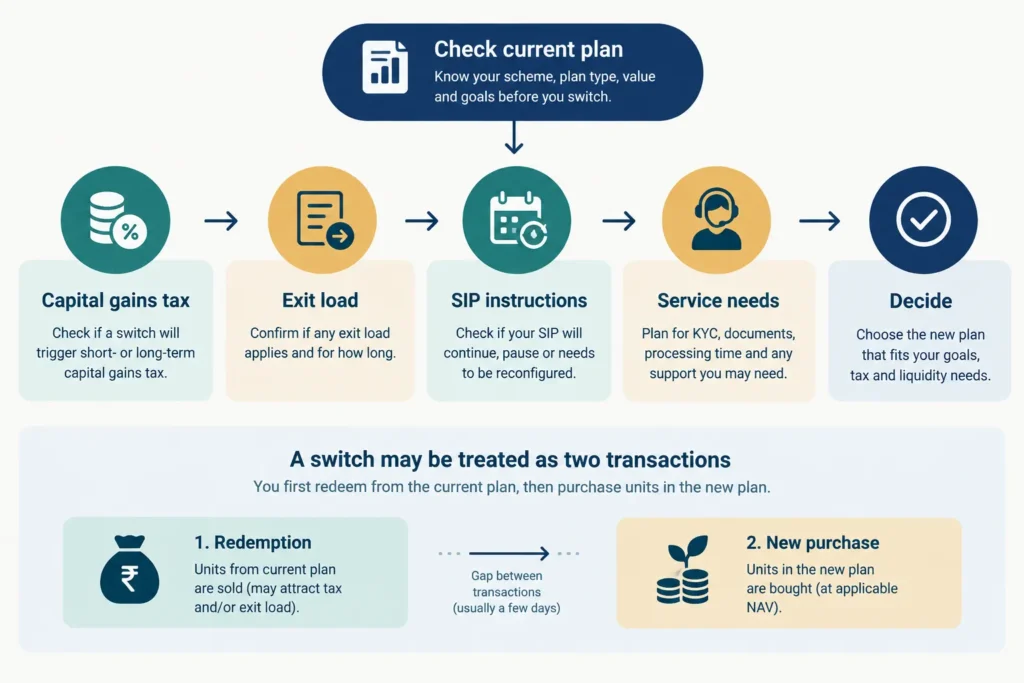
Moving from a regular plan to a direct plan, or from a direct plan to a regular plan, is generally not treated as a simple label change. It may be processed as a redemption from the existing plan and a fresh purchase in the new plan.
This can have financial and administrative consequences, including:
- Capital gains tax: A switch may create a taxable capital gain, depending on the type of fund, purchase date, holding period and applicable tax rules.
- Exit load: The scheme may charge an exit load if units are switched before the specified period ends.
- New purchase details: Units in the new plan will be allotted at the applicable NAV under the transaction rules.
- Holding-period reset: The acquisition date for the newly purchased units may be relevant for future taxation and exit-load calculations.
- Operational implications: SIP registrations, systematic withdrawal plans or other instructions may need to be stopped, changed or registered again.
Suppose an investor started a regular-plan SIP and later decides to use the direct plan. Changing future SIP instalments may not automatically move the units already accumulated. Existing units and future contributions may require separate instructions.
Do not switch only because the direct plan has a higher NAV or appears to show a better return. First estimate the potential tax, exit load and service impact. Check the latest scheme information document, statement of additional information, transaction rules and your personal tax position before acting.
Common Mistakes to Avoid
- Comparing different schemes: A fair direct-versus-regular comparison should use plans of the same scheme and the same option, such as growth versus growth. Comparing a direct equity fund with a regular hybrid fund does not isolate the effect of plan expenses.
- Ignoring the expense ratio: Expense ratios are deducted from scheme assets and affect the NAV. Check the current expense ratio rather than relying on an old factsheet or a general assumption.
- Assuming direct plans guarantee higher returns: Direct plans generally have lower expenses than regular plans of the same scheme. This can support a return difference, but it does not guarantee profits or protection from market losses.
- Overestimating intermediary support: Paying regular-plan expenses does not by itself ensure detailed advice or regular reviews. Confirm what service will actually be provided.
- Overlooking useful support: Some investors benefit from reliable administrative help or guidance. Dismissing all support as unnecessary may lead to unsuitable decisions or neglected paperwork.
- Switching without checking consequences: Tax, exit load, SIP instructions and holding periods should be reviewed before submitting a switch request.
Frequently Asked Questions
Are the portfolios of direct and regular plans the same?
Direct and regular plans of the same mutual fund scheme generally follow the same investment objective and underlying portfolio. The key difference is the distribution route and related expenses. Always compare the exact scheme name and the same option.
Why are their NAVs different?
The plans have separate NAVs because their expenses differ. Regular plans include distribution-related expenses, while direct plans do not include distributor commission. Over time, this difference in costs can cause their NAVs to diverge.
Do direct plans always earn more?
Direct plans usually have a lower expense ratio than regular plans of the same scheme. However, they do not guarantee positive or superior returns in every period. Both plans remain exposed to the same underlying market risks, and short-term return figures can vary for several reasons.
Does a regular plan include financial advice?
A regular plan may include product explanations, transaction support and other distributor services. It does not automatically include comprehensive or independent financial advice. Ask the intermediary about the scope of service, qualifications and compensation arrangement.
How can I verify whether my investment is direct or regular?
Check the scheme name shown on your mutual fund statement, account statement or investment platform. It should normally identify the plan as “Direct” or “Regular.” You can also confirm the details with the asset management company or its official service provider.
What should I check before switching?
Review the current expense ratios, exit-load rules, tax implications, holding period, transaction process and effect on SIPs or other systematic instructions. Also consider whether you will lose services that you currently use. Seek qualified tax or financial guidance if the consequences are unclear.
Summary
The direct vs regular mutual funds decision involves a trade-off between lower plan expenses and distributor-based support. Direct plans may suit investors who can select, transact and monitor schemes independently. Regular plans may suit investors who value the services provided by an intermediary, provided those services are understood and useful.
A switch is not necessarily cost-free. It may be treated as a redemption and fresh investment, which can create tax, exit-load and operational consequences. Compare the same scheme and option, verify current documents and evaluate the full impact before making a change.
Educational disclaimer: Mutual fund investments are subject to market risks. Read all scheme-related documents carefully. This article is for general education and does not provide personalised investment or tax advice. Seek guidance from a qualified professional when needed.
Editorial verification note: Before publication, verify all regulatory, expense-ratio, taxation and distribution-related statements against the latest SEBI and AMFI resources, current scheme documents and applicable tax rules.



Comments