


Quick Answer
The difference between large-cap, mid-cap and small-cap stocks in India is based on a company’s ranking by full market capitalisation. Under the current Indian classification framework, companies ranked 1 to 100 are large-cap, those ranked 101 to 250 are mid-cap, and those ranked 251 onwards are small-cap.
Market capitalisation shows the stock market value of a company’s equity. It does not directly show whether the company is profitable, financially strong, attractively priced or suitable for your portfolio. A large company can be poorly managed, while a smaller company can have a sound business. Market-cap category is a useful starting point, not a quality certificate.
Introduction
When beginners compare large cap vs mid cap vs small cap stocks, they often assume that the terms describe the physical size of a company. They may imagine a large-cap company as one with many factories, a mid-cap company as a regional business, and a small-cap company as a young start-up.
That is not how the classification works. In the stock market, these categories are mainly based on market capitalisation, commonly called market cap. This is the value that the stock market places on all the outstanding equity shares of a listed company.
The categories matter because companies of different market-cap sizes may behave differently. They can differ in trading liquidity, business maturity, access to finance and sensitivity to economic conditions. However, these are broad tendencies rather than fixed rules.
Before comparing the potential risks and opportunities in each category, it is important to understand how Indian companies are classified and what market capitalisation actually measures.
Before investing in individual companies, beginners should understand the fundamentals of stock market investing in India
Section 1: Market Capitalisation and Classification in India
What Is Market Capitalisation?
Market capitalisation is the total market value of a listed company’s outstanding equity shares. It is calculated using the prevailing market price of one share and the total number of equity shares outstanding.
Market capitalisation = Current market price per share × Total outstanding equity shares
Because share prices move during market hours, a company’s market capitalisation can also change from day to day. It may rise when the share price rises and fall when the share price falls. It can also change if the company issues new shares, buys back shares or otherwise changes its outstanding share count.
Hypothetical Market-Cap Calculation
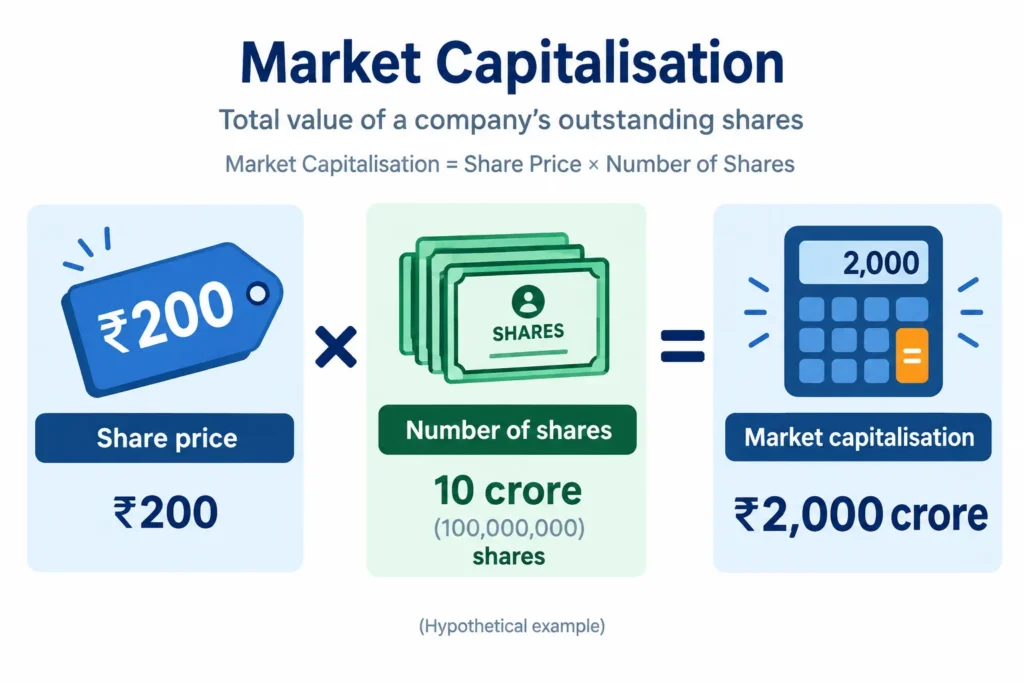
Consider an imaginary company called ABC Industries Limited. The following example is only for explaining the formula and does not refer to a real listed company.
| Item | Hypothetical amount |
|---|---|
| Market price per share | ₹200 |
| Total outstanding equity shares | 10 crore shares |
| Market capitalisation | ₹200 × 10 crore = ₹2,000 crore |
ABC Industries would therefore have a market capitalisation of ₹2,000 crore at that share price. If its share price increased to ₹250 and the number of shares remained unchanged, its market capitalisation would become ₹2,500 crore.
This increase would mean that the market value of its equity had risen. It would not automatically mean that its sales, profits or cash balance had increased by the same amount.
What Market Capitalisation Does Not Tell You
Market capitalisation is useful, but it is frequently confused with other financial measures. The following distinctions are important:
- Revenue: Revenue is the money a company earns from selling goods or services during a period. A company can have high revenue but a comparatively low market capitalisation if investors expect weak growth or low profitability.
- Profit: Profit is what remains after relevant expenses, interest and taxes are deducted. Market capitalisation can rise or fall even when reported profit has not changed.
- Cash: Cash is an asset shown on the company’s balance sheet. Market capitalisation is the stock market value of the company’s equity, not the cash available in its bank accounts.
- Enterprise value: Enterprise value is a broader valuation measure that generally considers market capitalisation, debt and cash. It is often used when comparing the total operating value of businesses with different levels of borrowing.
Market cap also does not tell you whether a share is cheap or expensive. A company with a market cap of ₹50,000 crore is not automatically more expensive than one with a market cap of ₹5,000 crore. Valuation requires comparing the share price or market value with earnings, cash flow, assets, growth prospects and other relevant factors.
How Indian Companies Are Classified
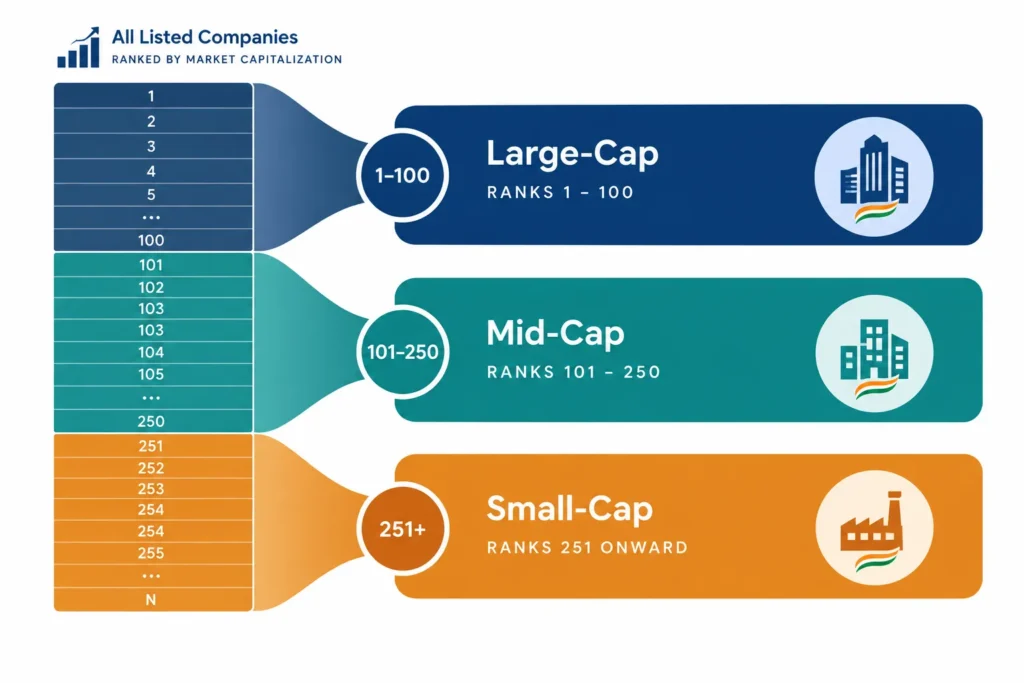
India does not classify companies using permanent rupee cut-offs such as “all companies above ₹50,000 crore are large-cap”. Instead, listed companies are arranged by their full market capitalisation, and their ranking determines the category.
| Category | Full market-cap ranking |
|---|---|
| Large-cap | 1st to 100th company |
| Mid-cap | 101st to 250th company |
| Small-cap | 251st company onwards |
This ranking-based system means that the rupee value required to enter a category can change. During a broad market rise, the company ranked 100th may have a much higher market capitalisation than it had several years earlier. During a market decline, the corresponding value may be lower.
It also means that “small-cap” does not necessarily mean a tiny business. Some companies classified as small-cap may still have operations across India or a market value running into thousands of crores. They are called small-cap because of their position relative to higher-ranked listed companies.
Full Market Capitalisation vs Free-Float Market Capitalisation
Full market capitalisation uses all outstanding equity shares of the company, including shares held by promoters and strategic shareholders.
Free-float market capitalisation considers only the shares that are considered readily available for public trading. It generally excludes tightly held promoter stakes and certain strategic holdings that are not normally traded in the market.
For example, suppose a hypothetical company has 10 crore outstanding shares, but only 4 crore are treated as free-float shares. At a market price of ₹100 per share, its full market capitalisation would be ₹1,000 crore. Its free-float market capitalisation would be ₹400 crore.
Both measures have valid uses. Free-float market capitalisation is commonly relevant for constructing and weighting certain stock market indices. However, the large-cap, mid-cap and small-cap classification discussed here is based on the ranking of companies by full market capitalisation, not free-float market capitalisation.
The Roles of SEBI and AMFI
The Securities and Exchange Board of India, or SEBI, provides the regulatory framework used for categorising companies by market capitalisation, particularly for the classification of mutual fund schemes.
The Association of Mutual Funds in India, or AMFI, publishes the list of companies arranged by market-cap category under the applicable framework. The list is updated periodically rather than every time a share price moves. The prescribed process generally uses market-cap data over the relevant review period instead of relying on a single trading day.
As a result, a company’s live market-cap position may appear to cross a ranking boundary before its category changes in the next official list. Investors should not assume that a one-day rise or fall has immediately changed the company’s official category.
Regulations, calculation methods and update schedules can be revised. Before publishing research, selecting a fund or relying on a company’s category, check the latest applicable SEBI framework and the most recent AMFI market-cap list.
How a Company Can Move Between Categories
Market-cap classifications are not permanent. Consider a hypothetical company ranked 245th in one official review. It would fall within the mid-cap range because its rank is between 101 and 250.
Suppose its share price later declines while several other companies rise in value. At the next periodic review, it may rank 268th. It would then move into the small-cap category, even if its factories, employees and products had not changed significantly.
The reverse can also happen. A company ranked 270th may perform strongly in the market and move to rank 240th in a later review, shifting from small-cap to mid-cap. Such movement reflects its relative full market-cap ranking under the applicable review process. By itself, it does not prove that the company’s business quality has improved or deteriorated.
Characteristics, Differences, Risks and Investor Fit
In the comparison of large cap vs mid cap vs small cap stocks, company size is only the starting point. Each category tends to have different business characteristics, trading activity and risk levels. However, these are broad patterns, not fixed rules.
A large-cap company can face serious financial trouble. A small-cap company can have a sound business and capable management. Investors must therefore examine the individual company instead of making decisions based only on its market-cap category.
Characteristics of Large-Cap Stocks
Large-cap stocks represent the biggest listed companies by market capitalisation. Many are established businesses with recognised brands, substantial operations and a long operating history. Indian large caps are commonly found in sectors such as banking, information technology, energy, consumer goods, automobiles and pharmaceuticals.
Business maturity can make their revenue and profits relatively more stable than those of smaller companies. Some large caps operate across several products, customer groups or countries, which may reduce dependence on a single market. This does not make them safe from business cycles, regulation, competition or management failures.
Large-cap shares generally have higher trading volumes. Investors can usually buy or sell them more easily without their individual orders causing a major price movement. This feature is known as liquidity.
These companies also tend to receive wider research coverage. Analysts, institutional investors and the financial media regularly monitor their results and business developments. More information may be publicly available, although investors must still judge its quality and relevance.
Possible advantages of large-cap stocks include:
- Established businesses and longer operating records
- Typically higher share-trading liquidity
- Greater availability of company information and analyst research
- Potentially stronger access to bank loans and capital markets
- Possibly better ability to withstand short-term business disruptions
Large caps also have limitations. Their size can make very rapid growth harder to achieve. A mature company may struggle to find opportunities large enough to meaningfully increase its overall profits. Its share price can also fall sharply if investors have paid an excessive valuation or if the business loses its competitive position.
Market indices such as Sensex and Nifty 50 can also help investors understand the broader direction of the Indian stock market.
Characteristics of Mid-Cap Stocks
Mid-cap companies sit between large caps and small caps in relative market value. This category contains a wide variety of businesses. One company may be expanding into new states or product categories, while another may be operating in a mature industry with limited growth.
Some mid caps have an established core business but still have room to expand. Successful expansion can improve revenue and profits. However, growth plans require money, capable management and careful execution. Opening factories, entering new markets or launching products does not automatically create shareholder value.
Mid-cap share prices are often more volatile than large-cap share prices. During optimistic market conditions, investors may quickly raise their expectations and valuations. During uncertain periods, the same stocks can face steep price corrections.
Liquidity is usually lower than in major large-cap stocks, though it can differ considerably from one company to another. A popular mid cap may trade actively, while another may have much lower daily volumes.
Important mid-cap risks include:
- Expansion projects costing more or taking longer than planned
- Dependence on a limited number of products, customers or regions
- Rising debt used to finance growth
- Stronger competition from larger companies
- Difficulty building management systems as the business expands
- Sharp valuation changes when market expectations shift
It is incorrect to assume that every mid-cap company is a fast-growing future large cap. Some businesses expand successfully, some remain in the same category for years, and others lose market value because of weak performance.
Characteristics of Small-Cap Stocks
Small-cap stocks represent relatively smaller listed companies. They may operate in specialised industries, serve limited geographic markets or focus on a narrow set of products. Some are young businesses, but others may be old companies whose market value remains small.
A small company can sometimes grow quickly because it starts from a lower base. It may benefit from a new product, additional capacity or entry into a larger market. Yet these opportunities come with significant uncertainty. Small size does not mean that a stock is automatically undervalued or likely to outperform.
Small-cap shares generally have lower liquidity. The difference between the best available buying and selling prices may be wider. A large order can move the market price, especially when trading volumes are low. Selling during a market decline may also be difficult at the expected price.
Business and financial risks can be higher because smaller companies may have fewer products, customers and funding sources. They may be more vulnerable to the loss of a major customer, an increase in raw material costs or a delay in receiving payments.
Investors should pay particular attention to:
- Debt levels and the ability to pay interest
- Cash flow compared with reported profit
- Promoter conduct and corporate governance
- Dependence on a few customers or suppliers
- Trading liquidity and unusual price movements
- The company’s ability to complete projects and manage expansion
Information and independent research coverage may be limited. This can make analysis harder, not necessarily more rewarding. Small-cap prices can rise or fall dramatically based on market sentiment, rumours or low trading activity.
Large Cap vs Mid Cap vs Small Cap Stocks: Comparison
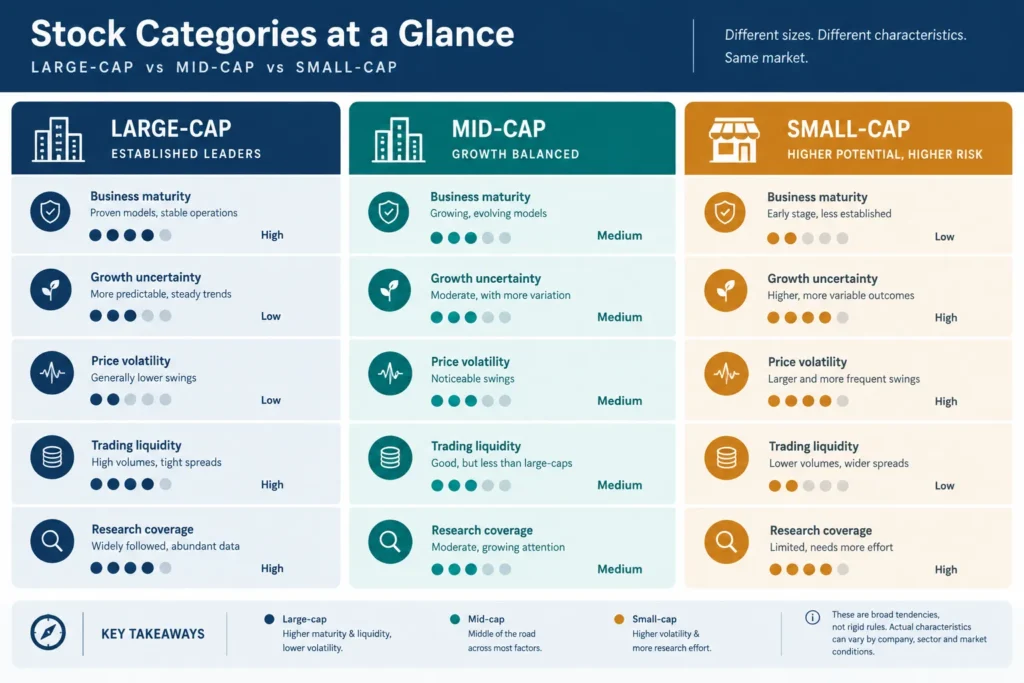
| Factor | Large Cap | Mid Cap | Small Cap |
|---|---|---|---|
| Relative company size | Largest listed companies | Between large and small companies | Relatively smaller listed companies |
| Typical business profile | Often established and mature | Varied; may be established but expanding | May be specialised, regional, young or narrowly focused |
| Growth possibilities | Can grow, but size may limit rapid expansion | May have meaningful expansion opportunities | May grow from a low base, with greater uncertainty |
| Share-price volatility | Usually lower on a relative basis, but losses can still be severe | Generally higher than large caps | Generally the highest of the three categories |
| Typical liquidity | Usually high | Moderate, but varies by stock | Often lower and less consistent |
| Research coverage | Usually extensive | Moderate and uneven | Often limited |
| Key risks | Slow growth, disruption, high valuation and large business setbacks | Expansion failure, debt, competition and valuation corrections | Business concentration, weak finances, governance, execution and liquidity |
| Research effort required | Still important despite wider information availability | Higher because business outcomes can vary widely | Often highest due to limited information and greater company-specific risk |
Understanding Risk and Return
Higher volatility does not guarantee higher returns. A small-cap stock may fluctuate more than a large cap and still produce poor long-term results. If its business fails, debt becomes unmanageable or governance is weak, investors can lose a substantial part of their capital.
Large caps are not protected from major losses either. A large company can suffer because of technological disruption, fraud, regulation, excessive borrowing or poor capital allocation. Its share price can also decline if investors previously valued it too highly.
Actual outcomes depend on several connected factors:
- The price paid in relation to the company’s earnings, assets and prospects
- Future business performance and cash generation
- Debt, governance and management decisions
- Economic and stock-market conditions
- Diversification across companies and sectors
- Investor behaviour during sharp rises and falls
Past returns do not guarantee future results. A category that performed well in a previous market cycle may underperform in the next one. Buying after a strong rally and selling during a panic can also turn a promising investment into a poor outcome.
Market-cap classification is only one part of stock research. Investors should also understand fundamental and technical analysis before evaluating individual stocks.
Which Category May Suit Different Investors?
Large-cap stocks may be easier to study for beginners because information is more widely available and liquidity is typically better. They may be considered by investors who prefer relatively established businesses, though such investors must still accept equity-market risk and price declines.
Mid-cap stocks may be more suitable for investors who can tolerate greater volatility, hold for a longer period and study expansion plans, balance sheets and competitive risks. The category requires patience because business growth may not happen according to schedule.
Small-cap stocks may suit investors with a high capacity for loss, a long time horizon and the ability to conduct detailed company research. Investors must also be comfortable with low liquidity and severe price movements. Risk capacity means the financial ability to absorb losses, not simply the willingness to chase higher returns.
These observations do not determine how much an investor should allocate to each category. Personal goals, income stability, existing investments, emergency savings and overall portfolio diversification also matter.
Why Category Alone Cannot Identify a Good Investment
Consider a hypothetical large-cap company with a famous brand but falling sales, rising debt and an unusually expensive share price. Now consider a hypothetical small-cap manufacturer with steady cash flow, low debt and capable management. The small company may appear stronger on some business measures.
However, this does not automatically make the small-cap stock the better investment. Its shares might be illiquid, its valuation could already reflect optimistic growth, or it could depend heavily on one customer. Meanwhile, the large company might successfully repair its business.
The label describes relative market size; it does not provide a final judgement on quality, valuation or future returns. A sound decision requires examining both the company and the price being paid.
Section 3: Mutual Funds, Common Mistakes, FAQs and Conclusion
How Mutual Funds Use Market-Cap Categories
Market-cap classification is important not only when you buy individual shares. It also affects how many Indian equity mutual funds build their portfolios.
For mutual fund classification, listed companies are generally ranked by their average full market capitalisation. The first 100 companies are classified as large-cap companies, companies ranked from 101 to 250 are classified as mid-cap companies, and companies ranked 251 onwards are classified as small-cap companies.
The Association of Mutual Funds in India, or AMFI, publishes the classification list based on the applicable framework. The list is updated periodically, so a company’s category can change when its market capitalisation and ranking change.
Equity mutual fund categories have specific allocation rules. In general, the main categories work as follows:
| Fund category | Broad allocation requirement | What it means for investors |
|---|---|---|
| Large-cap fund | At least 80% in large-cap stocks | The portfolio mainly holds the 100 largest listed companies by market-cap ranking. |
| Mid-cap fund | At least 65% in mid-cap stocks | The portfolio has substantial exposure to companies ranked from 101 to 250. |
| Small-cap fund | At least 65% in small-cap stocks | The portfolio mainly targets companies ranked 251 onwards. |
| Flexi-cap fund | At least 65% in equity and equity-related instruments | The fund manager can change the mix of large-cap, mid-cap and small-cap stocks without a fixed minimum for each size category. |
| Multi-cap fund | At least 75% in equity, with at least 25% each in large-cap, mid-cap and small-cap stocks | The scheme must maintain meaningful exposure to all three market-cap categories. |
A flexi-cap fund and a multi-cap fund are therefore not the same. A flexi-cap fund gives the fund manager greater freedom to shift between company sizes. A multi-cap fund must maintain the prescribed minimum exposure to each of the three categories.
These labels help you understand a scheme’s broad mandate, but they do not tell you everything about its risk. Two mid-cap funds, for example, may hold different companies, follow different investment styles and maintain different levels of portfolio concentration.
Mutual fund regulations, category definitions and allocation requirements can change. Before investing, verify the latest rules and read the scheme information document, factsheet and portfolio disclosures. Also check whether the scheme’s actual risk level, investment horizon and strategy suit your needs.
Investors who prefer diversified exposure to multiple companies can learn more about mutual funds and SIP investing in India
Common Mistakes to Avoid
1. Treating Market Cap as a Quality Score
A high market capitalisation does not automatically mean that a company has strong governance, low debt or reliable profits. Similarly, a small company is not automatically weak. Market cap measures the market value of a company’s equity; it is not a complete assessment of business quality.
Study revenue, profit, cash flow, debt, competitive position, management quality and corporate governance before making a decision.
2. Assuming Small Caps Always Earn More
Small-cap stocks may offer higher growth potential, but that potential comes with greater uncertainty. Some small companies grow into successful large businesses, while others struggle, dilute shareholders or fail to survive difficult business cycles.
Higher risk does not guarantee higher returns. It only means that the range of possible outcomes may be wider.
3. Believing Large Caps Cannot Fall Sharply
Large companies can also face business disruption, excessive debt, regulatory action, governance problems or expensive valuations. Their share prices can fall sharply during market crashes or when earnings disappoint investors.
Large-cap status may indicate greater size and usually better trading liquidity. It does not provide protection against loss.
4. Ignoring Valuation and Liquidity
A good company can be a poor investment if bought at an unreasonable price. Investors should consider valuation measures in the context of the company’s sector, growth prospects, balance sheet and profit quality.
Liquidity also matters, especially in smaller stocks. If trading volumes are low, it may be difficult to buy or sell a meaningful quantity without affecting the price. This can become a serious problem during market stress.
5. Relying Only on Past Returns
A stock or fund that performed well in the last one or three years may not repeat that performance. Strong past returns can sometimes result from rising valuations rather than lasting improvement in the underlying business.
Use past performance as one input, not as a promise. Examine how returns were generated and how the investment behaved during difficult periods.
6. Concentrating in One Category
Putting all your equity money into small caps can expose you to deep volatility and liquidity risk. Investing only in large caps may also limit exposure to faster-growing businesses in other segments.
A diversified allocation across categories can reduce dependence on one part of the market. The right mix depends on your goals, time horizon, ability to handle losses and overall asset allocation.
7. Using Outdated Fixed Rupee Cut-Offs
Statements such as “every company below a certain number of crores is a small cap” can quickly become outdated. Share prices, the number of outstanding shares and the overall market change over time.
In India’s mutual fund framework, the relevant categories are based on market-cap rankings rather than permanent rupee cut-offs. Check the latest applicable classification list instead of relying on an old article or social media post.
Frequently Asked Questions
1. What is market capitalisation?
Market capitalisation is the total market value of a company’s outstanding equity shares. It is calculated by multiplying the current share price by the number of outstanding shares.
2. How are market-cap categories defined in India?
For mutual fund classification, companies ranked from 1 to 100 by average full market capitalisation are large caps. Rankings from 101 to 250 are mid caps, while rankings from 251 onwards are small caps.
3. Are the rankings permanent?
No. Rankings change when share prices, share counts and the relative market values of listed companies change. The classification list is reviewed and updated periodically.
4. Who publishes the classification list?
AMFI publishes the list used by the mutual fund industry under the applicable regulatory framework. Investors should refer to the latest list rather than an old classification.
5. Is market cap the same as company value or enterprise value?
No. Market cap measures the market value of equity belonging to shareholders. Enterprise value is a broader measure that generally considers market cap, debt and cash. The two figures answer different valuation questions.
6. Are large-cap stocks always safer?
No stock is always safe. Large caps generally have established operations and better liquidity, but they can still suffer from poor management, high valuations, business decline or market crashes.
7. Do small-cap stocks always deliver higher returns?
No. Small caps may have more room to grow, but they also carry higher business, governance, volatility and liquidity risks. Many small-cap companies may underperform or destroy investor wealth.
8. Can a company move between categories?
Yes. A successful mid-cap company can become a large cap if its ranking rises. A large-cap company can also move down if its market value falls relative to other companies.
9. How do market-cap categories affect mutual funds?
They determine the investment universe and minimum allocation requirements of categories such as large-cap, mid-cap, small-cap and multi-cap funds. Flexi-cap funds have more freedom to change their market-cap mix.
10. Which category is best for a beginner?
There is no single best category for every beginner. A new investor should consider goals, investment horizon, emergency savings and risk tolerance. A diversified equity fund may be easier to manage than selecting several individual stocks, but it still carries market risk.
Conclusion
The comparison of large cap vs mid cap vs small cap stocks is mainly a comparison of company size based on market capitalisation. Large caps are generally more established and liquid. Mid caps may combine growth potential with meaningful risk. Small caps can offer greater growth possibilities, but they often bring higher volatility, lower liquidity and a greater need for research.
Market cap should be a starting point, not the final investment decision. Valuation, debt, profitability, cash flow, management quality, governance and industry conditions remain important across all three categories.
Avoid concentrating your portfolio simply because one category has recently performed well. Diversification across company sizes and other asset classes can help manage risk, although it cannot eliminate losses. Always conduct due diligence and choose investments that fit your goals and ability to handle market declines.
This article is for education only and is not investment advice or a recommendation to buy or sell any stock or mutual fund.




Comments