

Quick Answer
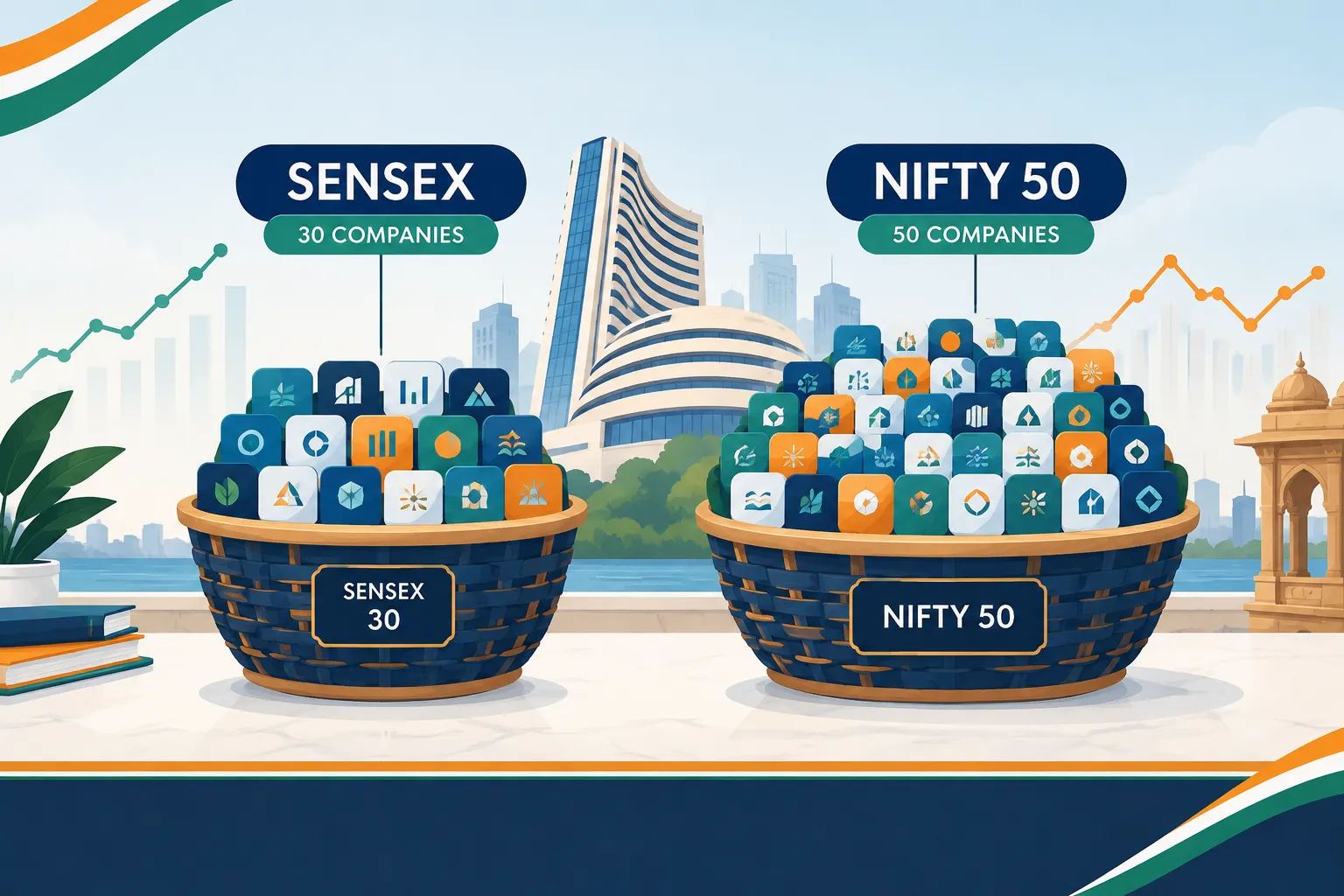
Sensex and Nifty 50 are benchmark stock market indices in India. They track the performance of selected large and actively traded companies listed on India’s two main stock exchanges.
The Sensex includes 30 selected companies listed on the BSE. The Nifty 50 includes 50 selected companies listed on the NSE. When these indices rise, it generally means that the combined value of their constituent companies has increased. When they fall, the combined value has generally declined.
However, neither index represents every company listed in India. They are useful market indicators, not a complete picture of the entire Indian stock market.
Introduction
If you watch business news, you may hear statements such as “the Sensex gained 500 points” or “the Nifty closed lower today.” For a beginner, these numbers can sound confusing. You may wonder what exactly has gone up, who calculates it, and whether it affects your investments.
Sensex and Nifty 50 are essentially market scoreboards. Instead of checking the share price of every listed company, investors can look at these indices to get a quick sense of how a selected group of major Indian companies is performing.
They are also widely used as benchmarks. For example, an investor may compare the return from an equity mutual fund with the return from an appropriate index. This helps the investor understand whether the fund performed better or worse than its stated benchmark. The comparison must be suitable, because not every fund invests in the same type of companies as the Sensex or Nifty 50.
This first section explains what a stock market index means, how the Sensex and Nifty 50 differ, and what these two indices do—and do not—represent. Readers who are completely new to shares may also find it useful to read the broader beginner’s guide to the Indian stock market and a separate explanation of BSE and NSE.
Before investing in the stock market, beginners should understand the fundamentals of stock market investing in India.
Understanding Sensex and Nifty 50
What Is a Stock Market Index?
A stock market index is a calculated number that tracks the combined price movement of a chosen group of shares. The companies included in the group are called the index’s constituents.
Imagine that you want to understand how students in a large school performed in an examination. Looking at the marks of every student would take time. A carefully selected summary can give you a broad indication of overall performance, although it cannot describe every student’s result.
An index works in a similar way. It summarises the movement of selected shares into one number. If the more influential shares in the index rise, the index may rise. If they fall, the index may fall.
Not every constituent affects the index equally. Sensex and Nifty 50 are based on free-float market capitalisation. In simple terms, larger companies generally receive higher weights, but the calculation focuses on shares that are considered available for public trading. Shares held by promoters or certain strategic holders are not treated in the same way as freely tradable shares.
This means a 2% movement in a high-weight company can affect the index more than the same 2% movement in a lower-weight company. An index is therefore not a simple average of all its share prices.
Why Is an Index Like a Market Scoreboard?
A scoreboard gives a quick summary without showing every event in a match. Similarly, Sensex and Nifty 50 provide an easy reference point for market direction.
They can help investors:
- see whether selected large companies broadly gained or lost value during a trading session;
- compare an investment portfolio or fund with a recognised benchmark;
- observe market performance over different periods; and
- understand the general mood around major Indian shares.
However, the scoreboard comparison has limits. An index can rise even when many individual shares fall. This may happen when a few highly weighted constituents gain enough to offset declines elsewhere. In the same way, an index can fall even though some companies perform well.
What Is the Sensex?
Sensex is the commonly used name for the BSE Sensex. It tracks 30 selected companies listed on the BSE. The name is formed from the words “sensitive” and “index.”
BSE, originally known as the Bombay Stock Exchange, is one of India’s main stock exchanges. A stock exchange provides the regulated marketplace and systems through which eligible securities can be bought and sold.
The Sensex was launched in 1986. Its constituents are selected according to the index methodology rather than simply being the 30 shares with the highest prices. Factors such as size, liquidity, trading history and representation may be relevant under the applicable rules.
The official index provider is BSE Index Services Private Limited, a BSE subsidiary. The provider maintains the index according to published methodology and review processes.
What Is the Nifty 50?
Nifty 50 is a benchmark index associated with the National Stock Exchange of India, or NSE. It tracks 50 selected companies listed on the NSE.
NSE is another major Indian stock exchange. Like BSE, it provides a regulated platform and infrastructure for trading eligible securities. A company may be listed on one exchange or on both, subject to the applicable requirements.
The Nifty 50 was launched in 1996. It is maintained by NSE Indices Limited, a subsidiary of NSE. Its constituents are selected and reviewed under the provider’s index methodology.
The word “Nifty” originated from “National Stock Exchange Fifty.” In everyday financial reporting, people often shorten Nifty 50 to “Nifty,” although NSE Indices maintains many other indices as well. The Nifty 50 is only one of them.
If you are new to financial planning, start by understanding these personal finance basics.
Sensex vs Nifty 50
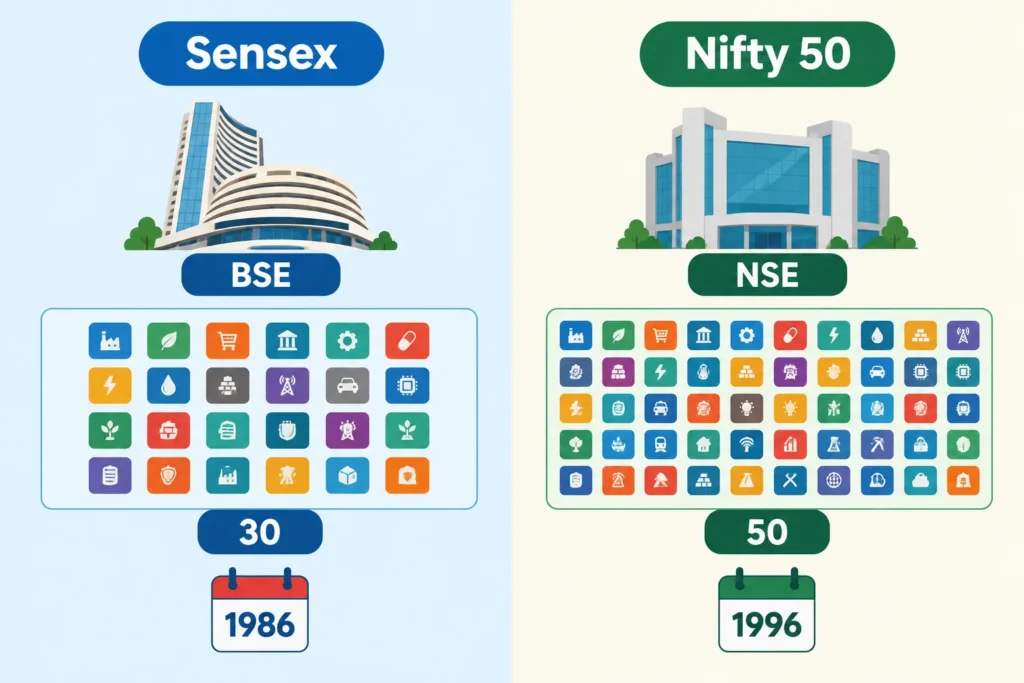
| Comparison point | Sensex | Nifty 50 |
|---|---|---|
| Associated exchange | BSE | NSE |
| Number of constituent companies | 30 | 50 |
| Launch year | 1986 | 1996 |
| Official index provider | BSE Index Services Private Limited | NSE Indices Limited |
| Market coverage | Selected large and liquid companies listed on BSE | Selected large and liquid companies listed on NSE |
| Main benchmark purpose | Indicates the performance of a selected group of major BSE-listed shares | Indicates the performance of a selected group of major NSE-listed shares |
The company counts are fixed by the design of each index, but the identities of the companies are not permanent. Index providers review constituents periodically under their rules. A company may be added if it meets the required criteria, while another may be removed.
Weights can also change even when the constituent list remains the same. Share-price movements, changes in free-float market capitalisation, corporate actions and index reviews can affect how much influence a company has on the index.
For this reason, an old list of constituents or weights may no longer be accurate. Investors should check the latest official index factsheet or constituent list before relying on company-specific information.
What These Indices Represent—and What They Do Not
Sensex and Nifty 50 represent the combined performance of their respective selected constituents. Because they include several prominent companies from important parts of the economy, they are widely used as indicators of India’s large-company equity market.
But they do not represent every listed business. India also has mid-sized companies, smaller companies and companies outside these benchmark indices. Their shares may move differently from the Sensex and Nifty 50.
An increase in an index also does not mean that every constituent gained or that the whole economy improved that day. Likewise, a fall does not mean every Indian company lost value. Economic conditions and stock prices are connected, but they are not identical.
In short, Sensex and Nifty 50 are useful benchmark scoreboards for selected major Indian shares. They provide a quick view of market direction, but they should not be treated as a complete measure of every listed company, every investor’s portfolio or the Indian economy as a whole.
How Sensex and Nifty 50 Are Calculated and Why They Move
Sensex and Nifty 50 are not simple averages of share prices. Each index uses a method called free-float market capitalisation weighting. This means that larger companies, based on the market value of shares broadly available for public trading, usually have a greater influence on the index.
The official calculations are carried out according to the methodology and eligibility rules set by the respective index providers. Investors do not need to memorise the full formula, but understanding the basic idea makes daily index movements easier to interpret.
What Is Free-Float Market Capitalisation?
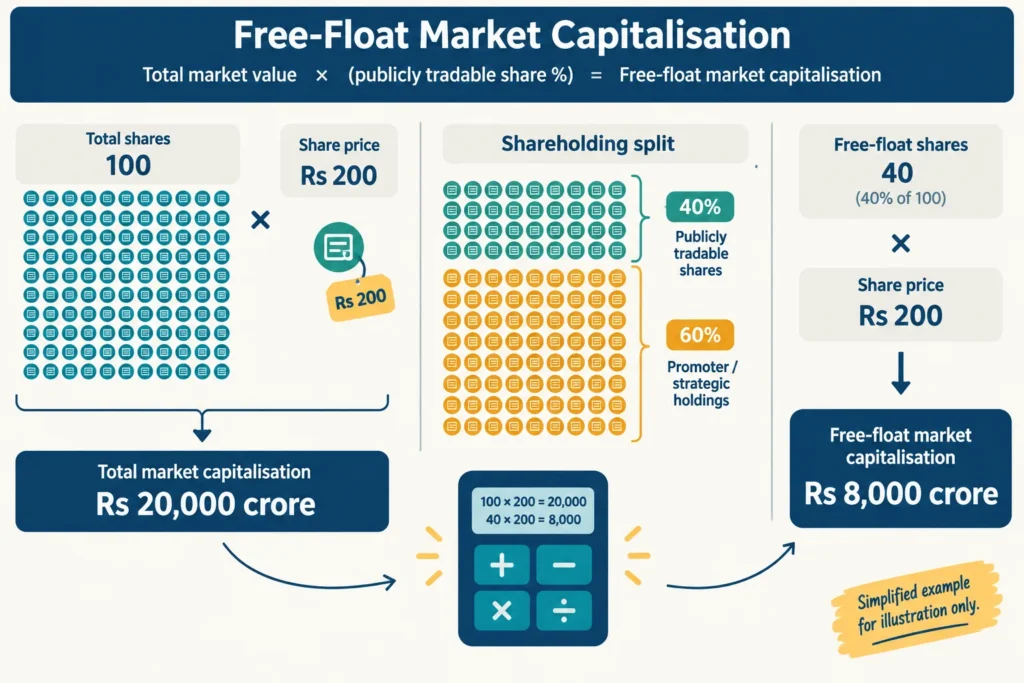
A company’s market capitalisation, or market cap, is broadly calculated by multiplying its share price by its total number of outstanding shares.
However, not all shares are normally available for regular public trading. Some may be held by promoters, governments, strategic investors or other controlling shareholders. Such holdings may be excluded when calculating free-float market capitalisation, subject to the official index methodology.
In simple terms:
- Total market capitalisation considers all outstanding shares.
- Free-float market capitalisation focuses broadly on shares considered available for public trading.
Suppose a company has 100 crore outstanding shares and its market price is Rs 200 per share. Its total market capitalisation would be Rs 20,000 crore.
Now suppose only 40% of those shares are treated as free float under the relevant methodology. Its free-float market capitalisation would broadly be Rs 8,000 crore.
This is a simplified explanation. The actual treatment of different shareholdings depends on the rules of the index provider. Readers who want to understand company size in more detail can refer to our separate beginner’s guide to market capitalisation.
Investors who want exposure to market indices can also learn about mutual funds and SIP investing in India.
Why Some Companies Have More Weight Than Others
Every company in an index does not have an equal effect on it. Eligible companies receive different weights based largely on their free-float market capitalisation.
A company with a larger free-float market value generally receives a higher weight. Therefore, a sharp move in a large-weight company can affect Sensex or Nifty 50 more than a similar percentage move in a small-weight company.
Index weight is usually expressed as a percentage. If a company has a weight of 10% in an index, its price movement has a much greater influence than that of a company with a weight of 1%, assuming other factors remain unchanged.
Hypothetical Example: Large Weight Versus Small Weight
The following figures are invented round numbers for learning purposes only. They are not current or historical weights of any actual Sensex or Nifty 50 company.
| Company | Hypothetical Index Weight | Share Price Movement | Approximate Effect on Index |
|---|---|---|---|
| Company A | 10% | Rises by 5% | About 0.50% |
| Company B | 1% | Rises by 5% | About 0.05% |
In this simplified example, both shares rise by the same 5%. Yet Company A has around ten times the effect because its hypothetical index weight is ten times larger.
The calculation can also work in the opposite direction. If Company A falls sharply, it can pull the index down even when several smaller constituents rise. This is why an index may close in the red despite gains in many individual shares.
Weights are not fixed forever. They can change as share prices move, free-float shareholding changes, companies issue or cancel shares, and the index is reviewed.
How the Index Value Is Calculated
At a broad level, the free-float market capitalisations of the constituents are combined and compared with a base value through an index calculation mechanism. The methodology uses an adjustment factor, often called a divisor, so that the index remains comparable over time.
This adjustment is important because a company may carry out a corporate action that changes its number of shares without creating an equivalent change in investor wealth. Without suitable adjustments, events such as stock splits could make the index appear to jump or fall for purely mechanical reasons.
Investors generally do not need to calculate Sensex and Nifty 50 manually. The useful lesson is that the published index level reflects the combined price movements of its constituents, adjusted for their respective weights and the official methodology.
You can estimate your regular investment growth using the RegularStation SIP calculator.
Why Sensex and Nifty 50 Move Every Day
Sensex and Nifty 50 move mainly because the market prices of their constituent shares change. During trading hours, buyers and sellers continuously place orders based on new information, expectations and risk preferences.
Common reasons for index movement include:
- Company results: Revenue, profit, margins, debt and management commentary can affect individual share prices. Results from a large-weight constituent may have a noticeable effect on the index.
- Interest rates: Changes in policy rates and borrowing costs can influence banks, property companies, automobile businesses and other sectors that depend on credit.
- Inflation expectations: Higher expected inflation may raise business costs and affect expectations about future interest rates.
- Government policy: The Union Budget, taxation changes, regulations, infrastructure spending and sector-specific policies can influence investor expectations.
- Global markets: Developments in the US, Europe, China and other major markets can affect risk appetite in India.
- Currency movements: A change in the rupee’s value can affect importers, exporters and companies with foreign-currency loans or overseas revenue.
- Commodity prices: Movements in crude oil, metals and agricultural commodities can change costs and earnings expectations for many businesses.
- Investor sentiment: Fear, optimism, foreign investor flows and expectations about future growth can move prices even before the final economic impact becomes clear.
These factors often interact. For example, a rise in crude oil prices may increase cost concerns for some Indian companies, affect inflation expectations and put pressure on the rupee. At the same time, it may support the share prices of certain energy-related businesses. The overall index effect depends on which constituents move and how much weight they carry.
Why Sensex and Nifty 50 Can Move by Different Amounts
Sensex and Nifty 50 often move in the same broad direction because both track large, established companies in the Indian stock market. Many major businesses may also be present in both indices.
However, the two indices do not contain exactly the same group of companies. Sensex has 30 constituents, while Nifty 50 has 50. Their company weights and sector representation can also differ.
As a result, Sensex may rise more than Nifty 50 on one day, while Nifty 50 may perform better on another. If large-weight banking shares rise, for example, the index with greater effective exposure to those particular shares may receive a stronger boost. A movement in a company included in only one of the indices can also create a difference.
This does not mean that one index is necessarily giving the “correct” picture and the other is not. Each represents the market through its own set of constituents, weights and official rules.
Periodic Reviews and Constituent Changes
Sensex and Nifty 50 are reviewed periodically. The purpose is to ensure that the indices continue to represent the part of the market they are designed to track.
During a review, the index provider may examine factors such as company size, free float, trading activity and other eligibility conditions. A company that no longer meets the required criteria may be removed, while another eligible company may be added.
Replacement does not automatically mean that the removed company is a bad business or that the new company is a guaranteed investment. It means that the index provider has applied its methodology at that review point.
Changes can also occur between regular reviews in certain situations, such as a merger, delisting or another major corporate event. Index funds and exchange-traded funds that track the index may then adjust their holdings to match the revised constituent list.
Corporate Actions and Changes in Weight
Companies regularly undertake corporate actions such as stock splits, bonus issues, rights issues, share buybacks, mergers and demergers. Some of these actions change the number of shares, the share price or the free-float market capitalisation.
The index methodology makes appropriate adjustments so that a purely mechanical corporate action does not create a misleading index movement. The exact treatment depends on the type of event and the relevant rules.
A constituent’s weight may also change naturally when its share price rises or falls relative to other constituents. Changes in promoter holding or public shareholding may affect the free-float factor as well. Therefore, today’s largest weights may not remain the largest weights in future.
To understand the exchanges behind these indices, read our guide on the difference between NSE and BSE.
What a Daily Index Move Really Tells You
A rise in Sensex and Nifty 50 indicates that the weighted combined performance of their constituents was positive over the measured period. A fall indicates that the weighted combined performance was negative.
It does not mean that every Indian share moved in the same direction. On a day when the indices rise, many small-cap, mid-cap or even index constituent shares may fall. Similarly, the indices can decline while some sectors and individual companies gain.
The key point is that Sensex and Nifty 50 are weighted snapshots of selected large companies, not scorecards for every listed share in India. Their daily movement is useful for understanding the broad direction of major stocks, but it should not be treated as the performance of the entire Indian market or of every investor’s portfolio.
Why Investors Track Sensex and Nifty 50
Sensex and Nifty 50 are widely followed because they provide a quick view of how large, established Indian companies are performing. When financial news says “the market rose today”, it often refers to a rise in one or both of these indices.
Sensex represents 30 selected companies listed on the BSE. Nifty 50 represents 50 selected companies listed on the NSE. Both indices cover several important sectors, although their company lists and sector weights are not identical.
They act as market benchmarks
A benchmark is a reference point used for comparison. Investors can compare their portfolio returns with an appropriate index to understand how their investments performed relative to a broad group of large companies.
For example, suppose a portfolio gained 8% during a period while its relevant benchmark gained 10%. The portfolio made money, but it did not keep pace with that benchmark. This comparison alone does not prove that the portfolio is good or bad. Its risk, investment style, costs and time horizon must also be considered.
Portfolio managers and mutual fund managers also use indices as benchmarks. An actively managed large-cap fund may try to perform better than its stated benchmark after accounting for costs. An index fund, in contrast, generally aims to follow the performance of its chosen index rather than beat it.
They help explain daily market movements
News reports use Sensex and Nifty 50 because reporting the price movement of every listed share would be impractical. An index turns the movement of a selected basket of shares into one number.
However, an index rising does not mean every Indian share has risen. A few highly weighted companies can have a meaningful effect on the index. Smaller companies and shares outside the index may move differently.
They provide a broad but limited market view
Both indices offer exposure to companies from multiple sectors, which makes them broader than following a single share or industry. Still, they do not represent the entire Indian stock market. Mid-cap, small-cap and many other listed companies are outside these baskets.
This is why beginners should treat Sensex and Nifty 50 as useful market indicators, not as complete measures of every investment opportunity in India.
Can You Invest in Sensex or Nifty 50?
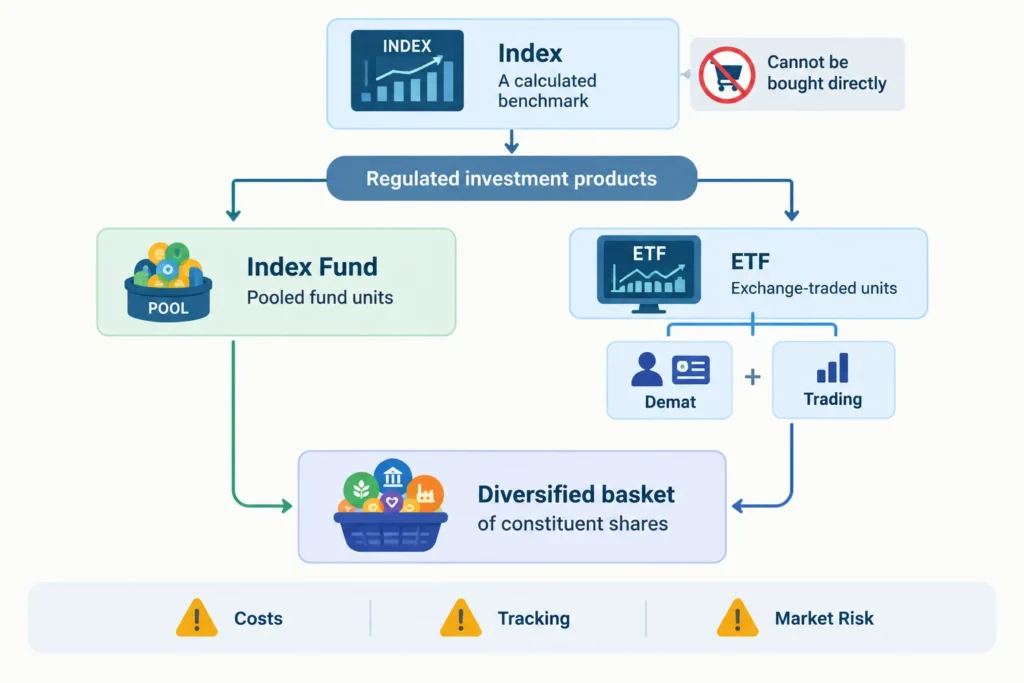
You cannot purchase an index directly. Sensex and Nifty 50 are calculated values, not securities held in a demat account.
Investors can instead use financial products designed to follow an index. Common choices include index mutual funds and exchange-traded funds, or ETFs. These products hold shares based on the selected index and aim to produce returns close to it, before and after applicable costs and tracking effects.
How an index mutual fund works
An index mutual fund collects money from investors and invests it according to a particular index. A Nifty 50 index fund, for example, generally holds Nifty 50 companies in proportions intended to reflect the index.
Investors usually buy or redeem units through the mutual fund platform or another authorised channel. Transactions are processed at the applicable net asset value under mutual fund rules, rather than at a continuously changing stock exchange price.
An index fund provides diversification within its selected basket. However, this does not remove market risk. If the underlying companies fall in value, the fund’s value can also fall.
How an ETF works
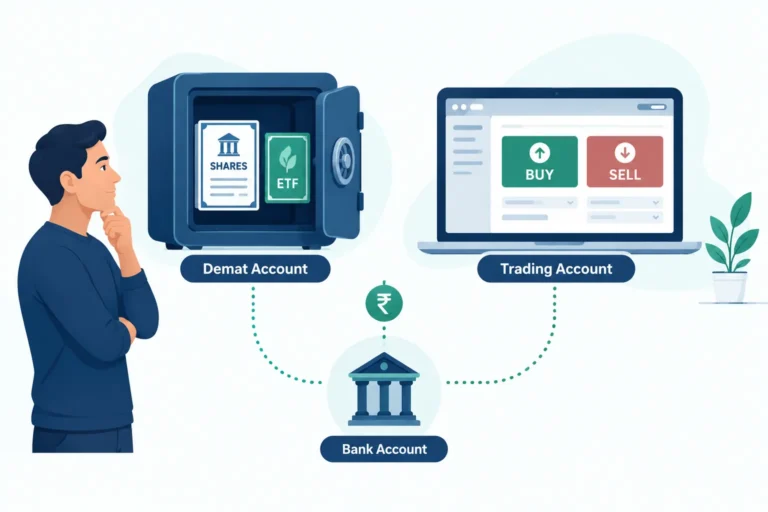
An ETF also aims to track an index, but its units trade on a stock exchange during market hours. Investors generally need a demat account and a trading account to buy or sell ETF units.
The traded price of an ETF may be slightly above or below its underlying net asset value. Liquidity matters because an ETF with low trading activity or a wide difference between buying and selling prices may be less efficient to trade.
Beginners who are unfamiliar with these arrangements may first want to understand how ETFs and demat accounts work. They should also check brokerage charges and other transaction costs where applicable.
Costs and tracking difference
Index funds and ETFs charge an expense ratio for managing the scheme. A lower expense ratio can reduce the drag on returns, but cost should not be the only factor considered.
Tracking difference is the gap between the return of a fund and the return of the index it follows over a period. Fund expenses, transaction costs, cash holdings, index changes and operational factors can contribute to this gap.
Investors should review the scheme’s stated benchmark, expense ratio, past tracking information and official product documents. Historical tracking quality does not guarantee the same result in the future.
Market risk still applies
Following a well-known index does not guarantee profits or prevent losses. Sensex and Nifty 50 can decline during economic uncertainty, weak company earnings, global market stress, interest-rate changes or other events.
Diversification across 30 or 50 companies can reduce dependence on one company compared with owning a single share. It cannot eliminate broad market risk. Our beginner guides on diversification and investment risk can help explain this distinction further.
A Neutral Checklist for Beginners
Neither Sensex nor Nifty 50 is universally better. Before selecting any index-based product, consider the following points:
- Investment goal: Be clear about whether the money is for long-term wealth creation, retirement, education or another goal.
- Time horizon: Equity investments can be volatile, especially over short periods. Match the investment with the time available.
- Risk tolerance: Consider whether you can accept temporary falls without making an emotional decision.
- Chosen index: Understand the companies, sectors and market segment represented by the index.
- Expense ratio: Check the recurring cost charged by the scheme.
- Tracking difference: Review how closely the product has followed its benchmark, while remembering that past results may not continue.
- ETF liquidity: If considering an ETF, examine trading activity, bid-ask spreads and applicable trading costs.
- Account requirements: Understand whether a demat and trading account is needed.
- Product documents: Read the current scheme information document, factsheet and risk disclosures before investing.
Index methodologies and scheme details can change. Investors should verify the latest information from official index and fund documents before making a decision.
Conclusion
Sensex and Nifty 50 are major Indian stock market indices linked to the BSE and NSE respectively. Sensex contains 30 selected companies, while Nifty 50 contains 50. Both are commonly used to describe market movements and as benchmarks for portfolios and funds.
An index cannot be bought directly. Index mutual funds and ETFs offer ways to gain exposure, but they involve costs, tracking differences and market risk. The suitable choice depends on an investor’s goal, time horizon, risk tolerance and preferred way of investing.
Frequently Asked Questions
1. Is Sensex the same as Nifty 50?
No. They are separate indices with different constituent counts, exchange associations and calculation bases. Their movements are often similar because both include several large Indian companies, but they are not identical.
2. Which exchange is linked to each index?
Sensex is linked to the BSE, while Nifty 50 is linked to the NSE.
3. Why does Sensex have 30 companies while Nifty has 50?
Each index was designed with its own methodology and selected basket size. Sensex uses 30 constituents, while Nifty 50 uses 50 to represent its chosen segment of the market.
4. Can beginners invest directly in an index?
No. An index is only a calculated measure. Beginners can obtain exposure through products such as index mutual funds or ETFs that aim to track it.
5. What is free-float market capitalisation?
It is the market value of shares considered readily available for public trading. Shares held by promoters or certain strategic holders are generally excluded according to the index provider’s methodology.
6. Why do Sensex and Nifty rise or fall?
They move when the prices of their constituent shares change. Company results, economic conditions, interest rates, global events and investor sentiment can all influence these prices.
7. Do both indices contain the same companies?
They have several companies in common, but their lists are not exactly the same. The weight assigned to a shared company may also differ.
8. Can index constituents change?
Yes. Index providers periodically review their indices. Companies may be added or removed under the applicable methodology and eligibility rules.
9. Are index funds and ETFs risk-free?
No. Their values can fall when the underlying market falls. They can also involve tracking difference, costs and, in the case of ETFs, trading and liquidity considerations.
10. Which is better, Sensex or Nifty 50?
Neither is better for every investor. They represent slightly different baskets. A decision should be based on the investment goal, risk tolerance, costs, tracking quality and the current product documents rather than only on the index name.



Comments