

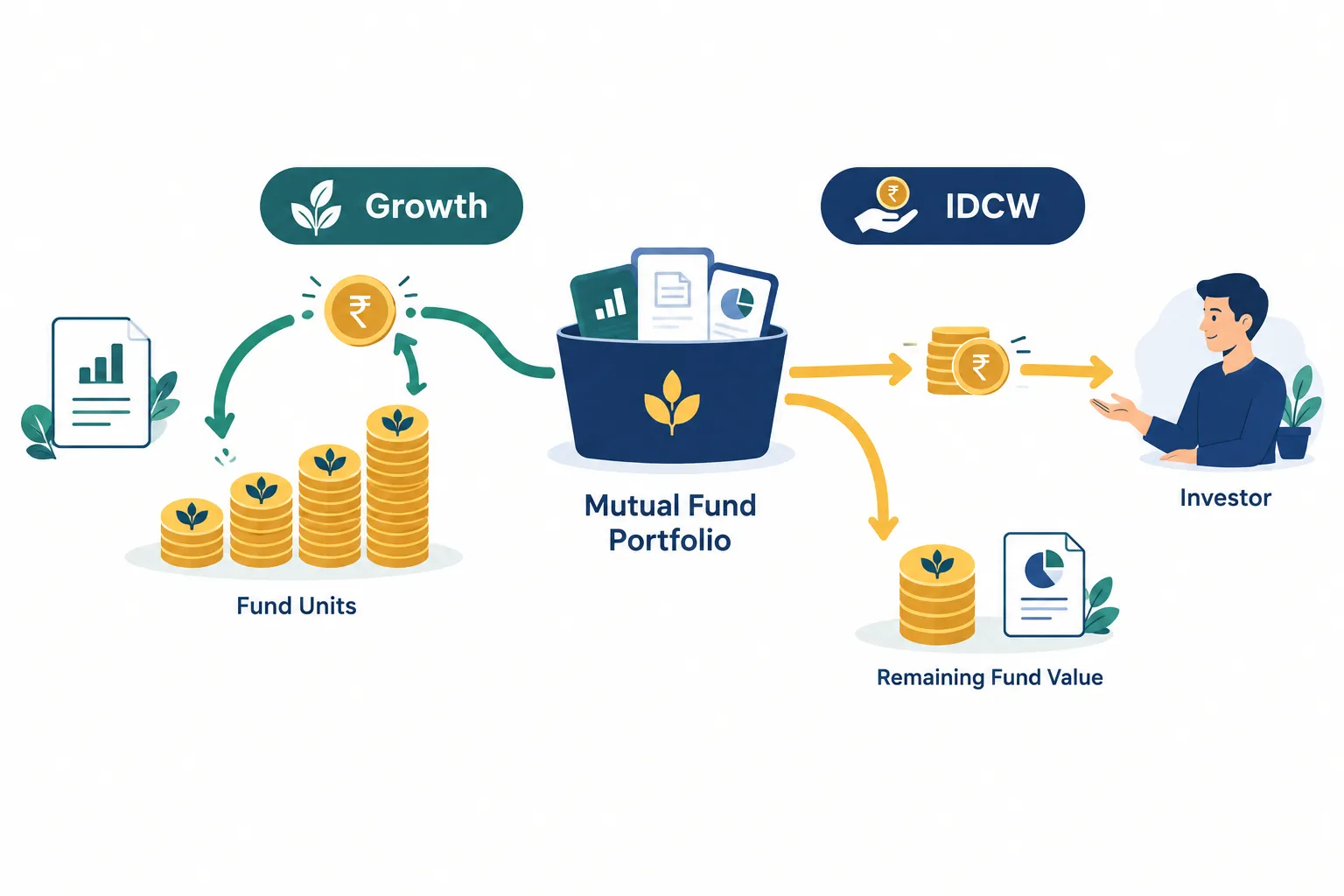
In a growth vs IDCW mutual fund choice, the underlying mutual fund scheme may be the same, but the treatment of earnings is different. Under the Growth option, profits and other earnings remain invested in the scheme. Your investment value rises or falls through changes in the Net Asset Value, or NAV.
Under the IDCW option, the mutual fund may distribute part of the scheme’s distributable surplus to investors. IDCW means Income Distribution cum Capital Withdrawal. The amount, timing and frequency of any distribution are not guaranteed. A payout can also include part of the investor’s capital, so it should not be viewed as free money or assured monthly income.
Growth is generally easier to understand for investors who want their money to remain invested. IDCW may suit someone who specifically wants possible cash distributions and understands that these payouts reduce the value remaining in the scheme. Neither option automatically produces better investment performance.
Introduction
Selecting a mutual fund scheme is not always the last decision an investor must make. After choosing a scheme, you may also need to select an option such as Growth or IDCW. This choice affects how the scheme’s earnings are reflected in your investment.
For example, suppose an investor chooses an equity mutual fund. Under the Growth option, any gains, dividends received by the fund and other earnings stay within the scheme. Under IDCW, the fund house may distribute an amount when it declares a payout, subject to the applicable rules and availability of distributable surplus.
This can create confusion for beginners. An IDCW payout may look like extra income earned over and above the investment. However, the payout comes from the scheme’s own assets. Once it is distributed, the scheme’s NAV normally falls to reflect the amount paid out, along with any market movement and applicable adjustments.
Therefore, comparing only the NAVs or looking only at the cash received can give an incomplete picture. Investors must consider both the current value of their units and any distributions they have received.
Understanding Growth and IDCW Mutual Fund Options
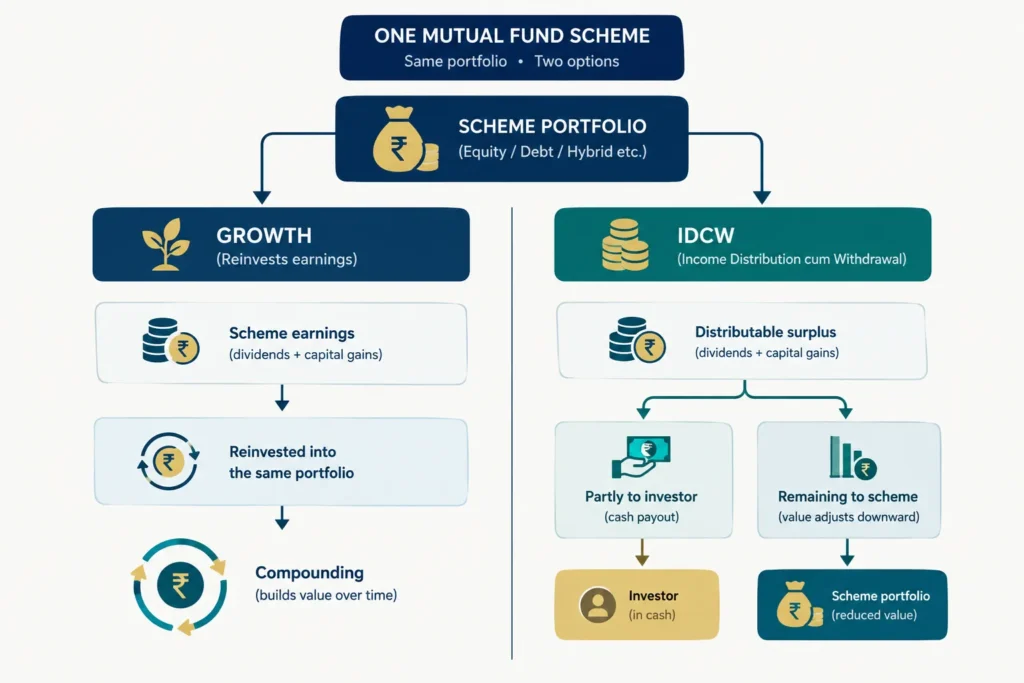
What Is the Growth Option?
In the Growth option, the mutual fund does not normally pay out the scheme’s earnings to investors as periodic distributions. Instead, those earnings remain invested in the scheme.
This allows the money to participate in future gains or losses along with the rest of the portfolio. If the investments held by the scheme perform well, the benefit is generally reflected in a higher NAV. If the portfolio loses value, the NAV can fall.
Consider a simple example. Meera invests ₹1 lakh in the Growth option of a mutual fund. The fund’s portfolio earns income and experiences market gains, but no amount is distributed to her. These earnings remain within the scheme and are reflected in its NAV. Her investment value will depend on the number of units she holds multiplied by the latest NAV.
This does not mean that Growth provides guaranteed growth. The word “Growth” describes how earnings are retained in the scheme. It does not promise that the NAV will always increase. Mutual fund returns remain subject to the performance of the underlying investments.
Keeping earnings invested can support compounding. Compounding means that earlier earnings remain invested and may generate further returns over time. However, the actual outcome depends on market performance, expenses and how long the investor stays invested.
What Is the IDCW Option?
IDCW stands for Income Distribution cum Capital Withdrawal. Under this option, the mutual fund may declare a distribution from the scheme’s distributable surplus in accordance with the applicable rules.
The word “may” is important. An IDCW option does not require the mutual fund to make a payout on a fixed date or at a fixed rate. Even if an option is described using terms such as monthly, quarterly or annual, the distribution is subject to availability of distributable surplus and a declaration by the fund house.
Suppose Ramesh holds units worth ₹1 lakh in an IDCW option. The mutual fund declares an IDCW payout of ₹2,000 for his holding. He receives the cash, but the value remaining in the scheme is adjusted because the payout has come from the scheme’s assets. Ignoring market movements and other adjustments, his total wealth does not become ₹1.02 lakh merely because ₹2,000 was distributed.
This is why IDCW should not be confused with interest from a fixed deposit. A fixed deposit may state an agreed interest rate, subject to its terms. An IDCW payout is not fixed, assured or guaranteed. The amount can change, and there may be periods when no distribution is declared.
Mutual funds and SIP investing in India
Why “Dividend Option” Was Renamed IDCW
IDCW was earlier commonly known as the Dividend option. The newer name gives investors a clearer idea of what the payout can represent.
The word “dividend” sometimes led investors to assume that the distribution was an additional return, similar to a company paying dividends to shareholders. In a mutual fund, however, a distribution is made from the scheme’s distributable surplus. It reduces the assets remaining in the option and is reflected in the NAV after the payout.
The phrase “cum Capital Withdrawal” is particularly important. It highlights that a distribution may include income as well as a portion of the investor’s invested capital. Therefore, an IDCW payout should not automatically be treated as profit.
The name change does not turn IDCW into a separate type of mutual fund. Growth and IDCW are options within a scheme. They generally invest through the same underlying portfolio, but they handle distributions differently.
Growth vs IDCW Mutual Fund: Key Differences
| Point of Comparison | Growth Option | IDCW Option |
|---|---|---|
| Treatment of earnings | Earnings remain invested in the scheme. | The fund may distribute an amount from distributable surplus. |
| Cash payout | No regular IDCW distribution is made. | A payout may be declared, but it is not guaranteed. |
| Effect on NAV | Earnings retained in the scheme are reflected in the NAV. | NAV normally falls after a distribution to reflect the payout, apart from market movements and other adjustments. |
| Compounding | Earnings stay invested and can participate in future returns. | Cash paid out no longer remains invested in the scheme unless the investor invests it again. |
| Nature of income | Value is accessed when the investor redeems units. | Possible distributions can provide cash, but the amount and timing are uncertain. |
| Guarantee | Growth in NAV is not guaranteed. | IDCW payouts and investment returns are not guaranteed. |
| Common misunderstanding | The word “Growth” may be mistaken for assured positive returns. | The payout may be mistaken for free or additional returns. |
Cash Distribution Is Not the Same as Investment Return
An investment return measures how the value of an investment has changed after considering relevant cash received from it. A cash distribution only tells you that money has been paid out. It does not, by itself, show whether the investment has generated a profit.
For example, assume two investors begin with the same amount in different options of the same scheme. The IDCW investor receives a distribution, while the Growth investor receives no cash. It would be incorrect to conclude that the IDCW investor earned more simply because money reached a bank account. The remaining investment value must also be considered.
Similarly, the Growth option may show a higher NAV than the IDCW option because it has retained earnings instead of distributing them. A higher NAV does not make a mutual fund expensive, and it does not by itself prove superior performance.
Neither option automatically guarantees better results. When comparing Growth and IDCW, investors should look at the total economic outcome: the value of units still held plus any distributions received. The central difference is whether earnings remain invested or may be paid out, not whether one option creates free additional returns.
NAV Impact, ₹1,00,000 Example and Taxation
To understand the growth vs IDCW mutual fund choice, you need to know what happens to the scheme’s Net Asset Value, or NAV. This is especially important because an IDCW payment may look like an extra return, even though it generally comes from the value already held within the scheme.
What Does NAV Mean?
NAV is the per-unit value of a mutual fund option. In simple terms, it represents the value of the option’s assets after accounting for its liabilities, divided by the number of units outstanding.
Suppose an option has an NAV of ₹20. If you invest ₹1,00,000 at that NAV, ignoring any applicable transaction-related adjustments for simplicity, you receive 5,000 units.
Your investment value is calculated as follows:
5,000 units × ₹20 NAV = ₹1,00,000
The NAV changes as the value of the scheme’s underlying investments changes. For example, movements in the prices of shares, bonds and other securities held by the scheme can increase or decrease the NAV.
The Growth and IDCW options of the same scheme invest through the same underlying portfolio, subject to the scheme structure and applicable expenses. However, their NAVs can be different because the IDCW option may have made distributions in the past, while the Growth option retained money within the scheme.
Therefore, a lower NAV does not automatically make an option cheaper or more attractive. You should not choose between Growth and IDCW merely by comparing their NAV numbers.
What Happens to NAV After an IDCW Distribution?
When an IDCW distribution is made, cash moves out of the option and is paid to eligible investors. As a result, the IDCW option’s NAV generally adjusts downward after the distribution, subject to market movements, applicable taxes or adjustments, and the scheme’s accounting treatment.
For example, if an option distributes ₹1 per unit, its NAV would generally fall by approximately that amount when other factors remain unchanged. In the real market, the exact change may not look identical because the portfolio’s value may also rise or fall around the same time.
An IDCW payment is therefore not free money added on top of an unchanged investment value. The investor receives cash, but the value remaining in the mutual fund generally reduces correspondingly.
The frequency and amount of IDCW are also not assured. A scheme may distribute IDCW only when the required conditions are met and the fund house decides to declare it. Investors should not treat it like guaranteed interest from a bank deposit.
Hypothetical ₹1,00,000 Example
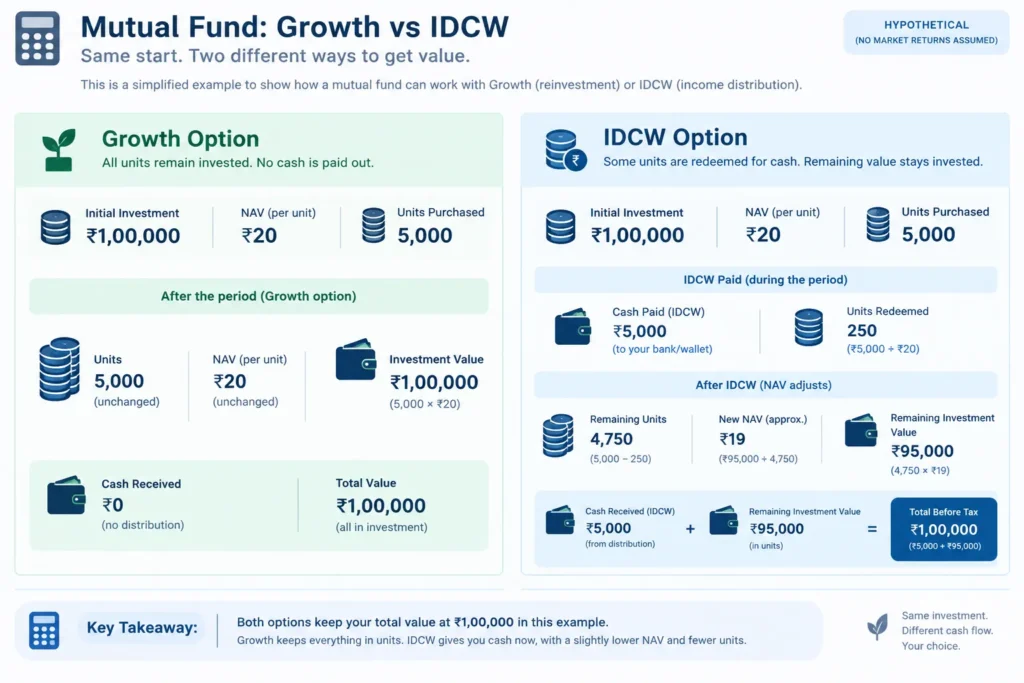
The following example uses simple assumed values only to explain the mechanics. It does not represent the actual performance of any mutual fund, and it ignores market movements, expenses, taxes and transaction-related adjustments.
Assume you are comparing the Growth and IDCW options of the same scheme. You invest ₹1,00,000 when the NAV of each option is ₹20.
| Particular | Growth Option | IDCW Option |
|---|---|---|
| Initial investment | ₹1,00,000 | ₹1,00,000 |
| Assumed purchase NAV | ₹20 | ₹20 |
| Units received | 5,000 | 5,000 |
Now assume there is no change in the underlying portfolio’s value. The IDCW option declares and pays ₹1 per unit. The Growth option does not make a distribution.
The IDCW investor receives:
5,000 units × ₹1 IDCW = ₹5,000 cash
With all other factors assumed to remain unchanged, the IDCW option’s NAV generally adjusts from ₹20 to approximately ₹19.
| Position After the Assumed Distribution | Growth Option | IDCW Option |
|---|---|---|
| Units held | 5,000 | 5,000 |
| Assumed NAV | ₹20 | ₹19 |
| Current investment value | ₹1,00,000 | ₹95,000 |
| Cash received | ₹0 | ₹5,000 |
| Total value before tax | ₹1,00,000 | ₹1,00,000 |
In this simplified example, the IDCW investor has ₹95,000 remaining in the mutual fund and ₹5,000 in cash. The combined value is still ₹1,00,000 before tax. The cash payment has not created an additional ₹5,000 return.
The Growth investor still has ₹1,00,000 invested because no money was distributed. If the portfolio later earns a return, that change is reflected in the NAV. In the IDCW option, the ₹5,000 already paid out will not participate in future portfolio growth unless the investor chooses to reinvest it.
This example does not mean that the final outcomes of the two options will always match. Taxes, the timing of distributions, subsequent market movements, expenses and the use of cash received can affect the investor’s result.
Calculate your SIP investment returns
Measure Total Return, Not Just the Cash Received
Looking only at an IDCW payment can give an incomplete picture. To understand your result, consider both the current value of your units and the cash already received.
A simple way to review the position is:
Total value = Current investment value + IDCW cash received
For a more complete assessment, you should also account for taxes, any redemption-related charges, additional investments, withdrawals and the timing of each cash flow.
For instance, an IDCW payment of ₹5,000 does not necessarily mean that the investment earned ₹5,000. If the remaining investment value declined by a similar amount because of the distribution, there may be no additional economic gain from the payment itself.
Similarly, the Growth option should not be judged only by its NAV. The relevant question is how the total value of your investment has changed compared with the amount invested, after considering applicable costs and taxes.
How Taxation Generally Works
Tax treatment is an important part of the growth vs IDCW mutual fund decision. However, mutual fund taxation can change, and the correct treatment depends on several factors. These can include the fund category, the nature of the income, the investor’s tax status, the holding period and the law applicable at the time of the transaction or distribution.
Under the Growth option, tax generally arises when units are redeemed, sold or otherwise transferred in a taxable transaction. The taxable amount is generally based on the capital gain, not automatically on the full redemption proceeds. A capital gain is broadly the difference between the value received and the applicable cost of acquisition, after considering the relevant tax rules.
The capital gains treatment may differ based on whether the scheme is treated as an equity-oriented fund, a specified mutual fund or another category under current law. Holding-period rules and other conditions can also affect the treatment.
Under the IDCW option, distributions are generally taxable in the investor’s hands according to the applicable provisions. The tax impact can depend on the investor’s total income, tax status and the character of the payment under current law.
Tax Deducted at Source, or TDS, may also apply in certain cases. TDS is only tax deducted at the payment stage; it is not necessarily the investor’s final tax liability. The final amount payable or refundable is determined under the applicable income-tax rules and the investor’s overall tax position.
An IDCW investor may therefore face tax when a distribution is received and may separately have a capital gains calculation when the units are later redeemed or transferred. These are distinct events and should be reviewed using the rules applicable at that time.
Verify Current Rules Before Making a Decision
Do not rely on old tax rates, past holding-period rules or a general statement that applies to every mutual fund. Tax provisions can be amended, and two schemes that appear similar may fall under different tax categories.
Before investing or publishing tax-related information, verify the latest details using current Income Tax Department guidance, SEBI or AMFI material, and the scheme documents or official tax information issued by the asset management company. For advice based on your income, residency or investor status, consult a qualified tax professional.
Which Option May Suit You?
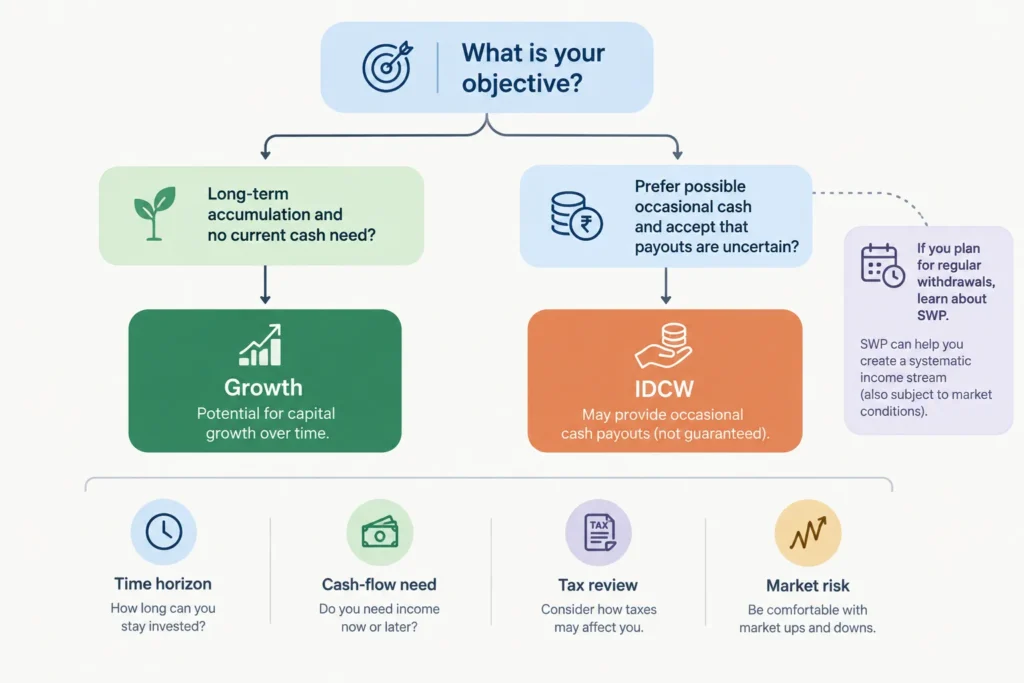
The choice between Growth and IDCW should depend on your financial objective, not on which option appears to offer a lower NAV or a recent payout. Both options generally invest in the same underlying portfolio of the mutual fund scheme. The main difference is how the scheme handles distributable surplus.
Under the Growth option, gains remain invested in the scheme. This allows the value of your investment to grow through compounding, although actual returns will depend on market performance.
Under the Income Distribution cum Capital Withdrawal, or IDCW, option, the scheme may distribute an amount when the fund house decides to do so. Such a distribution is not assured. It can also include a portion of the investor’s capital, not merely the income earned by the scheme.
When Growth May Be Considered
The Growth option may be considered by investors whose main objective is long-term wealth accumulation. It can be suitable when you do not need periodic cash from the investment and are comfortable leaving potential gains invested.
It may be relevant for goals such as:
- Building a retirement corpus over many years.
- Saving for a child’s higher education.
- Creating wealth through a long-term SIP.
- Accumulating money for a future home purchase.
- Investing without depending on scheme distributions for regular expenses.
For example, an investor with 15 years until retirement may prefer to keep scheme earnings invested instead of receiving occasional payouts. This does not guarantee a higher return, but it avoids interrupting compounding through IDCW distributions.
When IDCW May Be Considered
IDCW may be considered by an investor who understands that distributions are uncertain but still prefers occasional cash payouts from the scheme. The amount and timing depend on the fund house’s decision and the availability of distributable surplus.
IDCW should not be treated like interest from a fixed deposit, pension or guaranteed monthly income plan. A scheme may reduce, skip or stop distributions. In addition, the scheme’s NAV normally falls to the extent of the payout and applicable statutory levies.
An investor should therefore avoid selecting IDCW merely because the word “income” appears in its name. A payout is a transfer of value from the scheme to the investor; it is not an extra return added on top of the existing investment value.
Practical Factors to Check Before Choosing
| Factor | What to Consider |
|---|---|
| Financial goal | Growth may align with accumulation goals, while IDCW may suit a preference for uncertain, occasional distributions. |
| Investment horizon | A longer horizon may provide more time for compounding under Growth, although market risk remains. |
| Cash-flow needs | Decide whether you genuinely need cash now or can leave the money invested for a future goal. |
| Tax position | IDCW and capital gains can be taxed differently. Your income slab, scheme category and holding period may affect the result. |
| Market volatility | Both options remain exposed to the same scheme-level market risks. IDCW does not make an equity or debt fund safer. |
| Control over withdrawals | Growth keeps money invested until you redeem. IDCW payouts are decided by the fund house rather than scheduled by you. |
What If You Need Planned Withdrawals?
Investors who want planned cash flows may separately learn about a systematic withdrawal plan, or SWP. An SWP allows an investor to redeem a chosen amount or number of units at set intervals, subject to scheme rules.
An SWP is different from IDCW. Under an SWP, units are redeemed to provide the withdrawal. This reduces the number of units held and may attract capital gains tax and an exit load, where applicable. Frequent or high withdrawals can also deplete the investment, especially during weak markets.
Before using this approach, understand withdrawal sustainability through a detailed SWP guide. You can also refer to an NAV explainer to see how redemptions, market movements and IDCW payouts affect investment value.
SWP Explained: How Systematic Withdrawal Plans Work
Frequently Asked Questions
1. What is the full form and meaning of IDCW?
IDCW stands for Income Distribution cum Capital Withdrawal. It is an option under which a mutual fund may distribute part of the scheme’s distributable surplus to investors. The payout may include income as well as part of the investor’s invested capital.
2. Is IDCW the same as the old Dividend Option?
Yes. What was earlier commonly called the Dividend Option was renamed IDCW to describe its nature more clearly. The new name helps investors understand that a distribution may involve withdrawal from the scheme’s capital and is not necessarily an additional profit.
3. Is an IDCW payout guaranteed?
No. The amount, timing and frequency of an IDCW payout are not guaranteed. The fund house may announce a distribution only when permitted under applicable rules and when distributable surplus is available. Past payouts do not assure future payouts.
4. Why does NAV fall after an IDCW payout?
The payout comes from the scheme’s assets. Once that amount leaves the scheme, the NAV generally falls by approximately the distribution amount per unit, subject to applicable statutory levies and market movements.
For example, if a scheme distributes value to its unitholders, the scheme has fewer assets immediately after the payout. The investor receives cash, but the remaining investment value adjusts accordingly.
5. Does the Growth option always give higher returns?
No. Growth does not guarantee higher returns. Both options are exposed to the performance of the same underlying portfolio. However, Growth keeps gains invested, while IDCW may take some value out through distributions. When comparing performance, consider the total return, including IDCW received, rather than comparing NAVs alone.
6. How are Growth and IDCW taxed?
Under Growth, tax usually arises when units are redeemed or switched and a capital gain is realised. The applicable treatment depends on factors such as whether the scheme is equity-oriented or non-equity, the purchase date and the holding period.
IDCW received by an investor is generally added to taxable income and taxed according to the applicable income-tax slab. Tax may also be deducted at source when legal thresholds and conditions are met. For current rules, refer to a detailed mutual fund taxation guide or consult a qualified tax professional.
7. Can an investor switch between Growth and IDCW?
A switch may be allowed under the scheme’s rules, but it is not merely an administrative name change. It is generally treated as a redemption from one option and a fresh purchase into the other.
The transaction may therefore create capital gains tax and may attract an exit load. It could also affect the holding period of the newly purchased units. Check the scheme information document, account statement and tax consequences before switching.
8. Which option may suit long-term goals?
Growth may be considered for long-term goals when the investor wants potential gains to remain invested and does not need periodic distributions. This can support compounding over time, but market-linked returns are never assured.
IDCW may still be chosen by an informed investor who values occasional payouts and accepts their uncertainty. The decision should reflect the goal, time horizon, cash-flow requirement and tax position rather than a recent IDCW announcement.
9. Is a lower IDCW NAV cheaper than a higher Growth NAV?
No. A lower NAV does not automatically make an option cheaper or more attractive. The NAVs may differ because Growth retains gains while IDCW distributes some scheme value. Investors should compare portfolio exposure, total returns, costs and suitability instead of judging an option by NAV alone.
Conclusion
In the growth vs IDCW mutual fund decision, Growth keeps scheme earnings invested, while IDCW may distribute part of the scheme’s value to investors. Growth may align with long-term accumulation and compounding. IDCW may suit investors who understand the uncertainty of payouts and still prefer occasional cash distributions.
Neither option is automatically best for everyone. Match the choice with your financial goals, investment horizon, cash-flow needs, tax position and ability to handle market volatility. Beginners may also review a complete guide to mutual funds and SIP investing in India, along with separate explainers on NAV, mutual fund taxation and SWPs, before deciding.
Mutual fund investments are subject to market risks. Tax rules and scheme features can change. Read the official scheme documents carefully and consider consulting a SEBI-registered investment adviser, mutual fund distributor or qualified tax professional where appropriate.


Comments