


You may be able to reduce your loan EMI by extending the remaining loan tenure or securing a lower interest rate. However, a lower EMI does not automatically mean a cheaper loan. Extending the tenure usually reduces the monthly payment but increases the total interest paid when the outstanding principal and interest rate remain unchanged. Your actual options will depend on your loan agreement, repayment history, eligibility and the lender’s policy.
A high EMI can put pressure on a household budget. It may leave less money for rent, school fees, medical costs, insurance premiums and emergency savings. If your income has fallen or your expenses have risen, reducing the EMI can provide immediate monthly relief.
Before requesting a change, it is important to understand how an EMI works. Lenders do not decide the EMI based only on what you can comfortably pay. It is calculated mainly from the outstanding loan amount, interest rate and remaining repayment period.
You should also look beyond the new monthly figure. A restructuring option that lowers the EMI today may keep you in debt for longer or substantially increase the total interest cost. The right choice depends on both your present cash flow and your long-term finances.
What Determines Your Monthly EMI?
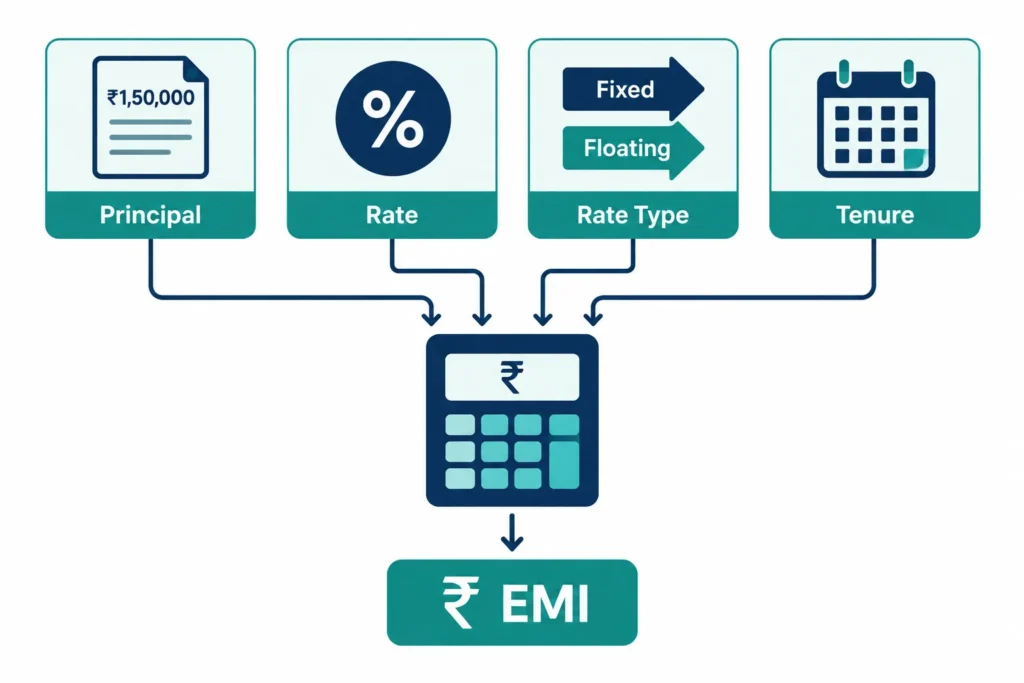
EMI stands for equated monthly instalment. It is the amount you pay to the lender each month under the repayment schedule. An EMI generally contains two components:
- Principal repayment: The portion that reduces the amount you owe.
- Interest payment: The cost charged by the lender for providing the loan.
In the earlier part of a typical reducing-balance loan, a larger share of the EMI may go towards interest. As the outstanding balance falls, more of the EMI generally goes towards principal repayment. The exact split can be seen in the loan’s amortisation or repayment schedule.
Four factors are especially important when understanding your current EMI and the possibility of reducing it.
1. Outstanding principal
The outstanding principal is the loan amount that remains unpaid. It is not necessarily the same as the amount you originally borrowed.
For example, suppose you took a home loan of Rs 30 lakh several years ago and have already repaid part of it. If the current outstanding principal is Rs 24 lakh, the lender will use that remaining amount when revising the future repayment schedule.
A higher outstanding principal normally results in a higher EMI when the interest rate and tenure are unchanged. Reducing the principal through a permitted part-prepayment can lower the future EMI or shorten the tenure, depending on the option selected and the lender’s rules.
2. Interest rate
The interest rate directly affects the cost of borrowing. If the rate rises while the principal and tenure remain the same, the required EMI will generally increase. If the rate falls, the EMI may decrease.
In practice, a lender may respond to an interest-rate change by adjusting the EMI, changing the remaining tenure, or using a combination of both. You should check the revised repayment schedule rather than assuming that a rate cut will automatically appear as a lower monthly payment.
3. Fixed or floating interest rate
The type of interest rate affects whether and how the loan cost can change.
- Fixed-rate loan: The interest rate is fixed for the period specified in the agreement. The EMI is usually more predictable during that period, though some products allow resets or contain other conditions.
- Floating-rate loan: The interest rate is linked to a benchmark or reference rate and may change according to the loan terms. A change can affect the EMI, tenure or both.
Do not rely only on the words “fixed” or “floating” in a sales discussion. Read the sanction letter and loan agreement. A loan described as fixed may be fixed only for an initial period, while a floating-rate loan may have specified reset dates and spreads.
4. Remaining tenure
The remaining tenure is the time left to repay the loan. Spreading the outstanding amount across more months generally lowers the EMI. Paying it over fewer months generally raises the EMI.
Tenure has a major effect on total interest. A longer period means interest is charged on the outstanding balance for more time. This is why the smallest EMI is not always the most economical choice.
Can You Reduce Your Loan EMI?
Yes, it may be possible to reduce your loan EMI, but you cannot assume that every option will be available. The lender must agree to any change that modifies the original repayment schedule.
Your choices may depend on:
- The type of loan, such as a home loan, personal loan, education loan or vehicle loan.
- Whether the interest rate is fixed or floating.
- The terms written in the loan agreement.
- Your repayment record and current credit profile.
- Your age, income and the lender’s maximum permitted tenure.
- The outstanding loan balance and time left.
- The lender’s internal eligibility and restructuring policies.
For example, a bank may allow an eligible home-loan borrower to extend the tenure within its maximum age and tenure limits. The same lender may be less willing to extend a short-term unsecured personal loan. Policies can also differ between lenders and products.
Ask the lender for a written illustration before accepting any revision. It should show the proposed EMI, revised tenure, applicable interest rate, total repayment and any charges. Also ask whether the change is a normal tenure modification or is treated as formal restructuring, because the process and possible credit implications may differ.
Compare the monthly relief with the full cost. A reduction of a few thousand rupees each month may be valuable if it prevents missed payments. But if you can comfortably afford the present EMI, extending the loan merely to create extra spending room may not be financially efficient.
Reduce EMI by Extending the Loan Tenure
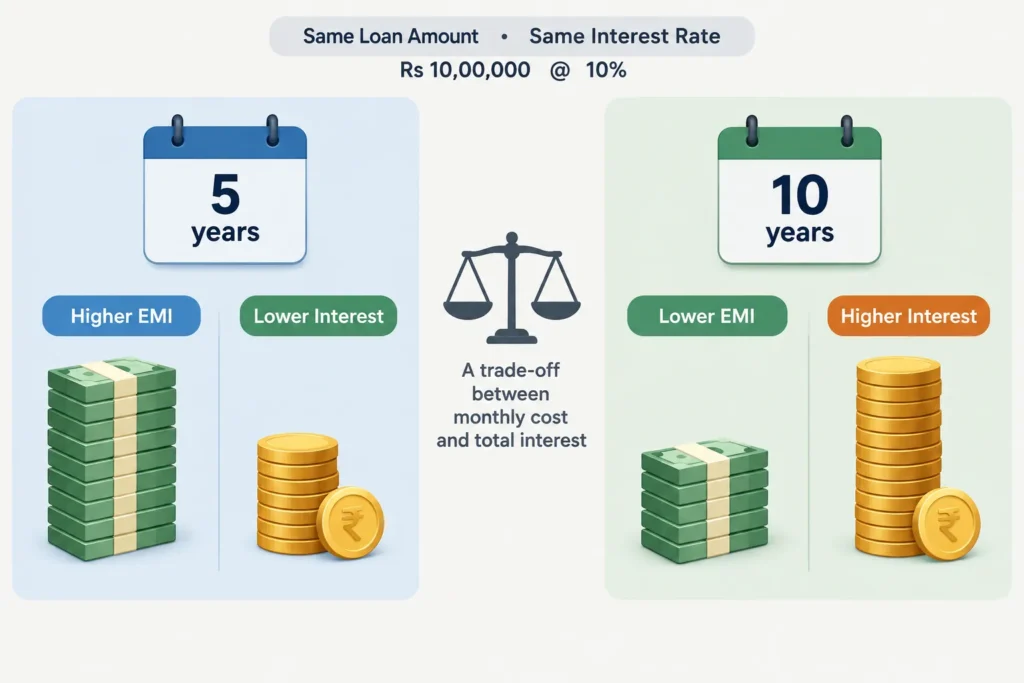
Extending the remaining tenure is one of the most direct ways to reduce an EMI. The same outstanding principal is divided across a greater number of monthly payments. This can make the instalment easier to manage without requiring an immediate lump-sum payment.
However, the outstanding balance remains unpaid for longer. If the principal and interest rate stay unchanged, you will usually pay more total interest over the life of the loan.
Hypothetical Indian rupee example
Consider a hypothetical borrower with an outstanding loan principal of Rs 10 lakh. Assume the interest rate remains 10% per year throughout the period, with monthly repayments on a reducing balance. Ignore fees, taxes, insurance and rate changes for simplicity.
| Repayment option | Remaining tenure | Approximate EMI | Approximate total repayment | Approximate total interest |
|---|---|---|---|---|
| Current schedule | 5 years | Rs 21,247 | Rs 12.75 lakh | Rs 2.75 lakh |
| Extended schedule | 10 years | Rs 13,215 | Rs 15.86 lakh | Rs 5.86 lakh |
In this illustration, extending the tenure from five years to ten years reduces the EMI by about Rs 8,032 per month. That may provide meaningful cash-flow relief.
But the approximate total interest rises from Rs 2.75 lakh to Rs 5.86 lakh. The borrower pays about Rs 3.11 lakh more in interest because the debt continues for a longer period. These figures are illustrative and may differ from a lender’s calculation because of rounding, payment dates, rate conventions and product terms.
When a tenure extension may be useful
A longer tenure may be worth considering when the present EMI has become genuinely difficult to manage. For example, a temporary fall in household income, a major medical expense or a sharp rise in essential costs could make monthly relief more important than minimising interest immediately.
Reducing the EMI may also help a borrower avoid late payments or defaults. Missing instalments can lead to penalties, collection action and possible damage to the borrower’s credit profile. Contacting the lender before missing a payment is generally better than waiting until arrears build up.
Trade-offs to check before extending the tenure
- Higher total interest: More repayment months usually mean a larger overall interest bill.
- Longer debt commitment: The loan may continue closer to retirement or other major financial goals.
- Eligibility limits: The lender may restrict the maximum loan tenure or the borrower’s age at final repayment.
- Possible charges: The lender may apply administrative, modification or restructuring fees.
- Future rate risk: On a floating-rate loan, interest rates may change during the extended period.
If you choose this route, ask whether future part-prepayments can reduce the tenure again without an unacceptable cost. This may allow you to use the lower EMI during a difficult period and repay faster later if your income improves. Any such flexibility must be confirmed from the applicable loan terms rather than assumed.
Reduce EMI Through an Interest Rate Reduction
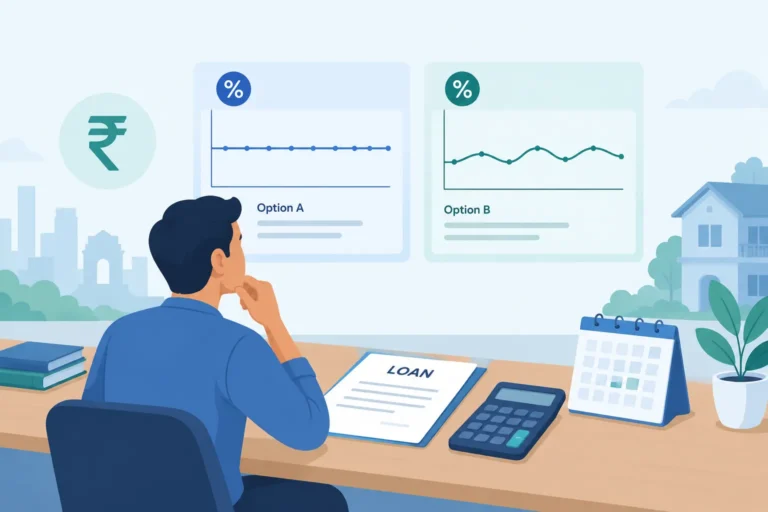
If you are exploring how to reduce loan EMI, start by checking the interest rate on your existing loan. A lower rate reduces the interest charged on the outstanding principal. This may lower your EMI, shorten your remaining tenure, or provide a mix of both.
Ask your current lender whether an internal interest rate revision is available. Depending on the loan agreement and lender policy, this may be called a rate conversion, repricing or switching to the lender’s current loan scheme.
The lender may charge a conversion fee. It may also reassess your repayment history, credit profile or income. Therefore, do not assume that the advertised rate will automatically apply to your loan.
Check the reset rules first
For a floating-rate loan, the interest rate may be linked to an external benchmark or the lender’s internal benchmark. A fall in the benchmark may not affect your EMI immediately because the loan can have a scheduled reset date.
Ask the lender for the following details in writing:
- Your current interest rate and benchmark.
- The new rate being offered.
- The date from which the revised rate will apply.
- The conversion fee and applicable taxes.
- The revised EMI and remaining tenure.
- The total interest payable under both options.
Consider an outstanding home loan of Rs. 10 lakh with 10 years remaining. Assume the current rate is 10.5% a year and the lender offers 9% a year. For simplicity, assume monthly repayments and no additional charges.
| Loan detail | At 10.5% | At 9% |
|---|---|---|
| Outstanding principal | Rs. 10 lakh | Rs. 10 lakh |
| Remaining tenure | 120 months | 120 months |
| Approximate EMI | Rs. 13,494 | Rs. 12,668 |
| Approximate future interest | Rs. 6.19 lakh | Rs. 5.20 lakh |
In this illustration, the EMI falls by about Rs. 826 a month. The approximate interest saving is Rs. 99,000 before conversion fees and taxes. Actual figures can differ because of reset dates, rounding, daily interest calculations and lender rules.
How Loan Balance Transfers Can Affect Your EMI
A loan balance transfer means moving the outstanding loan from the current lender to another lender. The new lender repays the old lender, and you then make EMIs to the new lender.
A balance transfer may help when the new interest rate is meaningfully lower. However, a lower advertised rate alone is not enough. The transfer can involve processing fees, documentation expenses, property valuation charges, legal verification charges and taxes. Some loans may also have foreclosure or pre-closure charges, subject to the loan type and applicable rules.
Compare the new loan over the same remaining tenure. If you compare your current 10-year balance with a new 15-year loan, the EMI may look much lower mainly because repayment has been stretched over more years. That does not necessarily mean the loan is cheaper.
When a balance transfer may be worth checking
- The difference between the old and new interest rates is significant.
- A substantial principal amount is still outstanding.
- Several years remain in the loan tenure.
- The expected interest saving is comfortably higher than all transfer costs.
- You meet the new lender’s income, credit and documentation requirements.
Request an amortisation schedule from the proposed lender. It should show the opening balance, interest component, principal component and closing balance for each instalment. Also confirm whether the quoted rate is fixed, floating or available only for a limited period.
A transfer is not guaranteed. The new lender can reject the application, offer a different rate, approve a smaller amount or attach conditions based on its assessment.
How Part-Prepayment Can Change Your EMI
Part-prepayment means paying an additional lump sum towards the principal without closing the entire loan. Because the outstanding principal becomes smaller, future interest is calculated on a lower amount.
After part-prepayment, the lender may allow one of the following adjustments:
- Reduce the EMI while keeping the remaining tenure broadly unchanged.
- Keep the EMI unchanged and shorten the tenure.
- Adjust both the EMI and tenure according to its policy.
Check the minimum prepayment amount, permitted frequency, charges and adjustment process before paying. Do not assume that the lender will automatically reduce the EMI. You may have to submit a specific request.
For example, assume you owe Rs. 10 lakh at 9% with 10 years remaining. The approximate EMI is Rs. 12,668. You make a part-prepayment of Rs. 2 lakh, reducing the principal to Rs. 8 lakh.
| Choice after prepayment | Approximate result | Main benefit |
|---|---|---|
| Keep 10-year tenure | EMI falls to about Rs. 10,134 | More monthly cash flow |
| Keep EMI near Rs. 12,668 | Loan may finish in about 86 months | Lower interest and earlier closure |
These are simplified estimates. The final instalment may be different, and the lender’s calculation method can change the exact result.
Do not use all your savings for prepayment if that leaves you without an emergency fund. A lower loan balance is useful, but you may still need accessible money for medical costs, job loss, repairs or other urgent expenses.
Should You Choose a Lower EMI or a Shorter Tenure?
A lower EMI is usually more helpful when your monthly budget is under pressure. It can create room for essential spending, insurance premiums and regular savings. It may also reduce the risk of missing payments.
A shorter tenure is generally better for reducing total interest, provided you can comfortably continue with the existing EMI. More of your future payments will go towards principal, and the loan will end sooner.
Use these questions to decide:
- Is the current EMI affecting essential household expenses?
- Do you have an adequate emergency fund?
- Is your income stable enough to maintain the present EMI?
- Are there higher-priority debts, such as expensive credit card balances?
- How much total interest will each option require from today?
Avoid choosing a longer tenure only for immediate comfort without checking its full cost. A small monthly reduction can result in many additional instalments and higher total interest.
How to Calculate the Impact of an EMI Reduction
The standard EMI formula is:
EMI = P × r × (1 + r)n ÷ [(1 + r)n − 1]
Here, P is the outstanding principal, r is the monthly interest rate, and n is the number of monthly instalments remaining.
To convert an annual rate into a monthly rate, divide it by 12 and then by 100. For example, 9% a year becomes 0.0075 per month.
A simple comparison process
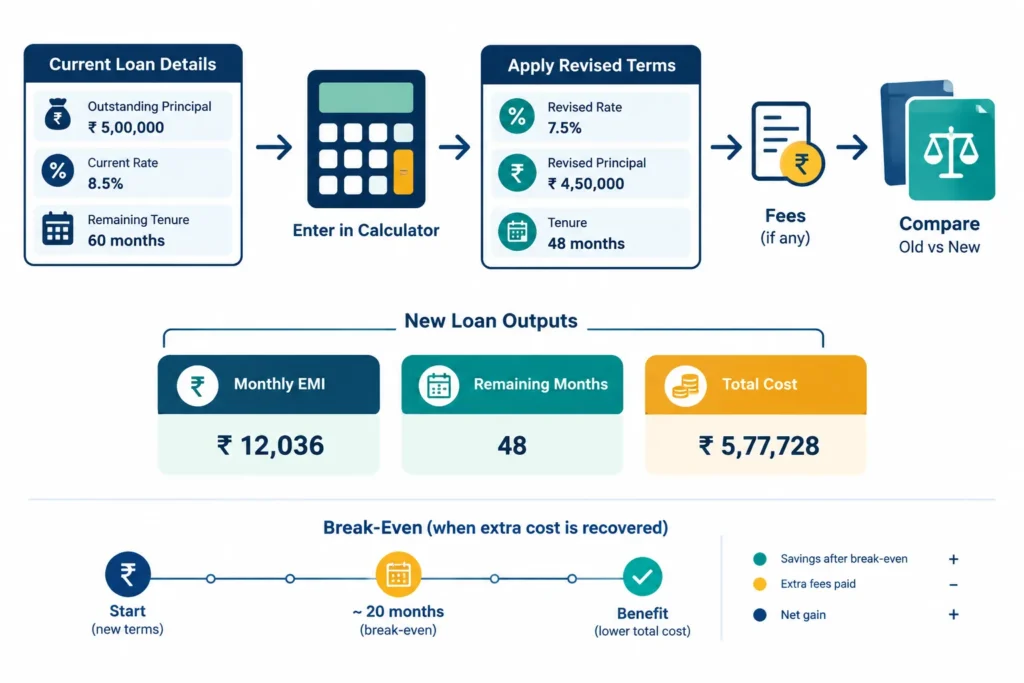
- Note the current outstanding principal, rate, EMI and remaining months.
- Calculate the future payments under the existing loan by multiplying the EMI by the remaining number of instalments.
- Use the formula with the proposed rate or reduced principal.
- Calculate the revised total payments over the new tenure.
- Subtract the outstanding principal to estimate future interest.
- Add conversion, transfer, valuation, legal and other applicable costs.
- Compare the revised EMI, remaining tenure and total cost side by side.
For a rate switch, a simple break-even estimate is useful. Divide the total switching cost by the monthly EMI saving. If the switch costs Rs. 12,000 and saves Rs. 800 a month, the break-even period is about 15 months. This estimate is only a quick check because it does not capture every timing and interest effect.
Always calculate from the current outstanding balance, not the original loan amount. The decision should be based on the cost remaining from today, after including all fees and the effect of any tenure change.
Costs and Risks to Consider Before Changing Your Loan
A lower monthly instalment can improve your cash flow, but it may not reduce the overall cost of your loan. Before deciding how to reduce loan EMI, check both the immediate charges and the long-term interest impact.
Processing and administrative costs
Your existing lender may charge a processing or administrative fee to change the interest rate, restructure the repayment schedule or modify the loan agreement. If you transfer the loan to another lender, the new lender may also charge a processing fee.
Ask for a written list of charges before accepting an offer. A small EMI reduction may not be worthwhile if the upfront costs are high compared with the expected savings.
Valuation and legal costs
For a home loan or loan against property, a new lender may conduct a fresh property valuation and legal review. You may have to pay for these checks. Requirements vary by lender, property and loan type.
There may also be documentation costs, agreement charges or other applicable expenses. Do not assume that an advertisement showing a lower interest rate includes every cost.
Insurance-related costs
A lender may offer or recommend loan protection insurance, property insurance or another insurance product. Understand whether the cover is compulsory under the loan terms, optional, or simply being offered as an add-on.
Check the premium, coverage, exclusions and payment method. If the premium is added to the loan, you may pay interest on that amount. Also check whether an existing policy can continue after a balance transfer or loan modification.
Longer tenure can increase total interest
Extending the tenure is one of the easiest ways to reduce EMI. However, it can keep you in debt for longer and increase the total interest paid.
For example, suppose an Indian borrower has a home loan with several years remaining. Extending the repayment period may create useful monthly breathing room. But if the borrower can already manage the current EMI, paying for additional years may be unnecessarily expensive.
Compare at least these figures before making a decision:
- Current EMI and remaining tenure
- Revised EMI and revised tenure
- Total remaining payment under each option
- Interest payable over the remaining period
- All one-time and recurring charges
Interest-rate and reset risks
A floating-rate loan can become cheaper when the applicable benchmark and lending rate decline. It can also become more expensive when rates rise. Confirm how often the rate resets, which benchmark applies and how a rate change affects the EMI or tenure.
A fixed-rate offer may provide greater predictability, but the terms require careful reading. Ask whether the rate is fixed for the entire remaining tenure or only for a specified period. Also check the conditions for switching between fixed and floating rates.
Using savings has an opportunity cost
Part-prepayment can reduce the principal, which may lower the EMI or shorten the tenure. However, using all your savings to prepay a loan can leave you unprepared for medical bills, job loss or urgent repairs.
Keep an adequate emergency fund before making a large prepayment. The right balance depends on your income stability, family responsibilities, insurance and access to other funds.
Steps to Request an EMI Reduction From Your Lender
You can approach your bank, housing finance company or other lender even if you have not missed any payments. A well-prepared request makes it easier to compare the available options.
1. Review your loan agreement
Read the sections covering interest-rate changes, prepayment, balance transfer, tenure modification and applicable charges. If any term is unclear, ask the lender to explain it in writing.
2. Obtain the latest loan statement
Collect an updated statement showing the outstanding principal, current interest rate, EMI, remaining tenure and repayment history. For a possible balance transfer, you may also need a foreclosure statement or a list of documents held by the existing lender.
3. Prepare your financial documents
The lender may ask for identity and address proof, income documents, bank statements, employment or business details, and property papers for secured loans. The exact requirements depend on the loan and lender.
A stronger repayment record, stable income and improved credit profile may help your request. However, approval and pricing remain subject to the lender’s assessment.
4. Ask for written options
Request clear proposals instead of relying on a phone conversation. Depending on the loan terms, possible options may include:
- A lower interest rate from the existing lender
- A longer repayment tenure
- Part-prepayment followed by EMI recalculation
- A switch between fixed and floating rates
- A balance transfer to another lender
- Temporary restructuring where the lender permits it
Ask the lender to show the revised EMI, tenure, interest rate, total repayment and all charges for each option.
5. Compare the total cost
Do not compare offers only by looking at the new EMI. Add processing, valuation, legal, documentation, insurance-related and other applicable costs. Then compare the total amount payable over the expected period.
If you expect to repay the loan soon, a balance transfer may provide limited benefit because there is less time to recover the switching costs. If a large principal and long tenure remain, the potential impact may be greater.
6. Confirm the revised terms
Before paying a fee or signing a document, confirm:
- Whether the EMI or tenure will change
- The effective date of the new terms
- The interest rate and benchmark, where applicable
- The rate-reset frequency
- All charges and taxes that may apply
- Prepayment conditions
- Whether any linked insurance changes
7. Keep records and verify the change
Save applications, emails, receipts, revised schedules and signed agreements. After the change takes effect, check your bank account and loan statement to ensure that the correct EMI is being collected and properly credited.
Common Mistakes to Avoid
Focusing only on the monthly EMI
A lower EMI may look attractive while hiding a much longer tenure. Always check the total interest and total repayment. Monthly affordability matters, but it should not be the only measure.
Extending the tenure too far
A tenure extension can be useful during a genuine cash-flow problem. Using it without a clear need may keep you paying interest for many extra years. Consider whether a smaller extension or controlled expense reduction could solve the problem.
Using emergency savings carelessly
Do not empty your emergency fund merely to reduce the EMI. A lower loan balance offers little comfort if the next emergency forces you to use costly credit.
Ignoring reset and benchmark terms
With a floating-rate loan, the advertised rate may change later. Understand the benchmark, spread, reset timing and whether future rate movements will alter the EMI, tenure or both.
Accepting verbal promises
A sales representative may discuss an attractive rate or fee waiver. Treat it as unconfirmed until it appears in an official offer, email or agreement. Written terms are especially important during a balance transfer.
Applying to many lenders without a plan
Repeated applications can create unnecessary paperwork and credit enquiries. First compare broad eligibility and terms, then apply selectively to lenders that appear suitable.
Frequently Asked Questions About Reducing Loan EMI
Who is eligible to request a lower EMI?
Any borrower can ask the lender about available options, but approval is not automatic. The lender may consider repayment history, income, outstanding balance, credit profile, remaining tenure, collateral and its internal policies.
Does a good credit score help reduce loan EMI?
A good credit score may strengthen your case for a better rate or balance transfer. It indicates responsible credit behaviour, but it does not guarantee approval or a particular interest rate. Income stability and the lender’s eligibility rules also matter.
Can part-prepayment reduce my EMI?
Yes, if the lender allows the EMI to be recalculated after reducing the principal. Some borrowers instead keep the EMI unchanged and shorten the tenure, which can generally reduce interest more quickly. Ask for both calculations before choosing.
Is a floating-rate loan better than a fixed-rate loan for lowering EMI?
Neither option is always better. A floating rate may benefit from falling rates but can rise later. A fixed rate offers more predictable payments, subject to the exact agreement. Compare the rate, reset conditions, switching costs and your ability to handle future changes.
Will transferring my loan always reduce the EMI?
No. A transfer may offer a lower rate, but the final EMI also depends on the outstanding principal and chosen tenure. Processing, valuation, legal and other costs can reduce the benefit. Compare the total cost after charges.
Does EMI reduction always save money?
No. Reducing the EMI by lowering the interest rate or principal may save money. Reducing it mainly by extending the tenure may increase total interest. The purpose may still be valid if you need short-term cash-flow relief, but you should understand the trade-off.
Summary
The practical answer to how to reduce loan EMI depends on your loan terms and financial position. You may seek a lower rate, extend the tenure, make a part-prepayment, switch the rate type or transfer the balance. Before proceeding, compare total repayment, charges and risks rather than focusing only on the monthly figure.
Review your agreement, obtain an updated loan statement, request written options and confirm every revised term. Keep enough emergency savings and retain all records. The best option is one that makes the EMI manageable without creating an unnecessary long-term cost.


Comments