

To create a monthly budget, start with your total take-home income. Then collect details of your recent spending and divide expenses into fixed, variable and irregular categories. Set aside money for essential expenses, savings, investments and debt repayments before deciding how much you can spend on non-essential items.
You may use the 50/30/20 rule as a starting point, but it is not compulsory. Your budget should reflect your actual income, family responsibilities, debts and financial goals.
Introduction
A monthly budget is a simple plan for your money. It shows how much money is expected to come in during a month and where that money needs to go.
Many people think budgeting means cutting out every enjoyable expense. That is not the purpose. A useful budget helps you pay bills on time, prepare for future expenses and spend without constantly worrying about your bank balance.
For example, suppose your salary is credited on the first working day of the month. You pay rent, an EMI and utility bills, but you also use UPI for groceries, food delivery, fuel and small purchases. If these expenses are not planned, you may have very little left by the final week.
A budget gives each part of your income a job. Some money may go towards household expenses, some towards savings and investments, and some towards repaying loans. You can also keep a reasonable amount for entertainment and personal spending.
The process does not need to be perfect in the first month. Your initial budget is an estimate. After tracking actual spending for a few months, you can adjust it to match your life more closely.
Understanding a Monthly Budget and Preparing Your Numbers
What Is a Monthly Budget?
A monthly budget compares your income with your planned expenses for one month. Its basic purpose is to make sure that your total planned outflow does not exceed the money available to you.
Your budget can assign income to four broad purposes:
- Expenses: Rent, groceries, transport, electricity, mobile bills and other household costs.
- Savings: Money kept for an emergency fund, a planned purchase or a short-term goal.
- Investments: Money invested for longer-term goals such as retirement, a child’s education or buying a home.
- Debt repayments: EMIs, credit card dues and other loan payments.
A budget should account for all four where relevant. Saving whatever remains at the end of the month is often unreliable because day-to-day spending can absorb the available balance. Planning savings or investments in advance makes them a deliberate part of the budget.
Use Net Take-Home Income, Not Gross Salary
If you are salaried, your offer letter or salary structure may show a gross salary or cost to company figure. This is not necessarily the amount available for spending.
Deductions such as employee provident fund contributions, professional tax, tax deducted at source and certain employer benefits may reduce the amount credited to your bank account. A budget based on gross salary can therefore overstate how much money you actually have.
Use your regular net take-home income instead. This is generally the amount credited to your bank account after payroll deductions.
For example, if your salary structure shows ₹60,000 per month but only ₹52,000 is normally credited, prepare the budget using ₹52,000. Do not treat the remaining ₹8,000 as available cash because it cannot be used for rent, groceries or other current expenses.
Some months may include a bonus, reimbursement, incentive or arrears. Do not automatically treat these amounts as regular income. Base recurring expenses on dependable income and decide separately how to use one-time receipts.
List All Sources of Monthly Income
Salary is not the only possible source of income. Include every source that regularly provides spendable money to the household.
Your income list may include:
- Net salary credited by an employer
- Freelance or consulting income
- Income from a small business
- Rental income received after regular property-related costs
- Pension income
- Regular interest or other dependable receipts
- A spouse’s contribution to shared household expenses
A household budget should avoid counting the same income twice. If both partners contribute to common expenses, decide whether you are preparing one combined household budget or separate personal budgets with a shared contribution.
Income can be less predictable for freelancers, professionals and business owners. In that case, review several recent months of actual personal withdrawals or income receipts. Use a cautious monthly estimate rather than assuming that your highest-earning month will repeat.
Business revenue should not be confused with personal income. If a shop receives ₹2 lakh in customer payments, that full amount is not available for household spending. Stock purchases, staff payments, rent, taxes and other business costs may still need to be paid.
Gather Your Spending Records
Before setting spending limits, understand where your money currently goes. Memory alone is usually not enough because frequent small payments are easy to forget.
Collect recent records from the payment methods you use, including:
- Bank account statements
- UPI transaction history
- Credit card statements
- Debit card transactions
- Loan and EMI statements
- Wallet or prepaid account history
- Bills, receipts or notes for cash spending
Reviewing two or three recent months can provide a more useful picture than looking at only one unusual month. However, even one complete month is enough to begin if you have never maintained a budget before.
Pay special attention to transfers. A transfer from your bank account to a wallet is not necessarily an expense at that point. The expense occurs when the wallet balance is used. Similarly, paying a credit card bill should not be counted again if the original card purchases have already been recorded as expenses.
Cash spending requires extra care. An ATM withdrawal tells you how much cash was taken out, but not what it was used for. For the next few weeks, note cash purchases in a notebook or phone. Broad labels such as vegetables, auto fare, domestic help and snacks are sufficient.
Classify Fixed, Variable and Irregular Expenses
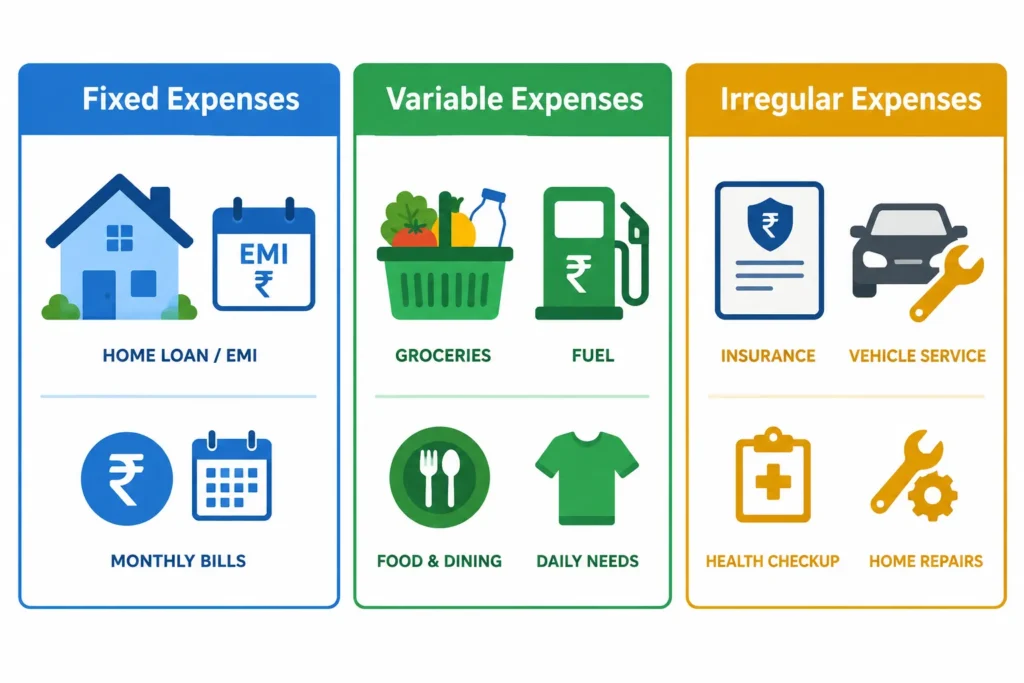
Once you have gathered your records, place each expense into a category. A useful starting method is to separate fixed, variable and irregular expenses.
| Expense type | Meaning | Common Indian examples |
|---|---|---|
| Fixed expenses | Payments that are usually due every month and remain broadly stable | Rent, home loan EMI, personal loan EMI, school transport and regular domestic help |
| Variable expenses | Regular expenses whose amount can change from month to month | Groceries, electricity, fuel, public transport, mobile usage, medicines and eating out |
| Irregular expenses | Costs that do not occur every month but can still be expected | Insurance premiums, school fees, festivals, vehicle servicing, annual subscriptions and home repairs |
Fixed does not always mean permanent. Your rent may increase when the agreement is renewed, and a loan EMI will eventually end. The term simply means that the payment is relatively predictable within the current budgeting period.
Variable expenses are not automatically unnecessary. Groceries, electricity and transport are essential for most households, even though the amounts change. At the same time, some variable spending can be adjusted if the budget is tight, such as restaurant meals, online shopping or entertainment.
Irregular expenses are often missed because they are not due every month. However, they are not always unexpected. A vehicle may require servicing twice a year, an insurance premium may be annual, and festival spending may rise around Diwali, Eid, Christmas, Onam or family celebrations.
Estimate the yearly cost of a predictable irregular expense and divide it by 12. For example, if an annual insurance premium is ₹12,000, you can reserve ₹1,000 each month. This helps prevent the full payment from disrupting one month’s budget.
Consider the 50/30/20 Rule as an Optional Starting Point
The 50/30/20 rule is a popular budgeting framework. It broadly suggests using 50% of income for needs, 30% for wants and 20% for savings and debt-related priorities.
These percentages are not a legal or financial requirement. They are only a reference point. A household in Mumbai or Bengaluru with high rent may spend more than 50% on essential needs. A person supporting parents or paying school fees may have less room for wants. Someone with a lower housing cost may be able to save more than 20%.
Use any framework as a guide, not as a reason to feel that your budget has failed. The right allocation is one that covers essential costs, keeps debt manageable and supports your goals without relying on unrealistic assumptions.
At this stage, focus on accurate numbers rather than ideal percentages. Once you know your take-home income and have classified your actual expenses, you will have the foundation needed to build a practical monthly budget.
Step-by-Step Process to Create a Realistic Monthly Budget
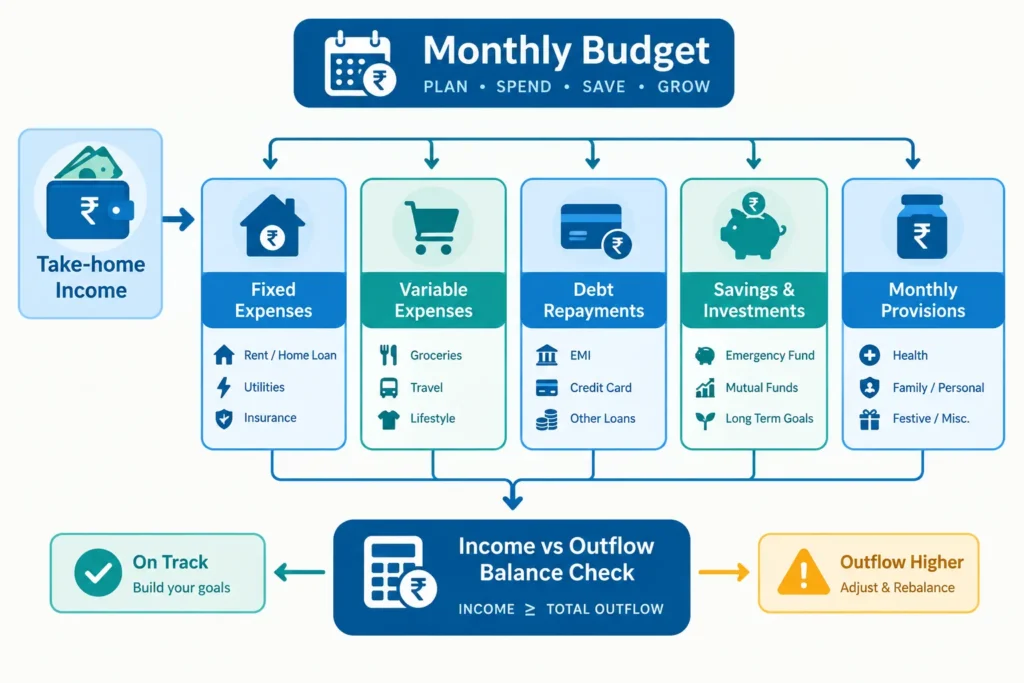
Learning how to create a monthly budget starts with understanding where your money comes from and where it needs to go. A useful budget is not based on ideal behaviour. It should reflect your actual income, regular commitments and recent spending habits.
Use the following steps to build a budget that is practical for an Indian household.
1. Calculate Your Reliable Take-Home Income
Begin with the money that actually reaches your bank account each month. For a salaried person, this is the amount received after deductions such as provident fund contributions, professional tax and tax deducted at source.
Do not use your cost to company, or CTC, as monthly income. CTC may include employer contributions, insurance, gratuity and performance-linked benefits that are not available for regular spending.
Your reliable monthly income may include:
- Salary credited to your bank account
- Regular pension income
- Stable rental income after expected property expenses
- Consistent income from freelance or business work
- Regular financial support received by the household
Avoid counting an uncertain bonus, sales incentive, investment gain or occasional freelance payment as regular income. If your earnings change every month, use a conservative estimate based on recent lower-income months. Extra income can be allocated separately when it is actually received.
2. List All Fixed Monthly Expenses
Fixed expenses are payments that remain the same or change very little from one month to another. They are usually easier to identify because they have a due date or a regular automatic payment.
Common fixed expenses in India include:
- House rent or home loan EMI
- Maintenance charges
- School or college fees paid monthly
- Insurance premiums paid monthly
- Internet and mobile plans
- Domestic help salary
- Subscriptions and memberships
Check your bank statements, UPI history and credit card statements so that you do not miss small recurring payments. A subscription of a few hundred rupees may appear minor, but it still needs a place in the budget.
3. Estimate Variable Expenses From Recent Spending
Variable expenses change from month to month. Groceries, electricity, transport, medicines, eating out and personal purchases are common examples.
Do not choose an unrealistically low amount simply because you want the budget to look balanced. Review the last two or three months of transactions and estimate a reasonable monthly amount for each category. Consider seasonal changes too. For example, an electricity bill may rise during summer because of air-conditioner or cooler use.
Separate essential variable expenses from discretionary ones. Groceries, basic medicines and travel to work are generally essential. Restaurant meals, entertainment and non-urgent shopping are more flexible. This distinction becomes important if you later need to reduce the total.
4. Account for All Debt Repayments
Include every required debt payment as a separate budget item. This may cover a home loan, vehicle loan, education loan, personal loan, consumer durable EMI or credit card repayment.
For credit cards, budgeting only for the minimum amount due can allow expensive outstanding debt to continue. Record the amount you realistically intend to repay, while ensuring that at least the required payment is made by the due date.
Keep debt repayments separate from ordinary shopping expenses. This makes it easier to see how much of your present income is paying for past purchases or borrowings.
5. Set Practical Amounts for Savings and Investments
Savings should be included in the budget rather than treated as whatever remains at the end of the month. However, the amount must be realistic. A very ambitious target that forces you to borrow for normal expenses is not useful.
You can divide this category by purpose, such as:
- Emergency fund contributions
- Short-term savings for planned purchases
- Recurring deposits or other deposits
- Mutual fund SIPs
- Voluntary retirement investments
Some long-term contributions may already be deducted from your salary, such as an employee provident fund contribution. Since you are starting with take-home income, do not subtract the same deduction again. You may still record it separately for your own tracking, but it should not be counted twice in monthly outflows.
6. Convert Annual and Irregular Costs Into Monthly Provisions
Many budgets fail because they include routine monthly bills but ignore predictable costs that arise only once or twice a year. These expenses are not true emergencies if you know they are likely to occur.
Examples include annual insurance premiums, school-related costs, vehicle servicing, property tax, festival spending, medical check-ups and family travel. Estimate the yearly amount and divide it by 12. Set aside that monthly provision in a separate bank account or clearly marked budget category.
For example, if you expect a vehicle insurance premium of ₹12,000, a monthly provision of ₹1,000 prepares you for the payment. The actual bill will still be annual, but its cost is spread across the budget.
7. Compare Total Outflows With Income
Add fixed expenses, variable expenses, debt repayments, savings, investments and provisions. Then compare the total with reliable take-home income.
| Calculation | Meaning |
|---|---|
| Income minus total outflows is positive | The budget has a surplus that can be assigned to a goal or kept as a buffer. |
| Income minus total outflows is zero | Every rupee has a purpose, but there may be little room for unexpected variation. |
| Income minus total outflows is negative | The planned spending and allocations exceed available income and must be adjusted. |
A small budget buffer can be helpful because utility bills, groceries and transport costs rarely remain exactly the same every month. A positive balance should still be assigned deliberately rather than disappearing through untracked spending.
8. Adjust the Categories Until the Budget Works
If expenses exceed income, do not solve the gap by entering figures that are unlikely to work in real life. Start by protecting basic needs and compulsory payments.
A practical order of priority is:
- Essential housing, food, utilities, transport and healthcare
- Minimum required debt repayments and unavoidable obligations
- Essential insurance and necessary family commitments
- Realistic savings and investment contributions
- Flexible lifestyle spending and non-urgent purchases
Review discretionary categories first, such as frequent dining out, entertainment or optional shopping. Next, examine whether a savings target is temporarily too aggressive. Reducing a contribution for a limited period may be more realistic than using a credit card to pay for groceries. However, repeatedly removing all savings without addressing a continuing deficit can leave the household exposed.
If the gap remains after flexible spending is adjusted, look at larger commitments. This could mean reconsidering a costly subscription, postponing a non-essential purchase or reviewing an unaffordable EMI commitment. Major decisions should be made carefully, particularly where cancellation charges, loan terms or family needs are involved.
Illustrative Monthly Budget for an Indian Household
The following budget is only an example to demonstrate the process. It is not a recommendation or a suggested spending ratio. Actual amounts will depend on the city, household size, income, debt and personal responsibilities.
| Category | Example monthly amount |
|---|---|
| Household take-home income | ₹80,000 |
| Rent and maintenance | ₹22,000 |
| Groceries and household supplies | ₹10,000 |
| Electricity, gas, mobile and internet | ₹4,500 |
| Transport | ₹5,500 |
| School and child-related expenses | ₹6,000 |
| Healthcare and medicines | ₹2,000 |
| Loan EMI | ₹7,000 |
| Emergency fund contribution | ₹4,000 |
| Long-term investments | ₹7,000 |
| Provision for annual and irregular costs | ₹4,000 |
| Eating out, entertainment and personal spending | ₹5,000 |
| Total planned outflows | ₹77,000 |
| Monthly buffer | ₹3,000 |
In this example, planned outflows are lower than income, leaving a ₹3,000 buffer. If actual expenses stay within the planned amounts, the household can later move some or all of that buffer towards an emergency fund, debt repayment or another financial goal.
Your first budget does not need to be perfect. Track actual spending during the month, compare it with the planned amounts and revise inaccurate categories for the next month. A realistic budget improves through regular adjustment, not through strict figures that ignore everyday life.
Tracking, Reviewing and Improving the Budget
Creating a budget is only the first step. To make it useful, you need to track what you actually spend, review the results and adjust the next month’s plan.
You do not need a complicated system. The best tracking method is one that you can follow regularly without feeling overwhelmed.
Choose a Simple Way to Track Spending
You can use any one of the following methods:
- Notebook: Write down each expense under categories such as groceries, transport, bills and entertainment.
- Spreadsheet: Use separate columns for the date, expense, category, payment method and amount.
- Budgeting app: Record expenses manually or use an app that helps organise transactions into categories.
- Bank and card statements: Review statements to identify transfers, purchases, subscriptions and charges.
- UPI history: Check payment histories in the UPI apps you use. This is especially helpful for small daily purchases.
- Category-based accounts: Keep money for bills, daily spending and savings in separate bank accounts or wallets.
Beginners should avoid using too many methods at once. For example, you could record cash expenses in a notebook and review digital payments through bank, card and UPI statements once a week.
Try to update your records every day or every few days. Waiting until the end of the month makes it easier to forget small expenses.
Record Cash Expenses Carefully
Cash spending can be difficult to track because it does not automatically appear in a digital statement. Record the expense when you make it, not merely when you withdraw cash.
For example, withdrawing ₹2,000 from an ATM is not automatically a ₹2,000 expense. If you later spend ₹800 on vegetables, ₹400 on transport and ₹300 at a pharmacy, record those individual expenses. The remaining ₹500 is still available.
If recording every small purchase feels difficult, keep a separate cash envelope for a category such as local travel or household items. At the end of the week, count the amount left and record the difference as spending in that category.
Avoid Double-Counting Card Purchases
A common mistake is to count both a credit card purchase and the later card bill payment as separate expenses.
Suppose you buy groceries worth ₹3,000 using a credit card in April. Record ₹3,000 as an April grocery expense. When you pay the credit card bill in May, treat the payment as settlement of the earlier purchase, not as a new expense.
The same principle applies to prepaid wallets. Adding ₹1,000 to a wallet is usually a transfer between your own accounts. Record the actual purchases made from the wallet unless the wallet top-up itself represents the final spending.
Transfers to your own savings, investment or bill-payment account should also be labelled clearly. Otherwise, they may be mistaken for household expenses.
Budgeting with Variable Income
If your income changes every month, build the budget using a conservative baseline. This is particularly useful for freelancers, commission-based employees, small business owners and people with seasonal income.
Review several months of income and choose an amount that you can reasonably expect in a weaker month. Use that baseline for essential expenses and important financial commitments. Do not build necessary expenses around your best month’s income.
When income is higher than the baseline, decide in advance how to use the extra amount. You could allocate it towards upcoming annual bills, debt repayment, savings or irregular business and household costs.
If income falls below the baseline, reduce flexible categories first. Dining out, shopping, subscriptions and optional travel are generally easier to adjust than rent, school fees or insurance premiums.
Plan for Irregular Expenses with Sinking Funds
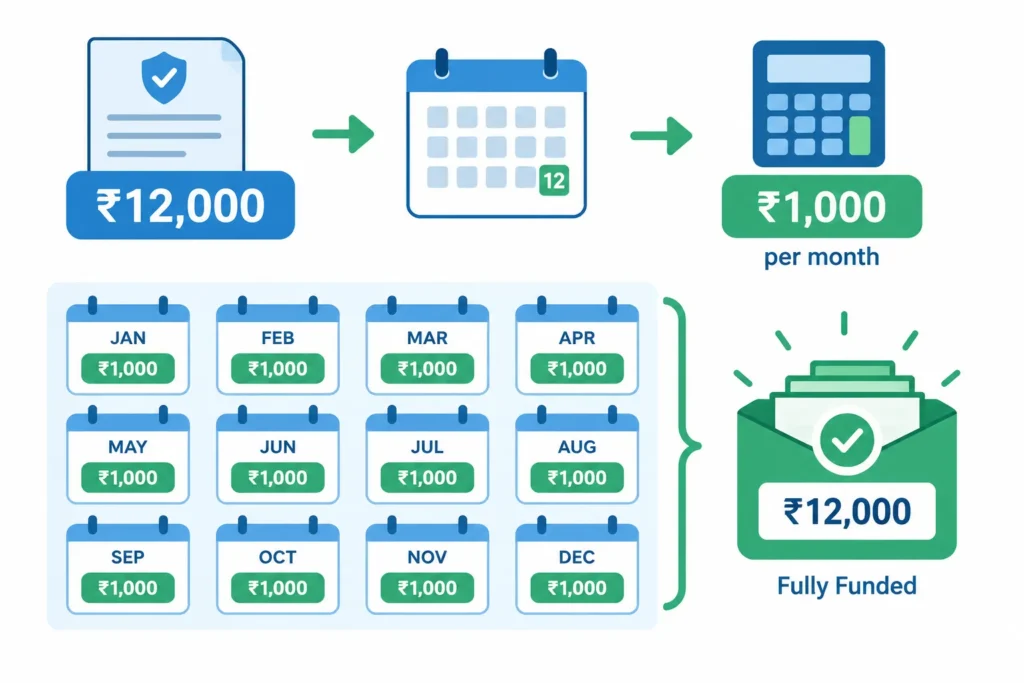
Some expenses do not occur every month, but they are still predictable. Examples include annual insurance premiums, school-related payments, vehicle servicing, festival spending, professional fees and appliance maintenance.
A sinking fund helps you set aside a small amount every month for such costs. It is different from treating an expected bill as an unexpected emergency.
For example, if a ₹12,000 insurance premium is due after 12 months, you can provision ₹1,000 each month. When the premium becomes due, the money is already available.
Create sinking funds only for meaningful obligations. Too many small funds can make the budget difficult to manage. You can combine similar costs under broad headings such as annual bills, vehicle expenses or festivals and gifts.
Keep a note of the target amount, due date, monthly provision and current balance. The money may be held in a separate bank account or tracked as a reserved amount within your main account.
Follow a Practical Month-End Review
Set aside 20 to 30 minutes near the end of every month. Review the budget before preparing the next one.
- Confirm total income: Check salary, freelance receipts, pension, rent or other income actually received.
- Compare budgeted and actual spending: Review each category rather than looking only at the total.
- Find major differences: Identify where spending was higher or lower than planned.
- Check the reason: Decide whether overspending resulted from an avoidable purchase, a price increase or an unrealistic estimate.
- Review pending obligations: Include upcoming rent, loan EMIs, school fees, insurance premiums, medical appointments or travel commitments.
- Check provisions: Confirm that amounts reserved for irregular expenses are still available.
- Adjust next month: Increase underestimated categories and reduce lower-priority spending where necessary.
Do not treat every overspent category as a failure. If your grocery budget was ₹6,000 but actual spending was ₹7,000 for several months, the original estimate may be too low. A realistic budget is more useful than an artificially strict one.
Also look at categories that are consistently underused. The unused amount can be redirected towards another genuine need, a future obligation or a financial goal.
Beginner Budgeting Mistakes to Avoid
- Using ideal numbers instead of real numbers: Start with recent bills and transaction history.
- Ignoring small UPI payments: Tea, snacks, delivery charges and short rides can add up.
- Forgetting annual expenses: Make monthly provisions for predictable non-monthly bills.
- Double-counting credit card spending: Record either the purchases by category or the bill as spending, not both.
- Making the budget too restrictive: Allow a reasonable amount for personal and social spending.
- Depending on uncertain income: Do not commit expected bonuses or freelance payments before receiving them.
- Failing to review: A budget that is never compared with actual spending cannot improve.
- Changing everything after one unusual month: Check whether the expense was temporary before permanently revising the plan.
Frequently Asked Questions
How often should I prepare and review my budget?
Prepare a budget before each month begins. Track expenses during the month and conduct a complete review at month-end. A brief weekly check can help you spot overspending early.
How do I budget when my income fluctuates?
Use a conservative monthly income baseline based on what you can reasonably expect during a weaker month. Cover essential expenses first. Allocate income above the baseline towards upcoming obligations, savings, debt repayment or other priorities.
What should I do if I overspend in one category?
Check whether the overspending was avoidable or whether the category was underestimated. If possible, reduce another flexible category in the same month. Then use the information to set a more realistic amount for the next month.
How should couples or families manage a joint household budget?
Agree on household income, shared bills, individual responsibilities and common goals. Decide which expenses will be paid jointly and which will remain personal. Both partners should be able to view important bills and understand the monthly plan.
Is the 50/30/20 rule compulsory?
No. It is only a general budgeting framework. Your allocation may differ because of rent, family responsibilities, debt, location or income level. Use categories and percentages that reflect your actual situation.
Summary
Learning how to create a monthly budget is an ongoing process, not a one-time calculation. Choose a simple tracking method, record cash and digital expenses correctly, and avoid double-counting card payments. Use a conservative baseline for variable income and create monthly provisions for predictable irregular costs.
At the end of each month, compare the plan with actual results and adjust future amounts. Start with realistic numbers rather than a perfect-looking budget. With regular review and small improvements, your budget can become a practical tool for making informed financial decisions.



Comments