Cryptocurrency vs Digital Currency: Key Differences Explained

A beginner-friendly guide to the differences between cryptocurrency, electronic bank money, UPI and India’s Digital Rupee, with practical Indian examples.

Cryptocurrency vs Digital Currency: Key Differences Explained

Cryptocurrency vs digital currency

Digital currency is a broad term for value that exists or is used in digital form. It can include money recorded in bank accounts, a sovereign digital currency issued by a central bank, and private digital assets.

Cryptocurrency is one category of digital asset. It usually relies on cryptography and a distributed ledger such as blockchain to record and verify transactions. Bitcoin is the best-known example.

The main difference in cryptocurrency vs digital currency is therefore simple: all cryptocurrencies are digital, but not every form of digital money is cryptocurrency. Your bank balance is digital, but it is not Bitcoin. A UPI payment is digital, but UPI itself is neither money nor cryptocurrency.

Introduction

People often use the terms digital currency, electronic money, cryptocurrency, Bitcoin and UPI as if they mean the same thing. They do not.

The confusion is understandable. You cannot physically hold any of them during an online transaction. Whether you pay a shop through UPI, transfer money by net banking or send a cryptoasset from one wallet to another, the activity happens through a phone or computer.

However, the systems behind these transactions can be very different. The value may be issued by the government, recorded by a bank, created under the rules of a private crypto network, or represented through another digital arrangement. Different systems also have different rules for storage, verification, transfers and dispute resolution.

Understanding these distinctions is an important first step before reading the main Cryptocurrency in India: A Complete Beginner’s Guide to Crypto. It also makes concepts in a Bitcoin explainer or blockchain guide easier to follow.

Understanding digital currency, cryptocurrency and electronic money
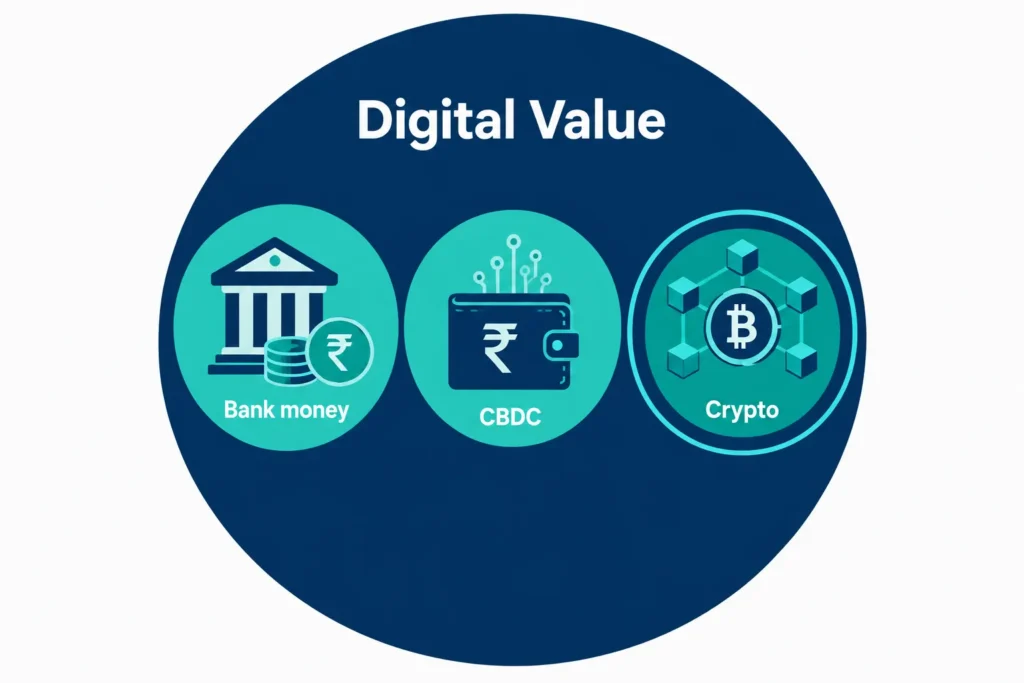
Diagram showing cryptocurrency as one category within the broader digital currency umbrella.

What is digital currency?

Digital currency is an umbrella term rather than the name of one specific product. In ordinary use, it can describe value that is stored, transferred or represented electronically.

This broad category may cover:

  • Rupee balances recorded in bank accounts.
  • Sovereign digital currency issued by a central bank.
  • Private crypto assets such as Bitcoin.
  • Other electronically stored forms of monetary value, depending on the legal and technical context.

These forms of digital value should not be treated as identical. They can differ in who issues them, what they represent, how transactions are confirmed and whether they are accepted as money.

For example, a balance of ₹10,000 in an Indian bank account is a rupee-denominated claim recorded electronically. One Bitcoin is a crypto asset governed by the rules of the Bitcoin network. Both can appear on a screen, but their legal status, price behavior and operating systems are not the same.

What is cryptocurrency?

Cryptocurrency is a type of privately created digital asset that generally uses cryptography to secure its records and transactions. Many cryptocurrencies use blockchain or another form of distributed ledger.

Bitcoin is the most familiar example. Instead of relying on one bank to maintain the complete transaction ledger, the Bitcoin network uses a distributed system in which participants follow shared rules to validate and record transactions. Our separate Bitcoin explainer discusses this model in greater detail.

Cryptocurrencies are not all designed in the same way. Some aim to support peer-to-peer transfers. Some provide access to a blockchain-based service. Others try to maintain a value linked to another asset. Their governance, supply rules, transaction methods and risks can vary widely.

It is also incorrect to assume that every cryptocurrency is fully anonymous. Many public blockchains maintain transaction records that anyone can inspect. The addresses may not directly display a person’s name, but transactions can sometimes be connected to an identity through exchanges, payment records or other information.

Cryptocurrency is not universally accepted either. A person may be able to buy or sell a cryptoasset through a platform, but that does not mean every shop, employer or government office will accept it as payment. Acceptance depends on the asset, the parties involved and applicable rules.

You May Also Like:Stablecoins Explained: Types, Uses and Risks for Indian Beginners

What is traditional electronic money?

Most money used digitally in India is ordinary rupee-denominated bank money. When your banking app shows a balance of ₹25,000, the app is displaying an electronic record maintained through the banking system.

Suppose you pay ₹500 to a local grocery shop using a debit card. Your bank balance falls, and the merchant receives funds through the relevant banking and payment arrangements. No new currency is created merely because the payment happened electronically.

The same basic point applies when you use net banking or a mobile banking app. The technology helps communicate and process the payment instruction. The underlying amount is still denominated in Indian rupees.

This is different from buying a crypto asset. If you use ₹5,000 from your bank account to purchase a crypto asset, rupee money leaves your bank account through the payment system, while the purchased crypto asset is recorded separately through the relevant platform, wallet or network.

UPI is a payment system, not a currency
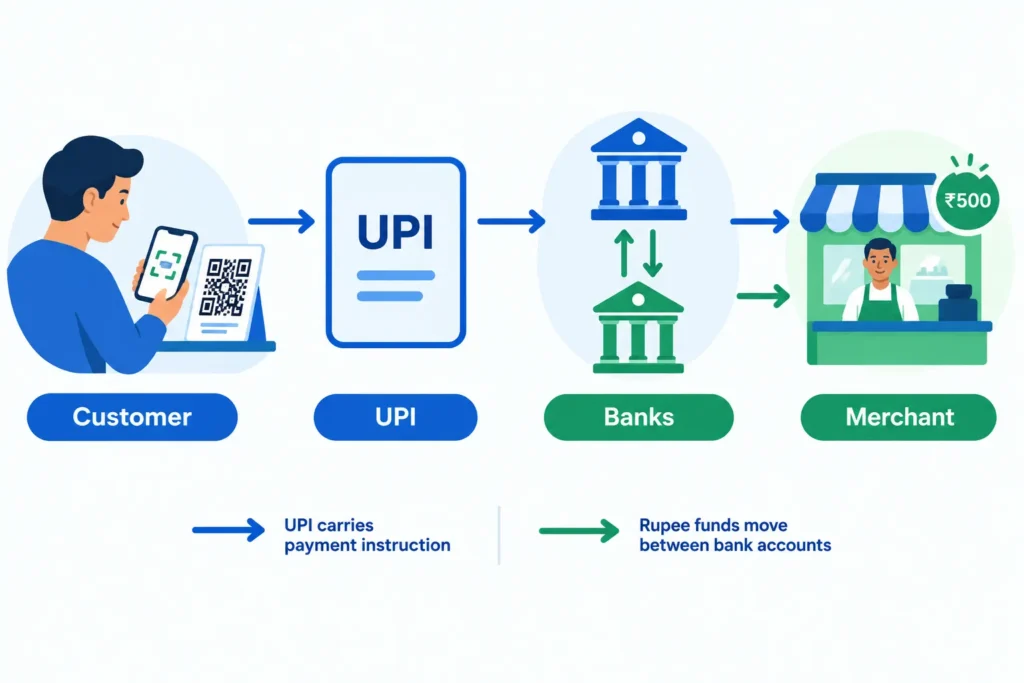
Flowchart showing UPI carrying payment instructions between a customer’s and merchant’s bank accounts.

UPI stands for Unified Payments Interface. It helps users send and receive money between supported accounts through participating apps and financial institutions.

UPI does not replace the rupee and does not create a separate “UPI currency”. It is a payment system that carries instructions for moving money. The amount being transferred is normally a rupee balance held within the regulated banking framework.

For example, when Meera sends ₹800 to Arjun through a UPI app, the app helps initiate the transaction. The relevant banks and payment infrastructure process the transfer. Meera has not sent a cryptocurrency, even though the entire experience took place digitally.

It is therefore useful to separate three ideas:

  • Currency: the unit in which value is expressed, such as the Indian rupee.
  • Payment system: the infrastructure used to transfer money, such as UPI.
  • Payment app: the interface a customer uses to give payment instructions.

How storage and transfers differ

Digital value can be stored and transferred in different ways depending on the system.

Feature Bank-account money Cryptocurrency
Unit of value Usually sovereign currency such as the rupee A particular crypto asset, such as Bitcoin
Record maintained through Banks and regulated financial infrastructure The asset’s network, ledger and related service providers
Typical access Bank account, card, net banking or UPI-enabled app Crypto wallet, exchange account or another supported service
Transfer verification Financial institutions and payment systems Network rules, validators or miners, depending on the design
Common use Saving, receiving income and making rupee payments Holding, transferring, trading or using a supported blockchain service

A bank usually acts as an intermediary for money in your account. It maintains records, applies account controls and processes eligible instructions through financial networks.

With cryptocurrency, control may depend on private cryptographic keys. A user who holds the relevant keys in a self-custody wallet may be able to authorise transfers without asking a bank to initiate them. However, many beginners use a crypto exchange or custodial wallet, which introduces a private intermediary that controls or manages access on the user’s behalf.

Cryptocurrency should therefore not automatically be described as “without intermediaries”. The underlying network may be decentralized, while the service used to buy, store or transfer the asset may be centralized.

Not every digital currency uses blockchain

Blockchain is one method of keeping a shared, ordered record of transactions. It is important to many cryptocurrencies, but it is not required for every digital payment or every form of digital value.

Banks can maintain electronic account records using conventional databases and centralized systems. Card payments and UPI transfers do not become blockchain transactions simply because they are fast, cashless or completed through a smartphone.

Even sovereign digital currency can be designed in different ways. The fact that a currency is issued digitally does not, by itself, tell you that it uses a public blockchain like Bitcoin. A fuller blockchain guide can help beginners understand the difference between a blockchain network and an ordinary digital database.

Centralized and decentralized systems

A centralized system places significant control or record-keeping responsibility with a central organisation, such as a bank, company or public authority. A decentralized system distributes certain functions across multiple participants operating under shared technical rules.

Private crypto assets and sovereign currency are also different concepts. A private crypto asset is created and operated outside the sovereign currency-issuing process. Sovereign currency is issued under the authority of a country’s monetary system, whether people use it as cash or through digital channels.

Neither “centralized” nor “decentralized” automatically means better, safer or more suitable. A centralized system may offer clear account support and defined controls, while also requiring users to trust the institution. A decentralized network may reduce dependence on one record keeper, while placing more responsibility on users and exposing them to technical, price and operational risks.

The practical question is not whether a system sounds modern. It is who issues the value, who keeps the records, how transfers are approved, what rights the user has and what can happen if something goes wrong.

Digital Rupee, UPI, bank deposits and cryptocurrency compared
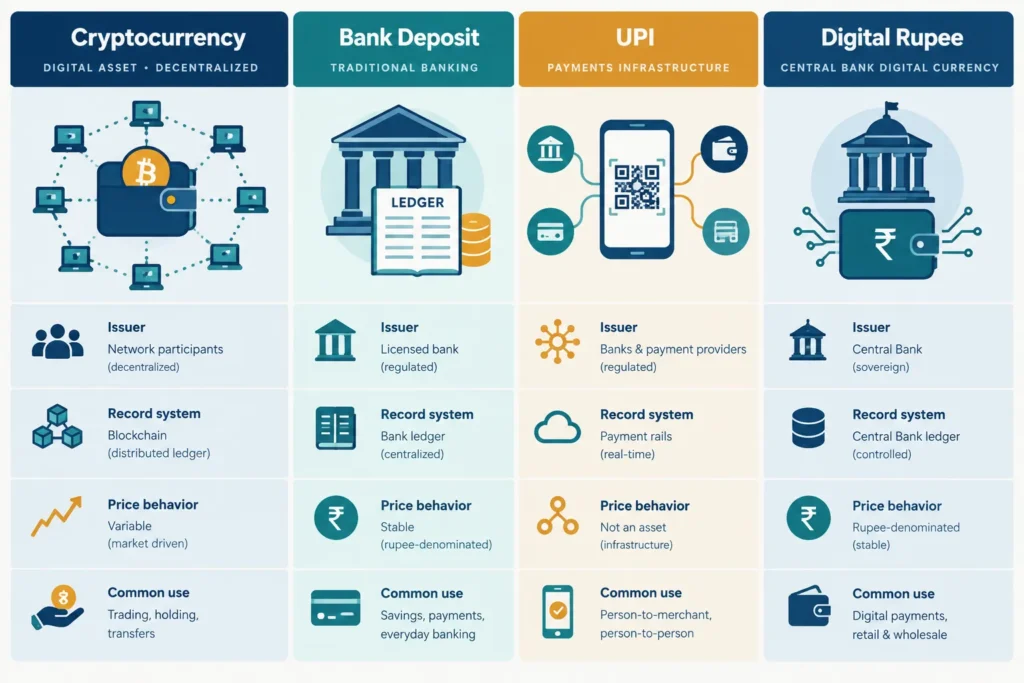
Visual comparison of cryptocurrency, bank deposits, UPI and the RBI-issued Digital Rupee.

The difference between cryptocurrency and digital currency becomes clearer when we compare four things Indians may use electronically: cryptocurrency, money in a bank account, UPI and the Digital Rupee.

They may all appear as numbers on a screen, but they do not represent the same kind of money. Their issuers, payment systems, legal status and risks are different.

You May Also Like:Bitcoin Explained: How It Works, Its Uses and Risks for Beginners

What is a central bank digital currency?

A central bank digital currency, or CBDC, is a digital form of sovereign currency issued by a country’s central bank. In India, the CBDC is called the Digital Rupee, e₹ or e-rupee. It is issued by the Reserve Bank of India.

The RBI describes the Digital Rupee as legal tender in digital form. One e₹ has the same face value as one physical rupee. It is not designed to rise or fall in price like Bitcoin or other traded crypto assets.

Sovereign backing is important. An e₹ is a direct liability of the RBI, just as physical currency is central bank money. Bitcoin is not issued, backed or guaranteed by the RBI or the Government of India.

India’s CBDC remains an evolving initiative rather than a universal replacement for cash, bank accounts or UPI. The RBI is developing it through two broad pilot categories:

  • Retail Digital Rupee, or e₹-R: Intended for individuals and businesses making retail payments.
  • Wholesale Digital Rupee, or e₹-W: Intended mainly for eligible financial institutions and selected wholesale settlement use cases.

The wholesale pilot began in November 2022, followed by the retail pilot in December 2022. The RBI has since tested additional features and use cases. Access, participating institutions, wallet functions and availability can change as the pilots develop.

For retail users, access is generally provided through supported CBDC wallet applications offered by participating institutions. Availability is not necessarily identical across every bank, app, merchant or customer. Users should check the latest information in their bank’s official app and the RBI’s current CBDC material.

Why the Digital Rupee is not a bank deposit

Money shown in a savings account is electronic bank money. It represents a claim on the commercial bank where the account is maintained.

For example, if your account shows a balance of ₹10,000, the bank owes you that amount under the account’s terms. The balance is denominated in Indian rupees, but it is a commercial bank liability.

An e₹ balance is different because the underlying digital currency is issued by the RBI. A Digital Rupee wallet is designed to hold central bank money in digital form.

Another practical difference is interest. A normal savings account may earn interest according to the bank’s rules. The RBI states that the Digital Rupee does not earn interest, similar to cash held in a physical wallet.

This distinction does not automatically make an e₹ wallet a better place for savings. It is primarily a payment instrument. A bank account continues to provide services such as deposits, withdrawals, statements, interest where applicable and access to other banking products.

Why UPI is not a separate currency

UPI stands for Unified Payments Interface. It is a payment system, not a currency.

When you pay a shop through UPI, the UPI system sends payment instructions between participating accounts and institutions. In a typical transaction, rupee funds move from your bank account to the merchant’s bank account.

The money is still Indian rupee bank money. UPI provides the payment route. It does not create a new type of rupee and does not issue a separate “UPI currency”.

The National Payments Corporation of India operates UPI under the Indian payment-system framework. The RBI regulates payment systems in India. A UPI app may provide the interface, but the app itself is not necessarily the issuer of the money in your linked bank account.

Cryptocurrency vs digital currency: side-by-side comparison

Feature Cryptocurrency Electronic bank money UPI Digital Rupee
Issuer Varies. Bitcoin has no central issuer; other crypto assets may be created by private organisations, foundations or protocols. Commercial banks maintain customer deposits denominated in rupees. UPI does not issue currency. It is a payment infrastructure operated by NPCI. Issued by the Reserve Bank of India.
Backing Generally not backed or guaranteed by the RBI. Value depends on the asset’s design and market demand. A claim on the account holder’s commercial bank, subject to banking rules. Usually moves money held in linked bank accounts or other supported payment arrangements. A direct liability of the RBI and sovereign central bank money.
Price stability Prices can be highly volatile. Some tokens aim for stability, but their risks and backing differ. Maintains its rupee denomination, such as ₹1 remaining ₹1 in the account. Transfers rupee amounts and does not have an independent market price. Has the same face value as the Indian rupee.
Infrastructure Usually blockchain or another distributed-ledger network, along with wallets and exchanges. Core banking systems and regulated payment networks. Interoperable payment infrastructure connecting participating apps, banks and accounts. RBI-authorised CBDC infrastructure and supported e₹ wallets.
Control Depends on the crypto asset. A network may be decentralised, while an exchange, token or wallet service may be centrally controlled. The bank controls the account under applicable laws, regulations and account terms. Payments operate under system rules, bank controls and regulatory requirements. Issued and governed within the RBI’s CBDC framework.
Indian legal-tender status Bitcoin and other private crypto assets are not legal tender in India. The balance is a bank liability denominated in legal Indian currency, rather than central bank currency itself. UPI is a payment method, not legal tender or a currency. Yes. The RBI describes e₹ as legal tender in digital form.
Common uses Trading, investment, token transfers and uses supported by particular networks. Saving, receiving salary, paying bills and transferring money. Everyday merchant payments and person-to-person bank transfers. Retail payments where supported; wholesale settlement in designated pilot use cases.
Major risks Price volatility, fraud, wallet-key loss, exchange failure, cyber risk and regulatory uncertainty. Fraud, account compromise, service disruption and bank-related risks, subject to regulatory safeguards. Scams, incorrect transfers, phishing, fake payment requests and temporary technical failures. Wallet fraud, device loss, privacy concerns, mistaken transfers and limited acceptance during the pilot stage.
You May Also Like:What Is Blockchain Technology? How It Works and Its Real-World Uses

How the transaction path changes

Consider a ₹500 purchase at a local shop. The customer and merchant may see a quick scan-and-pay experience in each case, but the transaction path is different.

Paying through UPI: You scan the merchant’s UPI QR code and approve ₹500. The payment instruction travels through the UPI system. Funds are debited from your linked bank account and credited through the participating banking arrangement to the merchant.

Paying with the Digital Rupee: Where the facility is supported, you use an e₹ wallet and scan an eligible QR code. Digital Rupee value moves under the CBDC arrangement. The payment uses RBI-issued digital currency rather than simply sending a normal bank-account transfer through UPI.

Some CBDC features may be designed to work with existing payment acceptance infrastructure, including supported QR arrangements. However, interoperability and functionality depend on the current pilot, participating institution and wallet.

Transferring Bitcoin: You enter or scan the recipient’s Bitcoin wallet address and authorise the transfer with your wallet. The transaction is broadcast to the Bitcoin network and recorded according to that network’s rules. Its value in rupees can change before or after the transfer, and an incorrect wallet transfer may be difficult or impossible to reverse.

These paths explain the central point in the cryptocurrency vs digital currency comparison: being digital does not make two assets equivalent. UPI moves money, bank deposits represent claims on commercial banks, the Digital Rupee is RBI-issued sovereign currency, and cryptocurrency operates under the rules of its private or decentralised network.

Official basis for the Digital Rupee explanation

The descriptions above are based on the Reserve Bank of India’s Concept Note on Central Bank Digital Currency, its official Digital Rupee frequently asked questions, pilot announcements and subsequent RBI publications on CBDC development. The explanation of UPI is based on official RBI and National Payments Corporation of India material. Readers should check the latest RBI information before using an e₹ service because pilot access, participating institutions, transaction features and use cases can change.

Uses, Risks, Privacy and Common Questions

The practical differences between cryptocurrency and digital currency become clearer when we look at how people use them. Both can move value electronically, but they rely on different organisations, technologies and rules.

Common uses of digital currency

Digital currency is commonly used for everyday payments and transfers. The money shown in a bank account is a familiar example of money represented digitally. People can use it to pay bills, receive salaries, shop online or send money through banking and payment services.

In India, a customer may use a banking app or UPI-enabled app to instruct a bank to transfer rupees. Banks, payment service providers and regulated payment systems help process the transaction. The rupee remains the underlying currency.

The Digital Rupee, also called the e₹, is different from an ordinary bank deposit. It is a central bank digital currency issued by the Reserve Bank of India. Depending on the available programme and wallet features, it may be used to make or receive payments in digital form.

Official digital currencies can be useful for:

  • Making payments in the currency recognised by the country.
  • Transferring value electronically.
  • Receiving refunds, salaries or other payments.
  • Reducing the need to handle physical cash in some situations.
  • Supporting new payment features where the issuer and payment system permit them.

However, official backing does not remove every risk. A user can still send money to the wrong person, fall for a fraud, lose access to a device or disclose a password or one-time password. Banks, wallet operators and payment providers can also face outages, technical failures and cybersecurity incidents.

Common uses of cryptocurrency

Cryptocurrencies can be used to transfer crypto assets between compatible wallets. Some people also use them within blockchain-based applications or to pay for certain products and services where they are accepted.

Acceptance remains limited compared with rupee payments. A shop may accept cash, cards or UPI but not Bitcoin or another cryptocurrency. Even where a merchant accepts crypto, the payment process may involve price conversion, network fees or a third-party service.

A distributed network generally verifies and records cryptocurrency transfers instead of a single bank maintaining the main transaction record. Cryptocurrency exchanges may help users buy, sell or store crypto, but an exchange is not the same as the underlying network.

The main participants can include:

  • Banks: Hold customer deposits and provide payment and transfer services in official currency.
  • Payment providers: Offer apps or infrastructure that helps customers initiate and receive digital payments.
  • Digital wallet providers: Provide software or services for holding and using eligible digital money or payment credentials.
  • Cryptocurrency exchanges: Allow customers to trade or hold supported crypto assets, subject to the exchange’s services and applicable requirements.
  • Crypto wallet providers: Provide tools for managing the keys used to access crypto assets.
  • Distributed networks: Validate and record transactions according to the relevant cryptocurrency protocol.

Important cryptocurrency risks

Cryptocurrency involves risks that may not be familiar to a beginner. Understanding these risks is important even if a person only wants to learn how the technology works.

  • Price volatility: Crypto prices can rise or fall sharply within a short period. The amount paid for an asset may be very different from the amount received when it is sold or spent.
  • Private-key risk: A private key or recovery phrase can control access to a crypto wallet. If it is lost, there may be no central help desk that can restore access. If another person obtains it, that person may be able to move the assets.
  • Scams: Fake trading platforms, impersonation schemes, fraudulent tokens and promises of fixed or unusually high returns are common warning signs.
  • Exchange and custody risk: An exchange or custodian can face hacking, withdrawal restrictions, insolvency, operational problems or regulatory action. Assets held through a service depend partly on that service’s controls and terms.
  • Transaction mistakes: Transfers may be difficult or impossible to reverse. Sending assets to an incorrect address or incompatible network can cause permanent loss.
  • Network fees: Users may have to pay fees to process a transaction. Fees can vary according to the network and demand at that time.
  • Limited acceptance: Many businesses do not accept cryptocurrency for payments. Converting it into rupees may require an exchange or another service.
  • Technology risk: Software bugs, malicious applications, compromised devices and weaknesses in smart contracts can affect users.

These risks are separate from market performance. A cryptocurrency can lose value even when its network is operating normally. A user can also lose assets through a scam or security mistake even when the market price is rising.

Privacy, traceability and security

Cryptocurrency should not automatically be described as anonymous. On many public blockchains, transactions and wallet addresses can be viewed by anyone. The record may not show a person’s name directly, but transactions can sometimes be connected to an identity through exchange records, payment information or blockchain analysis.

Privacy differs between cryptocurrencies. It can also depend on the wallet, exchange, network and transaction method. Some services conduct identity checks and keep customer records. Others may provide different levels of information to participants or authorities where legally required.

Bank and official digital currency transactions are usually recorded within systems operated or supervised by authorised institutions. Access to transaction information depends on the system design, the provider’s practices and applicable law. A Digital Rupee wallet should not be assumed to offer either complete anonymity or complete public visibility.

Security also works differently across systems. Banks and payment providers may offer account recovery, fraud reporting and customer support, although recovery is not guaranteed in every case. With a self-custody crypto wallet, the user may carry most of the responsibility for protecting the private key and checking every transaction.

Basic precautions include using official apps, checking recipient details, enabling available security controls and never sharing passwords, PINs, one-time passwords or crypto recovery phrases. Unexpected messages asking for urgent payment or remote access to a device should be treated with caution.

You May Also Like:Crypto Wallets in India: Types, How They Work and How to Choose One

The legal, tax and reporting treatment of crypto assets in India can change. Tax rules may apply to transactions involving virtual digital assets, while exchanges and service providers may have compliance obligations. A tax rule does not by itself mean that a crypto asset has become official currency or legal tender.

For more context, readers can consult RegularStation’s crypto tax guide, crypto exchange guide and cryptocurrency risk guide. Before acting, check the latest information from the RBI, the Income Tax Department and other relevant official authorities. Do not rely on an old article, social media post or exchange advertisement as the final statement of current rules.

Frequently Asked Questions

What is the difference between cryptocurrency and digital currency?

Digital currency is a broad term for value represented and transferred electronically. It can include money held digitally in bank accounts and central bank digital currencies. Cryptocurrency is a type of digital asset that generally uses cryptography and a distributed network to record transactions. It is usually not issued by a central bank.

Is UPI a digital currency?

No. UPI is a payment system, not a separate currency. It helps users transfer Indian rupees between eligible accounts through participating banks and payment apps. The currency being transferred remains the rupee.

What is the Digital Rupee?

The Digital Rupee, or e₹, is India’s central bank digital currency issued by the RBI. It is a digital form of the rupee. Its availability, wallet access, payment features and programme design may develop over time.

Is Bitcoin issued by the RBI?

No. Bitcoin is not issued, guaranteed or controlled by the RBI. It operates through a distributed network under its protocol. It should not be confused with the Digital Rupee or money held in an Indian bank account.

Do digital currencies always use blockchain?

No. Digital currencies and electronic payment systems can use centralised databases or other forms of technology. Some central bank digital currency designs may use distributed ledger technology, while others may not. Blockchain is therefore not a requirement for all digital currency.

Summary

In the cryptocurrency vs digital currency comparison, the main differences involve the issuer, transaction system, legal status, price behaviour and responsibility for security. Official digital money is connected to a recognised national currency and usually operates through banks, central banks or authorised payment providers. Cryptocurrency generally operates through distributed networks and can carry substantial price, custody, scam and technology risks.

Neither system is free from fraud, operational failures or cybersecurity threats. Privacy and traceability also vary, so it is inaccurate to assume that every cryptocurrency is anonymous or that every official digital payment works in exactly the same way. Check current RBI and other official guidance because Digital Rupee features, access arrangements and crypto-related rules may change.


Share this article
KEEP READING

Related Articles

View all →

Comments

Leave a Comment

Cryptocurrency vs Digital Currency: Key Differences Explained

Cryptocurrency vs digital currency

Digital currency is a broad term for value that exists or is used in digital form. It can include money recorded in bank accounts, a sovereign digital currency issued by a central bank, and private digital assets.

Cryptocurrency is one category of digital asset. It usually relies on cryptography and a distributed ledger such as blockchain to record and verify transactions. Bitcoin is the best-known example.

The main difference in cryptocurrency vs digital currency is therefore simple: all cryptocurrencies are digital, but not every form of digital money is cryptocurrency. Your bank balance is digital, but it is not Bitcoin. A UPI payment is digital, but UPI itself is neither money nor cryptocurrency.

Introduction

People often use the terms digital currency, electronic money, cryptocurrency, Bitcoin and UPI as if they mean the same thing. They do not.

The confusion is understandable. You cannot physically hold any of them during an online transaction. Whether you pay a shop through UPI, transfer money by net banking or send a cryptoasset from one wallet to another, the activity happens through a phone or computer.

However, the systems behind these transactions can be very different. The value may be issued by the government, recorded by a bank, created under the rules of a private crypto network, or represented through another digital arrangement. Different systems also have different rules for storage, verification, transfers and dispute resolution.

Understanding these distinctions is an important first step before reading the main Cryptocurrency in India: A Complete Beginner’s Guide to Crypto. It also makes concepts in a Bitcoin explainer or blockchain guide easier to follow.

Understanding digital currency, cryptocurrency and electronic money

Diagram showing cryptocurrency as one category within the broader digital currency umbrella.

What is digital currency?

Digital currency is an umbrella term rather than the name of one specific product. In ordinary use, it can describe value that is stored, transferred or represented electronically.

This broad category may cover:

  • Rupee balances recorded in bank accounts.
  • Sovereign digital currency issued by a central bank.
  • Private crypto assets such as Bitcoin.
  • Other electronically stored forms of monetary value, depending on the legal and technical context.

These forms of digital value should not be treated as identical. They can differ in who issues them, what they represent, how transactions are confirmed and whether they are accepted as money.

For example, a balance of ₹10,000 in an Indian bank account is a rupee-denominated claim recorded electronically. One Bitcoin is a crypto asset governed by the rules of the Bitcoin network. Both can appear on a screen, but their legal status, price behavior and operating systems are not the same.

What is cryptocurrency?

Cryptocurrency is a type of privately created digital asset that generally uses cryptography to secure its records and transactions. Many cryptocurrencies use blockchain or another form of distributed ledger.

Bitcoin is the most familiar example. Instead of relying on one bank to maintain the complete transaction ledger, the Bitcoin network uses a distributed system in which participants follow shared rules to validate and record transactions. Our separate Bitcoin explainer discusses this model in greater detail.

Cryptocurrencies are not all designed in the same way. Some aim to support peer-to-peer transfers. Some provide access to a blockchain-based service. Others try to maintain a value linked to another asset. Their governance, supply rules, transaction methods and risks can vary widely.

It is also incorrect to assume that every cryptocurrency is fully anonymous. Many public blockchains maintain transaction records that anyone can inspect. The addresses may not directly display a person’s name, but transactions can sometimes be connected to an identity through exchanges, payment records or other information.

Cryptocurrency is not universally accepted either. A person may be able to buy or sell a cryptoasset through a platform, but that does not mean every shop, employer or government office will accept it as payment. Acceptance depends on the asset, the parties involved and applicable rules.

What is traditional electronic money?

Most money used digitally in India is ordinary rupee-denominated bank money. When your banking app shows a balance of ₹25,000, the app is displaying an electronic record maintained through the banking system.

Suppose you pay ₹500 to a local grocery shop using a debit card. Your bank balance falls, and the merchant receives funds through the relevant banking and payment arrangements. No new currency is created merely because the payment happened electronically.

The same basic point applies when you use net banking or a mobile banking app. The technology helps communicate and process the payment instruction. The underlying amount is still denominated in Indian rupees.

This is different from buying a crypto asset. If you use ₹5,000 from your bank account to purchase a crypto asset, rupee money leaves your bank account through the payment system, while the purchased crypto asset is recorded separately through the relevant platform, wallet or network.

UPI is a payment system, not a currency

Flowchart showing UPI carrying payment instructions between a customer’s and merchant’s bank accounts.

UPI stands for Unified Payments Interface. It helps users send and receive money between supported accounts through participating apps and financial institutions.

UPI does not replace the rupee and does not create a separate “UPI currency”. It is a payment system that carries instructions for moving money. The amount being transferred is normally a rupee balance held within the regulated banking framework.

For example, when Meera sends ₹800 to Arjun through a UPI app, the app helps initiate the transaction. The relevant banks and payment infrastructure process the transfer. Meera has not sent a cryptocurrency, even though the entire experience took place digitally.

It is therefore useful to separate three ideas:

  • Currency: the unit in which value is expressed, such as the Indian rupee.
  • Payment system: the infrastructure used to transfer money, such as UPI.
  • Payment app: the interface a customer uses to give payment instructions.

How storage and transfers differ

Digital value can be stored and transferred in different ways depending on the system.

Feature Bank-account money Cryptocurrency
Unit of value Usually sovereign currency such as the rupee A particular crypto asset, such as Bitcoin
Record maintained through Banks and regulated financial infrastructure The asset’s network, ledger and related service providers
Typical access Bank account, card, net banking or UPI-enabled app Crypto wallet, exchange account or another supported service
Transfer verification Financial institutions and payment systems Network rules, validators or miners, depending on the design
Common use Saving, receiving income and making rupee payments Holding, transferring, trading or using a supported blockchain service

A bank usually acts as an intermediary for money in your account. It maintains records, applies account controls and processes eligible instructions through financial networks.

With cryptocurrency, control may depend on private cryptographic keys. A user who holds the relevant keys in a self-custody wallet may be able to authorise transfers without asking a bank to initiate them. However, many beginners use a crypto exchange or custodial wallet, which introduces a private intermediary that controls or manages access on the user’s behalf.

Cryptocurrency should therefore not automatically be described as “without intermediaries”. The underlying network may be decentralized, while the service used to buy, store or transfer the asset may be centralized.

Not every digital currency uses blockchain

Blockchain is one method of keeping a shared, ordered record of transactions. It is important to many cryptocurrencies, but it is not required for every digital payment or every form of digital value.

Banks can maintain electronic account records using conventional databases and centralized systems. Card payments and UPI transfers do not become blockchain transactions simply because they are fast, cashless or completed through a smartphone.

Even sovereign digital currency can be designed in different ways. The fact that a currency is issued digitally does not, by itself, tell you that it uses a public blockchain like Bitcoin. A fuller blockchain guide can help beginners understand the difference between a blockchain network and an ordinary digital database.

Centralized and decentralized systems

A centralized system places significant control or record-keeping responsibility with a central organisation, such as a bank, company or public authority. A decentralized system distributes certain functions across multiple participants operating under shared technical rules.

Private crypto assets and sovereign currency are also different concepts. A private crypto asset is created and operated outside the sovereign currency-issuing process. Sovereign currency is issued under the authority of a country’s monetary system, whether people use it as cash or through digital channels.

Neither “centralized” nor “decentralized” automatically means better, safer or more suitable. A centralized system may offer clear account support and defined controls, while also requiring users to trust the institution. A decentralized network may reduce dependence on one record keeper, while placing more responsibility on users and exposing them to technical, price and operational risks.

The practical question is not whether a system sounds modern. It is who issues the value, who keeps the records, how transfers are approved, what rights the user has and what can happen if something goes wrong.

Digital Rupee, UPI, bank deposits and cryptocurrency compared

Visual comparison of cryptocurrency, bank deposits, UPI and the RBI-issued Digital Rupee.

The difference between cryptocurrency and digital currency becomes clearer when we compare four things Indians may use electronically: cryptocurrency, money in a bank account, UPI and the Digital Rupee.

They may all appear as numbers on a screen, but they do not represent the same kind of money. Their issuers, payment systems, legal status and risks are different.

What is a central bank digital currency?

A central bank digital currency, or CBDC, is a digital form of sovereign currency issued by a country’s central bank. In India, the CBDC is called the Digital Rupee, e₹ or e-rupee. It is issued by the Reserve Bank of India.

The RBI describes the Digital Rupee as legal tender in digital form. One e₹ has the same face value as one physical rupee. It is not designed to rise or fall in price like Bitcoin or other traded crypto assets.

Sovereign backing is important. An e₹ is a direct liability of the RBI, just as physical currency is central bank money. Bitcoin is not issued, backed or guaranteed by the RBI or the Government of India.

India’s CBDC remains an evolving initiative rather than a universal replacement for cash, bank accounts or UPI. The RBI is developing it through two broad pilot categories:

  • Retail Digital Rupee, or e₹-R: Intended for individuals and businesses making retail payments.
  • Wholesale Digital Rupee, or e₹-W: Intended mainly for eligible financial institutions and selected wholesale settlement use cases.

The wholesale pilot began in November 2022, followed by the retail pilot in December 2022. The RBI has since tested additional features and use cases. Access, participating institutions, wallet functions and availability can change as the pilots develop.

For retail users, access is generally provided through supported CBDC wallet applications offered by participating institutions. Availability is not necessarily identical across every bank, app, merchant or customer. Users should check the latest information in their bank’s official app and the RBI’s current CBDC material.

Why the Digital Rupee is not a bank deposit

Money shown in a savings account is electronic bank money. It represents a claim on the commercial bank where the account is maintained.

For example, if your account shows a balance of ₹10,000, the bank owes you that amount under the account’s terms. The balance is denominated in Indian rupees, but it is a commercial bank liability.

An e₹ balance is different because the underlying digital currency is issued by the RBI. A Digital Rupee wallet is designed to hold central bank money in digital form.

Another practical difference is interest. A normal savings account may earn interest according to the bank’s rules. The RBI states that the Digital Rupee does not earn interest, similar to cash held in a physical wallet.

This distinction does not automatically make an e₹ wallet a better place for savings. It is primarily a payment instrument. A bank account continues to provide services such as deposits, withdrawals, statements, interest where applicable and access to other banking products.

Why UPI is not a separate currency

UPI stands for Unified Payments Interface. It is a payment system, not a currency.

When you pay a shop through UPI, the UPI system sends payment instructions between participating accounts and institutions. In a typical transaction, rupee funds move from your bank account to the merchant’s bank account.

The money is still Indian rupee bank money. UPI provides the payment route. It does not create a new type of rupee and does not issue a separate “UPI currency”.

The National Payments Corporation of India operates UPI under the Indian payment-system framework. The RBI regulates payment systems in India. A UPI app may provide the interface, but the app itself is not necessarily the issuer of the money in your linked bank account.

Cryptocurrency vs digital currency: side-by-side comparison

Feature Cryptocurrency Electronic bank money UPI Digital Rupee
Issuer Varies. Bitcoin has no central issuer; other crypto assets may be created by private organisations, foundations or protocols. Commercial banks maintain customer deposits denominated in rupees. UPI does not issue currency. It is a payment infrastructure operated by NPCI. Issued by the Reserve Bank of India.
Backing Generally not backed or guaranteed by the RBI. Value depends on the asset’s design and market demand. A claim on the account holder’s commercial bank, subject to banking rules. Usually moves money held in linked bank accounts or other supported payment arrangements. A direct liability of the RBI and sovereign central bank money.
Price stability Prices can be highly volatile. Some tokens aim for stability, but their risks and backing differ. Maintains its rupee denomination, such as ₹1 remaining ₹1 in the account. Transfers rupee amounts and does not have an independent market price. Has the same face value as the Indian rupee.
Infrastructure Usually blockchain or another distributed-ledger network, along with wallets and exchanges. Core banking systems and regulated payment networks. Interoperable payment infrastructure connecting participating apps, banks and accounts. RBI-authorised CBDC infrastructure and supported e₹ wallets.
Control Depends on the crypto asset. A network may be decentralised, while an exchange, token or wallet service may be centrally controlled. The bank controls the account under applicable laws, regulations and account terms. Payments operate under system rules, bank controls and regulatory requirements. Issued and governed within the RBI’s CBDC framework.
Indian legal-tender status Bitcoin and other private crypto assets are not legal tender in India. The balance is a bank liability denominated in legal Indian currency, rather than central bank currency itself. UPI is a payment method, not legal tender or a currency. Yes. The RBI describes e₹ as legal tender in digital form.
Common uses Trading, investment, token transfers and uses supported by particular networks. Saving, receiving salary, paying bills and transferring money. Everyday merchant payments and person-to-person bank transfers. Retail payments where supported; wholesale settlement in designated pilot use cases.
Major risks Price volatility, fraud, wallet-key loss, exchange failure, cyber risk and regulatory uncertainty. Fraud, account compromise, service disruption and bank-related risks, subject to regulatory safeguards. Scams, incorrect transfers, phishing, fake payment requests and temporary technical failures. Wallet fraud, device loss, privacy concerns, mistaken transfers and limited acceptance during the pilot stage.

How the transaction path changes

Consider a ₹500 purchase at a local shop. The customer and merchant may see a quick scan-and-pay experience in each case, but the transaction path is different.

Paying through UPI: You scan the merchant’s UPI QR code and approve ₹500. The payment instruction travels through the UPI system. Funds are debited from your linked bank account and credited through the participating banking arrangement to the merchant.

Paying with the Digital Rupee: Where the facility is supported, you use an e₹ wallet and scan an eligible QR code. Digital Rupee value moves under the CBDC arrangement. The payment uses RBI-issued digital currency rather than simply sending a normal bank-account transfer through UPI.

Some CBDC features may be designed to work with existing payment acceptance infrastructure, including supported QR arrangements. However, interoperability and functionality depend on the current pilot, participating institution and wallet.

Transferring Bitcoin: You enter or scan the recipient’s Bitcoin wallet address and authorise the transfer with your wallet. The transaction is broadcast to the Bitcoin network and recorded according to that network’s rules. Its value in rupees can change before or after the transfer, and an incorrect wallet transfer may be difficult or impossible to reverse.

These paths explain the central point in the cryptocurrency vs digital currency comparison: being digital does not make two assets equivalent. UPI moves money, bank deposits represent claims on commercial banks, the Digital Rupee is RBI-issued sovereign currency, and cryptocurrency operates under the rules of its private or decentralised network.

Official basis for the Digital Rupee explanation

The descriptions above are based on the Reserve Bank of India’s Concept Note on Central Bank Digital Currency, its official Digital Rupee frequently asked questions, pilot announcements and subsequent RBI publications on CBDC development. The explanation of UPI is based on official RBI and National Payments Corporation of India material. Readers should check the latest RBI information before using an e₹ service because pilot access, participating institutions, transaction features and use cases can change.

Uses, Risks, Privacy and Common Questions

The practical differences between cryptocurrency and digital currency become clearer when we look at how people use them. Both can move value electronically, but they rely on different organisations, technologies and rules.

Common uses of digital currency

Digital currency is commonly used for everyday payments and transfers. The money shown in a bank account is a familiar example of money represented digitally. People can use it to pay bills, receive salaries, shop online or send money through banking and payment services.

In India, a customer may use a banking app or UPI-enabled app to instruct a bank to transfer rupees. Banks, payment service providers and regulated payment systems help process the transaction. The rupee remains the underlying currency.

The Digital Rupee, also called the e₹, is different from an ordinary bank deposit. It is a central bank digital currency issued by the Reserve Bank of India. Depending on the available programme and wallet features, it may be used to make or receive payments in digital form.

Official digital currencies can be useful for:

  • Making payments in the currency recognised by the country.
  • Transferring value electronically.
  • Receiving refunds, salaries or other payments.
  • Reducing the need to handle physical cash in some situations.
  • Supporting new payment features where the issuer and payment system permit them.

However, official backing does not remove every risk. A user can still send money to the wrong person, fall for a fraud, lose access to a device or disclose a password or one-time password. Banks, wallet operators and payment providers can also face outages, technical failures and cybersecurity incidents.

Common uses of cryptocurrency

Cryptocurrencies can be used to transfer crypto assets between compatible wallets. Some people also use them within blockchain-based applications or to pay for certain products and services where they are accepted.

Acceptance remains limited compared with rupee payments. A shop may accept cash, cards or UPI but not Bitcoin or another cryptocurrency. Even where a merchant accepts crypto, the payment process may involve price conversion, network fees or a third-party service.

A distributed network generally verifies and records cryptocurrency transfers instead of a single bank maintaining the main transaction record. Cryptocurrency exchanges may help users buy, sell or store crypto, but an exchange is not the same as the underlying network.

The main participants can include:

  • Banks: Hold customer deposits and provide payment and transfer services in official currency.
  • Payment providers: Offer apps or infrastructure that helps customers initiate and receive digital payments.
  • Digital wallet providers: Provide software or services for holding and using eligible digital money or payment credentials.
  • Cryptocurrency exchanges: Allow customers to trade or hold supported crypto assets, subject to the exchange’s services and applicable requirements.
  • Crypto wallet providers: Provide tools for managing the keys used to access crypto assets.
  • Distributed networks: Validate and record transactions according to the relevant cryptocurrency protocol.

Important cryptocurrency risks

Cryptocurrency involves risks that may not be familiar to a beginner. Understanding these risks is important even if a person only wants to learn how the technology works.

  • Price volatility: Crypto prices can rise or fall sharply within a short period. The amount paid for an asset may be very different from the amount received when it is sold or spent.
  • Private-key risk: A private key or recovery phrase can control access to a crypto wallet. If it is lost, there may be no central help desk that can restore access. If another person obtains it, that person may be able to move the assets.
  • Scams: Fake trading platforms, impersonation schemes, fraudulent tokens and promises of fixed or unusually high returns are common warning signs.
  • Exchange and custody risk: An exchange or custodian can face hacking, withdrawal restrictions, insolvency, operational problems or regulatory action. Assets held through a service depend partly on that service’s controls and terms.
  • Transaction mistakes: Transfers may be difficult or impossible to reverse. Sending assets to an incorrect address or incompatible network can cause permanent loss.
  • Network fees: Users may have to pay fees to process a transaction. Fees can vary according to the network and demand at that time.
  • Limited acceptance: Many businesses do not accept cryptocurrency for payments. Converting it into rupees may require an exchange or another service.
  • Technology risk: Software bugs, malicious applications, compromised devices and weaknesses in smart contracts can affect users.

These risks are separate from market performance. A cryptocurrency can lose value even when its network is operating normally. A user can also lose assets through a scam or security mistake even when the market price is rising.

Privacy, traceability and security

Cryptocurrency should not automatically be described as anonymous. On many public blockchains, transactions and wallet addresses can be viewed by anyone. The record may not show a person’s name directly, but transactions can sometimes be connected to an identity through exchange records, payment information or blockchain analysis.

Privacy differs between cryptocurrencies. It can also depend on the wallet, exchange, network and transaction method. Some services conduct identity checks and keep customer records. Others may provide different levels of information to participants or authorities where legally required.

Bank and official digital currency transactions are usually recorded within systems operated or supervised by authorised institutions. Access to transaction information depends on the system design, the provider’s practices and applicable law. A Digital Rupee wallet should not be assumed to offer either complete anonymity or complete public visibility.

Security also works differently across systems. Banks and payment providers may offer account recovery, fraud reporting and customer support, although recovery is not guaranteed in every case. With a self-custody crypto wallet, the user may carry most of the responsibility for protecting the private key and checking every transaction.

Basic precautions include using official apps, checking recipient details, enabling available security controls and never sharing passwords, PINs, one-time passwords or crypto recovery phrases. Unexpected messages asking for urgent payment or remote access to a device should be treated with caution.

Indian legal and tax context

The legal, tax and reporting treatment of crypto assets in India can change. Tax rules may apply to transactions involving virtual digital assets, while exchanges and service providers may have compliance obligations. A tax rule does not by itself mean that a crypto asset has become official currency or legal tender.

For more context, readers can consult RegularStation’s crypto tax guide, crypto exchange guide and cryptocurrency risk guide. Before acting, check the latest information from the RBI, the Income Tax Department and other relevant official authorities. Do not rely on an old article, social media post or exchange advertisement as the final statement of current rules.

Frequently Asked Questions

What is the difference between cryptocurrency and digital currency?

Digital currency is a broad term for value represented and transferred electronically. It can include money held digitally in bank accounts and central bank digital currencies. Cryptocurrency is a type of digital asset that generally uses cryptography and a distributed network to record transactions. It is usually not issued by a central bank.

Is UPI a digital currency?

No. UPI is a payment system, not a separate currency. It helps users transfer Indian rupees between eligible accounts through participating banks and payment apps. The currency being transferred remains the rupee.

What is the Digital Rupee?

The Digital Rupee, or e₹, is India’s central bank digital currency issued by the RBI. It is a digital form of the rupee. Its availability, wallet access, payment features and programme design may develop over time.

Is Bitcoin issued by the RBI?

No. Bitcoin is not issued, guaranteed or controlled by the RBI. It operates through a distributed network under its protocol. It should not be confused with the Digital Rupee or money held in an Indian bank account.

Do digital currencies always use blockchain?

No. Digital currencies and electronic payment systems can use centralised databases or other forms of technology. Some central bank digital currency designs may use distributed ledger technology, while others may not. Blockchain is therefore not a requirement for all digital currency.

Summary

In the cryptocurrency vs digital currency comparison, the main differences involve the issuer, transaction system, legal status, price behaviour and responsibility for security. Official digital money is connected to a recognised national currency and usually operates through banks, central banks or authorised payment providers. Cryptocurrency generally operates through distributed networks and can carry substantial price, custody, scam and technology risks.

Neither system is free from fraud, operational failures or cybersecurity threats. Privacy and traceability also vary, so it is inaccurate to assume that every cryptocurrency is anonymous or that every official digital payment works in exactly the same way. Check current RBI and other official guidance because Digital Rupee features, access arrangements and crypto-related rules may change.
Leave a Comment