Stablecoins Explained: Types, Uses and Risks for Indian Beginners

A beginner-friendly guide to how stablecoins aim to track a reference value, how different stability mechanisms work, where these tokens are used and what risks Indian users should examine.

Stablecoins Explained: Types, Uses and Risks for Indian Beginners

What Are Stablecoins?

Stablecoins are crypto tokens designed to maintain a relatively stable value by tracking another asset or reference value. Most aim to follow a fiat currency, such as the US dollar. For example, a dollar-linked stablecoin may target a price of US$1 per token.

They differ from Bitcoin and Ether because their main purpose is usually price stability rather than price appreciation. However, the word “stable” does not mean risk-free. A stablecoin’s market price can move above or below its target, its reserves may be inadequate, and redemption may be delayed or restricted.

Introduction

Crypto prices can change quickly. Bitcoin or Ether may rise or fall substantially within a short period, making them difficult to use for routine payments, short-term trading balances or transfers where the sender wants a predictable value.

Stablecoins try to address this problem. They combine crypto-style transferability with a value that is intended to remain close to a reference asset. On a crypto exchange, an Indian investor may sell Bitcoin for a dollar-linked stablecoin instead of immediately withdrawing money to a bank account. A person may also receive stablecoins from someone in another country, subject to the platform’s rules and applicable Indian laws.

To understand where stablecoins fit within the wider crypto market, beginners can read Cryptocurrency in India: A Complete Beginner’s Guide to Crypto. It is also important not to confuse stablecoins with ordinary electronic money or a central bank-issued currency. The distinction is covered in Cryptocurrency vs Digital Currency: Key Differences Explained.

1. What Stablecoins Are and How They Seek Stability

A stablecoin is a digital token issued on a blockchain or similar distributed network. Its issuer or protocol aims to keep the token’s value close to a chosen reference. This reference is commonly the US dollar, but a stablecoin could theoretically track another currency, gold, a basket of assets or a different unit of value.

Suppose a stablecoin targets US$1. If the arrangement works as intended, one token should trade near US$1. For an Indian user, its rupee value will still change when the USD-INR exchange rate changes. A dollar-linked stablecoin can therefore remain close to its dollar target while becoming more or less expensive in rupee terms.

Peg, Redemption Value and Market Price Are Different
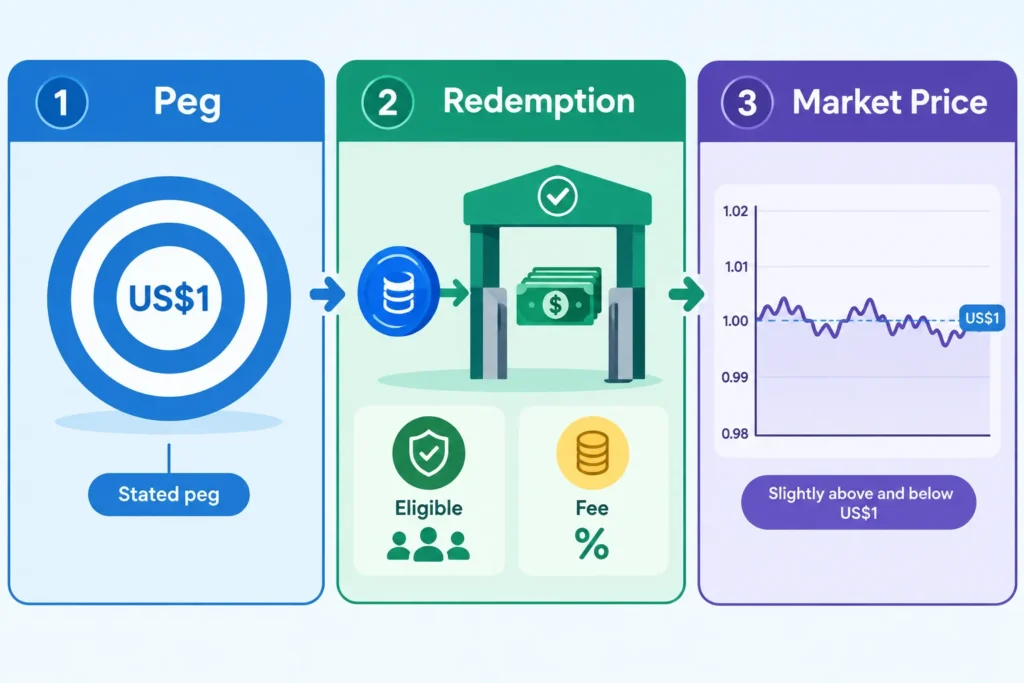
Diagram comparing a stablecoin's stated peg, redemption value and exchange market price.

Three related values help explain how a stablecoin works:

  • Stated peg: This is the value the stablecoin is designed to track, such as US$1.
  • Redemption value: This is the amount an eligible holder may receive by returning the token to the issuer or protocol. Redemption may involve minimum amounts, fees, identity checks, waiting periods or geographic restrictions.
  • Market price: This is the price at which buyers and sellers actually trade the token on an exchange or other market.

These values are not always identical. A token may have a stated peg of US$1 but trade at US$0.98 or US$1.02. It may also be redeemable at US$1 only by approved customers dealing directly with the issuer. A retail user in India might have access only to an exchange’s market price.

An intended peg is therefore a target, not a guarantee. Confidence, liquidity, reserve concerns, exchange problems and sudden demand can all move the actual price away from the target.

Stablecoins Compared With Bitcoin, Ether and Fiat Currency

Bitcoin has a limited issuance framework and no issuer promising to exchange each coin for a fixed amount of rupees or dollars. Its price is mainly determined by market demand and supply. Ether is the native asset of the Ethereum network and is used to pay transaction fees and interact with applications. Its market value also changes freely.

A stablecoin has a different design goal. It usually tries to minimise price movement relative to its reference asset. This can make it useful as a trading unit or temporary store of value within crypto markets, but it also creates extra dependence on reserves, collateral, software rules or an issuing organisation.

Stablecoins are not the same as traditional fiat currency. The Indian rupee is issued by the Reserve Bank of India and is legal tender in India. A private rupee-linked or dollar-linked crypto token is a claim or digital asset governed by its own arrangement; it is not automatically equivalent to money held in a regulated bank account.

You May Also Like:What Is DeFi? Decentralized Finance Explained for Beginners

Centralized and Decentralized Arrangements

Many fiat-backed stablecoins use a centralized structure. A company issues the tokens, controls the reserve accounts and sets the redemption conditions. It may also have technical powers to freeze particular wallet addresses or block transfers where required by its policies or legal obligations.

A simple centralized process may work like this:

  1. An approved customer sends fiat currency to the issuer.
  2. The issuer creates, or “mints,” a corresponding quantity of stablecoins.
  3. The customer receives the tokens and may transfer or trade them.
  4. When the customer redeems the tokens, the issuer destroys, or “burns,” them and returns fiat currency after fees and checks.

In theory, minting and redemption help keep the market price near the peg. If a token trades above US$1, eligible traders may buy it from the issuer at the redemption value and sell it in the market at the higher price. The additional supply can push the price down. If it trades below US$1, traders may buy discounted tokens and redeem them for US$1, reducing supply and helping the price recover.

This mechanism works only when users trust the issuer and redemption remains practical. If withdrawals are suspended or traders doubt the reserves, the price may stay below the peg.

Decentralized stablecoins aim to reduce reliance on a single company. Their rules may operate through blockchain-based smart contracts. Users can lock crypto assets as collateral and mint stablecoins against them. If the collateral value falls too far, the protocol may sell or liquidate it to protect the system.

“Decentralized” is not an all-or-nothing label. A protocol may use decentralized smart contracts while depending on centralized price feeds, governance groups, administrators or fiat-backed tokens as collateral. Users should examine how control actually works rather than relying only on the project’s description.

Main Types of Stablecoins
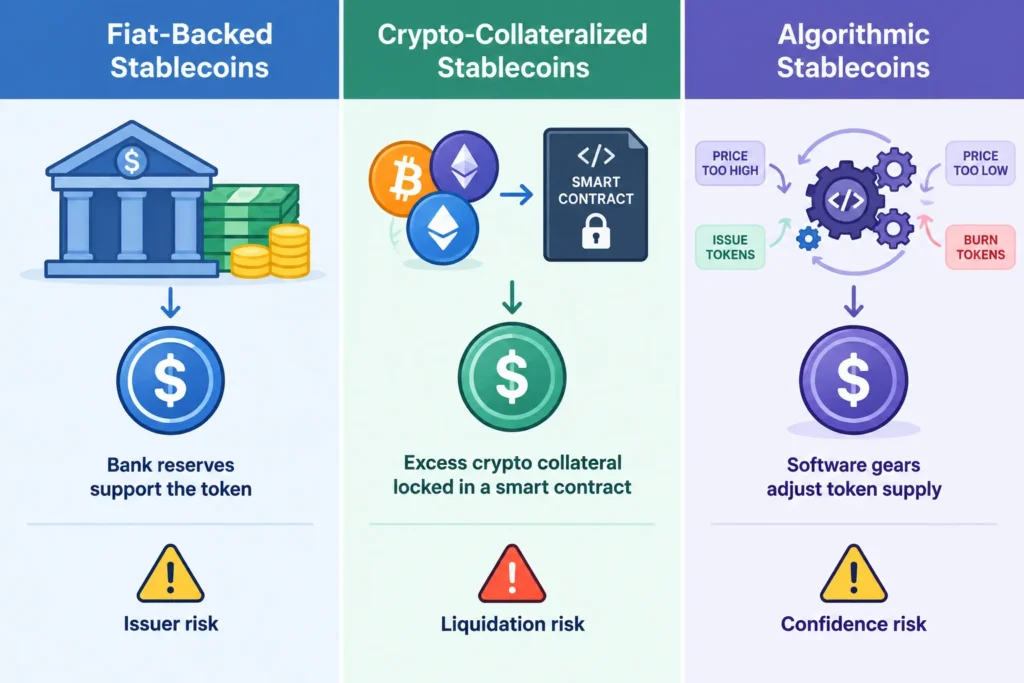
Comparison of fiat-backed, crypto-collateralized and algorithmic stablecoin mechanisms and risks.

Type How stability is attempted Main strengths Important risks
Fiat-backed An issuer holds reserve assets intended to support the tokens in circulation. Users may be able to redeem tokens for fiat currency. Usually simple to understand and may have a direct redemption mechanism. Depends on the issuer, reserve quality, custody, banking access and redemption rules.
Crypto-collateralized Users lock crypto assets in smart contracts and borrow or mint stablecoins against them. The collateral may exceed the stablecoins issued. Can offer greater on-chain transparency and reduce dependence on one traditional issuer. Crypto collateral can fall rapidly, triggering liquidations or leaving a shortfall during market stress.
Algorithmic Software rules, incentives or related tokens attempt to adjust supply and demand to defend the peg. May aim to operate with little or no conventional reserve backing. Confidence can collapse, incentives can stop working, and some designs have experienced severe or permanent de-pegging.

Why Overcollateralization May Be Used

Crypto-collateralized stablecoins often require collateral worth more than the stablecoins created. For example, a protocol might require a user to lock crypto worth considerably more than the amount borrowed. The extra collateral provides a buffer if the crypto price falls.

Overcollateralization reduces some risk but does not remove it. During a sudden market crash, collateral prices may fall faster than the system can sell the assets. Blockchain congestion, faulty price information or smart-contract problems can also interfere with liquidations.

Reserve Quality Matters

A fiat-backed stablecoin is only as reliable as its complete operating arrangement. Reserves may contain cash, bank deposits, government securities, commercial debt or other financial assets. These holdings do not all have the same liquidity or credit risk.

Cash or short-term high-quality instruments may be easier to sell during heavy redemptions than longer-term or riskier assets. The location of reserves, the identity of custodians and whether stablecoin holders have a clear legal claim can also matter if the issuer fails.

Reserve information may be presented through company reports, attestations or audits, but these forms of verification are not identical. A report may cover only a particular date, use a limited scope or rely on information supplied by the issuer. Some stablecoins provide frequent independent checks, while others disclose little. Users should not assume that every token is fully backed simply because its price has usually stayed near the peg.

How a Stablecoin Can Lose Its Peg

A stablecoin may trade below its target when holders rush to sell, doubt the reserves, fear regulatory action or cannot redeem directly. It may trade above the target when demand rises faster than new tokens can be issued, or when access to banking and redemption channels is limited.

Algorithmic models face an additional problem: they often depend heavily on market confidence. A design may encourage users to exchange the stablecoin for another token when the peg weakens. If both tokens lose demand at the same time, token creation can increase without restoring confidence. This can create a downward spiral.

Some algorithmic stablecoin designs have failed because their incentives could not withstand sustained selling. The broader lesson is that code can automate rules, but it cannot guarantee that buyers, liquidity or confidence will always exist. Before treating any stablecoin as digital cash, an investor should understand what supports its value, who can redeem it and what could prevent the peg from recovering.

You May Also Like:Bitcoin Explained: How It Works, Its Uses and Risks for Beginners

2. Common Uses, Networks and Potential Benefits

After understanding what are stablecoins, the next step is to see how people may use them. Stablecoins can act as a relatively steady unit within crypto markets, especially when compared with assets such as Bitcoin or Ether. They are commonly used for trading, transfers, settlement and decentralised finance, or DeFi.

However, a stablecoin is still a cryptoasset. Its value, availability and safety depend on factors such as its design, issuer, reserves, blockchain network and market liquidity. It should not be treated as the same as money held in an insured bank account.

Using Stablecoins for Crypto Trading

Many crypto exchanges offer trading pairs that include stablecoins. A trading pair shows the two assets that can be exchanged. For example, a BTC-stablecoin pair may allow a user to sell Bitcoin and receive a dollar-referenced stablecoin instead of immediately converting the value into Indian rupees.

This can make stablecoins one side of a token swap. Suppose an Indian user holds a cryptoasset that has risen sharply but does not want to buy another volatile token immediately. The user may exchange it for a stablecoin available on the platform. The stablecoin may then be used later to buy another supported cryptoasset.

This does not make the transaction tax-free or remove any reporting responsibility. Selling one cryptoasset for a stablecoin may still have Indian tax implications because one virtual digital asset is being transferred for another. Users should keep records of purchase values, sale values, dates, fees and transaction references, and seek professional tax advice where necessary.

Stablecoin trading also carries market and platform risks. A quoted price may move away from its intended reference value, particularly during periods of stress. A user may also face trading fees, withdrawal charges, low liquidity or restrictions imposed by an exchange.

Transfers Between Compatible Wallets

Stablecoins may be transferred between blockchain wallets. For example, a person could move a dollar-referenced token from a supported exchange wallet to a compatible self-custody wallet. The recipient may see the tokens after the blockchain confirms the transaction.

Such transfers may be useful when two parties already use the same blockchain ecosystem. Stablecoins can also support settlement between crypto market participants because their value may fluctuate less over short periods than many other cryptoassets.

But a wallet transfer does not bypass legal, banking, foreign exchange or tax obligations. The parties must consider the purpose of the payment, applicable Indian laws, platform rules and record-keeping requirements. Cross-border transfers can involve additional regulatory questions and should not be treated casually.

Blockchain transactions are generally difficult or impossible to reverse. If tokens are sent to the wrong wallet address, the sender may not be able to recover them. A sensible approach is to check the address carefully and consider sending a small test amount before making a larger transfer.

Network Compatibility and Transaction Costs

The same stablecoin name or symbol may appear on more than one blockchain network. For instance, a platform may support versions of a token on Ethereum and other networks. These versions are not automatically interchangeable, even if they aim to represent the same reference value.

The sending platform, receiving wallet and selected deposit address must all support the chosen token and network. Selecting the wrong network can result in delayed access, complicated recovery or permanent loss. A wallet displaying a similar address format does not by itself confirm compatibility.

Before sending a stablecoin, check:

  • The full token name and contract details shown by the platform.
  • The blockchain network selected for withdrawal.
  • Whether the receiving wallet supports that exact network and token.
  • The receiving address, including every character.
  • Any minimum deposit or withdrawal requirement.
  • The expected network fee and platform withdrawal fee.

A stablecoin transfer is not necessarily free. The blockchain may charge a network fee to process and confirm it. This fee is sometimes called a gas fee. It can vary according to network demand, transaction complexity and the blockchain being used.

Some exchanges charge a separate withdrawal fee. In other cases, a wallet transaction may require the network’s native token to pay for confirmation. For example, holding a token in a wallet may not be enough if the wallet has no native coin available for gas. Users should review the total cost before approving a transaction, especially for small transfers where fees may form a large part of the amount.

Stablecoins in Decentralised Finance

Stablecoins have an important role in decentralised finance applications. DeFi applications use blockchain-based software and smart contracts to provide functions such as token swaps, lending and liquidity provision. The broader concepts and risks are covered in What Is DeFi? Decentralized Finance Explained for Beginners.

In a decentralised exchange, a user may swap one token for a stablecoin through a smart contract. The exchange rate can depend on the assets available in a liquidity pool, the size of the transaction and current market activity. Users may also pay a network fee and experience slippage, which means receiving a different final rate from the initial quote.

A liquidity pool contains tokens supplied by participants so that other users can make swaps. A common pool may contain a stablecoin and another cryptoasset. In return for supplying assets, liquidity providers may receive a share of certain transaction fees or other incentives.

This activity is not risk-free income. A liquidity provider can lose money if token prices change, a stablecoin loses its reference value, or a smart contract is exploited. The application’s rules may also make withdrawals difficult during stressed market conditions. High advertised yields can reflect high risk rather than a dependable return.

Some DeFi lending applications allow users to deposit stablecoins for potential interest or borrow stablecoins against crypto collateral. Borrowers may need to provide collateral worth more than the loan. If the collateral value falls below the application’s required level, it may be sold automatically through liquidation.

DeFi users also face smart contract, governance, wallet and interface risks. A coding flaw, malicious approval or compromised private key can lead to losses. Unlike a conventional bank deposit, there may be no customer support desk or guaranteed recovery process.

You May Also Like:Smart Contracts Explained: How They Work, Uses and Risks

Access Through Exchanges and Custodial Services

Centralised crypto exchanges may allow users to buy, sell, hold or withdraw selected stablecoins. Availability can differ by platform, and an exchange may suspend deposits, withdrawals or trading for operational, compliance or liquidity reasons.

When stablecoins are kept on an exchange, the platform usually controls the private keys. This is known as custodial access. It can be convenient for beginners, but it creates counterparty risk because the user depends on the platform’s security, solvency and withdrawal systems.

Users should check whether an exchange clearly identifies the supported token and network, explains its fees, provides transaction records and applies suitable security controls. Platform selection is discussed in more detail in Crypto Exchanges in India: How They Work and How to Choose One.

A self-custody wallet gives the user control over the private keys, but it also places responsibility on the user. Losing a recovery phrase, approving a malicious contract or sending funds through the wrong network can result in permanent loss. Convenience should therefore be weighed against custody and operational risk.

Potential Benefit: Lower Short-Term Volatility

A major potential benefit of stablecoins is reduced short-term price volatility relative to highly volatile cryptoassets. If a stablecoin successfully tracks its reference asset, its market price may move within a narrower range than Bitcoin or many smaller tokens. This can make pricing, trading and settlement easier within crypto markets.

Reduced volatility does not mean no risk. A stablecoin can trade above or below its intended value. Its issuer may face reserve, banking or regulatory problems. Redemption may be restricted, delayed or unavailable to some users. Market liquidity may also disappear when many holders try to sell at the same time.

Users should therefore distinguish between a token’s target value and its actual market value. Stability, liquidity and redemption are not guaranteed. Before using a stablecoin, consider how it maintains its reference value, who controls it, what supports it, where it can be traded, which network it uses and what could happen during a market crisis.

3. Risks, India Considerations, Precautions and FAQ

Stablecoins may look simple because their price aims to remain linked to an asset such as the US dollar. However, price stability is a target, not a promise. Before buying or receiving one, understand who issues it, what supports it and how you can redeem it.

Main risks of stablecoins

Reserve quality: A reserve-backed stablecoin is only as dependable as the assets supporting it. Cash and short-term government securities may behave differently from corporate debt, crypto assets or loans. Reserves can also lose value or become difficult to sell during market stress.

Issuer solvency: Even if reserves exist, the issuing company can face operational losses, lawsuits, fraud, banking problems or insolvency. Token holders may not have first claim over reserve assets if the issuer fails.

Redemption restrictions: Direct redemption may be available only to approved customers or above a minimum amount. It can involve identity checks, waiting periods and fees. An issuer may also suspend redemption under its terms or because of legal and banking restrictions.

Depegging and liquidity pressure: A stablecoin can trade above or below its target price. This may happen when traders lose confidence, exchanges have limited liquidity or many holders try to sell at once. A token targeting one US dollar is not guaranteed to trade at exactly one dollar at every moment.

Custody and platform failure: If you hold stablecoins through an exchange, lending service or wallet provider, you depend on that intermediary. The platform may be hacked, freeze withdrawals, become insolvent or misuse customer assets. Your account balance does not necessarily mean that specific tokens are held separately for you.

Smart-contract bugs: Stablecoins issued on blockchains depend on software. A coding flaw, compromised administrator key or faulty upgrade can lead to stolen, frozen or incorrectly created tokens.

Oracle failures: Some crypto-collateralised and algorithmic stablecoins use price feeds called oracles. If an oracle reports an incorrect or manipulated price, the system may trigger improper liquidations or issue too many tokens.

Governance weaknesses: Control may rest with a company, a small group of key holders or token voters. They may change collateral rules, fees, software or emergency powers. Decentralised governance can also suffer from low participation and concentrated voting power.

Network risk: The same stablecoin may exist on several blockchains. Each version can have different transaction fees, confirmation times and security assumptions. Sending a token through an unsupported network can result in a difficult or permanent loss.

Regulatory change: Governments may introduce new rules for issuers, exchanges, transfers, reserves or customer verification. A service available today may later restrict Indian users or particular transactions.

Counterparty risk is not removed by a stable price

A stablecoin can maintain its peg while the service holding it fails. For example, an exchange may show a balance of 10,000 units in your account, but withdrawals could stop if the exchange faces a cyberattack or financial crisis.

Lending platforms add another layer of risk. They may lend deposited stablecoins to traders or institutions. If borrowers default and the platform has insufficient protection, depositors can lose money. A high advertised yield usually means that credit, liquidity, leverage or smart-contract risk is being taken somewhere.

Stablecoins are not government-guaranteed. They are not the same as insured bank deposits, and holding one does not create the same relationship that you have with a regulated bank account. Terms such as “cash equivalent” or “digital dollar” should not be treated as proof of safety.

Stablecoins and India’s Digital Rupee are different

India’s Digital Rupee, also called the e₹, is central bank digital currency issued by the Reserve Bank of India. It represents central bank money in digital form. It is not a privately issued stablecoin and does not depend on a private company’s reserve promise.

Point Private stablecoin Digital Rupee
Issuer A private entity or blockchain-based system Reserve Bank of India
Value mechanism Attempts to track an asset through reserves, collateral or software Digital form of the Indian rupee
Main dependency Issuer, collateral, code, market liquidity and service providers Central bank issuance and the authorised distribution system
Legal character Depends on the token, structure and applicable law Central bank money

A stablecoin tracking the rupee should not be described as an official Digital Rupee unless it is actually issued by the RBI. A familiar currency symbol or a stable price does not indicate government approval.

Crypto treatment in India depends on the token and the activity involved. Buying, selling, swapping, transferring, lending or earning rewards from stablecoins can have different tax and compliance consequences. The legal position can also change.

Indian tax law contains provisions for virtual digital assets, including rules concerning income and tax deduction at source for covered transactions. Whether a particular stablecoin and transaction fall within those provisions should be checked against current legislation, Income Tax Department guidance and the facts of the transaction. A swap between a stablecoin and another crypto asset should not automatically be assumed to be tax-free merely because no rupees were received.

Keep records of purchase cost, sale value, wallet addresses, exchange statements, transaction fees and the rupee value used for each transaction. For a detailed overview, read Cryptocurrency Tax in India: Tax Rules, TDS and ITR Filing Guide and verify the latest official rules before filing a return.

India also applies anti-money-laundering obligations to specified virtual digital asset service activities. Platforms may require identity verification and transaction information. Registration or compliance by a service provider should not be interpreted as RBI approval, a safety certificate or a guarantee against losses.

The RBI has repeatedly highlighted risks associated with private cryptocurrencies. Rules may come from different authorities depending on the activity, including the Government of India, the Income Tax Department, the Financial Intelligence Unit and other relevant bodies. If a transaction is large, frequent, business-related or legally unclear, consult a qualified Indian tax or legal professional.

You May Also Like:Bitcoin vs Ethereum: Key Differences, Uses and Risks

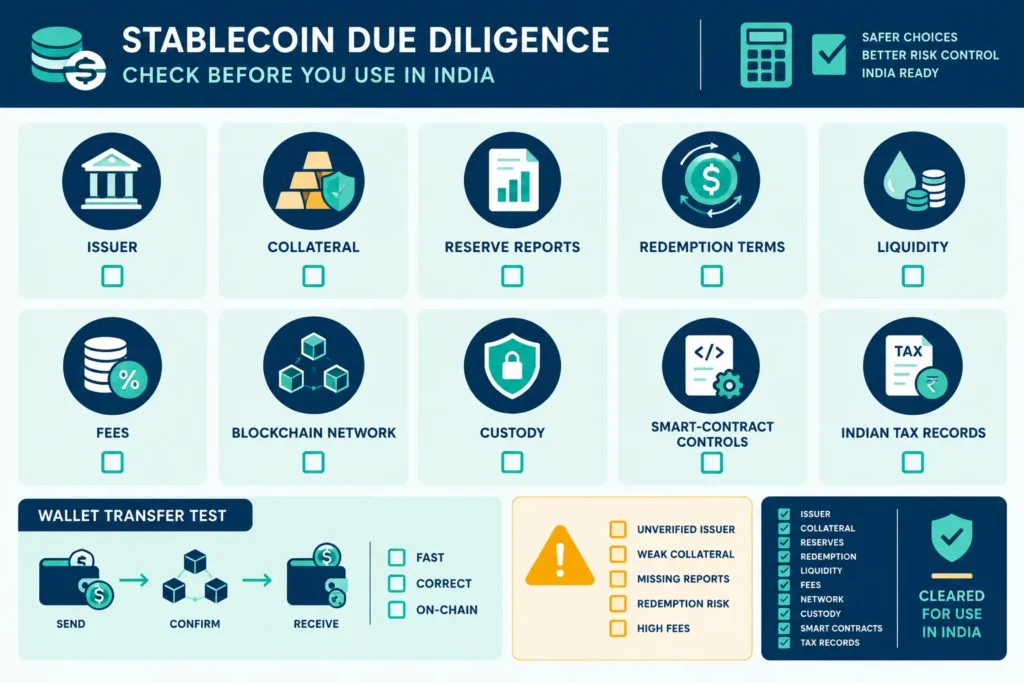
Practical stablecoin evaluation checklist

Visual checklist for reviewing stablecoin reserves, redemption, liquidity, network, custody and Indian tax records.

  • Issuer: Identify the legal entity, its location, operating history and responsible management.
  • Collateral: Check what backs the token and whether the assets can fall in value or become illiquid.
  • Reserve disclosures: Look for recent, detailed reports showing asset types, amounts and where reserves are held.
  • Audits or attestations: Understand the scope. A periodic attestation is not necessarily a full financial audit or continuous proof of reserves.
  • Redemption rights: Confirm who can redeem, minimum amounts, processing time, required documents and suspension powers.
  • Fees: Include trading spreads, withdrawal charges, blockchain fees and conversion costs.
  • Liquidity: Check whether meaningful trading volume and redemption access exist, especially during stressed markets.
  • Network: Confirm the correct blockchain, token contract and support from the receiving wallet or exchange.
  • Custody: Decide whether you will use self-custody or an intermediary, and understand the risks of each.
  • Smart contracts: Review whether the code has been independently assessed and whether administrators can freeze or upgrade it.
  • Service-provider terms: Read what happens during insolvency, maintenance, account suspension or unauthorised access.

Do not rely only on the token’s name, market size or past price stability. Start with a small test transfer when using a new wallet or network. Protect recovery phrases offline, enable strong account security and avoid keeping funds on a platform merely for an unusually high return. For wider precautions, see Cryptocurrency Risks: Common Dangers and How to Invest Safely.

Frequently Asked Questions

What are stablecoins?

Stablecoins are crypto tokens designed to track a reference asset, commonly a national currency such as the US dollar. They may use reserves, crypto collateral or software-based mechanisms to pursue that target.

Are stablecoins safe?

No stablecoin is risk-free. Safety depends on reserve quality, issuer solvency, redemption rights, blockchain security, custody arrangements and regulation. Different stablecoins can have very different risk levels.

Do stablecoins always maintain their peg?

No. Market stress, weak reserves, redemption problems, software failures or loss of confidence can push a stablecoin away from its target price. Some recover, while others may fail permanently.

How are stablecoins different from Bitcoin?

Stablecoins aim to maintain a relatively stable value against a reference asset. Bitcoin has no fixed price target and its market value can move sharply. Stablecoins also commonly depend on an issuer, collateral system or governance mechanism that differs from Bitcoin’s design.

Are stablecoins the same as India’s Digital Rupee?

No. The Digital Rupee is central bank money issued by the Reserve Bank of India. A private stablecoin is issued or managed through a private organisation or blockchain system and carries different legal, operational and financial risks.

Summary

Stablecoins can support crypto trading, transfers and blockchain applications, but a stable-looking price does not make them equivalent to cash in a bank. Evaluate the issuer, reserves, redemption rules, liquidity, technology, custody and service-provider terms before using one. In India, also consider current tax, anti-money-laundering and regulatory requirements. Most importantly, remember that private stablecoins are not government-guaranteed and are not the same as the RBI-issued Digital Rupee.

Share this article
KEEP READING

Related Articles

View all →

Comments

Leave a Comment

Stablecoins Explained: Types, Uses and Risks for Indian Beginners

What Are Stablecoins?

Stablecoins are crypto tokens designed to maintain a relatively stable value by tracking another asset or reference value. Most aim to follow a fiat currency, such as the US dollar. For example, a dollar-linked stablecoin may target a price of US$1 per token.

They differ from Bitcoin and Ether because their main purpose is usually price stability rather than price appreciation. However, the word “stable” does not mean risk-free. A stablecoin’s market price can move above or below its target, its reserves may be inadequate, and redemption may be delayed or restricted.

Introduction

Crypto prices can change quickly. Bitcoin or Ether may rise or fall substantially within a short period, making them difficult to use for routine payments, short-term trading balances or transfers where the sender wants a predictable value.

Stablecoins try to address this problem. They combine crypto-style transferability with a value that is intended to remain close to a reference asset. On a crypto exchange, an Indian investor may sell Bitcoin for a dollar-linked stablecoin instead of immediately withdrawing money to a bank account. A person may also receive stablecoins from someone in another country, subject to the platform’s rules and applicable Indian laws.

To understand where stablecoins fit within the wider crypto market, beginners can read Cryptocurrency in India: A Complete Beginner’s Guide to Crypto. It is also important not to confuse stablecoins with ordinary electronic money or a central bank-issued currency. The distinction is covered in Cryptocurrency vs Digital Currency: Key Differences Explained.

1. What Stablecoins Are and How They Seek Stability

A stablecoin is a digital token issued on a blockchain or similar distributed network. Its issuer or protocol aims to keep the token’s value close to a chosen reference. This reference is commonly the US dollar, but a stablecoin could theoretically track another currency, gold, a basket of assets or a different unit of value.

Suppose a stablecoin targets US$1. If the arrangement works as intended, one token should trade near US$1. For an Indian user, its rupee value will still change when the USD-INR exchange rate changes. A dollar-linked stablecoin can therefore remain close to its dollar target while becoming more or less expensive in rupee terms.

Peg, Redemption Value and Market Price Are Different

Diagram comparing a stablecoin's stated peg, redemption value and exchange market price.

Three related values help explain how a stablecoin works:

  • Stated peg: This is the value the stablecoin is designed to track, such as US$1.
  • Redemption value: This is the amount an eligible holder may receive by returning the token to the issuer or protocol. Redemption may involve minimum amounts, fees, identity checks, waiting periods or geographic restrictions.
  • Market price: This is the price at which buyers and sellers actually trade the token on an exchange or other market.

These values are not always identical. A token may have a stated peg of US$1 but trade at US$0.98 or US$1.02. It may also be redeemable at US$1 only by approved customers dealing directly with the issuer. A retail user in India might have access only to an exchange’s market price.

An intended peg is therefore a target, not a guarantee. Confidence, liquidity, reserve concerns, exchange problems and sudden demand can all move the actual price away from the target.

Stablecoins Compared With Bitcoin, Ether and Fiat Currency

Bitcoin has a limited issuance framework and no issuer promising to exchange each coin for a fixed amount of rupees or dollars. Its price is mainly determined by market demand and supply. Ether is the native asset of the Ethereum network and is used to pay transaction fees and interact with applications. Its market value also changes freely.

A stablecoin has a different design goal. It usually tries to minimise price movement relative to its reference asset. This can make it useful as a trading unit or temporary store of value within crypto markets, but it also creates extra dependence on reserves, collateral, software rules or an issuing organisation.

Stablecoins are not the same as traditional fiat currency. The Indian rupee is issued by the Reserve Bank of India and is legal tender in India. A private rupee-linked or dollar-linked crypto token is a claim or digital asset governed by its own arrangement; it is not automatically equivalent to money held in a regulated bank account.

Centralized and Decentralized Arrangements

Many fiat-backed stablecoins use a centralized structure. A company issues the tokens, controls the reserve accounts and sets the redemption conditions. It may also have technical powers to freeze particular wallet addresses or block transfers where required by its policies or legal obligations.

A simple centralized process may work like this:

  1. An approved customer sends fiat currency to the issuer.
  2. The issuer creates, or “mints,” a corresponding quantity of stablecoins.
  3. The customer receives the tokens and may transfer or trade them.
  4. When the customer redeems the tokens, the issuer destroys, or “burns,” them and returns fiat currency after fees and checks.

In theory, minting and redemption help keep the market price near the peg. If a token trades above US$1, eligible traders may buy it from the issuer at the redemption value and sell it in the market at the higher price. The additional supply can push the price down. If it trades below US$1, traders may buy discounted tokens and redeem them for US$1, reducing supply and helping the price recover.

This mechanism works only when users trust the issuer and redemption remains practical. If withdrawals are suspended or traders doubt the reserves, the price may stay below the peg.

Decentralized stablecoins aim to reduce reliance on a single company. Their rules may operate through blockchain-based smart contracts. Users can lock crypto assets as collateral and mint stablecoins against them. If the collateral value falls too far, the protocol may sell or liquidate it to protect the system.

“Decentralized” is not an all-or-nothing label. A protocol may use decentralized smart contracts while depending on centralized price feeds, governance groups, administrators or fiat-backed tokens as collateral. Users should examine how control actually works rather than relying only on the project’s description.

Main Types of Stablecoins

Comparison of fiat-backed, crypto-collateralized and algorithmic stablecoin mechanisms and risks.

Type How stability is attempted Main strengths Important risks
Fiat-backed An issuer holds reserve assets intended to support the tokens in circulation. Users may be able to redeem tokens for fiat currency. Usually simple to understand and may have a direct redemption mechanism. Depends on the issuer, reserve quality, custody, banking access and redemption rules.
Crypto-collateralized Users lock crypto assets in smart contracts and borrow or mint stablecoins against them. The collateral may exceed the stablecoins issued. Can offer greater on-chain transparency and reduce dependence on one traditional issuer. Crypto collateral can fall rapidly, triggering liquidations or leaving a shortfall during market stress.
Algorithmic Software rules, incentives or related tokens attempt to adjust supply and demand to defend the peg. May aim to operate with little or no conventional reserve backing. Confidence can collapse, incentives can stop working, and some designs have experienced severe or permanent de-pegging.

Why Overcollateralization May Be Used

Crypto-collateralized stablecoins often require collateral worth more than the stablecoins created. For example, a protocol might require a user to lock crypto worth considerably more than the amount borrowed. The extra collateral provides a buffer if the crypto price falls.

Overcollateralization reduces some risk but does not remove it. During a sudden market crash, collateral prices may fall faster than the system can sell the assets. Blockchain congestion, faulty price information or smart-contract problems can also interfere with liquidations.

Reserve Quality Matters

A fiat-backed stablecoin is only as reliable as its complete operating arrangement. Reserves may contain cash, bank deposits, government securities, commercial debt or other financial assets. These holdings do not all have the same liquidity or credit risk.

Cash or short-term high-quality instruments may be easier to sell during heavy redemptions than longer-term or riskier assets. The location of reserves, the identity of custodians and whether stablecoin holders have a clear legal claim can also matter if the issuer fails.

Reserve information may be presented through company reports, attestations or audits, but these forms of verification are not identical. A report may cover only a particular date, use a limited scope or rely on information supplied by the issuer. Some stablecoins provide frequent independent checks, while others disclose little. Users should not assume that every token is fully backed simply because its price has usually stayed near the peg.

How a Stablecoin Can Lose Its Peg

A stablecoin may trade below its target when holders rush to sell, doubt the reserves, fear regulatory action or cannot redeem directly. It may trade above the target when demand rises faster than new tokens can be issued, or when access to banking and redemption channels is limited.

Algorithmic models face an additional problem: they often depend heavily on market confidence. A design may encourage users to exchange the stablecoin for another token when the peg weakens. If both tokens lose demand at the same time, token creation can increase without restoring confidence. This can create a downward spiral.

Some algorithmic stablecoin designs have failed because their incentives could not withstand sustained selling. The broader lesson is that code can automate rules, but it cannot guarantee that buyers, liquidity or confidence will always exist. Before treating any stablecoin as digital cash, an investor should understand what supports its value, who can redeem it and what could prevent the peg from recovering.

2. Common Uses, Networks and Potential Benefits

After understanding what are stablecoins, the next step is to see how people may use them. Stablecoins can act as a relatively steady unit within crypto markets, especially when compared with assets such as Bitcoin or Ether. They are commonly used for trading, transfers, settlement and decentralised finance, or DeFi.

However, a stablecoin is still a cryptoasset. Its value, availability and safety depend on factors such as its design, issuer, reserves, blockchain network and market liquidity. It should not be treated as the same as money held in an insured bank account.

Using Stablecoins for Crypto Trading

Many crypto exchanges offer trading pairs that include stablecoins. A trading pair shows the two assets that can be exchanged. For example, a BTC-stablecoin pair may allow a user to sell Bitcoin and receive a dollar-referenced stablecoin instead of immediately converting the value into Indian rupees.

This can make stablecoins one side of a token swap. Suppose an Indian user holds a cryptoasset that has risen sharply but does not want to buy another volatile token immediately. The user may exchange it for a stablecoin available on the platform. The stablecoin may then be used later to buy another supported cryptoasset.

This does not make the transaction tax-free or remove any reporting responsibility. Selling one cryptoasset for a stablecoin may still have Indian tax implications because one virtual digital asset is being transferred for another. Users should keep records of purchase values, sale values, dates, fees and transaction references, and seek professional tax advice where necessary.

Stablecoin trading also carries market and platform risks. A quoted price may move away from its intended reference value, particularly during periods of stress. A user may also face trading fees, withdrawal charges, low liquidity or restrictions imposed by an exchange.

Transfers Between Compatible Wallets

Stablecoins may be transferred between blockchain wallets. For example, a person could move a dollar-referenced token from a supported exchange wallet to a compatible self-custody wallet. The recipient may see the tokens after the blockchain confirms the transaction.

Such transfers may be useful when two parties already use the same blockchain ecosystem. Stablecoins can also support settlement between crypto market participants because their value may fluctuate less over short periods than many other cryptoassets.

But a wallet transfer does not bypass legal, banking, foreign exchange or tax obligations. The parties must consider the purpose of the payment, applicable Indian laws, platform rules and record-keeping requirements. Cross-border transfers can involve additional regulatory questions and should not be treated casually.

Blockchain transactions are generally difficult or impossible to reverse. If tokens are sent to the wrong wallet address, the sender may not be able to recover them. A sensible approach is to check the address carefully and consider sending a small test amount before making a larger transfer.

Network Compatibility and Transaction Costs

The same stablecoin name or symbol may appear on more than one blockchain network. For instance, a platform may support versions of a token on Ethereum and other networks. These versions are not automatically interchangeable, even if they aim to represent the same reference value.

The sending platform, receiving wallet and selected deposit address must all support the chosen token and network. Selecting the wrong network can result in delayed access, complicated recovery or permanent loss. A wallet displaying a similar address format does not by itself confirm compatibility.

Before sending a stablecoin, check:

  • The full token name and contract details shown by the platform.
  • The blockchain network selected for withdrawal.
  • Whether the receiving wallet supports that exact network and token.
  • The receiving address, including every character.
  • Any minimum deposit or withdrawal requirement.
  • The expected network fee and platform withdrawal fee.

A stablecoin transfer is not necessarily free. The blockchain may charge a network fee to process and confirm it. This fee is sometimes called a gas fee. It can vary according to network demand, transaction complexity and the blockchain being used.

Some exchanges charge a separate withdrawal fee. In other cases, a wallet transaction may require the network’s native token to pay for confirmation. For example, holding a token in a wallet may not be enough if the wallet has no native coin available for gas. Users should review the total cost before approving a transaction, especially for small transfers where fees may form a large part of the amount.

Stablecoins in Decentralised Finance

Stablecoins have an important role in decentralised finance applications. DeFi applications use blockchain-based software and smart contracts to provide functions such as token swaps, lending and liquidity provision. The broader concepts and risks are covered in What Is DeFi? Decentralized Finance Explained for Beginners.

In a decentralised exchange, a user may swap one token for a stablecoin through a smart contract. The exchange rate can depend on the assets available in a liquidity pool, the size of the transaction and current market activity. Users may also pay a network fee and experience slippage, which means receiving a different final rate from the initial quote.

A liquidity pool contains tokens supplied by participants so that other users can make swaps. A common pool may contain a stablecoin and another cryptoasset. In return for supplying assets, liquidity providers may receive a share of certain transaction fees or other incentives.

This activity is not risk-free income. A liquidity provider can lose money if token prices change, a stablecoin loses its reference value, or a smart contract is exploited. The application’s rules may also make withdrawals difficult during stressed market conditions. High advertised yields can reflect high risk rather than a dependable return.

Some DeFi lending applications allow users to deposit stablecoins for potential interest or borrow stablecoins against crypto collateral. Borrowers may need to provide collateral worth more than the loan. If the collateral value falls below the application’s required level, it may be sold automatically through liquidation.

DeFi users also face smart contract, governance, wallet and interface risks. A coding flaw, malicious approval or compromised private key can lead to losses. Unlike a conventional bank deposit, there may be no customer support desk or guaranteed recovery process.

Access Through Exchanges and Custodial Services

Centralised crypto exchanges may allow users to buy, sell, hold or withdraw selected stablecoins. Availability can differ by platform, and an exchange may suspend deposits, withdrawals or trading for operational, compliance or liquidity reasons.

When stablecoins are kept on an exchange, the platform usually controls the private keys. This is known as custodial access. It can be convenient for beginners, but it creates counterparty risk because the user depends on the platform’s security, solvency and withdrawal systems.

Users should check whether an exchange clearly identifies the supported token and network, explains its fees, provides transaction records and applies suitable security controls. Platform selection is discussed in more detail in Crypto Exchanges in India: How They Work and How to Choose One.

A self-custody wallet gives the user control over the private keys, but it also places responsibility on the user. Losing a recovery phrase, approving a malicious contract or sending funds through the wrong network can result in permanent loss. Convenience should therefore be weighed against custody and operational risk.

Potential Benefit: Lower Short-Term Volatility

A major potential benefit of stablecoins is reduced short-term price volatility relative to highly volatile cryptoassets. If a stablecoin successfully tracks its reference asset, its market price may move within a narrower range than Bitcoin or many smaller tokens. This can make pricing, trading and settlement easier within crypto markets.

Reduced volatility does not mean no risk. A stablecoin can trade above or below its intended value. Its issuer may face reserve, banking or regulatory problems. Redemption may be restricted, delayed or unavailable to some users. Market liquidity may also disappear when many holders try to sell at the same time.

Users should therefore distinguish between a token’s target value and its actual market value. Stability, liquidity and redemption are not guaranteed. Before using a stablecoin, consider how it maintains its reference value, who controls it, what supports it, where it can be traded, which network it uses and what could happen during a market crisis.

3. Risks, India Considerations, Precautions and FAQ

Stablecoins may look simple because their price aims to remain linked to an asset such as the US dollar. However, price stability is a target, not a promise. Before buying or receiving one, understand who issues it, what supports it and how you can redeem it.

Main risks of stablecoins

Reserve quality: A reserve-backed stablecoin is only as dependable as the assets supporting it. Cash and short-term government securities may behave differently from corporate debt, crypto assets or loans. Reserves can also lose value or become difficult to sell during market stress.

Issuer solvency: Even if reserves exist, the issuing company can face operational losses, lawsuits, fraud, banking problems or insolvency. Token holders may not have first claim over reserve assets if the issuer fails.

Redemption restrictions: Direct redemption may be available only to approved customers or above a minimum amount. It can involve identity checks, waiting periods and fees. An issuer may also suspend redemption under its terms or because of legal and banking restrictions.

Depegging and liquidity pressure: A stablecoin can trade above or below its target price. This may happen when traders lose confidence, exchanges have limited liquidity or many holders try to sell at once. A token targeting one US dollar is not guaranteed to trade at exactly one dollar at every moment.

Custody and platform failure: If you hold stablecoins through an exchange, lending service or wallet provider, you depend on that intermediary. The platform may be hacked, freeze withdrawals, become insolvent or misuse customer assets. Your account balance does not necessarily mean that specific tokens are held separately for you.

Smart-contract bugs: Stablecoins issued on blockchains depend on software. A coding flaw, compromised administrator key or faulty upgrade can lead to stolen, frozen or incorrectly created tokens.

Oracle failures: Some crypto-collateralised and algorithmic stablecoins use price feeds called oracles. If an oracle reports an incorrect or manipulated price, the system may trigger improper liquidations or issue too many tokens.

Governance weaknesses: Control may rest with a company, a small group of key holders or token voters. They may change collateral rules, fees, software or emergency powers. Decentralised governance can also suffer from low participation and concentrated voting power.

Network risk: The same stablecoin may exist on several blockchains. Each version can have different transaction fees, confirmation times and security assumptions. Sending a token through an unsupported network can result in a difficult or permanent loss.

Regulatory change: Governments may introduce new rules for issuers, exchanges, transfers, reserves or customer verification. A service available today may later restrict Indian users or particular transactions.

Counterparty risk is not removed by a stable price

A stablecoin can maintain its peg while the service holding it fails. For example, an exchange may show a balance of 10,000 units in your account, but withdrawals could stop if the exchange faces a cyberattack or financial crisis.

Lending platforms add another layer of risk. They may lend deposited stablecoins to traders or institutions. If borrowers default and the platform has insufficient protection, depositors can lose money. A high advertised yield usually means that credit, liquidity, leverage or smart-contract risk is being taken somewhere.

Stablecoins are not government-guaranteed. They are not the same as insured bank deposits, and holding one does not create the same relationship that you have with a regulated bank account. Terms such as “cash equivalent” or “digital dollar” should not be treated as proof of safety.

Stablecoins and India’s Digital Rupee are different

India’s Digital Rupee, also called the e₹, is central bank digital currency issued by the Reserve Bank of India. It represents central bank money in digital form. It is not a privately issued stablecoin and does not depend on a private company’s reserve promise.

Point Private stablecoin Digital Rupee
Issuer A private entity or blockchain-based system Reserve Bank of India
Value mechanism Attempts to track an asset through reserves, collateral or software Digital form of the Indian rupee
Main dependency Issuer, collateral, code, market liquidity and service providers Central bank issuance and the authorised distribution system
Legal character Depends on the token, structure and applicable law Central bank money

A stablecoin tracking the rupee should not be described as an official Digital Rupee unless it is actually issued by the RBI. A familiar currency symbol or a stable price does not indicate government approval.

Tax, legal and regulatory considerations in India

Crypto treatment in India depends on the token and the activity involved. Buying, selling, swapping, transferring, lending or earning rewards from stablecoins can have different tax and compliance consequences. The legal position can also change.

Indian tax law contains provisions for virtual digital assets, including rules concerning income and tax deduction at source for covered transactions. Whether a particular stablecoin and transaction fall within those provisions should be checked against current legislation, Income Tax Department guidance and the facts of the transaction. A swap between a stablecoin and another crypto asset should not automatically be assumed to be tax-free merely because no rupees were received.

Keep records of purchase cost, sale value, wallet addresses, exchange statements, transaction fees and the rupee value used for each transaction. For a detailed overview, read Cryptocurrency Tax in India: Tax Rules, TDS and ITR Filing Guide and verify the latest official rules before filing a return.

India also applies anti-money-laundering obligations to specified virtual digital asset service activities. Platforms may require identity verification and transaction information. Registration or compliance by a service provider should not be interpreted as RBI approval, a safety certificate or a guarantee against losses.

The RBI has repeatedly highlighted risks associated with private cryptocurrencies. Rules may come from different authorities depending on the activity, including the Government of India, the Income Tax Department, the Financial Intelligence Unit and other relevant bodies. If a transaction is large, frequent, business-related or legally unclear, consult a qualified Indian tax or legal professional.

Practical stablecoin evaluation checklist
Visual checklist for reviewing stablecoin reserves, redemption, liquidity, network, custody and Indian tax records.

  • Issuer: Identify the legal entity, its location, operating history and responsible management.
  • Collateral: Check what backs the token and whether the assets can fall in value or become illiquid.
  • Reserve disclosures: Look for recent, detailed reports showing asset types, amounts and where reserves are held.
  • Audits or attestations: Understand the scope. A periodic attestation is not necessarily a full financial audit or continuous proof of reserves.
  • Redemption rights: Confirm who can redeem, minimum amounts, processing time, required documents and suspension powers.
  • Fees: Include trading spreads, withdrawal charges, blockchain fees and conversion costs.
  • Liquidity: Check whether meaningful trading volume and redemption access exist, especially during stressed markets.
  • Network: Confirm the correct blockchain, token contract and support from the receiving wallet or exchange.
  • Custody: Decide whether you will use self-custody or an intermediary, and understand the risks of each.
  • Smart contracts: Review whether the code has been independently assessed and whether administrators can freeze or upgrade it.
  • Service-provider terms: Read what happens during insolvency, maintenance, account suspension or unauthorised access.

Do not rely only on the token’s name, market size or past price stability. Start with a small test transfer when using a new wallet or network. Protect recovery phrases offline, enable strong account security and avoid keeping funds on a platform merely for an unusually high return. For wider precautions, see Cryptocurrency Risks: Common Dangers and How to Invest Safely.

Frequently Asked Questions

What are stablecoins?

Stablecoins are crypto tokens designed to track a reference asset, commonly a national currency such as the US dollar. They may use reserves, crypto collateral or software-based mechanisms to pursue that target.

Are stablecoins safe?

No stablecoin is risk-free. Safety depends on reserve quality, issuer solvency, redemption rights, blockchain security, custody arrangements and regulation. Different stablecoins can have very different risk levels.

Do stablecoins always maintain their peg?

No. Market stress, weak reserves, redemption problems, software failures or loss of confidence can push a stablecoin away from its target price. Some recover, while others may fail permanently.

How are stablecoins different from Bitcoin?

Stablecoins aim to maintain a relatively stable value against a reference asset. Bitcoin has no fixed price target and its market value can move sharply. Stablecoins also commonly depend on an issuer, collateral system or governance mechanism that differs from Bitcoin’s design.

Are stablecoins the same as India’s Digital Rupee?

No. The Digital Rupee is central bank money issued by the Reserve Bank of India. A private stablecoin is issued or managed through a private organisation or blockchain system and carries different legal, operational and financial risks.

Summary

Stablecoins can support crypto trading, transfers and blockchain applications, but a stable-looking price does not make them equivalent to cash in a bank. Evaluate the issuer, reserves, redemption rules, liquidity, technology, custody and service-provider terms before using one. In India, also consider current tax, anti-money-laundering and regulatory requirements. Most importantly, remember that private stablecoins are not government-guaranteed and are not the same as the RBI-issued Digital Rupee.


Leave a Comment