
Mutual Funds and SIP Investing in India: A Complete Beginner’s Guide

A practical beginner’s guide to mutual funds and SIPs in India, covering how they work, fund categories, investment methods, costs, risks, selection and portfolio reviews.

Mutual Funds and SIP Investing in India: A Complete Beginner’s Guide

A mutual fund collects money from many investors and invests it in assets such as shares, bonds or a mix of both. A Systematic Investment Plan, or SIP, is simply a way to invest a fixed amount in a mutual fund at regular intervals.

Mutual funds and SIP investing in India can help you work towards goals such as retirement, a child’s education or buying a home. However, mutual fund returns are market-linked. They are not fixed or guaranteed, and the right fund category depends on your goal, time horizon and ability to handle risk.

Introduction

Many beginners use the words “mutual fund” and “SIP” as if they are two different investments. They are not.

A mutual fund is the investment product. An SIP is one method of putting money into that product. You can usually invest in a mutual fund through an SIP or make a one-time investment, commonly called a lump sum.

For example, suppose you want to invest ₹3,000 every month for a long-term goal. You may start an SIP of ₹3,000 in a suitable mutual fund. Alternatively, if you receive a bonus of ₹36,000, you may invest it as a lump sum. In both cases, you are buying units of a mutual fund; only the method and timing of investment are different.

Mutual funds can make investing more accessible because you do not have to select and manage every share or bond yourself. Still, they are not automatically safe or suitable for every goal. Understanding how they work is the first step before choosing any scheme.

Section 1: Mutual Fund and SIP Foundations

What Is a Mutual Fund?

A mutual fund pools money from many investors. The pooled money is then invested according to the scheme’s stated objective and strategy.

Think of it as a common investment basket. Instead of one person trying to buy several shares or bonds individually, many people contribute money to a professionally managed scheme. Each investor receives units representing their share in that scheme.

Every mutual fund scheme has a mandate. This tells you what the scheme is allowed to invest in and what it is trying to achieve. For example, an equity fund may mainly invest in company shares, while a debt fund may invest in government securities and corporate bonds.

The mandate matters because two mutual funds can behave very differently. A fund investing in smaller companies may experience sharper price movements than one holding short-term debt instruments. The label “mutual fund” alone does not tell you the level of risk.

What Is an SIP?

Diagram showing that a mutual fund is the investment product while an SIP is a regular investing method

An SIP is an investment facility through which a fixed amount is invested in a mutual fund at regular intervals. Monthly SIPs are common, although other frequencies may be available.

An SIP is not a separate asset class, account or guaranteed-return plan. It is an investment method. The risk and return still come from the mutual fund scheme selected.

With an SIP, your fixed contribution buys more units when the applicable NAV is lower and fewer units when it is higher. This can spread purchases across different market levels. It is sometimes called rupee-cost averaging, but it does not prevent losses or guarantee a profit.

SIPs may be useful for salaried investors because they support regular investing and can be aligned with monthly cash flow. They can also reduce the temptation to wait endlessly for the “perfect” time to invest. However, regular investing cannot make an unsuitable or high-risk fund suitable for a short-term goal.

How a Mutual Fund Investment Works

Suppose an equity mutual fund has an applicable NAV of ₹20 per unit when you invest ₹5,000. Ignoring transaction-related adjustments for simplicity, you would receive 250 units.

If the NAV later rises to ₹22, the value of those 250 units would be ₹5,500. If the NAV falls to ₹18, their value would be ₹4,500. The number of units remains 250 unless you buy more units, redeem some units or another scheme-level adjustment applies.

Now assume you invest ₹5,000 through an SIP in the following month and the applicable NAV is ₹25. That contribution would buy 200 units. Your total holding from the two contributions would then be 450 units.

This example is only to explain the calculation. Actual mutual fund values change with the underlying investments, expenses and other applicable adjustments. Returns are not guaranteed.

AMCs, Fund Managers and Units

An Asset Management Company, or AMC, manages mutual fund schemes. The AMC handles activities such as investment operations, administration, disclosures and investor servicing through the mutual fund structure.

A fund manager makes investment decisions for an actively managed scheme within its mandate. The manager and research team may decide which securities to buy, hold or sell. In an index fund, the main objective is generally to track a selected market index rather than actively pick securities to outperform it.

Units show your proportional ownership in a scheme. You do not directly own each share or bond held by the fund. Instead, you own units whose value reflects your portion of the scheme’s net assets.

You May Also Like:When Should You Start Investing in Mutual Funds? A Beginner’s Guide

What Is Mutual Fund NAV?

NAV means Net Asset Value. In simple terms, it is the per-unit value of a mutual fund scheme after accounting for its assets and liabilities.

A lower NAV does not automatically mean a fund is cheaper or better. For example, a fund with an NAV of ₹10 is not necessarily more attractive than one with an NAV of ₹100. What matters is how the underlying portfolio performs, along with factors such as risk, costs and suitability.

The applicable NAV for a purchase or redemption depends on rules covering factors such as the transaction time and realisation of funds. Beginners should therefore avoid assuming that an order will always receive the NAV visible when it is submitted.

What Is an Expense Ratio?

Running a mutual fund involves costs, including investment management, administration and other permitted expenses. These costs are reflected through the scheme’s expense ratio and are charged to the scheme’s assets.

You generally do not receive a separate monthly bill. Instead, the expense affects the NAV and therefore reduces the return available to investors. Even a small difference in costs can matter over a long investment period, but cost should not be the only basis for selecting a fund.

Direct plans usually have a lower expense ratio than regular plans because direct plans do not include distributor commissions. Regular plans may be appropriate for investors who use a distributor’s service, while direct plans require the investor to take greater responsibility for scheme selection and monitoring.

SEBI’s Role in Mutual Funds

The Securities and Exchange Board of India, or SEBI, regulates mutual funds in India. It sets rules relating to areas such as disclosures, scheme classification, investor protection and mutual fund operations.

SEBI regulation creates a formal framework, but it does not remove investment risk or guarantee returns. A regulated mutual fund can still fall in value when markets or the securities held by the scheme perform poorly.

Main Types of Mutual Funds

Fund category Broad purpose General risk characteristics
Equity funds Invest mainly in company shares, usually for long-term capital growth Can be volatile and may face substantial short-term losses
Debt funds Invest mainly in bonds and money-market instruments Usually less volatile than equity funds, but exposed to interest-rate, credit and liquidity risks
Hybrid funds Combine equity, debt or other assets in different proportions Risk depends on the asset mix and investment strategy
Index funds Aim to track an index such as a broad equity or bond index Carry the market risk of the tracked index and may have tracking differences
Exchange-traded funds Track an index, commodity or another specified asset and trade on a stock exchange Carry underlying market risk and may involve trading-price and liquidity considerations
Solution-oriented or other specialised funds Target a stated theme, sector, goal or investment approach Risk varies widely; concentrated sector or thematic funds can be especially volatile

These categories contain several subcategories. For instance, equity funds may focus on large, mid-sized or small companies. Debt funds may hold securities with different maturities and credit profiles. Investors should read the scheme documents and Riskometer rather than judging a fund only by its category name.

How Mutual Funds May Fit into a Financial Plan

A mutual fund should be linked to a clear goal. Equity-oriented funds may be considered for long-term goals by investors who can tolerate market falls. Lower-volatility options may be more relevant for nearer goals, but even debt funds are not the same as bank deposits and do not promise fixed returns.

Your emergency fund, essential insurance and high-interest debt also deserve attention before aggressive investing. An SIP amount should be affordable enough to continue without disrupting rent, loan payments or everyday needs.

Most importantly, mutual fund returns are market-linked and are not guaranteed. Past performance does not assure future results. A fund that performed well earlier may underperform, and investors can receive less than the amount invested.

Comparing, Choosing and Starting an Investment

Once you understand the basic types of mutual funds, the next step is deciding how to invest. You can invest a fixed amount regularly through a systematic investment plan, or invest a larger amount at one time.

The right choice depends mainly on when your money becomes available, your goal, your investment period and your ability to handle market movements. Neither method guarantees returns or removes the risks of the underlying mutual fund.

SIP vs lumpsum: how do they work?

A systematic investment plan, commonly called an SIP, allows you to invest a fixed amount at regular intervals. For example, you may invest Rs 3,000 every month in an equity mutual fund. The amount is usually deducted automatically from your bank account on the selected date.

A lumpsum investment is a one-time investment. For example, you may invest Rs 1 lakh received as an annual bonus, maturity proceeds or accumulated savings.

Point SIP Lumpsum
How money is invested In regular instalments In one transaction
Suitable cash flow Monthly salary or other regular income Bonus, inheritance or existing surplus
Market timing concern Investment is spread across different dates The full amount enters at the prevailing market level
Financial discipline Automatic instalments can encourage consistency Requires a decision each time fresh money is available
Risk Depends on the chosen fund; losses remain possible Depends on the chosen fund; short-term timing can have a larger effect

An SIP may suit a salaried person who saves from monthly income. It reduces the need to wait until a large amount has accumulated. It can also make budgeting easier because investing becomes a regular expense.

A lumpsum may be practical when money is already available. However, investing the entire amount in an equity fund can feel uncomfortable if markets fall soon afterwards. The decision should reflect your investment horizon and risk tolerance, not a prediction about where the market will move next.

You do not always have to choose only one method. Someone may continue a monthly SIP and make an additional investment after receiving a bonus. Each contribution should still fit the same goal and asset allocation.

You May Also Like:Stock Market & Investing in India: A Complete Beginner’s Guide

Understanding rupee-cost averaging

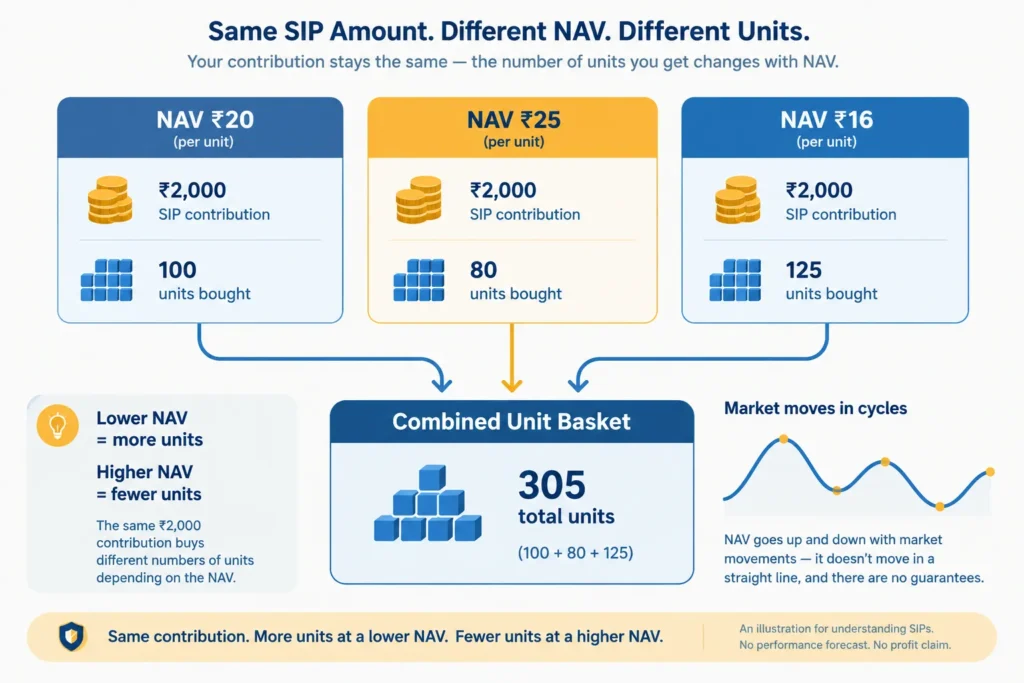
Example of equal SIP contributions buying different numbers of mutual fund units as NAV changes

Mutual fund units are allotted according to the applicable net asset value, or NAV. When you invest the same amount regularly, you generally receive more units when the NAV is lower and fewer units when it is higher. This effect is known as rupee-cost averaging.

Suppose an investor contributes Rs 2,000 each month. At an NAV of Rs 20, the investment buys 100 units. At an NAV of Rs 25, it buys 80 units. At an NAV of Rs 16, it buys 125 units, before considering any applicable charges or other operational details.

This process spreads purchases across different market levels. However, it does not ensure a profit or protect against a prolonged market decline. If the fund’s portfolio loses value, an SIP investor can also face losses. Rupee-cost averaging is an investment process, not a guarantee.

How compounding can help over time

Compounding means that any gains remaining invested may themselves participate in future growth. Over long periods, this can become meaningful because the investment base may grow over time.

For example, if you invest regularly in a growth option, gains are generally retained within the scheme rather than paid out periodically. Future returns, whether positive or negative, then apply to the updated value of your investment.

Compounding needs time and does not produce a fixed result in market-linked mutual funds. Returns can fluctuate, and actual outcomes may be lower or higher than calculator illustrations. You can use the RegularStation SIP Calculator to explore different contribution amounts, periods and assumed returns, but treat the result as an illustration rather than a promise.

A practical framework for selecting a mutual fund

Flowchart for selecting a mutual fund based on goal, time horizon, risk, category, costs and review

Do not select a fund only because it delivered the highest recent return. Start with your own requirements and then assess whether the scheme is suitable.

  1. Define the goal: State what the money is for and estimate when it will be needed. Examples include a home down payment, a child’s education or retirement.
  2. Check the investment horizon: Equity funds are generally considered for longer goals because they can be volatile. Shorter goals may require more stable categories, depending on your circumstances.
  3. Assess risk tolerance: Ask how you would react to a sharp temporary fall. A fund is unsuitable if its normal volatility is likely to make you exit in panic.
  4. Use the correct benchmark: Compare performance with the scheme’s stated benchmark and with similar funds. A large-cap fund should not be judged against a small-cap index.
  5. Review the expense ratio: This annual operating cost is charged to the scheme and affects investor returns. Lower costs are useful, but cost should not be the only selection factor.
  6. Study portfolio holdings: Check where the fund invests, its major holdings, sector concentration and credit quality where relevant. Make sure the portfolio matches the scheme’s stated category.
  7. Look for process consistency: Review whether the fund follows its stated investment approach across market cycles. Avoid relying only on one unusually strong year.

For tax-saving investments, compare the product with your goal rather than looking only at the tax deduction. The RegularStation comparison of PPF vs ELSS explains differences in market risk, lock-in, return structure and liquidity without treating the two products as interchangeable.

Steps to start mutual fund investing in India

The process can usually be completed online, although offline options remain available.

  1. Complete KYC: Know Your Customer verification generally requires details such as your PAN, identity and address information, bank details and a photograph. Video or in-person verification may be required depending on the process used. Ensure that your name and other details match across records.
  2. Choose where to invest: You may invest through an asset management company, or AMC, or use a mutual fund platform. A platform can provide access to multiple fund houses in one place. Check whether it offers direct plans, regular plans or both, and understand any fees or advisory arrangement.
  3. Select direct or regular: A direct plan is bought without a distributor and generally has a lower expense ratio. A regular plan includes distributor-related costs and may provide assistance. Both plans invest in the same scheme portfolio, but their expense ratios and NAVs differ. Direct plans may suit investors who can research and manage investments independently.
  4. Choose an appropriate fund: Match the category with your goal, horizon and risk capacity. Read the scheme information and risk disclosures. Do not choose merely from an app’s popularity list or a friend’s recommendation.
  5. Select SIP or lumpsum: Use an SIP for regular investible income or a lumpsum when surplus money is already available. Confirm the minimum amount and permitted frequency for the scheme.
  6. Set up payment instructions: For an SIP, choose an instalment amount and debit date, then approve the required bank mandate. For a lumpsum, make a one-time payment through the available method.
  7. Review the confirmation: Check the scheme name, plan, option, folio details, invested amount and units allotted. Keep nominee and contact details updated.

Detailed SIP guides on RegularStation can help with operational questions such as selecting a debit date, changing an instalment, pausing an SIP or understanding what happens when a payment fails. These actions may vary by AMC or platform.

What to do after you start

An SIP should not be treated as “set and forget” forever. Review the investment periodically, such as when your goal, income, time horizon or risk capacity changes. Also check whether the scheme continues to follow its mandate and remains suitable for the goal.

A temporary period of weak performance is not automatically a reason to switch. Compare the fund with an appropriate benchmark and category over a meaningful period, while considering changes in its portfolio or investment process. Frequent switching can disrupt discipline and may create tax or exit-load consequences.

Keep adequate emergency savings before committing money needed for regular expenses. The RegularStation Personal Finance pillar can help you place mutual funds within a broader plan covering budgeting, emergency funds, insurance, debt and long-term goals.

Section 3: Costs, Portfolio Management, Mistakes and FAQs

Returns are only one part of mutual fund investing. Costs, taxes, risk and investor behaviour also affect how much money you finally receive. Understanding these areas can help you manage mutual funds and SIP investing in India with more confidence.

Costs You Should Understand

Mutual fund costs may look small, but they can affect long-term returns. Always read the scheme documents and the latest fund factsheet before investing.

You May Also Like:Home Loan Processing Fees and Other Charges in India: A Beginner’s Guide

Expense Ratio

The expense ratio is the annual cost charged by the mutual fund for managing the scheme. It covers expenses such as investment management, administration and distribution.

This cost is adjusted in the scheme’s net asset value, or NAV. You do not usually receive a separate bill. A lower expense ratio leaves more of the fund’s gross return for investors, but cost should not be the only selection factor. The fund’s strategy, risk, consistency and suitability for your goal also matter.

Direct plans generally have lower expense ratios than regular plans because they do not include distributor commissions. Regular plans may suit investors who need assistance from a mutual fund distributor. Investors who require personalised advice should consider consulting a SEBI-registered investment adviser.

Exit Load

An exit load is a charge that may apply if you redeem units before a specified period. The rate and holding period vary by scheme.

For example, an equity fund may charge an exit load when units are redeemed within the period stated in its scheme documents. Some funds may have different rules, while others may not charge an exit load.

Each SIP instalment purchases separate units. Therefore, the exit-load holding period is normally assessed separately for each instalment.

Depending on the transaction and applicable rules, mutual fund investors may encounter stamp duty, taxes on redemption, platform charges or other permitted costs. A bank may also impose charges if an SIP debit fails because of insufficient balance.

Do not choose a platform only because it advertises “free” investing. Check whether it offers direct or regular plans, how it earns money, what support it provides and whether any account or transaction charges apply.

Taxation at a High Level

Mutual fund taxation depends on factors such as the type of fund, purchase date, holding period, redemption date and the tax rules applicable at that time. Equity-oriented funds and non-equity funds may receive different tax treatment. Dividends or income distributions may also be taxable in the investor’s hands.

A switch from one scheme to another can be treated as a redemption from the old scheme and a purchase into the new one. It may therefore create a tax liability even if the money remains within the same mutual fund company.

Editorial note: Tax rates, holding-period rules, expense limits and other regulations can change. Before publication or before acting on this information, verify the latest rules through SEBI, AMFI and the Income Tax Department. Consult a qualified tax professional where necessary.

How to Review Your Mutual Fund Portfolio

A portfolio review does not mean checking NAVs every day. For most long-term investors, a scheduled review once or twice a year may be more useful than reacting to every market movement.

Use the following questions during a review:

  • Does the goal still exist? Confirm the amount required, expected date and priority of the goal.
  • Is the fund suitable for the timeline? Equity funds may be unsuitable for money needed soon, while very conservative funds may not support long-term growth needs.
  • What role does the fund play? Each scheme should have a clear purpose, such as long-term equity growth, short-term stability or diversification.
  • How has it performed against an appropriate benchmark? Compare returns over meaningful periods rather than focusing on one good or bad year.
  • Is the investment process consistent? Review major changes in strategy, portfolio style, risk level or fund management.
  • Is there excessive overlap? Several funds may own many of the same shares, creating complexity without meaningful diversification.
  • Are costs and taxes reasonable? Consider the expense ratio, exit load and possible tax impact before making changes.

A fund underperforming for a short period is not automatically a bad fund. Its investment style may temporarily be out of favour. However, persistent weakness against its benchmark and category, combined with changes in process or rising risk, deserves closer examination.

Rebalancing Without Chasing the Market

Rebalancing means restoring your planned asset allocation. Suppose you intended to hold 70% in equity and 30% in debt. After a strong equity rally, the allocation could become 80% equity and 20% debt. Rebalancing brings the portfolio closer to the original risk level.

You may rebalance by directing new investments towards the underweighted asset, changing future SIP allocations or redeeming and reinvesting part of the portfolio. Using fresh investments may reduce unnecessary taxes and exit loads.

Rebalance according to a planned schedule or when the allocation moves meaningfully away from your target. Do not change the portfolio simply because of market headlines, election predictions or short-term forecasts.

Common Mutual Fund and SIP Mistakes

  • Chasing recent returns: Last year’s top-performing fund may not remain at the top. High recent returns may also reflect high risk.
  • Owning too many funds: More schemes do not always mean better diversification. A few suitable funds may be easier to understand and monitor.
  • Ignoring overlap: Multiple large-cap or flexi-cap funds can hold similar companies, making the portfolio look more diversified than it is.
  • Ignoring risk: Investors sometimes select sectoral, thematic or small-cap funds without understanding their volatility and concentration.
  • Stopping SIPs impulsively: A market fall can be uncomfortable, but stopping a long-term SIP only because prices have fallen may damage the original plan.
  • Investing without a goal: Without a target and timeline, it becomes difficult to select the right fund or decide when to withdraw.
  • Switching too often: Frequent changes may create taxes, exit loads and behavioural mistakes.
  • Expecting guaranteed returns: Mutual fund returns are market-linked. An SIP provides investing discipline but does not guarantee profit.
You May Also Like:5 Common Financial Traps to Avoid in India

Brief Note on Specialised SIP and Transfer Options

A top-up SIP increases the instalment periodically and may be useful when income rises. A systematic transfer plan, or STP, moves money gradually from one scheme to another. Transfers and switches may have tax and exit-load consequences.

If a fund appears to be underperforming, first compare it with the correct benchmark and similar funds over a suitable period. A transfer to another scheme should follow a portfolio review, not a short-term ranking.

Practical Beginner Checklist

  1. Write down the financial goal, target amount and expected date.
  2. Build an emergency fund before taking excessive investment risk.
  3. Select an asset mix that matches the goal and your risk capacity.
  4. Understand the scheme category, benchmark and main risks.
  5. Check whether you are choosing a direct or regular plan.
  6. Review the expense ratio, exit load and applicable tax treatment.
  7. Start with an SIP amount you can maintain through normal market falls.
  8. Keep nominee and bank details updated.
  9. Review the portfolio periodically instead of tracking it daily.
  10. Increase investments when affordable, but do not assume any return is guaranteed.

Frequently Asked Questions

What is the minimum amount needed for an SIP?

The minimum varies by scheme and mutual fund company. Some schemes accept small monthly amounts, while others require more. Check the current scheme details before registering the SIP.

Are mutual funds and SIPs safe?

Mutual funds are regulated investment products, but they are not risk-free. The level of risk depends on the assets held by the scheme. An SIP is only a method of investing and does not protect against market losses.

What returns can I expect?

There is no fixed or guaranteed return unless a product explicitly provides a lawful guarantee. Equity returns can vary widely, especially over short periods. Use conservative assumptions for planning and review them periodically.

How should a beginner select a fund?

Start with the goal, timeline and required asset class. Then compare funds using their mandate, benchmark, risk, consistency, cost and portfolio role. Avoid selecting a scheme only because it recently delivered the highest return.

Can I change or stop an SIP?

Yes. Investors can generally pause, stop or modify an SIP subject to the mutual fund or platform’s process and processing time. Stopping the SIP does not automatically redeem the units already purchased.

Can I withdraw money whenever I want?

Open-ended funds generally allow redemptions on business days, subject to scheme rules. Exit loads, taxes, processing time and special restrictions may apply. Tax-saving schemes and some other products may have lock-in periods.

Do I need multiple mutual funds?

Not necessarily. A beginner may be able to meet a goal with a small number of well-chosen funds. Add another scheme only when it provides a distinct portfolio role rather than duplicating existing holdings.

Summary

Successful mutual funds and SIP investing in India depends less on finding the latest winner and more on following a suitable plan. Understand costs and taxes, connect every fund to a goal, maintain an appropriate asset allocation and review the portfolio at sensible intervals.

For further support, readers can use a goal-planning calculator, SIP calculator and asset-allocation worksheet, while also consulting beginner articles on direct versus regular plans, mutual fund taxation, emergency funds and risk profiling. These tools should support decision-making, not replace careful research or professional advice.

An SIP can make investing regular and convenient, but it cannot remove market risk. Start with an affordable amount, keep expectations realistic and make changes only when your goals, financial position or fund fundamentals genuinely change.

RELATED GUIDES

Explore the supporting guides

Share this article
KEEP READING

Related Articles

View all →

Comments

Leave a Comment

Mutual Funds and SIP Investing in India: A Complete Beginner’s Guide

A mutual fund collects money from many investors and invests it in assets such as shares, bonds or a mix of both. A Systematic Investment Plan, or SIP, is simply a way to invest a fixed amount in a mutual fund at regular intervals.

Mutual funds and SIP investing in India can help you work towards goals such as retirement, a child’s education or buying a home. However, mutual fund returns are market-linked. They are not fixed or guaranteed, and the right fund category depends on your goal, time horizon and ability to handle risk.

Introduction

Many beginners use the words “mutual fund” and “SIP” as if they are two different investments. They are not.

A mutual fund is the investment product. An SIP is one method of putting money into that product. You can usually invest in a mutual fund through an SIP or make a one-time investment, commonly called a lump sum.

For example, suppose you want to invest ₹3,000 every month for a long-term goal. You may start an SIP of ₹3,000 in a suitable mutual fund. Alternatively, if you receive a bonus of ₹36,000, you may invest it as a lump sum. In both cases, you are buying units of a mutual fund; only the method and timing of investment are different.

Mutual funds can make investing more accessible because you do not have to select and manage every share or bond yourself. Still, they are not automatically safe or suitable for every goal. Understanding how they work is the first step before choosing any scheme.

Section 1: Mutual Fund and SIP Foundations

What Is a Mutual Fund?

A mutual fund pools money from many investors. The pooled money is then invested according to the scheme’s stated objective and strategy.

Think of it as a common investment basket. Instead of one person trying to buy several shares or bonds individually, many people contribute money to a professionally managed scheme. Each investor receives units representing their share in that scheme.

Every mutual fund scheme has a mandate. This tells you what the scheme is allowed to invest in and what it is trying to achieve. For example, an equity fund may mainly invest in company shares, while a debt fund may invest in government securities and corporate bonds.

The mandate matters because two mutual funds can behave very differently. A fund investing in smaller companies may experience sharper price movements than one holding short-term debt instruments. The label “mutual fund” alone does not tell you the level of risk.

What Is an SIP?

Diagram showing that a mutual fund is the investment product while an SIP is a regular investing method

An SIP is an investment facility through which a fixed amount is invested in a mutual fund at regular intervals. Monthly SIPs are common, although other frequencies may be available.

An SIP is not a separate asset class, account or guaranteed-return plan. It is an investment method. The risk and return still come from the mutual fund scheme selected.

With an SIP, your fixed contribution buys more units when the applicable NAV is lower and fewer units when it is higher. This can spread purchases across different market levels. It is sometimes called rupee-cost averaging, but it does not prevent losses or guarantee a profit.

SIPs may be useful for salaried investors because they support regular investing and can be aligned with monthly cash flow. They can also reduce the temptation to wait endlessly for the “perfect” time to invest. However, regular investing cannot make an unsuitable or high-risk fund suitable for a short-term goal.

How a Mutual Fund Investment Works

Suppose an equity mutual fund has an applicable NAV of ₹20 per unit when you invest ₹5,000. Ignoring transaction-related adjustments for simplicity, you would receive 250 units.

If the NAV later rises to ₹22, the value of those 250 units would be ₹5,500. If the NAV falls to ₹18, their value would be ₹4,500. The number of units remains 250 unless you buy more units, redeem some units or another scheme-level adjustment applies.

Now assume you invest ₹5,000 through an SIP in the following month and the applicable NAV is ₹25. That contribution would buy 200 units. Your total holding from the two contributions would then be 450 units.

This example is only to explain the calculation. Actual mutual fund values change with the underlying investments, expenses and other applicable adjustments. Returns are not guaranteed.

AMCs, Fund Managers and Units

An Asset Management Company, or AMC, manages mutual fund schemes. The AMC handles activities such as investment operations, administration, disclosures and investor servicing through the mutual fund structure.

A fund manager makes investment decisions for an actively managed scheme within its mandate. The manager and research team may decide which securities to buy, hold or sell. In an index fund, the main objective is generally to track a selected market index rather than actively pick securities to outperform it.

Units show your proportional ownership in a scheme. You do not directly own each share or bond held by the fund. Instead, you own units whose value reflects your portion of the scheme’s net assets.

What Is Mutual Fund NAV?

NAV means Net Asset Value. In simple terms, it is the per-unit value of a mutual fund scheme after accounting for its assets and liabilities.

A lower NAV does not automatically mean a fund is cheaper or better. For example, a fund with an NAV of ₹10 is not necessarily more attractive than one with an NAV of ₹100. What matters is how the underlying portfolio performs, along with factors such as risk, costs and suitability.

The applicable NAV for a purchase or redemption depends on rules covering factors such as the transaction time and realisation of funds. Beginners should therefore avoid assuming that an order will always receive the NAV visible when it is submitted.

What Is an Expense Ratio?

Running a mutual fund involves costs, including investment management, administration and other permitted expenses. These costs are reflected through the scheme’s expense ratio and are charged to the scheme’s assets.

You generally do not receive a separate monthly bill. Instead, the expense affects the NAV and therefore reduces the return available to investors. Even a small difference in costs can matter over a long investment period, but cost should not be the only basis for selecting a fund.

Direct plans usually have a lower expense ratio than regular plans because direct plans do not include distributor commissions. Regular plans may be appropriate for investors who use a distributor’s service, while direct plans require the investor to take greater responsibility for scheme selection and monitoring.

SEBI’s Role in Mutual Funds

The Securities and Exchange Board of India, or SEBI, regulates mutual funds in India. It sets rules relating to areas such as disclosures, scheme classification, investor protection and mutual fund operations.

SEBI regulation creates a formal framework, but it does not remove investment risk or guarantee returns. A regulated mutual fund can still fall in value when markets or the securities held by the scheme perform poorly.

Main Types of Mutual Funds

Fund category Broad purpose General risk characteristics
Equity funds Invest mainly in company shares, usually for long-term capital growth Can be volatile and may face substantial short-term losses
Debt funds Invest mainly in bonds and money-market instruments Usually less volatile than equity funds, but exposed to interest-rate, credit and liquidity risks
Hybrid funds Combine equity, debt or other assets in different proportions Risk depends on the asset mix and investment strategy
Index funds Aim to track an index such as a broad equity or bond index Carry the market risk of the tracked index and may have tracking differences
Exchange-traded funds Track an index, commodity or another specified asset and trade on a stock exchange Carry underlying market risk and may involve trading-price and liquidity considerations
Solution-oriented or other specialised funds Target a stated theme, sector, goal or investment approach Risk varies widely; concentrated sector or thematic funds can be especially volatile

These categories contain several subcategories. For instance, equity funds may focus on large, mid-sized or small companies. Debt funds may hold securities with different maturities and credit profiles. Investors should read the scheme documents and Riskometer rather than judging a fund only by its category name.

How Mutual Funds May Fit into a Financial Plan

A mutual fund should be linked to a clear goal. Equity-oriented funds may be considered for long-term goals by investors who can tolerate market falls. Lower-volatility options may be more relevant for nearer goals, but even debt funds are not the same as bank deposits and do not promise fixed returns.

Your emergency fund, essential insurance and high-interest debt also deserve attention before aggressive investing. An SIP amount should be affordable enough to continue without disrupting rent, loan payments or everyday needs.

Most importantly, mutual fund returns are market-linked and are not guaranteed. Past performance does not assure future results. A fund that performed well earlier may underperform, and investors can receive less than the amount invested.

Comparing, Choosing and Starting an Investment

Once you understand the basic types of mutual funds, the next step is deciding how to invest. You can invest a fixed amount regularly through a systematic investment plan, or invest a larger amount at one time.

The right choice depends mainly on when your money becomes available, your goal, your investment period and your ability to handle market movements. Neither method guarantees returns or removes the risks of the underlying mutual fund.

SIP vs lumpsum: how do they work?

A systematic investment plan, commonly called an SIP, allows you to invest a fixed amount at regular intervals. For example, you may invest Rs 3,000 every month in an equity mutual fund. The amount is usually deducted automatically from your bank account on the selected date.

A lumpsum investment is a one-time investment. For example, you may invest Rs 1 lakh received as an annual bonus, maturity proceeds or accumulated savings.

Point SIP Lumpsum
How money is invested In regular instalments In one transaction
Suitable cash flow Monthly salary or other regular income Bonus, inheritance or existing surplus
Market timing concern Investment is spread across different dates The full amount enters at the prevailing market level
Financial discipline Automatic instalments can encourage consistency Requires a decision each time fresh money is available
Risk Depends on the chosen fund; losses remain possible Depends on the chosen fund; short-term timing can have a larger effect

An SIP may suit a salaried person who saves from monthly income. It reduces the need to wait until a large amount has accumulated. It can also make budgeting easier because investing becomes a regular expense.

A lumpsum may be practical when money is already available. However, investing the entire amount in an equity fund can feel uncomfortable if markets fall soon afterwards. The decision should reflect your investment horizon and risk tolerance, not a prediction about where the market will move next.

You do not always have to choose only one method. Someone may continue a monthly SIP and make an additional investment after receiving a bonus. Each contribution should still fit the same goal and asset allocation.

Understanding rupee-cost averaging
Example of equal SIP contributions buying different numbers of mutual fund units as NAV changes

Mutual fund units are allotted according to the applicable net asset value, or NAV. When you invest the same amount regularly, you generally receive more units when the NAV is lower and fewer units when it is higher. This effect is known as rupee-cost averaging.

Suppose an investor contributes Rs 2,000 each month. At an NAV of Rs 20, the investment buys 100 units. At an NAV of Rs 25, it buys 80 units. At an NAV of Rs 16, it buys 125 units, before considering any applicable charges or other operational details.

This process spreads purchases across different market levels. However, it does not ensure a profit or protect against a prolonged market decline. If the fund’s portfolio loses value, an SIP investor can also face losses. Rupee-cost averaging is an investment process, not a guarantee.

How compounding can help over time

Compounding means that any gains remaining invested may themselves participate in future growth. Over long periods, this can become meaningful because the investment base may grow over time.

For example, if you invest regularly in a growth option, gains are generally retained within the scheme rather than paid out periodically. Future returns, whether positive or negative, then apply to the updated value of your investment.

Compounding needs time and does not produce a fixed result in market-linked mutual funds. Returns can fluctuate, and actual outcomes may be lower or higher than calculator illustrations. You can use the RegularStation SIP Calculator to explore different contribution amounts, periods and assumed returns, but treat the result as an illustration rather than a promise.

A practical framework for selecting a mutual fund

Flowchart for selecting a mutual fund based on goal, time horizon, risk, category, costs and review

Do not select a fund only because it delivered the highest recent return. Start with your own requirements and then assess whether the scheme is suitable.

  1. Define the goal: State what the money is for and estimate when it will be needed. Examples include a home down payment, a child’s education or retirement.
  2. Check the investment horizon: Equity funds are generally considered for longer goals because they can be volatile. Shorter goals may require more stable categories, depending on your circumstances.
  3. Assess risk tolerance: Ask how you would react to a sharp temporary fall. A fund is unsuitable if its normal volatility is likely to make you exit in panic.
  4. Use the correct benchmark: Compare performance with the scheme’s stated benchmark and with similar funds. A large-cap fund should not be judged against a small-cap index.
  5. Review the expense ratio: This annual operating cost is charged to the scheme and affects investor returns. Lower costs are useful, but cost should not be the only selection factor.
  6. Study portfolio holdings: Check where the fund invests, its major holdings, sector concentration and credit quality where relevant. Make sure the portfolio matches the scheme’s stated category.
  7. Look for process consistency: Review whether the fund follows its stated investment approach across market cycles. Avoid relying only on one unusually strong year.

For tax-saving investments, compare the product with your goal rather than looking only at the tax deduction. The RegularStation comparison of PPF vs ELSS explains differences in market risk, lock-in, return structure and liquidity without treating the two products as interchangeable.

Steps to start mutual fund investing in India

The process can usually be completed online, although offline options remain available.

  1. Complete KYC: Know Your Customer verification generally requires details such as your PAN, identity and address information, bank details and a photograph. Video or in-person verification may be required depending on the process used. Ensure that your name and other details match across records.
  2. Choose where to invest: You may invest through an asset management company, or AMC, or use a mutual fund platform. A platform can provide access to multiple fund houses in one place. Check whether it offers direct plans, regular plans or both, and understand any fees or advisory arrangement.
  3. Select direct or regular: A direct plan is bought without a distributor and generally has a lower expense ratio. A regular plan includes distributor-related costs and may provide assistance. Both plans invest in the same scheme portfolio, but their expense ratios and NAVs differ. Direct plans may suit investors who can research and manage investments independently.
  4. Choose an appropriate fund: Match the category with your goal, horizon and risk capacity. Read the scheme information and risk disclosures. Do not choose merely from an app’s popularity list or a friend’s recommendation.
  5. Select SIP or lumpsum: Use an SIP for regular investible income or a lumpsum when surplus money is already available. Confirm the minimum amount and permitted frequency for the scheme.
  6. Set up payment instructions: For an SIP, choose an instalment amount and debit date, then approve the required bank mandate. For a lumpsum, make a one-time payment through the available method.
  7. Review the confirmation: Check the scheme name, plan, option, folio details, invested amount and units allotted. Keep nominee and contact details updated.

Detailed SIP guides on RegularStation can help with operational questions such as selecting a debit date, changing an instalment, pausing an SIP or understanding what happens when a payment fails. These actions may vary by AMC or platform.

What to do after you start

An SIP should not be treated as “set and forget” forever. Review the investment periodically, such as when your goal, income, time horizon or risk capacity changes. Also check whether the scheme continues to follow its mandate and remains suitable for the goal.

A temporary period of weak performance is not automatically a reason to switch. Compare the fund with an appropriate benchmark and category over a meaningful period, while considering changes in its portfolio or investment process. Frequent switching can disrupt discipline and may create tax or exit-load consequences.

Keep adequate emergency savings before committing money needed for regular expenses. The RegularStation Personal Finance pillar can help you place mutual funds within a broader plan covering budgeting, emergency funds, insurance, debt and long-term goals.

Section 3: Costs, Portfolio Management, Mistakes and FAQs

Returns are only one part of mutual fund investing. Costs, taxes, risk and investor behaviour also affect how much money you finally receive. Understanding these areas can help you manage mutual funds and SIP investing in India with more confidence.

Costs You Should Understand

Mutual fund costs may look small, but they can affect long-term returns. Always read the scheme documents and the latest fund factsheet before investing.

Expense Ratio

The expense ratio is the annual cost charged by the mutual fund for managing the scheme. It covers expenses such as investment management, administration and distribution.

This cost is adjusted in the scheme’s net asset value, or NAV. You do not usually receive a separate bill. A lower expense ratio leaves more of the fund’s gross return for investors, but cost should not be the only selection factor. The fund’s strategy, risk, consistency and suitability for your goal also matter.

Direct plans generally have lower expense ratios than regular plans because they do not include distributor commissions. Regular plans may suit investors who need assistance from a mutual fund distributor. Investors who require personalised advice should consider consulting a SEBI-registered investment adviser.

Exit Load

An exit load is a charge that may apply if you redeem units before a specified period. The rate and holding period vary by scheme.

For example, an equity fund may charge an exit load when units are redeemed within the period stated in its scheme documents. Some funds may have different rules, while others may not charge an exit load.

Each SIP instalment purchases separate units. Therefore, the exit-load holding period is normally assessed separately for each instalment.

Transaction-Related Considerations

Depending on the transaction and applicable rules, mutual fund investors may encounter stamp duty, taxes on redemption, platform charges or other permitted costs. A bank may also impose charges if an SIP debit fails because of insufficient balance.

Do not choose a platform only because it advertises “free” investing. Check whether it offers direct or regular plans, how it earns money, what support it provides and whether any account or transaction charges apply.

Taxation at a High Level

Mutual fund taxation depends on factors such as the type of fund, purchase date, holding period, redemption date and the tax rules applicable at that time. Equity-oriented funds and non-equity funds may receive different tax treatment. Dividends or income distributions may also be taxable in the investor’s hands.

A switch from one scheme to another can be treated as a redemption from the old scheme and a purchase into the new one. It may therefore create a tax liability even if the money remains within the same mutual fund company.

Editorial note: Tax rates, holding-period rules, expense limits and other regulations can change. Before publication or before acting on this information, verify the latest rules through SEBI, AMFI and the Income Tax Department. Consult a qualified tax professional where necessary.

How to Review Your Mutual Fund Portfolio

A portfolio review does not mean checking NAVs every day. For most long-term investors, a scheduled review once or twice a year may be more useful than reacting to every market movement.

Use the following questions during a review:

  • Does the goal still exist? Confirm the amount required, expected date and priority of the goal.
  • Is the fund suitable for the timeline? Equity funds may be unsuitable for money needed soon, while very conservative funds may not support long-term growth needs.
  • What role does the fund play? Each scheme should have a clear purpose, such as long-term equity growth, short-term stability or diversification.
  • How has it performed against an appropriate benchmark? Compare returns over meaningful periods rather than focusing on one good or bad year.
  • Is the investment process consistent? Review major changes in strategy, portfolio style, risk level or fund management.
  • Is there excessive overlap? Several funds may own many of the same shares, creating complexity without meaningful diversification.
  • Are costs and taxes reasonable? Consider the expense ratio, exit load and possible tax impact before making changes.

A fund underperforming for a short period is not automatically a bad fund. Its investment style may temporarily be out of favour. However, persistent weakness against its benchmark and category, combined with changes in process or rising risk, deserves closer examination.

Rebalancing Without Chasing the Market

Rebalancing means restoring your planned asset allocation. Suppose you intended to hold 70% in equity and 30% in debt. After a strong equity rally, the allocation could become 80% equity and 20% debt. Rebalancing brings the portfolio closer to the original risk level.

You may rebalance by directing new investments towards the underweighted asset, changing future SIP allocations or redeeming and reinvesting part of the portfolio. Using fresh investments may reduce unnecessary taxes and exit loads.

Rebalance according to a planned schedule or when the allocation moves meaningfully away from your target. Do not change the portfolio simply because of market headlines, election predictions or short-term forecasts.

Common Mutual Fund and SIP Mistakes

  • Chasing recent returns: Last year’s top-performing fund may not remain at the top. High recent returns may also reflect high risk.
  • Owning too many funds: More schemes do not always mean better diversification. A few suitable funds may be easier to understand and monitor.
  • Ignoring overlap: Multiple large-cap or flexi-cap funds can hold similar companies, making the portfolio look more diversified than it is.
  • Ignoring risk: Investors sometimes select sectoral, thematic or small-cap funds without understanding their volatility and concentration.
  • Stopping SIPs impulsively: A market fall can be uncomfortable, but stopping a long-term SIP only because prices have fallen may damage the original plan.
  • Investing without a goal: Without a target and timeline, it becomes difficult to select the right fund or decide when to withdraw.
  • Switching too often: Frequent changes may create taxes, exit loads and behavioural mistakes.
  • Expecting guaranteed returns: Mutual fund returns are market-linked. An SIP provides investing discipline but does not guarantee profit.

Brief Note on Specialised SIP and Transfer Options

A top-up SIP increases the instalment periodically and may be useful when income rises. A systematic transfer plan, or STP, moves money gradually from one scheme to another. Transfers and switches may have tax and exit-load consequences.

If a fund appears to be underperforming, first compare it with the correct benchmark and similar funds over a suitable period. A transfer to another scheme should follow a portfolio review, not a short-term ranking.

Practical Beginner Checklist

  1. Write down the financial goal, target amount and expected date.
  2. Build an emergency fund before taking excessive investment risk.
  3. Select an asset mix that matches the goal and your risk capacity.
  4. Understand the scheme category, benchmark and main risks.
  5. Check whether you are choosing a direct or regular plan.
  6. Review the expense ratio, exit load and applicable tax treatment.
  7. Start with an SIP amount you can maintain through normal market falls.
  8. Keep nominee and bank details updated.
  9. Review the portfolio periodically instead of tracking it daily.
  10. Increase investments when affordable, but do not assume any return is guaranteed.

Frequently Asked Questions

What is the minimum amount needed for an SIP?

The minimum varies by scheme and mutual fund company. Some schemes accept small monthly amounts, while others require more. Check the current scheme details before registering the SIP.

Are mutual funds and SIPs safe?

Mutual funds are regulated investment products, but they are not risk-free. The level of risk depends on the assets held by the scheme. An SIP is only a method of investing and does not protect against market losses.

What returns can I expect?

There is no fixed or guaranteed return unless a product explicitly provides a lawful guarantee. Equity returns can vary widely, especially over short periods. Use conservative assumptions for planning and review them periodically.

How should a beginner select a fund?

Start with the goal, timeline and required asset class. Then compare funds using their mandate, benchmark, risk, consistency, cost and portfolio role. Avoid selecting a scheme only because it recently delivered the highest return.

Can I change or stop an SIP?

Yes. Investors can generally pause, stop or modify an SIP subject to the mutual fund or platform’s process and processing time. Stopping the SIP does not automatically redeem the units already purchased.

Can I withdraw money whenever I want?

Open-ended funds generally allow redemptions on business days, subject to scheme rules. Exit loads, taxes, processing time and special restrictions may apply. Tax-saving schemes and some other products may have lock-in periods.

Do I need multiple mutual funds?

Not necessarily. A beginner may be able to meet a goal with a small number of well-chosen funds. Add another scheme only when it provides a distinct portfolio role rather than duplicating existing holdings.

Summary

Successful mutual funds and SIP investing in India depends less on finding the latest winner and more on following a suitable plan. Understand costs and taxes, connect every fund to a goal, maintain an appropriate asset allocation and review the portfolio at sensible intervals.

For further support, readers can use a goal-planning calculator, SIP calculator and asset-allocation worksheet, while also consulting beginner articles on direct versus regular plans, mutual fund taxation, emergency funds and risk profiling. These tools should support decision-making, not replace careful research or professional advice.

An SIP can make investing regular and convenient, but it cannot remove market risk. Start with an affordable amount, keep expectations realistic and make changes only when your goals, financial position or fund fundamentals genuinely change.


Leave a Comment