


Portfolio diversification means spreading your money across different investments so that your financial future does not depend too heavily on one company, sector or asset class. For example, instead of investing all your savings in one bank stock, you may hold shares from several sectors along with debt investments, fixed deposits or gold. Diversification can reduce the damage caused by a poor result from one investment, but it cannot eliminate market risk, prevent every loss or guarantee profits.
Introduction
Putting all your money into the investment that looks most promising can be tempting. A fast-growing company, a popular sector or a recent top-performing mutual fund may appear to be an obvious choice.
However, every investment carries uncertainty. A profitable company can face management problems. A strong sector can be affected by new regulations. Interest rates can change, share markets can fall, and gold prices can remain weak for long periods.
This is why portfolio diversification is one of the basic principles of investing. It helps you avoid depending on a single prediction being correct.
Diversification does not mean buying investments randomly. It means building a sensible mix based on your goals, ability to handle losses and investment period. A young investor saving for retirement may use a different mix from a parent saving for college fees due in three years.
If you are new to shares, mutual funds and other market-linked products, first build a foundation with Stock Market & Investing in India: A Complete Beginner’s Guide. Once you understand the basic investment choices, diversification becomes easier to apply.
What Portfolio Diversification Means and Why It Matters
Portfolio diversification is the practice of spreading investments within and across different categories. The aim is to ensure that one disappointing investment does not have an excessive effect on the entire portfolio.
Investors can diversify at several levels:
- Across companies: Owning shares or funds with exposure to several businesses instead of relying on one company.
- Across sectors: Spreading equity exposure across areas such as banking, information technology, pharmaceuticals, consumer goods and manufacturing.
- Across asset classes: Combining equity with debt investments, fixed deposits, gold or other suitable assets.
- Across investment styles: Holding a reasonable mix of large, established businesses and smaller growth-oriented companies, where appropriate.
- Across time: Investing gradually can reduce the risk of committing all the money at an unusually high market level, although it does not assure better returns.
Understanding Concentration Risk
Concentration risk arises when a large part of your money depends on one investment or on investments that behave in a similar way.
Suppose an investor has Rs. 5 lakh and puts the entire amount into the shares of one Indian bank. The bank may have a strong brand and a long operating history. Even so, unexpected bad loans, governance concerns, regulatory action or weak quarterly results could cause its share price to fall sharply.
Because the investor owns only that stock, the entire equity portfolio is affected by the same event.
Now consider another investor who spreads the same amount across a broad equity fund, a debt investment, a bank fixed deposit and gold. A fall in banking shares may still affect the equity portion, but it is less likely to affect every part of the portfolio in exactly the same way.
Concentration can also exist even when you own several investments. For example, holding shares of five banks may look diversified because there are five companies. However, all five can be affected by rising defaults, changes in lending rules or stress in the financial system. This is diversification across companies, but not meaningful diversification across sectors.
Similarly, buying several mutual funds does not automatically create a diversified portfolio. Two large-cap equity funds may own many of the same leading Indian companies. The fund names are different, but the underlying exposure may be similar.
Diversification and Asset Allocation Are Not the Same
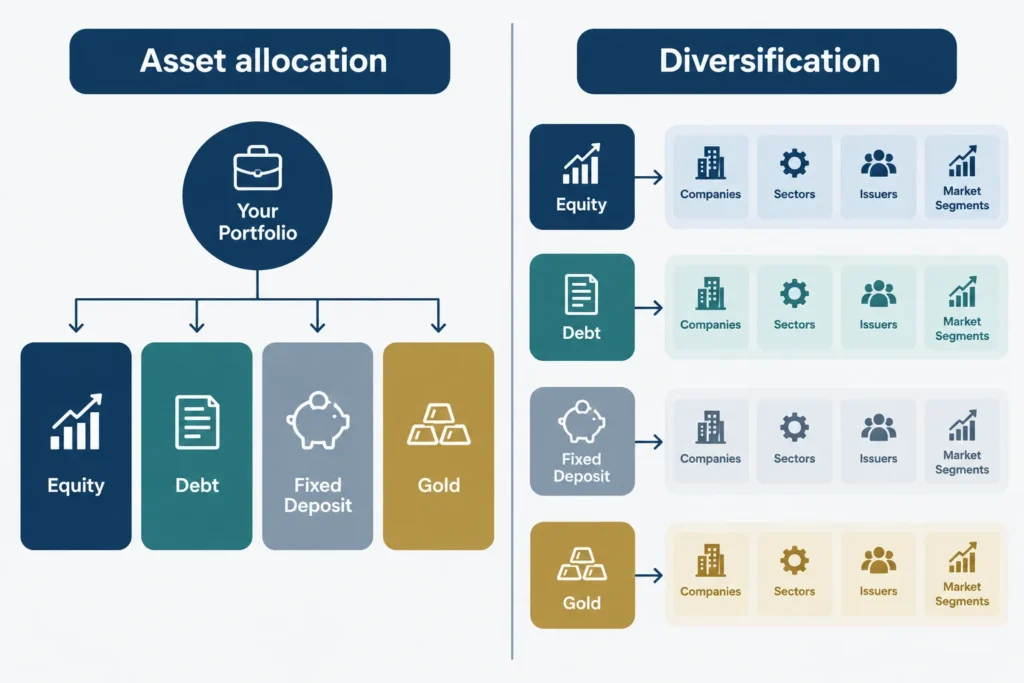
Diversification and asset allocation are closely connected, but they answer different questions.
Asset allocation decides how much of your portfolio should go into broad categories such as equity, debt, fixed deposits and gold.
Diversification decides how the money is spread within and across those categories.
| Concept | Main question | Simple example |
|---|---|---|
| Asset allocation | How much should go into each asset class? | Choosing to keep part of the portfolio in equity, part in debt and part in gold. |
| Diversification | How should investments be spread to avoid excessive dependence? | Using a broad equity fund instead of one stock and holding debt of suitable quality and maturity. |
Imagine that an investor chooses an allocation of 60% equity, 30% debt and 10% gold. That is an asset allocation decision. The investor must then decide how to diversify each part.
The equity portion might include a broad-market index fund and a diversified equity fund rather than one company’s shares. The debt portion might include an Employees’ Provident Fund balance, suitable debt securities or deposits with regulated institutions, depending on the investor’s needs. The gold portion could be held through an appropriate financial product rather than jewellery bought mainly for personal use.
Asset allocation sets the broad structure. Diversification helps make each part of that structure less dependent on a narrow outcome. Both should work together.
For a step-by-step approach to reviewing holdings, risk and rebalancing, the RegularStation portfolio management guide is the relevant next internal resource.
Main Benefits of Portfolio Diversification
The first benefit is reducing the effect of a poor result from one holding. If one company performs badly, gains or stability elsewhere may soften the impact on the full portfolio. The loss does not disappear, but it carries less weight than it would in a concentrated portfolio.
The second benefit is balancing exposure to different market conditions. Asset classes and sectors do not always react in the same way to inflation, interest rates, economic growth or global uncertainty.
For example, rising interest rates may create pressure for some highly valued shares while improving the rates available on new fixed deposits. Gold may behave differently during periods of economic uncertainty. Debt investments may provide greater stability than equity in some periods, although they also carry risks such as interest-rate and credit risk.
The third benefit is aligning investments with financial goals. Different goals often require different levels of risk.
- Short-term goal: Money needed for school fees next year generally requires stability and easy access. Heavy equity exposure may be unsuitable because the market could fall shortly before the payment is due.
- Medium-term goal: A home down payment planned several years away may use a cautious mix based on how flexible the purchase date is.
- Long-term goal: Retirement that is decades away may allow more equity exposure because there is more time to recover from market declines, subject to the investor’s risk tolerance.
Diversification can also make a portfolio easier to hold during difficult periods. If every investment falls for the same reason, an investor may panic and sell at the wrong time. A balanced portfolio may reduce extreme movements, though it cannot remove them.
Diversification Has Limits
Diversification is a risk-management tool, not a guarantee. During a broad market crash, many shares and equity funds may decline together. Debt investments can face defaults or price changes. Fixed deposits may lose purchasing power after inflation and tax. Gold can also fall or deliver weak returns for extended periods.
It is also possible to over-diversify. Owning too many stocks or funds can create duplication, increase monitoring work and make the portfolio difficult to understand. The objective is not to collect as many products as possible. It is to avoid unnecessary concentration while ensuring that every investment has a clear role.
A beginner should remember the central idea: do not let one company, one sector or one market outcome control the success of an important financial goal. Use asset allocation to choose the broad mix, and use portfolio diversification to spread risk sensibly within that mix. Neither approach can guarantee profits or prevent losses, but together they can create a more balanced and goal-focused investment plan.
Ways to Diversify a Portfolio in India
Portfolio diversification means spreading money across investments that do not depend on exactly the same source of return. The purpose is to reduce the damage that one company, sector or asset class can cause to the overall portfolio.
This does not mean buying investments at random. Each holding should have a role linked to your financial goal, time horizon and ability to handle losses. A diversified portfolio can still fall in value, especially during a broad market decline, but it is usually less dependent on a single investment outcome.
Spread Equity Exposure Across Companies
An equity portfolio that contains shares of only one or two companies is highly concentrated. Even a well-established company can face problems such as weak demand, regulatory action, poor management decisions or rising competition.
Spreading equity exposure across several suitable companies reduces company-specific risk. However, the number of shares alone does not prove that the portfolio is diversified. Ten companies from closely connected industries may react in similar ways.
For example, an investor might own shares of multiple public sector banks. This creates more company exposure than owning one bank, but the portfolio remains heavily dependent on the banking sector, interest-rate conditions and lending cycles.
Beginners who select individual shares should understand each business rather than adding companies only to increase the count. Owning too many shares without the time or knowledge to monitor them can make the portfolio difficult to manage.
Include Different Market Segments
Indian listed companies are commonly grouped by market capitalisation. Large-cap companies are generally more established, while mid-cap and small-cap companies may have greater growth potential but can experience sharper price movements and higher business risk.
A portfolio invested only in small companies may be vulnerable during periods when investors move away from higher-risk assets. On the other hand, investing only in large companies may leave out other parts of the market. The appropriate mix depends on the investor rather than on a fixed formula.
- Large-cap exposure: Usually provides access to established businesses, but prices can still decline and large companies can also underperform.
- Mid-cap exposure: May offer a balance between established operations and growth potential, along with meaningful volatility.
- Small-cap exposure: Can carry higher liquidity, governance and business risks, particularly during difficult market conditions.
Market-cap labels should not be treated as guarantees of quality. Investors must also consider valuation, financial strength and the suitability of the investment for their goals.
Spread Investments Across Sectors
Different sectors respond to different economic conditions. Banks may be affected by credit growth and bad loans. Information technology companies may be influenced by global technology spending and currency movements. Consumer businesses may depend on household demand, while metal companies can be affected by commodity prices.
Holding companies from several sectors can reduce dependence on one industry. Yet sector names can sometimes hide common risks. For instance, an automobile manufacturer, an auto-component company and a vehicle-finance business may all be affected by a slowdown in vehicle demand.
Sector diversification should therefore focus on the underlying drivers of each investment, not merely on collecting different labels.
Combine Different Asset Classes
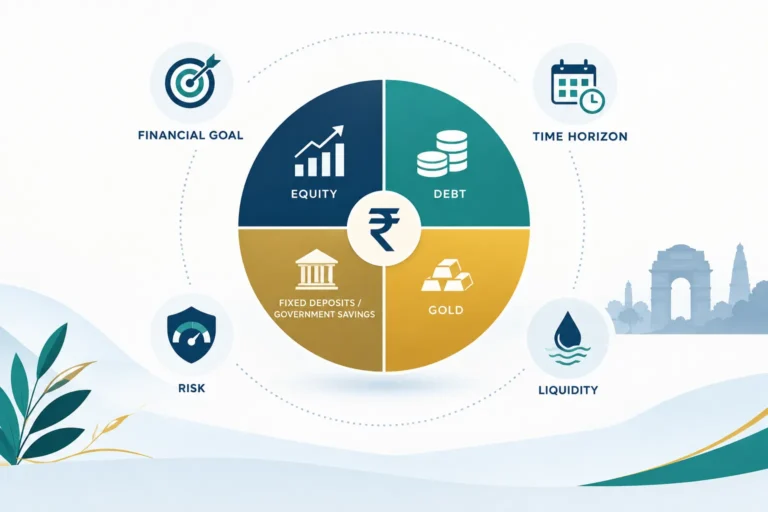
Portfolio diversification can also extend beyond shares. Equity, debt, bank fixed deposits and gold have different return drivers and risk characteristics. Combining them may help align the portfolio with a particular goal.
No asset class is completely risk-free or guaranteed to move independently of the others. During periods of market stress, several assets can fall together or behave differently from their historical patterns.
- Equity: Represents ownership in businesses. It can support long-term growth, but prices may fluctuate sharply and returns are not assured.
- Debt and other fixed-income products: May provide interest income and lower volatility than equity in some situations. They can still carry credit risk, interest-rate risk, liquidity risk and reinvestment risk.
- Bank fixed deposits: Offer a stated interest rate and predictable maturity value, subject to the deposit terms. Investors should consider bank-specific risk, premature-withdrawal rules, taxation and the applicable deposit-insurance limits.
- Gold: May provide a different source of return and can sometimes help during economic or currency uncertainty. Its price can also decline, and physical gold involves concerns such as storage, purity and transaction costs.
An asset should not be included merely because it performed well recently. Its purpose could be long-term growth, income, capital stability, liquidity or protection against a particular risk. One investment rarely performs all these roles equally well.
Use Mutual Funds to Access Multiple Securities
A mutual fund pools money from many investors and invests it according to a stated objective. An equity fund may hold shares of many companies, while a debt fund may hold government securities, corporate bonds or money-market instruments.
This structure can make it easier for beginners to access multiple securities without selecting and monitoring every holding directly. It does not automatically make every mutual fund suitable or adequately diversified.
For example, a broad-market fund and a diversified equity fund may hold many of the same large companies. Owning both could create less additional diversification than expected. A sector fund may hold multiple companies but remain concentrated in one industry.
Internal reading placement: Readers comparing fund structures can refer to RegularStation’s beginner guide to mutual funds in India and its guide to index funds. These guides can explain fund categories and costs separately without repeating them here.
Before investing, check the fund’s objective, portfolio, risk level, costs and overlap with existing investments. Debt mutual funds also require careful evaluation because they are not equivalent to bank deposits and their values can change.
Internal reading placement: For a closer look at fixed-income fund risks, place a reference here to RegularStation’s debt mutual fund guide.
Concentrated and Diversified Portfolios: A Hypothetical Comparison
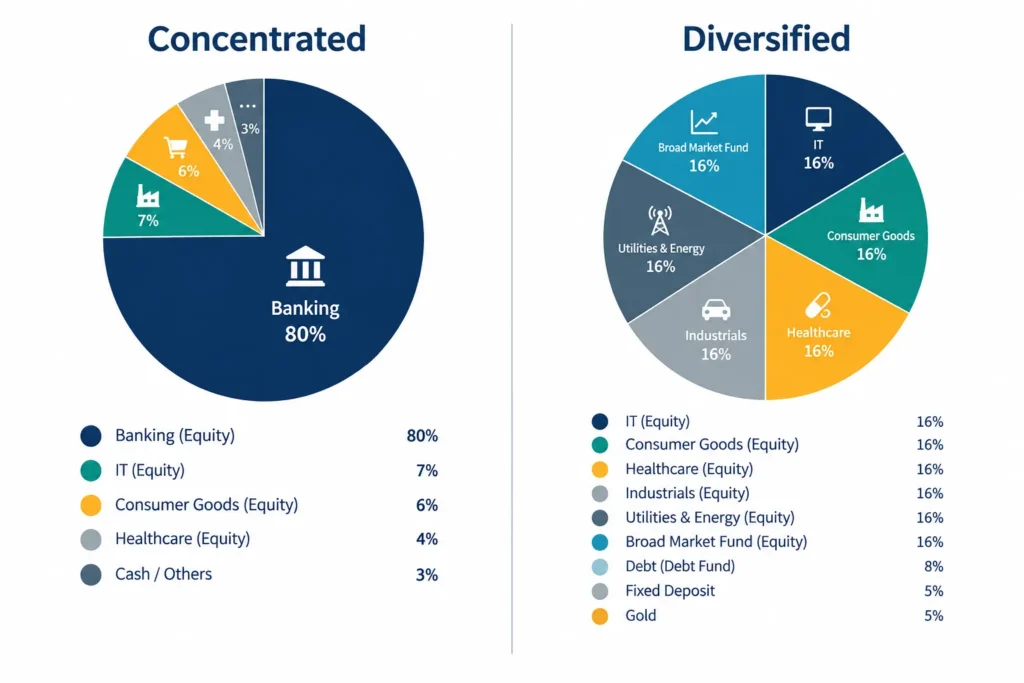
The following example is only an illustration. The allocations are not recommendations and may be unsuitable for a particular investor.
| Feature | Hypothetical concentrated portfolio | Hypothetical diversified portfolio |
|---|---|---|
| Indian banking shares | 70% | 10% |
| Shares from other sectors | 20% | 30% |
| Broad-market equity mutual fund | 0% | 20% |
| Debt or other fixed-income products | 0% | 20% |
| Bank fixed deposit | 10% | 15% |
| Gold | 0% | 5% |
| Main source of risk | Heavy dependence on one sector | Risks spread across companies, sectors and asset classes |
The diversified example still has risks. Equity can fall, debt issuers can face repayment problems, interest rates can affect bond prices, and gold may not provide protection when expected. Diversification manages concentration risk; it does not remove the possibility of loss.
Match Diversification to the Goal and Investor
There is no single diversified portfolio that works for everyone. The same asset mix can be appropriate for one person and unsuitable for another.
- Short-term goal: Money needed soon, such as for college fees next year, generally requires greater attention to capital stability and liquidity. Heavy equity exposure can create a risk that the money is unavailable at the required value.
- Long-term goal: A distant goal, such as retirement several decades away, may allow more equity exposure because there is more time to endure market fluctuations. The investor must still be emotionally and financially able to remain invested.
- Conservative investor: This investor may prefer a larger allocation to suitable deposits and fixed-income products, with limited equity exposure for growth. Inflation, taxation and credit risk should still be considered.
- Investor able to tolerate more volatility: This investor may hold a higher equity allocation across market segments and sectors. Higher risk tolerance does not justify excessive concentration or ignoring emergency needs.
Time horizon and risk tolerance should be assessed together. A young investor may have a long horizon but still be uncomfortable with large losses. Similarly, an experienced investor may accept volatility but need part of the money within a few years.
Remember That More Holdings Do Not Always Mean More Diversification
A portfolio can contain many investments and still behave like a concentrated one. Multiple mutual funds may own the same leading shares. Several companies may depend on the same commodity, customer group or economic cycle. A fixed deposit and a debt product may also have exposure to related issuers.
Review the portfolio as a whole rather than examining each holding in isolation. Look for repeated companies, sectors, issuers and return drivers. Genuine portfolio diversification comes from combining suitable investments with meaningfully different risks, not simply from increasing the number of items in the account.
Common Mistakes, Portfolio Review and Rebalancing
Portfolio diversification is not a one-time task. Even a well-planned portfolio can become unbalanced as markets move, goals change or new investments are added. Regular reviews can help you identify concentration, unnecessary duplication and an asset mix that no longer suits your needs.
Mistake 1: Owning Too Many Overlapping Mutual Funds
Buying several mutual funds does not automatically create better diversification. Two funds from different asset management companies may still hold many of the same large Indian companies.
For example, an investor may own three large-cap funds, two flexi-cap funds and a Nifty 50 index fund. Although this looks like six separate investments, their underlying portfolios may overlap substantially. The investor may repeatedly own the same banks, technology companies and consumer businesses.
Too many overlapping funds can make a portfolio difficult to monitor. They may also add little diversification while increasing paperwork and the chance of holding underperforming funds without a clear reason.
Before adding a fund, ask:
- What role will this fund play in my portfolio?
- Does an existing fund already provide similar exposure?
- Which sectors and major companies does it hold?
- Will it improve diversification or simply increase the number of folios?
Mistake 2: Putting Too Much Money in One Sector or Employer Stock
A sector may perform well for several years, encouraging investors to keep adding money to it. However, banking, technology, pharmaceuticals, infrastructure and other sectors can all face periods of weak performance.
Concentrated sector exposure can arise indirectly. You may own a sector fund, several individual stocks from that sector and diversified mutual funds that already have a large allocation to the same industry.
Employer stock requires particular care. Employees may receive shares through an employee stock option plan or buy company shares because they understand the business. But salary, career prospects and investments may then depend on the same company. A business setback could affect both employment income and investment value.
This does not mean that sector funds or employer shares must always be avoided. It means their place in the overall portfolio should be considered carefully rather than viewed in isolation.
Mistake 3: Confusing More Holdings with Genuine Diversification
A portfolio with 40 shares is not necessarily more diversified than one with 15. If most of those shares belong to closely related industries, respond to the same economic conditions or are all small companies, the portfolio may still carry substantial concentration risk.
Genuine diversification comes from combining investments with different risk drivers. This may include exposure across asset classes, sectors, company sizes and, where appropriate, geographies. The combination should also match the investor’s goals, time horizon and ability to handle losses.
Look through mutual funds and other pooled products when assessing exposure. Count what you effectively own, not merely the number of account entries.
Mistake 4: Ignoring Costs and Taxes
Costs reduce the return that remains with the investor. Depending on the product and transaction, these may include expense ratios, brokerage, securities transaction tax, stamp duty, account charges and exit loads.
Taxes can also affect the result when investments are sold or income is received. The applicable treatment may depend on factors such as the type of asset, holding period, investor status and rules in force at the time.
A complicated portfolio may create more transactions, records and tax calculations than necessary. Avoid buying or selling only to make the portfolio look perfectly balanced. The potential benefit should justify the costs, taxes and effort involved.
Indian investment regulations, product features and tax provisions can change. Current details should be checked from official documents or with a qualified professional before acting. Any older claim about tax rates, holding periods, product limits or regulatory rules should be verified rather than assumed to remain valid.
Mistake 5: Changing the Portfolio After Every Market Update
News about interest rates, elections, global conflicts, market corrections or a popular sector can create pressure to act immediately. Frequent changes based on headlines can turn a long-term investment plan into short-term speculation.
Investors may sell after prices have already fallen or buy an asset after a strong rise. Repeated reactions can also increase costs and taxes.
Your allocation should change mainly when your financial situation or investment plan changes, not simply because market sentiment changes. A predetermined review schedule can create useful distance from daily noise.
A Simple Portfolio Review Process
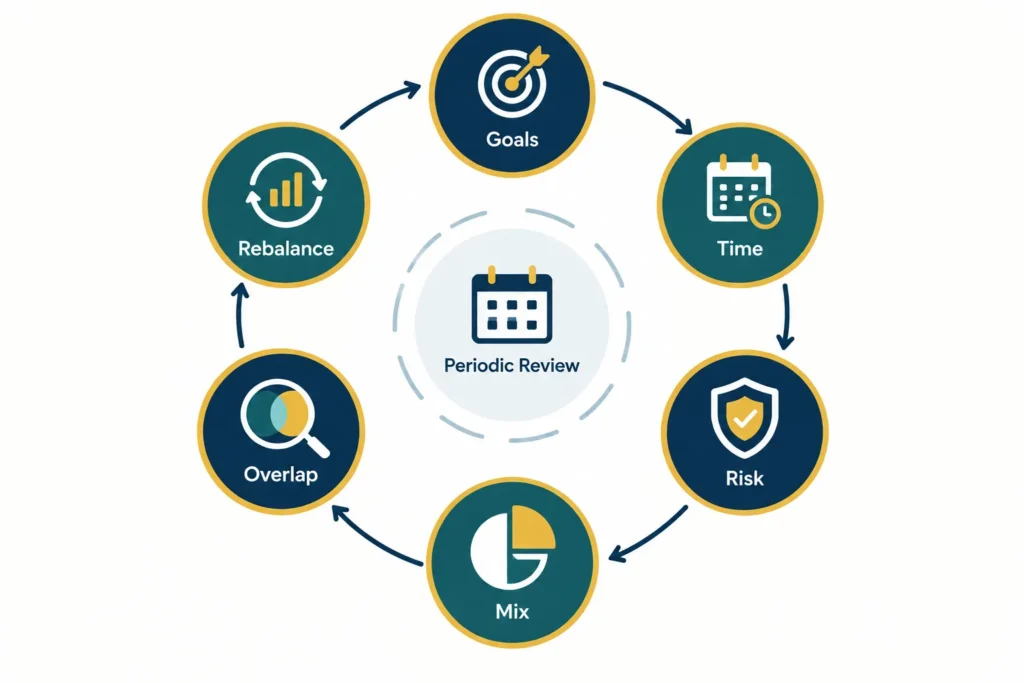
A review does not require daily tracking. Many long-term investors can use a periodic schedule, such as reviewing once or twice a year, along with additional reviews after a major life event.
- Revisit each goal: Confirm the amount required, expected date and importance of the goal. A house purchase in three years needs a different approach from retirement several decades away.
- Check the time horizon: As a goal gets closer, the capacity to recover from a sharp fall may reduce. The allocation may need to become more conservative gradually.
- Review risk tolerance and capacity: Consider both emotional comfort and financial ability to accept losses. Changes in income, dependants, debt or emergency savings may affect risk capacity.
- Calculate the actual allocation: Add investments across accounts and family portfolios where relevant. Compare the current percentages in equity, debt, cash and other assets with the intended allocation.
- Inspect concentration and overlap: Look for excessive exposure to one company, sector, fund category or asset class. Review major underlying holdings of mutual funds.
- Check costs and suitability: Confirm that each product still serves a clear purpose. Do not retain an unsuitable investment only because it was bought earlier.
- Record the decision: Note whether action is required and why. A brief written reason can reduce impulsive changes during the next market swing.
A review does not always need to result in a transaction. If the portfolio remains reasonably aligned with the plan, doing nothing may be appropriate.
What Is Portfolio Rebalancing?
Rebalancing means bringing a portfolio back towards its intended asset allocation. Suppose an investor starts with 60% in equity and 40% in debt. After a strong equity market, the allocation becomes 70% equity and 30% debt. The portfolio may now carry more risk than originally intended.
The investor could rebalance through measured actions:
- Direct new contributions towards the underweight asset class.
- Use interest, dividends or other cash flows to fill the gap.
- Reduce an overweight holding and move the proceeds to an underweight asset.
- Make changes gradually if immediate trading would create avoidable costs or tax consequences.
Rebalancing is not an attempt to predict which asset will perform best next. Its purpose is risk control and discipline. It encourages investors to follow an agreed allocation rather than allowing recent winners to dominate the portfolio.
Exact precision is usually unnecessary. Investors may review at fixed intervals or act when allocations move outside predetermined ranges. The method should be simple enough to follow consistently. Before selling, consider exit loads, liquidity, transaction costs and the applicable tax treatment.
Frequently Asked Questions
How often should I review my portfolio?
For many long-term investors, once or twice a year may be sufficient. An additional review may be useful after marriage, a job change, a major income change, taking a large loan or approaching an important financial goal.
Should I rebalance whenever the market falls?
Not automatically. First compare the actual allocation with your planned allocation and reassess your goal, time horizon and risk capacity. A market movement alone is not a complete reason to trade.
Is owning several mutual funds a problem?
Not necessarily. The issue is whether each fund has a distinct purpose. Several funds with similar portfolios may create duplication without meaningfully improving portfolio diversification.
Can I rebalance without selling investments?
Yes. New systematic investment plan contributions, lump-sum additions, interest or other available cash can be directed towards underweight assets. This may reduce unnecessary transactions, though it may take longer to restore the desired allocation.
Does rebalancing guarantee better returns?
No. Rebalancing cannot guarantee returns or prevent losses. It is mainly a way to keep portfolio risk closer to the level chosen for your financial plan.
Summary
Effective portfolio diversification depends on what you own, not simply how many investments appear in your account. Avoid overlapping funds, excessive sector or employer-stock exposure, unnecessary complexity and frequent reactions to market news.
Review the portfolio periodically by checking goals, time horizon, risk tolerance, actual asset allocation, concentration, costs and taxes. Rebalance through measured actions when the portfolio moves meaningfully away from its intended mix, while avoiding needless trading.
This article provides general educational information and is not personalised investment, legal or tax advice. Investment values can rise or fall, and returns are not guaranteed. Consider your circumstances and consult a qualified professional where necessary before making financial decisions.



Comments