
What Is Slippage in Crypto Trading? Causes and Examples

A beginner-friendly guide to slippage in crypto trading, with simple explanations of order books, liquidity pools, price differences, calculations and practical ways to manage execution costs.

What Is Slippage in Crypto Trading? Causes and Examples

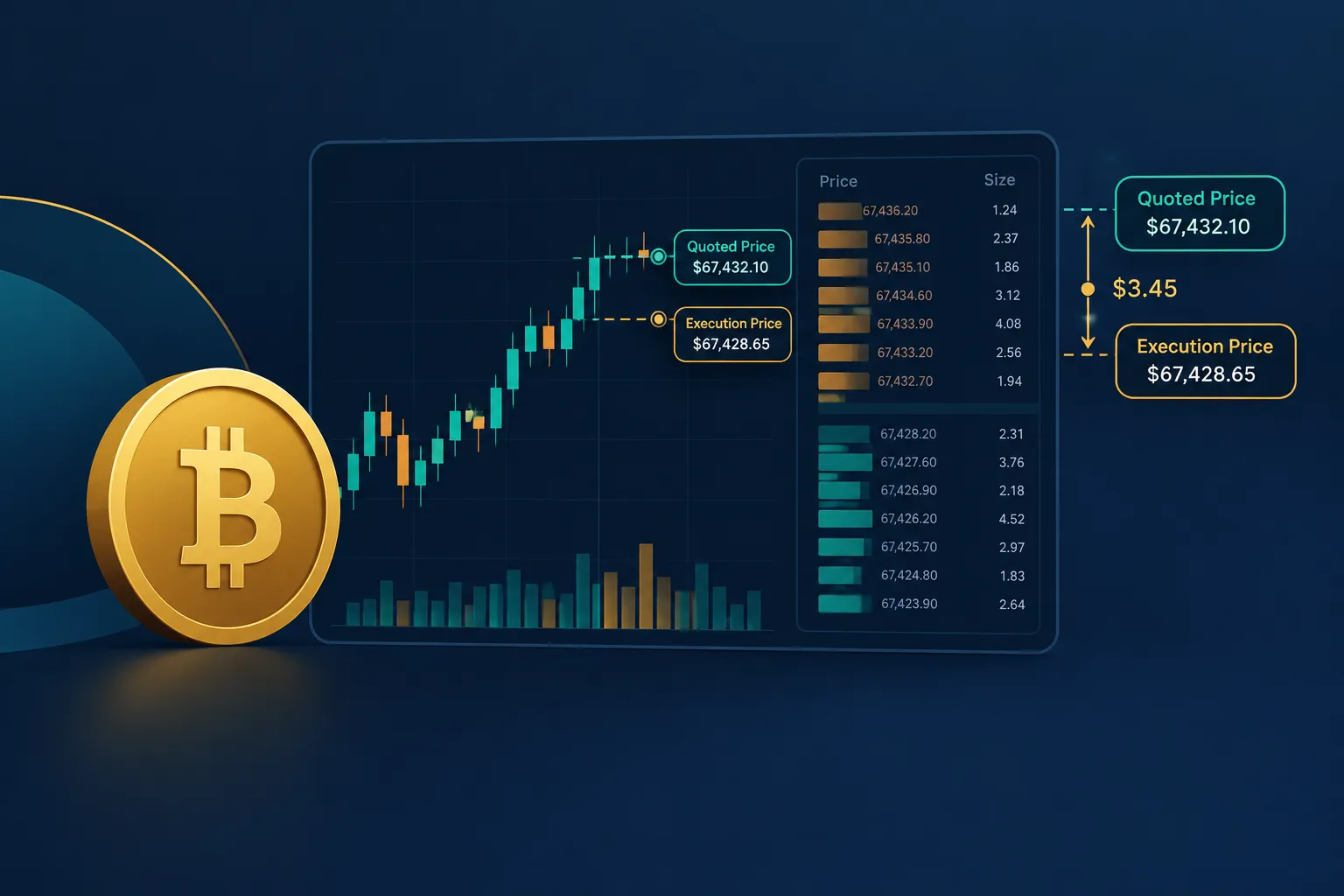
Quick answer: Slippage in crypto trading is the difference between the price you reasonably expected for a trade and the average price at which the trade was actually executed. It can occur when prices move quickly or when there is not enough liquidity available at the expected price. Slippage may be negative, which gives you a worse price, or positive, which gives you a better price. It is an execution outcome, not a platform fee.

Introduction

You open a crypto exchange and see Bitcoin available at ₹50,00,000. You place a market buy order, but the completed order shows an average purchase price of ₹50,10,000. The extra ₹10,000 per Bitcoin may be due to slippage.

This difference can feel surprising to a beginner. However, the displayed price is not always a promise. Crypto prices can change within seconds, and the quantity available at a particular price may be limited. By the time your order reaches the market, or as it is being filled, the available price may have changed.

Slippage is especially important when using market orders, trading a large amount, dealing in less liquid crypto assets, or swapping tokens through a decentralised exchange. Understanding it helps you read trade confirmations correctly and choose more suitable order settings.

Before placing trades, beginners should understand the fundamentals of crypto trading, including market orders, limit orders and price movements.

Section 1: Slippage Basics and How Trade Execution Works

What Is Slippage in Crypto Trading?

Slippage in crypto trading is the difference between an identified expected or reference execution price and the actual average execution price of an order.

The reference price depends on the type of trade and the trading venue. It could be:

  • The best available ask price when you are buying on an order-book exchange.
  • The best available bid price when you are selling on an order-book exchange.
  • The quoted swap price shown by a decentralised exchange before you confirm a token swap.

Choosing the correct reference price matters. Some traders compare their execution price with the last traded price shown on the screen. This can give a misleading result because the last trade may have happened moments earlier or on the opposite side of the market.

For example, suppose the best bid is ₹8,000 and the best ask is ₹8,050. A buyer can currently buy at the ₹8,050 ask. If the buyer compares this with a last traded price of ₹8,000, the ₹50 difference may mostly represent the bid-ask spread rather than slippage.

A more useful comparison would be between the best ask of ₹8,050 available when the buy order was submitted and the order’s actual average execution price. This keeps the spread and slippage conceptually separate.

Slippage Can Be Positive or Negative

Slippage is not automatically a loss. The market can move in your favour while an order is being processed.

For a buyer, paying more than the reference price is negative slippage. Paying less is positive slippage. For a seller, receiving less than the reference price is negative slippage, while receiving more is positive slippage.

Slippage is also not the same as a trading fee. An exchange may separately charge a fee for executing the transaction. On a blockchain, you may also pay a network or gas fee. These costs can appear alongside slippage, but they are different.

Suppose you expect to buy a token at ₹1,000 and the trade executes at an average of ₹1,008. The ₹8 difference is the execution slippage. If the exchange separately charges a trading fee, that fee should not be added to the execution price difference when measuring slippage.

Why the Execution Price Can Change

Slippage commonly appears in two situations: the market price moves before the order is completed, or the order uses up the quantity available at the best price.

Crypto markets can move quickly after major news, sharp changes in Bitcoin’s price, a large purchase or sale, or a sudden increase in trading activity. Even a short delay between viewing a quote and completing a trade can result in a different execution price.

Liquidity also matters. Liquidity describes how easily an asset can be bought or sold without causing a substantial price change. A liquid market usually has many buyers and sellers offering meaningful quantities at prices close to one another.

A thin or less liquid market has fewer orders available. In such a market, even a moderately sized trade may need to execute at several price levels.

You May Also Like:What Are Crypto Candlestick Charts? A Beginner’s Guide

How Slippage Works on a Centralised Exchange

Order-book diagram showing a 60-token market buy filling across three ask prices for an average execution price of ₹101.

Many centralised crypto exchanges match buyers and sellers through an order book. An order book is a live list of offers to buy and sell an asset.

  • Bids are prices at which traders are willing to buy.
  • Asks are prices at which traders are willing to sell.
  • Best bid is the highest currently available buying price.
  • Best ask is the lowest currently available selling price.
  • Bid-ask spread is the gap between the best bid and best ask.

A market order instructs the exchange to buy or sell immediately at the best available prices. It prioritises execution, but it does not normally guarantee one exact price.

Imagine that an order book contains the following sell offers for a token:

Ask priceQuantity available
₹10020 tokens
₹10130 tokens
₹10350 tokens

If you submit a market order to buy 10 tokens, the full order may execute at ₹100 because 20 tokens are available there. If nothing changes during execution, there would be no slippage against the ₹100 best ask.

Now suppose you place a market order for 60 tokens. The order could buy 20 tokens at ₹100, 30 at ₹101 and the remaining 10 at ₹103. Your order has consumed liquidity at multiple price levels.

The total cost would be ₹6,060, producing an average execution price of ₹101 per token. Compared with the initial best ask of ₹100, the negative slippage for the buyer is ₹1 per token, or 1% of the reference price. This excludes any separate exchange fee.

This example also explains order-book depth. Depth refers to how much buying or selling quantity is available across different price levels. A deep order book can often absorb a larger trade with less price impact. A shallow order book may produce a larger difference between the first available price and the final average price.

How Slippage Works on a Decentralised Exchange

A decentralised exchange, or DEX, may execute token swaps through a liquidity pool rather than a traditional order book. A liquidity pool holds reserves of two or more assets in a smart contract. Traders swap against these reserves.

An automated market maker, commonly called an AMM, uses a formula or another pricing mechanism to determine the swap price. As a trade changes the quantities held in the pool, the price offered by the mechanism can also change.

Suppose you want to swap rupee-linked stablecoin tokens for another crypto token. The DEX first shows a quote based on current pool conditions. If your trade is small relative to the available liquidity, its effect on the price may be limited. If your trade is large relative to the pool, the amount received per unit may become less favourable as the swap progresses.

The executed result may also differ from the quote if other users trade with the pool before your transaction is confirmed on the blockchain. Pool reserves and market conditions can change during that waiting period.

Many DEX interfaces use a slippage tolerance setting. This generally defines how much the execution result may move against the quoted result before the transaction is rejected. A wider tolerance may make execution more likely, but it can also permit a less favourable outcome. A very tight tolerance can cause the transaction to fail when the market is moving.

Not every DEX uses the same AMM model, pool design, routing process or slippage setting. Some trades may be split across several pools, while other platforms may use concentrated liquidity or different pricing rules. The basic point remains the same: trade size, available liquidity and changes before confirmation can affect the final execution.

Positive Versus Negative Slippage

TradeActual price versus referenceSlippage resultEffect on trader
BuyLower actual pricePositiveBuyer pays less
BuyHigher actual priceNegativeBuyer pays more
SellHigher actual pricePositiveSeller receives more
SellLower actual priceNegativeSeller receives less

Consider a hypothetical buy order with a reference ask of ₹2,000. If the order executes at an average of ₹1,990, the buyer receives positive slippage of ₹10 per token because the lower purchase price is favourable. If it executes at ₹2,020, the buyer experiences negative slippage of ₹20 per token.

For a sell order, suppose the reference bid is ₹2,000. An average execution price of ₹2,015 creates positive slippage because the seller receives ₹15 more per token. An execution price of ₹1,980 creates negative slippage because the seller receives ₹20 less.

The key is to judge the direction from the trader’s side. A lower execution price favours a buyer, while a higher execution price favours a seller. Slippage therefore describes the difference in execution, not simply whether the market price went up or down.

Slippage in crypto trading occurs when an order is executed at a price different from the price you expected. The difference may be favourable or unfavourable. It depends on whether you are buying or selling and how the market moves before the order is completed.

Slippage can happen on both centralised exchanges and decentralised exchanges, but the causes do not operate in exactly the same way. A centralised exchange usually matches orders through an order book. A decentralised exchange may determine prices through a liquidity pool and an automated formula.

Main Causes of Slippage

The following factors commonly create or increase slippage.

  • Low liquidity: A market has low liquidity when there are not enough buyers, sellers or pooled assets near the current price. Even a moderate order may then have to execute at several different prices.
  • Thin order book: On an order-book exchange, the best displayed price may be available for only a small quantity. The remaining part of a larger order moves to the next available price levels.
  • Large order size: An order that is large compared with the available liquidity can consume multiple order-book levels or significantly change the ratio of assets in a decentralised exchange pool.
  • High volatility: Crypto prices can change quickly. During a sharp rise or fall, the quoted price may disappear before the exchange executes the order.
  • Rapid market movement: News, liquidations or sudden buying and selling can cause prices to move in seconds. A market order prioritises execution, not a fixed price, so it is particularly exposed.
  • Execution delays: There may be a small gap between placing an order and completing it. System load, routing delays or slow connectivity can increase the chance that the market price changes during this period.
  • DEX pool mechanics: Many decentralised exchanges use liquidity pools rather than traditional order books. A trade changes the ratio of tokens in the pool, which can change the price received as the order is processed.
  • Network congestion: On-chain transactions may take longer to confirm when a blockchain is congested. The pool price can move while the transaction is waiting. Network fees may also rise, although those fees are a separate cost and are not slippage.
You May Also Like:Crypto Spot Trading vs Futures Trading: Key Differences for Beginners

Centralised exchanges are generally more affected by order-book depth, available quotes and matching speed. Decentralised exchanges are more directly affected by pool size, pool ratios, transaction ordering and blockchain confirmation conditions.

Slippage, Spread, Fees and Price Impact

Comparison graphic distinguishing slippage, bid-ask spread, trading fees, and price impact.

Several trading costs can appear together, but they should not be treated as the same thing.

ItemWhat it meansWhen it arises
SlippageThe difference between the expected price and the actual execution priceWhen the available or final execution price changes from the chosen reference price
Bid-ask spreadThe difference between the highest buying price and the lowest selling priceIt exists because buyers and sellers quote different prices
Trading feeA charge imposed by the exchange or trading protocolIt is usually calculated separately based on trade value or platform rules
Price impactThe price change associated with consuming available order-book liquidity or changing a liquidity pool ratioIt becomes more important when an order is large relative to available liquidity

A wide bid-ask spread can make an immediate trade appear expensive. For example, suppose the last traded price is ₹100, the highest bid is ₹99 and the lowest ask is ₹101. A market buy may begin near ₹101 even if the trader expected ₹100 after looking at the last traded price.

In that comparison, the apparent ₹1 difference may include the effect of crossing the spread. It should not automatically be described entirely as slippage. The spread already existed before the order was placed, while slippage concerns the difference between a suitable expected price and the actual execution price.

This is why the reference price matters. Comparing execution with the current best ask is usually more meaningful for a buy order than comparing it with the last traded price. For a sell order, the current best bid may be a more suitable reference.

Price impact is also related to slippage but remains a separate idea. If a large market order consumes several order-book levels, the trader’s own order contributes to a worse average price. On a decentralised exchange, the trade may change the pool ratio and move the quoted price. This price impact can contribute to the difference eventually seen at execution.

Understanding how to read crypto charts can help traders recognise price movements and market conditions that may affect trade execution.

How to Calculate Slippage

The percentage difference between the executed price and expected price can be calculated as follows:

Slippage (%) = ((Executed Price − Expected Price) / Expected Price) × 100

The sign of this calculation cannot be interpreted without knowing whether the transaction is a buy or a sell. A higher execution price is unfavourable for a buyer but favourable for a seller. A lower execution price is favourable for a buyer but unfavourable for a seller.

Traders also use the terms “positive slippage” and “negative slippage” to describe the outcome. Positive slippage generally means the trader received a better price, while negative slippage means the trader received a worse price. This favourable-or-unfavourable terminology may not match the mathematical sign produced by the formula.

Illustration 1: Negative-Slippage Buy

Suppose a trader expects to buy a token at ₹1,000, but the order is executed at ₹1,020.

Slippage = ((₹1,020 − ₹1,000) / ₹1,000) × 100 = 2%

The formula produces positive 2%, but the buyer paid more than expected. The outcome is therefore commonly called negative slippage because it is unfavourable to the buyer.

If the trader bought 10 tokens, the expected purchase value was ₹10,000, while the actual purchase value was ₹10,200. Any exchange trading fee would be added separately.

Illustration 2: Positive-Slippage Buy

Now suppose a trader expects to buy a token at ₹1,000, but the order is executed at ₹980.

Slippage = ((₹980 − ₹1,000) / ₹1,000) × 100 = −2%

The mathematical result is negative 2%, but the buyer received a lower and therefore better price. This is commonly called positive slippage because the outcome favours the buyer.

For a seller, the interpretation would be reversed. Selling above the expected price is favourable, while selling below it is unfavourable.

Illustration 3: Multi-Level Order-Book Market Order

Assume a trader places a market order to buy 2.5 ETH. The best ask is ₹2,50,000, but only 0.8 ETH is available at that price. The exchange fills the rest of the order at higher price levels.

Execution price per ETHQuantity filledCost
₹2,50,0000.8 ETH₹2,00,000
₹2,51,0001.0 ETH₹2,51,000
₹2,52,0000.7 ETH₹1,76,400
Total2.5 ETH₹6,27,400

The weighted average execution price is calculated by dividing the total cost by the total quantity:

₹6,27,400 / 2.5 ETH = ₹2,50,960 per ETH

If the best ask of ₹2,50,000 was the expected price, the percentage difference is:

((₹2,50,960 − ₹2,50,000) / ₹2,50,000) × 100 = 0.384%

The buyer experienced an unfavourable average execution because the order consumed liquidity at three price levels. This is an example of price impact contributing to slippage.

Finally, keep the full cost breakdown clear. The reference price is the price used to form the expectation. The average execution price reflects all fills in the completed order. The trading fee is a separate platform charge. The total transaction cost includes the actual purchase value plus applicable trading and network fees. Keeping these figures separate makes it easier to understand what the trade truly cost and which part came from slippage.

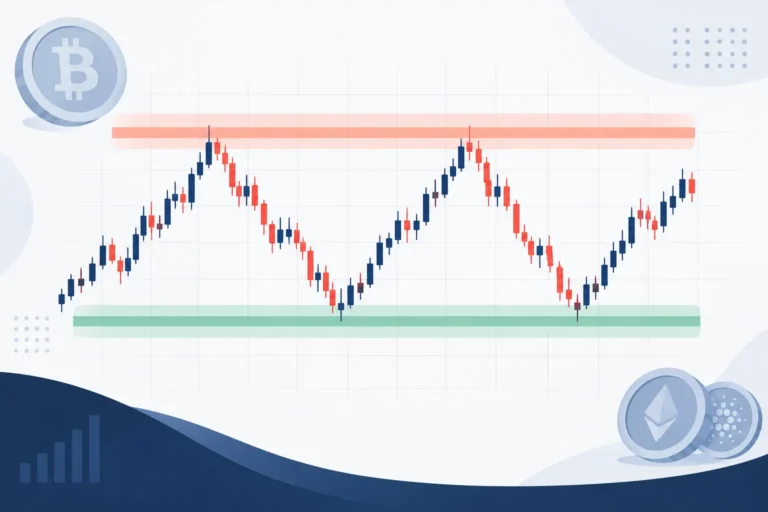
Market conditions near important crypto support and resistance levels may also influence price movement and trading activity.”

Slippage Tolerance, Reduction Methods and Common Mistakes

DEX flowchart showing how a 1% slippage tolerance can allow execution within a price band or cause a trade to revert.

What Is Slippage Tolerance on a DEX?

Slippage tolerance is the maximum permitted price movement or execution difference for a decentralised exchange transaction under the interface or protocol rules. It is usually entered as a percentage.

For example, suppose a token swap shows an estimated output of 1,000 tokens. If the tolerance is 1%, the transaction may proceed with a lower output within the permitted conditions. The exact treatment depends on the DEX, network and transaction design.

A tolerance setting is not a promise that you will receive the displayed price. It defines how much movement you are prepared to permit before the transaction should fail or revert.

If market conditions move beyond the permitted limit before execution, the swap may not complete. However, a failed transaction can still involve network costs on some blockchains because validators processed the attempted transaction.

Setting an excessively high tolerance may reduce the chance of failure, but it can also allow materially worse execution. This is particularly risky in volatile or illiquid token pools.

Network congestion can increase the time between submitting and confirming a transaction. A longer delay may increase exposure to price changes. However, transaction behaviour varies across networks, DEXs, liquidity pools and routing methods.

You May Also Like:Fundamental Analysis vs Technical Analysis: Key Differences Explained

Practical Ways to Reduce Slippage

Slippage cannot always be prevented. The following methods can help manage it, but each involves a trade-off.

  • Consider limit orders: A limit order sets the highest price you will pay or the lowest price you will accept. It provides price control, but the order may remain open or never fill.
  • Use more liquid trading pairs: Pairs with greater available liquidity can often absorb an order with less movement across price levels. Liquidity can still change quickly.
  • Inspect order-book depth: On a centralised exchange, check how much quantity is available at each price rather than relying only on the best quoted price.
  • Avoid extreme volatility where practical: Rapid markets can change between order submission and execution. Waiting may reduce urgency-related risk, but prices may also move away while you wait.
  • Consider splitting a large order: Several smaller orders may reduce the immediate effect on available liquidity. However, splitting can increase fees, execution time and exposure to changing prices.
  • Use a sensible DEX tolerance: A very tight setting may cause repeated failures, while a very high setting may permit poor execution. The appropriate setting depends on liquidity, volatility, network conditions and the transaction structure.
  • Assess the total trading cost: Compare fees, bid-ask spread, slippage and network charges together. A platform with a low stated fee is not necessarily the cheapest place to execute a particular trade.

Why Checking Order-Book Depth Matters

Consider a market buy for 10 units of a crypto asset. The lowest sell order may offer only two units at ₹5,000. The next three units may be available at ₹5,020, while the remaining five units may be offered at ₹5,060.

The visible best price is ₹5,000, but the full order cannot fill there. The average fill price would be ₹5,039 in this simplified example:

((2 × ₹5,000) + (3 × ₹5,020) + (5 × ₹5,060)) ÷ 10 = ₹5,039

If ₹5,000 is used as the reference price, the buyer experiences negative slippage of ₹39 per unit, or about 0.78%. Viewing the order-book depth before placing the order would not guarantee a particular result, but it would show that only a small quantity was available at ₹5,000.

Is Slippage Always Bad?

No. Negative slippage means the execution is worse than the reference price. A buyer pays more, or a seller receives less.

Positive slippage means the execution is better than the reference price. A buyer pays less, or a seller receives more. It can occur when the market moves favourably or when better-priced liquidity becomes available.

Market orders generally prioritise execution certainty over price certainty. Limit orders prioritise price control, but they sacrifice certainty of execution. Choosing between them involves deciding which risk matters more for the particular transaction.

Common Slippage Mistakes

  • Treating slippage as a fee: Slippage is an execution-price difference, not a charge collected in the same way as an exchange or network fee.
  • Using only the last traded price: The last price may relate to a small or older trade. It does not show whether enough liquidity is currently available.
  • Ignoring the average fill price: A large order can fill across several levels. The average price is more informative than the price of the first fill.
  • Selecting a very high DEX tolerance: This may allow the transaction to complete at a substantially worse rate.
  • Assuming limit orders guarantee fills: A limit order controls the acceptable price, but it may fill only partly or not at all.
  • Overlooking spread and network costs: A trade can have low slippage but still be expensive after the bid-ask spread, platform fee and blockchain charge are included.

Before trading any digital asset, it is important to research a cryptocurrency before trading it and understand its risks, liquidity and market behaviour.

Frequently Asked Questions

1. What is slippage in crypto trading?

Slippage in crypto trading is the difference between a reference or expected price and the actual average execution price. It often occurs because prices or available liquidity change while an order is being filled.

2. Is crypto slippage a trading fee?

No. A trading fee is charged by an exchange, broker or protocol. Slippage is a difference in execution price. Both can affect the total cost of a trade.

3. Can slippage be positive?

Yes. Positive slippage occurs when execution is better than the chosen reference price, such as when a buyer pays less than expected.

You May Also Like:Demat Account vs Trading Account: Key Differences Explained

4. What is negative slippage?

Negative slippage is an unfavourable execution difference. A buyer pays more than the reference price, or a seller receives less.

5. Why do market orders face slippage?

A market order takes the best available liquidity until the requested quantity is filled. If there is not enough quantity at the first price, the order moves through worse price levels.

6. Can limit orders prevent slippage?

Limit orders can prevent execution beyond the stated limit price. They do not guarantee a full fill, an immediate fill or any fill at all.

7. What is slippage tolerance on a DEX?

It is the maximum permitted movement or execution difference under the DEX interface or protocol conditions. It is not a guaranteed execution price.

8. What happens when a DEX trade exceeds the tolerance?

The transaction may fail or revert. Depending on the network and transaction design, the user may still incur a blockchain transaction cost.

9. How is slippage calculated?

A common calculation is: ((execution price − reference price) ÷ reference price) × 100. The sign must be interpreted according to whether the transaction is a buy or a sell.

10. What is the difference between slippage and spread?

The spread is the gap between the best available buy and sell quotes. Slippage is the difference between a selected reference price and the actual execution price.

11. What is the difference between slippage and price impact?

Price impact is the price movement linked to the order consuming available liquidity. Slippage is the broader difference between reference and execution prices, which may also reflect market movement, delays or changing orders.

12. How can beginners reduce slippage?

Beginners can inspect liquidity and order-book depth, consider limit orders, use liquid pairs, avoid extreme volatility where practical, choose sensible DEX tolerance settings and compare fees, spread, network costs and slippage together.

Conclusion

Understanding slippage in crypto trading starts with choosing a clear reference price and comparing it with the actual average fill price. Liquidity, order size, volatility, network delays and execution method can all influence the result.

Market orders offer greater execution certainty but less price control. Limit orders offer price control but may not fill. On a DEX, a tight tolerance can lead to failed transactions, while an excessive tolerance can permit worse execution. Checking depth, calculating slippage correctly and assessing every trading cost together can help beginners understand these trade-offs without assuming that any method can guarantee a particular outcome.

Share this article
KEEP READING

Related Articles

View all →

Comments

Leave a Comment

What Is Slippage in Crypto Trading? Causes and Examples

Quick answer: Slippage in crypto trading is the difference between the price you reasonably expected for a trade and the average price at which the trade was actually executed. It can occur when prices move quickly or when there is not enough liquidity available at the expected price. Slippage may be negative, which gives you a worse price, or positive, which gives you a better price. It is an execution outcome, not a platform fee.

Introduction

You open a crypto exchange and see Bitcoin available at ₹50,00,000. You place a market buy order, but the completed order shows an average purchase price of ₹50,10,000. The extra ₹10,000 per Bitcoin may be due to slippage.

This difference can feel surprising to a beginner. However, the displayed price is not always a promise. Crypto prices can change within seconds, and the quantity available at a particular price may be limited. By the time your order reaches the market, or as it is being filled, the available price may have changed.

Slippage is especially important when using market orders, trading a large amount, dealing in less liquid crypto assets, or swapping tokens through a decentralised exchange. Understanding it helps you read trade confirmations correctly and choose more suitable order settings.

Before placing trades, beginners should understand the fundamentals of crypto trading, including market orders, limit orders and price movements.

Section 1: Slippage Basics and How Trade Execution Works

What Is Slippage in Crypto Trading?

Slippage in crypto trading is the difference between an identified expected or reference execution price and the actual average execution price of an order.

The reference price depends on the type of trade and the trading venue. It could be:

  • The best available ask price when you are buying on an order-book exchange.
  • The best available bid price when you are selling on an order-book exchange.
  • The quoted swap price shown by a decentralised exchange before you confirm a token swap.

Choosing the correct reference price matters. Some traders compare their execution price with the last traded price shown on the screen. This can give a misleading result because the last trade may have happened moments earlier or on the opposite side of the market.

For example, suppose the best bid is ₹8,000 and the best ask is ₹8,050. A buyer can currently buy at the ₹8,050 ask. If the buyer compares this with a last traded price of ₹8,000, the ₹50 difference may mostly represent the bid-ask spread rather than slippage.

A more useful comparison would be between the best ask of ₹8,050 available when the buy order was submitted and the order’s actual average execution price. This keeps the spread and slippage conceptually separate.

Slippage Can Be Positive or Negative

Slippage is not automatically a loss. The market can move in your favour while an order is being processed.

For a buyer, paying more than the reference price is negative slippage. Paying less is positive slippage. For a seller, receiving less than the reference price is negative slippage, while receiving more is positive slippage.

Slippage is also not the same as a trading fee. An exchange may separately charge a fee for executing the transaction. On a blockchain, you may also pay a network or gas fee. These costs can appear alongside slippage, but they are different.

Suppose you expect to buy a token at ₹1,000 and the trade executes at an average of ₹1,008. The ₹8 difference is the execution slippage. If the exchange separately charges a trading fee, that fee should not be added to the execution price difference when measuring slippage.

Why the Execution Price Can Change

Slippage commonly appears in two situations: the market price moves before the order is completed, or the order uses up the quantity available at the best price.

Crypto markets can move quickly after major news, sharp changes in Bitcoin’s price, a large purchase or sale, or a sudden increase in trading activity. Even a short delay between viewing a quote and completing a trade can result in a different execution price.

Liquidity also matters. Liquidity describes how easily an asset can be bought or sold without causing a substantial price change. A liquid market usually has many buyers and sellers offering meaningful quantities at prices close to one another.

A thin or less liquid market has fewer orders available. In such a market, even a moderately sized trade may need to execute at several price levels.

How Slippage Works on a Centralised Exchange
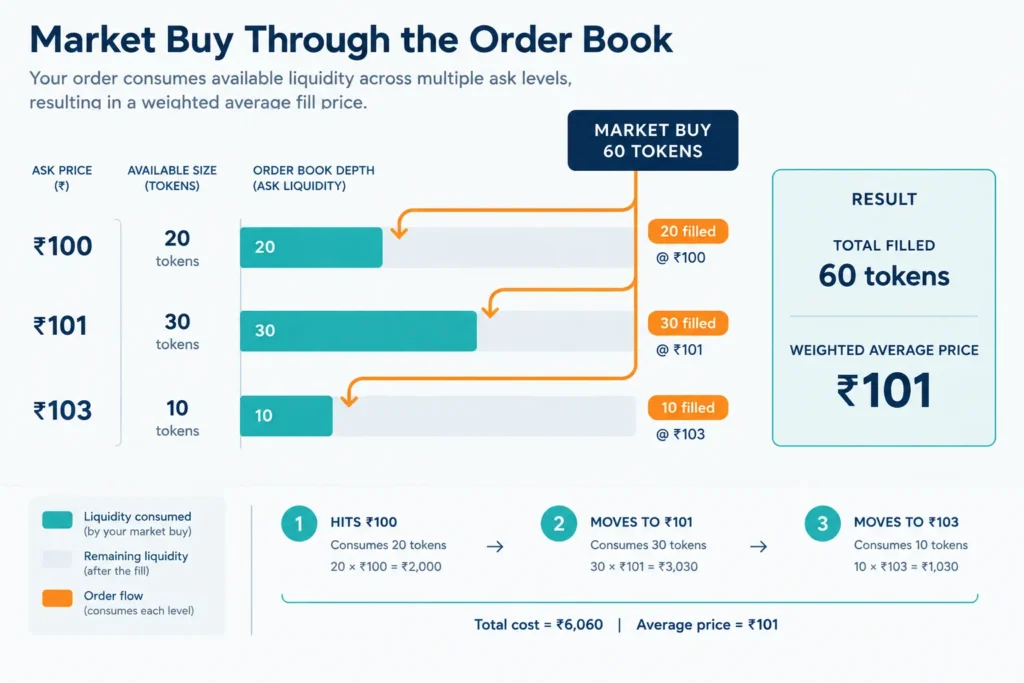
Order-book diagram showing a 60-token market buy filling across three ask prices for an average execution price of ₹101.

Many centralised crypto exchanges match buyers and sellers through an order book. An order book is a live list of offers to buy and sell an asset.

  • Bids are prices at which traders are willing to buy.
  • Asks are prices at which traders are willing to sell.
  • Best bid is the highest currently available buying price.
  • Best ask is the lowest currently available selling price.
  • Bid-ask spread is the gap between the best bid and best ask.

A market order instructs the exchange to buy or sell immediately at the best available prices. It prioritises execution, but it does not normally guarantee one exact price.

Imagine that an order book contains the following sell offers for a token:

Ask priceQuantity available
₹10020 tokens
₹10130 tokens
₹10350 tokens

If you submit a market order to buy 10 tokens, the full order may execute at ₹100 because 20 tokens are available there. If nothing changes during execution, there would be no slippage against the ₹100 best ask.

Now suppose you place a market order for 60 tokens. The order could buy 20 tokens at ₹100, 30 at ₹101 and the remaining 10 at ₹103. Your order has consumed liquidity at multiple price levels.

The total cost would be ₹6,060, producing an average execution price of ₹101 per token. Compared with the initial best ask of ₹100, the negative slippage for the buyer is ₹1 per token, or 1% of the reference price. This excludes any separate exchange fee.

This example also explains order-book depth. Depth refers to how much buying or selling quantity is available across different price levels. A deep order book can often absorb a larger trade with less price impact. A shallow order book may produce a larger difference between the first available price and the final average price.

How Slippage Works on a Decentralised Exchange

A decentralised exchange, or DEX, may execute token swaps through a liquidity pool rather than a traditional order book. A liquidity pool holds reserves of two or more assets in a smart contract. Traders swap against these reserves.

An automated market maker, commonly called an AMM, uses a formula or another pricing mechanism to determine the swap price. As a trade changes the quantities held in the pool, the price offered by the mechanism can also change.

Suppose you want to swap rupee-linked stablecoin tokens for another crypto token. The DEX first shows a quote based on current pool conditions. If your trade is small relative to the available liquidity, its effect on the price may be limited. If your trade is large relative to the pool, the amount received per unit may become less favourable as the swap progresses.

The executed result may also differ from the quote if other users trade with the pool before your transaction is confirmed on the blockchain. Pool reserves and market conditions can change during that waiting period.

Many DEX interfaces use a slippage tolerance setting. This generally defines how much the execution result may move against the quoted result before the transaction is rejected. A wider tolerance may make execution more likely, but it can also permit a less favourable outcome. A very tight tolerance can cause the transaction to fail when the market is moving.

Not every DEX uses the same AMM model, pool design, routing process or slippage setting. Some trades may be split across several pools, while other platforms may use concentrated liquidity or different pricing rules. The basic point remains the same: trade size, available liquidity and changes before confirmation can affect the final execution.

Positive Versus Negative Slippage

TradeActual price versus referenceSlippage resultEffect on trader
BuyLower actual pricePositiveBuyer pays less
BuyHigher actual priceNegativeBuyer pays more
SellHigher actual pricePositiveSeller receives more
SellLower actual priceNegativeSeller receives less

Consider a hypothetical buy order with a reference ask of ₹2,000. If the order executes at an average of ₹1,990, the buyer receives positive slippage of ₹10 per token because the lower purchase price is favourable. If it executes at ₹2,020, the buyer experiences negative slippage of ₹20 per token.

For a sell order, suppose the reference bid is ₹2,000. An average execution price of ₹2,015 creates positive slippage because the seller receives ₹15 more per token. An execution price of ₹1,980 creates negative slippage because the seller receives ₹20 less.

The key is to judge the direction from the trader’s side. A lower execution price favours a buyer, while a higher execution price favours a seller. Slippage therefore describes the difference in execution, not simply whether the market price went up or down.

Causes, Related Trading Costs and Slippage Calculations

Slippage in crypto trading occurs when an order is executed at a price different from the price you expected. The difference may be favourable or unfavourable. It depends on whether you are buying or selling and how the market moves before the order is completed.

Slippage can happen on both centralised exchanges and decentralised exchanges, but the causes do not operate in exactly the same way. A centralised exchange usually matches orders through an order book. A decentralised exchange may determine prices through a liquidity pool and an automated formula.

Main Causes of Slippage

The following factors commonly create or increase slippage.

  • Low liquidity: A market has low liquidity when there are not enough buyers, sellers or pooled assets near the current price. Even a moderate order may then have to execute at several different prices.
  • Thin order book: On an order-book exchange, the best displayed price may be available for only a small quantity. The remaining part of a larger order moves to the next available price levels.
  • Large order size: An order that is large compared with the available liquidity can consume multiple order-book levels or significantly change the ratio of assets in a decentralised exchange pool.
  • High volatility: Crypto prices can change quickly. During a sharp rise or fall, the quoted price may disappear before the exchange executes the order.
  • Rapid market movement: News, liquidations or sudden buying and selling can cause prices to move in seconds. A market order prioritises execution, not a fixed price, so it is particularly exposed.
  • Execution delays: There may be a small gap between placing an order and completing it. System load, routing delays or slow connectivity can increase the chance that the market price changes during this period.
  • DEX pool mechanics: Many decentralised exchanges use liquidity pools rather than traditional order books. A trade changes the ratio of tokens in the pool, which can change the price received as the order is processed.
  • Network congestion: On-chain transactions may take longer to confirm when a blockchain is congested. The pool price can move while the transaction is waiting. Network fees may also rise, although those fees are a separate cost and are not slippage.

Centralised exchanges are generally more affected by order-book depth, available quotes and matching speed. Decentralised exchanges are more directly affected by pool size, pool ratios, transaction ordering and blockchain confirmation conditions.

Slippage, Spread, Fees and Price Impact
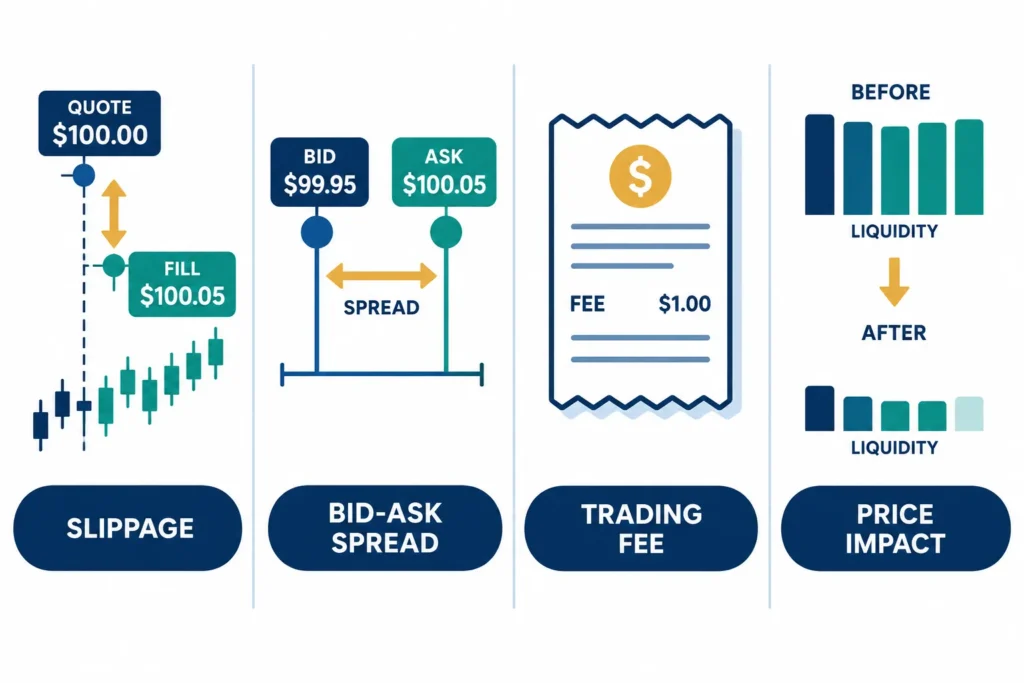
Comparison graphic distinguishing slippage, bid-ask spread, trading fees, and price impact.

Several trading costs can appear together, but they should not be treated as the same thing.

ItemWhat it meansWhen it arises
SlippageThe difference between the expected price and the actual execution priceWhen the available or final execution price changes from the chosen reference price
Bid-ask spreadThe difference between the highest buying price and the lowest selling priceIt exists because buyers and sellers quote different prices
Trading feeA charge imposed by the exchange or trading protocolIt is usually calculated separately based on trade value or platform rules
Price impactThe price change associated with consuming available order-book liquidity or changing a liquidity pool ratioIt becomes more important when an order is large relative to available liquidity

A wide bid-ask spread can make an immediate trade appear expensive. For example, suppose the last traded price is ₹100, the highest bid is ₹99 and the lowest ask is ₹101. A market buy may begin near ₹101 even if the trader expected ₹100 after looking at the last traded price.

In that comparison, the apparent ₹1 difference may include the effect of crossing the spread. It should not automatically be described entirely as slippage. The spread already existed before the order was placed, while slippage concerns the difference between a suitable expected price and the actual execution price.

This is why the reference price matters. Comparing execution with the current best ask is usually more meaningful for a buy order than comparing it with the last traded price. For a sell order, the current best bid may be a more suitable reference.

Price impact is also related to slippage but remains a separate idea. If a large market order consumes several order-book levels, the trader’s own order contributes to a worse average price. On a decentralised exchange, the trade may change the pool ratio and move the quoted price. This price impact can contribute to the difference eventually seen at execution.

Understanding how to read crypto charts can help traders recognise price movements and market conditions that may affect trade execution.

How to Calculate Slippage

The percentage difference between the executed price and expected price can be calculated as follows:

Slippage (%) = ((Executed Price − Expected Price) / Expected Price) × 100

The sign of this calculation cannot be interpreted without knowing whether the transaction is a buy or a sell. A higher execution price is unfavourable for a buyer but favourable for a seller. A lower execution price is favourable for a buyer but unfavourable for a seller.

Traders also use the terms “positive slippage” and “negative slippage” to describe the outcome. Positive slippage generally means the trader received a better price, while negative slippage means the trader received a worse price. This favourable-or-unfavourable terminology may not match the mathematical sign produced by the formula.

Illustration 1: Negative-Slippage Buy

Suppose a trader expects to buy a token at ₹1,000, but the order is executed at ₹1,020.

Slippage = ((₹1,020 − ₹1,000) / ₹1,000) × 100 = 2%

The formula produces positive 2%, but the buyer paid more than expected. The outcome is therefore commonly called negative slippage because it is unfavourable to the buyer.

If the trader bought 10 tokens, the expected purchase value was ₹10,000, while the actual purchase value was ₹10,200. Any exchange trading fee would be added separately.

Illustration 2: Positive-Slippage Buy

Now suppose a trader expects to buy a token at ₹1,000, but the order is executed at ₹980.

Slippage = ((₹980 − ₹1,000) / ₹1,000) × 100 = −2%

The mathematical result is negative 2%, but the buyer received a lower and therefore better price. This is commonly called positive slippage because the outcome favours the buyer.

For a seller, the interpretation would be reversed. Selling above the expected price is favourable, while selling below it is unfavourable.

Illustration 3: Multi-Level Order-Book Market Order

Assume a trader places a market order to buy 2.5 ETH. The best ask is ₹2,50,000, but only 0.8 ETH is available at that price. The exchange fills the rest of the order at higher price levels.

Execution price per ETHQuantity filledCost
₹2,50,0000.8 ETH₹2,00,000
₹2,51,0001.0 ETH₹2,51,000
₹2,52,0000.7 ETH₹1,76,400
Total2.5 ETH₹6,27,400

The weighted average execution price is calculated by dividing the total cost by the total quantity:

₹6,27,400 / 2.5 ETH = ₹2,50,960 per ETH

If the best ask of ₹2,50,000 was the expected price, the percentage difference is:

((₹2,50,960 − ₹2,50,000) / ₹2,50,000) × 100 = 0.384%

The buyer experienced an unfavourable average execution because the order consumed liquidity at three price levels. This is an example of price impact contributing to slippage.

Finally, keep the full cost breakdown clear. The reference price is the price used to form the expectation. The average execution price reflects all fills in the completed order. The trading fee is a separate platform charge. The total transaction cost includes the actual purchase value plus applicable trading and network fees. Keeping these figures separate makes it easier to understand what the trade truly cost and which part came from slippage.

Market conditions near important crypto support and resistance levels may also influence price movement and trading activity.”

Slippage Tolerance, Reduction Methods and Common Mistakes
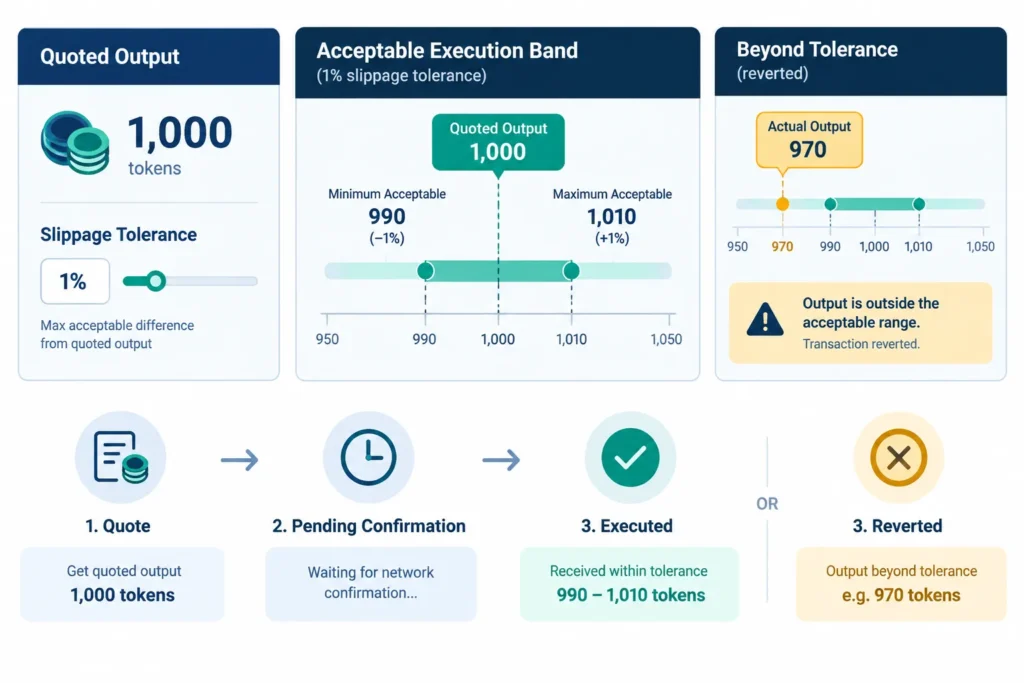
DEX flowchart showing how a 1% slippage tolerance can allow execution within a price band or cause a trade to revert.

What Is Slippage Tolerance on a DEX?

Slippage tolerance is the maximum permitted price movement or execution difference for a decentralised exchange transaction under the interface or protocol rules. It is usually entered as a percentage.

For example, suppose a token swap shows an estimated output of 1,000 tokens. If the tolerance is 1%, the transaction may proceed with a lower output within the permitted conditions. The exact treatment depends on the DEX, network and transaction design.

A tolerance setting is not a promise that you will receive the displayed price. It defines how much movement you are prepared to permit before the transaction should fail or revert.

If market conditions move beyond the permitted limit before execution, the swap may not complete. However, a failed transaction can still involve network costs on some blockchains because validators processed the attempted transaction.

Setting an excessively high tolerance may reduce the chance of failure, but it can also allow materially worse execution. This is particularly risky in volatile or illiquid token pools.

Network congestion can increase the time between submitting and confirming a transaction. A longer delay may increase exposure to price changes. However, transaction behaviour varies across networks, DEXs, liquidity pools and routing methods.

Practical Ways to Reduce Slippage

Slippage cannot always be prevented. The following methods can help manage it, but each involves a trade-off.

  • Consider limit orders: A limit order sets the highest price you will pay or the lowest price you will accept. It provides price control, but the order may remain open or never fill.
  • Use more liquid trading pairs: Pairs with greater available liquidity can often absorb an order with less movement across price levels. Liquidity can still change quickly.
  • Inspect order-book depth: On a centralised exchange, check how much quantity is available at each price rather than relying only on the best quoted price.
  • Avoid extreme volatility where practical: Rapid markets can change between order submission and execution. Waiting may reduce urgency-related risk, but prices may also move away while you wait.
  • Consider splitting a large order: Several smaller orders may reduce the immediate effect on available liquidity. However, splitting can increase fees, execution time and exposure to changing prices.
  • Use a sensible DEX tolerance: A very tight setting may cause repeated failures, while a very high setting may permit poor execution. The appropriate setting depends on liquidity, volatility, network conditions and the transaction structure.
  • Assess the total trading cost: Compare fees, bid-ask spread, slippage and network charges together. A platform with a low stated fee is not necessarily the cheapest place to execute a particular trade.

Why Checking Order-Book Depth Matters

Consider a market buy for 10 units of a crypto asset. The lowest sell order may offer only two units at ₹5,000. The next three units may be available at ₹5,020, while the remaining five units may be offered at ₹5,060.

The visible best price is ₹5,000, but the full order cannot fill there. The average fill price would be ₹5,039 in this simplified example:

((2 × ₹5,000) + (3 × ₹5,020) + (5 × ₹5,060)) ÷ 10 = ₹5,039

If ₹5,000 is used as the reference price, the buyer experiences negative slippage of ₹39 per unit, or about 0.78%. Viewing the order-book depth before placing the order would not guarantee a particular result, but it would show that only a small quantity was available at ₹5,000.

Is Slippage Always Bad?

No. Negative slippage means the execution is worse than the reference price. A buyer pays more, or a seller receives less.

Positive slippage means the execution is better than the reference price. A buyer pays less, or a seller receives more. It can occur when the market moves favourably or when better-priced liquidity becomes available.

Market orders generally prioritise execution certainty over price certainty. Limit orders prioritise price control, but they sacrifice certainty of execution. Choosing between them involves deciding which risk matters more for the particular transaction.

Common Slippage Mistakes

  • Treating slippage as a fee: Slippage is an execution-price difference, not a charge collected in the same way as an exchange or network fee.
  • Using only the last traded price: The last price may relate to a small or older trade. It does not show whether enough liquidity is currently available.
  • Ignoring the average fill price: A large order can fill across several levels. The average price is more informative than the price of the first fill.
  • Selecting a very high DEX tolerance: This may allow the transaction to complete at a substantially worse rate.
  • Assuming limit orders guarantee fills: A limit order controls the acceptable price, but it may fill only partly or not at all.
  • Overlooking spread and network costs: A trade can have low slippage but still be expensive after the bid-ask spread, platform fee and blockchain charge are included.

Before trading any digital asset, it is important to research a cryptocurrency before trading it and understand its risks, liquidity and market behaviour.

Frequently Asked Questions

1. What is slippage in crypto trading?

Slippage in crypto trading is the difference between a reference or expected price and the actual average execution price. It often occurs because prices or available liquidity change while an order is being filled.

2. Is crypto slippage a trading fee?

No. A trading fee is charged by an exchange, broker or protocol. Slippage is a difference in execution price. Both can affect the total cost of a trade.

3. Can slippage be positive?

Yes. Positive slippage occurs when execution is better than the chosen reference price, such as when a buyer pays less than expected.

4. What is negative slippage?

Negative slippage is an unfavourable execution difference. A buyer pays more than the reference price, or a seller receives less.

5. Why do market orders face slippage?

A market order takes the best available liquidity until the requested quantity is filled. If there is not enough quantity at the first price, the order moves through worse price levels.

6. Can limit orders prevent slippage?

Limit orders can prevent execution beyond the stated limit price. They do not guarantee a full fill, an immediate fill or any fill at all.

7. What is slippage tolerance on a DEX?

It is the maximum permitted movement or execution difference under the DEX interface or protocol conditions. It is not a guaranteed execution price.

8. What happens when a DEX trade exceeds the tolerance?

The transaction may fail or revert. Depending on the network and transaction design, the user may still incur a blockchain transaction cost.

9. How is slippage calculated?

A common calculation is: ((execution price − reference price) ÷ reference price) × 100. The sign must be interpreted according to whether the transaction is a buy or a sell.

10. What is the difference between slippage and spread?

The spread is the gap between the best available buy and sell quotes. Slippage is the difference between a selected reference price and the actual execution price.

11. What is the difference between slippage and price impact?

Price impact is the price movement linked to the order consuming available liquidity. Slippage is the broader difference between reference and execution prices, which may also reflect market movement, delays or changing orders.

12. How can beginners reduce slippage?

Beginners can inspect liquidity and order-book depth, consider limit orders, use liquid pairs, avoid extreme volatility where practical, choose sensible DEX tolerance settings and compare fees, spread, network costs and slippage together.

Conclusion

Understanding slippage in crypto trading starts with choosing a clear reference price and comparing it with the actual average fill price. Liquidity, order size, volatility, network delays and execution method can all influence the result.

Market orders offer greater execution certainty but less price control. Limit orders offer price control but may not fill. On a DEX, a tight tolerance can lead to failed transactions, while an excessive tolerance can permit worse execution. Checking depth, calculating slippage correctly and assessing every trading cost together can help beginners understand these trade-offs without assuming that any method can guarantee a particular outcome.
Leave a Comment

Contact RegularStation: klassicweb@gmail.com | +91 9376859993