

What are NFTs?
NFTs, or non-fungible tokens, are unique blockchain records associated with a particular asset, item or entitlement. Depending on the project, an NFT may represent digital art, a game item, a membership pass, a ticket or another record.
Owning an NFT usually means that your crypto wallet controls the token recorded on the blockchain. It does not automatically mean that you own the copyright, the original file or every commercial right connected with the asset. Those rights depend on the project’s terms, licence, contract and applicable law.
Introduction
NFTs became widely known through expensive sales of digital pictures and online collectibles. This led to a common misunderstanding: that an NFT is simply an image stored on a blockchain. The actual idea is broader and requires a little more care.
An NFT is first a token or record. It can point to an asset, identify a wallet as the token holder, or provide access to a benefit. What that ownership means in practice depends on how the NFT was created and what the issuer promised.
This distinction matters for Indian buyers, artists and businesses. A person may pay in cryptocurrency for an NFT but receive only limited permission to display the associated artwork. Another NFT may provide admission to an event or access to a private community. A third may have no practical benefit beyond being a collectible.
If concepts such as crypto wallets and digital tokens are new to you, read this alongside Cryptocurrency in India: A Complete Beginner’s Guide to Crypto. The blockchain explainer can also help you understand how distributed records confirm transactions without relying on one central database.
NFT basics: meaning, ownership and practical uses
What does “non-fungible” mean?
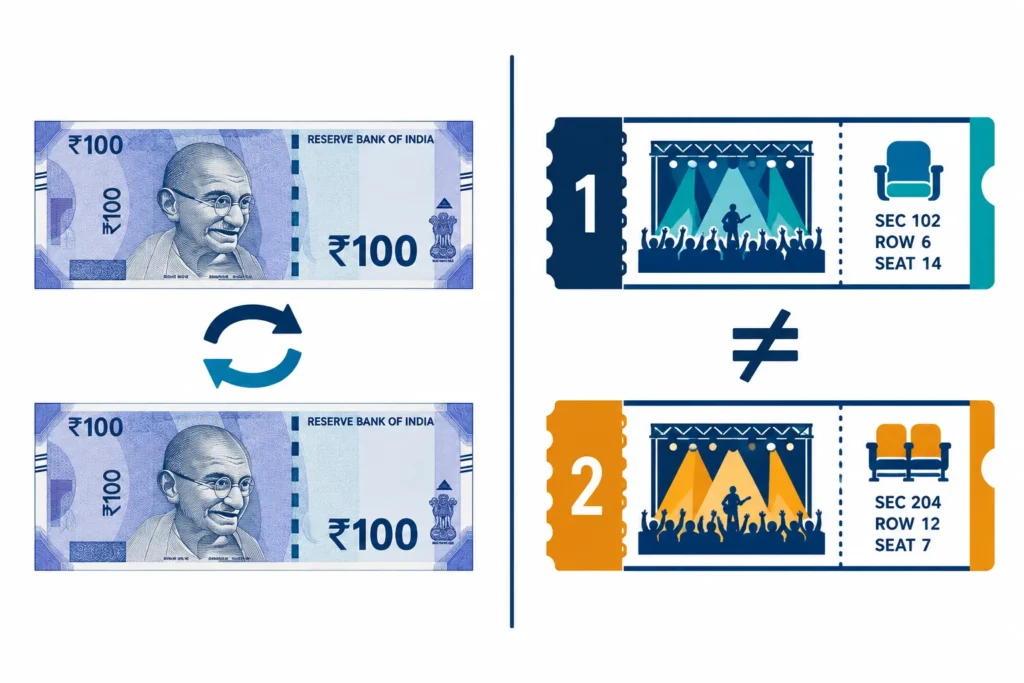
Something is fungible when one unit can normally be exchanged for another equivalent unit. For example, one genuine ₹100 note and another genuine ₹100 note have the same face value. You usually do not care which specific note you receive.
Cryptocurrencies such as Bitcoin are also designed to be fungible at the unit level. One bitcoin is generally treated as equivalent to another bitcoin of the same amount, just as interchangeable units of many other crypto tokens are treated alike.
An NFT is different because each token has its own identity or identifying data. It may have a distinct token number, transaction history and associated information. Even two NFTs that display similar images can remain separate blockchain records.
Think of a numbered concert ticket. Two tickets may cost the same, but one could be for seat A1 and the other for seat D20. They are not interchangeable in every respect. A signed original artwork is another example: it is not equivalent to every printed copy merely because the copies show the same picture.
“Unique” should not be taken too far, however. An NFT’s token record may be unique while the associated image can still be copied, downloaded or displayed elsewhere. Uniqueness on a blockchain does not make a digital file impossible to duplicate.
The main participants in an NFT transaction
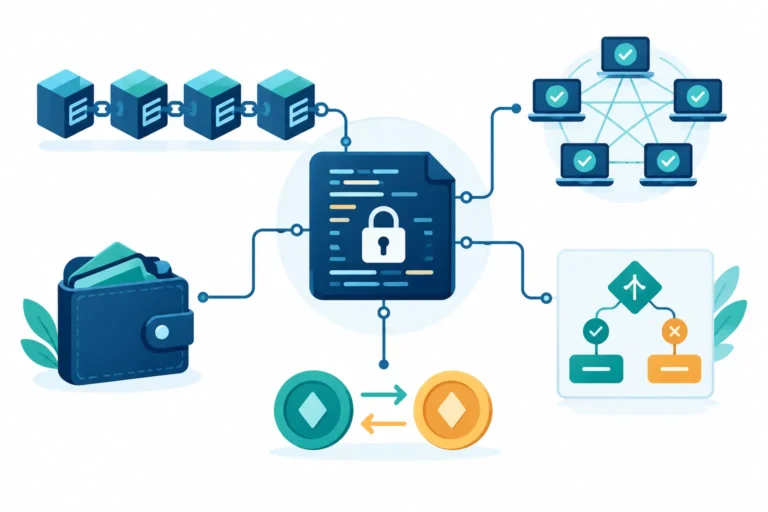
Several people and technologies can be involved in creating, selling and holding an NFT:
- Creator: The artist, developer, business or other person who prepares the asset and arranges for an NFT to be created.
- Buyer or collector: The person who acquires the NFT, usually through a marketplace or a direct transfer.
- Crypto wallet: The software or device used to interact with the blockchain and control the address holding the NFT. Control depends on the wallet’s private keys or recovery credentials.
- Marketplace: A platform that helps users view, list, buy or sell NFTs. Its rules, fees and checks may differ from those of another marketplace.
- Blockchain: The network that records the creation and transfer of the token.
- Smart contract: Blockchain-based code that defines functions such as issuing tokens, recording transfers or applying certain project rules.
Different blockchains can use different NFT standards and transaction methods. Wallet compatibility, fees and the cryptocurrency needed for payment may also vary by network. An NFT created on one blockchain does not automatically work in every wallet, marketplace or game.
A smart contract can carry out programmed instructions, but the name can be misleading. It is not necessarily a complete legal contract, and code alone may not describe every right or obligation. Buyers may also need to read marketplace terms, a separate licence and the creator’s written conditions.
A running example: an Indian digital artist
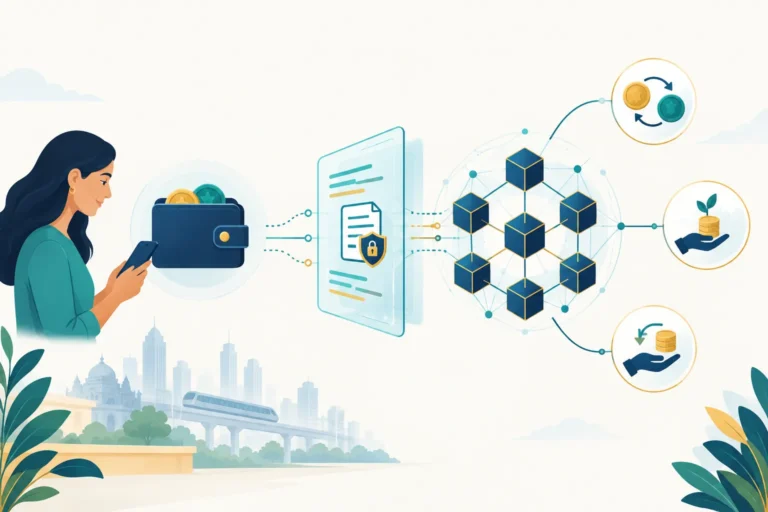
Suppose Meera, a digital artist in Bengaluru, creates an original illustration inspired by the city’s monsoon evenings. She wants to mint an NFT linked to the work. “Minting” generally means creating the token record on a blockchain through a smart contract.
Meera first selects a blockchain, a compatible wallet and an NFT service or marketplace. She then prepares the artwork and its descriptive details. Depending on the arrangement, the image itself may be stored outside the blockchain, while the token contains data that points to its location. Some projects may store more information on-chain, but the design varies.
Meera must also decide what the buyer receives. She could sell only the token and provide permission for personal display. Alternatively, she might offer additional benefits, such as access to a high-resolution file, entry to an online session or a physical signed print.
These promises should be stated clearly. A buyer should not have to assume that an attractive NFT listing includes copyright, commercial use or permanent access to an external file.
What does an NFT buyer actually own?
In the basic case, the buyer controls the NFT through a wallet address. The blockchain can show that the token moved from one address to another. This record can help establish the token’s transaction history.
Token ownership and ownership of the associated creative work are not the same thing. If Ravi buys Meera’s NFT, he may own the token without owning the copyright in her illustration. Meera may still hold the legal right to reproduce the work, sell prints, license it to a publisher or create related artwork, unless a valid agreement says otherwise.
Buying an NFT does not automatically:
- transfer copyright or other intellectual property rights;
- give permission to use the artwork commercially;
- provide an exclusive copy of a digital file;
- prove that the person selling it is the true creator or authorised seller;
- guarantee access to a community, event, game or service forever;
- guarantee that the NFT will keep or increase its value.
The buyer’s rights depend on the licence, sale terms, contractual promises and applicable law. If important rights are not clearly granted, the buyer should not assume they are included. The legal treatment can also depend on the facts of the transaction and the jurisdiction involved.
Blockchain history can show which wallet issued or transferred a token, but it cannot independently confirm that the issuer created the artwork or had permission to use it. Someone can mint a token linked to material they do not own. Buyers therefore need to examine the creator’s identity, the project’s terms and the source of the asset rather than relying only on the blockchain record.
Practical uses of NFTs
NFTs can be designed for several purposes. Their usefulness depends on whether the promised asset or benefit is genuine, accessible and supported after purchase.
- Digital art: Artists can issue identifiable tokens associated with their work and sell them directly or through marketplaces.
- Collectibles: A project can create limited or individually numbered tokens for collectors.
- Gaming assets: An NFT may represent a character, costume, tool or virtual land, subject to the game developer’s rules and continued support.
- Memberships: Holding a token may provide entry to a community, event or service.
- Tickets: A token can act as a verifiable entry record, although venue rules and identity checks may still apply.
- Tokenized records: Organisations may use unique tokens to represent certificates, claims or other records under a defined system.
These are possible applications, not automatic benefits. A membership NFT is useful only if the membership is honoured. A gaming NFT may lose its purpose if the game closes or stops supporting it. A tokenized record is meaningful only when the relevant institution recognises it.
NFTs are also frequently bought in the hope of resale at a higher price. That is speculation, not a practical use or a guaranteed source of returns. The technology can record token ownership and transfers, but it cannot ensure demand, authenticity, legal rights or future value.
How NFTs Are Minted, Bought, Transferred and Stored
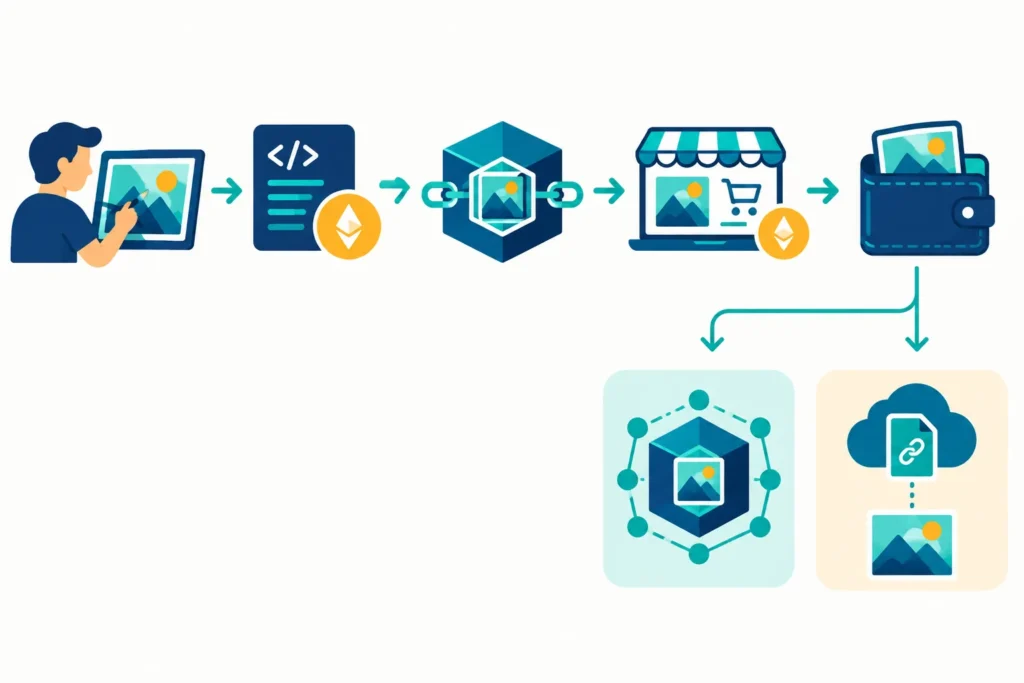
To understand how NFTs move from a creator to a buyer, consider a simple example. An Indian digital artist named Meera creates an original illustration. She wants to issue an NFT connected to that work and offer it for sale.
The process usually involves a crypto wallet, a blockchain, a smart contract and an NFT marketplace. The exact steps and costs depend on the services Meera chooses.
How an NFT Is Minted
Minting means creating an NFT record on a blockchain. It does not automatically prove that the person minting the NFT created the artwork or owns its copyright.
A typical minting process works like this:
- Connect a compatible wallet: Meera creates or connects a crypto wallet supported by the chosen platform. The wallet provides the address that will initially control the NFT.
- Choose a blockchain and platform: She selects a blockchain that supports NFTs and a marketplace or minting service built for it. Different blockchains have different fees, wallet requirements and technical standards.
- Add the NFT information: Meera uploads the illustration or provides information that points to where it is stored. She also enters details such as the title, description and collection name.
- Approve the smart contract action: The platform asks her wallet to approve a transaction. A smart contract then creates the NFT according to its programmed rules.
- Pay applicable fees: Depending on the blockchain and platform, Meera may have to pay a network transaction fee. Some platforms delay part of the minting process until the NFT is purchased.
- List the NFT for sale: After minting, she can keep the NFT, transfer it or list it on a marketplace.
The smart contract usually assigns the NFT a unique token identifier and associates it with a blockchain address. It may also define rules for transfers, access rights or creator payments.
Smart contracts are programs, not human judges. They carry out the instructions written into their code. Our smart contracts guide explains this concept in more detail, including why code errors and unexpected permissions can create risks.
How NFT Marketplace Sales Work
An NFT marketplace is a service where users can display, buy and sell NFTs. Meera might offer her NFT at a fixed price or through an auction.
In a fixed-price sale, a buyer agrees to pay the stated amount. In an auction, buyers submit bids, and the sale may go to the highest eligible bidder when the auction ends. Marketplace rules can vary, so an auction may also have a reserve price, a deadline or special settlement conditions.
Many marketplaces require payment in a particular cryptocurrency. A buyer in India may therefore need to acquire the required crypto, move it to a compatible wallet and keep an additional amount available for transaction fees. The rupee value of the total cost can change because crypto prices and network fees may move before the purchase is completed.
Before a purchase, the buyer’s wallet displays a transaction request. The buyer must review and approve it. Depending on the platform, the request may authorise an immediate payment, a token transfer or broader access to certain assets in the wallet.
Users should check the marketplace, contract address, amount, network and permission being requested. A transaction should not be approved merely because a website displays a familiar image or collection name. Our crypto wallets guide covers wallet approvals, private keys and basic safety practices in greater depth.
How Ownership and Transfers Are Recorded
Suppose Arjun buys Meera’s NFT. After the transaction is confirmed, the blockchain record shows that the NFT moved from one wallet address to another. Anyone using a suitable blockchain explorer can generally inspect information such as the token identifier, transaction time, sending address and receiving address.
This creates a traceable transfer history. It can help users follow the movement of an NFT between addresses and check which address currently controls it.
However, a public blockchain record has important limits. It may show that a wallet minted an NFT, but it does not necessarily reveal who controls that wallet. It also does not prove that the person had permission to use the artwork.
For example, someone could copy Meera’s publicly visible illustration and mint another NFT linked to the copy. The blockchain would accurately record that minting transaction, but it would not automatically identify the unauthorised use. Buyers may need to check the creator’s established channels, marketplace verification details, contract information and the history of the collection.
Ownership of an NFT also does not automatically transfer copyright in the underlying artwork. The buyer receives the token and any rights specifically provided by the creator’s terms or licence. Those rights might be narrow, broad or unclear.
Transferring an NFT Between Wallets
An owner can usually send an NFT directly to another compatible wallet address. The owner enters the destination address, reviews the transaction and approves it through the wallet. A network fee may apply even when no sale is involved.
Wallet addresses are long and easy to mistype. Blockchain transfers are generally difficult or impossible to reverse. Sending an NFT to the wrong address, an incompatible network or a contract that cannot receive it may result in loss of access.
A cautious user can verify the network and address carefully before approval. For a valuable NFT, sending a lower-value test asset first may sometimes be useful, although that creates an additional transaction fee.
Where an NFT Is Actually Stored
An NFT is not usually stored inside a wallet as if it were a photo saved on a phone. The wallet holds the cryptographic keys needed to control the blockchain address associated with the NFT. Wallet software reads blockchain data and displays the assets linked to that address.
The NFT record itself remains on the blockchain. But the connected artwork, video or other media may be stored somewhere else.
There are two broad ways to handle NFT information:
- On-chain storage: Some metadata, and occasionally the media itself, is stored directly on the blockchain. This can make the information less dependent on an outside service, but full on-chain storage may be expensive or technically restrictive.
- Off-chain storage: The NFT contains a reference to metadata or media stored outside the blockchain. This may use decentralised file-storage systems or conventional servers controlled by a platform, creator or service provider.
Metadata is descriptive information about the NFT. It may include its name, image location, attributes and collection details. Not every NFT contains the actual artwork on-chain. In many cases, the blockchain record points to a metadata file, which then points to the image.
This distinction matters because an NFT can continue to exist on a blockchain even if its external media becomes unavailable. A server may shut down, a platform may stop operating, or a link may change. Decentralised storage can reduce some dependence on a single operator, but availability still depends on how files are maintained and retrieved.
What Smart Contracts Can Automate
Smart contracts can automate parts of the NFT process. They can create tokens, set supply limits, transfer ownership after payment, unlock access to a digital service or apply rules to a collection.
They can also be used to offer benefits such as entry to an online community, access to an event or the ability to use an NFT within a particular application. These benefits may still depend on the project continuing to operate.
Automation does not mean that every transaction is safe or fair. A malicious or poorly designed contract may request excessive permissions or behave differently from what a user expects. Wallet prompts can also be confusing. Users should inspect transaction details rather than treating every approval as a routine login step.
How Creator Royalties Work
Meera may set a creator royalty intended to pay her a share when the NFT is resold. If Arjun later sells it to another buyer, the marketplace or smart contract may direct part of the sale proceeds to Meera’s address.
However, royalties are not guaranteed in every resale. Payment and enforcement can vary according to the smart contract, marketplace and technical implementation. One platform may enforce a royalty, while another may make it optional or handle the transfer in a way that does not trigger the intended payment.
Creators should not assume that every future transfer will generate income. Buyers should also examine the applicable royalty because it can affect resale costs and the amount a seller receives.
Benefits and Limitations of the NFT Process
NFTs can make transfers traceable and allow digital assets to interact with programmable services. A compatible NFT may move between wallets and, in some cases, appear across different marketplaces or applications.
That portability has limits. An application may not support the NFT’s blockchain, technical standard, media format or promised utility. Even when a token can be transferred, its visual display or special features may not work everywhere.
Users must also account for network fees, marketplace charges, wallet security and technical complexity. They may depend on blockchains, storage providers, marketplaces and project operators continuing to function. Public transaction history offers useful transparency, but it does not by itself guarantee identity, authenticity, copyright ownership or lasting access to the associated content.
NFT risks, safety checks and considerations in India
Understanding what are NFTs is only the first step. An NFT may prove ownership of a particular blockchain token, but it does not guarantee that the linked artwork is genuine, that promised benefits will continue, or that another person will buy it later.
NFT prices and resale risks
NFT prices can change sharply because demand is often driven by trends, online communities and speculation. A collection that attracts attention today may receive little interest later.
Trading activity can also be low. A displayed marketplace price does not mean a buyer is available at that price. If only a few people trade a collection, you may have to accept a much lower offer or may not find a buyer at all.
An NFT can therefore have little or no resale value. Marketplace fees, blockchain transaction fees and creator royalties may further reduce what you receive from a sale. Treat claims of guaranteed returns, fixed future prices or “risk-free” profits as warning signs.
Common NFT scams and failures
NFT scams often exploit the fact that collections, social media accounts and marketplace pages can look similar. Common problems include:
- Fake collections: A scammer creates a listing that copies the name, images and description of a genuine project.
- Copied artwork: Someone may mint an NFT using artwork they do not own. Blockchain records do not automatically confirm copyright ownership.
- Creator impersonation: Fraudsters may imitate an artist, celebrity or project team through fake accounts and websites.
- Phishing: A fake minting page or marketplace may ask you to connect your wallet and approve a harmful transaction.
- Fraudulent support accounts: A person pretending to provide customer support may ask for your recovery phrase or direct you to a malicious page.
- Malicious approvals: A wallet request may give a contract permission to transfer tokens from your wallet, sometimes beyond the NFT you intended to trade.
- Rug pulls: Project operators may collect money, abandon development and disappear.
- Broken content or utility: The image, game access or membership benefit may depend on a company, website or external server that later shuts down.
Some NFT marketplaces use smart contracts and decentralised trading mechanisms. The DeFi guide explains how such protocols and wallet approvals work. For protection against phishing, token scams and account theft more broadly, also refer to the cryptocurrency risks guide.
A practical NFT evaluation process
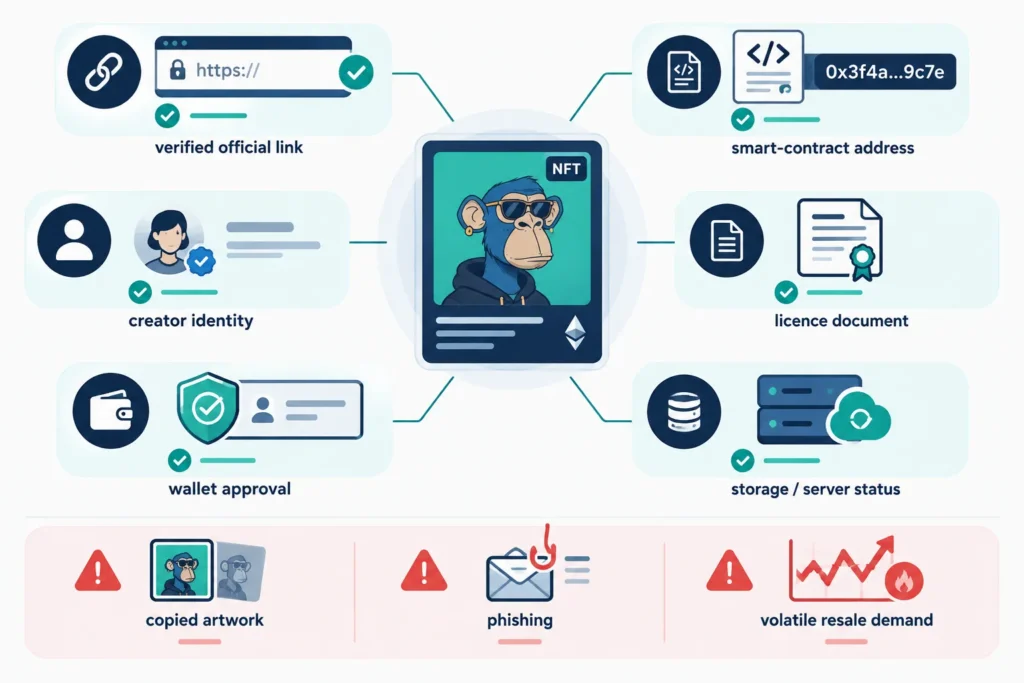
No checklist can remove all risk. However, the following checks may help you avoid obvious mistakes.
- Find official links independently. Use the creator’s established website or known public account instead of clicking an unsolicited message, advertisement or search result.
- Confirm collection details. Compare the blockchain, collection name and smart contract address with information published through official channels. Similar names are not enough.
- Research the creator and team. Check their history, previous work and whether important claims can be independently verified. Anonymous teams are not automatically fraudulent, but they may be harder to hold accountable.
- Examine the claims. Ask what you are actually buying. Separate the token from marketing promises about games, events, rewards or future business plans.
- Read the licence terms. Check whether you receive only the token, a personal licence to display the work, or limited commercial rights. Do not assume copyright is included.
- Review the marketplace. Consider its reputation, complaint process, supported blockchain, creator verification process and total fees.
- Inspect every transaction. Check the recipient, amount, network, contract and permission request before approving it in your wallet.
- Review wallet permissions. Remove permissions that are no longer needed, particularly broad approvals given to unfamiliar contracts.
- Check where content is stored. Consider whether the NFT’s image or benefit depends on one company, website or server. If that service closes, the token may remain while its associated content becomes unavailable.
A verified badge can reduce confusion, but it does not guarantee authenticity, safety or future value. Similarly, a marketplace listing does not mean the marketplace endorses the project. A smart contract audit may identify certain technical weaknesses, but it cannot confirm that the team is honest or that buyers will retain interest.
Basic wallet and account precautions
- Never share your private key or wallet recovery phrase. Genuine support staff should not ask for them.
- Consider using a separate wallet for new mints, unfamiliar websites and other higher-risk interactions.
- Protect your phone and computer with updates, screen locks and trusted security software.
- Use strong, unique passwords and available multi-factor authentication for marketplace and email accounts.
- Verify the blockchain and destination before transferring an NFT. Blockchain transfers are generally difficult or impossible to reverse.
- When using an unfamiliar address or process, consider a small test transaction where practical, while accounting for transaction fees.
- Do not approve a transaction merely because a countdown, limited supply claim or social media message creates urgency.
Environmental impact is not the same for every NFT
An NFT’s environmental impact depends mainly on the blockchain’s consensus mechanism, network design and overall energy use. It is misleading to assume that every NFT transaction uses the same amount of energy.
Proof-of-work networks rely on energy-intensive mining. Proof-of-stake networks use validators and generally have a different energy profile. Ethereum, a major network for NFTs, now uses proof of stake. However, estimating the exact impact attributable to one NFT transaction is difficult because a blockchain processes many kinds of activity at the same time.
Buyers who consider environmental factors should identify the blockchain being used and examine credible, current information about its consensus system rather than relying only on broad claims such as “green NFT” or “carbon-free”.
Legal, tax and regulatory considerations in India
NFTs do not operate outside Indian law. Depending on the facts, copyright, contracts, taxation, consumer protection, advertising, anti-money-laundering and other rules may become relevant. The treatment can differ according to what the NFT represents, how it is marketed and how a transaction is structured.
Indian copyright law generally distinguishes ownership of a token from ownership of copyright in the underlying work. Buying an NFT does not automatically transfer copyright. A valid assignment or licence needs appropriate terms, and the creator must have the rights they claim to grant.
Indian tax law contains provisions for virtual digital assets, and an NFT may fall within those provisions depending on its characteristics and any applicable government notification or exclusion. Tax consequences can also vary for creators, traders, businesses and occasional buyers. Records of purchase prices, sale proceeds, transaction fees, dates, wallet activity and rupee values should be preserved.
Do not assume that marketplace deductions settle every Indian tax obligation. Questions concerning income tax, withholding, GST, cross-border payments and business income can depend on the parties and transaction. Consult a chartered accountant or qualified tax professional for advice based on current rules.
Consumer protection and advertising rules may also apply where NFTs are marketed to Indian buyers, but practical remedies can be difficult when a seller is anonymous or based overseas. Crypto-assets are not the same as legal tender, and regulatory interpretations continue to develop. Check current materials from the Ministry of Finance, Income Tax Department, Central Board of Direct Taxes, Central Board of Indirect Taxes and Customs, Reserve Bank of India and other relevant authorities before acting.
Frequently asked questions
What is an NFT in simple terms?
An NFT is a unique blockchain token used to identify a particular digital item, record or entitlement. It can be linked to art, collectibles, tickets, game items or membership benefits.
Are NFTs cryptocurrencies?
NFTs and cryptocurrencies both use blockchain technology, but they are not identical. Cryptocurrency units are generally designed to be interchangeable. Each NFT has distinct identifying information.
Does buying an NFT transfer copyright?
Usually, no. You receive the token and any rights stated in the applicable sale and licence terms. Copyright transfers only when the rights holder validly assigns it under the relevant law.
How are NFTs created and sold?
A creator uploads or links content, enters token details and uses a smart contract to mint the NFT on a blockchain. It may then be sold at a fixed price, through an auction or directly between wallets.
Can an NFT lose value?
Yes. Demand may disappear, promised benefits may end, or buyers may be unavailable. An NFT can lose most or all of its resale value.
Are NFTs safe to buy?
NFT purchases carry market, fraud, technical, legal and custody risks. Careful checks can reduce some risks, but no badge, audit or marketplace can make a purchase completely safe.
Do I need cryptocurrency or have to pay transaction fees?
Many marketplaces require the blockchain’s supported cryptocurrency and charge network transaction fees. Some services accept other payment methods. Fees depend on the network, marketplace and transaction type.
What should beginners check before buying?
Confirm the official contract and collection, research the creator, read the licence, understand fees, inspect wallet approvals, check where associated content is stored and decide whether you can afford a total loss.
Summary
NFTs can record ownership of unique blockchain tokens, but they are not guaranteed investments or automatic proof of copyright. Prices may collapse, buyers may disappear, and linked content or promised utility may not last. Verify the collection independently, read the legal terms, protect your wallet and keep complete transaction records. Indian tax and regulatory treatment can depend on the NFT and transaction, so seek qualified professional advice when the amount or legal issue is significant.
Comments