

What Is Crypto Mining?
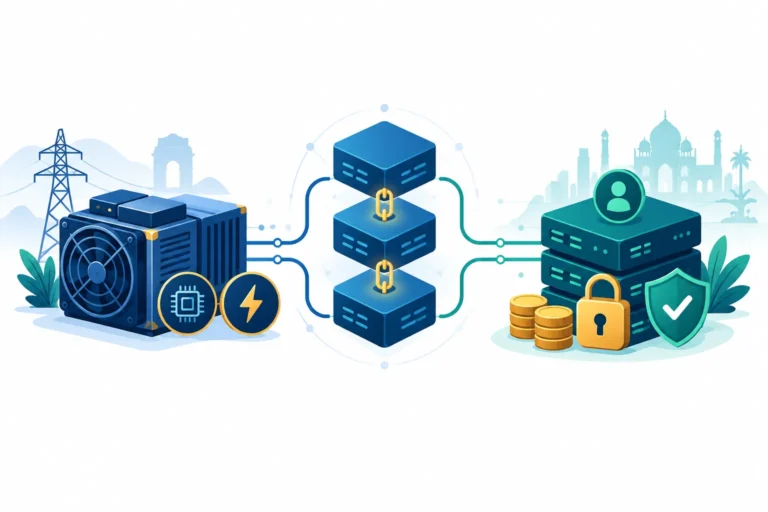
Crypto mining is the process used by some cryptocurrency networks to confirm transactions, add new blocks of records and protect the blockchain. Miners use specialised computing equipment to perform repeated calculations. The first miner to find a valid result can propose the next block and may receive a reward.
Bitcoin uses this system, called Proof of Work. Its mining reward can include newly issued bitcoin and transaction fees. However, not every cryptocurrency can be mined. Many networks use other methods, such as Proof of Stake, to confirm transactions.
Introduction
When people first hear about crypto mining, they may imagine digital coins being created from nothing. That is not quite how it works. Mining is mainly a method for maintaining agreement on a blockchain without relying on a bank, payment company or single central administrator.
On Bitcoin, miners collect pending transactions, check them against the network’s rules and compete to add a valid block to the blockchain. Their work helps decide the order in which transactions are recorded. It also makes changing old records extremely difficult because an attacker would need substantial computing power to redo the work and catch up with the honest network.
Mining can involve expensive machines, large electricity bills, technical maintenance and uncertain income. Before considering its costs and risks, a beginner should understand what miners actually do and how Proof of Work operates.
1. What Crypto Mining Is and How Proof of Work Operates
Why Do Some Blockchains Need Mining?
A blockchain is a shared record maintained by many computers. Because there is no single central operator deciding which transaction came first, the network needs rules for reaching agreement.
Mining is one way to achieve that agreement. In a Proof of Work network such as Bitcoin, miners compete to produce a valid block. Other network participants, usually called nodes, independently check that block before accepting it.
This distinction matters: miners propose blocks, but they cannot freely change Bitcoin’s rules. A miner cannot create unlimited bitcoin, spend someone else’s funds or include an invalid transaction and force nodes to accept it. Each node checks the proposed block according to the protocol rules.
For a broader explanation of shared records, blocks and decentralisation, see What Is Blockchain Technology? How It Works and Its Real-World Uses.
Not Every Cryptocurrency Can Be Mined
The word “mining” applies mainly to cryptocurrencies that use Proof of Work. Bitcoin is the best-known example. Some other crypto networks use Proof of Stake or a different consensus mechanism instead.
Proof of Stake generally selects validators based on coins placed at stake and the network’s selection rules, rather than requiring miners to perform large amounts of computational work. Therefore, buying a powerful mining machine does not allow you to mine every cryptocurrency.
Beginners comparing these systems can refer to Proof of Work vs Proof of Stake: What’s the Difference?.
How Bitcoin Mining Works, Step by Step
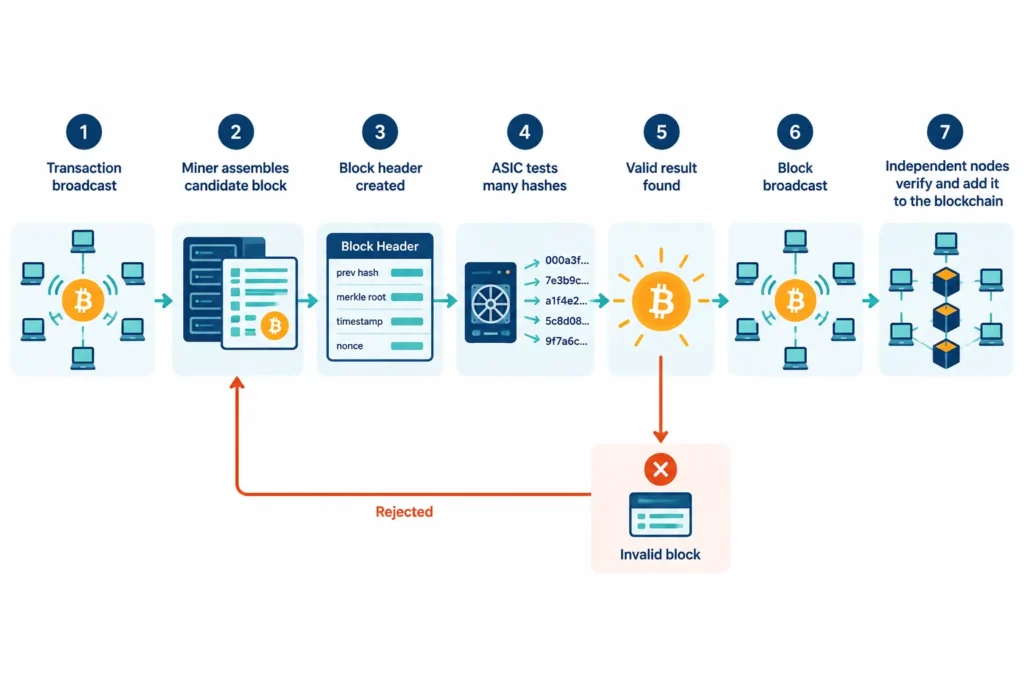
Bitcoin mining involves more than simply switching on a computer. In simplified terms, the process works as follows:
- Transactions are broadcast: Users send bitcoin transactions to the network. Nodes check basic rules, such as whether the digital signatures are valid and whether the coins being spent are available.
- A miner builds a candidate block: The miner selects valid pending transactions, usually giving preference to transactions offering attractive fees. The miner also creates a special transaction that identifies where the permitted mining reward should be paid.
- The miner creates a block header: This compact set of data represents important details about the candidate block, including a reference to the previous block and a summary derived from the selected transactions.
- The mining equipment tests hashes: The miner repeatedly changes permitted data and runs the block header through Bitcoin’s cryptographic hash function. Each attempt produces a hash, which can be thought of as a fixed-length digital result.
- The miner searches for a qualifying result: For the block to be valid, its hash must be below the target set by the network. There is no reliable shortcut for predicting the winning result. Miners must make a very large number of attempts.
- A valid block is broadcast: When a miner finds a qualifying hash, it sends the block to the network. Nodes verify the Proof of Work and every included transaction.
- Nodes accept or reject it: If the block follows the rules, nodes can add it to their copy of the blockchain. If it breaks the rules, they reject it even if the miner spent electricity producing it.
This competition helps order Bitcoin transactions. Occasionally, two valid blocks may appear at nearly the same time. The network eventually follows the chain with the most accumulated Proof of Work, and one branch falls behind. This is one reason users often wait for additional blocks, or confirmations, before treating a large payment as settled.
For more context on transactions, wallets and confirmations, see Bitcoin Explained: How It Works, Its Uses and Risks for Beginners.
Mining Difficulty and Difficulty Adjustment
Bitcoin tries to keep the average time between blocks close to ten minutes. It does not guarantee that every block will arrive exactly ten minutes after the previous one. A block may be found quickly, while another may take longer.
To maintain the long-term average, Bitcoin adjusts its mining difficulty after every 2,016 blocks. If recent blocks were produced faster than the protocol’s expected schedule, the difficulty can rise. If they were produced more slowly, it can fall.
Higher difficulty means miners must, on average, test more hashes before someone finds a valid block. Lower difficulty means the target is easier to meet. This automatic adjustment allows the network to respond when mining power enters or leaves.
What Network Hash Rate Means
Hash rate measures how many mining calculations are being attempted per second. An individual machine has its own hash rate, while the network hash rate is an estimate of the total computing power participating in Bitcoin mining.
A higher total network hash rate generally indicates that more computational work is competing to find blocks. It can strengthen the cost barrier against certain attacks, but it also means greater competition for an individual miner.
For example, suppose an Indian miner operates the same machine for several months while the total network hash rate rises. That machine represents a smaller share of the overall competition. All else being equal, its expected share of mining rewards may decline. Actual results can also be affected by difficulty, machine downtime, pool rules and transaction fees.
What Bitcoin Miners Receive
A Bitcoin block reward can have two main parts:
- Newly issued bitcoin: The protocol permits a fixed block subsidy under its issuance schedule. This subsidy is reduced through scheduled halving events.
- Transaction fees: Users can attach fees to their transactions. The miner of a valid block may collect the fees from the transactions included in that block.
The amount available is governed by Bitcoin’s protocol rules and the transactions selected for the block. Its value in rupees is not fixed. It changes with the bitcoin market price, fee conditions and other factors.
A valid reward also does not become immediately spendable. Under Bitcoin’s rules, the output created by the block’s special reward transaction must mature for 100 blocks before it can be spent.
Solo Mining and Mining Pools
A solo miner works independently. If that miner finds a valid block, the miner can claim the permitted reward. However, a small operator may have an extremely low chance of finding a block, leading to long and unpredictable gaps between payments.
A mining pool combines the computing work of many participants. The pool coordinates candidate work and distributes earnings according to its payout system. Participants submit “shares,” which are proofs that they have completed assigned work at a lower difficulty set by the pool. Shares help the pool estimate each participant’s contribution, but they are not necessarily valid Bitcoin blocks.
| Factor | Solo Mining | Pool Mining |
|---|---|---|
| Reward frequency | Potentially very rare for a small miner | Usually more frequent, subject to pool terms |
| Payment size | Large if a valid block is found | Smaller because rewards are shared |
| Income variation | Very high | Generally lower |
| Third-party reliance | Lower | Relies on the pool operator’s systems and payments |
Pools may use proportional, pay-per-share or other share-based reward methods. A pool may also deduct fees, set a minimum payout amount and pay only on a stated schedule. Some methods provide steadier payments but charge differently or transfer more short-term risk to the pool operator.
Before joining a pool, a miner should read its fee schedule, payout formula, minimum withdrawal condition and treatment of transaction fees. Pool mining can reduce payment variance, but it does not guarantee profit. It also introduces reliance on the operator’s honesty, security, uptime and accounting.
2. Equipment, Operating Costs and a Hypothetical Mining Assessment
Understanding what is crypto mining is only the first step. A miner must also choose suitable equipment and estimate the full cost of running it. The price of the machine is not the only expense. Electricity, cooling, repairs, downtime and depreciation can significantly change the result.
Mining is competitive. A machine may successfully perform mining work but still fail to earn enough cryptocurrency to cover its costs. This is why equipment and operating expenses must be assessed before any money is spent.
ASIC Miners, GPUs and Ordinary Computers
Crypto mining hardware generally falls into three broad categories: ASIC miners, graphics processing units and ordinary computers.
| Equipment type | Typical use | Important limitation |
|---|---|---|
| ASIC miner | Designed for a specific mining algorithm and commonly used in competitive Bitcoin mining | Can be expensive, noisy and difficult to reuse for another purpose |
| GPU | May be used on some mineable cryptocurrency networks | Profitability depends on the network, hardware efficiency and changing mining rules |
| Ordinary laptop or desktop | May be used for learning or limited experimentation | Generally not competitive for profitable Bitcoin mining today |
An application-specific integrated circuit, or ASIC, is built to perform a narrow type of calculation efficiently. Bitcoin miners commonly use ASIC machines because ordinary computers cannot usually compete with their specialised processing power.
An ASIC is not automatically profitable. Older models may use much more electricity for the same amount of mining work. A machine can therefore appear affordable but have poor efficiency and high monthly running costs.
GPUs are general-purpose graphics cards. They may support mining on certain networks, depending on the network’s algorithm and rules. However, a cryptocurrency that can be mined with a GPU today may change its reward structure or stop using mining in the future.
Mining Bitcoin on a normal laptop or household desktop is generally not commercially competitive. Such devices provide far less mining power than specialised machines. Continuous operation may also generate heat, consume electricity, slow down other tasks and shorten the life of components.
Unsuitable hardware can overheat or fail. Laptops are particularly vulnerable because their compact cooling systems are not designed for constant high-load mining. Any beginner testing mining software should monitor temperature, power use and equipment condition rather than assuming that unused computer capacity is free.
Purchase Price and Import Costs
The initial machine price is only part of the investment. Some ASIC models may not be readily available from Indian sellers and may need to be imported. The final landed cost can include shipping, customs duties, taxes, currency conversion charges and handling fees.
Buyers should also consider whether a warranty is valid in India. Sending a faulty machine to an overseas seller can be expensive and may involve long delays. Used mining machines may cost less, but their operating history, remaining life and repair condition can be difficult to verify.
Supporting equipment can add to the upfront cost. Depending on the setup, this may include power supply units, cables, racks, surge protection, networking equipment, exhaust fans and electrical work.
Electricity, Wiring and Power Capacity
Electricity is usually one of the largest recurring mining expenses. The calculation should use the tariff actually charged at the intended location, not a national average or a rate quoted by another miner.
Indian electricity tariffs vary by state, distribution company, consumer category and consumption slab. A higher level of use may move a household into a more expensive slab. Commercial use may also be treated differently from domestic consumption. Applicable rules and tariffs should be checked with the local electricity provider.
Power consumption can be estimated with a simple formula:
Electricity used in kilowatt-hours = power draw in kilowatts × operating hours
A machine drawing 3 kilowatts and operating for 24 hours uses 72 kilowatt-hours in one day. Cooling equipment must be added separately. The actual power drawn at the wall may also differ from a manufacturer’s headline figure.
High-power mining equipment should not simply be connected to an ordinary household socket without checking the electrical capacity. Continuous heavy loads can overheat weak wiring, plugs or extension boards. A qualified electrician should assess the circuit rating, earthing, breakers, wiring and available power capacity.
Cooling, Ventilation and Noise
Mining equipment converts much of the electricity it consumes into heat. That heat must be removed from the room. Indian summer temperatures can make cooling more difficult, especially in a small or poorly ventilated space.
Exhaust fans, air circulation or air-conditioning consume additional electricity. Dust can block airflow and increase temperatures, so filters and machines may need regular cleaning. Poor cooling may reduce performance, cause automatic shutdowns or damage hardware.
Noise is another practical issue. ASIC fans can run continuously and may be unsuitable for a bedroom, flat or shared residential building. Before buying a machine, a user should consider neighbours, family members, ventilation routes and any housing society restrictions.
Internet, Downtime, Repairs and Depreciation
Mining does not normally require the same internet speed as video streaming, but it does require a reasonably reliable connection. Disconnections can prevent a machine from submitting work to the network or mining pool. Power cuts can have the same effect.
Downtime means fewer hours available to earn mining rewards. It may result from electricity outages, internet problems, overheating, maintenance, pool interruptions or hardware failure. A realistic assessment should not automatically assume perfect operation every day of the month.
Fans and power supplies can fail, while dust, heat and voltage fluctuations can increase maintenance needs. Repair costs may be unpredictable, particularly when replacement parts are imported or a specialised technician is required.
Hardware also depreciates. A machine can lose value because it becomes less efficient than newer models, mining difficulty rises, market demand falls or the relevant network changes its rules. Depreciation is an economic cost even when no monthly cash payment is made.
Factors That Affect Possible Mining Revenue
Mining revenue is not fixed. It can change even when the same machine runs for the same number of hours. Important variables include:
- Hardware efficiency: More efficient equipment performs more mining work for each unit of electricity.
- Mining difficulty: When difficulty increases, the same machine may earn less cryptocurrency.
- Network competition: More total mining power can reduce an individual miner’s share of rewards.
- Reward rules: Block rewards and other network incentives can change according to protocol rules.
- Transaction fees: Fees included in blocks can affect the total reward available to miners.
- Pool fees: A mining pool generally deducts a fee under its payout terms.
- Cryptocurrency price: The rupee value of mined coins can rise or fall sharply before they are sold.
A basic assessment can use the following framework:
Estimated result = estimated cryptocurrency earned × realised sale value, less electricity, pool fees, cooling, maintenance, downtime and depreciation.
The realised value is the amount actually received when the cryptocurrency is sold, rather than a price seen at an earlier time. Any applicable exchange charges and other transaction costs should also be considered when making a personal estimate.
Hypothetical Monthly Mining Example
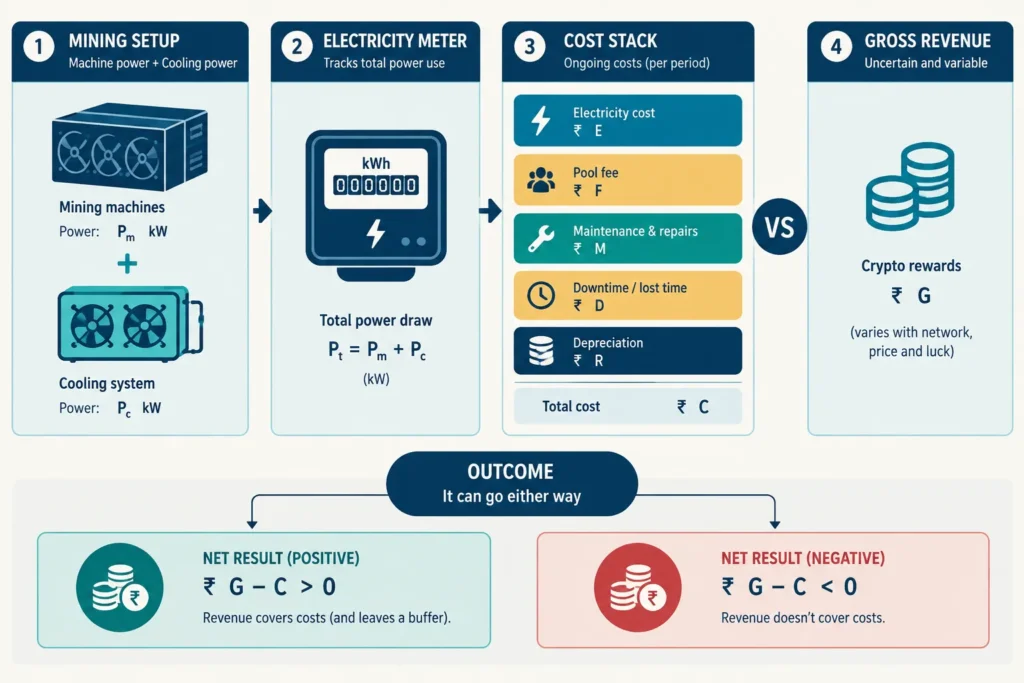
The following figures are entirely fictional and are included only to demonstrate the arithmetic. They are not a current profitability estimate, a quotation or an expected return.
Assume one mining machine draws 3 kilowatts. Cooling and ventilation draw another 0.6 kilowatts. Both operate for 24 hours a day over a 30-day month. The assumed electricity tariff is ₹8 per kilowatt-hour. Also assume fictional gross mining revenue of ₹45,000, a 2% pool fee, ₹2,000 for maintenance, ₹3,000 as a downtime allowance and ₹8,000 for monthly hardware depreciation.
| Calculation | Fictional amount |
|---|---|
| Machine electricity: 3 kW × 24 hours × 30 days × ₹8 | ₹17,280 |
| Cooling electricity: 0.6 kW × 24 hours × 30 days × ₹8 | ₹3,456 |
| Total electricity cost | ₹20,736 |
| Pool fee: 2% of ₹45,000 | ₹900 |
| Maintenance allowance | ₹2,000 |
| Downtime allowance | ₹3,000 |
| Hardware depreciation | ₹8,000 |
| Total estimated costs | ₹34,636 |
| Fictional gross revenue less estimated costs | ₹10,364 |
This positive result should not be treated as a promise. If gross revenue fell to ₹30,000 while the other assumptions stayed unchanged, the same setup would produce a negative estimated result. A higher electricity tariff, major repair or longer outage could also remove the apparent surplus.
Before buying equipment, readers should test several scenarios. These should include lower cryptocurrency earnings, a lower sale price, higher electricity tariffs, increased pool fees, hot-weather cooling costs and a period of equipment failure. Purchase and import costs should also be compared with the machine’s possible useful life.
Crypto mining profitability cannot be guaranteed. Revenue and costs can move in opposite directions, and past mining results do not establish future performance. A cautious assessment uses conservative assumptions and allows enough room for unexpected expenses before any capital is committed.
3. Risks, India Considerations, Alternatives, Mistakes and FAQ
Crypto mining is not effortless passive income. It is an operational activity involving specialised equipment, electricity, cooling, maintenance and financial risk. Before buying a mining machine, beginners should consider what can go wrong as carefully as they calculate possible rewards.
Major Financial and Operational Risks
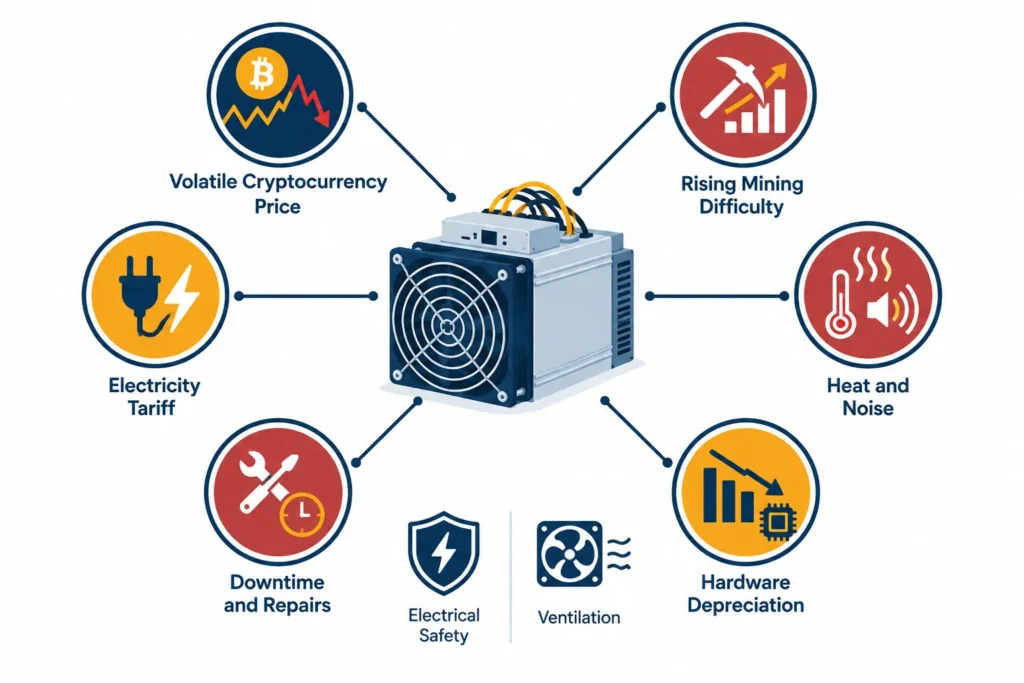
Mining income depends partly on the market price of the cryptocurrency received. If the coin’s price falls, the rupee value of the reward can decline even though the miner continues to pay the same electricity and maintenance costs.
Mining difficulty can also increase. When more computing power joins a network, an individual machine may earn a smaller share of rewards. Older hardware can become uncompetitive as newer and more efficient machines enter the market.
Important risks include:
- Equipment depreciation: Mining hardware may lose value quickly due to wear, changing algorithms or newer models.
- Electricity cost changes: A higher tariff can turn an apparently profitable setup into a loss-making one.
- Heat and noise: ASIC miners and GPU rigs can produce substantial heat and run loud fans continuously.
- Downtime: Power cuts, internet failures, pool problems and equipment faults can interrupt earnings.
- Electrical hazards: Overloaded sockets, unsuitable wiring and poor ventilation can create shock or fire risks.
- Uncertain resale demand: A specialised miner may be difficult to sell if it is no longer profitable.
Projected returns should never be treated as fixed. A calculator generally uses assumptions about coin price, network difficulty, pool fees, machine efficiency and uptime. Any of these can change.
Cloud Mining and Hosted Mining Services
Cloud mining usually means paying a provider for access to mining capacity without keeping the hardware at home. Hosted mining generally means that a third party stores and operates equipment for the customer. These options may appear convenient, but they introduce additional risks.
It may be unclear whether the promised equipment exists, who owns it or how rewards are calculated. Providers may change electricity and maintenance fees, restrict withdrawals or terminate contracts when mining becomes less profitable.
Overseas contracts can be especially difficult to enforce from India. Customers may have limited practical remedies if a foreign provider stops responding, changes its terms or closes its platform.
Check the legal entity, contract, fee structure, hardware ownership, withdrawal rules and dispute process. Even detailed documents do not remove business, market or fraud risk.
Crypto Mining Scam Warning Signs
Fraudulent schemes sometimes use mining language to make an investment offer sound technical. Common warning signs include:
- Guaranteed daily income or fixed, risk-free returns.
- Pressure to recruit friends or earn mainly through referrals.
- A dashboard showing profits without verifiable mining activity.
- Requests for extra tax, unlocking or verification payments before withdrawal.
- Claims that users can receive substantial “free Bitcoin mining” rewards without meaningful costs.
- No clear information about the company, equipment location or responsible management.
- Payment demands made only through cryptocurrency or personal accounts.
A balance displayed on a website is not proof that real cryptocurrency exists or can be withdrawn. For a broader safety checklist, readers should also review Crypto Scams in India: Common Warning Signs and How to Avoid Them and Cryptocurrency Risks: Common Dangers and How to Invest Safely.
Environmental and Practical Impact
Proof-of-Work mining can consume considerable electricity because machines perform calculations continuously. Its environmental impact depends partly on the amount of energy used and how that electricity is generated. Power from a carbon-intensive source has a different impact from power supplied through a lower-emission source.
Cooling adds to energy demand, particularly in hot Indian conditions. Fans, exhaust systems or air conditioning may be required to prevent overheating. This extra consumption must be included in both cost and environmental assessments.
Obsolete machines, graphics cards, power supplies and damaged components should not be discarded with normal household waste. Use responsible e-waste collection, repair or recycling channels. Data should be removed from any storage device before disposal.
India-Specific Checklist Before Mining
Cryptocurrency rules, taxation and compliance requirements in India can evolve. Mining arrangements also differ: one person may experiment with a computer at home, while another may operate multiple commercial machines. There is no single legal or tax conclusion that fits every setup.
Before proceeding, verify the following:
- Electricity connection: Ask the electricity provider whether the intended continuous load is permitted under the connection terms and applicable tariff category.
- Property restrictions: Check rental agreements, building rules, housing society conditions and limits relating to noise, ventilation or commercial activity.
- Electrical capacity: Have a qualified electrician assess wiring, earthing, circuit protection and load capacity. Do not assume a household socket is suitable.
- Registrations: Determine whether the scale and structure require business, local or other registrations.
- Invoices and records: Preserve hardware invoices, electricity bills, pool statements, wallet records, exchange records, fees and sale transactions.
- Imports and customs: If equipment is imported, check classification, customs duties, taxes, warranties and compliance requirements before ordering.
- Tax treatment: Ask how mined tokens, expenses, later sales and business income may be treated in your specific circumstances.
- Current regulation: Verify the latest requirements through authoritative Indian government, tax, customs and regulatory sources.
Do not rely on an old social media post for a universal tax rate or legal answer. Consult a chartered accountant, lawyer, electricity provider or another qualified professional where necessary. Cryptocurrency in India: A Complete Beginner’s Guide to Crypto can provide wider context, but current official guidance should take priority.
Common Beginner Mistakes and Misconceptions
Assuming every cryptocurrency can be mined: Only networks using a mining-based consensus mechanism can be mined. Some cryptocurrencies use staking or other systems instead.
Ignoring cooling and depreciation: Electricity is not the only cost. Cooling, repairs, pool fees, downtime and falling equipment value can materially affect the result.
Trusting projected returns: Profit estimates are scenarios, not promises. Test calculations using less favourable prices, higher difficulty and higher power costs.
Using household wiring without an assessment: Continuous high loads can be dangerous. Proper circuits, ventilation and fire precautions are essential.
Treating mining as effortless passive income: Equipment needs monitoring and maintenance. There may also be accounting, security, tax and compliance work.
Confusing mining, staking and investing: Mining uses computing equipment to support certain Proof-of-Work networks. Staking involves committing eligible cryptocurrency to participate in a Proof-of-Stake network. Buying and holding crypto is an investment activity and does not itself produce blocks.
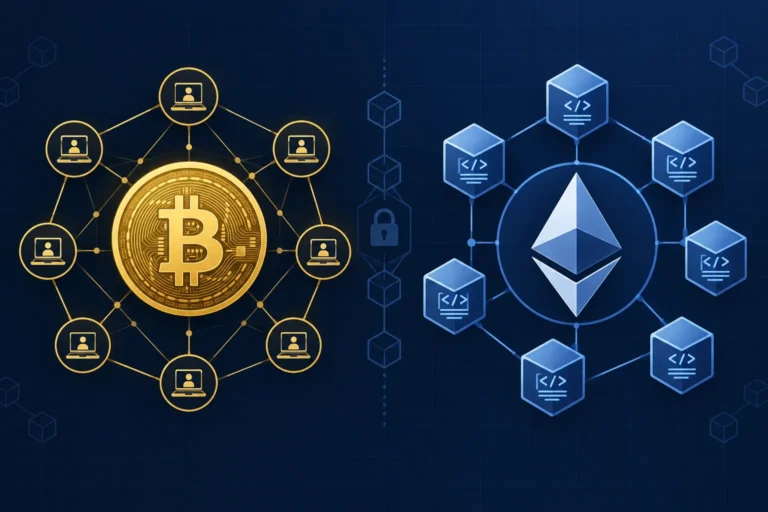
Ethereum Mainnet moved from Proof of Work to Proof of Stake in September 2022. It no longer uses mining to produce blocks. Separate cryptocurrency networks may still support GPU mining, but that does not mean Ether on Ethereum Mainnet can be mined. Readers can verify this through Ethereum.org’s current Proof-of-Stake documentation.
Frequently Asked Questions
What is crypto mining?
Crypto mining is the process used by certain Proof-of-Work blockchains to validate transactions, produce blocks and protect the network. Miners operate computing equipment and may receive cryptocurrency rewards, subject to the network’s rules.
Can Bitcoin be mined at home?
Technically, Bitcoin mining equipment can be operated at home where local rules and electrical conditions permit. In practice, specialised ASIC machines can be expensive, noisy, hot and power-intensive. Competing profitably from a home setup may be difficult.
Is crypto mining profitable in India?
It may be profitable in some circumstances and loss-making in others. The outcome depends on equipment cost, electricity tariff, cooling, network difficulty, uptime, fees, cryptocurrency prices, taxation and compliance costs. No profit is guaranteed.
Can Ethereum still be mined?
No. Ethereum Mainnet has used Proof of Stake since September 2022, so Ether is no longer produced through mining. Some separate networks may still allow GPU mining.
How is mining different from staking?
Mining uses computing power and electricity on Proof-of-Work networks. Staking uses eligible tokens within a Proof-of-Stake system. Both may provide rewards, but their costs, technical processes, risks and network roles are different.
Summary
Understanding what is crypto mining requires more than knowing how rewards are generated. A realistic assessment must include electricity, cooling, hardware depreciation, downtime, safety, regulation, taxation and cryptocurrency price risk. Verify current Indian requirements, avoid guaranteed-return schemes and seek professional advice before committing substantial money or installing power-intensive equipment.
Comments