


To calculate your net worth, add the current value of everything you own and subtract all the money you currently owe.
Net worth = Total assets − Total liabilities
For example, if your assets are worth ₹25 lakh and your outstanding loans and other dues total ₹9 lakh, your net worth is ₹16 lakh.
Your assets may include bank balances, fixed deposits, mutual funds, shares, provident fund balances, property and gold. Your liabilities may include outstanding home loans, personal loans, vehicle loans and credit-card dues.
Introduction
Net worth is one of the simplest ways to understand your overall financial position. It puts your savings, investments and debts into a single number.
This number can help you answer an important question: after accounting for everything you own and everything you owe, where do you stand financially?
You do not need advanced financial knowledge to work it out. You only need reasonably accurate and up-to-date values for your assets and liabilities. The calculation can be done using a notebook, spreadsheet or personal finance app.
Knowing how to calculate net worth is useful even if you are just starting your first job. It can also help when you are planning major goals such as buying a home, funding a child’s education or preparing for retirement.
However, net worth should be treated as a financial snapshot. It is not a judgement of your success, intelligence or personal value.
What Net Worth Means and What to Include
Your net worth is the difference between the current value of your assets and the total amount of your liabilities.
The basic formula is:
Net worth = Total value of assets − Total outstanding liabilities
What Is an Asset?
An asset is something you own that has financial value. It may be money that is immediately available, an investment that can be sold, or a valuable item such as a house or gold.
Common assets for an individual or household in India include:
- Savings and current account balances: Include the available balances in your bank accounts.
- Cash: Include cash kept at home or elsewhere, provided you can estimate it accurately.
- Fixed and recurring deposits: Use the latest value shown by the bank, including interest credited or accrued where this is available.
- Mutual funds: Use the current value of your holdings rather than the amount you originally invested.
- Shares: Use their latest reasonable market value. Share prices change frequently, so your net worth will also move.
- Provident fund balances: Include your EPF, VPF and PPF balances, as applicable. Use the latest balance available in your statement or passbook.
- Other retirement investments: Include investments such as the current value of your National Pension System account.
- Property: Include residential or commercial property that you own. Use a realistic current market estimate rather than the price you hope to receive.
- Gold: Include jewellery, coins and bars using a reasonable resale value. The retail purchase bill may include making charges that you may not recover when selling jewellery.
- Other investments: Bonds, government schemes and other investments with a measurable value may also be included.
Personal-use items such as a television, sofa, clothes and mobile phone are usually left out. They may technically have some resale value, but listing every household item makes the calculation complicated without adding much useful information.
A car or two-wheeler can be included if it has a meaningful resale value. If you include it, use its estimated current resale price, not the original showroom price. Vehicles generally lose value over time.
What Is a Liability?
A liability is money you currently owe to a bank, financial institution, company or another person. For net worth purposes, use the amount still outstanding, not the amount you originally borrowed.
Common liabilities in India include:
- Home loan: Include the outstanding principal shown in your latest loan statement.
- Personal loan: Record the amount that remains unpaid.
- Vehicle loan: Include the outstanding amount on a car or two-wheeler loan.
- Education loan: Include the unpaid loan balance, even if repayment has not started.
- Loan against property or investments: Add the amount still owed.
- Credit-card dues: Include the full outstanding amount, not only the minimum amount due.
- Buy now, pay later balances: Add unpaid instalments or balances owed.
- Money borrowed from family or friends: Include it if you are expected to repay it.
Regular future expenses such as next month’s rent, groceries, school fees or electricity bill are generally not liabilities until they become amounts that you owe. Net worth is not a budget for future spending.
Assets and Liabilities at a Glance
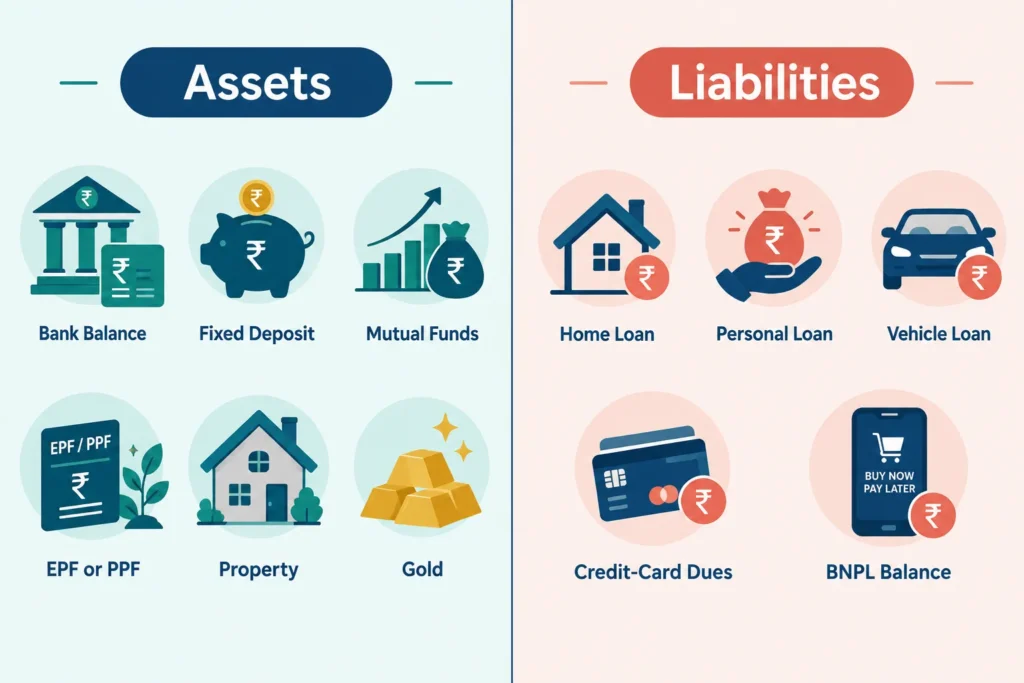
| Category | What to Include | Value to Use |
|---|---|---|
| Bank money | Savings accounts, current accounts and cash | Current available balance |
| Deposits | Fixed deposits and recurring deposits | Latest value available from the bank |
| Market investments | Mutual funds, shares and bonds | Current market value |
| Retirement assets | EPF, VPF, PPF and NPS | Latest statement or account value |
| Property | House, flat, plot or commercial property | Realistic current market estimate |
| Gold | Jewellery, coins and bars | Reasonable estimated resale value |
| Other valuable assets | Vehicles or other items with meaningful resale value | Estimated current resale value |
| Secured loans | Home, vehicle and loan-against-property balances | Outstanding amount |
| Unsecured loans | Personal loans and money borrowed privately | Outstanding amount |
| Short-term debt | Credit-card and buy now, pay later dues | Full unpaid balance |
A Simple Indian Example
Suppose Ananya has ₹1.5 lakh across her savings accounts, fixed deposits worth ₹2 lakh, mutual funds worth ₹3 lakh, an EPF balance of ₹2.5 lakh and gold with an estimated resale value of ₹1 lakh. Her total assets are ₹10 lakh.
She also has an outstanding personal loan of ₹1.8 lakh and credit-card dues of ₹20,000. Her total liabilities are ₹2 lakh.
Her net worth is therefore:
₹10 lakh − ₹2 lakh = ₹8 lakh
If liabilities are greater than assets, the result will be a negative net worth. For example, someone who has recently taken a large education loan or home loan may temporarily have a negative or low net worth. This is a financial position to understand and monitor, not a reason for shame.
Net Worth Is Not the Same as Income
Income is what you earn over a period, such as your monthly salary, business income, rent or interest. Net worth is what remains after comparing everything you own with everything you owe on a particular date.
A person with a high salary can have a low net worth if they have little savings and large debts. Another person with a moderate income may build a higher net worth over time by saving regularly, investing and controlling debt.
Net Worth Is Not the Same as Available Cash
Your net worth does not show how much money you can spend immediately. Some assets are liquid, which means they can be accessed or sold relatively quickly. Bank balances and many listed investments are examples.
Other assets are less liquid. A house may form a large part of your net worth, but you cannot normally use its full value for an emergency without selling it or borrowing against it. Provident fund and retirement balances may also have withdrawal conditions.
This is why someone can have a positive net worth but still face a cash shortage. Net worth measures overall financial position, while available cash measures short-term spending capacity.
Use Current Values and Avoid Double Counting
Use values from roughly the same date so that the result is a meaningful snapshot. Bank statements, investment statements, provident fund records and loan statements are useful sources.
Avoid counting the same asset twice. For example, if money from a bank account has been invested in a mutual fund, include the remaining bank balance and the current mutual fund value. Do not also count the original investment amount separately.
For jointly owned assets and loans, include only your share when calculating individual net worth. If you and your spouse are calculating household net worth together, include the full household values but make sure no asset or liability is entered twice.
Finally, remember what the number does and does not mean. Net worth is a practical measure of financial progress at a specific point in time. It is not your income, your bank balance or a measure of your worth as a person.
How to Calculate Net Worth Step by Step
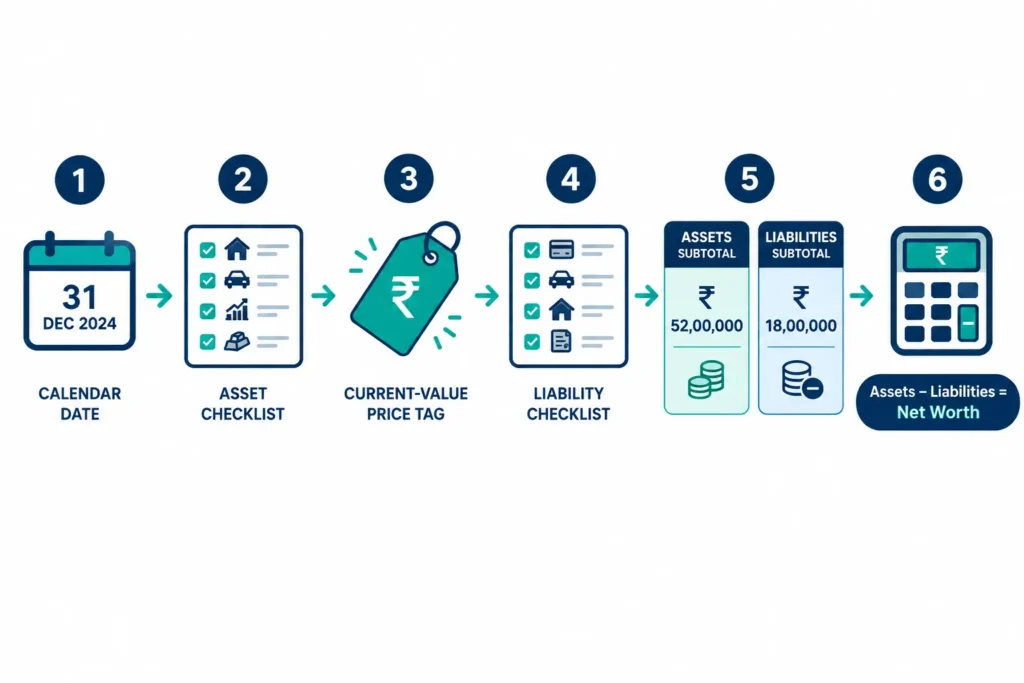
To understand how to calculate net worth, start with a simple formula:
Net worth = Total value of assets − Total outstanding liabilities
Assets are things you own that have financial value. Liabilities are amounts you currently owe. The calculation is simple, but the quality of the result depends on using current values and avoiding duplicate entries.
Step 1: Choose a Calculation Date
Net worth is a snapshot of your finances on a particular date. Choose one date and use values that are as close to that date as possible.
For example, you may calculate your net worth on 31 March, 30 June or the last day of every month. There is no compulsory date for a personal net worth calculation. Consistency matters more than the date itself.
A fixed date makes future comparisons easier. If you calculate net worth every six months, you can see whether your assets are growing, your debts are reducing, or both.
Step 2: List All Your Assets
Write down assets that you own individually as well as your share of jointly owned assets. Common assets for an Indian household may include:
- Balances in savings and current accounts
- Fixed deposits and recurring deposits
- Cash kept at home
- Mutual fund investments
- Shares, bonds and other listed investments
- Public Provident Fund balance
- Employees’ Provident Fund balance
- National Pension System investments
- Post Office savings and small savings schemes
- Residential property, plots and other real estate
- Gold jewellery, coins or bars
- Vehicles or other possessions with a meaningful resale value
Only include something if you own it and can reasonably assign a financial value to it. Your monthly salary is income, not an asset. However, the part of your salary already lying in your bank account can be included as an asset.
Future inheritance should normally not be counted because you do not own it yet. Similarly, avoid including expected bonuses, future investment returns or the maturity value that an investment may reach several years later.
Step 3: Estimate the Current Value of Each Asset
Use the value of each asset on or near your chosen calculation date. Do not automatically use the amount you originally paid.
Recent statements and online account records are useful for financial assets. Check your bank statement for account balances, your investment platform or registrar statement for mutual funds and shares, and the relevant statement or passbook for provident fund accounts.
For listed shares and mutual funds, use the current market value shown in your latest statement. Their values may move daily, so your calculation will remain a snapshot rather than a permanent figure.
For PPF, EPF and similar accounts, use the available balance shown in the latest official statement or passbook. Do not enter only your total contributions, because credited interest may have changed the balance.
Property valuation needs reasonable judgement. You may use a recent professional valuation, a realistic estimate based on comparable properties in the same locality, or a conservative market estimate. An asking price in an advertisement may be higher than the price at which a property can actually be sold.
Record property at its estimated current value, not merely its purchase price. Property prices can rise or fall, and selling a property may involve time and transaction costs. It is sensible to review the estimate periodically instead of changing it based on every local rumour.
For gold jewellery, use a realistic resale value rather than the original bill amount. Making charges paid when buying jewellery may not be fully recovered on sale. Purity, weight and deductions applied by a buyer can also affect the amount received.
Vehicles, furniture, electronics and similar possessions should be valued at a realistic resale price, not their original purchase cost. Many people leave ordinary household items out because their resale value is small and difficult to estimate. This keeps the calculation practical.
Step 4: List Your Outstanding Liabilities
Next, list every amount you owe as of the same date. Use the outstanding balance, not the original amount borrowed.
Common liabilities include:
- Outstanding home loan
- Vehicle loan balance
- Education loan balance
- Personal loan balance
- Gold loan or loan against securities
- Credit card amount due
- Buy now, pay later dues
- Unpaid taxes or other confirmed financial obligations
- Loans taken from family members or friends
Your latest loan statement should show the principal amount still outstanding. Do not use the sum of all future equated monthly instalments, because those instalments may include future interest that has not yet become payable.
For credit cards, include the actual outstanding amount on the calculation date. Do not count the entire credit limit as debt. If your card has a ₹2 lakh limit but the outstanding balance is ₹18,000, your liability is ₹18,000, not ₹2 lakh.
Step 5: Total Assets and Liabilities Separately
Add the current values of all assets to find your total assets. Then add all outstanding debts and obligations to find your total liabilities.
Keep the two totals separate before calculating the final result. A simple spreadsheet, notebook or personal finance app can help, but no special tool is necessary.
Step 6: Subtract Liabilities from Assets
Use the formula:
Total assets − Total liabilities = Net worth
A positive result means your assets are worth more than your liabilities. A negative result means your liabilities currently exceed your assets. A negative figure can occur early in a career or after taking a large loan. The calculation is meant to show your current position, not judge your financial success.
Avoid Common Double-Counting Mistakes
Double-counting can make your net worth appear higher or lower than it really is. Review every entry before finalising the calculation.
- Do not count one bank balance twice: If a balance appears in your savings account total, do not add it again as emergency savings unless it is held in a separate account or deposit.
- Do not count the same investment through two records: A mutual fund shown in a consolidated statement should not be added again from an investment app.
- Use one consistent method for a financed property: Record the property at its full estimated current value and record only the outstanding home loan as a liability. Do not first reduce the property value by the loan and then subtract the same loan again.
- Do not treat a credit limit as debt: Count only the actual outstanding dues.
- Check joint ownership: If you own 50% of a jointly held property, normally include only your share of its value and your share of the related liability.
- Do not count future receipts: Expected salary, bonuses, inheritance or possible investment gains are not current assets.
Hypothetical Net Worth Example
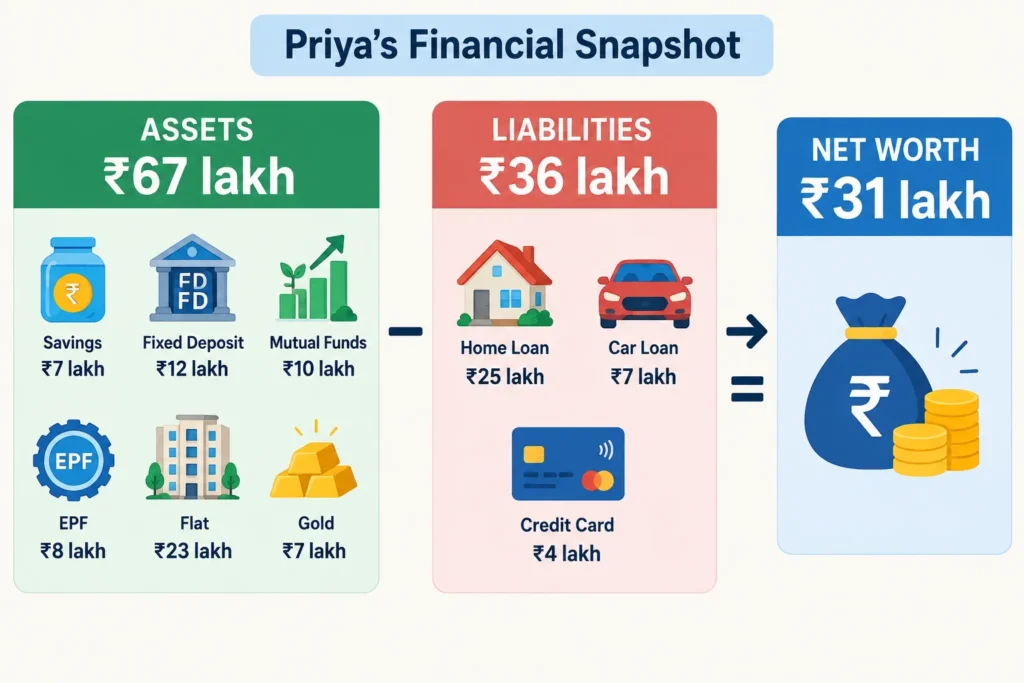
This is a hypothetical example. Assume Priya calculates her net worth on 31 March. She checks her latest statements and uses reasonable current values.
| Assets | Current value |
|---|---|
| Savings account | ₹2,00,000 |
| Fixed deposit | ₹3,00,000 |
| Mutual funds | ₹5,50,000 |
| EPF balance | ₹4,50,000 |
| Flat | ₹50,00,000 |
| Gold at estimated resale value | ₹2,00,000 |
| Total assets | ₹67,00,000 |
| Liabilities | Outstanding amount |
|---|---|
| Home loan | ₹32,00,000 |
| Car loan | ₹3,50,000 |
| Credit card dues | ₹50,000 |
| Total liabilities | ₹36,00,000 |
Priya’s net worth is:
₹67,00,000 − ₹36,00,000 = ₹31,00,000
Her net worth on 31 March is therefore ₹31 lakh. This figure may change when she repays debt, saves more money, makes new investments, or when the market values of her flat, mutual funds and gold move up or down.
For useful comparisons, Priya should apply broadly consistent valuation methods each time. Regular calculation helps reveal the direction of her finances, even though property and investment values will always fluctuate.
How to Interpret, Review and Improve Your Net Worth
Once you know how to calculate net worth, the next step is to understand what the number means. Your net worth is a financial snapshot: the current value of your assets minus your outstanding liabilities.
The result should be viewed in context. Your age, income, family responsibilities, recent purchases and existing loans can all affect it. Comparing your net worth with someone else’s number is usually not useful because their circumstances may be very different.
What a Positive Net Worth Can Indicate
A positive net worth means the total value of your assets is higher than the total amount you owe. For example, if your assets are worth Rs. 25 lakh and your liabilities are Rs. 15 lakh, your net worth is Rs. 10 lakh.
This does not automatically mean that your finances are perfect. A person may have a positive net worth but very little accessible money because most of the value is tied up in a house or other assets that cannot be sold quickly.
Look beyond the total and consider the composition of your net worth. A healthy mix may include accessible savings, provident fund balances and suitable long-term assets, along with manageable debt.
What Zero Net Worth Can Indicate
A net worth of zero means your assets and liabilities are equal. For instance, you may own assets worth Rs. 8 lakh while also having loans and other dues of Rs. 8 lakh.
This is a neutral starting point rather than a verdict on your financial position. Someone beginning a career may have limited assets. Another person may have recently used savings for a major life event. The calculation simply shows the position on that date.
Regular tracking can help you see whether the balance is gradually moving in the desired direction.
What a Negative Net Worth Can Indicate
A negative net worth means your liabilities are greater than your assets. Suppose your total assets are Rs. 12 lakh and your liabilities are Rs. 17 lakh. Your net worth is then negative Rs. 5 lakh.
This situation should be understood calmly and in context. It can occur after taking an education loan, especially when you are at the beginning of your career and have not yet built substantial savings. It may also happen in the early years of a home loan if your outstanding debts are high compared with your other assets.
Personal loans and unpaid credit-card balances can also pull net worth down. These debts require closer attention because their borrowing costs may be relatively high and they generally do not create an asset.
A negative figure is not permanent. It provides a starting point for deciding which liabilities to reduce and which assets to build over time.
Review Your Net Worth at Regular Intervals
For most people, calculating net worth every six or twelve months is enough. Checking it every day or every week may not be helpful because asset values can change and many financial improvements take time.
You should also consider updating the calculation after a major financial change, such as:
- Taking or closing a large loan
- Buying or selling a house
- Receiving an inheritance
- Changing jobs and moving provident fund balances
- Making a major withdrawal from savings or investments
- Paying off substantial credit-card or personal-loan debt
Use approximately the same valuation method each time. For example, if you record your house using a reasonable current market estimate, do not suddenly switch to its original purchase price in the next review. Consistency makes comparisons more meaningful.
Keep the calculation date clearly recorded. Bank balances, loan amounts and market-linked asset values should ideally relate to the same date, or as close to it as practical.
Focus on the Trend, Not Just One Number
A single net worth figure gives you a snapshot. A series of figures shows the direction of your finances.
For example, assume your net worth was Rs. 4 lakh last year and is Rs. 5.5 lakh this year. You can then examine what caused the change. It may be due to loan repayment, regular savings, changes in asset values or a combination of these factors.
Your net worth may also fall during a particular period. That does not always mean you made a mistake. Market-linked assets may decline in value, a car may depreciate, or you may use savings for an important planned expense. Taking a new loan can also reduce net worth, depending on what you received in return and how the asset is valued.
Review the reason for the movement instead of reacting only to the final number.
Practical Ways to Improve Your Net Worth
Improving net worth usually involves reducing liabilities, increasing assets, or doing both. There is no need to make every change at once. Consistent actions can gradually improve the balance.
- Repay costly debt first: Review the interest rates and charges on your loans. Credit-card balances and some personal loans can be expensive. Reducing such debt lowers your liabilities and limits the amount lost to borrowing costs.
- Avoid carrying unnecessary credit-card dues: Paying only the minimum amount can keep debt outstanding for longer. Where possible, pay the full bill by the due date and avoid spending more than you can repay.
- Save consistently: A regular monthly saving habit can help build assets over time. The amount should fit your income and essential expenses. Even a modest sum tracked consistently is more useful than an unrealistic plan that is quickly abandoned.
- Add to suitable long-term assets: Depending on your needs and risk comfort, this may include provident fund balances or other appropriate long-term financial assets. Choose products after understanding their purpose, costs, risks and access conditions.
- Avoid debt for preventable purchases: Before borrowing for a phone, holiday, luxury item or frequent lifestyle upgrade, consider whether the purchase can be delayed or funded from savings. Avoidable debt raises liabilities without necessarily creating lasting value.
- Direct extra cash thoughtfully: A bonus, incentive or other occasional income can be used partly to reduce expensive debt or add to assets. The right choice depends on your borrowing costs, near-term needs and financial position.
- Check for missing or forgotten assets: Old bank accounts, fixed deposits, provident fund balances and other legitimate holdings may be absent from your records. Keeping an organised list improves the accuracy of your calculation.
Do not rely only on asset prices rising. Market values can move in either direction, and vehicles and household items usually lose value over time. Actions within your control—such as saving regularly and reducing expensive debt—provide a more practical basis for progress.
Frequently Asked Questions
What Counts as an Asset When Calculating Net Worth?
An asset is something you own that has a reasonable financial value. Common examples include money in bank accounts, fixed deposits, investments, provident fund balances, property, gold and the realistic resale value of a vehicle.
Avoid assigning inflated values to personal belongings. Everyday clothes, furniture and electronics usually have limited resale value and may be left out unless they are individually valuable and can be valued reasonably.
Should I Include My Home in My Net Worth?
Yes, you can include a home that you own. Use a reasonable current value rather than an optimistic asking price. If there is an outstanding home loan, include the remaining loan balance under liabilities.
Your home may form a large part of your net worth, but remember that it is not as easily accessible as cash in a bank account.
Should Provident Fund Balances Be Included?
Yes. Your Employees’ Provident Fund, Public Provident Fund or other provident fund balance is an asset because the money belongs to you, subject to the relevant withdrawal and maturity rules.
Use the balance shown in the latest available official statement. Do not add future employer contributions or expected interest that has not yet been credited.
Should a Car Be Counted as an Asset?
A car can be included using its realistic current resale value. Do not use the original showroom price because vehicles generally depreciate with age and use.
If you have an outstanding car loan, show the car under assets and the remaining loan under liabilities. If estimating the resale value is difficult, use a conservative figure and apply a similar method in future reviews.
Why Can My Net Worth Fall?
Net worth can fall because asset values decline, liabilities rise, or savings are spent. Common reasons include a fall in market-linked investments, vehicle depreciation, a new loan, credit-card debt or a large withdrawal for an expense.
The fall should be examined in context. Spending savings on a necessary medical cost or education expense has a different meaning from repeatedly borrowing for avoidable purchases.
How Often Should I Calculate My Net Worth?
Calculating it once every six or twelve months is suitable for most people. You may also update it after a major event such as buying a home, taking a large loan, receiving an inheritance or clearing significant debt.
Use the same broad valuation approach each time so that changes between periods are easier to understand.
Summary
Knowing how to calculate net worth gives you a clear view of what you own and what you owe. A positive, zero or negative result should be interpreted according to your stage of life, debt and recent financial decisions.
Track the figure accurately at regular intervals, focus on the long-term direction and understand the reasons behind each change. Repaying costly debt, avoiding unnecessary credit-card dues, saving consistently and adding suitable assets can support gradual improvement without relying on unrealistic expectations.




Comments