


The best answer to when to invest in mutual funds is not based on the next market correction. A beginner can consider starting when essential finances are stable, financial goals are reasonably clear, and the selected mutual fund suits the goal, investment period and ability to handle risk.
Before investing, build an accessible emergency fund, manage expensive debt and set aside money for near-term expenses. Do not put money into an equity mutual fund if you may need it soon. Equity funds can fall sharply, sometimes when the money is most needed.
You do not need to wait for the “perfect” market level. It is usually more practical to prepare your finances, choose an appropriate fund category and invest according to a plan.
Introduction
Many first-time investors delay mutual fund investing because they are unsure about timing. They wonder whether the stock market is too high, whether a correction is coming, or whether the next few months will offer a better entry point.
These concerns are understandable. Nobody wants to invest today and see the value fall next week. However, short-term market movements are difficult to predict consistently. Even experienced investors cannot reliably identify every market peak and bottom in advance.
For a beginner, financial readiness is therefore more useful than market forecasting. The important questions are personal: Is your monthly budget under control? Can you handle an emergency without selling investments? Do you know what the money is meant for? Can you leave it invested for an appropriate period?
Mutual funds are also not one single type of investment. An equity fund, debt fund and hybrid fund can behave very differently. The right time to invest depends partly on whether the chosen category is suitable for your goal and risk tolerance.
The Right Time Depends on Financial Readiness, Not Market Predictions
You may be ready to consider mutual funds when three broad conditions are met:
- Your essential financial needs are protected.
- You have a clear purpose for the investment.
- The fund’s risk and expected holding period match that purpose.
This does not mean every part of your financial life must be perfect. It means an investment should not weaken your ability to pay rent, buy groceries, meet loan payments or deal with an unexpected expense.
Do Not Wait for a Perfect Market Entry
A common question is: “Should beginners wait for a market correction before investing?” There is no universal yes-or-no answer, but waiting only because a correction might happen can create another problem. You may remain uninvested while the market rises, or you may still hesitate after it falls because the news looks frightening.
A correction is easy to recognise after prices have dropped. It is much harder to know beforehand when it will begin, how deep it will be and when the recovery will start. A market that appears expensive can keep rising. A falling market can fall further. Predictions are possibilities, not dependable schedules.
This is why beginners should avoid making their entire plan depend on a forecast. If your finances are ready and the investment is suitable for a long-term goal, a systematic investment plan, or SIP, can help you invest gradually at regular intervals. It does not prevent losses or guarantee returns, but it reduces the need to choose one supposedly perfect entry date.
A lump-sum investment requires the same attention to suitability. Investing a large amount simply because the market has fallen may be unwise if the money belongs to an emergency fund or is needed for a near-term goal. A lower market level does not make unsuitable money suitable for equity investing.
Build an Accessible Emergency Fund First
An emergency fund is money kept aside for genuine surprises, such as a temporary loss of income, urgent medical spending or an essential home repair. It should be easy to access and should not depend on selling a volatile investment at the right time.
For example, suppose an employee in Pune invests all available savings in an equity mutual fund. Soon afterwards, a job interruption creates an urgent need for cash. If the market is down, the employee may have to redeem units at a loss. An emergency fund can reduce the chance of being forced into such a sale.
The appropriate emergency amount differs from one household to another. A salaried person with stable income may have different needs from a freelancer, business owner or family relying on one income. Regular expenses, dependants, insurance coverage and job stability all matter.
The key principle is accessibility. Emergency money should be available when required. It should not be locked into a product that is difficult to withdraw from, and it should not be exposed to a level of fluctuation that could make the amount unreliable.
Manage High-Interest Debt
Expensive debt can work against your investment plan. Credit card balances and some unsecured loans may charge substantial interest. Mutual fund returns, on the other hand, are uncertain. There is no guarantee that an investment will earn more than the cost of the debt.
Consider a person carrying a revolving credit card balance while starting an equity SIP. The investment may rise or fall, but interest on the unpaid card balance continues according to the lender’s terms. In such a case, controlling the expensive debt may deserve priority.
This does not mean every loan must always be closed before any mutual fund investment begins. A home loan, education loan and credit card balance have different costs, terms and purposes. Review the interest rate, repayment obligations, tax treatment where applicable, and the effect of prepayment on your cash reserves.
At a minimum, avoid using borrowed money to invest in mutual funds. Borrowing adds a fixed repayment obligation to an investment with uncertain returns.
Protect Essential and Near-Term Expenses
Money reserved for essential bills should not be treated as investment capital. Keep upcoming rent, school fees, insurance premiums, tax payments, loan instalments and routine household costs separate from mutual fund investments.
You should also avoid investing money that may be needed soon in a fund that can fluctuate sharply. For instance, money required for a house deposit in a few months has a different purpose from money intended for retirement many years later.
If the house-deposit money is placed in an equity fund, a market decline could reduce its value just before payment is due. The problem is not that equity funds are always inappropriate. The problem is a mismatch between the investment and the deadline.
Classify Goals by When You May Need the Money
It can help to group goals as short-term, medium-term and long-term. These are flexible planning categories, not fixed universal timelines. Different advisers and investors may define the boundaries differently.
| Planning category | Typical focus | Main question |
|---|---|---|
| Short-term goal | Money likely to be needed relatively soon | Can the amount remain stable and accessible? |
| Medium-term goal | Money needed after a moderate period | How much fluctuation can the goal tolerate? |
| Long-term goal | Money that can remain invested for many years | Can you stay invested through market declines? |
Examples of shorter-term needs may include an upcoming fee payment, planned travel or a vehicle purchase. Medium-term goals might include a home down payment or a planned course. Long-term goals commonly include retirement or a young child’s future education.
The label alone is not enough. A goal with a firm deadline requires more caution than one that can be postponed. The consequence of falling short also matters. A flexible holiday and a compulsory education payment should not be treated in the same way, even if their dates are similar.
Understand Why Equity Funds Need Time
Equity mutual funds mainly invest in shares. Share prices respond to company performance, economic conditions, interest rates, global events and investor sentiment. As a result, equity funds can move up or down sharply over shorter periods.
A longer investment horizon can give an investor more time to remain invested through weak markets, but it does not remove risk or guarantee a profit. The fund category, portfolio and investor behaviour still matter.
Before choosing an equity fund, ask whether you could continue holding it after a meaningful decline. If a fall would force you to redeem, stop essential payments or lose sleep, the amount or fund category may not suit your risk tolerance.
Risk tolerance is both financial and emotional. You may have the income to absorb market fluctuations but still feel uncomfortable seeing the investment value fall. A suitable plan should account for both realities.
A Simple Readiness Check
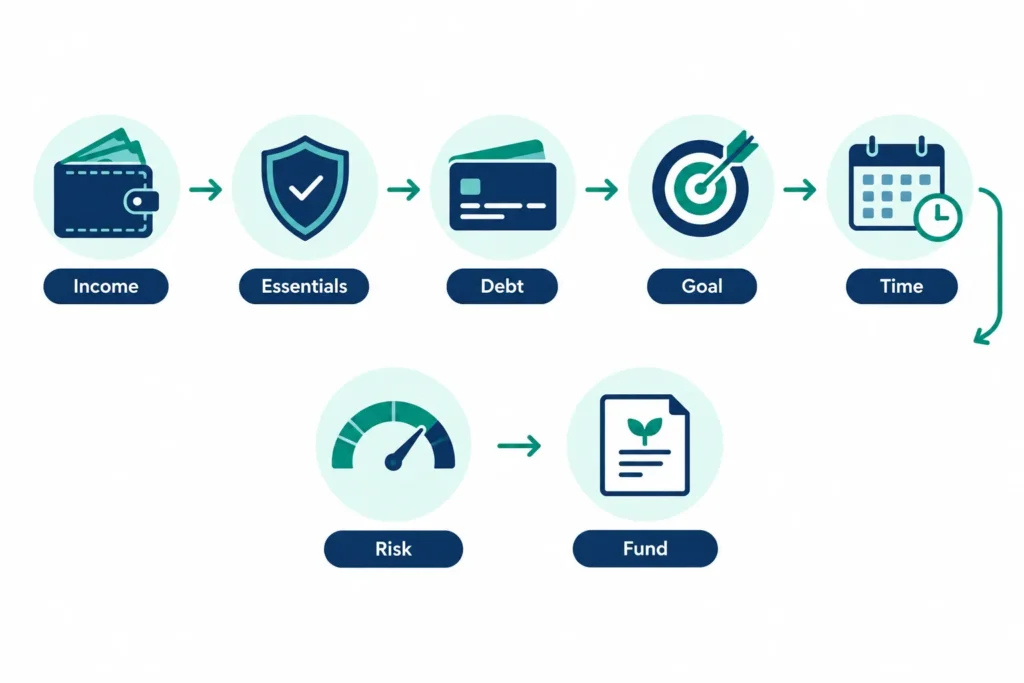
Before starting, consider these questions:
- Do I have accessible money for emergencies?
- Are essential bills and near-term expenses already provided for?
- Am I managing high-interest debt?
- What exact goal is this investment meant to support?
- When might I need the money?
- Can I accept fluctuations in the chosen fund?
- Would I be able to stay invested during a market decline?
If several answers are unclear, work on those foundations before chasing the ideal market date. For a broader explanation of fund types, SIPs, risks and beginner decisions, continue with the RegularStation pillar guide, Mutual Funds and SIP Investing in India: A Complete Beginner’s Guide.
How to Start: Goals, Risk, SIPs and Lump-Sum Investing
Before deciding when to invest in mutual funds, first decide what the money is meant to achieve. A clear goal, suitable time period and realistic understanding of risk can help you choose a more appropriate investment approach.
Do not begin only because a friend recommended a fund or because a scheme recently delivered high returns. Mutual fund values can rise and fall, and past performance does not guarantee future results.
Start by Defining Your Financial Goal
A financial goal gives your investment a purpose. It also helps you estimate how long you can remain invested and how much risk may be reasonable.
Your goal should answer three basic questions:
- What are you investing for? Examples include higher education, a house down payment, retirement or long-term wealth creation.
- When will you need the money? This could be in three years, eight years or several decades.
- How much might you need? Make a practical estimate and review it periodically because costs can change over time.
A goal does not have to be perfectly calculated before you start. A beginner can begin with a sensible amount and refine the plan as income, expenses and priorities become clearer.
However, avoid using equity mutual funds for money that may be needed very soon. Equity markets can decline sharply, and there may not be enough time for the investment to recover before the goal date.
Match the Investment to Your Time Horizon
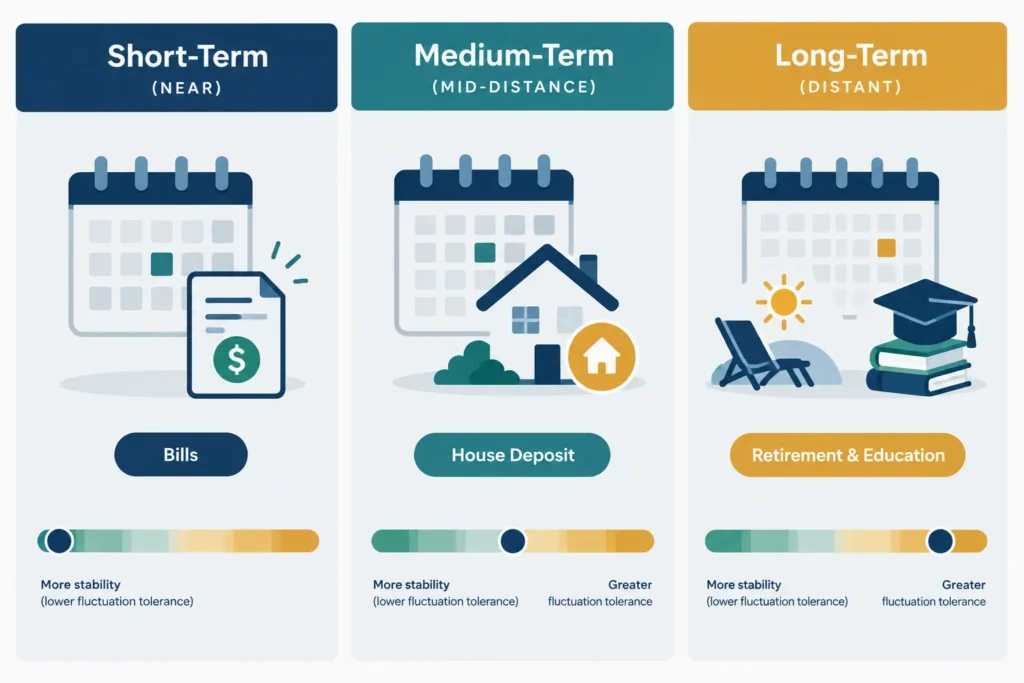
Your time horizon is the period between investing the money and needing to withdraw it. It is one of the most important factors in fund selection.
| Time horizon | What to consider |
|---|---|
| Short term | Capital stability and access to money may be more important than seeking high growth. Equity-oriented funds may be unsuitable for a near-term expense. |
| Medium term | A mix of stability and growth may be considered, depending on the exact goal date and your capacity for loss. |
| Long term | An investor may be able to consider more equity exposure, provided short-term market declines will not force an early withdrawal. |
Time horizon alone does not decide the right fund. Two people investing for ten years may still need different portfolios because their income stability, responsibilities and comfort with losses may be different.
Understand Your Ability and Willingness to Take Risk
Risk tolerance has two parts: your ability to accept a loss and your willingness to accept it.
Your ability to take risk depends on practical factors. These may include your income, job stability, emergency savings, existing loans, insurance cover, dependants and the flexibility of your goal date.
For example, a person with stable income, no expensive debt and an adequate emergency fund may have a greater ability to take investment risk. A person with uncertain income and a large loan may have less ability, even if both people are the same age.
Your willingness to take risk is emotional. Ask yourself how you might react if an investment of ₹1 lakh temporarily fell to ₹80,000 or lower. Would you continue investing, or would fear make you sell?
Do not select an aggressive fund merely because you want high returns. If normal market fluctuations cause sleepless nights or panic selling, the investment may not match your willingness to take risk.
Use the SEBI Riskometer as a Starting Point
Mutual fund schemes display a SEBI-mandated Riskometer. It classifies a scheme’s risk on levels ranging from low to very high. The assessment is based on characteristics of the scheme’s portfolio and may change when the portfolio changes.
The Riskometer makes it easier to compare the broad risk level of different schemes. For instance, an equity fund will generally carry more market risk than a fund investing mainly in short-term, high-quality debt instruments.
However, the Riskometer should not be your only selection tool. Two schemes with the same risk label may have different investment strategies, portfolios and suitability. You must still understand what the scheme owns and how it plans to generate returns.
Read the Scheme Information Document
Before investing, read the Scheme Information Document, commonly called the SID. It may look lengthy, but beginners can focus first on the sections that directly affect their decision.
- Investment objective: What the scheme aims to achieve.
- Asset allocation: Where the scheme can invest and the permitted allocation ranges.
- Investment strategy: How the fund manager intends to build and manage the portfolio.
- Risk factors: The major risks associated with the scheme and its investments.
- Benchmark: The index against which the scheme’s performance is compared.
- Fees and expenses: Costs that can reduce the investor’s return.
- Exit load: A charge that may apply if units are redeemed within a specified period.
Also check the latest factsheet and portfolio disclosures. If you cannot explain in simple words where a scheme invests and why it suits your goal, consider learning more before investing.
SIP or Lump Sum: Which Approach Fits You?
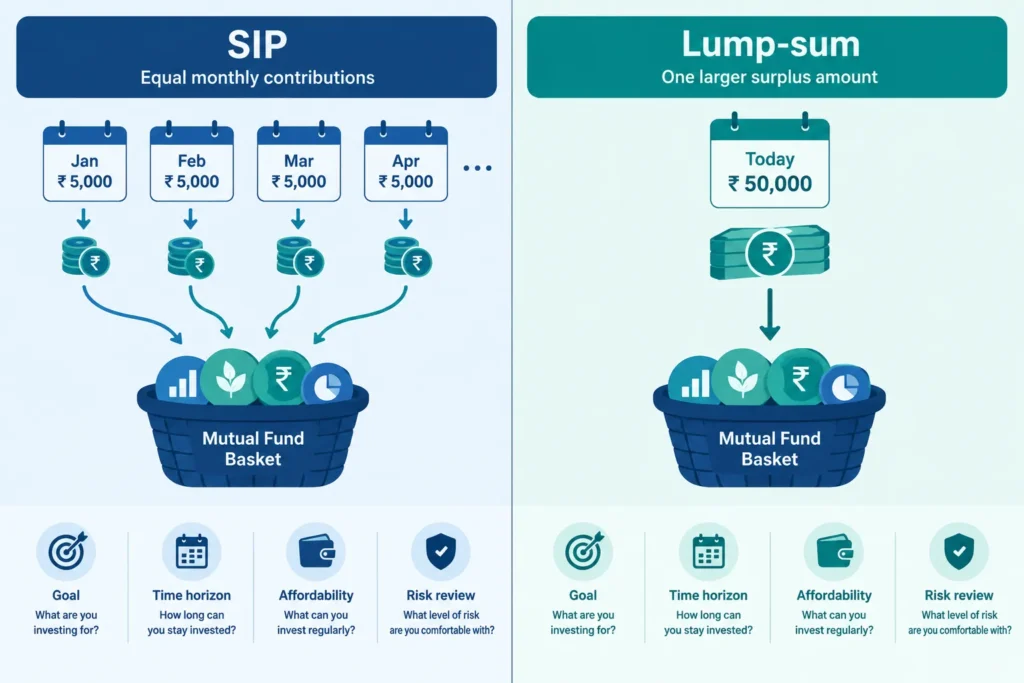
A systematic investment plan, or SIP, allows you to invest a fixed amount at regular intervals, usually every month. A lump-sum investment places a larger available amount into a scheme at one time.
| Approach | May suit | Important limitation |
|---|---|---|
| SIP | People earning a regular monthly income who want a disciplined investing habit | It does not guarantee profits or protect against market losses |
| Lump sum | People with available surplus money, a suitable time horizon and a planned asset allocation | The full amount becomes exposed to market movements after investment |
SIPs spread purchases across different dates. When market prices are lower, the same contribution may buy more units. When prices are higher, it may buy fewer units. This reduces the need to choose one perfect entry date, but it does not remove investment risk.
A SIP can also help regular earners invest soon after receiving their salary. The amount should remain manageable even when routine expenses rise. Missing essential payments or borrowing money to maintain a SIP defeats the purpose of disciplined investing.
For a detailed explanation of how instalments, units and SIP dates work, read the RegularStation SIP explainer. You can also use the RegularStation SIP calculator to estimate how different monthly contributions and investment periods may affect a goal. Calculator results are illustrations, not promised returns.
Lump-sum investing may be considered when you receive a bonus, sell an asset or have other surplus funds. Before investing, confirm that the money is not required for an emergency, near-term expense or debt repayment.
Do not invest a lump sum in equity solely because the market has recently fallen or because someone says prices cannot decline further. Market timing is uncertain. The decision should follow your goal, horizon, risk profile and chosen asset allocation.
Practical Examples for Indian Investors
A first-job earner: Neha has recently started working in Pune. After building a basic emergency fund and managing her monthly expenses, she can comfortably invest ₹2,000 a month. A manageable SIP may help her build the habit without straining her budget. She can increase the contribution later as her salary rises.
A family planning a medium-term expense: Arjun and Meera expect to need money for a major family expense in about five years. They should not choose a fund only by looking at recent equity returns. They need to consider the fixed goal date, how much temporary loss they can accept and whether a combination of lower-risk and growth-oriented assets is more suitable. As the goal approaches, protecting the accumulated amount may become more important.
A long-term wealth builder: Rakesh has stable income, emergency savings and no need to use the invested money for many years. He may consider investing regularly in a diversified equity-oriented fund if it matches his risk profile. If he also receives an annual bonus, he can invest part of the surplus according to his asset allocation rather than automatically placing the entire amount in the latest top-performing fund.
A Simple Checklist Before You Begin
- Define the goal and expected date.
- Keep emergency money separate from investments.
- Assess both your financial ability and emotional willingness to face losses.
- Check the scheme’s Riskometer.
- Read the SID, especially the objective, asset allocation, risks, costs and exit load.
- Choose a SIP for regular investing or a lump sum for suitable surplus money.
- Invest an amount you can maintain without affecting essential expenses.
- Review the goal and allocation periodically instead of reacting to every market movement.
The right time to start is not simply when markets appear cheap or when a fund is popular. It is when your basic finances are ready, your goal is clear and the chosen investment matches your horizon and risk profile.
Costs, Tax, Common Mistakes and a Practical Starting Checklist
Deciding when to invest in mutual funds is not only about choosing a date. You should also understand the costs, risks and tax treatment before investing. A simple plan can help you avoid common mistakes and select an approach that suits your financial situation.
Understand the Expense Ratio
A mutual fund charges investors for managing and operating the scheme. This annual cost is called the expense ratio. It is deducted from the scheme’s assets, so you do not usually pay it through a separate bill.
A higher expense ratio reduces the return that remains for investors. The difference may look small in one year, but it can matter over a long investment period.
Direct plans generally have lower expense ratios than regular plans because direct plans do not include distributor commissions. However, direct plans require you to research, select and monitor funds yourself. A regular plan may be suitable for someone who needs guidance, provided the costs and the adviser’s role are clearly understood.
Do not choose a fund only because it has the lowest expense ratio. Cost is important, but the scheme’s objective, portfolio, risk level, investment process and suitability for your goal also matter.
Check the Exit Load
An exit load is a fee that may apply when you redeem, switch or withdraw units within a specified period. The rules can differ across schemes. Some schemes may not charge an exit load, while others may apply one if you withdraw too early.
For example, if you invest money meant for a goal six months away in a scheme with an applicable exit load, an early withdrawal could reduce the amount you receive. This is one reason to match the fund with your expected holding period.
Read the latest scheme documents before investing. Check when the exit load applies, how it is calculated and whether different rules apply to systematic transactions.
Recognise Market and Scheme-Specific Risks
Mutual fund returns are not guaranteed unless a guarantee is explicitly provided under the applicable scheme structure and documents. The value of your investment can rise or fall.
Equity funds are affected by stock market movements. They can experience sharp declines, particularly over short periods. Debt funds may face interest-rate risk, credit risk and liquidity risk. Even funds in the same broad category can hold different securities and follow different strategies.
There is also scheme-specific risk. A fund concentrated in one sector, theme, market segment or small group of companies may fluctuate more than a broadly diversified fund. A scheme that performed well recently may not continue to do so.
Review the Riskometer and the scheme’s stated investment objective. The Riskometer gives a standardised indication of risk, but it should not be your only check. Look at what the scheme invests in and whether that exposure fits your goal and time horizon.
Consider Tax Before You Invest
Mutual fund taxation in India can depend on factors such as the type of fund, its underlying portfolio, the date of investment, the holding period and the nature of the transaction. Capital gains and distributions may be taxed differently.
Tax rules, holding-period definitions, rates and regulatory terminology can change. The latest Indian mutual fund tax provisions should therefore be verified immediately before publication and again before you make an investment or redemption decision.
Do not select a fund only to save tax. First check whether it suits your goal, risk capacity and required lock-in or holding period. If your situation involves a large redemption, inherited units, non-resident status or complicated capital gains, consider consulting a qualified tax professional.
Common Mistakes to Avoid
- Waiting indefinitely for the perfect entry point: Markets are difficult to predict consistently. If your finances are ready and your goal is long term, delaying every decision while waiting for a fall can leave your money uninvested for years.
- Investing emergency savings: Emergency money should remain accessible and relatively stable. Using it for volatile investments may force you to sell at a loss when an urgent expense arises.
- Ignoring costly debt: High-interest debt, such as revolving credit card balances, can weaken your finances. Repaying costly debt may deserve priority before increasing market-linked investments.
- Copying another person’s portfolio: A colleague or relative may have different income, goals, responsibilities and risk tolerance. Their fund selection may not be suitable for you.
- Chasing recent returns: A fund at the top of a short-term performance list can later underperform. Recent returns do not reveal the full risk, consistency or suitability of a scheme.
- Ignoring costs and risk labels: Expense ratios, exit loads and portfolio risks affect your experience and outcome. Read the relevant documents instead of relying only on an app’s headline rating.
- Investing without a clear goal: Money for a home down payment in two years should not automatically be invested like retirement money needed after 25 years.
- Stopping SIPs only because markets fall: A market decline can feel uncomfortable, but fear alone is not a complete reason to stop. Review whether your goal, income, horizon or risk capacity has changed. If they have not, an affordable SIP may still support a disciplined long-term approach.
Continuing an SIP is not always the correct choice. You may need to pause or reduce it after a job loss, medical expense or other financial emergency. The key is to make the decision based on your circumstances rather than short-term market headlines alone.
Practical Checklist Before Starting
- Secure emergency money: Keep a suitable emergency reserve for essential household expenses and unexpected needs.
- Address costly debt: Review credit cards, personal loans and other high-interest obligations before committing too much to investments.
- Define the goal: State what the money is for, the approximate amount required and when it will be needed.
- Assess your risk: Consider both your willingness to tolerate losses and your financial ability to absorb them.
- Match the scheme to the horizon: Avoid using high-volatility funds for money you may need soon.
- Read the scheme information: Review the Scheme Information Document, investment objective, portfolio approach, benchmark and Riskometer.
- Understand costs: Check the expense ratio, exit load and whether you are choosing a direct or regular plan.
- Check current tax treatment: Verify the latest classification, holding-period rules and applicable tax provisions.
- Start with an affordable approach: Choose a lump sum or SIP based on your cash flow. Do not commit an amount that makes monthly expenses difficult.
- Review periodically: Check progress at sensible intervals and after major life changes. Avoid reacting to every market movement.
Frequently Asked Questions
Should I wait for the market to fall before investing?
Waiting for a better price may appear sensible, but no one can reliably identify every market high or low. If you have emergency savings, manageable debt, a suitable long-term goal and the ability to handle fluctuations, you can consider starting gradually. An SIP can spread investments across different market levels, although it does not remove market risk or guarantee profit.
Is there a best day of the month for an SIP?
There is no universally best SIP date. Choose a date that fits your cash flow, such as a few days after your salary is credited. Consistency and affordability are generally more useful than trying to identify a special date.
How much should a beginner invest?
Start with an amount you can maintain without affecting essential expenses, emergency savings or debt repayments. The right amount depends on your income, goal, time horizon and existing commitments. It can be increased later as your income and financial capacity improve.
Should I stop my SIP when markets fall?
Do not stop solely because prices have declined. First review your goal, horizon, fund suitability and financial position. A pause may be reasonable if your income has fallen or you need cash for an emergency. Market fear by itself should not replace a considered review.
How often should I review my mutual funds?
A periodic review, such as once or twice a year, may be enough for many long-term investors. You should also review after a major change in your goal, income, family responsibilities or risk capacity. Frequent checking can encourage unnecessary decisions.
Summary
The answer to when to invest in mutual funds depends more on your financial readiness than on predicting the market. Build emergency savings, deal with costly debt, define your goal and choose a scheme whose risk and time horizon fit that goal.
Before investing, understand the expense ratio, exit load, Riskometer and current tax treatment. Avoid chasing recent returns, copying someone else’s portfolio or using emergency money. Start with an affordable amount and review your plan periodically rather than reacting to daily market movements.
Disclaimer: Mutual fund investments are subject to market risks. Read all scheme-related documents carefully before investing. This article is for education only and is not personalised investment, legal or tax advice. Tax rules and regulatory requirements may change, so verify the latest provisions or consult a qualified professional before acting.




Comments