


To learn how to invest in stocks in India, first understand what shares represent and how stock prices can rise or fall. Before investing, build an emergency fund, control high-interest debt and decide how much money you can leave invested for your goal. Then assess your risk tolerance and plan to spread your money across different companies or investments rather than depending on one stock.
Stocks can help build wealth over the long term, but returns are not guaranteed. Their value can fall, sometimes sharply. Beginners should invest only money they can expose to market risk without affecting rent, loan repayments, insurance premiums or other essential needs.
Introduction
Stock investing may appear complicated when you are starting. You may hear unfamiliar terms such as equity, IPO, dividend, market capitalisation and portfolio. You may also see stories about investors making quick profits or losing money during a market fall.
The basic idea, however, is straightforward. When you buy a company’s shares, you purchase a small ownership interest in that business. If the business grows and the market values it more highly, your shares may become more valuable. In some cases, the company may also distribute part of its profits to shareholders.
This does not mean every company will succeed or every share price will rise. A strong business can face temporary setbacks, while a weak business can sometimes attract excitement and trade at an expensive price. Understanding this relationship between a company, its shares and the market is an important first step.
Before opening a trading app or selecting a stock, you also need to prepare your finances. Your goals, investment period and ability to handle losses should influence how much risk you take.
Section 1: Understand Stock Investing and Prepare Your Finances
What Is a Stock or Share?
A stock represents ownership in a company. A share is one unit of that ownership. In everyday conversation, people often use the words “stock” and “share” interchangeably.
Suppose an imaginary company is divided into 10 lakh shares. If you own 100 of those shares, you own a very small part of the company. Your ownership is limited, but the basic principle is the same as that of a large shareholder.
Owning shares may give you certain rights, depending on the type of shares and applicable rules. These can include the right to vote on selected company matters and the possibility of receiving dividends. However, shareholders do not receive a fixed return merely because they own part of the company.
Why Do Companies Issue Shares?
Companies need money to start operations, expand factories, develop products, enter new markets or reduce debt. One way to raise this money is to issue shares to investors.
Unlike a normal loan, money raised by issuing equity does not generally require fixed interest payments. In exchange, the original owners share part of the company’s ownership with new investors.
A company may offer shares to the public through a new issue, such as an initial public offering. An IPO is the process through which a company offers its shares to public investors and seeks a stock exchange listing for the first time. Companies already listed on an exchange may also raise additional equity through other types of issues.
How Can Investors Earn Money from Stocks?
There are two main ways investors may earn from shares:
- Price appreciation: You buy a share and later sell it at a higher price. For example, if you buy at Rs. 500 and sell at Rs. 620, the difference is a capital gain before taxes and transaction costs.
- Dividends: A profitable company may distribute part of its earnings to shareholders. A dividend is not compulsory, and its amount can change. A company may instead retain its profits to fund future growth.
Investors can also lose money. If you buy a share at Rs. 500 and sell it at Rs. 380, you have a capital loss. Even if you do not sell, the market value of your investment will fluctuate as the share price changes.
In a severe case, a business may fail and its shares may lose most or all of their value. Dividends cannot protect investors from every loss. This is why stocks should not be treated like a bank deposit or a guaranteed savings product.
Long-Term Investing Is Different from Short-Term Trading
Long-term investing usually means buying shares with the intention of participating in a company’s growth over several years. Investors study factors such as the business model, financial position, management, competitive advantages and valuation.
Short-term trading focuses more on price movements over periods ranging from minutes to months. Traders may rely on charts, market momentum, news events or specific trading strategies. It requires strict risk controls and frequent decision-making.
The difference is not simply how often someone checks an app. It concerns the reason for buying, the expected holding period and the method used to make decisions.
A beginner should not assume that frequent buying and selling creates faster or easier returns. Trading involves market risk, transaction costs, taxes and the possibility of emotional decisions. Long-term investing also carries risk, but it gives a sound business more time to grow and allows investors to take a goal-based approach.
Primary Market and Secondary Market
The Indian stock market has two broad parts that beginners should understand.
The primary market is where companies or other issuers offer new securities to investors. An IPO is a familiar example. Depending on the issue, investors may apply for shares, but an application does not ensure allotment. An IPO is also not automatically a good investment merely because it is new or popular.
The secondary market is where investors buy and sell shares after they are listed. When you purchase listed shares through a stock exchange, you are generally buying them from another market participant rather than giving money directly to the company.
India’s major stock exchanges provide organised markets in which listed securities can be traded. Orders are matched according to exchange systems and applicable market rules.
Why Do Share Prices Move?
A share price reflects what buyers are willing to pay and what sellers are willing to accept. If buying demand is stronger than selling supply, the price may rise. If more investors want to sell, the price may fall.
Several factors can influence this demand and supply:
- Company performance: Revenue growth, profits, debt, cash flows and business expansion can affect how investors value a company.
- Industry conditions: Changes in competition, input costs, technology or regulation can help or hurt an entire sector.
- Economic conditions: Interest rates, inflation, employment, currency movements and economic growth may influence businesses and markets.
- Investor expectations: Markets often react to what investors expect in the future, not only to current results.
- News and sentiment: Management changes, government policies, global events and market optimism or fear can move prices.
A company can report higher profits and still see its share price fall if investors expected even better results. Similarly, the price of a struggling company may rise if the market believes its future will improve. A rising price does not by itself prove that a share is safe or reasonably valued.
Prepare Your Finances Before Investing
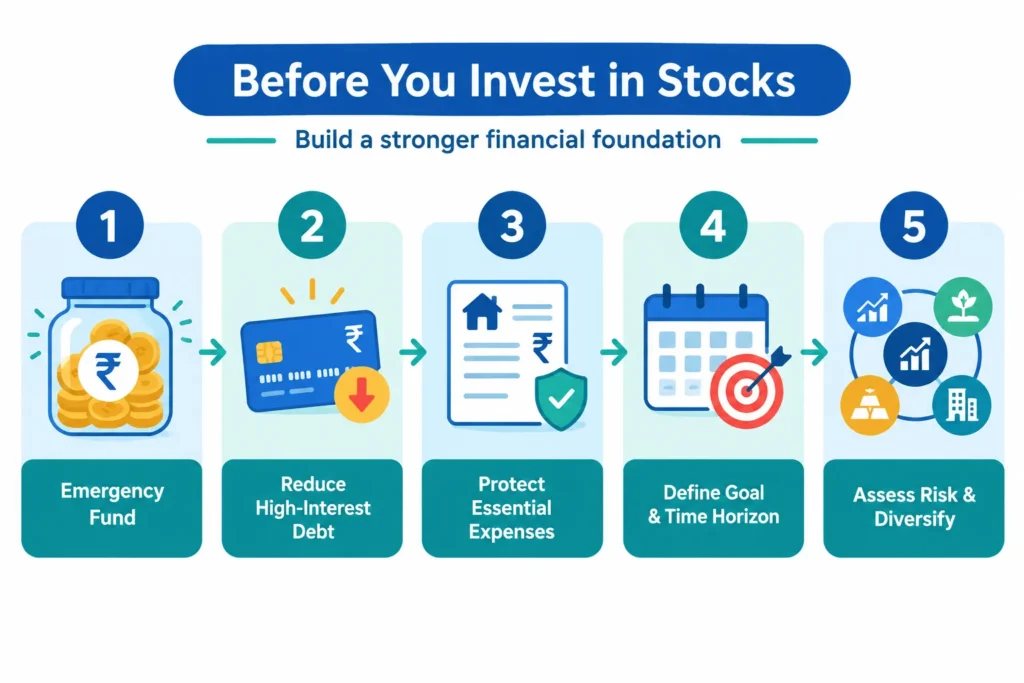
The right starting point is not a stock recommendation. It is a stable personal financial base.
First, build an emergency fund. This is money kept for unexpected expenses such as a medical bill, urgent home repair or temporary loss of income. It should generally be held in an accessible and relatively stable form, rather than depending on stocks that may be down when cash is needed.
Second, review high-interest debt. Credit card balances and expensive personal loans can create a significant, certain cost, while stock returns are uncertain. Paying down costly debt may deserve priority before taking substantial market risk.
Third, invest only suitable money. Do not use funds needed soon for school fees, rent, loan instalments, insurance premiums or household expenses. Avoid borrowing money to buy shares. A market decline should not force you to sell investments merely to meet an essential payment.
Define Your Goal, Time Horizon and Risk Tolerance
Give every investment a purpose. A goal could be building retirement savings, funding a child’s education or accumulating money for a long-term purchase.
Your time horizon is the period before you expect to need the money. Stocks can be volatile over short periods, so they are generally more suitable for goals with enough time to withstand market fluctuations. Money required in the near future usually needs greater stability.
Risk tolerance describes your financial and emotional ability to handle losses. Ask yourself how you might react if your investment temporarily fell by 20% or more. If such a decline would make you panic, lose sleep or sell immediately, a heavily stock-based approach may not suit you.
Your ability to take risk also matters. A person with stable income, adequate insurance, limited debt and a long time horizon may be better placed to tolerate volatility than someone with uncertain income and an approaching financial goal.
Use Diversification to Limit Concentration Risk
Diversification means spreading money across different investments instead of relying on one company, industry or market theme. If your entire investment is in a single banking, technology or pharmaceutical stock, a company-specific problem can seriously damage your portfolio.
Holding multiple investments does not prevent all losses. During a broad market decline, many shares can fall together. However, sensible diversification can reduce the damage caused by one poor selection or one troubled sector.
Beginners should focus first on creating a suitable overall mix rather than searching for one “best” share. The aim is not to eliminate risk, which is impossible, but to avoid taking unnecessary concentration risk.
Educational disclaimer: This article provides general educational information and does not constitute personalised investment, tax or legal advice. Stock investments are subject to market risk, and returns are not guaranteed. Consider your circumstances and consult a qualified professional where necessary before making investment decisions.
Open the Right Accounts and Learn How Orders Work
To understand how to invest in stocks in India, you first need to know which accounts are required and what happens after you place an order. You also need a reliable, regulated stockbroker.
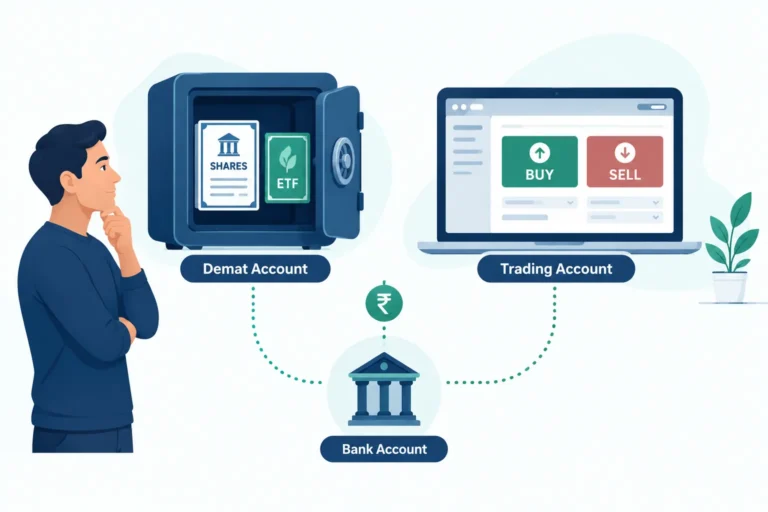
The process may appear technical at first. In practice, your bank account, trading account and demat account work together to help you buy, hold and sell shares.
Who Does What in the Indian Stock Market?
Several regulated organisations support the Indian stock market. Each has a different role.
- SEBI: The Securities and Exchange Board of India regulates the securities market. It creates rules for market participants, registers intermediaries and works to protect investors.
- NSE and BSE: The National Stock Exchange and BSE are stock exchanges. They provide electronic marketplaces where buy and sell orders are matched.
- Stockbroker: A stockbroker provides the platform through which you place orders. The broker acts as an intermediary between you and the stock exchange.
- Depositories: NSDL and CDSL hold securities in electronic form through depository participants. Your broker or another financial institution may act as the depository participant for your demat account.
A company’s shares may be available on NSE, BSE or both. When placing an order, you may be asked to select an exchange. Prices can differ slightly between exchanges because orders are matched separately on each one.
Demat Account, Trading Account and Bank Account
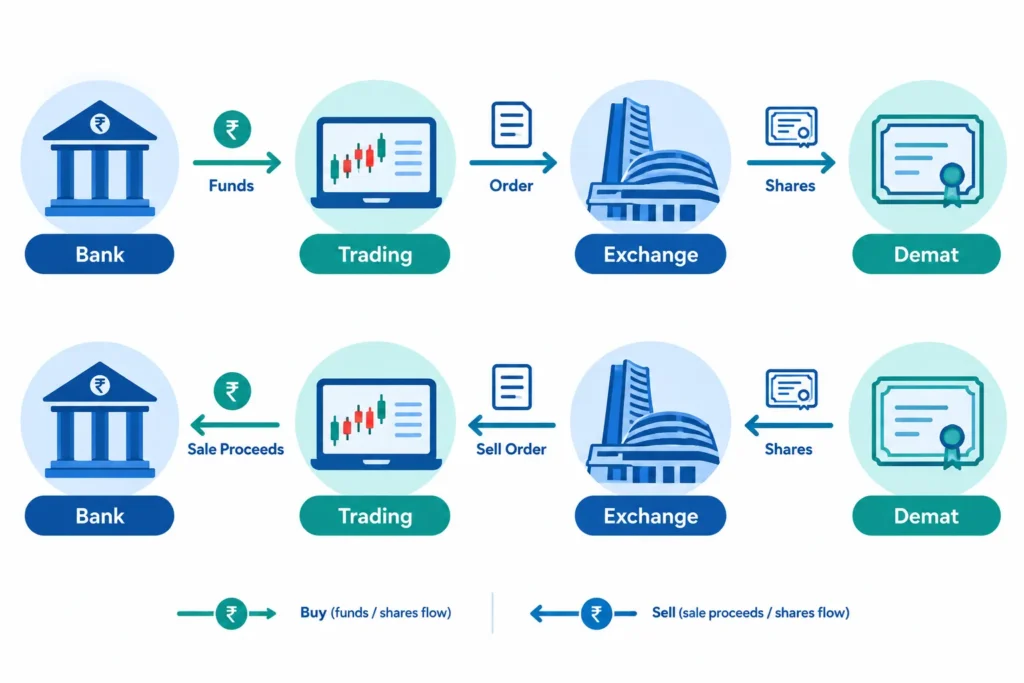
These three accounts serve different purposes.
| Account | Main purpose |
|---|---|
| Demat account | Holds your shares and other eligible securities electronically. |
| Trading account | Allows you to place buy and sell orders through a broker. |
| Bank account | Provides money for purchases and receives eligible withdrawals or sale proceeds. |
Suppose you buy five shares of an Indian listed company. You place the order through your trading account and pay using funds made available through the linked bank account. After the trade is completed and settled, the shares are credited to your demat account.
When you sell, the shares are debited from the demat account. The sale proceeds become available according to the applicable settlement and withdrawal rules.
Many brokers offer a combined demat and trading account. However, the two accounts still perform separate functions. Some banks and brokers also offer integrated arrangements that connect banking, trading and demat services.
How to Select a Stockbroker
Do not select a broker only because its advertisements promise low brokerage or quick profits. Start by checking whether the broker is registered with SEBI and is an authorised member of the relevant exchange.
Use official SEBI and stock exchange records to verify the broker’s legal name and registration details. Be cautious if the name on an app, website or payment request does not match the registered entity.
Compare brokers using the following points:
- Brokerage and other charges: Review the pricing for delivery trades, intraday trades and any other service you intend to use. Also check account-opening, maintenance, call-and-trade, pledge and demat-related charges.
- Platform reliability: The app or website should make it easy to place, modify and cancel orders. Look for clear order status messages and access to transaction records.
- Customer service: Check whether the broker offers practical support through recognised channels. Understand how complaints are recorded and escalated.
- Account features: Decide whether you need only basic investing features or additional reports and tools. Beginners do not need a complicated platform simply because it offers more screens.
- Statements and records: Check how you can access ledger statements, holding statements, order history, trade confirmations and contract notes.
- Security: Prefer a broker that provides strong login controls, two-factor authentication, alerts and clear processes for reporting unauthorised activity.
- Data protection: Read how the broker handles personal and financial information. Avoid giving unnecessary permissions to an investing app.
- Grievance channels: Confirm that the broker publishes official complaint and escalation details. Investors should also understand the applicable exchange and SEBI grievance mechanisms.
A broker with zero or low brokerage may still levy other permitted charges. Read the complete tariff sheet rather than relying on one headline price.
KYC and Account Opening
To open an account, you generally complete Know Your Customer, or KYC, requirements. The broker may ask for identity, address, bank and tax-related information. You may also need to complete identity verification, provide a signature and accept account agreements electronically or physically.
The exact process depends on the broker, account type and current regulations. Some products or trading segments may require additional declarations or financial information.
Review nominee or nomination-related choices carefully instead of skipping the screen without understanding it. Also check whether your mobile number, email address and bank details are entered correctly, because important alerts and records may be sent through these channels.
Publication note: Identity documents, nomination rules, account-opening procedures, regulatory requirements and settlement processes can change. Current requirements should be verified before publication through SEBI, the relevant exchange, depository and broker documentation.
Adding Money to the Trading Account
After activation, you can add funds using a payment method supported by the broker. The money normally comes from a registered bank account linked to your trading account.
Before transferring money, verify the broker’s official payment instructions. Do not send investment money to an employee’s personal bank account, an unknown UPI ID or an account shared through an unsolicited message.
Your broker may display an available funds balance after a successful transfer. This balance is used for eligible purchases and charges. Withdrawal availability can differ from the displayed trading balance because settlement and other rules may apply.
How Basic Stock Orders Work
When you open a company’s order screen, you usually need to enter the exchange, quantity and order type. Check every field before confirming the order.
The two basic order types are:
- Market order: This requests execution at the best available market price. The final price may differ from the price visible when you pressed the button, particularly when prices are moving quickly or trading activity is low.
- Limit order: This lets you set a maximum purchase price or a minimum sale price. The order executes only if a matching price is available. Execution is not guaranteed.
For example, assume a share is trading near Rs 500. A market buy order for two shares seeks immediate execution at available prices. If you instead enter a limit buy order at Rs 490, it will execute only if sellers are available at Rs 490 or a better permitted price.
Also confirm whether you are placing a buy or sell order and whether the order is intended for delivery or another permitted product type. A beginner planning to own shares should not accidentally select a leveraged or intraday product without understanding its rules and risks.
After submission, the order may appear as open, pending, partially filled, completed, cancelled or rejected. A partially filled order means only some of the requested quantity has traded. A rejection message should state the reason, such as insufficient funds, an invalid price or a regulatory restriction.
Check the Contract Note and Transaction Charges
After a trade, the broker provides a contract note or other prescribed trade confirmation. It records important details such as the security, exchange, quantity, trade price and charges. Review it and report unexplained differences promptly through official channels.
Your total transaction cost can include brokerage, securities transaction tax where applicable, GST on specified services, stamp duty, exchange transaction charges, SEBI-related charges and depository charges where relevant. The type and amount of charges can differ between purchases, sales, products and brokers.
Do not calculate returns using only the difference between the buy and sell prices. Transaction costs reduce a gain and increase a loss.
Publication note: Tax rates, brokerage structures and exchange-related charges should be checked against current official and broker disclosures before publication. Tax treatment can also depend on the transaction and the investor’s circumstances.
A Simple Buy-and-Sell Example
Suppose Meera buys 10 shares at Rs 200 each. The value of her purchase is Rs 2,000 before transaction costs.
Later, she sells all 10 shares at Rs 230 each. Her sale value is Rs 2,300 before transaction costs. The price difference produces a gross gain of Rs 300.
Now assume the combined eligible costs connected with the purchase and sale are represented by Rs 30 purely for this hypothetical illustration. Her gain after those assumed transaction costs would be Rs 270.
If Meera had sold the shares at Rs 190 each, her gross sale value would have been Rs 1,900. The price difference would create a gross loss of Rs 100. After including the same hypothetical Rs 30 in costs, her total loss would be Rs 130.
This simplified example does not calculate actual tax liability. Its purpose is to show why investors should include transaction costs when reviewing performance.
Protect Your Account from Fraud
Treat your trading and demat accounts like your bank account. Basic security habits can prevent many avoidable problems.
- Never share your password, trading PIN, demat authorisation details or one-time code with anyone.
- Do not allow another person to remotely control your phone or computer.
- Install the broker’s app only after confirming that it is genuine.
- Avoid links and files sent through unsolicited messages, social media groups or unknown callers.
- Do not trust guaranteed-return claims, “operator” tips or requests to transfer money to personal accounts.
- Be cautious of people impersonating brokers, exchanges, SEBI officials or customer-care representatives.
- Enable two-factor authentication and use a unique, strong password.
- Review trade alerts, contract notes, fund statements and demat holding statements regularly.
- Use only the broker’s official grievance channel if you notice an unauthorised order or suspicious login.
Learning the account structure and order process before investing real money can reduce operational mistakes. Start with a small amount, read every confirmation screen and keep proper records of each transaction.
Section 3: Research a Company, Make a Careful First Purchase and Review It
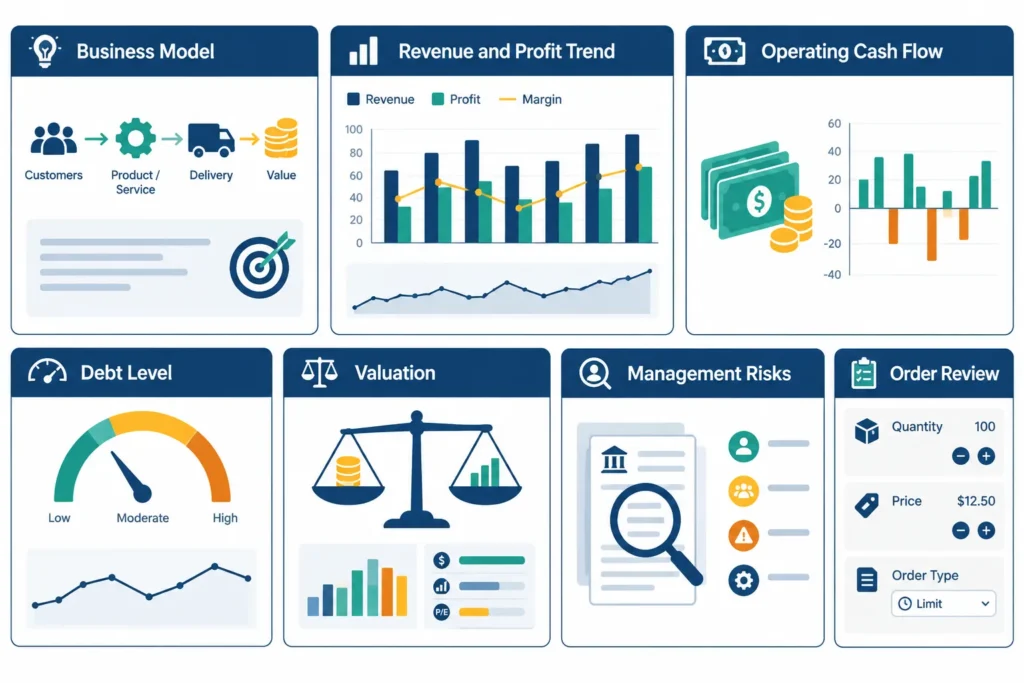
Learning how to invest in stocks in India is not only about opening a demat account and placing an order. Before buying a share, you should understand the business, check its financial condition and decide whether the current price is reasonable.
You do not need to become a professional analyst. A simple and consistent research process can help you avoid many common mistakes.
Understand How the Company Makes Money
Start with the company’s business model. Ask what it sells, who its customers are and why customers choose it over competitors.
For example, a company may earn money by selling consumer products, providing banking services, manufacturing auto parts or operating software subscriptions. Some businesses have one main source of revenue, while others operate across several segments or countries.
Check whether you can explain the business in a few simple sentences. If the business is too complicated for you to understand, it may be sensible to study it further or avoid investing until you are comfortable.
Check Revenue, Profit and Cash Flow
Review the company’s financial performance over several years rather than relying on one strong quarter.
- Revenue: Look at whether sales are growing, falling or moving unpredictably.
- Profit: Check whether the company is earning a consistent profit and whether profit growth is supported by its main operations.
- Profit margins: See how much profit the company keeps from its revenue and whether margins are improving or weakening.
- Cash flow: Check whether the core business generates actual cash. Reported profit without healthy operating cash flow deserves closer investigation.
Temporary changes are not always bad. A company may report lower profit because it is expanding capacity or facing a short-term increase in raw material costs. The important step is to understand the reason instead of judging the company from one number.
Examine Debt and Financial Strength
Debt can help a company expand, but excessive borrowing can become dangerous. Interest payments may reduce profit, especially when business conditions weaken or interest rates rise.
Compare debt with the company’s earnings, cash flow and assets. Also check whether debt has been rising and whether the company can comfortably pay interest. The acceptable level of borrowing differs by industry, so comparisons should generally be made with similar businesses.
A bank and a manufacturing company, for example, cannot be assessed using exactly the same debt measures. Industry context matters.
Consider Valuation Before Buying
A good company can still be a poor investment if you buy it at an unreasonable valuation. Valuation indicates how much investors are paying in relation to factors such as earnings, sales, assets or cash flow.
Common measures include the price-to-earnings ratio, price-to-book ratio and dividend yield. No single ratio provides a complete answer. Compare a company’s valuation with its own history, similar companies and its expected growth and risks.
A low valuation does not automatically mean that a stock is cheap. The business may be facing serious problems. Similarly, a high valuation may reflect strong expectations, but it also creates a risk if actual performance disappoints.
Study Competitive Position and Management
Consider whether the company has a durable advantage. This could come from a trusted brand, efficient distribution, lower production costs, specialised technology, regulatory approvals or long-term customer relationships.
Also assess management quality. Look for clear communication, sensible use of shareholder money and fair treatment of minority shareholders. Frequent changes in business direction, unexplained related-party transactions, repeated dilution or poor disclosure standards may be warning signs.
Promoter shareholding and pledged shares can provide useful context, but they should not be viewed in isolation. Read the explanations and examine the broader pattern.
Read Risks and Official Disclosures
Every investment carries risks. These may include competition, regulation, raw material prices, currency movements, customer concentration, technological change or dependence on a few key products.
Use official sources wherever possible. Relevant documents include annual reports, quarterly results, investor presentations, exchange filings, shareholding patterns and announcements about major corporate events. Pay attention to auditor comments, legal disputes and changes in senior management.
Social-media posts and online discussions can help you identify questions, but they should not replace official disclosures or your own assessment.
How to Make a Cautious First Purchase
Once your research is complete, decide how much you can afford to invest. This should be money that is not required for regular expenses, emergency needs or near-term goals.
- Choose a limited amount: A first purchase does not need to be large. Starting small gives you time to understand market movements and the broker’s platform.
- Confirm diversification: Do not put all your investment money into one company, sector or theme.
- Check available funds: Make sure sufficient cleared funds are available in your trading account or linked bank account.
- Select the order type: A market order seeks execution at the available market price. A limit order lets you specify the maximum price you are willing to pay, but it may remain unexecuted.
- Review the order: Confirm the company name, exchange, quantity, price, product type and estimated charges before submitting it.
- Retain the records: Check the trade confirmation and contract note. The contract note records details such as the trade, brokerage, taxes and other charges.
Order features and labels may differ between brokers. Do not select intraday, margin or leveraged products unless you fully understand their operation and risks.
Mistakes Beginners Should Avoid
- Investing all available money in one stock.
- Borrowing money or using emergency funds to invest.
- Buying only because a stock has risen sharply in recent days.
- Making frequent purchases and sales because of fear or excitement.
- Following unverified tips from messaging groups, influencers or social media.
- Ignoring brokerage, securities transaction tax and other applicable charges.
- Assuming that a well-known company or a past winner guarantees future returns.
Stock prices can fall even when your research is careful. A sound process helps manage risk, but it cannot remove it.
Review Your Portfolio Without Watching It Constantly
After investing, review your portfolio periodically instead of reacting to every daily price movement. The appropriate review frequency depends on your goals and investing approach, but constant checking often encourages emotional decisions.
Focus on whether your goal, time horizon or financial situation has changed. Also check whether the company’s revenue, profit, cash flow, debt, management or competitive position has developed differently from your original expectations.
A price fall alone does not always mean you should sell, and a price rise does not prove that the business has improved. Revisit your original reason for buying and use the principles covered in the portfolio management guide when deciding whether rebalancing is necessary.
Practical Pre-Order Checklist
- I have an emergency fund and do not need this money for near-term expenses.
- I know the financial goal and expected holding period for this investment.
- I understand that the share price can fall and that returns are not guaranteed.
- I have verified that my broker is registered with the appropriate regulator or exchange.
- My account password is strong, and available security features are enabled.
- I understand the company’s business model and main sources of revenue.
- I have reviewed financial trends, cash flow, debt, management, competition and risks.
- I have read recent official corporate disclosures.
- I have considered valuation rather than buying only because the company appears good.
- This purchase will not leave my portfolio excessively dependent on one stock or sector.
- I have checked the exchange, quantity, order type, price and product selection.
- I understand the applicable brokerage, taxes and other charges.
- I am financially and emotionally prepared to accept a loss.
Frequently Asked Questions
How much money does a beginner need to buy stocks in India?
There is no universal minimum investment amount. The amount depends on the share price, broker requirements and your financial position. Start with a sum you can afford to keep invested and potentially lose without affecting essential expenses.
Should a beginner use a market order or a limit order?
A market order prioritises execution, while a limit order gives you more control over the purchase price. However, a limit order may not execute. Beginners should understand both choices and carefully verify the order screen before submitting it.
How many stocks should a beginner buy?
There is no correct number for everyone. The objective is to avoid excessive concentration while owning only investments you can understand and monitor. Diversification can also be achieved through suitable diversified investment products rather than selecting many individual stocks without adequate research.
When should an investor sell a stock?
A sale may be considered when the original investment reason is no longer valid, business fundamentals deteriorate, management concerns emerge, valuation becomes difficult to justify, or the investment no longer suits your goal or portfolio allocation. A short-term price movement alone is not a complete selling rule.
Are stock market returns guaranteed?
No. Share prices and dividends can rise, fall or stop altogether. Even established companies can face business and market risks. Past performance does not guarantee future results.
Summary
Research a company by understanding its business, revenue, profit, cash flow, debt, valuation, competitive position, management and risks. Use official disclosures, start with an affordable amount, diversify and review every order carefully. Keep the contract note and evaluate the investment periodically based on your goals and company developments rather than daily price changes.
This information is for education only and is not personalised investment, legal or tax advice. Stock investing involves the risk of partial or complete loss. Before acting, verify current regulatory, taxation, account-opening, order and settlement rules through SEBI, NSE, BSE and relevant Indian government resources. Consider consulting a SEBI-registered investment adviser or an appropriately qualified professional when needed.



Comments