

Types of Mutual Funds in India: Equity, Debt, Hybrid and More

A beginner-friendly guide to the major mutual fund categories in India, how they invest, the risks they carry and how to compare them for different financial goals.

Types of Mutual Funds in India: Equity, Debt, Hybrid and More

The main types of mutual funds in India include equity, debt, hybrid, solution-oriented and other schemes. They may also differ by investment strategy, management style and structure. Equity funds invest mainly in company shares and can offer long-term growth potential, but their value may rise or fall sharply. Within equity funds, categories such as large-cap, mid-cap, small-cap, flexi-cap, ELSS and sectoral funds carry different levels and kinds of risk.

Introduction to Mutual Fund Categories
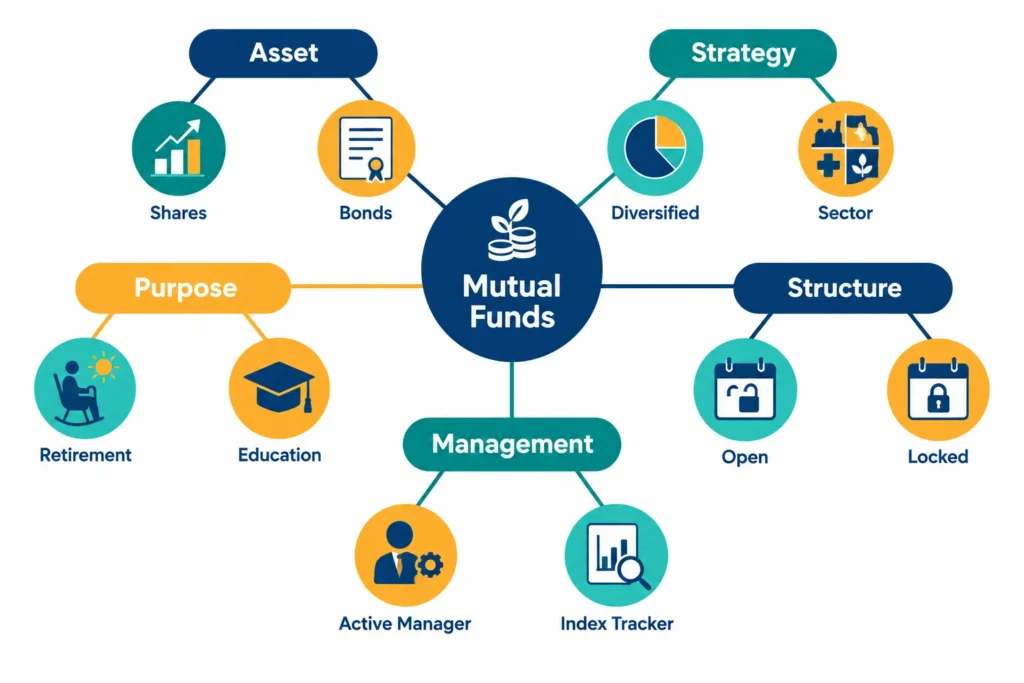
Flowchart showing how Indian mutual funds can be classified by asset, strategy, structure, management style and purpose.

A mutual fund collects money from many investors and invests it according to a stated objective. A professional fund manager manages the portfolio. Depending on the scheme, the money may be invested in shares, bonds, money-market instruments, gold-related assets or a combination of investments.

Understanding the different types of mutual funds in India is important because two schemes with the same “mutual fund” label can behave very differently. An equity fund may fluctuate considerably when stock markets move. A debt fund may be less volatile in some situations, but it can still face interest-rate and credit risks. A hybrid fund combines more than one asset class, but that does not automatically make it suitable for every cautious investor.

Indian mutual fund schemes can be classified in several ways:

  • By asset class: Equity, debt, hybrid, gold-related or other assets.
  • By investment strategy: For example, investing in large companies, a particular sector or a mix of market-cap segments.
  • By structure: Open-ended, close-ended or interval schemes.
  • By management approach: Actively managed funds or passive funds such as index funds.
  • By purpose: Some schemes are designed around goals or features, such as tax-saving equity funds or retirement-oriented funds.

A scheme’s category and investment objective help you understand how it is expected to invest. They do not guarantee returns, prevent losses or prove that the scheme is suitable for you. Investors should also consider their goal, time horizon, ability to tolerate losses, liquidity needs, costs and the scheme’s actual portfolio.

For example, “equity” does not mean that every equity fund carries identical risk. A diversified large-cap fund and a fund investing only in technology businesses both invest in shares, but their portfolios may react differently to market events. Category names are therefore a starting point, not a complete investment decision.

Equity Mutual Funds
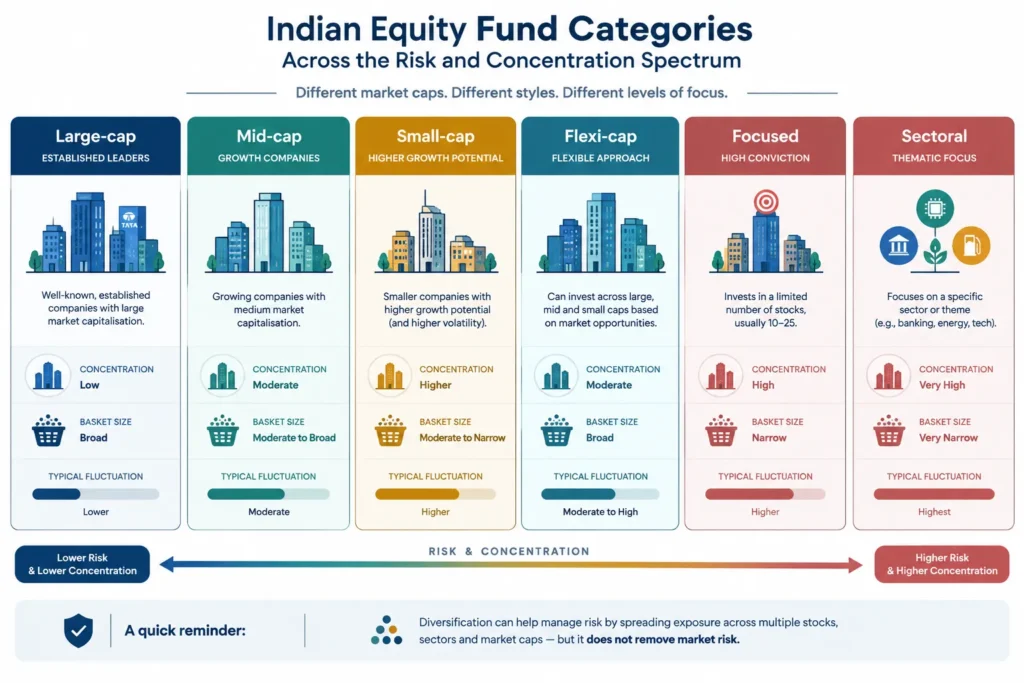
Visual comparison of large-cap, mid-cap, small-cap, flexi-cap, focused and sectoral equity mutual funds by portfolio style and relative fluctuation.

Equity mutual funds invest primarily in shares of listed companies. When you invest in one, you indirectly own a small portion of the fund’s portfolio. Your investment value changes with the value of the underlying shares, after accounting for expenses and other portfolio items.

Equity funds are generally used for long-term wealth creation because shares can participate in the growth of businesses and the economy. However, this growth is uncertain. Stock prices may fall because of weak company results, high valuations, economic slowdowns, changes in government policy, global events or broad market pessimism.

Even a well-diversified equity fund can suffer substantial losses. Diversification can reduce the effect of one company performing badly, but it cannot remove market-wide risk. Equity funds are therefore usually inappropriate for money needed in the near future or for investors who cannot accept significant fluctuations.

Large-Cap Funds

Large-cap funds invest mainly in large, established listed companies. Under Indian mutual fund categorisation, large-cap companies are generally the first 100 companies by full market capitalisation, based on the applicable industry list. A large-cap fund must invest at least 80% of its total assets in large-cap stocks.

These companies may have established brands, broader operations and easier access to capital. Their shares can still decline sharply, and a large business is not automatically a safe or attractively priced investment. Large-cap funds may be relatively less volatile than funds focused on smaller companies, but they remain equity investments.

Mid-Cap Funds

Mid-cap funds invest at least 65% of their total assets in mid-cap stocks. These generally refer to companies ranked from 101 to 250 by full market capitalisation under the applicable classification.

Mid-sized companies may have more room to expand than mature businesses. They may also be more vulnerable to competition, funding problems, economic slowdowns and management errors. Mid-cap share prices can move quickly in both directions, especially when market sentiment changes.

You May Also Like:How to Calculate Your Net Worth in India: Assets, Liabilities and Examples

Small-Cap Funds

Small-cap funds invest at least 65% of their total assets in small-cap stocks. In the standard classification, companies ranked below the first 250 by full market capitalisation fall into the small-cap segment.

Some small businesses can grow considerably, but the segment carries high uncertainty. Smaller companies may have limited financial resources, lower trading liquidity, less diversified operations or weaker bargaining power. Small-cap funds can experience steep falls and may take a long time to recover. Investors should not treat them as a shortcut to higher returns.

Multi-Cap Funds

Multi-cap funds invest across large-cap, mid-cap and small-cap companies. They must keep at least 75% of total assets in equities, with a minimum allocation of 25% each to large-cap, mid-cap and small-cap stocks.

This mandatory spread provides exposure to all three market-cap segments. However, the required mid-cap and small-cap holdings can make these funds more volatile than a portfolio dominated by large companies. Diversification across company sizes does not protect the fund from an overall stock market decline.

Flexi-Cap Funds

Flexi-cap funds invest at least 65% of their total assets in equities, but the fund manager can vary the allocation among large-cap, mid-cap and small-cap companies without maintaining the fixed minimum exposure required in a multi-cap fund.

This flexibility allows the manager to respond to opportunities and risks. It also means the portfolio’s character can change. A flexi-cap fund may be heavily tilted towards large companies at one time and hold more mid-sized or smaller companies at another. Investors should examine the portfolio rather than relying only on the category name.

Focused Funds

A focused fund holds a concentrated equity portfolio with no more than 30 stocks. The scheme must invest at least 65% of its total assets in equity and equity-related instruments and must state the market-cap segment on which it intends to focus, where applicable.

Holding fewer companies can increase the effect of each selection. If a major holding performs well, it can help the portfolio. If it performs poorly, the damage may also be greater. Focused funds therefore carry concentration risk even when their holdings come from different industries.

ELSS Tax-Saving Funds

An Equity Linked Savings Scheme, or ELSS, is an equity mutual fund with a tax-saving feature. It invests at least 80% of its total assets in equity and equity-related instruments and has a three-year statutory lock-in for each investment.

An eligible investment may qualify for a deduction under Section 80C of the Income-tax Act, subject to the investor’s chosen tax regime, applicable limits and prevailing tax rules. The deduction does not make the investment risk-free. ELSS returns are market-linked, and the value can be below the invested amount when the lock-in ends.

Each SIP instalment in an ELSS has its own three-year lock-in. Investors should check current tax provisions or consult a qualified tax professional before investing for tax purposes.

Sectoral and Thematic Funds

Sectoral funds invest mainly in one sector, such as banking, pharmaceuticals, technology or infrastructure. Thematic funds follow a broader idea that may include companies from several sectors, such as consumption, manufacturing or business opportunities linked to a particular economic trend. These funds must generally invest at least 80% of their total assets in the relevant sector or theme.

The narrow mandate creates concentration risk. A banking fund may be affected by credit problems or financial regulation. A technology fund may react to overseas demand, currency changes or shifts in global spending. A theme can also remain unpopular for years, even if its long-term story sounds convincing.

Diversified Fund Versus Sector-Focused Fund: A Hypothetical Example

Suppose Meera invests in a diversified equity fund holding companies from banking, consumer goods, healthcare, technology and manufacturing. If technology shares fall because overseas clients reduce spending, weakness in that part of the portfolio may be partly offset if healthcare or consumer businesses remain stable. The fund can still lose money if the broader market declines.

Now suppose Arjun invests in a technology sector fund. The fund’s holdings may include software services, digital platforms and technology-related businesses, but they are exposed to many of the same industry forces. A decline in technology spending could affect several holdings at once. Arjun may experience a sharper loss because the portfolio has limited exposure outside the sector.

This example does not mean a diversified fund will always outperform a sector fund. A concentrated sector can sometimes rise strongly. The key difference is that the sector fund depends more heavily on one part of the economy, making both its potential gains and its possible losses more concentrated.

Before choosing an equity category, investors should ask what role it serves in their plan, how long they can remain invested and whether they could continue holding through a severe market fall. The category should match the investor’s needs; it should not be selected only because it has recently attracted attention.

You May Also Like:Portfolio Diversification Explained: Benefits, Asset Allocation and Common Mistakes

Debt, Hybrid, Index Funds and ETFs

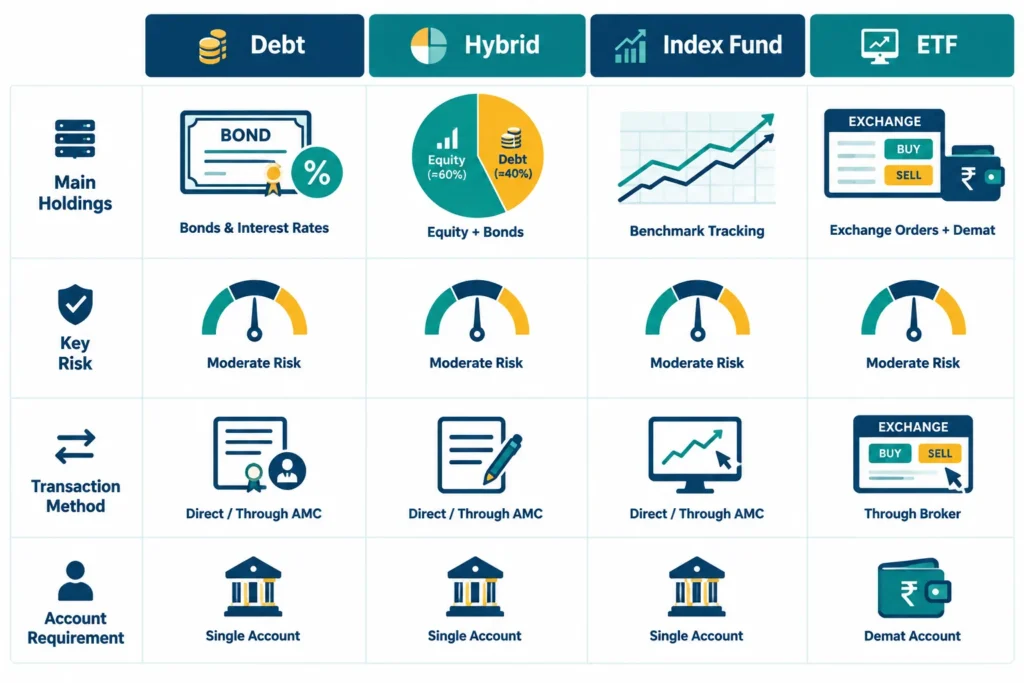
Comparison graphic explaining the holdings, risks and transaction methods of debt funds, hybrid funds, index funds and ETFs.

Among the major types of mutual funds in India, debt, hybrid and passive funds serve different purposes. Debt funds focus mainly on bonds and money-market instruments. Hybrid funds combine asset classes such as equity and debt. Index funds and exchange-traded funds, or ETFs, usually follow a market index rather than relying on a fund manager to select securities actively.

These labels help with initial screening, but funds within the same broad group can still have very different risks. Always check the latest scheme information document, portfolio, investment mandate and SEBI riskometer before investing.

What Are Debt Mutual Funds?

Debt mutual funds invest mainly in fixed-income securities. These may include government securities, treasury bills, corporate bonds, certificates of deposit and commercial paper.

A debt fund is not the same as a bank fixed deposit. A fixed deposit generally states an interest rate when you open it, subject to its terms. A debt fund does not promise a fixed return. Its net asset value, or NAV, can rise or fall as bond prices, interest rates, credit quality and market liquidity change.

Debt fund categories are commonly distinguished by the maturity profile or type of securities they hold:

  • Overnight funds: Invest in securities with a maturity of one day. They usually have very low interest-rate risk, though they are not guaranteed.
  • Liquid funds: Invest in debt and money-market securities with maturity of up to 91 days.
  • Ultra-short-duration funds: Maintain a very short portfolio duration, generally between three and six months.
  • Low-duration funds: Usually maintain portfolio duration between six and 12 months.
  • Money-market funds: Invest in money-market instruments with maturity of up to one year.
  • Short-duration funds: Generally maintain portfolio duration between one and three years.
  • Medium-duration funds: Usually maintain duration between three and four years, subject to permitted adjustments in adverse conditions.
  • Medium-to-long-duration funds: Generally maintain duration between four and seven years, subject to permitted adjustments.
  • Long-duration funds: Maintain portfolio duration above seven years.
  • Dynamic-bond funds: Can change portfolio duration based on the fund manager’s interest-rate view.
  • Corporate-bond funds: Invest predominantly in highly rated corporate bonds.
  • Credit-risk funds: Invest mainly in corporate bonds rated below the highest credit-rating category. They take higher credit risk in search of potentially higher yields.
  • Banking and PSU funds: Invest predominantly in debt issued by banks, public sector undertakings, public financial institutions and municipal bodies.
  • Gilt funds: Invest mainly in government securities across maturities. They have very low default risk but can face substantial interest-rate risk.
  • Gilt funds with 10-year constant duration: Invest mainly in government securities while maintaining portfolio duration around 10 years.
  • Floater funds: Invest predominantly in floating-rate instruments, including securities converted into floating-rate exposure through permitted methods.

Category definitions and regulatory requirements can change. Investors should confirm the latest classification and minimum allocation rules in current SEBI, AMFI and scheme documents before making a decision.

Three Important Risks in Debt Funds

Interest-rate risk arises because bond prices generally move in the opposite direction to market interest rates. Long-maturity bonds are usually more sensitive to rate changes than short-maturity instruments.

Suppose a debt fund owns a bond paying 7% interest. If similar new bonds begin offering 8%, the older 7% bond becomes less attractive. Its market price may fall, reducing the fund’s NAV. If market rates fall instead, the older bond may become more valuable.

Credit risk is the risk that a bond issuer may delay payment, fail to repay, or suffer a rating downgrade. A downgrade can reduce the bond’s market value even before an actual default occurs.

Liquidity risk appears when a security cannot be sold quickly at a reasonable price. During market stress, a fund may have to accept a lower price to meet redemptions.

For example, imagine two funds with similar past returns. Fund A holds short-term, highly rated securities that trade frequently. Fund B holds lower-rated corporate bonds that are harder to sell. Fund B may offer a higher yield, but it may also fall more sharply if an issuer is downgraded or buyers disappear. Past returns alone would not reveal this difference.

What Are Hybrid Mutual Funds?

Hybrid funds invest across more than one asset class, usually equity and debt. The idea is to combine equity’s growth potential with the relative stability of debt. However, a hybrid fund is not automatically low-risk. Its behaviour depends on its equity allocation, debt quality, derivatives use and rebalancing strategy.

  • Conservative hybrid funds: Invest mainly in debt, with a smaller equity allocation. They can still lose money because both portions carry market risk.
  • Balanced hybrid funds: Keep equity and debt in broadly balanced ranges. Under the category framework, a fund house generally offers either a balanced hybrid fund or an aggressive hybrid fund.
  • Aggressive hybrid funds: Invest a larger share in equity, so their returns can move significantly with the stock market.
  • Dynamic asset allocation or balanced advantage funds: Change equity and debt exposure according to the scheme’s valuation model or investment strategy.
  • Multi-asset allocation funds: Invest in at least three asset classes. These may include equity, debt, gold or other permitted assets.
  • Arbitrage funds: Seek to benefit from price differences between cash and derivatives markets. Their risk and return pattern differs from that of ordinary equity funds, though spreads can narrow.
  • Equity savings funds: Combine equity, arbitrage positions and debt. Actual market exposure can be lower than the headline equity allocation because some equity positions may be hedged.

Consider a hypothetical year in which Indian shares fall while short-term bonds remain relatively stable. An aggressive hybrid fund may decline because of its larger equity allocation. A conservative hybrid fund may fall less, though weak bonds could still hurt it. A balanced advantage fund may behave differently depending on how much equity its model held before the fall. The word “hybrid” alone does not predict the outcome.

Index Funds and Passive Investing

An index fund aims to track an index such as the Nifty 50 or Sensex. Instead of asking a manager to choose stocks expected to outperform, it generally holds the index securities in similar proportions, subject to the scheme’s method and practical constraints.

Passive funds usually have lower portfolio turnover and may have lower expense ratios than actively managed funds. The expense ratio is the annual cost charged to the scheme’s assets. A lower cost helps, but it should not be the only selection factor.

Tracking error shows how consistently a fund follows its benchmark. Tracking difference is the gap between the fund’s return and the index return over a period. Expenses, cash holdings, transaction costs and portfolio adjustments can create this gap. Two funds tracking the same index may therefore deliver slightly different returns.

Index Mutual Funds Versus ETFs

Feature Index Mutual Fund ETF
Buying and selling Transactions are made with the mutual fund at the applicable NAV under cut-off rules. Units trade on a stock exchange during market hours.
Demat account Usually not required. Generally required, along with a trading account.
Transaction price Based on the applicable end-of-day NAV. Based on the market price available on the exchange.
Liquidity Investors transact through the fund, subject to scheme rules. Depends partly on exchange volumes, bid-ask spreads and underlying asset liquidity.
Regular investing SIPs are generally easy to set up. Regular purchases may require broker-based orders and can involve brokerage or other trading costs.
Cost comparison Compare the expense ratio and tracking performance. Compare the expense ratio, tracking performance, bid-ask spread and trading charges.

An ETF’s market price can be slightly above or below its underlying NAV. A thinly traded ETF may also have a wide gap between its buying and selling prices. For a beginner making small monthly investments, an index mutual fund may be operationally simpler. An investor comfortable with exchange trading may prefer an ETF, especially when liquidity and spreads are reasonable.

You May Also Like:How to Start Investing in Stocks in India: A Beginner’s Guide

Why These Funds Behave Differently

Suppose three investors each invest ₹1 lakh. One chooses a long-duration debt fund, another selects an aggressive hybrid fund, and the third buys a Nifty 50 index fund.

If interest rates rise sharply while share prices remain steady, the long-duration debt fund may fall because bond prices decline. The aggressive hybrid fund may be partly affected through its debt holdings, while its equity portion could offset or add to the movement. The index fund would mainly follow the Nifty 50, less its costs and tracking difference.

If the stock market then rises strongly, the index fund may benefit directly. The aggressive hybrid fund may also rise, but usually not in exactly the same way because part of its portfolio is in debt. The debt fund may deliver a very different result based on interest rates, yields and credit conditions. This is why fund selection should begin with the investment goal, time horizon and acceptable risk—not with whichever category recently gave the highest return.

Specialised and Structural Types, Active Versus Passive, and a Shortlisting Checklist

Some types of mutual funds in India are designed for a particular goal, while others are classified by how investors can enter and exit the scheme. These distinctions are important because two funds investing in similar assets may still have different liquidity rules, costs and investment approaches.

Solution-Oriented Mutual Funds

Solution-oriented schemes are designed around a specific long-term financial goal. In the current Indian mutual fund classification framework, the main categories are retirement funds and children’s funds.

Retirement Funds

A retirement fund aims to help investors build money for life after employment. Depending on the scheme, it may invest in equity, debt or a combination of both.

These funds may have restrictions on redemption, such as a specified lock-in period or a condition linked to retirement age. The exact rules can differ between schemes. Investors should not assume that every retirement fund has identical withdrawal conditions.

Before investing, check the latest Scheme Information Document and official disclosures for:

  • The mandatory lock-in or redemption restriction
  • The fund’s equity and debt allocation
  • The investment strategy and benchmark
  • Exit load and other applicable charges
  • What happens if money is needed before retirement

A retirement label does not automatically make a fund suitable for every retirement plan. Your remaining investment period, expected expenses, existing savings and ability to handle market falls still matter.

Children’s Funds

Children’s funds are intended for goals such as higher education or other future expenses for a child. They may follow an equity-oriented, debt-oriented or hybrid strategy.

These schemes can also have lock-ins or conditions connected to the child’s age. Such restrictions may encourage long-term investing, but they can reduce flexibility if the family needs the money earlier.

Parents should compare the fund’s rules with the actual date of the goal. For example, a family investing for college expenses four years away may need a different asset mix from one investing for a newborn child’s education.

Always verify current restrictions and eligibility conditions through the scheme documents and applicable regulatory disclosures. Do not rely only on the scheme name or a brief description in an investment app.

Other Specialised Categories

Some mutual funds follow a more specialised investment method. Common examples within Indian classification terminology include index funds, exchange-traded funds and fund of funds schemes.

  • Index funds: These aim to track a stated market index rather than selecting securities mainly through active research.
  • Exchange-traded funds: ETFs generally track an index, commodity or another specified underlying exposure and are traded on a stock exchange. Investors usually need a demat and trading account to buy or sell ETF units on the exchange.
  • Fund of funds: These schemes invest primarily in units of other funds rather than directly building a portfolio of shares or bonds. Their total cost should be reviewed carefully because expenses can arise at more than one level.

The word “specialised” does not mean safer or superior. Suitability depends on what the fund holds, how it works and whether it matches the investor’s goal.

Open-Ended, Close-Ended and Interval Funds

Equity, debt and hybrid are asset-based categories. Open-ended, close-ended and interval describe a scheme’s structure and liquidity arrangements. A fund can therefore be both an equity fund and an open-ended fund.

Structure How transactions generally work Main point to check
Open-ended fund Investors can generally purchase or redeem units from the fund on applicable business days at the relevant net asset value, subject to scheme rules. Exit load, cut-off timings, liquidity and redemption processing rules
Close-ended fund Units are usually offered during a limited initial period and the scheme has a stated maturity. Units may be listed on an exchange, but actual trading liquidity can be limited. Maturity date, exchange liquidity and the possibility of trading away from net asset value
Interval fund Purchases and redemptions are allowed only during specified transaction windows. Frequency of transaction windows and whether the timing meets your cash needs

An exchange listing does not guarantee that an investor can sell units quickly at a desired price. Anyone who may need money at short notice should understand the scheme’s redemption arrangement before investing.

Active Versus Passive Mutual Funds

An actively managed fund has a fund manager or investment team that selects securities and adjusts the portfolio according to the scheme’s stated strategy. The objective may be to outperform a benchmark, manage risk differently or seek opportunities not fully represented by an index.

A passive fund aims to replicate or track a specified index or underlying asset. Index funds and many ETFs use this approach. Their success is usually judged by how closely they follow the chosen benchmark, after costs and operational differences.

Factor Active fund Passive fund
Portfolio decisions Made by the fund management team Mainly determined by the tracked index or methodology
Cost Often higher because of research and active management Often lower, though costs vary by scheme
Key risk The manager’s decisions may underperform the benchmark The index itself may fall, and the fund may have tracking difference
What to assess Consistency, process, portfolio, risk and benchmark-relative performance Index suitability, expense ratio, tracking difference and liquidity where relevant

Neither approach will always perform better. Active funds can outperform or underperform their benchmarks. Passive funds reduce dependence on security selection, but they still carry the risks of the market segment they track.

You May Also Like:How Does the Stock Market Work in India? A Beginner’s Guide

Practical Mutual Fund Shortlisting Checklist

A fund should be shortlisted for a purpose, not simply because its recent return appears high. Use the following checks before comparing schemes:

  1. Define the financial goal: State what the money is for and the approximate amount required.
  2. Read the investment objective: Confirm that the scheme’s stated objective matches the role you want it to play.
  3. Set the time horizon: Money needed soon generally requires greater attention to stability and liquidity than money intended for a distant goal.
  4. Assess risk tolerance: Consider how emotionally comfortable you are with fluctuations.
  5. Assess loss capacity: This is your financial ability to absorb a fall without disturbing essential expenses or near-term goals.
  6. Check liquidity: Review lock-ins, redemption restrictions, settlement arrangements and whether an exit load may apply.
  7. Use the correct benchmark: Compare performance with the scheme’s stated benchmark and relevant category, not an unrelated market index.
  8. Review the expense ratio: Costs reduce the returns received by investors. Compare similar plans and categories.
  9. Check the exit load: Understand when it applies and how long units must be held to avoid or reduce it.
  10. Study portfolio holdings: Look at major securities, sector exposure and whether the holdings match the stated strategy.
  11. Check concentration: Heavy exposure to a few companies, sectors, issuers or themes can increase risk.
  12. Review credit quality where relevant: For debt funds, examine the credit profile, maturity pattern and interest-rate exposure. A higher indicated yield can involve higher risk.
  13. Read the Riskometer: Use the current scheme Riskometer as a starting point for understanding risk, not as the only decision tool.

Also read the latest Scheme Information Document, Key Information Memorandum, factsheet, portfolio disclosure and other official updates. These documents explain what the fund can invest in, its risks, costs and operating rules.

Tax treatment depends on the fund’s characteristics, the investor’s holding period and the law applicable at the time of the transaction. Tax rules can change, so verify the current position through official sources or consult a qualified tax professional.

Frequently Asked Questions

Is an open-ended fund the same as an equity fund?

No. “Open-ended” describes how investors can purchase and redeem units. “Equity” describes the assets in which the fund mainly invests. An equity fund, debt fund or hybrid fund may be open-ended.

Are retirement and children’s funds tax-free?

Their goal-based names do not automatically make them tax-free. Taxation depends on the scheme’s characteristics, holding period and current law. Check the latest tax rules before investing or redeeming.

Are passive funds always cheaper and better?

Passive funds often have lower expenses than actively managed funds, but costs vary. Lower cost does not remove market risk, and a passive fund can fall when its underlying index falls. “Better” depends on the chosen index, tracking quality, cost and investor needs.

Can close-ended fund units always be sold easily on an exchange?

No. Listing provides a trading facility, but there may not be enough buyers at the desired price. Investors should examine trading liquidity and the scheme’s maturity before investing.

Should beginners select the fund with the highest past return?

No. Past performance is only one factor and does not guarantee future results. Beginners should first consider the goal, time horizon, risk, costs, portfolio, liquidity and benchmark.

Summary

The types of mutual funds in India include not only equity, debt and hybrid categories but also goal-based schemes, specialised approaches and different structural formats. Retirement and children’s funds may carry restrictions, while open-ended, close-ended and interval funds provide different levels of transaction flexibility. Active and passive funds also follow different portfolio management methods, and neither is guaranteed to perform better.

Shortlist a fund only after matching its objective, time horizon, risk, liquidity, benchmark, expenses and portfolio with your needs. Mutual fund investments are subject to market risks. Read all scheme-related documents carefully before investing. This article is for general education and is not personalised financial advice.

Share this article
KEEP READING

Related Articles

View all →

Comments

Leave a Comment

Types of Mutual Funds in India: Equity, Debt, Hybrid and More

The main types of mutual funds in India include equity, debt, hybrid, solution-oriented and other schemes. They may also differ by investment strategy, management style and structure. Equity funds invest mainly in company shares and can offer long-term growth potential, but their value may rise or fall sharply. Within equity funds, categories such as large-cap, mid-cap, small-cap, flexi-cap, ELSS and sectoral funds carry different levels and kinds of risk.

Introduction to Mutual Fund Categories

Flowchart showing how Indian mutual funds can be classified by asset, strategy, structure, management style and purpose.

A mutual fund collects money from many investors and invests it according to a stated objective. A professional fund manager manages the portfolio. Depending on the scheme, the money may be invested in shares, bonds, money-market instruments, gold-related assets or a combination of investments.

Understanding the different types of mutual funds in India is important because two schemes with the same “mutual fund” label can behave very differently. An equity fund may fluctuate considerably when stock markets move. A debt fund may be less volatile in some situations, but it can still face interest-rate and credit risks. A hybrid fund combines more than one asset class, but that does not automatically make it suitable for every cautious investor.

Indian mutual fund schemes can be classified in several ways:

  • By asset class: Equity, debt, hybrid, gold-related or other assets.
  • By investment strategy: For example, investing in large companies, a particular sector or a mix of market-cap segments.
  • By structure: Open-ended, close-ended or interval schemes.
  • By management approach: Actively managed funds or passive funds such as index funds.
  • By purpose: Some schemes are designed around goals or features, such as tax-saving equity funds or retirement-oriented funds.

A scheme’s category and investment objective help you understand how it is expected to invest. They do not guarantee returns, prevent losses or prove that the scheme is suitable for you. Investors should also consider their goal, time horizon, ability to tolerate losses, liquidity needs, costs and the scheme’s actual portfolio.

For example, “equity” does not mean that every equity fund carries identical risk. A diversified large-cap fund and a fund investing only in technology businesses both invest in shares, but their portfolios may react differently to market events. Category names are therefore a starting point, not a complete investment decision.

Equity Mutual Funds

Visual comparison of large-cap, mid-cap, small-cap, flexi-cap, focused and sectoral equity mutual funds by portfolio style and relative fluctuation.

Equity mutual funds invest primarily in shares of listed companies. When you invest in one, you indirectly own a small portion of the fund’s portfolio. Your investment value changes with the value of the underlying shares, after accounting for expenses and other portfolio items.

Equity funds are generally used for long-term wealth creation because shares can participate in the growth of businesses and the economy. However, this growth is uncertain. Stock prices may fall because of weak company results, high valuations, economic slowdowns, changes in government policy, global events or broad market pessimism.

Even a well-diversified equity fund can suffer substantial losses. Diversification can reduce the effect of one company performing badly, but it cannot remove market-wide risk. Equity funds are therefore usually inappropriate for money needed in the near future or for investors who cannot accept significant fluctuations.

Large-Cap Funds

Large-cap funds invest mainly in large, established listed companies. Under Indian mutual fund categorisation, large-cap companies are generally the first 100 companies by full market capitalisation, based on the applicable industry list. A large-cap fund must invest at least 80% of its total assets in large-cap stocks.

These companies may have established brands, broader operations and easier access to capital. Their shares can still decline sharply, and a large business is not automatically a safe or attractively priced investment. Large-cap funds may be relatively less volatile than funds focused on smaller companies, but they remain equity investments.

Mid-Cap Funds

Mid-cap funds invest at least 65% of their total assets in mid-cap stocks. These generally refer to companies ranked from 101 to 250 by full market capitalisation under the applicable classification.

Mid-sized companies may have more room to expand than mature businesses. They may also be more vulnerable to competition, funding problems, economic slowdowns and management errors. Mid-cap share prices can move quickly in both directions, especially when market sentiment changes.

Small-Cap Funds

Small-cap funds invest at least 65% of their total assets in small-cap stocks. In the standard classification, companies ranked below the first 250 by full market capitalisation fall into the small-cap segment.

Some small businesses can grow considerably, but the segment carries high uncertainty. Smaller companies may have limited financial resources, lower trading liquidity, less diversified operations or weaker bargaining power. Small-cap funds can experience steep falls and may take a long time to recover. Investors should not treat them as a shortcut to higher returns.

Multi-Cap Funds

Multi-cap funds invest across large-cap, mid-cap and small-cap companies. They must keep at least 75% of total assets in equities, with a minimum allocation of 25% each to large-cap, mid-cap and small-cap stocks.

This mandatory spread provides exposure to all three market-cap segments. However, the required mid-cap and small-cap holdings can make these funds more volatile than a portfolio dominated by large companies. Diversification across company sizes does not protect the fund from an overall stock market decline.

Flexi-Cap Funds

Flexi-cap funds invest at least 65% of their total assets in equities, but the fund manager can vary the allocation among large-cap, mid-cap and small-cap companies without maintaining the fixed minimum exposure required in a multi-cap fund.

This flexibility allows the manager to respond to opportunities and risks. It also means the portfolio’s character can change. A flexi-cap fund may be heavily tilted towards large companies at one time and hold more mid-sized or smaller companies at another. Investors should examine the portfolio rather than relying only on the category name.

Focused Funds

A focused fund holds a concentrated equity portfolio with no more than 30 stocks. The scheme must invest at least 65% of its total assets in equity and equity-related instruments and must state the market-cap segment on which it intends to focus, where applicable.

Holding fewer companies can increase the effect of each selection. If a major holding performs well, it can help the portfolio. If it performs poorly, the damage may also be greater. Focused funds therefore carry concentration risk even when their holdings come from different industries.

ELSS Tax-Saving Funds

An Equity Linked Savings Scheme, or ELSS, is an equity mutual fund with a tax-saving feature. It invests at least 80% of its total assets in equity and equity-related instruments and has a three-year statutory lock-in for each investment.

An eligible investment may qualify for a deduction under Section 80C of the Income-tax Act, subject to the investor’s chosen tax regime, applicable limits and prevailing tax rules. The deduction does not make the investment risk-free. ELSS returns are market-linked, and the value can be below the invested amount when the lock-in ends.

Each SIP instalment in an ELSS has its own three-year lock-in. Investors should check current tax provisions or consult a qualified tax professional before investing for tax purposes.

Sectoral and Thematic Funds

Sectoral funds invest mainly in one sector, such as banking, pharmaceuticals, technology or infrastructure. Thematic funds follow a broader idea that may include companies from several sectors, such as consumption, manufacturing or business opportunities linked to a particular economic trend. These funds must generally invest at least 80% of their total assets in the relevant sector or theme.

The narrow mandate creates concentration risk. A banking fund may be affected by credit problems or financial regulation. A technology fund may react to overseas demand, currency changes or shifts in global spending. A theme can also remain unpopular for years, even if its long-term story sounds convincing.

Diversified Fund Versus Sector-Focused Fund: A Hypothetical Example

Suppose Meera invests in a diversified equity fund holding companies from banking, consumer goods, healthcare, technology and manufacturing. If technology shares fall because overseas clients reduce spending, weakness in that part of the portfolio may be partly offset if healthcare or consumer businesses remain stable. The fund can still lose money if the broader market declines.

Now suppose Arjun invests in a technology sector fund. The fund’s holdings may include software services, digital platforms and technology-related businesses, but they are exposed to many of the same industry forces. A decline in technology spending could affect several holdings at once. Arjun may experience a sharper loss because the portfolio has limited exposure outside the sector.

This example does not mean a diversified fund will always outperform a sector fund. A concentrated sector can sometimes rise strongly. The key difference is that the sector fund depends more heavily on one part of the economy, making both its potential gains and its possible losses more concentrated.

Before choosing an equity category, investors should ask what role it serves in their plan, how long they can remain invested and whether they could continue holding through a severe market fall. The category should match the investor’s needs; it should not be selected only because it has recently attracted attention.

Debt, Hybrid, Index Funds and ETFs
Comparison graphic explaining the holdings, risks and transaction methods of debt funds, hybrid funds, index funds and ETFs.

Among the major types of mutual funds in India, debt, hybrid and passive funds serve different purposes. Debt funds focus mainly on bonds and money-market instruments. Hybrid funds combine asset classes such as equity and debt. Index funds and exchange-traded funds, or ETFs, usually follow a market index rather than relying on a fund manager to select securities actively.

These labels help with initial screening, but funds within the same broad group can still have very different risks. Always check the latest scheme information document, portfolio, investment mandate and SEBI riskometer before investing.

What Are Debt Mutual Funds?

Debt mutual funds invest mainly in fixed-income securities. These may include government securities, treasury bills, corporate bonds, certificates of deposit and commercial paper.

A debt fund is not the same as a bank fixed deposit. A fixed deposit generally states an interest rate when you open it, subject to its terms. A debt fund does not promise a fixed return. Its net asset value, or NAV, can rise or fall as bond prices, interest rates, credit quality and market liquidity change.

Debt fund categories are commonly distinguished by the maturity profile or type of securities they hold:

  • Overnight funds: Invest in securities with a maturity of one day. They usually have very low interest-rate risk, though they are not guaranteed.
  • Liquid funds: Invest in debt and money-market securities with maturity of up to 91 days.
  • Ultra-short-duration funds: Maintain a very short portfolio duration, generally between three and six months.
  • Low-duration funds: Usually maintain portfolio duration between six and 12 months.
  • Money-market funds: Invest in money-market instruments with maturity of up to one year.
  • Short-duration funds: Generally maintain portfolio duration between one and three years.
  • Medium-duration funds: Usually maintain duration between three and four years, subject to permitted adjustments in adverse conditions.
  • Medium-to-long-duration funds: Generally maintain duration between four and seven years, subject to permitted adjustments.
  • Long-duration funds: Maintain portfolio duration above seven years.
  • Dynamic-bond funds: Can change portfolio duration based on the fund manager’s interest-rate view.
  • Corporate-bond funds: Invest predominantly in highly rated corporate bonds.
  • Credit-risk funds: Invest mainly in corporate bonds rated below the highest credit-rating category. They take higher credit risk in search of potentially higher yields.
  • Banking and PSU funds: Invest predominantly in debt issued by banks, public sector undertakings, public financial institutions and municipal bodies.
  • Gilt funds: Invest mainly in government securities across maturities. They have very low default risk but can face substantial interest-rate risk.
  • Gilt funds with 10-year constant duration: Invest mainly in government securities while maintaining portfolio duration around 10 years.
  • Floater funds: Invest predominantly in floating-rate instruments, including securities converted into floating-rate exposure through permitted methods.

Category definitions and regulatory requirements can change. Investors should confirm the latest classification and minimum allocation rules in current SEBI, AMFI and scheme documents before making a decision.

Three Important Risks in Debt Funds

Interest-rate risk arises because bond prices generally move in the opposite direction to market interest rates. Long-maturity bonds are usually more sensitive to rate changes than short-maturity instruments.

Suppose a debt fund owns a bond paying 7% interest. If similar new bonds begin offering 8%, the older 7% bond becomes less attractive. Its market price may fall, reducing the fund’s NAV. If market rates fall instead, the older bond may become more valuable.

Credit risk is the risk that a bond issuer may delay payment, fail to repay, or suffer a rating downgrade. A downgrade can reduce the bond’s market value even before an actual default occurs.

Liquidity risk appears when a security cannot be sold quickly at a reasonable price. During market stress, a fund may have to accept a lower price to meet redemptions.

For example, imagine two funds with similar past returns. Fund A holds short-term, highly rated securities that trade frequently. Fund B holds lower-rated corporate bonds that are harder to sell. Fund B may offer a higher yield, but it may also fall more sharply if an issuer is downgraded or buyers disappear. Past returns alone would not reveal this difference.

What Are Hybrid Mutual Funds?

Hybrid funds invest across more than one asset class, usually equity and debt. The idea is to combine equity’s growth potential with the relative stability of debt. However, a hybrid fund is not automatically low-risk. Its behaviour depends on its equity allocation, debt quality, derivatives use and rebalancing strategy.

  • Conservative hybrid funds: Invest mainly in debt, with a smaller equity allocation. They can still lose money because both portions carry market risk.
  • Balanced hybrid funds: Keep equity and debt in broadly balanced ranges. Under the category framework, a fund house generally offers either a balanced hybrid fund or an aggressive hybrid fund.
  • Aggressive hybrid funds: Invest a larger share in equity, so their returns can move significantly with the stock market.
  • Dynamic asset allocation or balanced advantage funds: Change equity and debt exposure according to the scheme’s valuation model or investment strategy.
  • Multi-asset allocation funds: Invest in at least three asset classes. These may include equity, debt, gold or other permitted assets.
  • Arbitrage funds: Seek to benefit from price differences between cash and derivatives markets. Their risk and return pattern differs from that of ordinary equity funds, though spreads can narrow.
  • Equity savings funds: Combine equity, arbitrage positions and debt. Actual market exposure can be lower than the headline equity allocation because some equity positions may be hedged.

Consider a hypothetical year in which Indian shares fall while short-term bonds remain relatively stable. An aggressive hybrid fund may decline because of its larger equity allocation. A conservative hybrid fund may fall less, though weak bonds could still hurt it. A balanced advantage fund may behave differently depending on how much equity its model held before the fall. The word “hybrid” alone does not predict the outcome.

Index Funds and Passive Investing

An index fund aims to track an index such as the Nifty 50 or Sensex. Instead of asking a manager to choose stocks expected to outperform, it generally holds the index securities in similar proportions, subject to the scheme’s method and practical constraints.

Passive funds usually have lower portfolio turnover and may have lower expense ratios than actively managed funds. The expense ratio is the annual cost charged to the scheme’s assets. A lower cost helps, but it should not be the only selection factor.

Tracking error shows how consistently a fund follows its benchmark. Tracking difference is the gap between the fund’s return and the index return over a period. Expenses, cash holdings, transaction costs and portfolio adjustments can create this gap. Two funds tracking the same index may therefore deliver slightly different returns.

Index Mutual Funds Versus ETFs

Feature Index Mutual Fund ETF
Buying and selling Transactions are made with the mutual fund at the applicable NAV under cut-off rules. Units trade on a stock exchange during market hours.
Demat account Usually not required. Generally required, along with a trading account.
Transaction price Based on the applicable end-of-day NAV. Based on the market price available on the exchange.
Liquidity Investors transact through the fund, subject to scheme rules. Depends partly on exchange volumes, bid-ask spreads and underlying asset liquidity.
Regular investing SIPs are generally easy to set up. Regular purchases may require broker-based orders and can involve brokerage or other trading costs.
Cost comparison Compare the expense ratio and tracking performance. Compare the expense ratio, tracking performance, bid-ask spread and trading charges.

An ETF’s market price can be slightly above or below its underlying NAV. A thinly traded ETF may also have a wide gap between its buying and selling prices. For a beginner making small monthly investments, an index mutual fund may be operationally simpler. An investor comfortable with exchange trading may prefer an ETF, especially when liquidity and spreads are reasonable.

Why These Funds Behave Differently

Suppose three investors each invest ₹1 lakh. One chooses a long-duration debt fund, another selects an aggressive hybrid fund, and the third buys a Nifty 50 index fund.

If interest rates rise sharply while share prices remain steady, the long-duration debt fund may fall because bond prices decline. The aggressive hybrid fund may be partly affected through its debt holdings, while its equity portion could offset or add to the movement. The index fund would mainly follow the Nifty 50, less its costs and tracking difference.

If the stock market then rises strongly, the index fund may benefit directly. The aggressive hybrid fund may also rise, but usually not in exactly the same way because part of its portfolio is in debt. The debt fund may deliver a very different result based on interest rates, yields and credit conditions. This is why fund selection should begin with the investment goal, time horizon and acceptable risk—not with whichever category recently gave the highest return.

Specialised and Structural Types, Active Versus Passive, and a Shortlisting Checklist

Some types of mutual funds in India are designed for a particular goal, while others are classified by how investors can enter and exit the scheme. These distinctions are important because two funds investing in similar assets may still have different liquidity rules, costs and investment approaches.

Solution-Oriented Mutual Funds

Solution-oriented schemes are designed around a specific long-term financial goal. In the current Indian mutual fund classification framework, the main categories are retirement funds and children’s funds.

Retirement Funds

A retirement fund aims to help investors build money for life after employment. Depending on the scheme, it may invest in equity, debt or a combination of both.

These funds may have restrictions on redemption, such as a specified lock-in period or a condition linked to retirement age. The exact rules can differ between schemes. Investors should not assume that every retirement fund has identical withdrawal conditions.

Before investing, check the latest Scheme Information Document and official disclosures for:

  • The mandatory lock-in or redemption restriction
  • The fund’s equity and debt allocation
  • The investment strategy and benchmark
  • Exit load and other applicable charges
  • What happens if money is needed before retirement

A retirement label does not automatically make a fund suitable for every retirement plan. Your remaining investment period, expected expenses, existing savings and ability to handle market falls still matter.

Children’s Funds

Children’s funds are intended for goals such as higher education or other future expenses for a child. They may follow an equity-oriented, debt-oriented or hybrid strategy.

These schemes can also have lock-ins or conditions connected to the child’s age. Such restrictions may encourage long-term investing, but they can reduce flexibility if the family needs the money earlier.

Parents should compare the fund’s rules with the actual date of the goal. For example, a family investing for college expenses four years away may need a different asset mix from one investing for a newborn child’s education.

Always verify current restrictions and eligibility conditions through the scheme documents and applicable regulatory disclosures. Do not rely only on the scheme name or a brief description in an investment app.

Other Specialised Categories

Some mutual funds follow a more specialised investment method. Common examples within Indian classification terminology include index funds, exchange-traded funds and fund of funds schemes.

  • Index funds: These aim to track a stated market index rather than selecting securities mainly through active research.
  • Exchange-traded funds: ETFs generally track an index, commodity or another specified underlying exposure and are traded on a stock exchange. Investors usually need a demat and trading account to buy or sell ETF units on the exchange.
  • Fund of funds: These schemes invest primarily in units of other funds rather than directly building a portfolio of shares or bonds. Their total cost should be reviewed carefully because expenses can arise at more than one level.

The word “specialised” does not mean safer or superior. Suitability depends on what the fund holds, how it works and whether it matches the investor’s goal.

Open-Ended, Close-Ended and Interval Funds

Equity, debt and hybrid are asset-based categories. Open-ended, close-ended and interval describe a scheme’s structure and liquidity arrangements. A fund can therefore be both an equity fund and an open-ended fund.

Structure How transactions generally work Main point to check
Open-ended fund Investors can generally purchase or redeem units from the fund on applicable business days at the relevant net asset value, subject to scheme rules. Exit load, cut-off timings, liquidity and redemption processing rules
Close-ended fund Units are usually offered during a limited initial period and the scheme has a stated maturity. Units may be listed on an exchange, but actual trading liquidity can be limited. Maturity date, exchange liquidity and the possibility of trading away from net asset value
Interval fund Purchases and redemptions are allowed only during specified transaction windows. Frequency of transaction windows and whether the timing meets your cash needs

An exchange listing does not guarantee that an investor can sell units quickly at a desired price. Anyone who may need money at short notice should understand the scheme’s redemption arrangement before investing.

Active Versus Passive Mutual Funds

An actively managed fund has a fund manager or investment team that selects securities and adjusts the portfolio according to the scheme’s stated strategy. The objective may be to outperform a benchmark, manage risk differently or seek opportunities not fully represented by an index.

A passive fund aims to replicate or track a specified index or underlying asset. Index funds and many ETFs use this approach. Their success is usually judged by how closely they follow the chosen benchmark, after costs and operational differences.

Factor Active fund Passive fund
Portfolio decisions Made by the fund management team Mainly determined by the tracked index or methodology
Cost Often higher because of research and active management Often lower, though costs vary by scheme
Key risk The manager’s decisions may underperform the benchmark The index itself may fall, and the fund may have tracking difference
What to assess Consistency, process, portfolio, risk and benchmark-relative performance Index suitability, expense ratio, tracking difference and liquidity where relevant

Neither approach will always perform better. Active funds can outperform or underperform their benchmarks. Passive funds reduce dependence on security selection, but they still carry the risks of the market segment they track.

Practical Mutual Fund Shortlisting Checklist

A fund should be shortlisted for a purpose, not simply because its recent return appears high. Use the following checks before comparing schemes:

  1. Define the financial goal: State what the money is for and the approximate amount required.
  2. Read the investment objective: Confirm that the scheme’s stated objective matches the role you want it to play.
  3. Set the time horizon: Money needed soon generally requires greater attention to stability and liquidity than money intended for a distant goal.
  4. Assess risk tolerance: Consider how emotionally comfortable you are with fluctuations.
  5. Assess loss capacity: This is your financial ability to absorb a fall without disturbing essential expenses or near-term goals.
  6. Check liquidity: Review lock-ins, redemption restrictions, settlement arrangements and whether an exit load may apply.
  7. Use the correct benchmark: Compare performance with the scheme’s stated benchmark and relevant category, not an unrelated market index.
  8. Review the expense ratio: Costs reduce the returns received by investors. Compare similar plans and categories.
  9. Check the exit load: Understand when it applies and how long units must be held to avoid or reduce it.
  10. Study portfolio holdings: Look at major securities, sector exposure and whether the holdings match the stated strategy.
  11. Check concentration: Heavy exposure to a few companies, sectors, issuers or themes can increase risk.
  12. Review credit quality where relevant: For debt funds, examine the credit profile, maturity pattern and interest-rate exposure. A higher indicated yield can involve higher risk.
  13. Read the Riskometer: Use the current scheme Riskometer as a starting point for understanding risk, not as the only decision tool.

Also read the latest Scheme Information Document, Key Information Memorandum, factsheet, portfolio disclosure and other official updates. These documents explain what the fund can invest in, its risks, costs and operating rules.

Tax treatment depends on the fund’s characteristics, the investor’s holding period and the law applicable at the time of the transaction. Tax rules can change, so verify the current position through official sources or consult a qualified tax professional.

Frequently Asked Questions

Is an open-ended fund the same as an equity fund?

No. “Open-ended” describes how investors can purchase and redeem units. “Equity” describes the assets in which the fund mainly invests. An equity fund, debt fund or hybrid fund may be open-ended.

Are retirement and children’s funds tax-free?

Their goal-based names do not automatically make them tax-free. Taxation depends on the scheme’s characteristics, holding period and current law. Check the latest tax rules before investing or redeeming.

Are passive funds always cheaper and better?

Passive funds often have lower expenses than actively managed funds, but costs vary. Lower cost does not remove market risk, and a passive fund can fall when its underlying index falls. “Better” depends on the chosen index, tracking quality, cost and investor needs.

Can close-ended fund units always be sold easily on an exchange?

No. Listing provides a trading facility, but there may not be enough buyers at the desired price. Investors should examine trading liquidity and the scheme’s maturity before investing.

Should beginners select the fund with the highest past return?

No. Past performance is only one factor and does not guarantee future results. Beginners should first consider the goal, time horizon, risk, costs, portfolio, liquidity and benchmark.

Summary

The types of mutual funds in India include not only equity, debt and hybrid categories but also goal-based schemes, specialised approaches and different structural formats. Retirement and children’s funds may carry restrictions, while open-ended, close-ended and interval funds provide different levels of transaction flexibility. Active and passive funds also follow different portfolio management methods, and neither is guaranteed to perform better.

Shortlist a fund only after matching its objective, time horizon, risk, liquidity, benchmark, expenses and portfolio with your needs. Mutual fund investments are subject to market risks. Read all scheme-related documents carefully before investing. This article is for general education and is not personalised financial advice.


Leave a Comment