
Loan Guarantor vs Co-Applicant in India: Differences, Responsibilities and Risks

Learn how a loan guarantor differs from a co-applicant in India, what each role may require, and which financial and legal risks to check before signing.

Loan Guarantor vs Co-Applicant in India: Differences, Responsibilities and Risks

A loan guarantor promises to repay a loan if the borrower fails to meet the repayment obligation. A co-applicant applies for the loan along with the main applicant and may also be responsible for repayment from the beginning. However, the exact liability of either person depends on the loan agreement, guarantee deed and other documents they sign.

The terms guarantor, co-applicant and co-borrower are often used casually, but they do not always mean the same thing. A co-applicant may be included mainly to meet a lender’s eligibility or procedural requirements, while a co-borrower is normally a joint borrower with a clear repayment obligation. Never rely only on the label used by a bank employee or loan advertisement. Read the signed documents to understand the actual responsibility.

Introduction

Suppose a person applies for a home loan but does not have enough income to qualify for the required amount. The lender may allow the person to apply with a working spouse as a co-applicant. In another case, a lender may approve a business, education or personal loan only if a financially stable family member gives a guarantee.

Both arrangements provide additional comfort to the lender, but they work differently. A co-applicant usually participates in the loan application itself. A guarantor normally gives the lender a separate promise that the debt will be paid if the borrower defaults.

This distinction matters because signing either document can affect your finances, borrowing capacity and credit history. It may also create a serious repayment burden if the main borrower faces job loss, business failure, illness or another financial problem.

As explained in RegularStation’s complete guide to loans and EMIs in India, borrowers should evaluate the total repayment obligation rather than looking only at the EMI. The same principle applies to anyone considering becoming a guarantor or co-applicant: understand the full legal and financial commitment before signing.

Who Is a Loan Guarantor?

A loan guarantor is a person who gives the lender an assurance that the loan obligation will be met if the main borrower does not pay as agreed. The guarantor may sign a guarantee deed or a guarantee clause included in the loan documents.

The borrower generally remains the person expected to pay the regular EMIs. The guarantor may not receive the loan money or use the asset purchased with it. Even so, the guarantee is not merely a character reference or a statement that the borrower is trustworthy. It can create a legally enforceable financial obligation.

For example, assume Arun takes an education loan and his uncle signs as guarantor. Arun is expected to repay the loan according to the agreed schedule. If Arun defaults, the lender may demand payment from the uncle based on the terms of the guarantee and applicable law.

A common misunderstanding is that the lender must first exhaust every possible recovery step against the borrower before contacting the guarantor. That should not be assumed. The timing and extent of recovery action can depend on the guarantee, the loan documents and the law. A guarantor should therefore treat the potential liability seriously from the day the guarantee is signed.

When May a Lender Request a Guarantor?

A lender may request a guarantor when it wants additional protection against the possibility of non-payment. This may happen when:

  • The applicant’s income or repayment capacity is not strong enough for the requested loan.
  • The borrower has a limited or weak credit history.
  • The loan amount is high compared with the borrower’s income or available security.
  • The borrower’s income is irregular, such as income from a new business or self-employment.
  • The lender’s policy requires a guarantor for a particular loan product or applicant profile.
  • The lender has concerns about the borrower’s age, employment continuity or other eligibility factors.

These are only common examples. Indian banks, non-banking financial companies and other lenders do not follow one identical policy. One lender may ask for a guarantor while another may reduce the loan amount, request collateral, charge a different interest rate or reject the application.

Being a close relative does not automatically make someone an acceptable guarantor. The lender may examine the proposed guarantor’s income, existing EMIs, age, credit profile and financial stability before accepting the guarantee.

Who Is a Loan Co-Applicant?

A co-applicant is a person who applies for the loan together with the primary applicant. The lender may consider the co-applicant’s income, age, credit history and existing obligations while deciding eligibility and the loan amount.

For instance, Meera and Rohan may apply jointly for a home loan. If both incomes are accepted, the lender may calculate repayment capacity using their combined eligible income. This could help them qualify for a larger loan than either person could obtain alone.

However, adding a name to an application form does not by itself explain the person’s complete liability. In everyday conversations, lenders and borrowers may use the terms co-applicant and co-borrower as if they are identical. In legal and financial terms, the signed agreement is more important than the informal label.

A co-borrower is generally a joint borrower who shares the contractual responsibility to repay the debt. A person described as a co-applicant may also become a co-borrower when the loan documents impose joint repayment liability. In some situations, a co-applicant may be included to meet a lender’s procedural or ownership-related requirement, but the exact arrangement varies.

Participation and Repayment Duties Depend on the Documents

Before signing, a co-applicant should check whether the documents describe the liability as joint, several, or joint and several. Joint and several liability can allow the lender to demand the outstanding amount from either borrower, subject to the agreement and applicable law. It does not necessarily mean that each person is responsible only for an informal share such as 50%.

The co-applicant should also check whose income is being considered, who will pay the EMIs, who owns the asset and what happens after a default. Private arrangements between family members may not limit the lender’s contractual rights.

Co-applicant status and asset ownership are also separate issues. Being a co-applicant on a home loan does not automatically make a person a co-owner of the property. Similarly, tax benefits on a home loan do not arise merely because someone is named in the application. Eligibility generally depends on factors such as ownership, repayment and the applicable tax rules.

You May Also Like:Home Loan Processing Fees and Other Charges in India: A Beginner’s Guide

Loan Guarantor vs Co-Applicant: Key Differences

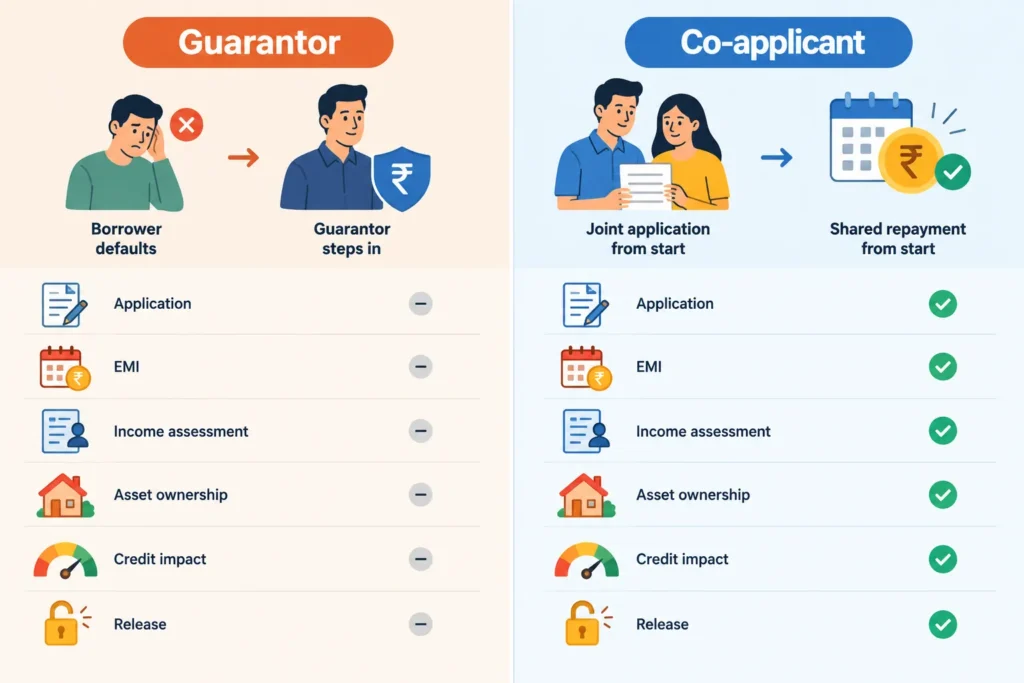
Visual comparison of a loan guarantor and co-applicant across repayment, eligibility, ownership and credit impact

Point of comparison Loan guarantor Co-applicant or co-borrower
Basic role Provides a promise supporting the borrower’s repayment obligation. Applies for the loan with the primary applicant.
Expected repayment Usually becomes relevant when the borrower fails to pay, subject to the guarantee terms. May be responsible for repayment from the beginning if treated as a joint borrower.
Use of income for eligibility Income may be checked for guarantee strength but is not always combined to calculate the loan amount. Eligible income may be combined with the main applicant’s income, depending on lender policy.
Access to loan funds Normally does not receive or use the loan merely because of the guarantee. May participate in the borrowing, although actual use of funds depends on the loan purpose.
Ownership of the asset Does not become an owner only by giving a guarantee. Does not automatically become an owner; ownership depends on title and purchase documents.
Credit impact The guarantee may be considered by lenders, and a default can affect the guarantor’s credit profile if reported. The loan and repayment conduct may appear in the co-borrower’s credit records.
Ending the role Cannot normally withdraw unilaterally after the loan is granted unless the lender agrees or the contract permits it. Cannot normally remove the name or repayment liability without lender approval and revised documents.
Main document to examine Guarantee deed and related loan terms. Loan agreement, application, sanction terms and repayment clauses.

The central difference is the stage at which responsibility usually operates. A guarantor supports another person’s debt and may be called upon after non-payment. A co-borrower is generally part of the borrowing arrangement from the start. Nevertheless, both roles can create substantial liability.

The credit effect can also differ in practice. A co-borrower’s loan is commonly linked to that person’s credit profile. A guarantee may also be visible or considered when the guarantor applies for another loan. If the borrower defaults and the lender reports the account accordingly, the guarantor’s future access to credit may be affected.

Neither role can usually be cancelled through a simple personal request. A guarantor cannot assume that a family disagreement ends the guarantee. A co-applicant cannot assume that moving out of a jointly purchased home removes loan liability. A release generally requires the lender’s consent, repayment or refinancing, and properly revised documentation.

Therefore, the safest way to compare a loan guarantor vs co-applicant is to look beyond the title. Check who has signed as borrower, who has guaranteed repayment, whose income was used, who owns the asset, how default is defined and what recovery rights the lender has under the documents.

Guarantor vs Co-Applicant in a Home Loan

In a home loan, a co-applicant applies for the loan together with the main applicant. A guarantor usually promises to repay the lender if the borrower fails to meet the agreed repayment obligations. However, the exact responsibility of each person depends on the loan agreement.

Consider an example. Arjun wants to buy a flat in Pune and applies for a home loan. His wife, Meera, earns a regular salary and joins the application. The lender may assess both incomes while deciding the eligible loan amount. If the loan is approved jointly, Arjun and Meera may both be contractually responsible for repayment.

Now consider a different situation. Arjun qualifies for the required loan amount, but the lender asks for additional security because of its internal lending policy. Arjun’s father agrees to become a guarantor. His income may not necessarily be combined with Arjun’s income in the same way as a co-applicant’s income. Instead, he gives the lender a contractual promise to pay if the borrower defaults, subject to the guarantee terms.

Is a co-applicant always a co-owner?

No. The terms “co-applicant” and “co-owner” describe different roles. A co-applicant is connected to the loan, while a co-owner has a legal ownership share in the property.

Some lenders may require every co-owner to join the home loan as a co-applicant. They may not require every co-applicant to be a co-owner. Other lenders may follow different rules based on the property, relationship between applicants and internal policy.

For example, Meera may join Arjun’s home loan as a co-applicant and may also be named as a joint owner in the property documents. In another case, a parent may be accepted as a co-applicant without receiving an ownership share. Whether this arrangement is allowed depends on the lender and the transaction documents.

Ownership also matters for income-tax benefits. Merely signing as a co-applicant does not automatically create a right to claim home loan tax deductions. The person generally needs to satisfy the relevant ownership, repayment and tax-law conditions. Borrowers should take professional tax advice for their specific case.

Can any family member join the loan?

Not necessarily. Banks and housing finance companies commonly have rules about acceptable relationships between applicants. A lender may accept a spouse, parent, child or sibling in certain combinations, but it may place conditions on income, age, ownership, residence or repayment tenure.

A lender may also decide whose income can be considered. For instance, a retired parent’s pension may be evaluated differently from a salaried spouse’s income. If the parent is older, the lender may consider how that affects the available loan tenure.

Therefore, applicants should not assume that adding a working relative will automatically increase eligibility. They should ask the lender:

  • Which relationships are accepted for this loan?
  • Must the co-applicant also be a co-owner?
  • Whose income will be included in the eligibility calculation?
  • Will age or retirement reduce the permitted tenure?
  • Is the liability joint, several, or both under the agreement?

A guarantor should ask a separate set of questions. The person should check the maximum scope of the guarantee, the events that can trigger payment, whether interest and recovery costs are covered, and how long the guarantee remains effective.

How Can Being a Guarantor or Co-Applicant Affect Your Credit Profile?

Becoming a co-applicant or guarantor is not merely a personal favour. It may create a financial connection that affects how lenders assess your credit profile and future applications.

A jointly applied loan may appear in the credit records of the co-applicants, depending on how the lender reports the account and how the credit bureau records that information. Repayment behaviour associated with the account may then form part of their credit history.

If EMIs are paid on time, the account may show a regular repayment record. If instalments are delayed or remain unpaid, the delay may be reported and may negatively affect the credit profiles connected with the loan. Reporting practices and the treatment of each role are not necessarily identical across all lenders and credit bureaus.

A guarantor’s position can also be relevant to future borrowing. Some lenders may consider an existing guarantee while assessing the person’s overall obligations and risk. They may ask about the guaranteed loan, outstanding balance or repayment status before approving a new loan.

Effect on future borrowing capacity

Suppose Meera is a co-applicant on Arjun’s home loan. Two years later, she applies for a car loan in her own name. The car loan lender may consider her responsibility for the home loan while calculating whether she can manage another EMI.

Similarly, if Arjun’s father has guaranteed the home loan and later applies for a personal loan, the new lender may examine that guarantee. It may view the commitment as a possible future liability even if Arjun has paid every EMI so far.

This does not mean that every co-applicant or guarantor will automatically be refused another loan. The outcome can depend on income, existing EMIs, repayment history, credit policy, the outstanding loan amount and the nature of the contractual obligation.

Before signing, a person should consider whether the commitment could interfere with planned borrowing. This is particularly important if the person expects to take a home loan, education loan or business loan soon.

Check records and correct errors

Co-applicants and guarantors should monitor their credit reports periodically. They should check whether the loan role, outstanding amount and payment status are recorded correctly.

If an EMI was paid on time but is shown as overdue, the person can raise a dispute with the relevant credit bureau and contact the lender with supporting payment records. The lender is generally the source of the account information, so correcting its records may be necessary.

You May Also Like:How to Improve Home Loan Eligibility in India

What Happens If the Borrower Misses EMIs?

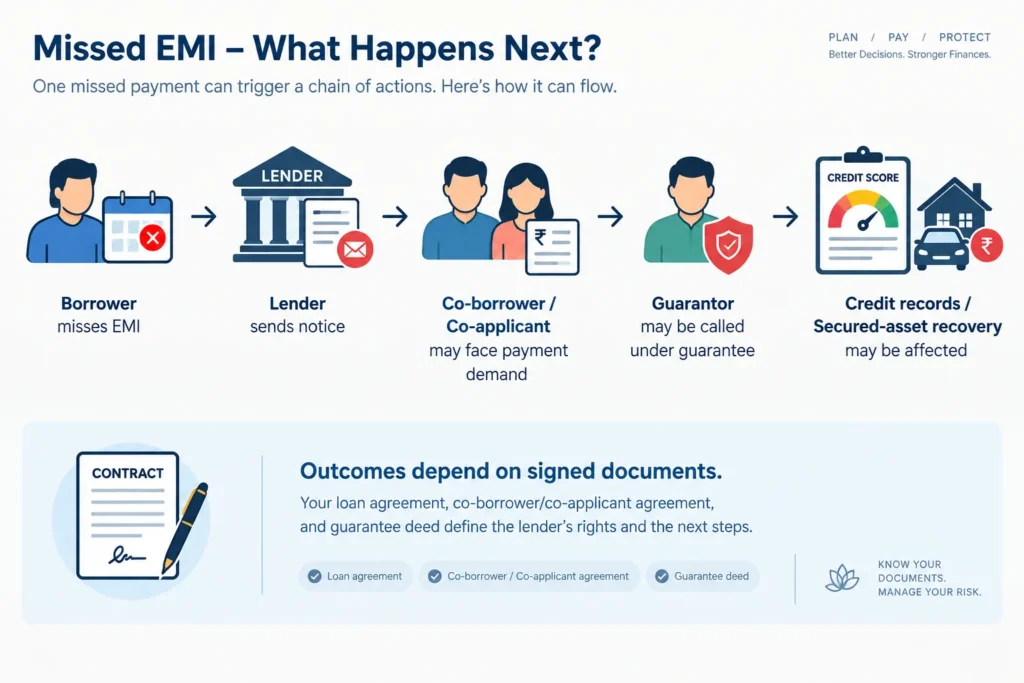
Flowchart showing how a missed EMI can affect the borrower, co-applicant, guarantor, credit records and secured asset

The consequences of a missed EMI depend on the loan agreement, the guarantee document, lender policy and applicable Indian law. A single delayed payment and a continuing default may not lead to the same action, but neither should be ignored.

The lender may first send payment reminders or a formal notice. Late payment charges, penal charges or additional interest may apply if permitted under the agreement and relevant rules. The missed payment may also be reported to credit bureaus.

Where there are co-applicants, the lender may demand payment from the persons contractually responsible for the debt. A private understanding such as “Arjun will pay all EMIs” may not limit the lender’s rights if both Arjun and Meera signed an agreement making them jointly and severally liable.

Joint and several liability can allow a lender to seek the due amount from one or more liable borrowers, subject to the contract and law. A co-applicant should therefore read the repayment and default clauses rather than assuming that liability is divided equally.

What can happen to a guarantor?

If the borrower defaults, the lender may invoke the guarantee and demand payment from the guarantor according to its terms. Under Indian contract law, a guarantor’s liability can be extensive and may generally be co-extensive with that of the principal debtor unless the contract provides otherwise.

This means a guarantor should not assume that the lender must first exhaust every recovery option against the borrower or property before approaching the guarantor. The actual sequence and remedies depend on the documents, the type of security and applicable law.

If the guarantor pays the lender, the guarantor may have legal rights against the borrower. However, recovering that money can take time, involve cost and depend on the borrower’s financial position. The existence of a recovery right does not remove the immediate risk.

Consequences for the home and credit records

A home loan is normally secured by the property. In a continuing default, the lender may begin recovery action and may enforce its security interest if the legal requirements are met. Such action involves prescribed notices and procedures; the lender cannot simply disregard the contract and applicable law.

Missed payments may damage the repayment history of the borrower and may also affect connected co-applicants or guarantors, depending on reporting and account status. Recovery proceedings can also lead to legal expenses and other charges where the documents and law permit them.

The borrower, co-applicant and guarantor should contact the lender promptly when repayment trouble begins. They can ask about available options, but restructuring, tenure extension, temporary relief or settlement is never automatic and may have financial or credit consequences.

Most importantly, each person should keep a copy of the sanction letter, loan agreement, guarantee deed, repayment schedule and payment records. These documents show who owes what, when the lender may make a demand, and what remedies may follow after default.

Can You Withdraw as a Guarantor or Co-Applicant?

Becoming a guarantor or co-applicant is usually a long-term contractual commitment. You generally cannot remove your name simply by sending a request to the lender. The lender’s written approval and a formal change to the loan documents are normally required.

The exact process depends on the loan agreement, lender policy, outstanding amount, repayment history and the financial strength of the remaining borrower. Until the lender confirms your release in writing, assume that your obligations continue.

Withdrawal as a Guarantor

A guarantor may ask to be released, but the lender is not normally required to agree. The guarantee was often one of the reasons the loan was approved. Removing it could increase the lender’s risk.

The lender may consider releasing a guarantor if:

  • The borrower provides another guarantor who meets the lender’s eligibility requirements.
  • Additional collateral or other acceptable security is provided.
  • The borrower refinances the outstanding loan in their own name or with another lender.
  • The borrower’s income and credit profile have improved enough to qualify without a guarantee.
  • The outstanding loan is fully repaid or settled according to the lender’s terms.
  • A release is allowed under a specific clause in the guarantee agreement.

A private arrangement between the borrower and guarantor does not necessarily release the guarantor from the lender’s claim. For example, a borrower may promise a relative that the relative is “no longer responsible”. That promise does not change the signed guarantee unless the lender accepts the change through the required contractual process.

Do not stop monitoring the account merely because you have requested withdrawal. Continue to check relevant notices and maintain records until you receive a clear written release from the lender.

Withdrawal as a Co-Applicant

Removing a co-applicant can also be difficult, particularly if that person is a co-borrower with repayment liability. The lender may have considered both applicants’ incomes, credit histories and existing obligations while approving the loan amount.

The remaining borrower may need to prove that they can service the EMI independently. The lender could conduct a fresh eligibility assessment, request updated income documents or ask for a replacement co-applicant.

Possible routes include refinancing, transferring the loan, making a substantial part-payment or completing a formal borrower substitution. Full repayment will also end future repayment obligations, subject to closure of the account and completion of any required documentation.

In a home loan, ownership and loan liability are separate issues. Removing a person from a property title does not automatically remove them from the loan. Similarly, removing a co-applicant from the loan does not by itself transfer their ownership rights. Property documents, the loan agreement and lender requirements must all be reviewed separately.

You May Also Like:Loan-to-Value Ratio (LTV): Meaning, Formula and Home Loan Example

Get Proof of Release

If the lender approves removal, ask for written confirmation identifying the loan account and the person being released. Where applicable, obtain amended loan documents, a revised repayment arrangement and confirmation about future credit reporting.

After the change is completed, review your credit report after a reasonable reporting period. If the account continues to appear incorrectly, raise a dispute with the lender and the relevant credit bureau using the release documents.

Questions to Ask Before Signing

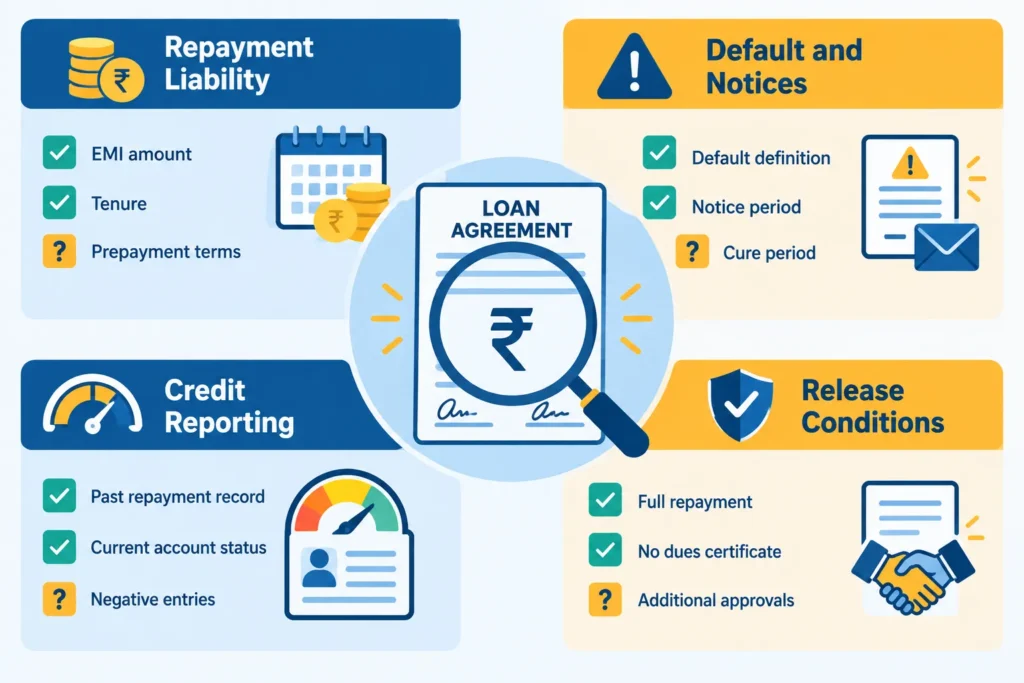
Checklist of repayment, default, credit reporting and release questions to review before signing loan documents

Do not sign only because the main borrower is a spouse, sibling, friend or colleague. A loan document can create serious financial and legal obligations even when no money is credited to your bank account.

Ask the lender for complete documents and enough time to read them. Never sign blank forms or rely only on verbal explanations from the borrower, agent or sales representative.

Questions About Repayment

  • Am I described as a co-applicant, co-borrower or guarantor in the final agreement?
  • Am I responsible for the entire outstanding amount or only a defined portion?
  • Can the lender demand payment from me if the main borrower misses an EMI?
  • Does the lender need to recover from the borrower or collateral before approaching me?
  • Will my income and bank account be considered part of the repayment arrangement?
  • Can the lender change the interest rate, tenure or EMI under the agreement, and how will I be informed?

Questions About Default and Notices

  • What events count as default apart from a missed EMI?
  • Will I receive EMI reminders, overdue notices and legal communications directly?
  • Which postal address, email address and mobile number will the lender use?
  • What collection or enforcement action may be taken against me?
  • Could legal costs, penal charges or other permitted expenses be added to the amount claimed?

Make sure the lender has your current contact details. If all notices go only to the main borrower, you may learn about repayment problems too late to take practical action.

Questions About Credit Reporting and Future Borrowing

  • Will this loan appear on my credit report?
  • How will missed payments or a settlement be reported against my name?
  • Will the obligation be considered when I apply for another loan or credit card?
  • How will the lender update credit bureaus if I am formally released?

Even when payments remain regular, lenders considering your future application may take an existing co-borrowing or guarantee obligation into account. It can affect how much additional debt they believe you can safely manage.

Questions About Documents and Release

  • Can I receive a complete copy of the application, sanction letter, loan agreement and guarantee deed before signing?
  • Are there clauses allowing the lender to extend, renew or restructure the loan without fresh consent from me?
  • What conditions must be met to remove my name?
  • Can another person replace me, and what eligibility rules would apply?
  • Will refinancing or full repayment be necessary for release?
  • Which document will confirm that my liability has ended?

Also ask whether your liability continues if the borrower dies, becomes insolvent, separates from a spouse or has a dispute with you. Personal relationships can change, but the lender’s contractual rights may continue.

Check Your Own Financial Capacity

Before signing, consider whether you could handle the EMI without damaging your essential household budget. Review your income stability, emergency savings, insurance needs and existing EMIs.

If repaying the loan would be impossible, do not assume that the borrower will always protect you. Ask questions before signing rather than depending on informal assurances.

You May Also Like:Home Loan Down Payment in India: How Much Do You Need?

Frequently Asked Questions

Is a co-applicant always responsible for repayment?

Not always. “Co-applicant” can describe different roles across lenders and products. A person who signs as a co-borrower is generally contractually responsible for repayment, often along with the other borrower. In some cases, a co-applicant may be included mainly to satisfy an application or property-related requirement. The final loan agreement, not the label used in conversation, determines the obligation.

Can a guarantor be required to repay the loan?

Yes. If the borrower defaults, the lender may demand repayment from the guarantor according to the guarantee and applicable law. A guarantor should not assume that the lender must exhaust every recovery option against the borrower first. The wording and scope of the guarantee must be checked carefully.

Can being a guarantor or co-applicant affect future loan eligibility?

Yes, it can. A lender assessing a new application may consider the existing obligation, especially if you are a co-borrower or if the guaranteed account has payment problems. Delays or defaults associated with the account may also affect your credit profile if reported against your name.

Can a spouse be a co-applicant for a home loan?

Yes, spouses can commonly apply together, subject to the lender’s policy. Whether both incomes are considered may depend on each person’s eligibility and repayment role. Some lenders may also require property owners to join the loan. Co-applicant status does not automatically create property ownership, so the title documents must be checked separately.

Can a guarantor withdraw after the loan is approved?

A guarantor can request withdrawal, but release is generally not automatic. The lender may require a replacement guarantor, additional security, refinancing, repayment or another process allowed by the contract. Liability normally continues until the lender provides a valid written release or the guaranteed obligation ends.

What is the difference between a guarantor and a co-borrower?

A co-borrower directly takes the loan with the other borrower and usually shares primary repayment responsibility. A guarantor promises to meet the obligation if the borrower fails to do so, subject to the guarantee terms and applicable law. Both roles can create significant liability, but their contractual positions are different.

Summary

In a loan guarantor vs co-applicant decision, the title alone is not enough. Check whether you have primary repayment responsibility, what happens after default, how the account will be reported and what conditions apply to release.

Removal usually requires lender approval and may involve replacement security, refinancing or repayment. Read every document, keep signed copies and obtain written confirmation of any change. If the obligations or legal exposure are unclear, seek advice from a qualified financial adviser or lawyer before signing.

Share this article
KEEP READING

Related Articles

View all →

Comments

Leave a Comment

Loan Guarantor vs Co-Applicant in India: Differences, Responsibilities and Risks

A loan guarantor promises to repay a loan if the borrower fails to meet the repayment obligation. A co-applicant applies for the loan along with the main applicant and may also be responsible for repayment from the beginning. However, the exact liability of either person depends on the loan agreement, guarantee deed and other documents they sign.

The terms guarantor, co-applicant and co-borrower are often used casually, but they do not always mean the same thing. A co-applicant may be included mainly to meet a lender’s eligibility or procedural requirements, while a co-borrower is normally a joint borrower with a clear repayment obligation. Never rely only on the label used by a bank employee or loan advertisement. Read the signed documents to understand the actual responsibility.

Introduction

Suppose a person applies for a home loan but does not have enough income to qualify for the required amount. The lender may allow the person to apply with a working spouse as a co-applicant. In another case, a lender may approve a business, education or personal loan only if a financially stable family member gives a guarantee.

Both arrangements provide additional comfort to the lender, but they work differently. A co-applicant usually participates in the loan application itself. A guarantor normally gives the lender a separate promise that the debt will be paid if the borrower defaults.

This distinction matters because signing either document can affect your finances, borrowing capacity and credit history. It may also create a serious repayment burden if the main borrower faces job loss, business failure, illness or another financial problem.

As explained in RegularStation’s complete guide to loans and EMIs in India, borrowers should evaluate the total repayment obligation rather than looking only at the EMI. The same principle applies to anyone considering becoming a guarantor or co-applicant: understand the full legal and financial commitment before signing.

Who Is a Loan Guarantor?

A loan guarantor is a person who gives the lender an assurance that the loan obligation will be met if the main borrower does not pay as agreed. The guarantor may sign a guarantee deed or a guarantee clause included in the loan documents.

The borrower generally remains the person expected to pay the regular EMIs. The guarantor may not receive the loan money or use the asset purchased with it. Even so, the guarantee is not merely a character reference or a statement that the borrower is trustworthy. It can create a legally enforceable financial obligation.

For example, assume Arun takes an education loan and his uncle signs as guarantor. Arun is expected to repay the loan according to the agreed schedule. If Arun defaults, the lender may demand payment from the uncle based on the terms of the guarantee and applicable law.

A common misunderstanding is that the lender must first exhaust every possible recovery step against the borrower before contacting the guarantor. That should not be assumed. The timing and extent of recovery action can depend on the guarantee, the loan documents and the law. A guarantor should therefore treat the potential liability seriously from the day the guarantee is signed.

When May a Lender Request a Guarantor?

A lender may request a guarantor when it wants additional protection against the possibility of non-payment. This may happen when:

  • The applicant’s income or repayment capacity is not strong enough for the requested loan.
  • The borrower has a limited or weak credit history.
  • The loan amount is high compared with the borrower’s income or available security.
  • The borrower’s income is irregular, such as income from a new business or self-employment.
  • The lender’s policy requires a guarantor for a particular loan product or applicant profile.
  • The lender has concerns about the borrower’s age, employment continuity or other eligibility factors.

These are only common examples. Indian banks, non-banking financial companies and other lenders do not follow one identical policy. One lender may ask for a guarantor while another may reduce the loan amount, request collateral, charge a different interest rate or reject the application.

Being a close relative does not automatically make someone an acceptable guarantor. The lender may examine the proposed guarantor’s income, existing EMIs, age, credit profile and financial stability before accepting the guarantee.

Who Is a Loan Co-Applicant?

A co-applicant is a person who applies for the loan together with the primary applicant. The lender may consider the co-applicant’s income, age, credit history and existing obligations while deciding eligibility and the loan amount.

For instance, Meera and Rohan may apply jointly for a home loan. If both incomes are accepted, the lender may calculate repayment capacity using their combined eligible income. This could help them qualify for a larger loan than either person could obtain alone.

However, adding a name to an application form does not by itself explain the person’s complete liability. In everyday conversations, lenders and borrowers may use the terms co-applicant and co-borrower as if they are identical. In legal and financial terms, the signed agreement is more important than the informal label.

A co-borrower is generally a joint borrower who shares the contractual responsibility to repay the debt. A person described as a co-applicant may also become a co-borrower when the loan documents impose joint repayment liability. In some situations, a co-applicant may be included to meet a lender’s procedural or ownership-related requirement, but the exact arrangement varies.

Participation and Repayment Duties Depend on the Documents

Before signing, a co-applicant should check whether the documents describe the liability as joint, several, or joint and several. Joint and several liability can allow the lender to demand the outstanding amount from either borrower, subject to the agreement and applicable law. It does not necessarily mean that each person is responsible only for an informal share such as 50%.

The co-applicant should also check whose income is being considered, who will pay the EMIs, who owns the asset and what happens after a default. Private arrangements between family members may not limit the lender’s contractual rights.

Co-applicant status and asset ownership are also separate issues. Being a co-applicant on a home loan does not automatically make a person a co-owner of the property. Similarly, tax benefits on a home loan do not arise merely because someone is named in the application. Eligibility generally depends on factors such as ownership, repayment and the applicable tax rules.

Loan Guarantor vs Co-Applicant: Key Differences
Visual comparison of a loan guarantor and co-applicant across repayment, eligibility, ownership and credit impact

Point of comparison Loan guarantor Co-applicant or co-borrower
Basic role Provides a promise supporting the borrower’s repayment obligation. Applies for the loan with the primary applicant.
Expected repayment Usually becomes relevant when the borrower fails to pay, subject to the guarantee terms. May be responsible for repayment from the beginning if treated as a joint borrower.
Use of income for eligibility Income may be checked for guarantee strength but is not always combined to calculate the loan amount. Eligible income may be combined with the main applicant’s income, depending on lender policy.
Access to loan funds Normally does not receive or use the loan merely because of the guarantee. May participate in the borrowing, although actual use of funds depends on the loan purpose.
Ownership of the asset Does not become an owner only by giving a guarantee. Does not automatically become an owner; ownership depends on title and purchase documents.
Credit impact The guarantee may be considered by lenders, and a default can affect the guarantor’s credit profile if reported. The loan and repayment conduct may appear in the co-borrower’s credit records.
Ending the role Cannot normally withdraw unilaterally after the loan is granted unless the lender agrees or the contract permits it. Cannot normally remove the name or repayment liability without lender approval and revised documents.
Main document to examine Guarantee deed and related loan terms. Loan agreement, application, sanction terms and repayment clauses.

The central difference is the stage at which responsibility usually operates. A guarantor supports another person’s debt and may be called upon after non-payment. A co-borrower is generally part of the borrowing arrangement from the start. Nevertheless, both roles can create substantial liability.

The credit effect can also differ in practice. A co-borrower’s loan is commonly linked to that person’s credit profile. A guarantee may also be visible or considered when the guarantor applies for another loan. If the borrower defaults and the lender reports the account accordingly, the guarantor’s future access to credit may be affected.

Neither role can usually be cancelled through a simple personal request. A guarantor cannot assume that a family disagreement ends the guarantee. A co-applicant cannot assume that moving out of a jointly purchased home removes loan liability. A release generally requires the lender’s consent, repayment or refinancing, and properly revised documentation.

Therefore, the safest way to compare a loan guarantor vs co-applicant is to look beyond the title. Check who has signed as borrower, who has guaranteed repayment, whose income was used, who owns the asset, how default is defined and what recovery rights the lender has under the documents.

Guarantor vs Co-Applicant in a Home Loan

In a home loan, a co-applicant applies for the loan together with the main applicant. A guarantor usually promises to repay the lender if the borrower fails to meet the agreed repayment obligations. However, the exact responsibility of each person depends on the loan agreement.

Consider an example. Arjun wants to buy a flat in Pune and applies for a home loan. His wife, Meera, earns a regular salary and joins the application. The lender may assess both incomes while deciding the eligible loan amount. If the loan is approved jointly, Arjun and Meera may both be contractually responsible for repayment.

Now consider a different situation. Arjun qualifies for the required loan amount, but the lender asks for additional security because of its internal lending policy. Arjun’s father agrees to become a guarantor. His income may not necessarily be combined with Arjun’s income in the same way as a co-applicant’s income. Instead, he gives the lender a contractual promise to pay if the borrower defaults, subject to the guarantee terms.

Is a co-applicant always a co-owner?

No. The terms “co-applicant” and “co-owner” describe different roles. A co-applicant is connected to the loan, while a co-owner has a legal ownership share in the property.

Some lenders may require every co-owner to join the home loan as a co-applicant. They may not require every co-applicant to be a co-owner. Other lenders may follow different rules based on the property, relationship between applicants and internal policy.

For example, Meera may join Arjun’s home loan as a co-applicant and may also be named as a joint owner in the property documents. In another case, a parent may be accepted as a co-applicant without receiving an ownership share. Whether this arrangement is allowed depends on the lender and the transaction documents.

Ownership also matters for income-tax benefits. Merely signing as a co-applicant does not automatically create a right to claim home loan tax deductions. The person generally needs to satisfy the relevant ownership, repayment and tax-law conditions. Borrowers should take professional tax advice for their specific case.

Can any family member join the loan?

Not necessarily. Banks and housing finance companies commonly have rules about acceptable relationships between applicants. A lender may accept a spouse, parent, child or sibling in certain combinations, but it may place conditions on income, age, ownership, residence or repayment tenure.

A lender may also decide whose income can be considered. For instance, a retired parent’s pension may be evaluated differently from a salaried spouse’s income. If the parent is older, the lender may consider how that affects the available loan tenure.

Therefore, applicants should not assume that adding a working relative will automatically increase eligibility. They should ask the lender:

  • Which relationships are accepted for this loan?
  • Must the co-applicant also be a co-owner?
  • Whose income will be included in the eligibility calculation?
  • Will age or retirement reduce the permitted tenure?
  • Is the liability joint, several, or both under the agreement?

A guarantor should ask a separate set of questions. The person should check the maximum scope of the guarantee, the events that can trigger payment, whether interest and recovery costs are covered, and how long the guarantee remains effective.

How Can Being a Guarantor or Co-Applicant Affect Your Credit Profile?

Becoming a co-applicant or guarantor is not merely a personal favour. It may create a financial connection that affects how lenders assess your credit profile and future applications.

A jointly applied loan may appear in the credit records of the co-applicants, depending on how the lender reports the account and how the credit bureau records that information. Repayment behaviour associated with the account may then form part of their credit history.

If EMIs are paid on time, the account may show a regular repayment record. If instalments are delayed or remain unpaid, the delay may be reported and may negatively affect the credit profiles connected with the loan. Reporting practices and the treatment of each role are not necessarily identical across all lenders and credit bureaus.

A guarantor’s position can also be relevant to future borrowing. Some lenders may consider an existing guarantee while assessing the person’s overall obligations and risk. They may ask about the guaranteed loan, outstanding balance or repayment status before approving a new loan.

Effect on future borrowing capacity

Suppose Meera is a co-applicant on Arjun’s home loan. Two years later, she applies for a car loan in her own name. The car loan lender may consider her responsibility for the home loan while calculating whether she can manage another EMI.

Similarly, if Arjun’s father has guaranteed the home loan and later applies for a personal loan, the new lender may examine that guarantee. It may view the commitment as a possible future liability even if Arjun has paid every EMI so far.

This does not mean that every co-applicant or guarantor will automatically be refused another loan. The outcome can depend on income, existing EMIs, repayment history, credit policy, the outstanding loan amount and the nature of the contractual obligation.

Before signing, a person should consider whether the commitment could interfere with planned borrowing. This is particularly important if the person expects to take a home loan, education loan or business loan soon.

Check records and correct errors

Co-applicants and guarantors should monitor their credit reports periodically. They should check whether the loan role, outstanding amount and payment status are recorded correctly.

If an EMI was paid on time but is shown as overdue, the person can raise a dispute with the relevant credit bureau and contact the lender with supporting payment records. The lender is generally the source of the account information, so correcting its records may be necessary.

What Happens If the Borrower Misses EMIs?
Flowchart showing how a missed EMI can affect the borrower, co-applicant, guarantor, credit records and secured asset

The consequences of a missed EMI depend on the loan agreement, the guarantee document, lender policy and applicable Indian law. A single delayed payment and a continuing default may not lead to the same action, but neither should be ignored.

The lender may first send payment reminders or a formal notice. Late payment charges, penal charges or additional interest may apply if permitted under the agreement and relevant rules. The missed payment may also be reported to credit bureaus.

Where there are co-applicants, the lender may demand payment from the persons contractually responsible for the debt. A private understanding such as “Arjun will pay all EMIs” may not limit the lender’s rights if both Arjun and Meera signed an agreement making them jointly and severally liable.

Joint and several liability can allow a lender to seek the due amount from one or more liable borrowers, subject to the contract and law. A co-applicant should therefore read the repayment and default clauses rather than assuming that liability is divided equally.

What can happen to a guarantor?

If the borrower defaults, the lender may invoke the guarantee and demand payment from the guarantor according to its terms. Under Indian contract law, a guarantor’s liability can be extensive and may generally be co-extensive with that of the principal debtor unless the contract provides otherwise.

This means a guarantor should not assume that the lender must first exhaust every recovery option against the borrower or property before approaching the guarantor. The actual sequence and remedies depend on the documents, the type of security and applicable law.

If the guarantor pays the lender, the guarantor may have legal rights against the borrower. However, recovering that money can take time, involve cost and depend on the borrower’s financial position. The existence of a recovery right does not remove the immediate risk.

Consequences for the home and credit records

A home loan is normally secured by the property. In a continuing default, the lender may begin recovery action and may enforce its security interest if the legal requirements are met. Such action involves prescribed notices and procedures; the lender cannot simply disregard the contract and applicable law.

Missed payments may damage the repayment history of the borrower and may also affect connected co-applicants or guarantors, depending on reporting and account status. Recovery proceedings can also lead to legal expenses and other charges where the documents and law permit them.

The borrower, co-applicant and guarantor should contact the lender promptly when repayment trouble begins. They can ask about available options, but restructuring, tenure extension, temporary relief or settlement is never automatic and may have financial or credit consequences.

Most importantly, each person should keep a copy of the sanction letter, loan agreement, guarantee deed, repayment schedule and payment records. These documents show who owes what, when the lender may make a demand, and what remedies may follow after default.

Can You Withdraw as a Guarantor or Co-Applicant?

Becoming a guarantor or co-applicant is usually a long-term contractual commitment. You generally cannot remove your name simply by sending a request to the lender. The lender’s written approval and a formal change to the loan documents are normally required.

The exact process depends on the loan agreement, lender policy, outstanding amount, repayment history and the financial strength of the remaining borrower. Until the lender confirms your release in writing, assume that your obligations continue.

Withdrawal as a Guarantor

A guarantor may ask to be released, but the lender is not normally required to agree. The guarantee was often one of the reasons the loan was approved. Removing it could increase the lender’s risk.

The lender may consider releasing a guarantor if:

  • The borrower provides another guarantor who meets the lender’s eligibility requirements.
  • Additional collateral or other acceptable security is provided.
  • The borrower refinances the outstanding loan in their own name or with another lender.
  • The borrower’s income and credit profile have improved enough to qualify without a guarantee.
  • The outstanding loan is fully repaid or settled according to the lender’s terms.
  • A release is allowed under a specific clause in the guarantee agreement.

A private arrangement between the borrower and guarantor does not necessarily release the guarantor from the lender’s claim. For example, a borrower may promise a relative that the relative is “no longer responsible”. That promise does not change the signed guarantee unless the lender accepts the change through the required contractual process.

Do not stop monitoring the account merely because you have requested withdrawal. Continue to check relevant notices and maintain records until you receive a clear written release from the lender.

Withdrawal as a Co-Applicant

Removing a co-applicant can also be difficult, particularly if that person is a co-borrower with repayment liability. The lender may have considered both applicants’ incomes, credit histories and existing obligations while approving the loan amount.

The remaining borrower may need to prove that they can service the EMI independently. The lender could conduct a fresh eligibility assessment, request updated income documents or ask for a replacement co-applicant.

Possible routes include refinancing, transferring the loan, making a substantial part-payment or completing a formal borrower substitution. Full repayment will also end future repayment obligations, subject to closure of the account and completion of any required documentation.

In a home loan, ownership and loan liability are separate issues. Removing a person from a property title does not automatically remove them from the loan. Similarly, removing a co-applicant from the loan does not by itself transfer their ownership rights. Property documents, the loan agreement and lender requirements must all be reviewed separately.

Get Proof of Release

If the lender approves removal, ask for written confirmation identifying the loan account and the person being released. Where applicable, obtain amended loan documents, a revised repayment arrangement and confirmation about future credit reporting.

After the change is completed, review your credit report after a reasonable reporting period. If the account continues to appear incorrectly, raise a dispute with the lender and the relevant credit bureau using the release documents.

Questions to Ask Before Signing
Checklist of repayment, default, credit reporting and release questions to review before signing loan documents

Do not sign only because the main borrower is a spouse, sibling, friend or colleague. A loan document can create serious financial and legal obligations even when no money is credited to your bank account.

Ask the lender for complete documents and enough time to read them. Never sign blank forms or rely only on verbal explanations from the borrower, agent or sales representative.

Questions About Repayment

  • Am I described as a co-applicant, co-borrower or guarantor in the final agreement?
  • Am I responsible for the entire outstanding amount or only a defined portion?
  • Can the lender demand payment from me if the main borrower misses an EMI?
  • Does the lender need to recover from the borrower or collateral before approaching me?
  • Will my income and bank account be considered part of the repayment arrangement?
  • Can the lender change the interest rate, tenure or EMI under the agreement, and how will I be informed?

Questions About Default and Notices

  • What events count as default apart from a missed EMI?
  • Will I receive EMI reminders, overdue notices and legal communications directly?
  • Which postal address, email address and mobile number will the lender use?
  • What collection or enforcement action may be taken against me?
  • Could legal costs, penal charges or other permitted expenses be added to the amount claimed?

Make sure the lender has your current contact details. If all notices go only to the main borrower, you may learn about repayment problems too late to take practical action.

Questions About Credit Reporting and Future Borrowing

  • Will this loan appear on my credit report?
  • How will missed payments or a settlement be reported against my name?
  • Will the obligation be considered when I apply for another loan or credit card?
  • How will the lender update credit bureaus if I am formally released?

Even when payments remain regular, lenders considering your future application may take an existing co-borrowing or guarantee obligation into account. It can affect how much additional debt they believe you can safely manage.

Questions About Documents and Release

  • Can I receive a complete copy of the application, sanction letter, loan agreement and guarantee deed before signing?
  • Are there clauses allowing the lender to extend, renew or restructure the loan without fresh consent from me?
  • What conditions must be met to remove my name?
  • Can another person replace me, and what eligibility rules would apply?
  • Will refinancing or full repayment be necessary for release?
  • Which document will confirm that my liability has ended?

Also ask whether your liability continues if the borrower dies, becomes insolvent, separates from a spouse or has a dispute with you. Personal relationships can change, but the lender’s contractual rights may continue.

Check Your Own Financial Capacity

Before signing, consider whether you could handle the EMI without damaging your essential household budget. Review your income stability, emergency savings, insurance needs and existing EMIs.

If repaying the loan would be impossible, do not assume that the borrower will always protect you. Ask questions before signing rather than depending on informal assurances.

Frequently Asked Questions

Is a co-applicant always responsible for repayment?

Not always. “Co-applicant” can describe different roles across lenders and products. A person who signs as a co-borrower is generally contractually responsible for repayment, often along with the other borrower. In some cases, a co-applicant may be included mainly to satisfy an application or property-related requirement. The final loan agreement, not the label used in conversation, determines the obligation.

Can a guarantor be required to repay the loan?

Yes. If the borrower defaults, the lender may demand repayment from the guarantor according to the guarantee and applicable law. A guarantor should not assume that the lender must exhaust every recovery option against the borrower first. The wording and scope of the guarantee must be checked carefully.

Can being a guarantor or co-applicant affect future loan eligibility?

Yes, it can. A lender assessing a new application may consider the existing obligation, especially if you are a co-borrower or if the guaranteed account has payment problems. Delays or defaults associated with the account may also affect your credit profile if reported against your name.

Can a spouse be a co-applicant for a home loan?

Yes, spouses can commonly apply together, subject to the lender’s policy. Whether both incomes are considered may depend on each person’s eligibility and repayment role. Some lenders may also require property owners to join the loan. Co-applicant status does not automatically create property ownership, so the title documents must be checked separately.

Can a guarantor withdraw after the loan is approved?

A guarantor can request withdrawal, but release is generally not automatic. The lender may require a replacement guarantor, additional security, refinancing, repayment or another process allowed by the contract. Liability normally continues until the lender provides a valid written release or the guaranteed obligation ends.

What is the difference between a guarantor and a co-borrower?

A co-borrower directly takes the loan with the other borrower and usually shares primary repayment responsibility. A guarantor promises to meet the obligation if the borrower fails to do so, subject to the guarantee terms and applicable law. Both roles can create significant liability, but their contractual positions are different.

Summary

In a loan guarantor vs co-applicant decision, the title alone is not enough. Check whether you have primary repayment responsibility, what happens after default, how the account will be reported and what conditions apply to release.

Removal usually requires lender approval and may involve replacement security, refinancing or repayment. Read every document, keep signed copies and obtain written confirmation of any change. If the obligations or legal exposure are unclear, seek advice from a qualified financial adviser or lawyer before signing.

Leave a Comment