

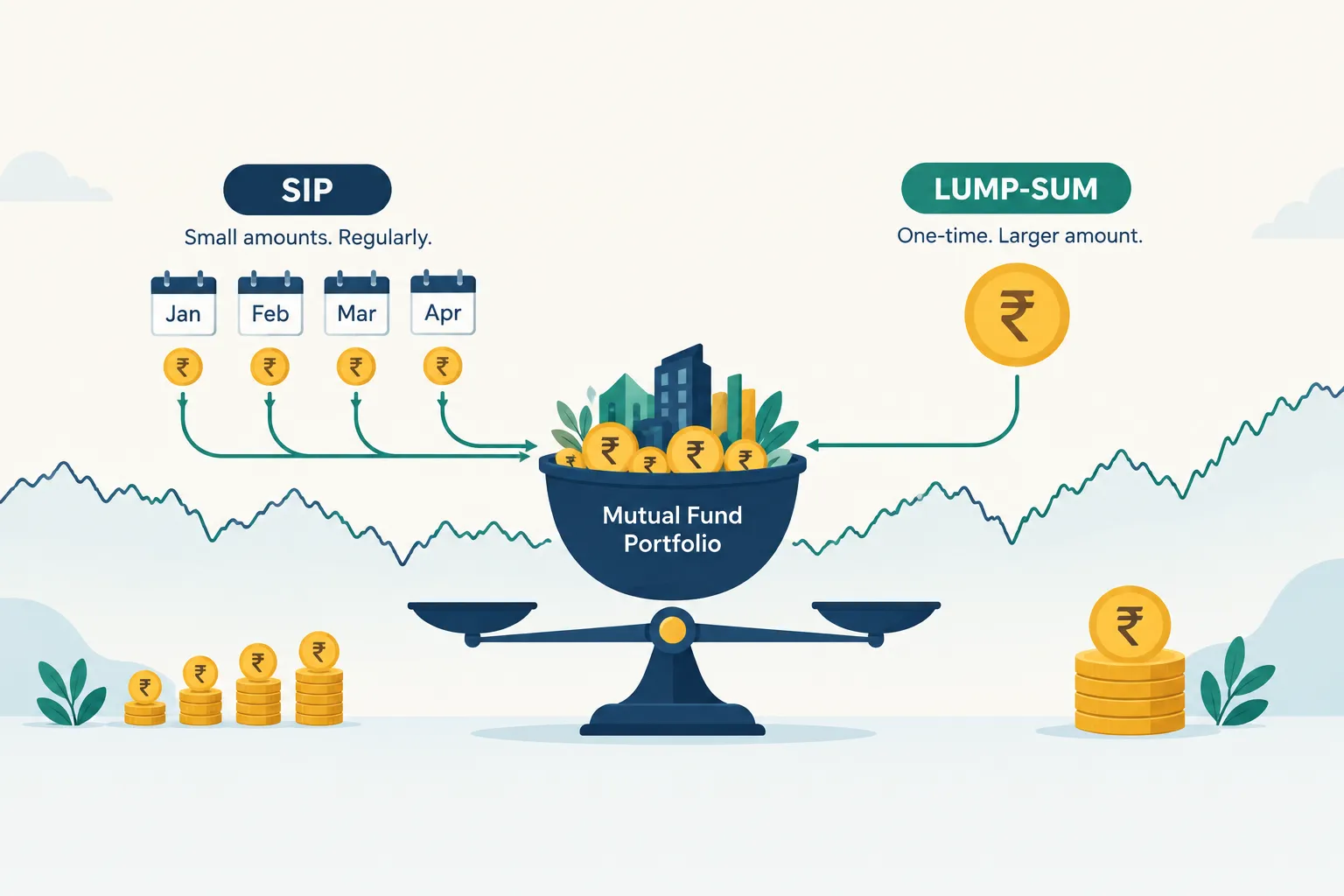
In the SIP vs lump sum comparison, neither method is automatically better. A Systematic Investment Plan, or SIP, invests a fixed amount at regular intervals. Lump-sum investing puts a larger amount into a mutual fund in one transaction.
SIPs spread purchases across different market levels and can suit investors investing from monthly income. A lump sum gives the entire amount market exposure immediately and may suit someone who already has money available. Both methods carry market risk, and neither guarantees higher returns or protection from losses.
Introduction
Many beginners assume that SIP and lump sum are two different types of mutual funds. They are not. They are simply two methods of investing in a mutual fund scheme.
For example, the same equity mutual fund may allow you to invest ₹5,000 every month through an SIP or invest ₹60,000 at one time. The mutual fund scheme remains the same. What changes is when and how your money enters it.
This difference affects your purchase price, the timing of market exposure and the way you manage your cash flow. Understanding these basics is important before deciding which approach may fit your financial situation.
How SIP and Lump-Sum Investing Work
What Is an SIP?
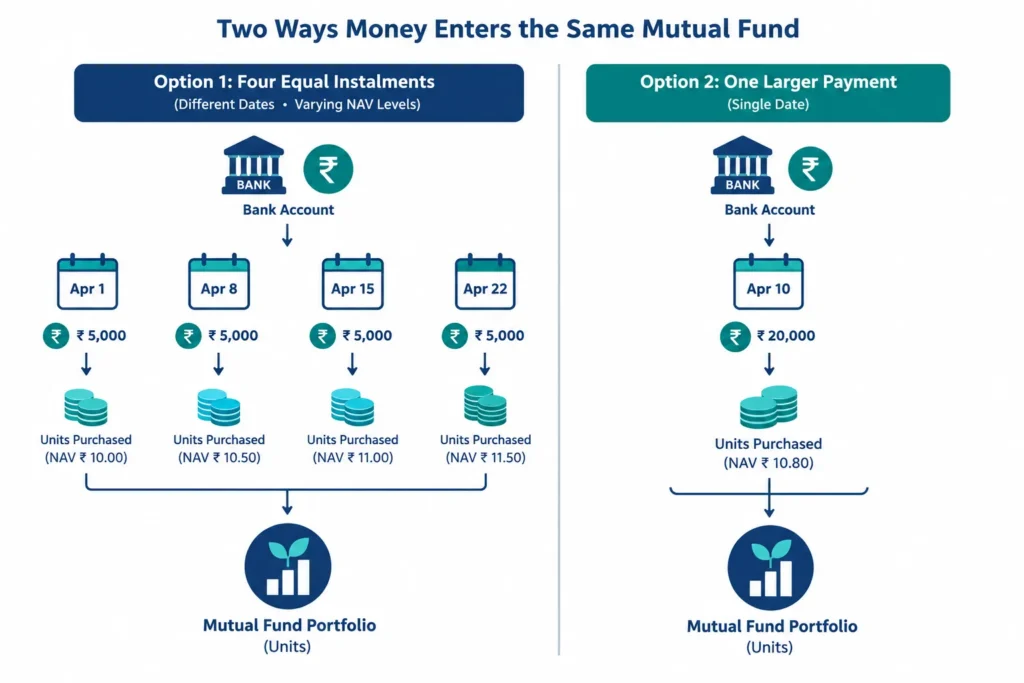
A Systematic Investment Plan is a facility through which you invest a chosen amount in a mutual fund at regular intervals. The interval is commonly monthly, although fund houses may offer other frequencies.
For example, you may set up an SIP of ₹3,000 per month in an equity mutual fund. The amount is usually debited from your registered bank account on the selected date, subject to the mandate and fund-house process.
Each SIP instalment is a separate mutual fund purchase. Your money buys units at the applicable Net Asset Value, or NAV, for that transaction.
NAV represents the per-unit value of a mutual fund scheme after accounting for its assets and liabilities. It changes as the value of the securities held by the scheme changes.
Consider a simplified illustration:
| Month | SIP amount | Illustrative NAV | Units purchased |
|---|---|---|---|
| January | ₹3,000 | ₹30 | 100 units |
| February | ₹3,000 | ₹25 | 120 units |
| March | ₹3,000 | ₹40 | 75 units |
In this example, the investor puts in ₹9,000 over three months and receives 295 units. When the NAV is lower, the fixed SIP amount buys more units. When the NAV is higher, it buys fewer units.
The figures are only for explanation. Actual units may differ due to the applicable NAV and other operational factors. The NAV applicable to a transaction depends on mutual fund rules, cut-off timings and when the investment money becomes available to the fund. It should not be assumed that the NAV visible when the bank debit starts will always be the final purchase NAV.
What Is Lump-Sum Investing?
Lump-sum investing means investing a larger amount in a mutual fund through a single transaction. Instead of spreading ₹60,000 across monthly installments, for example, you invest the full ₹60,000 at one time.
The full amount buys units at the applicable NAV for that transaction. If the applicable NAV is ₹30, an investment of ₹60,000 would purchase 2,000 units in this simplified example.
Unlike an SIP, the purchase is not divided across several dates. As a result, the entire amount becomes exposed to the performance of the mutual fund scheme after the units are allotted.
If the market rises after the investment, the full amount participates in that rise. If the market falls, the full amount is also exposed to the decline. This does not make lump-sum investing good or bad by itself. It simply means the timing of the single purchase can have a larger effect on the investor’s early experience.
SIP and Lump Sum Are Investment Methods
SIP and lump sum should not be confused with mutual fund categories. Categories describe where or how a scheme invests, such as equity funds, debt funds or hybrid funds. SIP and lump sum describe how you put money into an eligible scheme.
In many cases, an investor can use either method for the same mutual fund. An investor may even use both methods at different times. For instance, a salaried person may run a monthly SIP and make an additional lump-sum investment after receiving a bonus.
The investment method does not remove the risks associated with the underlying scheme. An SIP in an equity fund still carries equity-market risk. A lump-sum investment in a debt fund still carries the relevant interest-rate, credit and liquidity risks. The scheme’s portfolio and risk profile remain important regardless of the payment method.
How Rupee-Cost Averaging Works
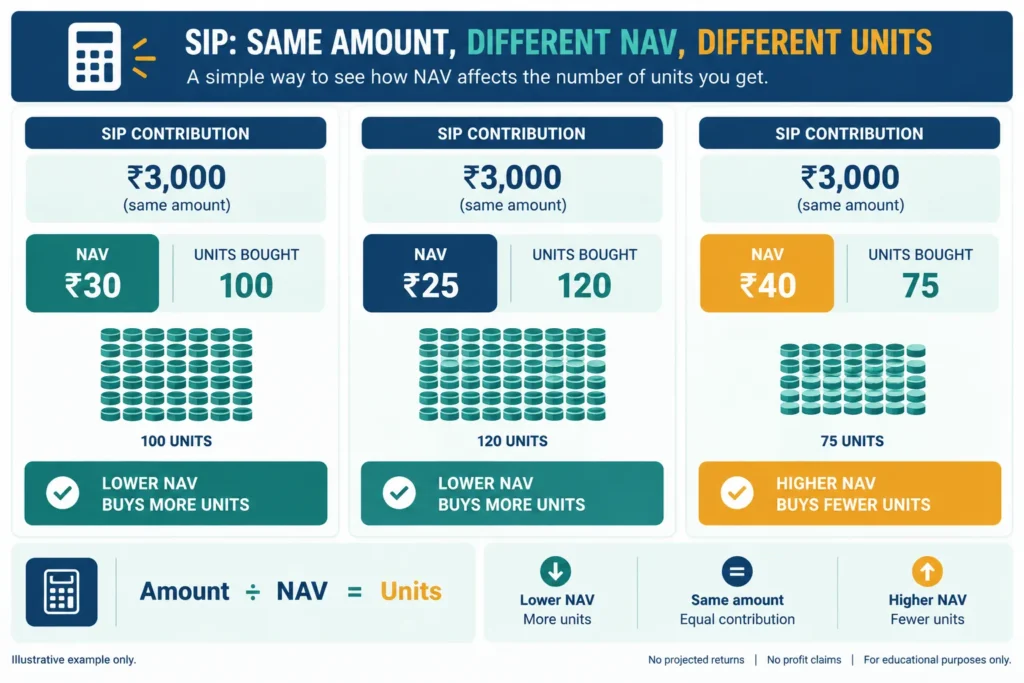
Rupee-cost averaging refers to investing the same amount at regular intervals when market prices are changing. Because a fixed amount buys more units at a lower NAV and fewer units at a higher NAV, the purchases take place at different prices over time.
This can reduce the need to choose one entry price for the entire investment. It may also create discipline because the investor continues investing according to a schedule rather than making every decision based on short-term market movements.
However, rupee-cost averaging does not mean that the investor will always earn a profit. It also does not guarantee that the average purchase cost will be lower than the price available at the beginning or end of the period.
If markets keep rising, investing the entire available amount earlier could produce a different and potentially better result than gradually investing it through an SIP. If markets fall after a lump-sum investment, spreading purchases through an SIP could result in some installments buying at lower NAVs. The actual outcome depends on the sequence of market movements, which cannot be known in advance.
An SIP can average purchase prices, but it cannot prevent the value of the accumulated units from falling. If the mutual fund’s NAV declines, the current value of the SIP portfolio may be below the total amount invested.
Why the Perfect Entry Point Is Difficult to Find
It is easy to identify market highs and lows after they have occurred. Identifying them in advance is much harder. Markets respond to company results, interest rates, inflation, government policy, global developments and investor expectations. Prices can move before the reason becomes obvious to individual investors.
An investor waiting for a major fall may remain uninvested while the market rises. Another investor may invest a lump sum expecting prices to increase, only to see a short-term correction. Even professional investors cannot consistently identify the exact best day to enter or exit.
This uncertainty is one reason many beginners use SIPs for regular, long-term investing. It removes the need to make a fresh market-timing decision for every installment. However, an SIP does not make timing irrelevant in all situations, nor does it assure superior returns.
The central point in the SIP vs lump sum discussion is simple: an SIP spreads purchases across multiple dates, while a lump sum makes one main purchase at the applicable NAV. Both are valid investment methods, and both remain subject to the performance and risks of the chosen mutual fund scheme.
When Should You Start Investing in Mutual Funds?
SIP vs Lump Sum Comparison and Practical Example
The main difference between SIP and lump-sum investing is how and when your money enters a mutual fund. With a systematic investment plan, or SIP, you invest smaller amounts at regular intervals. With a lump sum, you invest a larger amount in one transaction.
Neither method is automatically better for every investor. The suitable choice depends on when the money is available, your income pattern, investment horizon, ability to handle market fluctuations and financial responsibilities.
SIP vs Lump Sum: Key Differences
| Factor | SIP | Lump Sum |
|---|---|---|
| Investment timing | Money is invested at regular intervals, such as every month. | The full amount is invested on one selected date. |
| Cash-flow requirement | May suit investors who receive a regular salary or monthly income. | Requires a substantial amount to be available at once. |
| Market exposure | Market exposure increases gradually with each installment. | The full amount becomes exposed to market movements immediately. |
| Purchase price | Units are purchased at different NAVs over time. | All units are purchased at the NAV applicable to the investment date. |
| Investor behaviour | Automation may reduce the temptation to delay regular investing. | The investor must decide when to deploy the available money. |
| Discipline | Encourages a regular investing habit. | Requires discipline to invest and remain invested through fluctuations. |
| Near-term volatility | Only the amount invested so far is affected by market movements. | The entire investment may rise or fall soon after it is made. |
| Liquidity planning | Smaller installments may be easier to manage alongside monthly expenses. | Investing the full amount can reduce cash available for immediate needs. |
| Investment horizon | Can be used to build money gradually towards a long-term goal. | May be considered when the available amount can remain invested for the required horizon. |
| Typical financial situation | Regular income with a limited monthly surplus. | A bonus, inheritance, matured deposit or other amount already available. |
When a SIP May Be More Practical
A SIP may suit someone who earns and saves monthly. For example, a salaried employee may decide that ₹5,000 can be invested after paying rent, household bills, insurance premiums and other essential expenses.
This approach connects investing with the investor’s cash flow. There is no need to wait until a large amount has accumulated. If the SIP is automated through a bank mandate, it can also support consistent investing.
SIPs purchase more units when the applicable NAV is lower and fewer units when it is higher. This is often called rupee-cost averaging. However, it does not ensure a profit or protect against losses. If the fund’s value falls, the value of SIP investments can also fall.
A SIP may be suitable when:
- Your income arrives regularly, but you do not have a large investible amount today.
- You have a limited monthly surplus after essential expenses and existing commitments.
- You prefer a systematic process rather than making a fresh investment decision every month.
- You are investing gradually for a goal with an appropriate time horizon.
- You want to reduce the behavioural pressure of selecting one investment date for the full amount.
Before fixing a SIP amount, keep enough money for routine expenses and emergencies. A SIP should not force you to borrow for predictable bills or redeem investments whenever a short-term expense appears.
When Lump-Sum Investing May Be Considered
Lump-sum investing may be considered when a substantial amount is already available. This could come from an annual bonus, the maturity of a bank deposit, a property transaction or an inheritance.
The investor should first check whether any part of that money is needed for taxes, near-term purchases, debt repayment or an emergency fund. Only the amount that can remain invested for the intended period should be considered.
Investing the full amount immediately gives all of it market exposure from the investment date. If markets rise afterwards, the entire amount participates in that rise. If markets fall soon after investment, the entire amount is also affected.
Lump-sum investing may be considered when:
- The money is already available and is not required for immediate expenses.
- The investment horizon matches the risk and nature of the chosen mutual fund.
- You can tolerate fluctuations without making an emotional redemption.
- Your emergency fund and essential financial commitments are adequately planned.
- You understand that selecting an investment date does not guarantee a favourable outcome.
Some investors spread an available amount across several instalments because they are uncomfortable investing everything on one day. This changes the timing of market exposure. It does not guarantee a better return than investing immediately.
Hypothetical Example: Same Amount, Different Timing
Consider an investor with a total planned investment of ₹40,000. To keep the example simple, assume there are no exit loads, taxes or other charges. The NAV figures are hypothetical and are not a forecast of any mutual fund.
Under the SIP approach, the investor contributes ₹10,000 on the first business day of four consecutive months. Under the lump-sum approach, the investor puts the entire ₹40,000 into the same fund on the first SIP date.
| Investment date | Assumed NAV | SIP amount | SIP units | Lump-sum amount | Lump-sum units |
|---|---|---|---|---|---|
| 2 January | ₹10 | ₹10,000 | 1,000.00 | ₹40,000 | 4,000.00 |
| 1 February | ₹8 | ₹10,000 | 1,250.00 | ₹0 | 0.00 |
| 1 March | ₹12.50 | ₹10,000 | 800.00 | ₹0 | 0.00 |
| 1 April | ₹10 | ₹10,000 | 1,000.00 | ₹0 | 0.00 |
| Total | Not applicable | ₹40,000 | 4,050.00 | ₹40,000 | 4,000.00 |
The units are calculated using a simple formula: investment amount divided by the applicable NAV. For example, the February SIP purchases 1,250 units because ₹10,000 divided by ₹8 equals 1,250.
Assume the NAV is ₹11 on 30 April, the chosen valuation date. The SIP units would be worth ₹44,550, calculated as 4,050 units multiplied by ₹11. The lump-sum units would be worth ₹44,000, calculated as 4,000 units multiplied by ₹11.
In this particular sequence, the SIP ends with more units because one installment purchased units at the lower NAV of ₹8. A different NAV sequence could produce the opposite result. For example, if the NAV rose steadily after January, investing the full amount earlier could result in more units than delaying part of the investment.
Why the Comparison Needs Care
Although both approaches use ₹40,000, the money is not invested for the same length of time. The lump-sum amount is fully invested from 2 January. In the SIP, the February, March and April contributions enter later and remain invested for shorter periods by the valuation date.
A fair SIP vs lump sum comparison should therefore consider:
- The total amount invested under each approach.
- The exact dates on which each cash flow enters the fund.
- The NAV applicable on every investment date.
- The common date on which the final values are compared.
- How long each contribution remains invested.
- Any applicable costs, loads and taxes.
Simple point-to-point return calculations may not fully reflect investments made on several dates. When cash-flow dates differ, a money-weighted measure such as XIRR may be relevant because it considers the amount and timing of each cash flow. XIRR is a calculation method, not a promise of future performance.
The practical decision is less about finding one universally superior method and more about matching the method to your circumstances. A regular monthly surplus may naturally support a SIP. An amount already available may support lump-sum investing if the horizon, liquidity position and ability to tolerate fluctuations are appropriate. Spreading an available amount can change short-term timing risk, but it cannot ensure a better final result.
Section 3: How to Choose, Mistakes to Avoid and Final Checklist
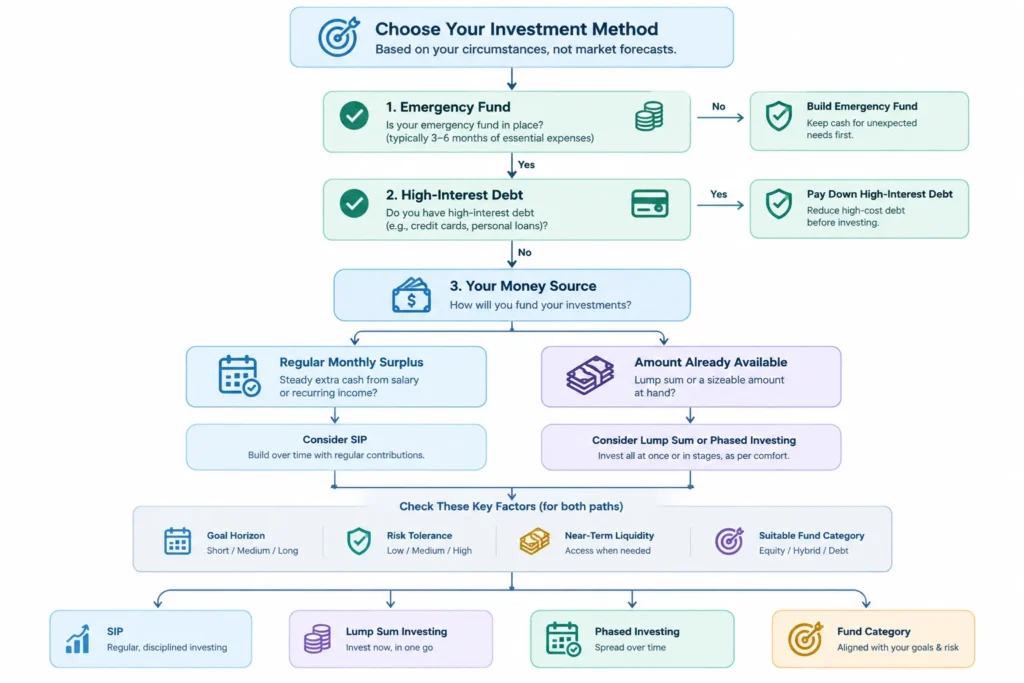
The SIP vs lump sum decision should begin with your financial position, not with a prediction about where the stock market will move next. Both methods can be useful, but they suit different cash flows, goals and comfort levels.
Build an Emergency Fund First
Before investing in volatile mutual funds, keep enough money aside for emergencies. This reserve may help with medical bills, temporary loss of income, urgent repairs or other unexpected expenses.
An emergency fund should generally be easy to access and should not depend heavily on stock market movements. The suitable amount varies by household. Someone with an uncertain income, dependants or limited insurance may need a larger safety cushion than a salaried person with stable income.
Without this reserve, you may have to redeem an equity mutual fund during a market fall. This can turn a temporary decline into an actual loss and interrupt your long-term plan.
Deal With High-Interest Debt
Review expensive debt before starting a large SIP or making a lump sum investment. Credit card balances and some personal loans can carry high interest costs. Paying such debt may be more urgent than taking market risk in the hope of earning a higher return.
This does not mean every loan must be closed before you invest. A home loan, education loan and credit card debt have different costs and purposes. Compare the interest cost, repayment terms, available tax treatment and your overall financial security before deciding.
Most importantly, do not borrow money to invest in mutual funds. Investment returns are uncertain, while loan repayments are compulsory.
Match the Method to Your Financial Goal
Write down the goal, required amount and expected date. A vague aim such as “wealth creation” is harder to plan for than a defined goal such as a child’s higher education in 12 years.
Money needed soon should not automatically be placed in an equity mutual fund. Equity markets can fall sharply and may take time to recover. If the money is meant for next year’s school fees, a home down payment in two years or an upcoming family expense, capital stability and liquidity may matter more than growth.
For long-term goals, equity-oriented funds may be considered if they match your risk tolerance. For shorter periods, lower-volatility categories may be more appropriate. Fund selection should still consider credit risk, interest-rate risk, exit conditions and taxation.
50/30/20 Budget rule applied in india
Assess Your Risk Tolerance Honestly
Risk tolerance is not simply your willingness to earn higher returns. It is your ability and willingness to handle losses without abandoning the plan.
Ask how you would react if the value of an equity investment fell soon after investing. If a large fall would cause panic, investing the entire amount at once may be emotionally difficult. A phased approach or SIP may feel more manageable, although it cannot remove market risk.
Your financial capacity also matters. A person with stable income, adequate insurance and a long investment horizon may be able to accept more volatility than someone who may need the money at short notice.
Consider the Source of the Money
A SIP usually fits regular income. For example, a salaried investor may invest a fixed amount after receiving each month’s salary. This supports discipline and aligns investing with cash flow.
A lump sum may be relevant when money is already available, such as from a matured fixed deposit, annual bonus, sale of an asset or inheritance. However, having a large amount does not mean all of it must immediately enter one mutual fund.
First separate money required for tax payments, emergencies, debt repayment and near-term goals. The remaining investable amount can then be allocated according to the financial plan. If immediate investment feels uncomfortable, the amount may be introduced gradually, but delaying investment also has an opportunity cost if markets rise.
Choose the Fund Category Carefully
The choice between SIP and lump sum is only the investment method. It does not decide whether the underlying fund is suitable.
A SIP into a high-risk sector fund remains high risk. A lump sum in a lower-volatility category has a different risk profile. Review the fund’s investment objective, asset allocation, portfolio risks, benchmark, expense ratio, exit load and suitability for your time horizon.
Diversified funds may be easier for beginners to understand than narrowly focused sector or thematic funds. However, diversification does not prevent losses, and even broad equity funds can be volatile.
Check Liquidity Requirements
Mutual fund units can often be redeemed, but access may be affected by market holidays, processing timelines, exit loads, lock-in conditions and the nature of the scheme. The amount received will also depend on the applicable net asset value and any relevant deductions.
Do not treat an equity mutual fund as a substitute for cash needed on a fixed date. Keep planned expenses and emergency requirements in suitable, accessible instruments.
Understand Taxation and Costs
Tax treatment can differ according to the mutual fund category, holding period, type of transaction and rules applicable at the time. Costs may include the scheme’s expense ratio, exit load and applicable taxes or transaction-related charges.
SIP installments are separate purchases. Therefore, their holding periods and tax calculations may be considered separately when units are redeemed. A lump sum purchase has its own acquisition date and cost.
Tax laws and mutual fund regulations can change. Current rates, category definitions and rules should be checked through official documents or with a qualified tax professional before investing or redeeming.
Common Mistakes to Avoid
- Choosing only from recent returns: A fund that performed well recently may not repeat that performance. Check the strategy, risks, consistency and suitability instead of chasing the latest winner.
- Assuming SIPs are risk-free: A SIP spreads purchases across dates, but the underlying investment can still lose value. It does not guarantee profits or protect capital.
- Investing borrowed money: Market returns are uncertain, while interest and repayment obligations continue even during a downturn.
- Stopping solely because markets fall: A fall is not automatically a reason to stop a long-term SIP. Review whether the goal, fund suitability or personal finances have changed. Do not react only to fear.
- Ignoring near-term needs: Investing money required soon in volatile equity funds may force redemption at an unfavourable time.
- Putting an entire windfall into one idea: Separate essential needs and assess diversification before investing a bonus, inheritance or asset-sale proceeds.
- Comparing returns incorrectly: A lump sum is invested from the beginning, while SIP money enters over time. Comparing only the final values ignores the timing and amount of each cash flow.
- Confusing the method with the product: SIP and lump sum describe how money is invested. The selected mutual fund determines the underlying portfolio and much of the investment risk.
Final Decision Checklist
- Do I have an adequate emergency fund?
- Have I reviewed high-interest debt?
- What is the exact goal and when will I need the money?
- Can I tolerate a temporary fall without panic-selling?
- Is the money arriving monthly, or is it already available?
- Does the fund category match my horizon and risk profile?
- Could I need this money for a near-term expense?
- Have I checked the expense ratio, exit load and redemption conditions?
- Have I verified the current tax and regulatory rules?
- Am I choosing based on a plan rather than recent market performance?
Frequently Asked Questions
Is SIP better than lump sum for beginners?
A SIP may be easier for beginners with monthly income because it encourages regular investing and avoids the need to invest a large amount at once. However, it is not automatically safer or more profitable. The fund, goal and investment horizon remain important.
Should I invest a bonus through SIP or lump sum?
First reserve money for taxes, emergencies, debt and upcoming expenses. The remaining amount may be invested at once or gradually, depending on your asset allocation, risk tolerance and time horizon. There is no single answer for every investor.
Should I stop my SIP when the market falls?
Not solely because the market has fallen. If your goal is long term, the fund remains suitable and your finances are stable, continuing may support investment discipline. Stop or modify it when your goal, cash flow, risk capacity or fund suitability changes, not merely because of short-term market fear.
Can SIP prevent losses?
No. SIPs buy units on different dates and at different prices, but they cannot eliminate market risk. The investment value may still fall, particularly in equity-oriented funds.
Can I use both SIP and lump sum?
Yes. An investor may use SIPs for regular salary-based contributions and lump sum investments for occasional surplus money. Both should support the same financial plan and appropriate asset allocation.
Summary
Neither SIP nor lump sum investing is universally superior. SIPs generally suit regular cash flows and investors who prefer a disciplined, gradual approach. Lump sum investing may suit money that is already available and can remain invested for an appropriate period.
Before choosing, secure emergency savings, review expensive debt, define the goal, assess risk tolerance and match the mutual fund category to the investment horizon. Keep near-term expense money away from unnecessary volatility, and do not base the decision only on recent returns or market predictions.
Mutual fund investments are subject to market risks. This article is for education and does not provide personalised investment, tax or legal advice. Read the scheme documents carefully and consider consulting a qualified adviser for decisions based on your circumstances.




Comments