
What Is a High-Net-Worth Individual (HNI)? Meaning, Criteria and Planning

A beginner-friendly guide to the meaning of HNI in India, net-worth calculation, wealth categories and the main planning considerations for managing substantial wealth.

What Is a High-Net-Worth Individual (HNI)? Meaning, Criteria and Planning

A high-net-worth individual in India is generally a person who has substantial wealth or investible assets. However, there is no single wealth threshold that makes someone an HNI in every situation. A bank, wealth manager, investment product or regulatory rule may use its own definition for a specific purpose.

Net worth is calculated by subtracting total liabilities from total assets. For example, if your assets are worth ₹4 crore and your outstanding loans are ₹1 crore, your net worth is ₹3 crore. Some financial institutions may ignore assets such as your self-occupied home and look mainly at liquid or investible assets.

Introduction

You may see the term HNI in private banking brochures, investment applications, business news and discussions about wealth management. It is short for “high-net-worth individual.” The label usually indicates that a person has accumulated significant financial resources and may require more specialised financial services.

Being called an HNI is not the same as receiving a permanent legal status. It also does not automatically mean that a person is financially secure. Someone may own valuable property but have limited cash, large loans or irregular income. Another person may have fewer physical assets but hold a large, diversified investment portfolio.

This is why the context matters. A bank may classify customers based on the assets they maintain with that bank. A wealth manager may focus on investible wealth. An investment offer may use a minimum application amount. A rule issued by a regulator may define a category only for that particular transaction, product or reporting requirement.

Before accepting any HNI threshold, check who has issued it, what assets it includes and why the classification is being used. Numerical limits can differ between institutions and may change over time.

HNI Meaning, Indian Context and Net-Worth Calculation

What Does High-Net-Worth Individual Mean?

In general financial language, a high-net-worth individual is a person with substantial wealth. That wealth may include bank balances, investments, property, business ownership and other valuable assets, after accounting for debt.

The term is commonly used by banks, portfolio managers, brokers, insurers, family offices and other financial service providers. Such institutions may offer HNI clients services such as dedicated relationship management, customised investment planning, estate planning support or access to products with higher minimum investment requirements.

These services are not automatically better or suitable for everyone. They may involve higher fees, complicated products, concentration risk or longer lock-in periods. The HNI label should therefore not replace normal checks on cost, risk, liquidity and suitability.

Is There an Official HNI Definition in India?

India does not have one universal HNI threshold that applies to every financial situation. The meaning depends on where and why the term is being used.

It helps to separate two types of definition:

  • General industry terminology: Banks and wealth-management firms may create internal customer categories based on total relationship value, investible assets, income or assets managed by that institution.
  • Definitions for a specific purpose: A regulator, exchange, tax provision or financial product may define an investor category for a particular transaction, application process or compliance rule.

An official definition issued for one purpose should not automatically be applied elsewhere. For example, an investor category used in a particular market process may depend on the application amount rather than the person’s complete household net worth. Similarly, qualifying for premium banking at one institution does not prove that the customer meets another institution’s wealth criteria.

Any current numerical threshold should be checked against the latest document from the relevant bank, institution, product provider or regulator. Avoid relying only on an old article, a sales presentation or a threshold quoted without context.

Affluent, HNI and Ultra-HNI: What Is the Difference?

Financial institutions often divide wealthy clients into broad groups. Common labels include affluent, high-net-worth individual and ultra-high-net-worth individual. These terms describe increasing levels of wealth, but they are not universal legal grades.

Common label General meaning Important limitation
Affluent individual A person with income or assets above the ordinary retail customer range The institution may use salary, deposits, investments or total relationship value
High-net-worth individual A person with substantial wealth or investible assets The qualifying amount and assets counted can vary
Ultra-high-net-worth individual A person at a much higher wealth level who may need complex planning There is no single universal boundary separating HNIs from ultra-HNIs

These labels may influence the kind of service offered. An affluent customer might receive premium banking benefits, while an HNI may be offered portfolio management or customised advisory services. An ultra-HNI may require planning across businesses, trusts, succession, philanthropy and several countries.

Still, the label itself does not reveal a person’s cash flow, financial discipline or investment knowledge. A high salary does not necessarily create a high net worth. Likewise, a retired person with modest monthly income may have substantial accumulated assets.

You May Also Like:Portfolio Diversification Explained: Benefits, Asset Allocation and Common Mistakes

How to Calculate Net Worth

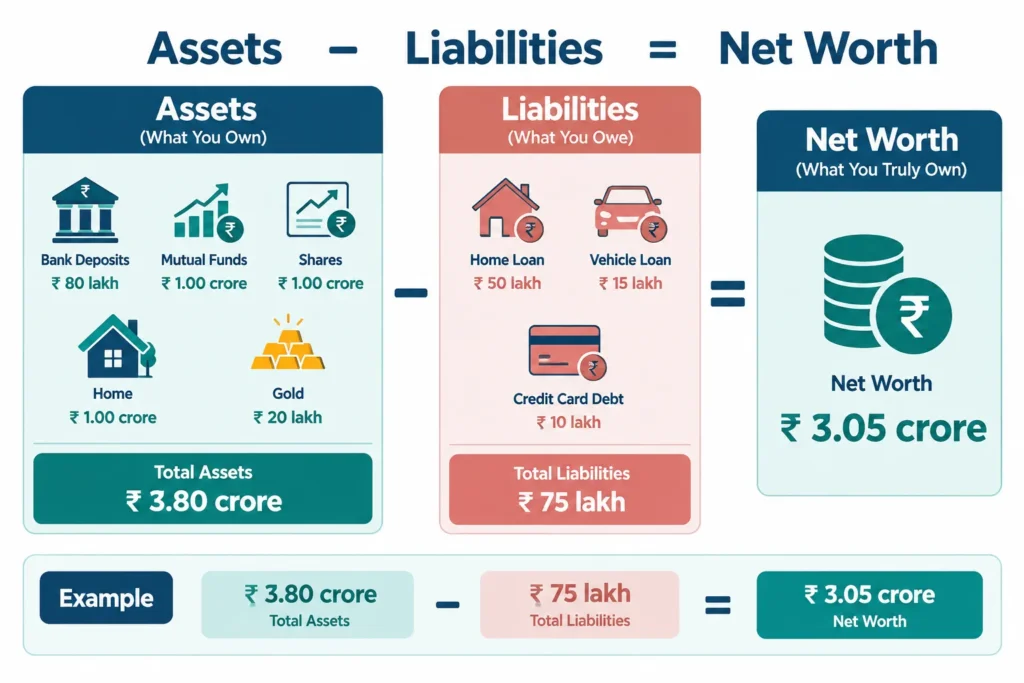
Infographic showing assets of ₹3.80 crore minus liabilities of ₹75 lakh resulting in net worth of ₹3.05 crore.

Your net worth is the value of everything you own minus everything you owe.

Net worth = Total assets − Total liabilities

Assets are items with financial value. Liabilities are debts and payment obligations. For a personal net-worth calculation, common items include:

  • Assets: Bank deposits, mutual funds, shares, bonds, retirement savings, property, gold and ownership in a business.
  • Liabilities: Home loans, vehicle loans, personal loans, education loans, credit card balances and other outstanding debt.

Use realistic current values where possible. Do not simply use the original purchase price of a house, share or gold item. Property and unlisted business interests can be difficult to value, so a reasonable estimate may be needed. Avoid counting the same asset twice, such as including mutual funds separately and again as part of a portfolio total.

Simple Net-Worth Example

Consider Neha, a fictional professional living in Pune. She owns a home, keeps money in bank deposits and has built an investment portfolio. She also has an outstanding home loan and a small vehicle loan.

Item Value
Current estimated value of home ₹2.40 crore
Bank deposits ₹20 lakh
Mutual funds, shares and bonds ₹90 lakh
Retirement savings and other financial assets ₹30 lakh
Total assets ₹3.80 crore
Outstanding home loan ₹70 lakh
Vehicle loan and other debt ₹5 lakh
Total liabilities ₹75 lakh
Net worth ₹3.05 crore

Neha’s net worth is ₹3.05 crore because her assets of ₹3.80 crore are reduced by liabilities of ₹75 lakh. This calculation describes her overall financial position, but it does not automatically establish that she is an HNI under every bank or investment rule.

Total Net Worth Is Not the Same as Investible Wealth

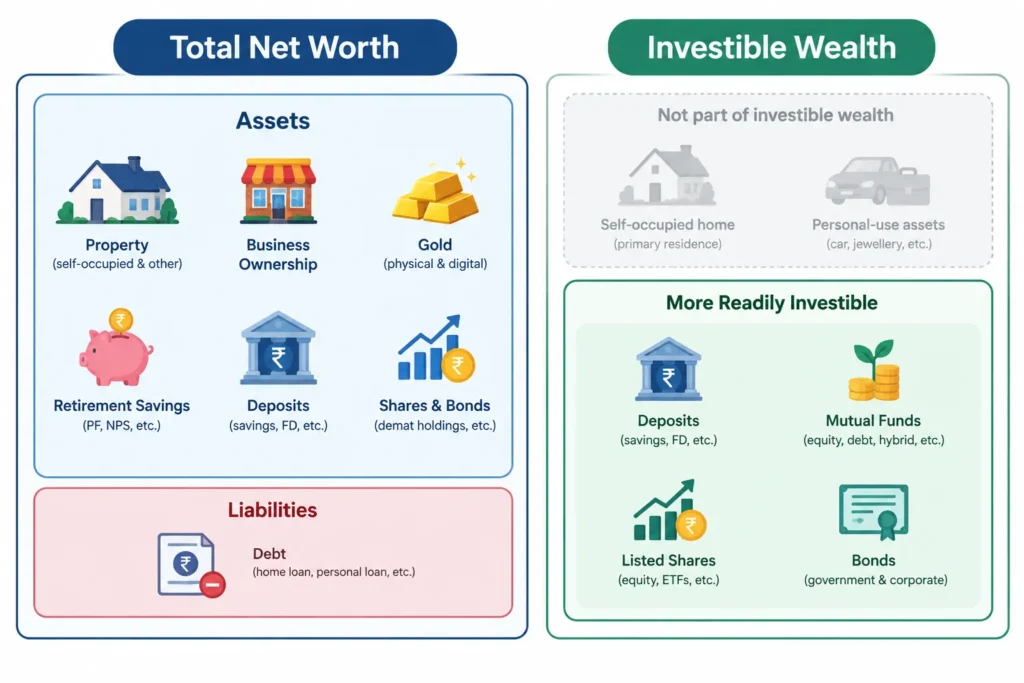
Comparison showing that total net worth can include property and other assets, while investible wealth focuses on accessible financial assets.

Some institutions focus on investible or liquid assets instead of total net worth. Investible assets generally refer to money and investments that can be allocated to financial products. These may include deposits, mutual funds, listed shares and bonds.

A self-occupied home may be included in total net worth because it has value. However, it is not usually available for investment unless it is sold, rented, mortgaged or otherwise monetised. Personal jewellery, vehicles and household possessions may also be excluded when an institution calculates investible wealth.

In Neha’s example, her total net worth includes her home. Her investible wealth would be lower if the institution excluded that property and counted only eligible financial assets. It might fall further if retirement accounts, locked investments or emergency savings were not considered available for investment.

Therefore, when someone is described as a high-net-worth individual in India, ask whether the figure refers to total net worth, liquid net worth, investible assets or assets held with a particular institution. That distinction provides a more accurate picture than the HNI label alone.

Financial Planning and Investment Considerations for HNIs in India

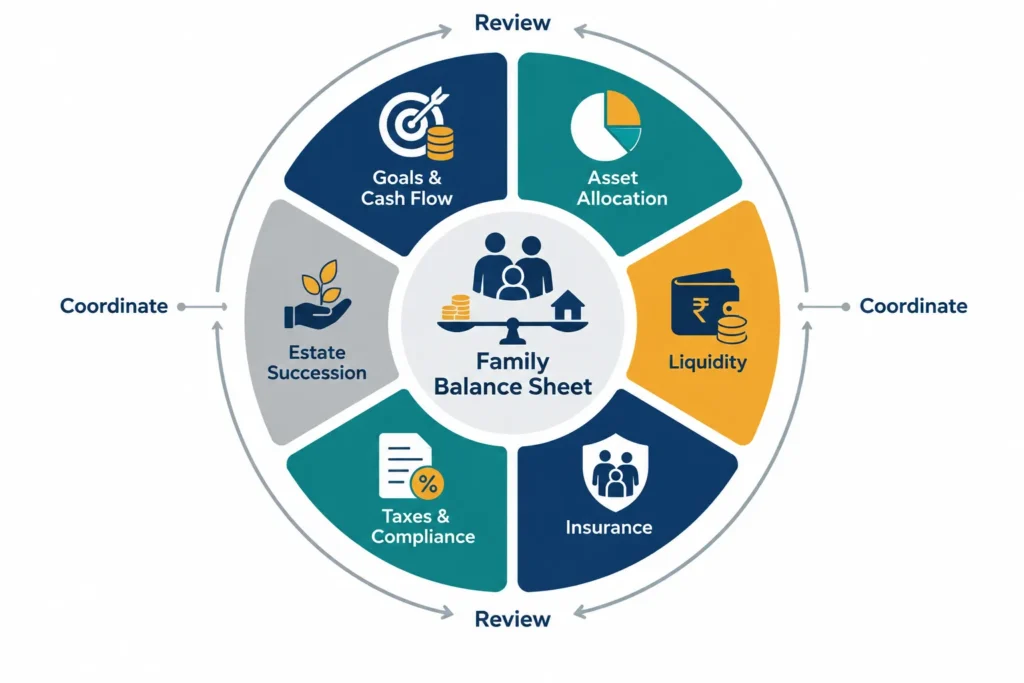
Financial planning framework connecting goals, asset allocation, liquidity, insurance, taxes and succession for an HNI in India.

Financial planning for a high-net-worth individual in India is not based on a completely different set of rules. The basic principles remain familiar: spend carefully, maintain liquidity, manage risk, invest according to goals, pay taxes correctly and plan for dependants.

What changes is the level of complexity. An HNI may own a business, several properties, shares in an employer, investments across countries or assets held through different family members and legal structures. A mistake in one area can affect a much larger part of the family’s wealth.

Therefore, HNI planning should focus not only on earning higher returns but also on protecting wealth, keeping it accessible when needed and transferring it efficiently.

Start With Goals, Cash Flows and Time Horizons

Before selecting investments, an HNI should map major financial goals and expected cash flows. These may include children’s education, buying a home, funding a new business, supporting parents, retirement, charitable giving or passing wealth to the next generation.

Each goal needs a time horizon. Money required within two years should generally not face the same investment risk as money intended for retirement after 20 years.

Cash-flow planning can be more complicated when income is irregular. For example, a business owner may receive a modest monthly salary but a large annual dividend. A senior executive may receive bonuses or employee shares. A landlord may have substantial assets but uneven rental income and high property expenses.

A practical plan should answer questions such as:

  • How much does the family spend each month and each year?
  • Which large payments are expected over the next few years?
  • How much income is predictable, and how much is variable?
  • Which assets can be sold quickly without a major loss or penalty?
  • Which goals must be funded even if business income falls?

This exercise helps separate visible wealth from usable wealth. A person may have a high net worth on paper but still face difficulty meeting expenses if most assets are locked in property or a private business.

Understand Risk Capacity and Risk Tolerance

Risk capacity and risk tolerance are related, but they are not the same.

Risk capacity is the financial ability to absorb a loss. Someone with stable income, limited debt and long-term goals may have a high capacity for investment risk.

Risk tolerance is the emotional willingness to accept market fluctuations. A wealthy investor may have the capacity to take risk but still feel uncomfortable when the portfolio falls sharply.

Both should influence investment decisions. High net worth does not automatically justify an aggressive portfolio. An HNI approaching retirement, funding a near-term property purchase or depending on investments for regular living expenses may need a more conservative allocation.

Time horizon also matters. Short-term needs usually require greater stability and liquidity. Long-term goals may allow measured exposure to assets that fluctuate more but may offer growth potential.

You May Also Like:When Should You Start Investing in Mutual Funds? A Beginner’s Guide

Use Asset Allocation as the Foundation

Asset allocation means dividing money among suitable asset classes rather than depending on one investment. Depending on goals and circumstances, these may include equity, fixed-income investments, cash or cash equivalents, property, gold and business interests.

The appropriate mix will differ from one person to another. It should reflect financial goals, tax position, liquidity needs, existing assets and comfort with risk. It should not be based only on recent returns or market trends.

Mutual funds, SIPs and direct securities may form part of an HNI portfolio, but they are only tools. A SIP can support disciplined investing, while mutual funds can provide professional management and diversification. Neither removes market risk or replaces the need for an overall asset-allocation plan.

Portfolio allocation should also be reviewed periodically. Strong performance in one asset class can cause it to become a much larger share of total wealth than originally intended. Rebalancing may restore the planned risk level, although taxes, exit costs and liquidity conditions should be considered before making changes.

Watch for Concentration Risk

Many HNIs become wealthy through concentration. A founder may hold most wealth in one company. An executive may accumulate employer shares. A family may own several properties in the same city. While such assets can create wealth, they can also expose the family to a single source of risk.

Common concentration risks include:

  • A large stake in the family business
  • Employer shares linked to the same company that provides salary
  • Several properties in one location or market segment
  • Heavy exposure to one industry
  • Loans or guarantees connected to a business
  • Investments that cannot be sold easily

Consider an executive whose salary, annual bonus and investment portfolio all depend on the same listed company. If the company performs poorly, income and wealth may fall at the same time.

Diversification can reduce this dependence, but selling a concentrated holding may involve tax, legal, contractual or market considerations. The process may need to happen gradually and with professional advice.

Maintain Adequate Liquidity

Liquidity is the ability to access money when required without being forced to sell an asset at an unfavourable price. Even an HNI needs an emergency reserve.

The right liquidity level depends on family expenses, stability of income, debt obligations and upcoming commitments. Business owners and people with irregular income may need a larger buffer than salaried individuals with predictable cash flows.

Liquidity planning should cover more than routine emergencies. It may also include tax payments, business capital requirements, medical costs, property maintenance, school fees and loan repayments.

Too little liquidity can lead to distress sales or expensive borrowing. However, keeping an excessive amount in low-return cash for many years may reduce the portfolio’s ability to meet long-term goals. The aim is an appropriate balance, not the largest possible cash balance.

Review Insurance Separately From Investments

Wealth does not remove every financial risk. Insurance can still protect the family from events that would otherwise require a large and sudden outflow.

An HNI insurance review may cover health insurance, life insurance, disability or personal accident protection, property cover, motor insurance and liability risks. Business owners may also need policies connected with key employees, operations or business assets.

Life insurance needs should be based on financial dependence, liabilities and future goals rather than income alone. A person with enough liquid and diversified assets to support all dependants may require less life cover than someone whose wealth is tied up in a business or property.

Policy exclusions, deductibles, waiting periods, sub-limits and claim conditions deserve close attention. Insurance should be reviewed when family responsibilities, assets, debts or business risks change.

Plan for Taxes and Compliance

HNIs may face more detailed tax and reporting requirements because they have multiple income sources or complex assets. Relevant items can include salary, business income, dividends, interest, rent, capital gains, foreign assets, gifts and inherited property.

Tax planning should be lawful and documented. It should not be confused with hiding income or using arrangements that lack a genuine purpose. Records of purchase costs, property improvements, investment transactions, gifts, loans and overseas holdings may be important when returns are prepared or assessments arise.

Investment decisions should not be driven by tax benefits alone. An unsuitable or risky product does not become appropriate merely because it offers a deduction or a favourable tax treatment.

Indian tax rules, disclosure requirements and product regulations can change. Cross-border income and residency questions may be especially complex. Current treatment should be checked using credible official information and advice from a qualified chartered accountant, tax adviser or other relevant professional.

Include Estate and Succession Planning

Estate planning explains how assets and responsibilities should be handled after death or incapacity. It is particularly important when wealth includes a family business, jointly owned property, assets in several states or countries, or family members with different needs.

A clear, legally valid will is often a starting point. Nominations should also be reviewed across bank accounts, demat accounts, mutual funds, insurance policies and other financial holdings. However, a nomination and legal ownership after death may not always mean the same thing. The position depends on the asset and applicable law.

Families should maintain an organised asset list containing ownership details, liabilities, important documents and professional contacts. Secure access arrangements for digital records should also be considered. This reduces confusion for family members during an emergency.

Business succession requires separate attention. The founder may need to decide who will manage the company, who will own it and how family members who are not involved in the business will be treated. Trusts, family arrangements, shareholder agreements or other structures may sometimes help, but they should not be created without suitable legal and tax advice.

Coordinate the Entire Financial Plan

An HNI may work with an investment adviser, chartered accountant, lawyer, insurance professional and estate-planning specialist. Their recommendations should fit together. For example, an investment sale may affect taxes, liquidity, business control and succession plans at the same time.

Fees and conflicts of interest should be understood before accepting advice. Ask whether the professional is paid directly by the client, receives product commissions or has another commercial interest in the recommendation.

The broader principles of budgeting, emergency planning, debt management and goal-based investing remain relevant. These foundations are explained in The Ultimate Personal Finance Guide for Beginners in India. For an HNI, the main task is to apply those principles across a larger and often more interconnected financial life.

A strong plan should be reviewed after major events such as marriage, inheritance, sale of a business, retirement, relocation or a significant change in tax residency. Regular review helps ensure that investments, insurance, taxes, liquidity and succession arrangements continue to support the family’s actual goals.

You May Also Like:Portfolio Management: How to Build and Manage an Investment Portfolio

Common Mistakes HNIs and Wealth Builders Should Avoid

Building a high net worth is only one part of financial success. Protecting that wealth, keeping enough cash available and transferring assets smoothly are equally important. A high-net-worth individual in India can still face financial stress if the overall plan has weak spots.

Concentrating Wealth in One Asset

Many Indian families hold a large share of their wealth in one type of asset. This may be property, family-business shares, employer stock or gold. Such assets may have created substantial wealth, but excessive concentration also creates risk.

For example, a business owner may have a high net worth on paper because the business is valuable. However, selling part of that business quickly may be difficult. Similarly, several properties can increase net worth while producing limited cash flow.

Diversification does not mean selling everything at once. It means gradually spreading money across suitable assets so that one business, property or market event does not control the family’s entire financial future.

Keeping Too Little Liquidity

Net worth and available cash are not the same. A person may own valuable land, property or unlisted shares but still struggle to meet an urgent expense.

Maintain an emergency reserve in instruments that are easy to access. The appropriate amount depends on household expenses, income stability, health needs and business obligations. A salaried household with stable income may have different liquidity needs from an entrepreneur with irregular cash flows.

Planned near-term expenses should also remain separate from long-term investments. Money required soon for tax payments, education fees, a home purchase or business commitments should not depend entirely on volatile assets.

Using Excessive Leverage

Borrowing can help purchase a home, expand a business or acquire an income-producing asset. However, too much debt can turn an asset-rich balance sheet into a fragile one.

Interest costs, repayment dates and changes in income must be considered before taking a large loan. Special care is needed when borrowing against property, shares or investments. If the asset value falls or the lender asks for additional security, the borrower may have to sell assets at an unsuitable time.

Review expensive debt first. Also check whether loan repayments remain manageable if business income, rent or salary declines temporarily.

Overlooking Insurance Gaps

Investments are not a substitute for insurance. A family may have substantial assets but still face disruption after hospitalisation, disability, death or damage to important property.

Review health insurance for all family members, including parents where relevant. Earning members should assess whether life insurance is needed to support dependants and repay major liabilities. Business owners may also need cover linked to key people, assets or business responsibilities.

Insurance requirements should be based on actual risks and obligations, not on HNI labels. Policy terms, exclusions, deductibles and claim conditions deserve careful attention.

Delaying Nominations, Wills and Succession Planning

As the number and value of assets grow, incomplete records and unclear succession instructions can create serious problems. Families may not know about every bank account, investment, property document, insurance policy or loan.

Add or update nominations wherever the facility is available. However, a nomination and a will do not necessarily serve the same legal purpose. A properly drafted will can state how assets should be distributed, subject to applicable succession laws.

Business owners should also think about management succession. Ownership may pass to heirs, but the business still needs people who can operate it. Complex estates, family businesses, trusts or cross-border assets may require advice from qualified legal, tax and financial professionals.

Long-Term Wealth Checklist

You do not need to be an HNI before using disciplined wealth-management practices. The following checklist can help beginners build and protect wealth over time.

  1. Calculate your current net worth. Add the present value of your assets and subtract all outstanding liabilities. Use reasonable values rather than optimistic estimates.
  2. Prepare a complete asset and liability list. Record bank balances, investments, retirement accounts, property, business interests, gold and other meaningful assets. List home loans, personal loans, credit card balances and other obligations separately.
  3. Create an emergency reserve. Keep enough accessible money for essential household expenses and foreseeable emergencies. Adjust the reserve for income stability, dependants and medical needs.
  4. Manage expensive debt. Prioritise loans with high interest costs while maintaining essential savings and insurance. Avoid repeatedly carrying unpaid credit card balances.
  5. Diversify gradually. Reduce excessive dependence on one company, property, business sector or asset class. Consider taxes, liquidity and exit restrictions before making major changes.
  6. Match investments to time horizons. Money required in the near future generally needs greater stability and accessibility. Long-term goals may allow a measured allocation to growth assets, depending on risk capacity.
  7. Review insurance protection. Check health, life, property and relevant business covers. Confirm that policy details, nominees and contact information are current.
  8. Maintain organised records. Keep account details, policy documents, loan records, property papers and tax documents secure. Ensure a trusted family member knows how to locate essential information.
  9. Plan succession. Update nominations and consider making a valid will. Obtain professional advice where family arrangements, business ownership or legal issues are complex.
  10. Review the plan periodically. Revisit net worth, asset allocation, debt, insurance and succession arrangements after major life or financial changes.
You May Also Like:5 Common Financial Traps to Avoid in India

This exercise is most useful when done consistently. A yearly review may be sufficient for a straightforward household, while business owners or people with complex portfolios may need more frequent checks. The purpose is not to react to every market movement. It is to keep the plan aligned with goals, responsibilities and changing circumstances.

Conclusion

The meaning of HNI depends on the context in which the term is used. Banks, wealth managers, investment products and other institutions may apply different criteria. Some focus on total net worth, while others consider investible assets, income, relationship value or the size of a particular investment.

Therefore, being described as a high-net-worth individual in India is not a universal legal certificate of wealth. It also does not automatically mean that a person is financially secure. Wealth may be concentrated, illiquid, heavily financed by debt or unsupported by adequate insurance and succession planning.

A stronger measure of financial well-being is whether assets can support goals, liabilities are manageable, risks are controlled and family arrangements are clear. Regularly tracking net worth and following a practical long-term plan can be valuable at every wealth level.

Frequently Asked Questions

What does HNI mean in India?

HNI stands for high-net-worth individual. In India, the term is commonly used by banks, wealth managers and investment providers for people with substantial wealth, investible assets or investment capacity. The exact meaning depends on the institution and purpose.

Is there a fixed HNI threshold in India?

There is no single threshold that applies in every situation. A bank may use one eligibility level for premium services, while an investment category or wealth manager may use another. Always check the definition given in the relevant product, offer document or service agreement.

How is net worth calculated?

Net worth is calculated by subtracting total liabilities from the current value of total assets.

Net worth = Total assets − Total liabilities

Assets may include cash, investments, property, gold and business interests. Liabilities may include home loans, personal loans, unpaid credit card balances and other debts. Asset values should be realistic, and outstanding loan amounts should be current.

Is a primary residence included in net worth?

A primary residence is generally included when calculating total personal net worth, with the outstanding home loan deducted as a liability. However, an institution calculating investible assets may exclude the home because it is used by the family and is not readily available for investment.

What is the difference between net worth and investible assets?

Net worth includes the value of all assets after subtracting liabilities. Investible assets generally refer to financial resources that can be invested relatively easily. They may exclude a primary home, personal-use assets, locked-in holdings or ownership interests that cannot be readily sold. Definitions can vary between institutions.

Does HNI status guarantee financial security?

No. HNI status does not guarantee stable income, sufficient liquidity or protection from financial loss. Security depends on factors such as diversification, debt levels, cash reserves, insurance, spending needs, tax planning and succession arrangements. A person can have a high net worth on paper and still face cash-flow or risk-management problems.

Share this article
KEEP READING

Related Articles

View all →

Comments

Leave a Comment

What Is a High-Net-Worth Individual (HNI)? Meaning, Criteria and Planning

A high-net-worth individual in India is generally a person who has substantial wealth or investible assets. However, there is no single wealth threshold that makes someone an HNI in every situation. A bank, wealth manager, investment product or regulatory rule may use its own definition for a specific purpose.

Net worth is calculated by subtracting total liabilities from total assets. For example, if your assets are worth ₹4 crore and your outstanding loans are ₹1 crore, your net worth is ₹3 crore. Some financial institutions may ignore assets such as your self-occupied home and look mainly at liquid or investible assets.

Introduction

You may see the term HNI in private banking brochures, investment applications, business news and discussions about wealth management. It is short for “high-net-worth individual.” The label usually indicates that a person has accumulated significant financial resources and may require more specialised financial services.

Being called an HNI is not the same as receiving a permanent legal status. It also does not automatically mean that a person is financially secure. Someone may own valuable property but have limited cash, large loans or irregular income. Another person may have fewer physical assets but hold a large, diversified investment portfolio.

This is why the context matters. A bank may classify customers based on the assets they maintain with that bank. A wealth manager may focus on investible wealth. An investment offer may use a minimum application amount. A rule issued by a regulator may define a category only for that particular transaction, product or reporting requirement.

Before accepting any HNI threshold, check who has issued it, what assets it includes and why the classification is being used. Numerical limits can differ between institutions and may change over time.

HNI Meaning, Indian Context and Net-Worth Calculation

What Does High-Net-Worth Individual Mean?

In general financial language, a high-net-worth individual is a person with substantial wealth. That wealth may include bank balances, investments, property, business ownership and other valuable assets, after accounting for debt.

The term is commonly used by banks, portfolio managers, brokers, insurers, family offices and other financial service providers. Such institutions may offer HNI clients services such as dedicated relationship management, customised investment planning, estate planning support or access to products with higher minimum investment requirements.

These services are not automatically better or suitable for everyone. They may involve higher fees, complicated products, concentration risk or longer lock-in periods. The HNI label should therefore not replace normal checks on cost, risk, liquidity and suitability.

Is There an Official HNI Definition in India?

India does not have one universal HNI threshold that applies to every financial situation. The meaning depends on where and why the term is being used.

It helps to separate two types of definition:

  • General industry terminology: Banks and wealth-management firms may create internal customer categories based on total relationship value, investible assets, income or assets managed by that institution.
  • Definitions for a specific purpose: A regulator, exchange, tax provision or financial product may define an investor category for a particular transaction, application process or compliance rule.

An official definition issued for one purpose should not automatically be applied elsewhere. For example, an investor category used in a particular market process may depend on the application amount rather than the person’s complete household net worth. Similarly, qualifying for premium banking at one institution does not prove that the customer meets another institution’s wealth criteria.

Any current numerical threshold should be checked against the latest document from the relevant bank, institution, product provider or regulator. Avoid relying only on an old article, a sales presentation or a threshold quoted without context.

Affluent, HNI and Ultra-HNI: What Is the Difference?

Financial institutions often divide wealthy clients into broad groups. Common labels include affluent, high-net-worth individual and ultra-high-net-worth individual. These terms describe increasing levels of wealth, but they are not universal legal grades.

Common label General meaning Important limitation
Affluent individual A person with income or assets above the ordinary retail customer range The institution may use salary, deposits, investments or total relationship value
High-net-worth individual A person with substantial wealth or investible assets The qualifying amount and assets counted can vary
Ultra-high-net-worth individual A person at a much higher wealth level who may need complex planning There is no single universal boundary separating HNIs from ultra-HNIs

These labels may influence the kind of service offered. An affluent customer might receive premium banking benefits, while an HNI may be offered portfolio management or customised advisory services. An ultra-HNI may require planning across businesses, trusts, succession, philanthropy and several countries.

Still, the label itself does not reveal a person’s cash flow, financial discipline or investment knowledge. A high salary does not necessarily create a high net worth. Likewise, a retired person with modest monthly income may have substantial accumulated assets.

How to Calculate Net Worth
Infographic showing assets of ₹3.80 crore minus liabilities of ₹75 lakh resulting in net worth of ₹3.05 crore.

Your net worth is the value of everything you own minus everything you owe.

Net worth = Total assets − Total liabilities

Assets are items with financial value. Liabilities are debts and payment obligations. For a personal net-worth calculation, common items include:

  • Assets: Bank deposits, mutual funds, shares, bonds, retirement savings, property, gold and ownership in a business.
  • Liabilities: Home loans, vehicle loans, personal loans, education loans, credit card balances and other outstanding debt.

Use realistic current values where possible. Do not simply use the original purchase price of a house, share or gold item. Property and unlisted business interests can be difficult to value, so a reasonable estimate may be needed. Avoid counting the same asset twice, such as including mutual funds separately and again as part of a portfolio total.

Simple Net-Worth Example

Consider Neha, a fictional professional living in Pune. She owns a home, keeps money in bank deposits and has built an investment portfolio. She also has an outstanding home loan and a small vehicle loan.

Item Value
Current estimated value of home ₹2.40 crore
Bank deposits ₹20 lakh
Mutual funds, shares and bonds ₹90 lakh
Retirement savings and other financial assets ₹30 lakh
Total assets ₹3.80 crore
Outstanding home loan ₹70 lakh
Vehicle loan and other debt ₹5 lakh
Total liabilities ₹75 lakh
Net worth ₹3.05 crore

Neha’s net worth is ₹3.05 crore because her assets of ₹3.80 crore are reduced by liabilities of ₹75 lakh. This calculation describes her overall financial position, but it does not automatically establish that she is an HNI under every bank or investment rule.

Total Net Worth Is Not the Same as Investible Wealth
Comparison showing that total net worth can include property and other assets, while investible wealth focuses on accessible financial assets.

Some institutions focus on investible or liquid assets instead of total net worth. Investible assets generally refer to money and investments that can be allocated to financial products. These may include deposits, mutual funds, listed shares and bonds.

A self-occupied home may be included in total net worth because it has value. However, it is not usually available for investment unless it is sold, rented, mortgaged or otherwise monetised. Personal jewellery, vehicles and household possessions may also be excluded when an institution calculates investible wealth.

In Neha’s example, her total net worth includes her home. Her investible wealth would be lower if the institution excluded that property and counted only eligible financial assets. It might fall further if retirement accounts, locked investments or emergency savings were not considered available for investment.

Therefore, when someone is described as a high-net-worth individual in India, ask whether the figure refers to total net worth, liquid net worth, investible assets or assets held with a particular institution. That distinction provides a more accurate picture than the HNI label alone.

Financial Planning and Investment Considerations for HNIs in India
Financial planning framework connecting goals, asset allocation, liquidity, insurance, taxes and succession for an HNI in India.

Financial planning for a high-net-worth individual in India is not based on a completely different set of rules. The basic principles remain familiar: spend carefully, maintain liquidity, manage risk, invest according to goals, pay taxes correctly and plan for dependants.

What changes is the level of complexity. An HNI may own a business, several properties, shares in an employer, investments across countries or assets held through different family members and legal structures. A mistake in one area can affect a much larger part of the family’s wealth.

Therefore, HNI planning should focus not only on earning higher returns but also on protecting wealth, keeping it accessible when needed and transferring it efficiently.

Start With Goals, Cash Flows and Time Horizons

Before selecting investments, an HNI should map major financial goals and expected cash flows. These may include children’s education, buying a home, funding a new business, supporting parents, retirement, charitable giving or passing wealth to the next generation.

Each goal needs a time horizon. Money required within two years should generally not face the same investment risk as money intended for retirement after 20 years.

Cash-flow planning can be more complicated when income is irregular. For example, a business owner may receive a modest monthly salary but a large annual dividend. A senior executive may receive bonuses or employee shares. A landlord may have substantial assets but uneven rental income and high property expenses.

A practical plan should answer questions such as:

  • How much does the family spend each month and each year?
  • Which large payments are expected over the next few years?
  • How much income is predictable, and how much is variable?
  • Which assets can be sold quickly without a major loss or penalty?
  • Which goals must be funded even if business income falls?

This exercise helps separate visible wealth from usable wealth. A person may have a high net worth on paper but still face difficulty meeting expenses if most assets are locked in property or a private business.

Understand Risk Capacity and Risk Tolerance

Risk capacity and risk tolerance are related, but they are not the same.

Risk capacity is the financial ability to absorb a loss. Someone with stable income, limited debt and long-term goals may have a high capacity for investment risk.

Risk tolerance is the emotional willingness to accept market fluctuations. A wealthy investor may have the capacity to take risk but still feel uncomfortable when the portfolio falls sharply.

Both should influence investment decisions. High net worth does not automatically justify an aggressive portfolio. An HNI approaching retirement, funding a near-term property purchase or depending on investments for regular living expenses may need a more conservative allocation.

Time horizon also matters. Short-term needs usually require greater stability and liquidity. Long-term goals may allow measured exposure to assets that fluctuate more but may offer growth potential.

Use Asset Allocation as the Foundation

Asset allocation means dividing money among suitable asset classes rather than depending on one investment. Depending on goals and circumstances, these may include equity, fixed-income investments, cash or cash equivalents, property, gold and business interests.

The appropriate mix will differ from one person to another. It should reflect financial goals, tax position, liquidity needs, existing assets and comfort with risk. It should not be based only on recent returns or market trends.

Mutual funds, SIPs and direct securities may form part of an HNI portfolio, but they are only tools. A SIP can support disciplined investing, while mutual funds can provide professional management and diversification. Neither removes market risk or replaces the need for an overall asset-allocation plan.

Portfolio allocation should also be reviewed periodically. Strong performance in one asset class can cause it to become a much larger share of total wealth than originally intended. Rebalancing may restore the planned risk level, although taxes, exit costs and liquidity conditions should be considered before making changes.

Watch for Concentration Risk

Many HNIs become wealthy through concentration. A founder may hold most wealth in one company. An executive may accumulate employer shares. A family may own several properties in the same city. While such assets can create wealth, they can also expose the family to a single source of risk.

Common concentration risks include:

  • A large stake in the family business
  • Employer shares linked to the same company that provides salary
  • Several properties in one location or market segment
  • Heavy exposure to one industry
  • Loans or guarantees connected to a business
  • Investments that cannot be sold easily

Consider an executive whose salary, annual bonus and investment portfolio all depend on the same listed company. If the company performs poorly, income and wealth may fall at the same time.

Diversification can reduce this dependence, but selling a concentrated holding may involve tax, legal, contractual or market considerations. The process may need to happen gradually and with professional advice.

Maintain Adequate Liquidity

Liquidity is the ability to access money when required without being forced to sell an asset at an unfavourable price. Even an HNI needs an emergency reserve.

The right liquidity level depends on family expenses, stability of income, debt obligations and upcoming commitments. Business owners and people with irregular income may need a larger buffer than salaried individuals with predictable cash flows.

Liquidity planning should cover more than routine emergencies. It may also include tax payments, business capital requirements, medical costs, property maintenance, school fees and loan repayments.

Too little liquidity can lead to distress sales or expensive borrowing. However, keeping an excessive amount in low-return cash for many years may reduce the portfolio’s ability to meet long-term goals. The aim is an appropriate balance, not the largest possible cash balance.

Review Insurance Separately From Investments

Wealth does not remove every financial risk. Insurance can still protect the family from events that would otherwise require a large and sudden outflow.

An HNI insurance review may cover health insurance, life insurance, disability or personal accident protection, property cover, motor insurance and liability risks. Business owners may also need policies connected with key employees, operations or business assets.

Life insurance needs should be based on financial dependence, liabilities and future goals rather than income alone. A person with enough liquid and diversified assets to support all dependants may require less life cover than someone whose wealth is tied up in a business or property.

Policy exclusions, deductibles, waiting periods, sub-limits and claim conditions deserve close attention. Insurance should be reviewed when family responsibilities, assets, debts or business risks change.

Plan for Taxes and Compliance

HNIs may face more detailed tax and reporting requirements because they have multiple income sources or complex assets. Relevant items can include salary, business income, dividends, interest, rent, capital gains, foreign assets, gifts and inherited property.

Tax planning should be lawful and documented. It should not be confused with hiding income or using arrangements that lack a genuine purpose. Records of purchase costs, property improvements, investment transactions, gifts, loans and overseas holdings may be important when returns are prepared or assessments arise.

Investment decisions should not be driven by tax benefits alone. An unsuitable or risky product does not become appropriate merely because it offers a deduction or a favourable tax treatment.

Indian tax rules, disclosure requirements and product regulations can change. Cross-border income and residency questions may be especially complex. Current treatment should be checked using credible official information and advice from a qualified chartered accountant, tax adviser or other relevant professional.

Include Estate and Succession Planning

Estate planning explains how assets and responsibilities should be handled after death or incapacity. It is particularly important when wealth includes a family business, jointly owned property, assets in several states or countries, or family members with different needs.

A clear, legally valid will is often a starting point. Nominations should also be reviewed across bank accounts, demat accounts, mutual funds, insurance policies and other financial holdings. However, a nomination and legal ownership after death may not always mean the same thing. The position depends on the asset and applicable law.

Families should maintain an organised asset list containing ownership details, liabilities, important documents and professional contacts. Secure access arrangements for digital records should also be considered. This reduces confusion for family members during an emergency.

Business succession requires separate attention. The founder may need to decide who will manage the company, who will own it and how family members who are not involved in the business will be treated. Trusts, family arrangements, shareholder agreements or other structures may sometimes help, but they should not be created without suitable legal and tax advice.

Coordinate the Entire Financial Plan

An HNI may work with an investment adviser, chartered accountant, lawyer, insurance professional and estate-planning specialist. Their recommendations should fit together. For example, an investment sale may affect taxes, liquidity, business control and succession plans at the same time.

Fees and conflicts of interest should be understood before accepting advice. Ask whether the professional is paid directly by the client, receives product commissions or has another commercial interest in the recommendation.

The broader principles of budgeting, emergency planning, debt management and goal-based investing remain relevant. These foundations are explained in The Ultimate Personal Finance Guide for Beginners in India. For an HNI, the main task is to apply those principles across a larger and often more interconnected financial life.

A strong plan should be reviewed after major events such as marriage, inheritance, sale of a business, retirement, relocation or a significant change in tax residency. Regular review helps ensure that investments, insurance, taxes, liquidity and succession arrangements continue to support the family’s actual goals.

Common Mistakes HNIs and Wealth Builders Should Avoid

Building a high net worth is only one part of financial success. Protecting that wealth, keeping enough cash available and transferring assets smoothly are equally important. A high-net-worth individual in India can still face financial stress if the overall plan has weak spots.

Concentrating Wealth in One Asset

Many Indian families hold a large share of their wealth in one type of asset. This may be property, family-business shares, employer stock or gold. Such assets may have created substantial wealth, but excessive concentration also creates risk.

For example, a business owner may have a high net worth on paper because the business is valuable. However, selling part of that business quickly may be difficult. Similarly, several properties can increase net worth while producing limited cash flow.

Diversification does not mean selling everything at once. It means gradually spreading money across suitable assets so that one business, property or market event does not control the family’s entire financial future.

Keeping Too Little Liquidity

Net worth and available cash are not the same. A person may own valuable land, property or unlisted shares but still struggle to meet an urgent expense.

Maintain an emergency reserve in instruments that are easy to access. The appropriate amount depends on household expenses, income stability, health needs and business obligations. A salaried household with stable income may have different liquidity needs from an entrepreneur with irregular cash flows.

Planned near-term expenses should also remain separate from long-term investments. Money required soon for tax payments, education fees, a home purchase or business commitments should not depend entirely on volatile assets.

Using Excessive Leverage

Borrowing can help purchase a home, expand a business or acquire an income-producing asset. However, too much debt can turn an asset-rich balance sheet into a fragile one.

Interest costs, repayment dates and changes in income must be considered before taking a large loan. Special care is needed when borrowing against property, shares or investments. If the asset value falls or the lender asks for additional security, the borrower may have to sell assets at an unsuitable time.

Review expensive debt first. Also check whether loan repayments remain manageable if business income, rent or salary declines temporarily.

Overlooking Insurance Gaps

Investments are not a substitute for insurance. A family may have substantial assets but still face disruption after hospitalisation, disability, death or damage to important property.

Review health insurance for all family members, including parents where relevant. Earning members should assess whether life insurance is needed to support dependants and repay major liabilities. Business owners may also need cover linked to key people, assets or business responsibilities.

Insurance requirements should be based on actual risks and obligations, not on HNI labels. Policy terms, exclusions, deductibles and claim conditions deserve careful attention.

Delaying Nominations, Wills and Succession Planning

As the number and value of assets grow, incomplete records and unclear succession instructions can create serious problems. Families may not know about every bank account, investment, property document, insurance policy or loan.

Add or update nominations wherever the facility is available. However, a nomination and a will do not necessarily serve the same legal purpose. A properly drafted will can state how assets should be distributed, subject to applicable succession laws.

Business owners should also think about management succession. Ownership may pass to heirs, but the business still needs people who can operate it. Complex estates, family businesses, trusts or cross-border assets may require advice from qualified legal, tax and financial professionals.

Long-Term Wealth Checklist

You do not need to be an HNI before using disciplined wealth-management practices. The following checklist can help beginners build and protect wealth over time.

  1. Calculate your current net worth. Add the present value of your assets and subtract all outstanding liabilities. Use reasonable values rather than optimistic estimates.
  2. Prepare a complete asset and liability list. Record bank balances, investments, retirement accounts, property, business interests, gold and other meaningful assets. List home loans, personal loans, credit card balances and other obligations separately.
  3. Create an emergency reserve. Keep enough accessible money for essential household expenses and foreseeable emergencies. Adjust the reserve for income stability, dependants and medical needs.
  4. Manage expensive debt. Prioritise loans with high interest costs while maintaining essential savings and insurance. Avoid repeatedly carrying unpaid credit card balances.
  5. Diversify gradually. Reduce excessive dependence on one company, property, business sector or asset class. Consider taxes, liquidity and exit restrictions before making major changes.
  6. Match investments to time horizons. Money required in the near future generally needs greater stability and accessibility. Long-term goals may allow a measured allocation to growth assets, depending on risk capacity.
  7. Review insurance protection. Check health, life, property and relevant business covers. Confirm that policy details, nominees and contact information are current.
  8. Maintain organised records. Keep account details, policy documents, loan records, property papers and tax documents secure. Ensure a trusted family member knows how to locate essential information.
  9. Plan succession. Update nominations and consider making a valid will. Obtain professional advice where family arrangements, business ownership or legal issues are complex.
  10. Review the plan periodically. Revisit net worth, asset allocation, debt, insurance and succession arrangements after major life or financial changes.

This exercise is most useful when done consistently. A yearly review may be sufficient for a straightforward household, while business owners or people with complex portfolios may need more frequent checks. The purpose is not to react to every market movement. It is to keep the plan aligned with goals, responsibilities and changing circumstances.

Conclusion

The meaning of HNI depends on the context in which the term is used. Banks, wealth managers, investment products and other institutions may apply different criteria. Some focus on total net worth, while others consider investible assets, income, relationship value or the size of a particular investment.

Therefore, being described as a high-net-worth individual in India is not a universal legal certificate of wealth. It also does not automatically mean that a person is financially secure. Wealth may be concentrated, illiquid, heavily financed by debt or unsupported by adequate insurance and succession planning.

A stronger measure of financial well-being is whether assets can support goals, liabilities are manageable, risks are controlled and family arrangements are clear. Regularly tracking net worth and following a practical long-term plan can be valuable at every wealth level.

Frequently Asked Questions

What does HNI mean in India?

HNI stands for high-net-worth individual. In India, the term is commonly used by banks, wealth managers and investment providers for people with substantial wealth, investible assets or investment capacity. The exact meaning depends on the institution and purpose.

Is there a fixed HNI threshold in India?

There is no single threshold that applies in every situation. A bank may use one eligibility level for premium services, while an investment category or wealth manager may use another. Always check the definition given in the relevant product, offer document or service agreement.

How is net worth calculated?

Net worth is calculated by subtracting total liabilities from the current value of total assets.

Net worth = Total assets − Total liabilities

Assets may include cash, investments, property, gold and business interests. Liabilities may include home loans, personal loans, unpaid credit card balances and other debts. Asset values should be realistic, and outstanding loan amounts should be current.

Is a primary residence included in net worth?

A primary residence is generally included when calculating total personal net worth, with the outstanding home loan deducted as a liability. However, an institution calculating investible assets may exclude the home because it is used by the family and is not readily available for investment.

What is the difference between net worth and investible assets?

Net worth includes the value of all assets after subtracting liabilities. Investible assets generally refer to financial resources that can be invested relatively easily. They may exclude a primary home, personal-use assets, locked-in holdings or ownership interests that cannot be readily sold. Definitions can vary between institutions.

Does HNI status guarantee financial security?

No. HNI status does not guarantee stable income, sufficient liquidity or protection from financial loss. Security depends on factors such as diversification, debt levels, cash reserves, insurance, spending needs, tax planning and succession arrangements. A person can have a high net worth on paper and still face cash-flow or risk-management problems.


Leave a Comment