


When Should You Start Investing in Mutual Funds? A Beginner’s Guide

The right time to start investing in mutual funds depends on your financial readiness, goals, time horizon and comfort with risk. This guide offers a practical checklist for Indian beginners.

When Should You Start Investing in Mutual Funds? A Beginner’s Guide

The best time to start investing in mutual funds is usually when your basic finances are stable – not when you successfully predict the next market fall. Before investing, build a suitable emergency fund, control expensive debt, create a monthly surplus and identify the goal for which you are investing. Money needed soon, borrowed money and essential household funds should generally not be placed in volatile equity mutual funds.

Introduction

Many beginners wonder when to invest in mutual funds. They may wait for the stock market to fall, for interest rates to change or for an expert to announce the “perfect” entry point.

The problem is that market movements cannot be predicted consistently. A correction may come next week, next year or only after the market has risen further. Even experienced investors cannot reliably identify every market high and low in advance.

A more practical approach is to focus on financial readiness. You do not need a very high salary or a large lump sum to begin. However, you should be able to invest without affecting rent, groceries, loan payments, insurance premiums and other essential expenses.

Starting early can give your money more time to grow, but “start early” does not mean “invest at any cost”. If investing leaves you unable to handle a medical bill or forces you to borrow on a credit card, you may not be ready yet.

The right starting point is therefore personal. It depends on your cash flow, debts, emergency savings, goals, investment period and comfort with temporary losses.

The Right Time Depends on Financial Readiness, Not Market Timing

Mutual funds collect money from many investors and invest it according to a stated objective. Different schemes can hold equity shares, bonds, money-market instruments or a combination of assets. Their risks are not the same.

Equity mutual funds can rise and fall sharply because they invest mainly in shares. Debt mutual funds are generally less volatile than equity funds, but they also carry risks such as interest-rate and credit risk. No mutual fund return is guaranteed unless a specific guarantee is formally provided, which is uncommon.

This is why the question is not simply whether the market looks cheap or expensive. Before choosing a fund, check whether your household finances can support the investment.

1. Build a Suitable Emergency Fund

An emergency fund is money kept aside for unexpected but necessary expenses. Examples include urgent medical treatment, major home repairs or a temporary loss of income.

The appropriate amount varies by household. A salaried person with stable employment and another earning family member may need a different buffer from a self-employed person with irregular income. Dependants, health needs, insurance cover and monthly loan payments also matter.

Emergency savings should generally be easy to access and should not depend heavily on stock-market conditions. If your emergency money is invested in an equity fund, you may have to sell after a market fall just when you urgently need cash.

You do not always have to wait until every possible financial risk is covered before starting. Some beginners build their emergency fund while beginning with a small systematic investment plan, or SIP. But emergency savings should receive priority if your current safety buffer is very low.

2. Bring High-Interest Debt Under Control

Review your debt before investing. Credit-card balances and some personal loans can carry high interest costs. Paying down such debt may improve your finances more reliably than investing while the interest continues to accumulate.

This does not mean every loan must be fully repaid before you invest. A manageable home loan, for example, is different from revolving credit-card debt. Compare the loan’s cost, your repayment ability, the available safety buffer and the risk of the proposed investment.

Do not borrow money to invest in mutual funds. The investment can lose value while the lender will still expect interest and repayment on time.

3. Make Sure You Have Positive Monthly Cash Flow

You are in a stronger position to invest when your regular income is higher than your regular spending and commitments. The remaining amount is your monthly surplus.

For example, suppose a household receives Rs. 70,000 a month and needs Rs. 62,000 for rent, groceries, transport, school expenses, insurance and loan payments. The apparent surplus is Rs. 8,000. Before investing the full amount, the household should also account for irregular costs such as annual insurance premiums, vehicle servicing and festival spending.

An SIP should fit comfortably within your genuine surplus. If you repeatedly stop the SIP, use a credit card for necessities or withdraw investments to pay routine bills, the amount may be too high.

You May Also Like:5 Common Financial Traps to Avoid in India

4. Define a Clear Financial Goal

A goal explains why you are investing. It could be retirement, a child’s higher education, a future home purchase or another important objective.

A clear goal helps you choose the investment period and an appropriate level of risk. Investing only because friends are discussing a popular fund can lead to unsuitable decisions.

Write down three basic details for each goal:

  • The purpose of the money.
  • The approximate amount required.
  • The expected date on which the money will be needed.

The amount and date may change later. Even an initial estimate is more useful than investing without a purpose.

5. Match the Fund to Your Investment Horizon
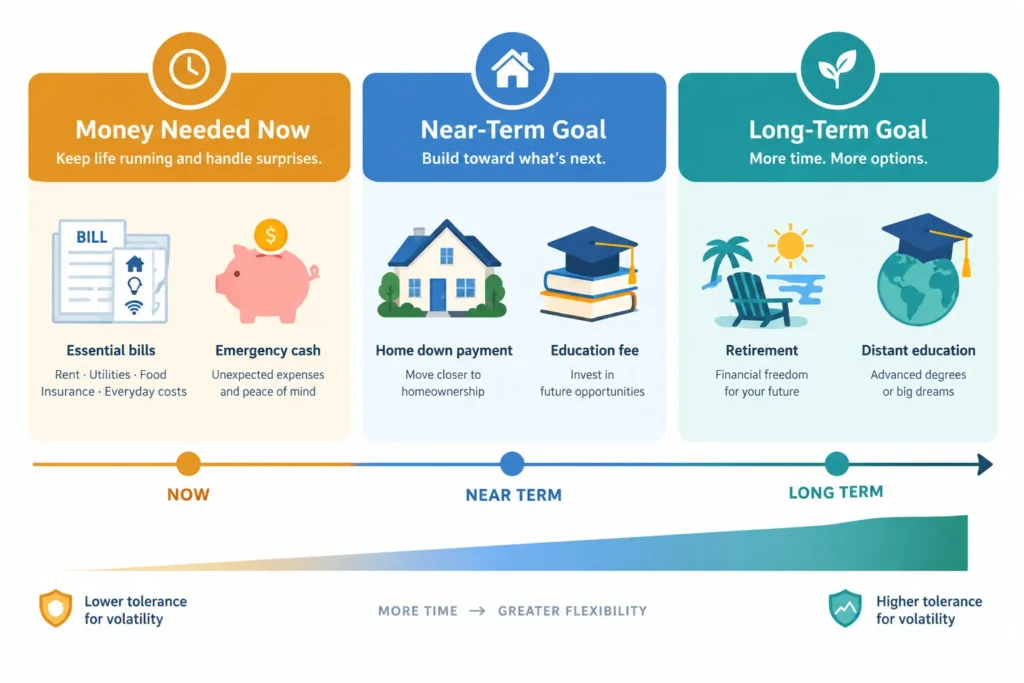
Timeline comparing essential, near-term and long-term money needs with their capacity for investment volatility.

Your investment horizon is the time between investing the money and needing it. This period matters because volatile investments may require time to recover from market declines.

Money required for immediate expenses or near-term obligations should not automatically be placed in equity mutual funds. Examples include next month’s rent, an upcoming college fee, a tax payment or the down payment for a home that you plan to make soon.

Equity funds are generally considered for longer-term goals because short-term returns can be unpredictable. Even over long periods, however, returns are not assured. For shorter goals, capital stability and accessibility may be more important than seeking higher growth.

Type of money What to consider before investing
Monthly rent, bills and groceries Keep available for essential spending rather than exposing it to market volatility.
Emergency savings Prioritise accessibility and stability based on your household needs.
Money needed for a near-term goal Avoid taking more risk than the goal’s timeline can support.
Long-term surplus Consider suitable mutual fund categories after assessing risk and the goal.
Borrowed money Do not treat it as investible surplus.

6. Be Prepared for Temporary Losses

Starting an equity mutual fund investment means accepting that its value may sometimes fall below the amount invested. A decline does not automatically mean that the fund is unsuitable, but it can test your patience and financial capacity.

Ask yourself how you might react if an investment of Rs. 1 lakh temporarily became worth less. Would you continue with the plan, review it calmly or sell immediately out of fear? Your answer can help reveal whether the risk level is appropriate.

Risk tolerance is emotional, but risk capacity is financial. You may feel comfortable taking risk, yet still lack the capacity if the money is needed soon. Both factors matter.

A Simple Mutual Fund Readiness Checklist
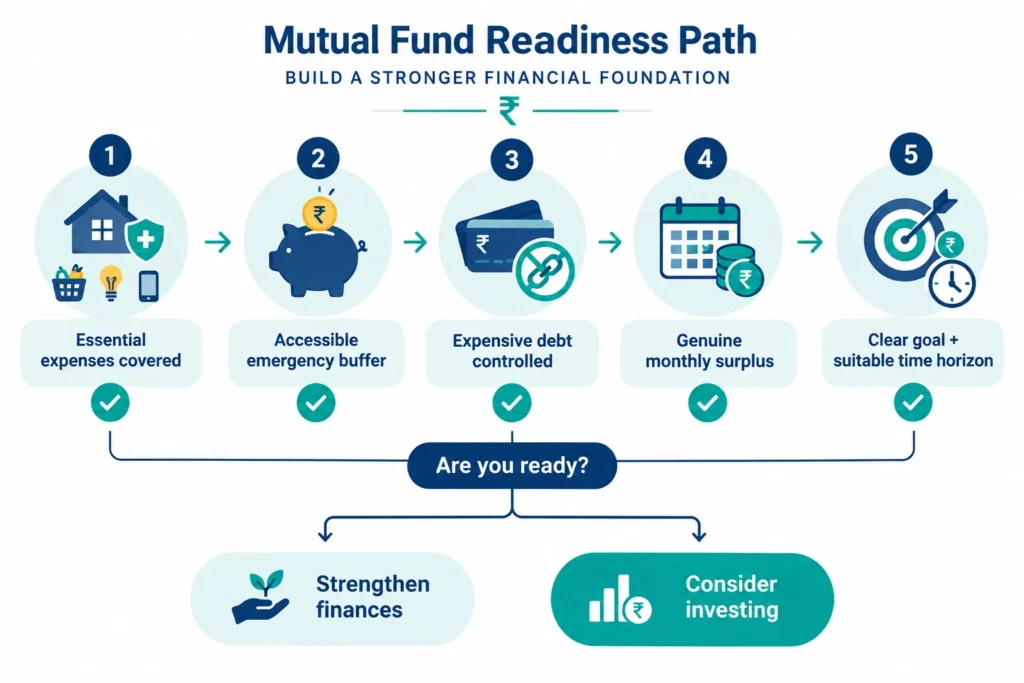
Flowchart checking essential expenses, emergency savings, debt, surplus and goals before mutual fund investing.

You may be financially ready to consider investing if most of the following statements are true:

  • I can pay essential monthly expenses without using the money meant for investing.
  • I have an emergency buffer suitable for my income stability and household responsibilities.
  • High-interest debt is under control and I am not borrowing to invest.
  • I have a real monthly surplus after allowing for irregular expenses.
  • I know the goal for which I am investing.
  • I understand when the money is likely to be required.
  • I can accept temporary declines if I choose a market-linked fund.
  • I understand that mutual fund returns are not guaranteed.

If several answers are “no”, delaying a large investment can be sensible. Use the time to strengthen cash flow, reduce expensive debt and build emergency savings. If the answers are mostly “yes”, you can consider starting with an amount that is sustainable rather than waiting indefinitely for a perfect market level.

For a broader explanation of fund categories, SIPs, costs, risks and beginner selection steps, refer to Mutual Funds and SIP Investing in India: A Complete Beginner’s Guide. The key principle remains simple: start when your finances and goal are ready, not merely when the market appears ready.

Choosing Between SIP and Lump-Sum Investing

Once you decide to invest in mutual funds, the next question is how to put your money into a scheme. You can invest gradually through a Systematic Investment Plan, commonly called a SIP, or invest a larger amount at one time through a lump-sum investment.

Neither method is automatically better. The suitable choice depends on when the money is available, how regularly you earn, your financial goal, your investment horizon and your ability to handle market movements.

What Is a SIP?

A SIP is a method of investing a fixed amount in a mutual fund scheme at regular intervals. Most investors choose a monthly SIP because their salary or business income also arrives every month.

For example, a salaried employee may invest Rs 3,000 every month shortly after receiving a salary. The amount is used to buy units of the selected mutual fund scheme at the applicable net asset value, or NAV.

When the NAV is lower, the SIP amount generally buys more units. When the NAV is higher, it buys fewer units. This is often called rupee-cost averaging. However, it does not mean that losses are impossible or that the final return will always be positive.

A SIP may be considered when:

  • You want to invest regularly from your monthly income.
  • You do not have a large investible amount available today.
  • Your goal is several years away and you want to build money gradually.
  • You find it difficult to invest consistently without an automatic process.
  • You prefer spreading your investments across different market levels instead of investing everything on one date.
You May Also Like:What Is a High-Net-Worth Individual (HNI)? Meaning, Criteria and Planning

A SIP can encourage financial discipline because the investment is scheduled in advance. It can also make investing feel more manageable for beginners. But a SIP does not guarantee profits, prevent losses or remove market risk. Your results will still depend on the fund, market performance, costs, investment period and the price at which units are eventually redeemed.

For a more detailed explanation of how instalments, NAV and SIP dates work, readers can refer to RegularStation’s existing SIP explainer. The SIP calculator can also help illustrate how different contribution amounts and assumed return rates may affect a projected value. Such projections are estimates, not promised returns.

What Is Lump-Sum Investing?

Lump-sum investing means putting an available amount into a mutual fund scheme in one transaction. For example, an investor may receive an annual bonus, proceeds from a matured deposit or money from the sale of an asset and decide to invest part of it at one time.

A lump-sum investment may be considered when:

  • Investible money is already available.
  • The money is not required for emergency expenses or near-term commitments.
  • The chosen fund category matches your goal and investment horizon.
  • You understand that the investment value may fall soon after you invest.
  • Your risk tolerance allows you to remain invested through market volatility.

A lump-sum investment gets the full amount invested immediately. This may be useful when the investor has a suitable long-term goal and is comfortable with market risk. However, the entire amount is also exposed to the market from the investment date. A sharp fall soon afterwards can be emotionally difficult, especially for a first-time investor.

Do not confuse “money available” with “money available for investment”. Funds kept aside for rent, school fees, loan repayments, taxes, medical needs or an emergency reserve should generally not be treated as investible surplus merely because they are temporarily sitting in a bank account.

SIP or Lump Sum: A Simple Decision Guide
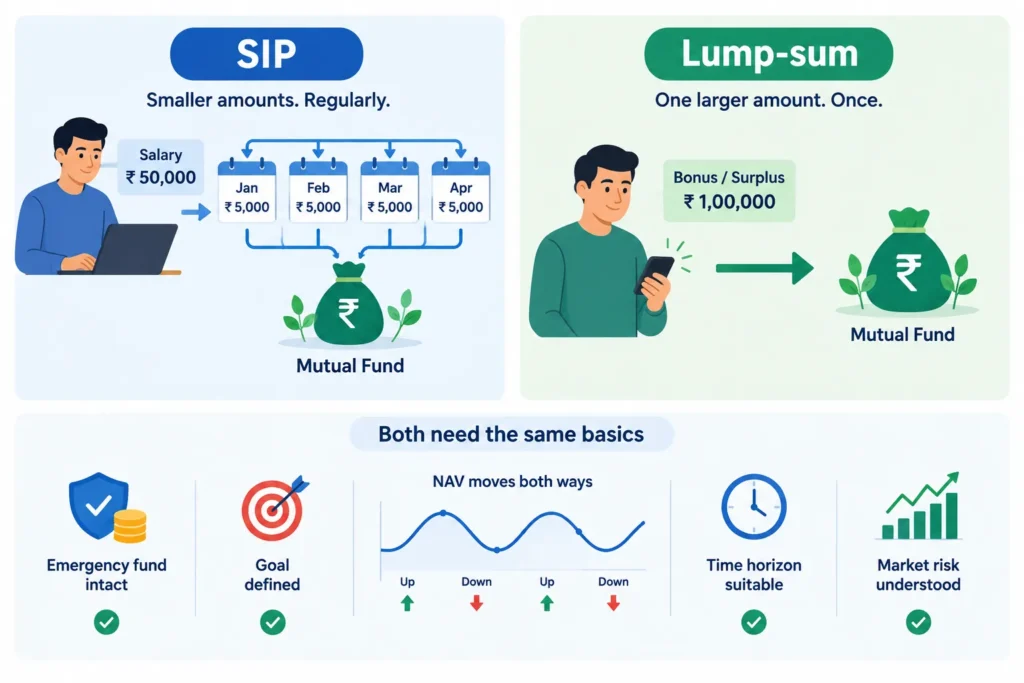
Comparison of regular SIP instalments and a one-time lump-sum investment with shared suitability checks.

Situation Method that may be considered Reason
You earn a monthly salary and want to invest from each salary SIP It supports regular and automated investing.
You have no large amount today but can save a fixed sum each month SIP You can begin gradually instead of waiting to collect a large amount.
You have received an investible bonus or another genuine surplus Lump sum The money is already available for investment.
You may need the money soon Reconsider the investment first The goal and time horizon matter more than the payment method.
You have a lump sum but are uncomfortable investing it on one date Review a phased approach Gradual deployment may feel easier, but it still involves market risk.

The table is only a starting point. Choosing SIP or lump sum does not decide whether a mutual fund is suitable for you. A monthly SIP into a high-risk fund can still be inappropriate for a short-term goal. Similarly, a lump-sum investment is not automatically reckless when the goal is long term, the scheme is suitable and the investor understands the risks.

Do Not Decide Only by Looking at Market Conditions

Many beginners ask whether they should wait for the market to fall before investing. The problem is that short-term market movements cannot be predicted reliably. Even if the market appears expensive or cheap, it may move differently from what you expect.

Waiting for the “perfect” level can delay a suitable long-term investment. On the other hand, investing hurriedly because markets are rising can lead to a poor choice of scheme or unnecessary risk.

Your decision about when to invest in mutual funds should begin with your personal situation. Ask whether your emergency fund is in place, your expensive debt is under control, the goal is clear and the money can remain invested for the required period. Market conditions may be considered as part of the wider picture, but they should not be the only reason for choosing a SIP, making a lump-sum investment or staying out.

Checks to Make Before Using Either Method

Whether you choose a SIP or a lump sum, review the mutual fund scheme before investing. The payment method cannot correct a mismatch between the fund and your needs.

  • Fund category: Check whether the scheme invests mainly in equity, debt, a combination of the two or another asset type. Different categories serve different goals and carry different risks.
  • Riskometer: Look at the scheme’s current Riskometer level. It gives a standard indication of risk, although it cannot predict your actual gain or loss.
  • Expense ratio: This is the recurring cost charged by the scheme. It affects returns because expenses are deducted from the scheme’s assets.
  • Exit load: Some schemes charge an exit load when units are redeemed within a specified period. Check the applicable conditions before investing.
  • Scheme documents: Read the Scheme Information Document, Key Information Memorandum and other official disclosures. Pay attention to the investment objective, strategy, risks and investor eligibility.
  • Taxation: Mutual fund taxation can depend on the fund type, holding period and applicable tax rules. Consider the tax treatment before investing or redeeming, but do not select a fund only for a possible tax benefit.
You May Also Like:How to Calculate Your Net Worth in India: Assets, Liabilities and Examples

Also confirm whether you are selecting a direct or regular plan and a growth or income-distribution option. These choices can affect costs and how returns are received, so they should be made consciously rather than accepted as default selections.

The Practical Takeaway

A SIP can suit investors who want to invest a manageable amount from regular monthly income. A lump-sum investment may be considered when genuine surplus money is already available and the goal, time horizon and risk tolerance support investing it.

The important question is not simply which method may earn more. It is which method you can follow without harming your emergency savings, near-term needs or peace of mind. Choose the fund first on the basis of suitability, and then choose the investment method that matches your cash flow and behaviour.

Practical Examples, Common Mistakes and Final Decision Check

There is no single perfect answer to when to invest in mutual funds. The right time depends on your cash flow, emergency savings, goals, responsibilities, time horizon and ability to handle market movements.

The following examples show how different people may approach the decision. They are illustrations, not fixed recommendations.

Example 1: A Young Professional in a First Job

Suppose Aditi has started her first job in Bengaluru. She receives a regular salary but has only a small amount in her bank account. She also pays rent and is still learning how much she spends each month.

Aditi wants to begin a SIP immediately because her colleagues are discussing mutual funds. However, she does not yet have enough emergency savings to cover an unexpected medical bill, job loss or urgent trip home.

Her first priority may be to understand her monthly expenses and build an emergency fund in a suitable, accessible place. If her budget permits, she could consider starting with a manageable investment amount while continuing to strengthen her emergency savings. She should not invest so much that she has to redeem the investment for routine expenses.

The main lesson is that starting early can help, but financial stability also matters. A small sustainable step may be more practical than a large SIP that creates stress.

Example 2: Stable Cash Flow and an Established Emergency Fund

Consider Rohan, who has a stable job, health insurance and an emergency fund. He has no expensive short-term debt and can regularly save part of his income. His goal is to build wealth over a long period, but he is unsure whether markets are currently too high.

Rohan may not need to wait endlessly for an ideal market level. If he understands the risks and chooses a suitable mutual fund category, a regular SIP can help him invest gradually instead of trying to predict short-term market movements.

This does not remove risk. Equity mutual funds can fall sharply and may remain weak for extended periods. Rohan still needs to select investments according to his time horizon and risk tolerance. The advantage he has is that his essential finances are already in reasonable order, so temporary market declines are less likely to disrupt his daily needs.

Example 3: A Parent Investing for a Future Goal

Meera wants to invest for her daughter’s future education. The goal is several years away, but the exact cost is uncertain. She also has household responsibilities, insurance premiums and other family goals.

Meera should first estimate the goal amount, available time and monthly contribution she can maintain. Her choice of mutual fund category should reflect how long she can remain invested and how much volatility she can accept.

As the goal comes closer, protecting the accumulated amount may become more important than seeking higher growth. This could require reviewing the portfolio and gradually reducing exposure to assets with high short-term volatility. The appropriate approach will depend on her circumstances rather than on a universal formula.

She should also review the goal periodically. Education costs, family income and other responsibilities may change over time. A SIP should support the financial plan; it should not be treated as a plan by itself.

Example 4: Someone Approaching a Planned Expense

Suppose Imran plans to use his savings for a home down payment in the near future. He cannot postpone the payment easily and would be uncomfortable if the amount fell just before it was required.

For this money, capital stability and access may matter more than the possibility of earning a higher return. Investing it in a volatile equity mutual fund simply because the recent returns look attractive could expose him to an avoidable shortfall.

Not every goal requires an equity fund. When the planned expense is close, the person may need to consider lower-volatility and more accessible options based on the required withdrawal date. Even debt-oriented mutual funds can carry interest-rate, credit and liquidity risks, so the scheme’s risk level and portfolio should be understood.

This example highlights an important point: the best time and type of investment depend on when the money will be needed. A product suitable for a distant goal may be unsuitable for a near-term expense.

Common Mistakes to Avoid

  • Waiting forever for the perfect market level: Market peaks and bottoms are clear only in hindsight. Repeatedly postponing a long-term investment while waiting for a correction can keep your money uninvested. Focus instead on your goal, readiness and chosen method.
  • Investing borrowed money: A mutual fund return is uncertain, while loan repayments and interest are contractual obligations. Borrowing to invest can increase financial pressure and losses.
  • Using emergency savings: Emergency money should generally remain available for urgent needs. If it is placed in a volatile investment, you may have to sell after a market decline.
  • Copying friends, relatives or online personalities: Another person may have a different income, time horizon, portfolio and ability to bear losses. A fund that suits them may not suit you.
  • Chasing recent returns: A scheme that performed well recently may not repeat that performance. Past performance should not be the only basis for selection. Review the fund category, risk, costs, portfolio and consistency with your goal.
  • Stopping a SIP only because markets decline: A fall in the market does not automatically mean the original plan has failed. Before stopping, check whether your goal, income, time horizon or risk tolerance has changed. However, continuing blindly is also unwise if the fund or plan is unsuitable.
  • Ignoring near-term obligations: Rent, school fees, insurance premiums, taxes and loan payments should not depend on uncertain market returns.
  • Assuming a SIP guarantees profit: A SIP is a way to invest regularly. It does not guarantee returns or prevent losses.
You May Also Like:Loan Amortization Schedule Explained With an Example

Final Decision Checklist

Before deciding when to invest in mutual funds, ask yourself these questions:

  • Do I have a clear goal for this money?
  • When will I need the money?
  • Can I handle a temporary fall in the investment value?
  • Do I have accessible emergency savings?
  • Can I invest without borrowing or missing essential payments?
  • Is the contribution affordable even during a difficult month?
  • Does the mutual fund category match my time horizon and risk tolerance?
  • Have I read the scheme documents, risk disclosures and expense information?
  • Am I choosing the fund for the right reasons rather than recent returns or social pressure?
  • Do I know how taxation, exit loads and redemption timelines may affect me?

If several answers are unclear, pause and organise your finances before committing a large amount. Starting with a modest, sustainable contribution may be reasonable for some investors, while others may need to prioritise emergency savings, debt repayment or an upcoming expense.

Frequently Asked Questions

Should I wait for the stock market to fall before investing?

Not necessarily. Market movements are difficult to predict consistently. For a long-term goal, financial readiness and a suitable investment plan may be more useful than waiting for a specific index level. If short-term volatility worries you, investing gradually through a SIP may feel more manageable, but it does not eliminate risk.

Can I start a mutual fund SIP before building an emergency fund?

You may be able to start with a small amount, but emergency savings should remain an important priority. Do not invest so aggressively that a medical bill, income interruption or urgent family expense forces you to borrow or redeem during a market decline.

Is salary day the best date for a SIP?

There is no universally best SIP date. A date shortly after salary credit may help with budgeting and consistency. The practical goal is to ensure enough money is available in the bank account when the instalment is due.

Should I stop my SIP when markets fall?

A market decline alone may not be a sufficient reason to stop. Review whether your goal, time horizon, cash flow or risk tolerance has changed. Also check whether the selected scheme remains suitable. If you need the money soon or cannot tolerate the volatility, reassessment may be necessary.

Can I invest money needed within the next year?

You should be cautious with money required soon. Capital stability and timely access may be more important than higher potential returns. Avoid exposing a near-term essential expense to unnecessary market volatility.

Do mutual fund investments guarantee returns?

No. Mutual fund returns are market-linked and are not guaranteed unless a specific product structure explicitly provides otherwise under applicable rules. The value of an investment can rise or fall, and different fund categories carry different risks.

Summary

The answer to when to invest in mutual funds depends on your financial readiness, goal, time horizon and comfort with risk. Someone with stable cash flow and emergency savings may be ready to invest for a long-term goal. A person facing a near-term expense may need to prioritise stability and access to money. A new earner may need to balance a small beginning with building a stronger financial safety net.

Avoid waiting endlessly for a perfect market level, investing borrowed money, using emergency savings, copying others or chasing recent returns. Choose an affordable approach that you can understand and sustain.

Indian mutual fund regulations, taxation rules, scheme features and disclosure requirements can change. Current information should be verified from official documents and qualified sources before publication or before making a financial decision.

This article provides general educational information and is not personalised investment, tax or legal advice. Consider your circumstances and consult a qualified professional where necessary.


Share this article
KEEP READING

Related Articles

View all →

Comments

Leave a Comment

When Should You Start Investing in Mutual Funds? A Beginner’s Guide

The best time to start investing in mutual funds is usually when your basic finances are stable – not when you successfully predict the next market fall. Before investing, build a suitable emergency fund, control expensive debt, create a monthly surplus and identify the goal for which you are investing. Money needed soon, borrowed money and essential household funds should generally not be placed in volatile equity mutual funds.

Introduction

Many beginners wonder when to invest in mutual funds. They may wait for the stock market to fall, for interest rates to change or for an expert to announce the “perfect” entry point.

The problem is that market movements cannot be predicted consistently. A correction may come next week, next year or only after the market has risen further. Even experienced investors cannot reliably identify every market high and low in advance.

A more practical approach is to focus on financial readiness. You do not need a very high salary or a large lump sum to begin. However, you should be able to invest without affecting rent, groceries, loan payments, insurance premiums and other essential expenses.

Starting early can give your money more time to grow, but “start early” does not mean “invest at any cost”. If investing leaves you unable to handle a medical bill or forces you to borrow on a credit card, you may not be ready yet.

The right starting point is therefore personal. It depends on your cash flow, debts, emergency savings, goals, investment period and comfort with temporary losses.

The Right Time Depends on Financial Readiness, Not Market Timing

Mutual funds collect money from many investors and invest it according to a stated objective. Different schemes can hold equity shares, bonds, money-market instruments or a combination of assets. Their risks are not the same.

Equity mutual funds can rise and fall sharply because they invest mainly in shares. Debt mutual funds are generally less volatile than equity funds, but they also carry risks such as interest-rate and credit risk. No mutual fund return is guaranteed unless a specific guarantee is formally provided, which is uncommon.

This is why the question is not simply whether the market looks cheap or expensive. Before choosing a fund, check whether your household finances can support the investment.

1. Build a Suitable Emergency Fund

An emergency fund is money kept aside for unexpected but necessary expenses. Examples include urgent medical treatment, major home repairs or a temporary loss of income.

The appropriate amount varies by household. A salaried person with stable employment and another earning family member may need a different buffer from a self-employed person with irregular income. Dependants, health needs, insurance cover and monthly loan payments also matter.

Emergency savings should generally be easy to access and should not depend heavily on stock-market conditions. If your emergency money is invested in an equity fund, you may have to sell after a market fall just when you urgently need cash.

You do not always have to wait until every possible financial risk is covered before starting. Some beginners build their emergency fund while beginning with a small systematic investment plan, or SIP. But emergency savings should receive priority if your current safety buffer is very low.

2. Bring High-Interest Debt Under Control

Review your debt before investing. Credit-card balances and some personal loans can carry high interest costs. Paying down such debt may improve your finances more reliably than investing while the interest continues to accumulate.

This does not mean every loan must be fully repaid before you invest. A manageable home loan, for example, is different from revolving credit-card debt. Compare the loan’s cost, your repayment ability, the available safety buffer and the risk of the proposed investment.

Do not borrow money to invest in mutual funds. The investment can lose value while the lender will still expect interest and repayment on time.

3. Make Sure You Have Positive Monthly Cash Flow

You are in a stronger position to invest when your regular income is higher than your regular spending and commitments. The remaining amount is your monthly surplus.

For example, suppose a household receives Rs. 70,000 a month and needs Rs. 62,000 for rent, groceries, transport, school expenses, insurance and loan payments. The apparent surplus is Rs. 8,000. Before investing the full amount, the household should also account for irregular costs such as annual insurance premiums, vehicle servicing and festival spending.

An SIP should fit comfortably within your genuine surplus. If you repeatedly stop the SIP, use a credit card for necessities or withdraw investments to pay routine bills, the amount may be too high.

4. Define a Clear Financial Goal

A goal explains why you are investing. It could be retirement, a child’s higher education, a future home purchase or another important objective.

A clear goal helps you choose the investment period and an appropriate level of risk. Investing only because friends are discussing a popular fund can lead to unsuitable decisions.

Write down three basic details for each goal:

  • The purpose of the money.
  • The approximate amount required.
  • The expected date on which the money will be needed.

The amount and date may change later. Even an initial estimate is more useful than investing without a purpose.

5. Match the Fund to Your Investment Horizon

Timeline comparing essential, near-term and long-term money needs with their capacity for investment volatility.

Your investment horizon is the time between investing the money and needing it. This period matters because volatile investments may require time to recover from market declines.

Money required for immediate expenses or near-term obligations should not automatically be placed in equity mutual funds. Examples include next month’s rent, an upcoming college fee, a tax payment or the down payment for a home that you plan to make soon.

Equity funds are generally considered for longer-term goals because short-term returns can be unpredictable. Even over long periods, however, returns are not assured. For shorter goals, capital stability and accessibility may be more important than seeking higher growth.

Type of money What to consider before investing
Monthly rent, bills and groceries Keep available for essential spending rather than exposing it to market volatility.
Emergency savings Prioritise accessibility and stability based on your household needs.
Money needed for a near-term goal Avoid taking more risk than the goal’s timeline can support.
Long-term surplus Consider suitable mutual fund categories after assessing risk and the goal.
Borrowed money Do not treat it as investible surplus.

6. Be Prepared for Temporary Losses

Starting an equity mutual fund investment means accepting that its value may sometimes fall below the amount invested. A decline does not automatically mean that the fund is unsuitable, but it can test your patience and financial capacity.

Ask yourself how you might react if an investment of Rs. 1 lakh temporarily became worth less. Would you continue with the plan, review it calmly or sell immediately out of fear? Your answer can help reveal whether the risk level is appropriate.

Risk tolerance is emotional, but risk capacity is financial. You may feel comfortable taking risk, yet still lack the capacity if the money is needed soon. Both factors matter.

A Simple Mutual Fund Readiness Checklist

Flowchart checking essential expenses, emergency savings, debt, surplus and goals before mutual fund investing.

You may be financially ready to consider investing if most of the following statements are true:

  • I can pay essential monthly expenses without using the money meant for investing.
  • I have an emergency buffer suitable for my income stability and household responsibilities.
  • High-interest debt is under control and I am not borrowing to invest.
  • I have a real monthly surplus after allowing for irregular expenses.
  • I know the goal for which I am investing.
  • I understand when the money is likely to be required.
  • I can accept temporary declines if I choose a market-linked fund.
  • I understand that mutual fund returns are not guaranteed.

If several answers are “no”, delaying a large investment can be sensible. Use the time to strengthen cash flow, reduce expensive debt and build emergency savings. If the answers are mostly “yes”, you can consider starting with an amount that is sustainable rather than waiting indefinitely for a perfect market level.

For a broader explanation of fund categories, SIPs, costs, risks and beginner selection steps, refer to Mutual Funds and SIP Investing in India: A Complete Beginner’s Guide. The key principle remains simple: start when your finances and goal are ready, not merely when the market appears ready.

Choosing Between SIP and Lump-Sum Investing

Once you decide to invest in mutual funds, the next question is how to put your money into a scheme. You can invest gradually through a Systematic Investment Plan, commonly called a SIP, or invest a larger amount at one time through a lump-sum investment.

Neither method is automatically better. The suitable choice depends on when the money is available, how regularly you earn, your financial goal, your investment horizon and your ability to handle market movements.

What Is a SIP?

A SIP is a method of investing a fixed amount in a mutual fund scheme at regular intervals. Most investors choose a monthly SIP because their salary or business income also arrives every month.

For example, a salaried employee may invest Rs 3,000 every month shortly after receiving a salary. The amount is used to buy units of the selected mutual fund scheme at the applicable net asset value, or NAV.

When the NAV is lower, the SIP amount generally buys more units. When the NAV is higher, it buys fewer units. This is often called rupee-cost averaging. However, it does not mean that losses are impossible or that the final return will always be positive.

A SIP may be considered when:

  • You want to invest regularly from your monthly income.
  • You do not have a large investible amount available today.
  • Your goal is several years away and you want to build money gradually.
  • You find it difficult to invest consistently without an automatic process.
  • You prefer spreading your investments across different market levels instead of investing everything on one date.

A SIP can encourage financial discipline because the investment is scheduled in advance. It can also make investing feel more manageable for beginners. But a SIP does not guarantee profits, prevent losses or remove market risk. Your results will still depend on the fund, market performance, costs, investment period and the price at which units are eventually redeemed.

For a more detailed explanation of how instalments, NAV and SIP dates work, readers can refer to RegularStation’s existing SIP explainer. The SIP calculator can also help illustrate how different contribution amounts and assumed return rates may affect a projected value. Such projections are estimates, not promised returns.

What Is Lump-Sum Investing?

Lump-sum investing means putting an available amount into a mutual fund scheme in one transaction. For example, an investor may receive an annual bonus, proceeds from a matured deposit or money from the sale of an asset and decide to invest part of it at one time.

A lump-sum investment may be considered when:

  • Investible money is already available.
  • The money is not required for emergency expenses or near-term commitments.
  • The chosen fund category matches your goal and investment horizon.
  • You understand that the investment value may fall soon after you invest.
  • Your risk tolerance allows you to remain invested through market volatility.

A lump-sum investment gets the full amount invested immediately. This may be useful when the investor has a suitable long-term goal and is comfortable with market risk. However, the entire amount is also exposed to the market from the investment date. A sharp fall soon afterwards can be emotionally difficult, especially for a first-time investor.

Do not confuse “money available” with “money available for investment”. Funds kept aside for rent, school fees, loan repayments, taxes, medical needs or an emergency reserve should generally not be treated as investible surplus merely because they are temporarily sitting in a bank account.

SIP or Lump Sum: A Simple Decision Guide

Comparison of regular SIP instalments and a one-time lump-sum investment with shared suitability checks.

Situation Method that may be considered Reason
You earn a monthly salary and want to invest from each salary SIP It supports regular and automated investing.
You have no large amount today but can save a fixed sum each month SIP You can begin gradually instead of waiting to collect a large amount.
You have received an investible bonus or another genuine surplus Lump sum The money is already available for investment.
You may need the money soon Reconsider the investment first The goal and time horizon matter more than the payment method.
You have a lump sum but are uncomfortable investing it on one date Review a phased approach Gradual deployment may feel easier, but it still involves market risk.

The table is only a starting point. Choosing SIP or lump sum does not decide whether a mutual fund is suitable for you. A monthly SIP into a high-risk fund can still be inappropriate for a short-term goal. Similarly, a lump-sum investment is not automatically reckless when the goal is long term, the scheme is suitable and the investor understands the risks.

Do Not Decide Only by Looking at Market Conditions

Many beginners ask whether they should wait for the market to fall before investing. The problem is that short-term market movements cannot be predicted reliably. Even if the market appears expensive or cheap, it may move differently from what you expect.

Waiting for the “perfect” level can delay a suitable long-term investment. On the other hand, investing hurriedly because markets are rising can lead to a poor choice of scheme or unnecessary risk.

Your decision about when to invest in mutual funds should begin with your personal situation. Ask whether your emergency fund is in place, your expensive debt is under control, the goal is clear and the money can remain invested for the required period. Market conditions may be considered as part of the wider picture, but they should not be the only reason for choosing a SIP, making a lump-sum investment or staying out.

Checks to Make Before Using Either Method

Whether you choose a SIP or a lump sum, review the mutual fund scheme before investing. The payment method cannot correct a mismatch between the fund and your needs.

  • Fund category: Check whether the scheme invests mainly in equity, debt, a combination of the two or another asset type. Different categories serve different goals and carry different risks.
  • Riskometer: Look at the scheme’s current Riskometer level. It gives a standard indication of risk, although it cannot predict your actual gain or loss.
  • Expense ratio: This is the recurring cost charged by the scheme. It affects returns because expenses are deducted from the scheme’s assets.
  • Exit load: Some schemes charge an exit load when units are redeemed within a specified period. Check the applicable conditions before investing.
  • Scheme documents: Read the Scheme Information Document, Key Information Memorandum and other official disclosures. Pay attention to the investment objective, strategy, risks and investor eligibility.
  • Taxation: Mutual fund taxation can depend on the fund type, holding period and applicable tax rules. Consider the tax treatment before investing or redeeming, but do not select a fund only for a possible tax benefit.

Also confirm whether you are selecting a direct or regular plan and a growth or income-distribution option. These choices can affect costs and how returns are received, so they should be made consciously rather than accepted as default selections.

The Practical Takeaway

A SIP can suit investors who want to invest a manageable amount from regular monthly income. A lump-sum investment may be considered when genuine surplus money is already available and the goal, time horizon and risk tolerance support investing it.

The important question is not simply which method may earn more. It is which method you can follow without harming your emergency savings, near-term needs or peace of mind. Choose the fund first on the basis of suitability, and then choose the investment method that matches your cash flow and behaviour.

Practical Examples, Common Mistakes and Final Decision Check

There is no single perfect answer to when to invest in mutual funds. The right time depends on your cash flow, emergency savings, goals, responsibilities, time horizon and ability to handle market movements.

The following examples show how different people may approach the decision. They are illustrations, not fixed recommendations.

Example 1: A Young Professional in a First Job

Suppose Aditi has started her first job in Bengaluru. She receives a regular salary but has only a small amount in her bank account. She also pays rent and is still learning how much she spends each month.

Aditi wants to begin a SIP immediately because her colleagues are discussing mutual funds. However, she does not yet have enough emergency savings to cover an unexpected medical bill, job loss or urgent trip home.

Her first priority may be to understand her monthly expenses and build an emergency fund in a suitable, accessible place. If her budget permits, she could consider starting with a manageable investment amount while continuing to strengthen her emergency savings. She should not invest so much that she has to redeem the investment for routine expenses.

The main lesson is that starting early can help, but financial stability also matters. A small sustainable step may be more practical than a large SIP that creates stress.

Example 2: Stable Cash Flow and an Established Emergency Fund

Consider Rohan, who has a stable job, health insurance and an emergency fund. He has no expensive short-term debt and can regularly save part of his income. His goal is to build wealth over a long period, but he is unsure whether markets are currently too high.

Rohan may not need to wait endlessly for an ideal market level. If he understands the risks and chooses a suitable mutual fund category, a regular SIP can help him invest gradually instead of trying to predict short-term market movements.

This does not remove risk. Equity mutual funds can fall sharply and may remain weak for extended periods. Rohan still needs to select investments according to his time horizon and risk tolerance. The advantage he has is that his essential finances are already in reasonable order, so temporary market declines are less likely to disrupt his daily needs.

Example 3: A Parent Investing for a Future Goal

Meera wants to invest for her daughter’s future education. The goal is several years away, but the exact cost is uncertain. She also has household responsibilities, insurance premiums and other family goals.

Meera should first estimate the goal amount, available time and monthly contribution she can maintain. Her choice of mutual fund category should reflect how long she can remain invested and how much volatility she can accept.

As the goal comes closer, protecting the accumulated amount may become more important than seeking higher growth. This could require reviewing the portfolio and gradually reducing exposure to assets with high short-term volatility. The appropriate approach will depend on her circumstances rather than on a universal formula.

She should also review the goal periodically. Education costs, family income and other responsibilities may change over time. A SIP should support the financial plan; it should not be treated as a plan by itself.

Example 4: Someone Approaching a Planned Expense

Suppose Imran plans to use his savings for a home down payment in the near future. He cannot postpone the payment easily and would be uncomfortable if the amount fell just before it was required.

For this money, capital stability and access may matter more than the possibility of earning a higher return. Investing it in a volatile equity mutual fund simply because the recent returns look attractive could expose him to an avoidable shortfall.

Not every goal requires an equity fund. When the planned expense is close, the person may need to consider lower-volatility and more accessible options based on the required withdrawal date. Even debt-oriented mutual funds can carry interest-rate, credit and liquidity risks, so the scheme’s risk level and portfolio should be understood.

This example highlights an important point: the best time and type of investment depend on when the money will be needed. A product suitable for a distant goal may be unsuitable for a near-term expense.

Common Mistakes to Avoid

  • Waiting forever for the perfect market level: Market peaks and bottoms are clear only in hindsight. Repeatedly postponing a long-term investment while waiting for a correction can keep your money uninvested. Focus instead on your goal, readiness and chosen method.
  • Investing borrowed money: A mutual fund return is uncertain, while loan repayments and interest are contractual obligations. Borrowing to invest can increase financial pressure and losses.
  • Using emergency savings: Emergency money should generally remain available for urgent needs. If it is placed in a volatile investment, you may have to sell after a market decline.
  • Copying friends, relatives or online personalities: Another person may have a different income, time horizon, portfolio and ability to bear losses. A fund that suits them may not suit you.
  • Chasing recent returns: A scheme that performed well recently may not repeat that performance. Past performance should not be the only basis for selection. Review the fund category, risk, costs, portfolio and consistency with your goal.
  • Stopping a SIP only because markets decline: A fall in the market does not automatically mean the original plan has failed. Before stopping, check whether your goal, income, time horizon or risk tolerance has changed. However, continuing blindly is also unwise if the fund or plan is unsuitable.
  • Ignoring near-term obligations: Rent, school fees, insurance premiums, taxes and loan payments should not depend on uncertain market returns.
  • Assuming a SIP guarantees profit: A SIP is a way to invest regularly. It does not guarantee returns or prevent losses.

Final Decision Checklist

Before deciding when to invest in mutual funds, ask yourself these questions:

  • Do I have a clear goal for this money?
  • When will I need the money?
  • Can I handle a temporary fall in the investment value?
  • Do I have accessible emergency savings?
  • Can I invest without borrowing or missing essential payments?
  • Is the contribution affordable even during a difficult month?
  • Does the mutual fund category match my time horizon and risk tolerance?
  • Have I read the scheme documents, risk disclosures and expense information?
  • Am I choosing the fund for the right reasons rather than recent returns or social pressure?
  • Do I know how taxation, exit loads and redemption timelines may affect me?

If several answers are unclear, pause and organise your finances before committing a large amount. Starting with a modest, sustainable contribution may be reasonable for some investors, while others may need to prioritise emergency savings, debt repayment or an upcoming expense.

Frequently Asked Questions

Should I wait for the stock market to fall before investing?

Not necessarily. Market movements are difficult to predict consistently. For a long-term goal, financial readiness and a suitable investment plan may be more useful than waiting for a specific index level. If short-term volatility worries you, investing gradually through a SIP may feel more manageable, but it does not eliminate risk.

Can I start a mutual fund SIP before building an emergency fund?

You may be able to start with a small amount, but emergency savings should remain an important priority. Do not invest so aggressively that a medical bill, income interruption or urgent family expense forces you to borrow or redeem during a market decline.

Is salary day the best date for a SIP?

There is no universally best SIP date. A date shortly after salary credit may help with budgeting and consistency. The practical goal is to ensure enough money is available in the bank account when the instalment is due.

Should I stop my SIP when markets fall?

A market decline alone may not be a sufficient reason to stop. Review whether your goal, time horizon, cash flow or risk tolerance has changed. Also check whether the selected scheme remains suitable. If you need the money soon or cannot tolerate the volatility, reassessment may be necessary.

Can I invest money needed within the next year?

You should be cautious with money required soon. Capital stability and timely access may be more important than higher potential returns. Avoid exposing a near-term essential expense to unnecessary market volatility.

Do mutual fund investments guarantee returns?

No. Mutual fund returns are market-linked and are not guaranteed unless a specific product structure explicitly provides otherwise under applicable rules. The value of an investment can rise or fall, and different fund categories carry different risks.

Summary

The answer to when to invest in mutual funds depends on your financial readiness, goal, time horizon and comfort with risk. Someone with stable cash flow and emergency savings may be ready to invest for a long-term goal. A person facing a near-term expense may need to prioritise stability and access to money. A new earner may need to balance a small beginning with building a stronger financial safety net.

Avoid waiting endlessly for a perfect market level, investing borrowed money, using emergency savings, copying others or chasing recent returns. Choose an affordable approach that you can understand and sustain.

Indian mutual fund regulations, taxation rules, scheme features and disclosure requirements can change. Current information should be verified from official documents and qualified sources before publication or before making a financial decision.

This article provides general educational information and is not personalised investment, tax or legal advice. Consider your circumstances and consult a qualified professional where necessary.

Leave a Comment