

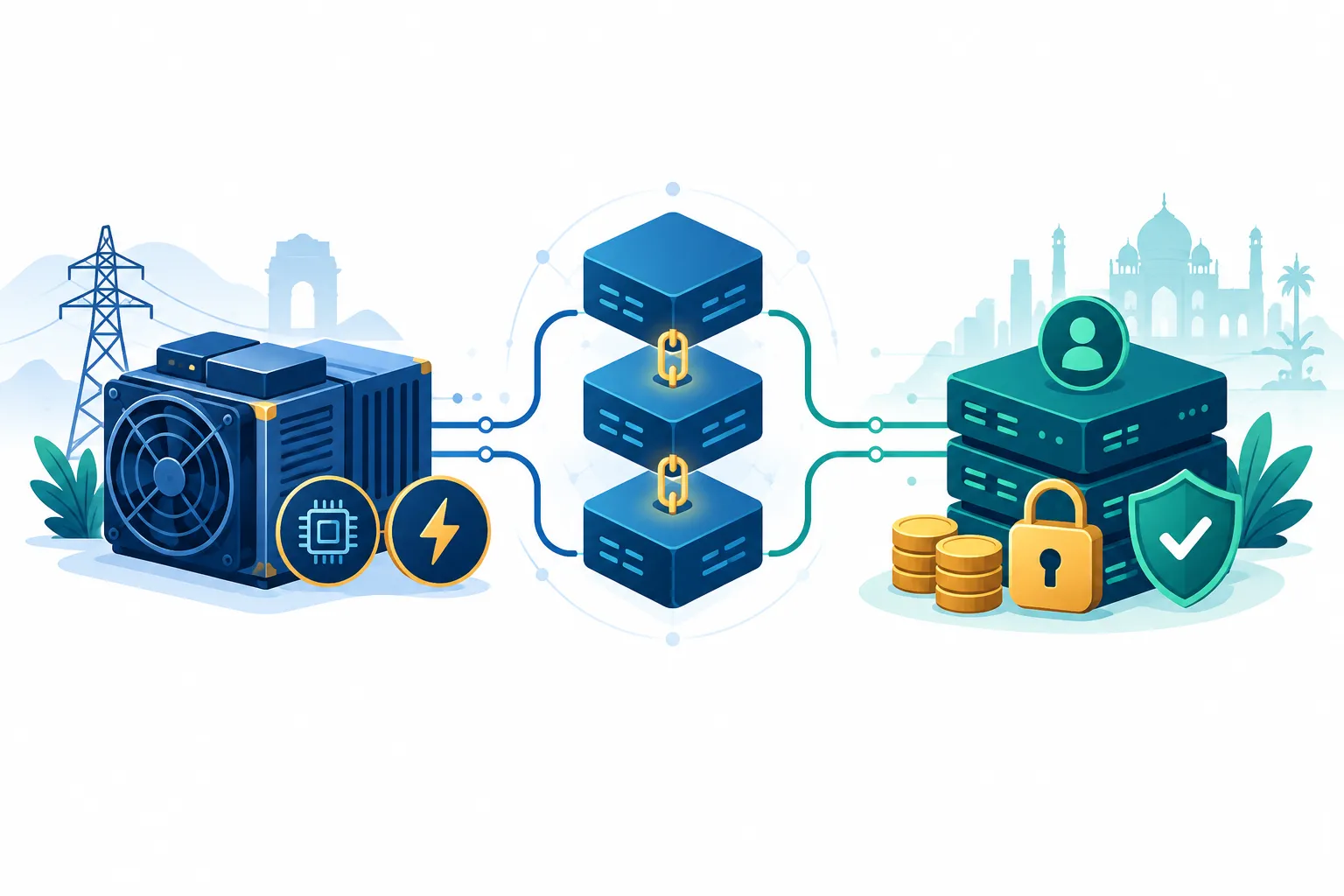
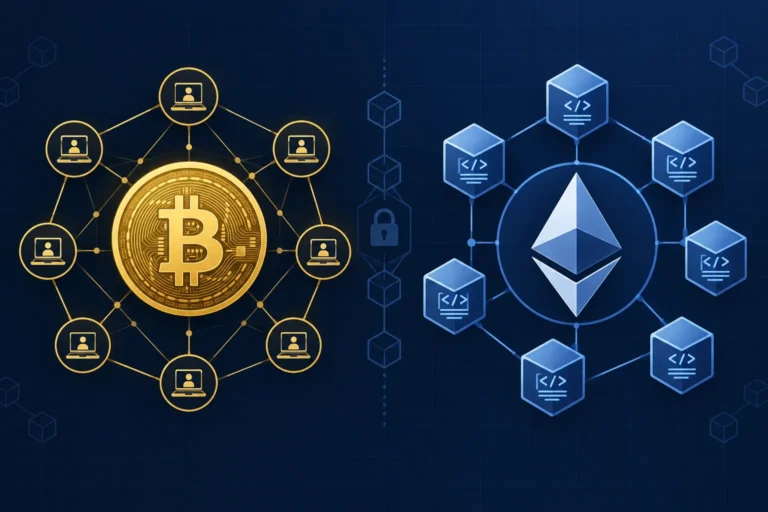
Proof of Work vs Proof of Stake are two ways for a blockchain network to agree on valid transactions. Proof of Work uses miners, specialised computers and computational effort to add blocks. Proof of Stake generally uses validators who lock up cryptocurrency as stake. Both aim to protect a blockchain without relying on one central record keeper, but they differ in how participants are selected, what resources they use and the risks they create.
Introduction
The difference between Proof of Work and Proof of Stake can seem highly technical. At its core, however, the question is simple: who gets to update a blockchain, and how can everyone else check that the update is valid?
This matters because a public blockchain may have thousands of participants spread across different countries. They do not necessarily know or trust each other. Yet they need to maintain a consistent record of transactions, including which transaction happened first and whether the same cryptocurrency has been spent twice.
A bank solves this problem by maintaining a central ledger. If you send ₹5,000 through a banking system, the bank’s records determine whether you had enough money and whether the transfer was completed. A decentralised blockchain does not have one bank or company making every decision. It therefore needs a set of rules for reaching agreement.
These rules are commonly called a consensus mechanism. Proof of Work and Proof of Stake are the best-known examples. This article begins with how blockchain consensus works and why Proof of Work is central to Bitcoin’s design.
If blockchain terminology is new to you, the broader concepts are covered in Cryptocurrency in India: A Complete Beginner’s Guide to Crypto and What Is Blockchain Technology? How It Works and Its Real-World Uses.
Blockchain Consensus and How Proof of Work Operates
What is a blockchain consensus mechanism?
A blockchain is a shared record maintained by many computers, often called nodes. Transactions are grouped into blocks, and each accepted block is connected to the blocks that came before it.
The network must agree on several points:
- Which transactions follow the protocol’s rules.
- Whether the sender is allowed to spend the coins involved.
- What order valid transactions should appear in.
- Which proposed block should become part of the accepted chain.
- How the network should respond if participants disagree.
Imagine a group of shopkeepers maintaining copies of the same digital account book. Customers continuously report new payments, but no single shopkeeper controls the book. The group needs rules for checking each payment, choosing the next page and ensuring that everyone copies the same accepted page.
This analogy explains the purpose of consensus, but a real blockchain involves more than a group vote. Consensus mechanisms operate as part of a broader system that includes software rules, peer-to-peer networking, cryptography and financial incentives. Nodes independently check whether blocks comply with the protocol.
Consensus does not mean every participant must trust every other participant. Instead, the aim is to make valid behaviour verifiable and dishonest behaviour difficult, expensive or punishable, depending on the blockchain’s design.
What is Proof of Work?
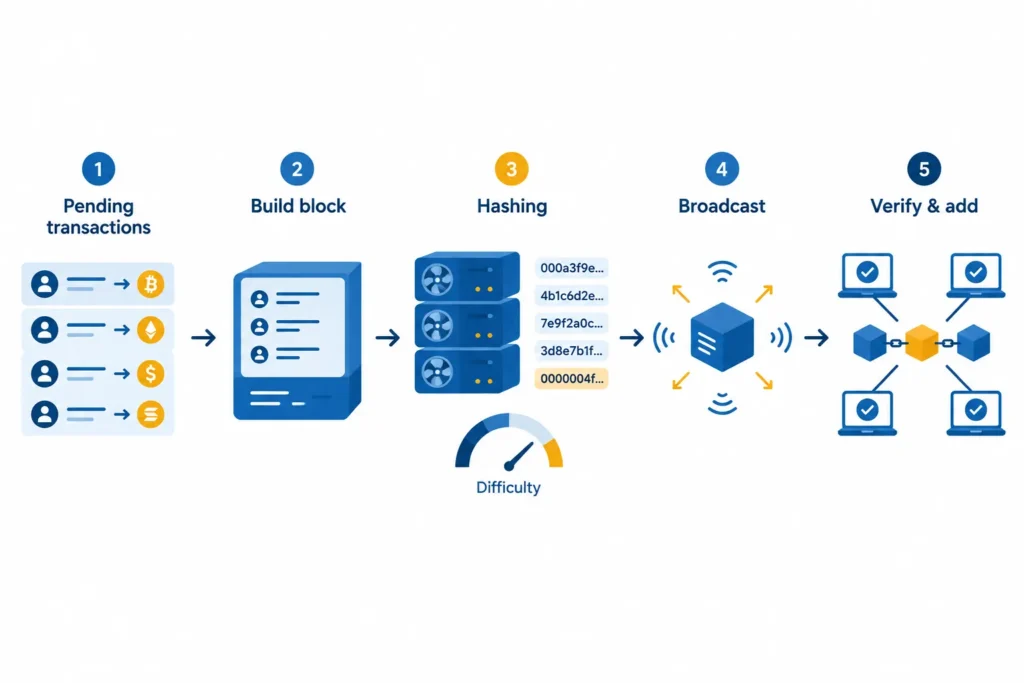
Proof of Work is a consensus approach in which participants called miners use computing equipment to compete for the right to propose the next block. They perform repeated calculations until one miner finds an output that meets the network’s current requirements.
The process involves a cryptographic hash function. A hash function takes input data and produces a fixed-length output, often represented as a long sequence of letters and numbers. A small change to the input produces a very different output. It is difficult to predict the output without performing the calculation.
A miner builds a candidate block containing transactions and other required information. The miner then changes a variable in the block data and calculates the hash repeatedly. The goal is to find a hash that falls below a target set by the protocol.
There is no reliable shortcut for finding the winning result. Miners generally have to make many attempts. More computational power allows a miner to try more possibilities per second, but it does not guarantee that the miner will find the next valid block.
Once a miner finds a qualifying hash, it broadcasts the proposed block to the network. Other nodes can quickly check the block’s transactions, structure and Proof of Work. If the block follows the rules, nodes may accept it and build on top of it.
Why mining difficulty matters
A Proof of Work network can adjust its mining difficulty. Difficulty determines how hard it is to find a qualifying hash.
If more computing power joins the network, blocks could otherwise be found too quickly. If computing power leaves, blocks could arrive too slowly. A difficulty-adjustment rule helps the network keep block production closer to its intended schedule over time.
Bitcoin, for example, adjusts its mining difficulty periodically according to its protocol. This does not keep every individual block on an exact timetable. One block may be found quickly and another may take longer. The adjustment concerns the average pace across a period.
How Proof of Work helps secure transaction history
Proof of Work makes block production costly because mining equipment consumes electricity while performing calculations. This cost is an important part of the security model.
Suppose an attacker wants to alter an old transaction. Changing that transaction would also change the block’s hash. The attacker would need to redo the Proof of Work for that block and subsequent blocks, while competing against honest miners who continue adding new blocks.
The deeper a transaction sits in the chain, the more accumulated work an attacker may need to overcome. This is why users often wait for additional blocks, sometimes called confirmations, before treating a significant Bitcoin payment as more firmly settled.
Proof of Work does not make a blockchain magically immune to every attack. Its protection depends partly on the distribution and total amount of mining power. If one party controlled enough effective mining power, it could create serious risks, including reorganising recent blocks or attempting to spend the same coins more than once.
Even such control would not normally allow the attacker to create coins outside the protocol rules or spend coins without the required cryptographic authorisation. Other nodes still verify whether proposed blocks follow the software’s rules.
Why miners participate
Mining requires equipment, electricity, cooling, maintenance and technical knowledge. Networks therefore commonly offer economic incentives.
A miner who successfully adds a valid block may receive newly issued cryptocurrency under the protocol’s rules. The miner may also collect transaction fees included in that block. In Bitcoin, the amount of new bitcoin awarded through the block subsidy reduces at scheduled intervals.
These rewards do not guarantee a profit. A miner’s result can depend on:
- The cost and reliability of electricity.
- The efficiency and purchase price of mining hardware.
- Changes in mining difficulty.
- The cryptocurrency’s market price.
- Transaction-fee levels.
- Cooling, rent, repairs and other operating expenses.
- Indian tax, import, legal and regulatory considerations.
Someone in India should not assume that owning a powerful computer automatically makes crypto mining profitable. The supporting guide Crypto Mining Explained: How It Works, Costs and Risks examines these practical issues in more detail.
Why Bitcoin uses Proof of Work
Bitcoin’s main network uses Proof of Work to order transactions and secure its blockchain. Miners propose blocks, while independently operated nodes check whether those blocks comply with Bitcoin’s rules.
This model has operated since Bitcoin’s launch and is a central part of its established security design. It allows the network to function without appointing a bank, government department or private company as the final transaction authority.
Bitcoin’s long operating history does not remove its risks. Its security model comes with trade-offs, particularly energy use, hardware requirements and the possibility that mining power becomes concentrated. Readers looking for broader context on the asset itself can refer to Bitcoin Explained: How It Works, Its Uses and Risks for Beginners.
Mining hardware and mining pools
Early Bitcoin mining could be performed using ordinary computer processors. As competition increased, miners moved to more powerful and efficient equipment. Bitcoin mining is now commonly associated with application-specific integrated circuits, or ASICs, designed for a narrow set of calculations.
Specialised hardware can improve efficiency, but it raises the cost of competing. Individual miners may struggle to find blocks regularly because block discovery involves chance. A small miner could run equipment for a long period without independently producing a winning block.
To reduce this income uncertainty, many miners join mining pools. A pool combines the computational power of multiple participants. When the pool earns a reward, it distributes proceeds according to its rules and each participant’s contributed work, after any applicable fees.
A mining pool does not necessarily own all the equipment connected to it. However, large pools can still influence which transactions their coordinated miners include and which block they build upon. If too much mining power is directed through a small number of pools, concentration becomes a concern.
Energy use and concentration risks
Proof of Work intentionally requires computational effort. That means energy consumption is not merely an accidental side effect; it is linked to the cost of producing blocks and attacking the chain.
The environmental impact cannot be judged only from a network-wide electricity figure. The source of electricity, equipment efficiency, location and use of otherwise curtailed energy may also matter. At the same time, high energy demand is a genuine trade-off and a major reason some blockchain projects prefer other consensus designs.
Mining can also become geographically or commercially concentrated where electricity is cheaper, regulation is favourable or specialised infrastructure is available. Hardware manufacturing may likewise be dominated by a limited number of suppliers.
These risks do not mean that one mining company automatically controls Bitcoin. Full nodes still reject blocks that violate protocol rules. Nevertheless, concentration of effective mining power can weaken resilience and increase the potential for transaction censorship or short-term chain disruption.
Proof of Work therefore combines a clear security idea with meaningful costs: miners prove that they have committed computational resources, making dishonest changes expensive, but the same process requires energy, specialised equipment and continued economic incentives.
How Proof of Stake Works and How It Differs from Mining
Proof of Stake, or PoS, is a method used by some blockchains to agree on valid transactions and add new blocks. Instead of asking miners to compete using computing power, it relies on participants who lock cryptocurrency as a stake.
These participants are generally called validators. Their job is to follow the protocol, check transactions and help the network agree on the correct blockchain history.
The central difference in Proof of Work vs Proof of Stake is therefore what supports network security. Proof of Work uses computing work and electricity. Proof of Stake mainly uses locked capital and the possibility of financial penalties.
What Does “Staking” Mean?
Staking means committing eligible crypto assets to a Proof of Stake protocol. The staked assets act somewhat like a security deposit. A validator may earn rewards for performing its duties correctly, but it may face penalties for certain failures or dishonest actions.
For example, suppose a blockchain requires its native coin to participate in validation. A person who meets the technical and minimum stake requirements could lock those coins and run validator software. The coins are not spent as payment, but they may remain locked or subject to withdrawal rules while the person participates.
Each blockchain has its own staking system. The minimum amount, reward calculation, withdrawal process and penalty rules can differ. “Proof of Stake” is a broad category, not one identical system used by every PoS blockchain.
How Validators Help Create Blocks
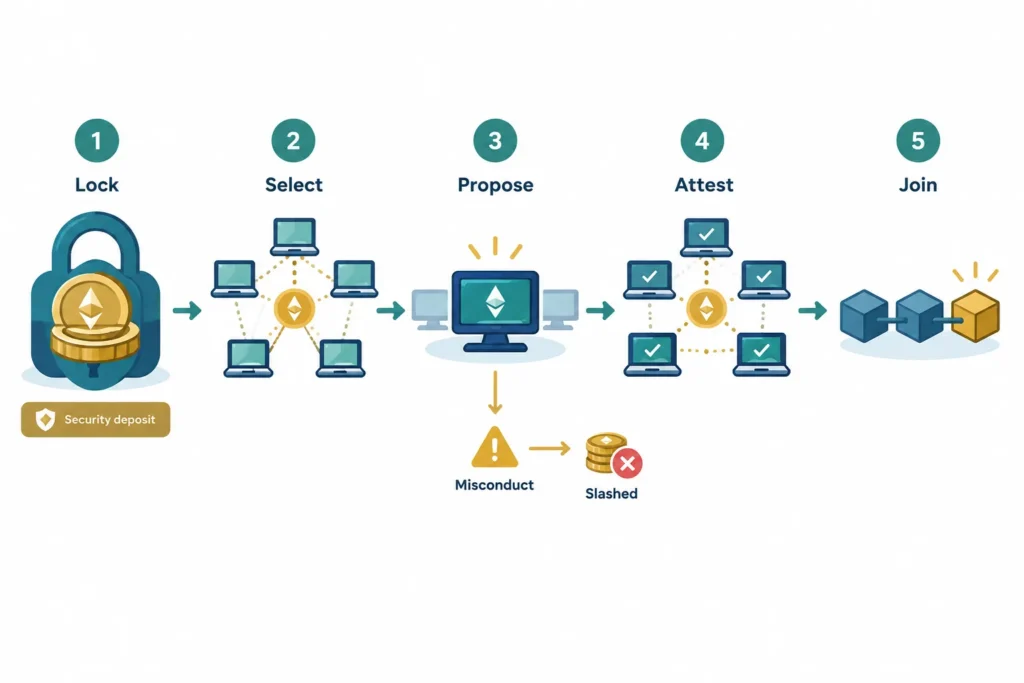
A Proof of Stake network generally follows a process like this:
- Assets are staked: Participants lock the required cryptocurrency under the protocol’s rules.
- A validator is selected: The protocol chooses a validator to propose a block. Selection may consider factors such as stake and randomisation, depending on the blockchain.
- A block is proposed: The selected validator packages eligible transactions into a proposed block.
- Other validators check it: They verify whether the transactions and block follow the network’s rules.
- Validators attest or vote: They signal which proposed block or chain history they consider valid.
- The network reaches agreement: Once the protocol’s required conditions are met, the block becomes part of the accepted blockchain history.
An attestation is essentially a validator’s signed confirmation or vote about a block. The exact meaning and timing of attestations depend on the protocol. Some PoS networks use different terms or organise validator duties differently.
Having more stake does not always mean that one participant can directly choose every outcome. Many protocols combine stake-based selection with randomisation and voting rules. However, participants controlling a large amount of stake can still gain significant influence, which creates concentration concerns.
Ethereum’s Move from Mining to Staking
Ethereum is an important example, but its rules should not be treated as the definition of every Proof of Stake system.
Ethereum Mainnet originally used Proof of Work. Miners used specialised computing equipment to compete for the right to add blocks. In 2022, Ethereum Mainnet switched to Proof of Stake in an event commonly known as “The Merge”. It no longer uses mining to produce Mainnet blocks.
Under Ethereum’s current system, validators propose blocks and make attestations. A person who wants to operate an independent Ethereum validator must meet Ethereum’s staking and technical requirements, maintain the necessary software and keep the validator functioning securely.
People with smaller holdings may access staking through a pool or a service provider. This is different from independently running a validator. The provider may control the validator infrastructure or hold certain keys, so users must understand the custody, fees, withdrawal terms and risks involved.
Miners and Validators: A Simple Comparison
| Feature | Proof of Work miner | Proof of Stake validator |
|---|---|---|
| Main resource committed | Computing equipment, electricity and operating costs | Eligible crypto assets locked as stake |
| Role in block production | Competes through computational work | May be selected to propose a block |
| Role in checking the chain | Follows network rules and builds on valid blocks | Checks blocks and may attest or vote |
| Potential reward | Protocol rewards and transaction fees, depending on the network | Staking rewards and fee-related income, depending on the network |
| Main direct cost or exposure | Hardware, electricity, maintenance and equipment becoming outdated | Capital lock-up, price movements, technical failures and possible penalties |
Both miners and validators perform a security function. They are not simply receiving free coins. They commit resources, follow protocol rules and face costs if their activity is unsuccessful or poorly managed.
How Staked Capital Discourages Dishonest Behaviour
Proof of Stake aims to make attacks economically costly. A validator has assets committed to the system. If it breaks specified rules, it may lose rewards or face other protocol penalties.
A serious penalty is often called slashing. Slashing does not mean that every minor error, missed duty or investment loss automatically causes part of a stake to be taken away. It generally applies to particular types of validator misconduct defined by the protocol, such as signing conflicting messages in situations where the rules prohibit it.
Less serious failures may receive smaller penalties, depending on the blockchain. For instance, a validator that is offline may miss rewards and could face protocol penalties without necessarily being slashed. The precise result depends on the network’s rules and the nature of the failure.
This system is designed to align incentives: honest participation may earn rewards, while specified harmful behaviour can put staked capital at risk. However, incentive design is complex and cannot remove every technical or governance risk.
Staking Rewards Are Not Risk-Free Income
Staking rewards may look similar to interest in an app, but they are not the same as guaranteed bank interest or a fixed deposit return. Rewards can change, and the market value of the staked coin can fall.
An Indian investor should consider several risks before staking:
- Market risk: The rupee value of the crypto asset may fall by more than the rewards earned.
- Protocol risk: A flaw or unexpected event in the blockchain protocol could affect validators or funds.
- Technical risk: Incorrect configuration, lost keys or unreliable validator operation may cause losses or penalties.
- Custody risk: A centralised exchange or staking provider may be hacked, fail, restrict withdrawals or misuse assets.
- Liquidity risk: Staked assets may not be immediately available for sale. Some products issue a separate token representing the stake, which can trade at a different price.
- Penalty risk: Validator misconduct or operational problems may reduce rewards or lead to protocol penalties under applicable rules.
Taxes, platform charges and provider commissions can also affect the amount an Indian user finally retains. A displayed annual reward rate should not be treated as a guaranteed return.
Energy Use and Capital Requirements
Proof of Stake generally has much lower direct energy use than Proof of Work because validators do not need to run a large computational race for every block. They still require computers, internet connections and supporting infrastructure, but the electricity requirement is usually not driven by competitive hashing.
Lower direct energy use does not mean PoS has no costs. It shifts the main security commitment from electricity and mining equipment to staked capital, software and validator operations.
Running an independent validator may require a substantial minimum stake and technical knowledge. Staking pools lower the entry barrier by combining funds from many users. Centralised platforms can make participation even simpler, but convenience introduces dependence on the platform.
Staking Pools and Concentration Concerns
Large staking pools and service providers can control a meaningful share of validation activity. Users may prefer them because they offer simple interfaces, regular reporting and lower minimum amounts.
However, concentration can weaken the goal of distributed control. A few large operators may gain greater influence over block production, transaction handling or governance discussions. A technical failure affecting one major provider could also disrupt many validators at once.
Protocols and communities may try to reduce these risks through validator design, delegation rules or incentives, but Proof of Stake does not automatically guarantee decentralization. Actual decentralization depends on who owns the stake, who controls validator keys, where infrastructure is hosted and how easily users can switch providers.
Does Proof of Stake Make Transactions Faster or Cheaper?
Not necessarily. Moving from mining to staking changes the consensus and security process, but transaction fees and speed depend on more than the consensus method.
Fees can be influenced by network capacity, transaction complexity, demand, block size or gas limits, and the way users compete for limited block space. Speed can also depend on confirmation rules, network design and scaling systems.
For example, a busy PoS blockchain can still have high fees if many people want to use limited block space. Similarly, a blockchain can use PoS without processing every transaction instantly. Scaling choices, including additional layers or other capacity improvements, are separate parts of the design.
Finally, blockchain consensus is broader than only Proof of Work and Proof of Stake. Some networks use delegated, authority-based or hybrid designs. These alternatives help show that PoW and PoS are two major approaches, not the only possible ways for a distributed network to reach agreement.
Security Trade-offs, Comparison and Beginner FAQ
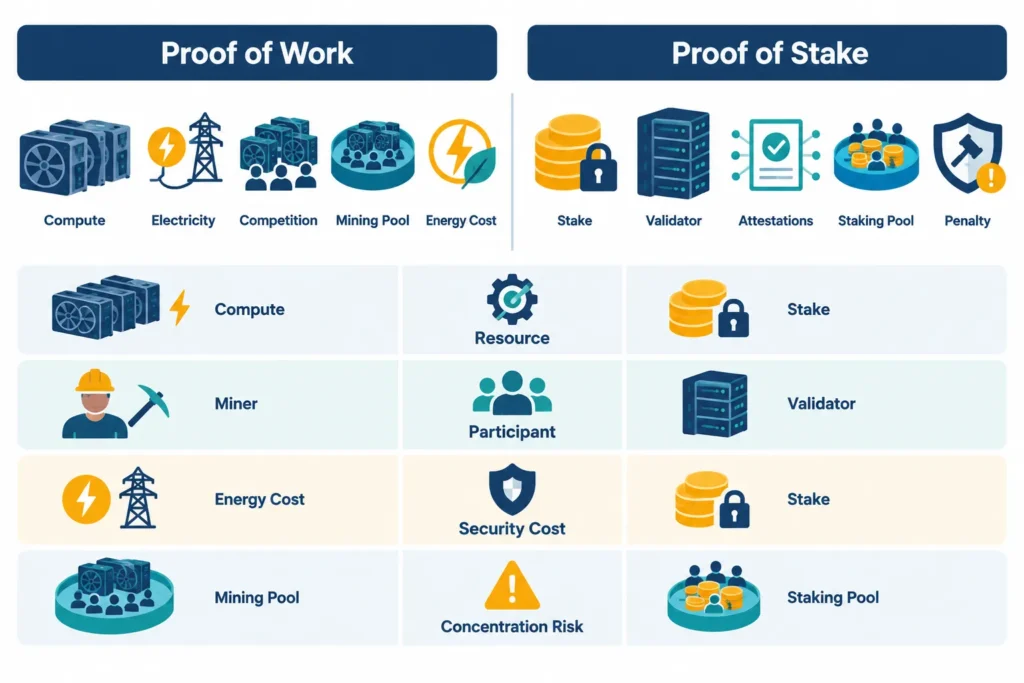
Proof of Work and Proof of Stake protect blockchains in different ways. Proof of Work requires miners to commit computing power and electricity. Proof of Stake requires validators to lock cryptocurrency that can be put at risk if they break certain rules.
Neither system is universally better. Security depends on the network’s design, participation, software, decentralization and response to attacks—not only on the consensus mechanism.
Proof of Work vs Proof of Stake: Quick Comparison
| Factor | Proof of Work | Proof of Stake |
|---|---|---|
| Security model | Miners compete using computing power to add valid blocks. | Validators lock stake and are selected under the network’s rules to propose or confirm blocks. |
| Main resource committed | Computing equipment, electricity and operating infrastructure. | The network’s cryptocurrency, validator infrastructure and reliable operation. |
| Direct energy use | Usually high because mining machines repeatedly perform computations. | Usually much lower because validators do not compete through energy-intensive computation. |
| Hardware requirements | Competitive mining may require specialized machines, cooling and access to affordable electricity. | A validator generally uses ordinary server-class equipment, although exact requirements vary. |
| Capital requirements | Money is needed for hardware, electricity and maintenance. | Money is needed to obtain the required stake. Smaller holders may participate through pools or services. |
| Participation | Users can mine directly or join a mining pool, subject to practical costs. | Users can run validators, delegate or use staking pools where the protocol and service support it. |
| Incentives | Successful miners may receive newly issued coins and transaction fees. | Validators may receive protocol rewards and fees for correct participation. |
| Dishonest-behavior penalties | Invalid blocks are rejected, while attempted attacks can waste hardware time and electricity. | Invalid activity may lead to lost rewards or “slashing” of stake, depending on the protocol. |
| Attack cost | An attacker may need substantial mining equipment, electricity and continued operating expenditure. | An attacker may need control of a large amount of stake and could face protocol penalties. |
| Concentration risks | Mining pools, hardware production and low-cost energy access can become concentrated. | Large holders, staking pools, exchanges and infrastructure providers can become influential. |
| Maturity | Bitcoin has used Proof of Work since its launch, giving the model a long operating history. | Proof of Stake has several designs. Ethereum’s current model is widely used, but PoS rules differ across networks. |
| Key trade-off | Strong dependence on real-world energy and hardware, with higher direct energy demand. | Lower direct energy demand, but greater reliance on stake distribution, penalty rules and protocol governance. |
What Is a 51% Attack?
A “51% attack” is a simple label for a situation in which one party, or a coordinated group, gains majority influence over the resource used for consensus. It does not always require exactly 51%, and its effects depend on the blockchain’s rules.
In Proof of Work, this normally means controlling most of the active mining power. Such an attacker may try to reorganise recent blocks, delay some transactions or spend the same coins twice. The attacker would need to maintain enough computing power and continue paying operating costs.
In Proof of Stake, majority influence relates to control of stake. Ethereum’s design uses different stake thresholds for particular actions, so “51% attack” is not a precise description of every possible PoS attack. A dishonest validator may lose rewards or have stake slashed. The community and protocol may also have recovery options, depending on the event.
Majority control does not normally allow an attacker to create coins outside the rules, spend another person’s coins without their private key, or make invalid transactions valid. Network software operated by other participants still checks protocol rules.
Attack execution, cost and recovery therefore differ by network. A large, distributed network may be harder to influence than a small network using the same broad consensus type. Social coordination, software updates and governance decisions can also affect recovery.
Environmental Considerations
Proof of Work has a direct energy requirement because miners continuously operate machines to compete for blocks. The environmental impact depends on total electricity use, the source of that electricity, equipment efficiency and electronic waste.
Proof of Stake does not use computational competition in the same way. Validators still need computers, internet connections and data centres, but their direct electricity demand is generally much lower. Ethereum’s move to Proof of Stake removed mining from its consensus process.
Lower energy use does not answer every environmental or security question. A fair comparison should also examine hardware replacement, infrastructure, decentralisation and the economic resources needed to attack the network.
Common Misconceptions
- “Mining guarantees profit.” It does not. Revenue depends on rewards, fees, competition and the coin’s market price. Costs include machines, electricity, cooling, repairs and downtime.
- “Staking is the same as mining.” Both help reach consensus, but the resources and processes differ. Mining commits computation and energy; staking commits cryptocurrency under validator rules.
- “Validators can approve anything.” Validators must follow protocol rules. Other nodes verify blocks, while dishonest validators may lose rewards or stake.
- “Proof of Stake guarantees low transaction fees.” It does not. Fees also depend on block capacity, demand, transaction complexity and scaling systems. Ethereum’s switch to PoS was not itself a promise of permanently low fees.
- “The consensus mechanism defines all blockchain security.” Security also depends on software quality, node distribution, private-key safety, bridges, applications, governance and user behaviour.
For a broader comparison of the two largest networks, readers can refer to Bitcoin vs Ethereum: Key Differences, Uses and Risks. Risks outside consensus, including scams, custody failures and price volatility, are covered in Cryptocurrency Risks: Common Dangers and How to Invest Safely.
Checklist for Examining a Blockchain
Before judging a network as secure or decentralised, check the following:
- Consensus rules: How are blocks proposed, verified and finalised?
- Miner or validator distribution: Is participation spread across independent parties and regions?
- Pool concentration: Do a few mining or staking pools control a large share of participation?
- Entry barriers: What hardware, electricity, technical knowledge or minimum stake is required?
- Penalty rules: What happens after downtime, conflicting votes or other dishonest conduct?
- Software maturity: How long has the current design operated, and has its code been reviewed and tested?
- Governance assumptions: Who coordinates upgrades or emergency responses?
- Incident history: Has the network suffered outages, reorganisations, exploits or serious consensus failures?
- Client and infrastructure diversity: Would one software bug or service failure affect a large part of the network?
This checklist does not produce a guaranteed safety score. It helps beginners look beyond simple claims such as “PoW is always safer” or “PoS is automatically decentralised.”
Frequently Asked Questions
What is Proof of Work?
Proof of Work is a consensus mechanism in which miners use computing equipment to compete for the right to add blocks. Other nodes independently verify that the blocks follow the network’s rules.
What is Proof of Stake?
Proof of Stake is a family of consensus mechanisms in which validators commit cryptocurrency as stake. The protocol selects and rewards validators under defined rules, while penalties may apply for certain failures or dishonest actions.
Is staking the same as mining?
No. Mining relies on computing work and electricity. Staking relies on locked cryptocurrency, validator operation and economic incentives. Both support consensus, but they do so differently.
Why does Bitcoin use mining?
Bitcoin was designed around Proof of Work. Mining helps order transactions and makes changing confirmed history costly because an attacker must obtain and operate substantial computing power. Changing Bitcoin to another consensus mechanism would require broad agreement and major protocol changes.
Why did Ethereum stop mining?
Ethereum replaced Proof of Work with Proof of Stake in an upgrade known as the Merge. The change was part of Ethereum’s technical roadmap and sharply reduced the network’s direct energy requirement. Validators now secure Ethereum by staking ETH rather than operating mining equipment.
Does Proof of Stake make a blockchain risk-free?
No. Proof of Stake can face stake concentration, validator failures, software bugs, governance disputes and attacks on applications or user accounts. Slashing and other safeguards reduce certain incentives but cannot remove every risk.
Summary
Proof of Work secures a network through computing power and continuing energy expenditure. Proof of Stake secures it through committed capital, validator rules and potential economic penalties. Their energy needs, participation barriers and attack dynamics are different.
Neither mechanism is completely secure, automatically decentralised or suitable for every network. A balanced comparison should examine who controls mining power or stake, how concentrated the major pools are, what penalties apply, how mature the software is and how the community has handled past incidents.


Comments